


Chapter 14.05
CALIFORNIA BUILDING CODE1
Sections:
14.05.010 California Building Standards Code adoption by reference.
14.05.020 Other codes adoption by reference.
14.05.030 Permit fees.
14.05.040 Repealed.
14.05.050 Repealed.
14.05.060 Repealed.
14.05.070 Repealed.
14.05.080 Amendments to the California Fire Code.
14.05.010 California Building Standards Code adoption by reference.
A. The California Building Standards Code, 2022 Edition, California Code of Regulations, Title 24, published by the International Code Council, is adopted by reference, including all volumes listed below. These codes are hereby adopted and incorporated as fully as if set out at length herein, save and except such portions as are deleted, modified or amended in this chapter.
Part 1: California Administrative Code.
Part 2: California Building Code – Volumes 1 and 2, including Division II of Chapter 1.
Part 2.5: California Residential Code, including Division II of Chapter 1.
Part 3: California Electrical Code, including Article 89.
Part 4: California Mechanical Code, including Division II of Chapter 1.
Part 5: California Plumbing Code, including Division II of Chapter 1.
Part 6: California Energy Code.
Part 9: California Fire Code, including Division II of Chapter 1.
Part 10: California Existing Building Code.
Part 11: California Green Building Standards Code.
Part 12: California Referenced Standards Code.
B. A copy of the California Building Standards Code is on file in the building division for use and examination by the public. (Ord. 958 § 1, 2022; Ord. 936 § 1, 2019; Ord. 905 § 1, 2016; Ord. 877 § 1, 2013; Ord. 859 § 1, 2011; Ord. 852 § 1, 2010; Ord. 843 § 1, 2009; Ord 841 § 1, 2009; Ord. 826 § 1, 2007; Ord. 773 § 1, 2003; Ord. 746 § 1, 2000; Ord. 722 § 1, 1998; 1991 code § 10-1.1)
14.05.020 Other codes adoption by reference.
The following additional code and manual are adopted by reference:
A. 2021 International Property Maintenance Code.
B. Fire Resistance Design Manual (2021), published by the Gypsum Association.
In the event of any conflict between these other codes and the California Building Standards Code, as adopted and amended by this chapter, the California Building Standards Code, as amended, shall prevail. (Ord. 958 § 2, 2022; Ord. 936 § 2, 2019; Ord. 905 § 2, 2016; Ord. 877 § 1, 2013; Ord. 852 § 1, 2010; Ord. 826 § 1, 2007; Ord. 773 § 1, 2003; Ord. 746 § 1, 2000; Ord. 722 § 1, 1998; 1991 code § 10-1.2)
14.05.030 Permit fees.
The permit fees are established by city council resolution, as authorized by Chapter 1, section 109 of the California Building Code. (Ord. 958 § 3, 2022; Ord. 936 § 3, 2019; Ord. 905 § 3, 2016; Ord. 877 § 1, 2013; Ord. 852 § 1, 2010; Ord. 826 § 1, 2007; Ord. 773 § 1, 2003; Ord. 746 § 1, 2000; Ord. 722 § 1, 1998; 1991 code § 10-1.3)
14.05.040 Amendments to the California Building Code.
Repealed by Ord. 958. (Ord. 936 § 4, 2019; Ord. 905 § 4, 2016; Ord. 877 § 1, 2013; Ord. 852 § 1, 2010; Ord. 826 § 1, 2007; Ord. 773 § 1, 2003; Ord. 746 § 1, 2000; Ord. 722 § 1, 1998; 1991 code § 10-1.4)
14.05.050 Drainage.
Repealed by Ord. 852. (Ord. 826 § 1, 2007; Ord. 773 § 1, 2003; Ord. 746 § 1, 2000; Ord. 722 § 1, 1998; 1991 code § 10-1.5)
14.05.060 Conformity with grade, sidewalk and curb standards.
Repealed by Ord. 852. (Ord. 826 § 1, 2007; Ord. 773 § 1, 2003; Ord. 746 § 1, 2000; Ord. 722 § 1, 1998; 1991 code § 10-1.7)
14.05.070 Barriers for swimming pools, spas and hot tubs.
Repealed by Ord. 852. (Ord. 826 § 1, 2007; Ord. 773 § 1, 2003; Ord. 746 § 1, 2000; Ord. 722 § 1, 1998; 1991 code § 10-1.8)
14.05.080 Amendments to the California Fire Code.
The 2022 California Fire Code is amended by the changes, additions and deletions set forth in this section. Chapter and section numbers used in this section are those of the 2022 California Fire Code.
Chapter 1. Scope and Administration.
Section 101.1 is amended to read:
101.1 Title. This code is the Fire Code of Contra Costa County, the Crockett-Carquinez Fire Protection District, and the Contra Costa County Fire Protection District, and is hereinafter referred to as “this code.”
Section 102.1 is amended to add item 5, to read:
5. Where not otherwise limited by law, the provisions of this code shall apply to vehicles, ships, and boats that are permanently affixed to a specific location within the boundaries of this jurisdiction.
Section 105.5 is amended to read:
105.5 Required operational permits. The fire code official is authorized to issue operational permits for the operations set forth in Chapter 1, Sections 105.5.1 through 105.5.52.
Section 105.5.33 is amended to read:
105.5.33 Motor Fuel Dispensing Facilities. An operational permit is required for the operation of automotive, marine, and fleet motor fuel dispensing facilities, including for sites that allow mobile fueling from a service provider to the general public.
Section 105.5.40 is amended to read:
105.5.40 Cannabis/Plant Extraction Related System(s)/Operations. An operational permit is required for any of the following cannabis/plant extraction related systems operations.
1. Cultivation
2. Plant Extraction Systems
3. Testing/Lab
4. Manufacturing
5. Distribution
6. Carbon Dioxide Systems or volatile solvent
Section 105.5 is amended to read:
105.5.52 Wood products. An operational permit is required to store chips, hogged material, wood or other combustible pallets, lumber or plywood in excess of 200 cubic feet (6 m3).
Section 105.5 is amended by adding subsections 105.5.55 through 105.5.63, to read:
105.5.55 Asbestos removal. A permit is required to conduct asbestos-removal operations regulated by Section 3318.
105.5.56 Automobile Wrecking or Dismantling Yard. An operation permit is required for all automobile wrecking yards, automobile dismantling operations, and similar operations.
105.5.57 Christmas tree sales. A permit is required to use a property for the purpose of selling cut Christmas trees.
105.5.58 Firework aerial display. A permit is required to conduct a firework display regulated by California Code of Regulations, Title 19 and Chapter 56 of this code.
105.5.59 Model rockets. A permit is required to sell model rocket motors or launch model rockets (in excess of 3 launches per event) pursuant to California Code of Regulations, Title 19, Division 1, Article 17. Permits issued in accordance with this section are for the site, and are effective as long as site conditions have not changed.
105.5.60 Temporary Occupancy. A permit is required for any temporary occupancy.
105.5.61 Temporary water supply. A permit is required to use a temporary water supply for construction of residential projects or subdivisions pursuant to Section 3313.1.
105.5.62 Tire storage. A permit is required to store more than 1,000 cubic feet (28.3m3) of tires inside buildings pursuant to Chapter 34.
105.5.63 Indoor Growing Operation. A permit is required to operate an indoor growing operation.
Exception: Agricultural Greenhouses in an agricultural zone.
Section 105.6 is amended to read:
105.6 Required construction permits. The fire code official is authorized to issue construction permits for the operations set forth in Chapter 1, Sections 105.6.1 through 105.6.30.
Section 105.6 is amended by adding Sections 105.6.25 through 105.6.29, to read:
105.6.25 Access for fire apparatus. Plans shall be submitted and a permit is required to install, improve, modify, or remove public or private roadways, driveways, and bridges for which Fire District access is required by the Fire Code. A permit is required to install a gate across a fire apparatus access road pursuant to Section 503.
105.6.26 Construction, alteration, or renovation of a building for which a building permit is required. Plans shall be submitted to the fire code official for all land developments or for the construction, alteration, or renovation of a building within the jurisdiction where a building permit is required.
Exception: Non-sprinklered Group R-3 Occupancies where work does not involve a substantial addition or expansion.
105.6.27 Land Development, Subdivisions. Plans shall be submitted to the fire code official for all land developments or improvements proposed within the jurisdiction that involve the subdivision of land.
105.6.28 Water supply for fire protection. Plans shall be submitted to the fire code official for the purpose of determining whether adequate water supplies, fire hydrants, and associated systems are provided for all facilities, buildings, or portions of buildings either constructed or moved into the District pursuant to Section 507.
105.6.29 Land Development. Plans shall be submitted to the fire code official for all land developments or improvements proposed within the jurisdiction.
Section 105.7 is added, to read:
105.7 Responsibility of permittee. Construction permits shall be presumed by the Fire District to incorporate all of the work that the applicant or the applicant’s agent, employees, or contractors shall carry out. Work performed shall be in accordance with the approved plans and with all requirements of this code and any other laws or regulations applicable thereto. No Fire District approval shall relieve or exonerate any person from the responsibility of complying with the provisions of this code nor shall any vested rights be created for any work performed in violation of this code.
Section 112.4 is amended to read:
112.4 Violation penalties. Every person who violates any provision of this fire code is guilty of an infraction or misdemeanor in accordance with Health and Safety Code Section 13871 and Government Code Section 53069.4. The imposition of one penalty for any violation shall not excuse the violation or permit it to continue; and all such persons shall be required to correct or remedy such violations or defects within a reasonable time; and when not otherwise specified, each ten (10) days that prohibited conditions are maintained shall constitute a separate offense. The application of the aforesaid penalty shall not be held to prevent the enforced removal of prohibited conditions.
Chapter 2. Definitions.
Section 202 is amended by adding the following definitions to that section:
Administrator. Shall mean the Fire Chief.
Aerial Pre-Plans. An overhead layout of a parcel that contains structure(s) that identifies specific first responder related items to assist in effectively managing incidents and events for the protection of occupants, responding personnel, property, and the environment. The preplan shall be developed in accordance with a format approved by the AHJ. Preplan symbols shall comply with AHJ or the latest edition of NFPA 170 (Standard for Fire Safety and Emergency Symbols), and NFPA 1620 (Standard for Pre-Incident Planning).
All-weather driving surface. A roadway with a minimum surface finish that is designed to carry the imposed weight loads of fire apparatus.
Automobile Dismantling. The operation of dismantling or removing parts from salvaged vehicles including engines or engine parts.
Automobile Wrecking Yard or Wrecking Yard. An area that stores or dismantles salvaged vehicles.
Wrecking Yard. An area that stores or dismantles salvaged vehicles.
Board of Directors. The Contra Costa County Board of Supervisors as the governing body of the Crockett-Carquinez Fire Protection District and the Contra Costa County Fire Protection District.
Board of Fire Commissioners. An advisory commission appointed by the Board of Directors to act as set forth in this ordinance and by resolutions of the Board of Directors.
Combustible Material. Rubbish, litter or material of any kind other than hazardous vegetation that is combustible and endangers the public safety by creating a fire hazard as determined by the fire code official.
Defensible Space. The area adjacent to a structure or dwelling as determined by the fire code official where wildfire prevention or protection practices are implemented to provide the key point of defense from an approaching wildfire or to minimize the spread of a structure fire to wildlands or surrounding areas.
Driveway. A private roadway that provides access to no more than two (2) single-family dwellings.
Fire Apparatus Access Road. A road that provides fire apparatus access from a fire station to a facility, building or portion thereof. This is a general term that includes, but is not limited to a fire lane, public street, private street, driveway, parking lot lane, and access roadway.
Fire Code Official. The Fire Chief or a duly authorized representative, or other person as may be designated by law, appointment or delegation and charged with the administration and enforcement of this code.
Firebreak. A continuous strip of land upon and from which all combustible material hazardous vegetation or other growth has been removed to bare mineral soil to stop or prevent the extension of fire from one area to another.
Fire Trail. A graded firebreak of sufficient width, surface, and design to provide access for personnel and equipment to suppress and to assist in preventing a surface extension of fires. Must be able to support the safe travel of a Type 3 Fire Apparatus.
Fuel Break. A strategically located block or strip, on which a cover of dense, heavy, or combustible vegetation has been changed to one of lower fuel volume or reduced combustibility, as an aid to fire control. Fuel breaks require annual and recurring maintenance.
Hazardous Vegetation. Vegetation that is combustible and endangers the public safety by creating a fire hazard including but not limited to seasonal and recurrent grasses, weeds, stubble, brush, dry leaves, dry needles, dead, dying or diseased trees and any other vegetation as determined by the fire code official.
Key Box or Knox Box. (Underwriters Laboratory) UL "Listed" box, size and style, approved by the Fire Code Official or designee that meets the requirements and uses the same security key code adopted by the Fire Department
Ladder Fuel. Fuel that provides vertical continuity between surface fuel and canopy fuel strata, increasing the likelihood that fire will carry from surface fuel into the crowns of shrubs and trees.
Nuisance Fire Alarm. The activation of any fire protection or alarm system which results in the response of the Fire District and is caused by malfunction, improper maintenance, negligence, or misuse of the system by an owner, occupant, employee, or agent, or any other activation not caused by excessive heat, smoke, fire, or similar activating event.
Ornamental Landscaping. Decorative plants growing within a tended garden or yard which are appropriately irrigated, maintained and located to provide aesthetic decoration and functional utility, such as privacy screening, shade, weed suppression and erosion control. The use of fire-resistant plants and the removal of fire hazardous vegetation will enhance fire safety.
Person. Includes any agency of the county, city, district or other local public agency and any individual, firm, association, partnership, business trust, corporations, limited liability company, or company.
Public Nuisance. A declaration by the fire code official that the presence of combustible materials on any parcel creates a fire hazard or threat to public safety (Health and Safety Code 14875 and 14876) or any violation of this code.
Priority Hazard Zone. An area where the threat from wildfire is severe due to proximity to open space, topography, degree of space, density of homes and/or amount of vegetation (native and ornamental), and/or other conditions favorable to fast moving fires.
Response Time. The elapsed time from receipt of call to the arrival of the first unit on scene.
Rubbish. Waste matter, litter, trash, refuse, debris, and dirt on streets or private property in the jurisdiction, which is or when dry may become a fire hazard. See combustible material.
Rural Area. An area generally designated for agricultural or open space uses with parcels more than 10 acres (4.046873ha) in size.
Rural Residential Area. An area generally designated for single family residential use with parcels between three (1.2140619ha) and 10 (4.046873ha) acres in size.
Sprinkler Alarm and Supervisory System (SASS). A Dedicated Function Fire Alarm System located at the protected premise installed specifically to monitor sprinkler water-flow alarm, valve supervisory, and general trouble conditions where a Building Fire Alarm is not required.
Streets. Includes alleys, parkways, driveways, sidewalks, and areas between sidewalks and curbs, highways, public right of ways, private road, paper street and, easements.
Substantial Addition. The addition of new gross floor area exceeds fifty percent of the existing gross floor area and the total new gross floor area is 5,000 square feet or greater.
Substantial Alteration. Where fifty percent or greater of the linear length of the wall of the building (exterior and interior) and fifty percent of the roof are removed or replaced within a one-year period.
Temporary Fire Department Access Road for Construction. An approved temporary roadway for emergency vehicle use during construction of residential subdivision projects.
Temporary Fire Department Access Road for Construction of One (1) Residential (R3) Unit. A temporary roadway for emergency vehicle use during construction of an individual residential (R3) structure where a fire department access road is required as part of the project.
Temporary Water Supply. Water stored for firefighting purposes in an approved aboveground tank during combustible construction.
Tree Litter. Any limbs, bark, branches, and/or leaves in contact with other vegetation or left to gather on the ground.
Weeds. All weeds growing upon streets or private property in the jurisdiction, including any of the following:
1. Weeds that bear seeds of a fluffy nature or are subject to flight.
2. Sagebrush, chaparral (including Chamise, Coyote Brush/Greasewood, Brooms, and Buckwheat), and any other brush or weeds that attain such large growth as to become, when dry, a fire menace to adjacent improved property.
3. Weeds that are otherwise noxious or dangerous.
4. Poison oak and poison sumac when the conditions of growth constitute a menace to public health.
5. Dry grass, brush, tree litter, litter, or other flammable materials that endanger the public safety by creating a fire hazard.
Chapter 3. General Precautions Against Fire.
Section 304.3.5 is added, to read:
304.3.5 Clothes Dryers. Clothes dryers shall be frequently cleaned to maintain the lint trap, mechanical and heating components, vent duct, and associated equipment free from accumulations of lint and combustible materials.
Section 308.1.4, Exception 1 is amended to read:
Exception 1. Residential Occupancies.
Section 324 is added to Chapter 3, to read:
SECTION 324 Exterior Fire Hazard Control.
324.1 Subsurface Fires.
324.1.1 Peat Fire. It is the duty of each person, firm, corporation, or association not to permit a peat fire or a fire involving combustible vegetable matters under the surface of the natural ground to remain upon the property. It is hereby declared that it is the duty of any person as herein defined to take all necessary precautions to extinguish any subsurface fire involving peat or vegetable material at the owner’s own cost and expense.
324.1.2 Fire Suppression Costs. If there exists upon the lands or property of any person as herein defined a subsurface fire involving the burning or combustion of peat, vegetable matter, or vegetation, and the owner or occupant thereof has not taken reasonable precautions within a reasonable time to extinguish or minimize such fire or combustion, the Fire District may, in addition to its regular duties to extinguish or minimize such fire or combustion, go upon the lands of any person as herein defined and extinguish such fire or combustion. Any costs incurred by the Fire District in fighting the fire and for the cost of proving rescue or emergency medical services shall be a charge against the property owner. The charge shall constitute a debt of the property owner and is collectable by the jurisdiction incurring those costs in the same manner as in the case of an obligation under a contract, express or implied. (See Health and Safety Code, §13009.)
Section 325 is added to Chapter 3, to read:
325 Automobile Wrecking Yards.
325.1 General. The operation of automobile wrecking yards shall be in accordance with this section.
325.2 Definitions. The following terms are defined in Chapter 2:
Automobile Dismantling
Automobile Wrecking Yard
325.3 Requirements.
325.3.1 Permits. An operational fire code permit is required as in Section 105.6.53.
325.3.2 Fire Apparatus Access Roads. Fire apparatus access roads shall be constructed throughout the site in accordance with this code and shall be maintained clear of all vehicles and stored items.
325.3.3 Welding and cutting. Welding and cutting operations shall be conducted in an approved location, clear of all flammable liquids and combustible materials, including weeds, tires, and all other debris.
325.3.4 Housekeeping. Combustible rubbish accumulated on site shall be collected and stored in approved containers, rooms, or vaults of noncombustible materials. Combustible vegetation, cut or uncut, shall be removed when determined by the fire code official to be a fire hazard.
325.3.5 Fire Protection. Offices, storage buildings, and vehicles used for site operations shall each be provided with at least one portable fire extinguisher with not less than a 4-A: 40-B-C rating. When required by the fire code official, additional fire extinguishers shall be provided.
325.3.6 Tire storage. Tires shall be stored in racks or in a manner as approved by the fire code official.
325.3.6.1 Distance from Water Supply. Tire storage shall be located on-site and no further than 500 feet from a fire hydrant or an approved water supply as determined by the fire code official.
325.3.7 Storage Piles. Storage piles shall be located a minimum of 20 feet from property lines and shall have an unobstructed access road on all sides of not less than 20 feet.
325.3.8 Burning operations. The burning of salvaged vehicles and salvaged or waste materials is prohibited.
325.3.9 Motor vehicle fluids. Motor vehicle fluid shall be drained from salvaged vehicles when such liquids are leaking onto the ground and prior to dismantling or removing engine/motor parts.
325.3.9.1 Mitigation of leaking fluids. Precautions shall be taken to prevent fluids from salvaged vehicles from leaking onto the ground. Supplies or equipment capable of mitigating leaks from fuel tanks, crankcases, brake systems, and transmissions shall be kept available on site. Single-use plugs, diking, and absorbent materials shall be disposed of as hazardous waste and removed from the site in a manner in accordance with federal, state, and local requirements.
325.3.10 Fuel tanks. Fuel tanks of salvaged vehicles shall be emptied of all flammable (gasoline, diesel) fuels in an approved manner and stored in approved tanks.
325.3.10.1 Repair of vehicle fuel tanks. The repair of fuel tanks, including cutting, welding, or drilling of any kind, is prohibited.
325.3.11 Lead acid batteries. Lead acid batteries shall be removed from all salvaged vehicles and stored in an approved manner in a location approved by the fire code official.
Chapter 4. Emergency Planning and Preparedness.
Section 401.5.1 is added, to read:
401.5.1 Nuisance Fire Alarm Fee. A fee may be charged for false and/or nuisance fire alarms in accordance with a fee schedule adopted by the Board of Directors.
Section 401.10 is added to read:
401.10 Aerial Pre-Plans. For all new construction the fire official is authorized to require a fire aerial pre-plan to be prepared by an approved vendor at the cost of the developer.
Section 403.11.1 is amended to read:
403.11.1 Standby Personnel. Where, in the opinion of the fire code official or Fire Chief, it is essential for public safety in a place of assembly, or any other place where people congregate, because of the number of persons, or the nature of the performance, exhibition, display, contest, or activity, the owner, agent, or lessee shall provide standby personnel as required and approved by the fire code official or Fire Chief. If the activity requires fire watch, fire watch shall be provided in accordance with Sections 403.11.1.1 and 403.11.1.2. Standby personnel needed for EMS standby shall be provided in accordance with Contra Costa County EMS Protocols.
Chapter 5. Fire Service Features.
Section 503.1.4 is added, to read:
503.1.4 Access to Open Spaces. When existing access to open land or space, or to fire trail systems maintained for public or private use, is obstructed by new development of any kind, the developer shall provide an alternate means of access into the area that is sufficient to allow access for fire personnel and apparatus. The alternate means of access must be approved by the fire code official.
Section 503.1.5 is added to read:
503.1.5 Existing fire trail systems shall be maintained. When conditions make maintenance of existing trails impractical, alternate means of access shall be provided and requires approval by fire code official.
Section 503.2.1 is amended by adding the following exception:
Exception: A driveway with a minimum width of 16 feet is acceptable for access to one or two single-family dwellings.
Section 505.3 is added, to read:
505.3 Street names and addressing. Street names and addressing shall be submitted for review and approval to the fire code official, whose approval will not be unreasonably withheld. The purpose of the review is to verify that new street names and addressing will not duplicate existing street names and addressing.
Chapter 6. Building Services and Systems.
Section 605.3.1 is added, to read:
605.3.1 Sparks Arrestors. All Chimneys attached to any appliance or fireplace that burns solid fuel shall be equipped with an approved spark arrestor per CBC 2113.9.2.
Chapter 9. Fire Protection Systems.
Section 901.6.3 is amended to read:
901.6.3 Records. Records of all system inspections, tests, and maintenance required by the reference standards shall be maintained in paper form or by a third party electronic record keeping service as chosen by the fire district.
Section 902.1 is amended to add:
Substantial Addition. The addition of new gross floor area exceeds fifty percent of the existing gross floor area and the total new gross floor area is 5,000 square feet or greater.
Substantial Alteration. Where fifty percent or greater of the linear length of the wall of the building (exterior and interior) and fifty percent of the roof are removed or replaced within a one-year period.
Section 903.2.1.1 is amended to read:
903.2.1.1 Group A-1. An automatic sprinkler system shall be provided for fire areas containing Group A-1 occupancies and intervening floors of the building where one of the following conditions exists:
1. The fire area exceeds 5,000 square feet.
2. The fire area has an occupant load of 300 or more.
3. The fire area is located on a floor other than a level of exit discharge serving such occupancies.
4. The fire area contains a multi-theater complex.
Section 903.2.1.3 is amended to read:
903.2.1.3 Group A-3. An automatic sprinkler system shall be provided for fire areas containing Group A-3 occupancies and intervening floors of the building where one of the following conditions exists:
1. The fire area exceeds 5,000 square feet.
2. The fire area has an occupant load of 300 or more.
3. The fire area is located on a floor other than a level of exit discharge serving such occupancies.
4. The structure exceeds 10,000 square feet, contains more than one fire area containing exhibition and display rooms, and is separated into two or more buildings by fire walls of less than four-hour fire resistance rating without openings.
Section 903.2.1.4 is amended to read:
903.2.1.4 Group A-4. An automatic sprinkler system shall be provided for fire areas containing Group A-4 occupancies and intervening floors of the building where one of the following conditions exists:
1. The fire area exceeds 5,000 square feet
2. The fire area has an occupant load of 300 or more.
3. The fire area is located on a floor other than a level of exit discharge serving such occupancies.
Section 903.2.2 is amended in its entirety, to read:
903.2.2 Group B. An automatic sprinkler system shall be provided for Group B occupancies and intervening floors of the building where the fire area exceeds 5,000 square feet.
903.2.2.1 Ambulatory care facilities. An automatic sprinkler system shall be installed throughout the entire floor containing an ambulatory care facility where either of the following conditions exist at any time:
1. Four or more care recipients are incapable of self-preservation.
2. One or more care recipients that are incapable of self-preservation are located at other than the level of exit discharge serving such a facility.
3. In buildings where ambulatory care is provided on levels other than the level of exit discharge, an automatic sprinkler system shall be installed throughout the entire floor as well as all floors below where such care is provided, and all floors between the level of ambulatory care and the nearest level of exit discharge, the level of exit discharge, and all floors below the level of exit discharge.
Exception: Floors classified as an open parking garage are not required to be sprinklered.
Section 903.2.3 is amended to read:
903.2.3 Group E. An automatic sprinkler system shall be provided for new Group E occupancies as follows:
1. Throughout all Group E fire areas greater than 2,000 square feet in area.
Exception: An automatic sprinkler system is not required in any Group E Day Care Facility less than 5,000 square feet.
2. The Group E fire area is located on a floor other than a level of exit discharge serving such occupancies.
Exception: In buildings where every classroom has not fewer than one exterior exit door at ground level, an automatic sprinkler system is not required in any area below the lowest level of exit discharge serving that area.
3. The Group E fire area has an occupant load of 300 or more.
4. In rooms or areas with special hazards such as laboratories, vocational shops, and other such areas where hazardous materials in quantities not exceeding the maximum allowable quantity are used or stored.
5. Throughout any Group E structure greater than 4,000 square feet in area, which contains more than one fire area, and which is separated into two or more buildings by fire walls of less than four-hour fire resistance rating without openings.
6. For public school state-funded construction projects, see Section 903.2.19.
7. For public school campuses, Kindergarten through 12th grade, see Section 903.2.20.
Section 903.2.4 is amended in its entirety, to read:
903.2.4 Group F
903.2.4 Group F-1. An automatic sprinkler system shall be provided throughout all buildings containing a Group F-1 occupancy where one of the following conditions exists:
1. A Group F-1 fire area exceeds 5,000 square feet.
2. A Group F-1 fire area is located more than three stories above grade plane.
3. The combined area of all Group F-1 fire areas on all floors, including any mezzanines, exceeds 10,000 square feet.
4. A Group F-1 occupancy used for the manufacture of upholstered furniture or mattresses exceeding 2,500 square feet (232 m2).
Section 903.2.4.4 is added to read:
903.2.4.4 Group F-2. An automatic sprinkler system shall be provided throughout all buildings containing a Group F-2 occupancy greater than 5,000 square feet.
Section 903.2.7 is amended to read:
903.2.7 Group M. An automatic sprinkler system shall be provided throughout buildings containing a Group M occupancy where one of the following conditions exists:
1. A Group M fire area exceeds 5,000 square feet.
2. A Group M fire area is located more than three stories above grade plane.
3. The combined area of all Group M fire areas on all floors, including any mezzanines, exceeds 10,000 square feet.
4. A Group M occupancy used for the display and sale of upholstered furniture or mattresses exceeds 5,000 square feet (464 m2).
5. The structure exceeds 5,000 square feet, contains more than one fire area containing a Group M occupancy, and is separated into two or more buildings by fire walls of less than 4-hour fire-resistance rating without openings.
Section 903.2.8 is amended to read:
903.2.8 Group R. An automatic sprinkler system installed in accordance with Section 903.3 shall be provided throughout all Group R occupancies. An automatic sprinkler system shall be installed in new manufactured homes, new mobile homes, including those located in mobile home parks, in accordance with Title 25 of the California Code of Regulations.
Section 903.2.8.1.1 is added, to read:
903.2.8.1.1 Group R-3 Substantial Addition or Expansion. An automatic sprinkler system shall be provided throughout all existing Group R-3 dwellings where either of the following occurs:
1. Substantial Addition. The addition of new gross floor area exceeds fifty percent of the existing gross floor area and the total new gross floor area is 3,600 square feet.
2. Substantial Alteration. Where fifty percent or greater of the linear length of the wall of the building (exterior and interior) and fifty percent of the roof are removed or replaced within a one-year period.
Section 903.2.9 is amended to read:
903.2.9 Group S-1. An automatic sprinkler system shall be provided throughout all buildings containing a Group S-1 occupancy where one of the following conditions exists:
1. A Group S-1 fire area exceeds 5,000 square feet.
2. A Group S-1 fire area is located more than three stories above grade plane.
3. The combined area of all Group S-1 fire areas on all floors, including any mezzanines, exceeds 10,000 square feet.
4. A Group S-1 occupancy used for the storage of commercial motor vehicles where the fire area exceeds 5,000 square feet.
Section 903.2.9.1 is amended to read:
903.2.9.1 Repair garages. An automatic sprinkler system shall be provided throughout all buildings used as repair garages in accordance with Section 406.8 of the California Building Code, as shown:
1. Buildings having two or more stories above grade plane, including basements, with a fire area containing a repair garage exceeding 5,000 square feet.
2. Buildings not more than one story above grade plane, with a fire area containing a repair garage exceeding 5,000 square feet.
3. Buildings with repair garages servicing vehicles parked in basements.
4. A Group S-1 fire area used for the repair of commercial motor vehicles where the fire area exceeds 5,000 square feet.
Section 903.2.10.1 is amended, to read:
903.2.10.1 Group S-2 enclosed parking garages. An automatic sprinkler system shall be provided throughout buildings classified as enclosed parking garages in accordance with Section 406.6 of the California Building Code where any of the following conditions exists:
1. Where the fire area of the enclosed parking garage, in accordance with Section 406.6 of the California Building Code, exceeds 5,000 square feet.
2. Where the enclosed parking garage, in accordance with Section 406.6 of the California Building Code, is located beneath other groups.
Exception: Enclosed parking garages located beneath Group R-3 occupancies.
3. Where the fire area of the open parking garage, in accordance with Section 406.5 of the California Building Code, exceeds 48,000 square feet.
903.2.10.2 Commercial parking garages. An automatic sprinkler system shall be provided throughout buildings used for storage of commercial motor vehicles where the fire area exceeds 5,000 square feet.
903.3.10.3 Group S-2 low hazard storage. An automatic sprinkler system shall be provided throughout all buildings containing a Group S-2 occupancy exceeding 5,000 square feet.
Exception: Open parking garages, including canopies and photovoltaic panel systems with open parking underneath, shall meet automatic sprinkler system requirements in accordance with the 2022 California Building Code and 2022 California Fire Code without local amendment.
Section 903.3.1.1.4 is added, to read:
903.3.1.1.4 Undeclared Use. In buildings of undeclared use with floor to structure height greater than 14 feet (4,256 mm), the fire sprinkler system shall be designed to conform to Extra Hazard Group I design density. In buildings of undeclared use with floor to structure height less than 14 feet (4,256 mm), the fire sprinkler system shall be designed to conform to Ordinary Group II design density. Where a subsequent occupancy requires a system with greater capability, it shall be the responsibility of the owner and/or the occupant to upgrade the system.
Section 903.3.1.3 is amended to read:
903.3.1.3 Sprinkler Systems for One and Two family dwellings. Automatic sprinkler systems for one- and two- family dwellings shall be permitted to be installed in accordance with section 903.3.1.3.1.
Section 903.3.1.3.1 is added, to read:
903.3.1.3.1 Pipe limitations. Where CPVC pipe is installed above the insulation or is otherwise located in an unconditioned space, such as in an attic space, or a garage without conditioned living space above, CPVC pipe shall be adequately insulated to a minimum R-19 value, or equivalent, or pipe shall be limited to Type K or L copper, or ferrous piping.
Section 903.3.5.3 is added, to read:
903.3.5.3 Non-permissible water supply storage. Swimming pools and ponds shall not be considered water storage for the purposes of Section 903.3.5.
Section 903.3.9 is amended to read:
903.3.9. Floor control valves. Individual floor control valves and waterflow detection assemblies shall be provided for each floor in multi-floor buildings at an approved location.
Exception: Group R-3 and R-3.1 Occupancies.
Section 903.4.2 is amended to read:
903.4.2 Alarms. One approved audible and visual device shall be connected to every automatic sprinkler system at an approved location. Such sprinkler water-flow alarm devices shall be activated by water flow equivalent to the flow of a single sprinkler of the smallest orifice size installed in the system. Audible and visual alarm devices shall be provided on the exterior of the building in an approved location. Where a fire alarm system is installed, actuation of the automatic sprinkler system shall actuate the building fire alarm system.
Sections 903.6.1 and 903.6.2 are added, to read:
903.6.1 Substantial Addition. An automatic sprinkler system shall be provided throughout all existing R-3 Occupancy buildings where a substantial addition occurs and the total new gross floor area of the structure exceeds 3,600 square feet. Group R-3 substantial additions or alterations shall comply with Section 903.2.8.1.1.
903.6.2 Change of occupancy classification. Any existing building that undergoes a change of occupancy classification into a higher hazard category shall comply with the requirements of Section 903.2. Relative hazard categories of occupancy groups shall be established based upon the Heights and Areas Hazard Categories of Table 1011.5 of the current edition of the International Existing Building Code, as published by the International Code Council. The requirements of Section 903.2 shall not be required when a change of occupancy classification is made to an equal or lesser hazard category. Group L occupancies shall be considered a relative hazard of 1 (highest hazard).
Section 907.4.4 is added, to read:
907.4.4 Monitoring of other fire systems. In buildings equipped with a fire alarm system or sprinkler alarm and supervisory service (SASS) system, where other fire suppression or extinguishing systems are installed in the building (including but not limited to commercial kitchen suppression systems, pre-action fire suppression systems, dry chemical systems, and clean agent systems), these other suppression systems shall be monitored by the SASS dedicated function fire alarm system and transmitted as a specific signal to the Central Station. The system shall be monitored in compliance with Section 907.6.6.
Section 907.5.2.3.1 is amended to read:
907.5.2.3.1 Public and common areas. Visible alarm notification appliances shall be provided in public use areas and common use areas, including but not limited to:
1. Sanitary facilities including restrooms, bathrooms, shower rooms, and locker rooms.
2. Corridors, hallways, and aisles with shelving and/or fixtures obstructing the required light intensity for that area.
3. Music practice rooms.
4. Band rooms.
5. Gymnasiums.
6. Multipurpose rooms.
7. Occupational shops.
8. Occupied rooms where ambient noise impairs hearing of the fire alarm.
9. Lobbies.
10. Meeting/Conference rooms.
11. Classrooms.
12. Medical exam rooms.
13. Open office areas.
14. Sales floor areas.
15. Break or lunch rooms
16. Copy or work rooms.
17. Computer server rooms exceeding 200 sq. ft.
18. File or Storage rooms exceeding 200 sq. ft.
Section 907.6.6 is amended to read:
907.6.6 Monitoring of fire alarm systems. A fire alarm system required by this chapter, or by the California Building Code, shall be monitored by a UL-listed Central Station service in accordance with NFPA 72 and this code.
Exception: Monitoring by a UL-listed central station is not required for:
1. Single- and multiple-station smoke alarms required by Section 907.2.10.
2. Group I-3 occupancies shall be monitored in accordance with Section 907.2.6.3.
3. Residential Day Care Facilities (occupancy load of 14 or less).
4. One- and two-family dwellings.
5. Residential Care Facilities licensed by the state with an occupant load of 6 or less.
6. Occupancies with a local fire alarm system that will give an audible and visible signal at a constantly attended location, as approved by the Fire Code Official.
Section 907.6.7 is added, to read:
907.6.7 Certification. New fire alarm systems shall be UL-Certified. A Certificate of Completion and other documentation as listed in NFPA 72 shall be provided for all new fire alarm system installations. It is the responsibility of the building owner or owner’s representative to obtain and maintain a current and valid Certificate.
Section 907.6.7.1 is added, to read:
907.6.7.1 Posting of Certificate. The UL Certificate shall be posted in a durable transparent cover within three feet of the fire alarm control panel within 45 days of the final acceptance test/inspection.
Chapter 10. Means of Egress.
Section 1028.5.1 is added, to read:
1028.5.1 Exit discharge surface. Exterior exit pathway surfaces shall be suitable for pedestrian use in inclement weather, and shall terminate at a public way as defined in the California Building Code.
Chapter 33. Fire Safety During Construction and Demolition.
Section 3301.1.2 is added, to read:
3301.1.2 Amendments. Amendments may be required to an approved site safety plan if deemed necessary by both the building official and fire official, based on previous fires or hazards that occurred on site or occurring within the jurisdiction.
Section 3303.1.3 is added to read:
3303.1.3 Site Security requirements. Site security requirements shall include the following if deemed necessary by both the building official and fire official:
1. Controlled access points.
2. Site fencing, up to 12 feet in height with tamper sensors and security wires on top.
3. Security guards, full-time 24/7 presence on-site, to perform fire watch and patrols.
4. Detection check points located throughout the buildings for fire watch and patrol verification.
5. Security camera coverage throughout the site with motion detection notifications.
6. Identify measures taken to prevent tampering with security cameras and motion sensors.
7. Necessary lighting throughout the project site.
Section 3319, Asbestos Removal, is added to read as follows:
Section 3319 Asbestos removal.
3319.1 General. Operations involving removal of asbestos or asbestos-containing materials from buildings shall be in accordance with Section 3319.
Exception: Section 3319 does not apply to the removal of asbestos from:
1. Pumps, valves, gaskets and similar equipment.
2. Pipes, ducts, girders or beams that have a length less than 21 linear feet (6400 mm).
3. Wall or ceiling panels that have an area of less than 10 square feet (0.93 m2) or a dimension of less than 10 linear feet (3048 mm).
4. Floor tiles when their removal can be completed in less than four hours.
5. Group R-3 occupancies.
3319.2 Notification. The fire code official shall be notified 24 hours prior to the commencement and closure of asbestos-removal operations. The permit applicant shall notify the building official when asbestos abatement involves the removal of materials that were used as a feature of the building’s fire resistance.
3319.3 Plastic Film. Plastic film that is installed on building elements shall be flame resistant as required for combustible decorative material, in accordance with Section 807.
3319.4 Signs. Approved signs shall be posted at the entrance, exit and exit-access door, decontamination areas, and waste disposal areas for asbestos-removal operations. The signs shall state that asbestos is being removed from the area, that asbestos is a suspected carcinogen, and that proper respiratory protection is required. Signs shall have a reflective surface. Lettering shall be a minimum of 2 inches (51 mm) high.
Chapter 50. Hazardous Materials – General Provisions.
Section 5001.5.1 is amended to add item numbers 10 and 11 to read as follows:
10. Fire Department related safety equipment.
A. Fire alarm control panel (FACP).
B. Sprinkler riser.
C. Fire department connection (FDC).
D. Knox Box location.
E. Gas valve shutoff.
F. Electrical main shutoff.
G. Water shutoff.
H. Elevator equipment room.
11. A Site Fire/Explosion/Hazardous Material Release Analysis Assessment. A Fire Protection Engineer (FPE) stamped risk assessment is required for each possible hazard risk associated with fire, explosion, smoke, and toxicity associated with the possible incident at a facility that is identified as a bulk transfer/process/storage facility. Refer to NFPA 550 & 551 for references.
Section 5001.5.3 is added, to read:
5001.5.3 Emergency response support information. Floor plans, material safety data sheets, Hazardous Materials Management Plans (HMMP), Hazardous Material Inventory Statements (HMIS), and other information must be stored at a readily accessible location, as determined by the fire code official. This location may be in cabinets located outside of facilities or buildings. Information may be required to be maintained in a specific electronic media format to facilitate computer aided dispatching.
Section 5003.9.1.2 is added, to read:
5003.9.1.2 Documentation. Evidence of compliance with provisions of this chapter as well as with state and federal hazardous material regulations shall be maintained on site and available for inspection by fire department personnel.
Chapter 56. Explosives and Fireworks.
Section 5601.1.3 is amended to read:
5601.1.3 Fireworks. The possession, manufacture, storage, sale, handling, and use of fireworks are prohibited within the jurisdiction of the District.
Exceptions:
1. Storage and handling of fireworks by a Public Safety Agency.
2. The use of fireworks for fireworks displays, pyrotechnics before a proximate audience, pyrotechnic special effects in motion pictures, television, theatrical, or group entertainment productions as allowed by Title 19, Division 1, Chapter 6 Fireworks reprinted in Section 5608 and the Health and Safety Code Division 11.
3. Snap Caps and Party Poppers classified by the State Fire Marshal as pyrotechnic devices.
Section 5601.2.2 is amended to read:
5601.2.2 Sale and retail display. No person shall construct a retail display or offer for sale any explosives, explosive materials, or fireworks within the jurisdiction.
Exception: Snap Caps and Party Poppers classified by the State Fire Marshal as pyrotechnic devices.
Section 5601.2.4 is amended as follows:
5601.2.4 Financial responsibility. Before a permit is issued pursuant to Section 5601.2, the applicant shall file with the jurisdiction a corporate surety bond in the principal sum of $2,000,000 or a public liability insurance policy for the same amount, for the purpose of the payment of all damages to persons or property which arise from, or are caused by, the conduct of any act authorized by the permit upon which any judicial judgment results. The fire code official is authorized to specify a greater or lesser amount when, in his or her opinion, conditions at the location of use indicate a greater or lesser amount is required. Government entities shall be exempt from this bond requirement.
Exception: Fireworks in accordance with California Code of Regulations, Title 19, Division 1, Chapter 6. See Section 5608.
Chapter 57. Flammable and Combustible Liquids.
Section 5703.3.1 is added to read:
5703.3.1 Facility site Fire/Explosion/Hazardous Material Release Analysis Assessment. A Fire Protection Engineer (FPE) stamped risk assessment is required for each possible hazard risk associated with fire, explosion, smoke, and toxicity associated with the possible incident at a facility that is identified as a bulk transfer/process/storage facility when required by the fire official. Refer to NFPA 550 & 551 for references.
Section 5704.2.9.6.1 is amended to read:
5704.2.9.6.1 Locations where above-ground tanks are prohibited. The storage of Class I and II liquids in above-ground tanks outside of buildings is prohibited in all zoning districts except districts zoned for commercial, industrial, or agricultural uses.
Exception: Protected above-ground tanks for the purpose of emergency power generator installations in areas zoned commercial, industrial, agricultural, business district, rural or rural residential, and for facilities on an individual basis consistent with the intent of this provision. Tank size shall not exceed 1,000 gallons for any class of liquids.
Section 5706.2.4.4 is amended to read:
5706.2.4.4 Locations where above-ground tanks are prohibited. Storage of Class I and II liquids in above-ground tanks is prohibited in all zoning districts except district zoned for commercial, industrial, or agricultural use.
Exception: Protected above-ground tanks for the purpose of emergency power generator installations in areas zoned commercial, industrial, agricultural, business district, rural or rural residential, and for facilities on an individual basis consistent with the intent of this provision. Tank size shall not exceed 1,000 gallons for any class liquids.
Chapter 58. Flammable Gases and Flammable Cryogenic Fluids.
Section 5806.2 is amended to read:
5806.2 Limitation. The storage of flammable cryogenic fluids in stationary containers outside of buildings is prohibited in any area which is zoned for other than industrial use.
Exception: Liquid hydrogen fuel systems in compliance with Section 5806.3 or 5806.4.
Chapter 61. Liquefied Petroleum Gases.
Section 6103.2.1.7 is amended to read:
6103.2.1.7 Use for food preparation. Individual portable L-P containers used, stored, or handled inside a building classified as a Group A, Group B, or Group M occupancy for the purposes of cooking, food display, or a similar use, shall be limited in size to one quart capacity and shall be of an approved type. The number of portable containers permitted will be at the discretion of the fire code official. LP-gas appliances used for food preparation shall be listed for such use in accordance with the California Mechanical Code and NFPA 58.
Section 6104.2 is amended to read:
6104.2 Maximum capacity within established limits. The storage of liquefied petroleum gas is prohibited in any central business district and in all zoning districts except districts zoned for commercial, industrial, rural, or agricultural uses. The aggregate capacity of any one installation used for the storage of liquefied petroleum gas shall not exceed a water capacity of 2,000 gallons (7570 L).
Chapter 80. Referenced Standards.
Chapter 80 is amended by adding the following referenced standards:
NFPA 3 (2021): Recommended Practice for Commissioning of Fire Protection and Life Safety Systems
NFPA 850 (2020): Recommended Practice for Fire Protection for Electric Generating Plants and High Voltage Direct Current Converter Stations
Chapter 80 is further amended by amending the NFPA 13D (2022) (Standard for the Installation of Sprinkler Systems in One- and Two-Family Dwellings and Manufactured Homes) standard as follows:
Section 7.7.1 is added, to read:
7.7.1 Where CPVC pipe is installed above the normal insulation in an unconditioned space, such as in an attic space, or a garage without conditioned living space above, CPVC pipe shall be adequately insulated to a minimum R-19 value, or equivalent, or pipe shall be limited to Type K or L copper, or ferrous piping.
Section 8.3.5.1.2 is amended to read:
8.3.5.1.2 Where fuel-fired equipment is below or on the same level as occupied areas of the dwelling unit, at least one quick-response intermediate temperature sprinkler shall be installed above the equipment or at the wall separating the space with the fuel-fired equipment from the occupied space. In unconditioned spaces, CPVC pipe shall be adequately insulated to a minimum R-19 value, or equivalent, or pipe shall be limited to Type K or L copper, or ferrous piping.
Appendix B. Fire-Flow Requirements for Buildings.
Table B105.2 is amended to read:
|
AUTOMATIC SPRINKLER SYSTEM (DESIGN STANDARD) |
MINIMUM FIRE-FLOW (GALLONS PER MINUTE) |
FLOW DURATION (HOURS) |
|---|---|---|
|
No automatic sprinkler system |
Value in Table B105.1(2) |
Duration in Table B105.1(2) |
|
Section 903.3.1.1 of the California Fire Code |
50% of the value in Table B105.1(2)a |
Duration in Table B105.1(2) at the reduced flow rate |
|
Section 903.3.1.2 of the California Fire Code |
50% of the value in Table B105.1(2)a |
Duration in Table B105.1(2) at the reduced flow rate |
For SI: 1 gallon per minute = 3.785 L/m
a. The reduced fire-flow shall be not less than 1,500 gallons per minute.
Appendix C. Fire Hydrant Locations and Distribution.
Table C102.1 is amended as follows:
The title of Table C102.1 is amended to read:
TABLE C102.1 REQUIRED NUMBER AND SPACING OF FIRE HYDRANTS (footnote h and j)
The heading of the fourth column of Table C102.1 is amended to read:
MAXIMUM DISTANCE FROM ANY POINT ON STREET OR ROAD FRONTAGE TO A HYDRANT (d, f, g, i)
Footnotes “i” and “j” are added to Table C102.1, to read:
i. A fire hydrant shall be provided within 250 feet of a fire trail access point off a public or private street.
j. For infill projects within existing single-family residential developments, Section 507.5.1 applies.
Appendix D. Fire Apparatus Access Roads.
Section D102.1 is amended to read:
D102.1 Access and loading. Facilities, buildings or portions of buildings hereafter constructed shall be accessible to fire department apparatus by way of an approved fire apparatus access road with an asphalt, concrete, or other approved all-weather driving surface capable of supporting the imposed load of fire apparatus weighing at least 74,000 pounds (34,473 kg) in accordance with CalTrans Design Standard HS-20-44.
Exception: Driveways serving one or two single-family dwellings may be constructed of an alternate surface material, providing the imposed weight load design minimums are met and the grade does not exceed 10 percent.
Section D103.1 is deleted.
Section D103.2 is amended to read:
D103.2 Grade. Fire department access roadways having a grade of between 16 percent and 20 percent shall be designed to have a finished surface of grooved concrete sufficient to hold a 44,000 pound (19,958 kg) traction load. The grooves in the concrete surface shall be ½ inch (13 mm) wide by ½ inch (13 mm) deep and 1 ½ inch (38 mm) on center and set at a 30 to 45-degree angle across the width of the roadway surface. No grade shall exceed 20 percent, nor shall the cross slope exceed 8%, unless authorized in writing by the fire code official.
Section D103.2.1 is added, to read:
D103.2.1 Angles of approach and departure. The angles of approach and departure for any means of access shall not exceed 10 percent at 10 feet of the grade break.
Section D103.3 is amended to read:
D103.3 Turning radius. Based on a minimum unobstructed width of 20 feet, a fire apparatus access roadway shall be capable of providing a minimum standard turning radius of 25 feet (7,620 mm) inside and 45 feet (13,716 mm) outside.
Figure D103.1 is amended to read: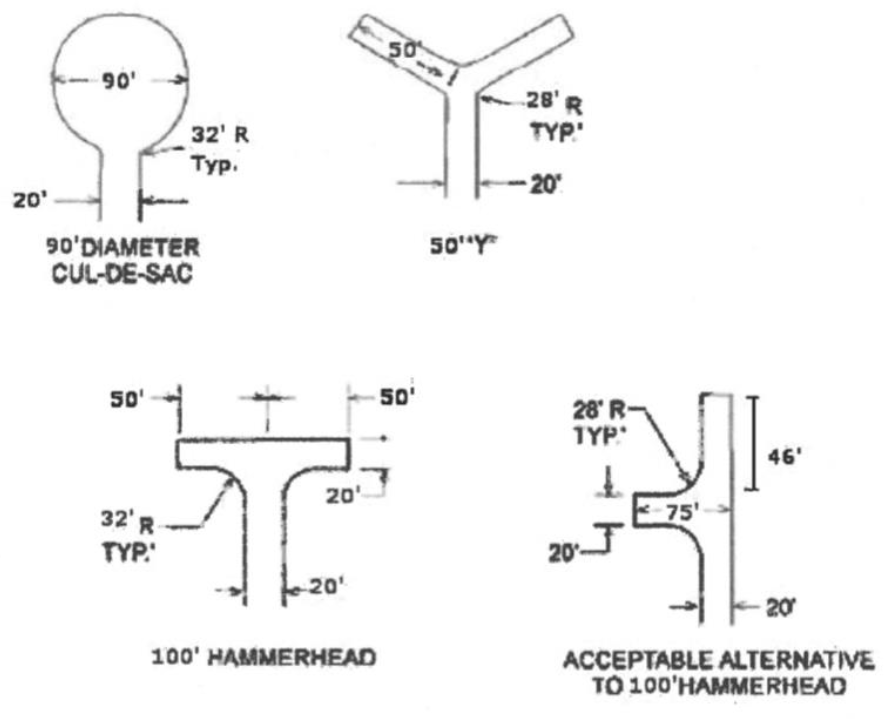
Figure D103.1
Dead-end Fire Apparatus Access Road Turnaround
Table D103.4 is amended to read:
|
LENGTH (feet) |
MINIMUM WIDTH (feet) |
TURNAROUNDS REQUIRED |
|---|---|---|
|
0 – 150 |
20a |
None required |
|
151 – 750 |
20a |
100-foot Hammerhead, 50-foot “Y”, 75-foot Shunt or 90-foot-diameter cul-de-sac in accordance with figure D103.1 |
|
Over 750 |
Special approval requiredb |
|
a. A driveway with a minimum width of 16 feet is acceptable for access to no more than two single-family dwellings.
b. Any fire apparatus access roadway or driveway that is approved to be less than 20 feet wide and to exceed 750 feet in length shall have outsets or turnouts every 300 feet along the length of the road or driveway, or at locations approved by the fire code official. Each outset or turnout shall be of the following dimensions: an 8-foot-wide turnout that extends at least 40 feet in length.
Section D103.5 is amended as follows:
Criteria 1 of Section D103.5 is amended to read:
1. The minimum clear width shall be 20 feet (6096mm).
Exception: For access to one or two single-family dwellings, 16 feet clear width is acceptable.
Criteria 9 is added to Section D103.5, to read:
9. All gates shall be installed and located a minimum of 30 feet off the street.
Section D103.6.1 is amended to read:
D103.6.1 Roads less than 28 feet in width. Fire apparatus access roads less than 28 feet wide shall be posted on both sides as a fire lane.
Section D103.6.2 is amended to read:
D103.6.2 Roads 28 feet in width or greater, but less than 36 feet in width. Fire apparatus access roads 28 feet wide or greater, but less than 36 feet wide, shall be posted on one side of the road as a fire lane.
Section D106.1 is amended by deleting the exception and to read:
D106.1 Projects having more than 100 dwelling units. Multiple-family residential projects having more than 100 dwelling units shall be provided with two separate and approved fire apparatus access roads and shall meet the requirements of Section D104.3.
Section D106.2 is deleted in its entirety. (Ord. 959 § 2, 2022; Ord. 939 § 2, 2020; Ord. 913 § 1 (Exh. A), 2017; Ord. 884 § 1 (Exh. A), 2014; Ord. 859 § 2 (Exh. A), 2011; Ord. 841 § 1 (Exh. A), 2009)
Editor’s note: Prior ordinance history includes portions of 1978 code §§ 4.04.010 – 4.04.030, 4.04.060 – 4.04.140, and Ords. 532, 624, 644, 671 and 707.