


Chapter 15.10
IMPROVEMENT AND DESIGN STANDARDS
Sections:
15.10.050 Sewers and sewage facilities.
15.10.060 Water and sewer laterals.
15.10.080 Pressurized irrigation system.
15.10.100 Street widths, intersecting driveways, maximum street grades.
15.10.110 Intersection grades.
15.10.140 Temporary turnarounds.
15.10.150 Offsetting intersections.
15.10.170 Curbs, gutters and sidewalks.
15.10.180 Parking lots and driveways.
15.10.200 Underground utilities.
15.10.205 Abandoning underground utilities.
15.10.210 Licensed contractor.
15.10.220 Time limitation for completion.
15.10.240 Security for improvements required.
15.10.250 Standards for construction drawings.
15.10.260 Landscape improvement standards.
15.10.290 Construction safety.
15.10.320 Construction entrance.
15.10.370 Reimbursement agreements.
15.10.380 Improvements warranty.
15.10.010 Utility connection.
It shall be the responsibility of the developer to connect to any utilities or improvements wherever they are located and extend those improvements to and through the development as shown on the approved construction drawings. [Ord. O-09-2024 § 2 (Exh. A); Ord. O-13-2015 § 1 (Exh. A); Ord. O-03-2010 § 1 (Exh. A § 2.010)].
15.10.020 Utility extension.
It may be the responsibility of the developer to extend all utilities or improvements to the end of their property for future connection of adjacent property. Reimbursements may be made for these extensions based on the excess capacity, provided these expenses meet the requirements as set forth by the city or as stated in the master development agreement. The excess capacity, if any, formula and terms for any reimbursement agreement will be identified prior to the beginning of construction. Utilities that connect onto Eagle Mountain public utilities will maintain Eagle Mountain City standards for material, workmanship, and trench backfill/pipe bedding. [Ord. O-09-2024 § 2 (Exh. A); Ord. O-13-2015 § 1 (Exh. A); Ord. O-03-2010 § 1 (Exh. A § 2.011)].
15.10.030 Water supply.
The developer shall connect the subdivision with the city water system with all appurtenances and shall make such water available to each lot within the subdivided area. Adequacy of supply and sizes of water mains shall be established by the city engineer or his/her designee. The minimum water line size shall be eight inches in diameter.
Workmanship and details of construction shall be in accordance with the APWA Standard Specifications as amended by the city. All work in connection with water services shall be done as directed and under the supervision of the city engineer or his/her designee.
The design of all subdivisions shall be such that a minimum water pressure of 50 psi and a maximum of 115 psi will be maintained at street level. [Ord. O-09-2024 § 2 (Exh. A); Ord. O-13-2015 § 1 (Exh. A); Ord. O-03-2010 § 1 (Exh. A § 2.020)].
15.10.040 Flush hydrants.
Flush hydrants, blow-offs, or some other adequate mechanism shall be installed at the end of all water lines to adequately flush all water lines. [Ord. O-09-2024 § 2 (Exh. A); Ord. O-13-2015 § 1 (Exh. A); Ord. O-03-2010 § 1 (Exh. A § 2.021)].
15.10.050 Sewers and sewage facilities.
The developer shall provide each lot with a sanitary sewer system in accordance with the ordinances of the city and pursuant to the APWA Standard Specifications as amended by the city. All work shall be completed by the developer as directed and under the supervision of the city engineer or his/her designee. The minimum sewer pipe size shall be eight inches in diameter. [Ord. O-09-2024 § 2 (Exh. A); Ord. O-13-2015 § 1 (Exh. A); Ord. O-03-2010 § 1 (Exh. A § 2.030)].
15.10.060 Water and sewer laterals.
All sewer services and water services need to be marked with a two-inch by four-inch stake at the end of each service a minimum of 36 inches above grade and a two-inch “S” for sewer or two-inch “W” for water needs to be stamped in the top of the curb at the service locations. Curb markings may also be made on a brass cap hammered into the curb. Water and sewer lateral must extend a minimum of 15 feet behind the property line. The minimum sewer lateral pipe size shall be four inches in diameter. The minimum water lateral size shall be three-quarters inch in diameter. [Ord. O-09-2024 § 2 (Exh. A); Ord. O-21-2022 § 2 (Exh. A); Ord. O-13-2015 § 1 (Exh. A); Ord. O-03-2010 § 1 (Exh. A § 2.031)].
15.10.070 Storm drainage.
The developer shall provide on-site facilities for a 100-year storm event and piping and appurtenances to convey the highest intensity 10-year storm to the on-site retention facilities. Additional piping and appurtenances shall be required to convey the 10-year historical discharge from the on-site retention facility to the city’s existing storm water facility. The minimum storm drain pipe size shall be 15 inches in diameter.
All improvements shall be constructed in accordance with city ordinances and pursuant to the APWA Standard Specifications as amended by the city and/or other codes adopted by the city. All said work shall be done as directed and under the supervision of the city engineer or his/her designee. [Ord. O-09-2024 § 2 (Exh. A); Ord. O-13-2015 § 1 (Exh. A); Ord. O-03-2010 § 1 (Exh. A § 2.040)].
15.10.080 Pressurized irrigation system.
The developer may be required to connect the subdivision to the city secondary pressurized irrigation system, as designated by the city’s master secondary irrigation plan, as outlined in the development agreement, if such facilities are expected to be available for use within three years of the installation of such improvements. The use of treated re-use water may allow a credit of banked water rights consistent with the amount of culinary water which should have been used for irrigation to be offset with secondary irrigation.
The minimum pressurized irrigation size shall be six inches in diameter. The adequacy of supply lines and sizes of mains shall be established by the city engineer or his/her designee. Workmanship and construction shall comply with the Eagle Mountain City construction standards and specifications. Installation shall conform to Chapter 15.40 EMMC.
Pressurized irrigation systems to be installed in existing city roads and rights-of-way shall conform to all relevant chapters of this title. [Ord. O-09-2024 § 2 (Exh. A); Ord. O-13-2015 § 1 (Exh. A); Ord. O-03-2010 § 1 (Exh. A § 2.050)].
15.10.090 Streets.
The developer shall construct all streets required by the subdivision as specified by the city council in accordance with the APWA Standard Specifications as amended by the city. All streets shall be constructed pursuant to standards recommended by the city engineer or his/her designee based on soil conditions and required structural engineered materials to be used in the construction of the road.
The developer shall be responsible to construct all streets required in the final plat and as a condition of the final plat approval to the standard required by the city engineer or his/her designee. The developer shall be required to provide an engineered design for the street subgrade construction. [Ord. O-09-2024 § 2 (Exh. A); Ord. O-13-2015 § 1 (Exh. A); Ord. O-03-2010 § 1 (Exh. A § 2.060)].
15.10.100 Street widths, intersecting driveways, maximum street grades.
Street widths, intersecting driveways and maximum street grades shall conform to EMMC Titles 16 and 17.
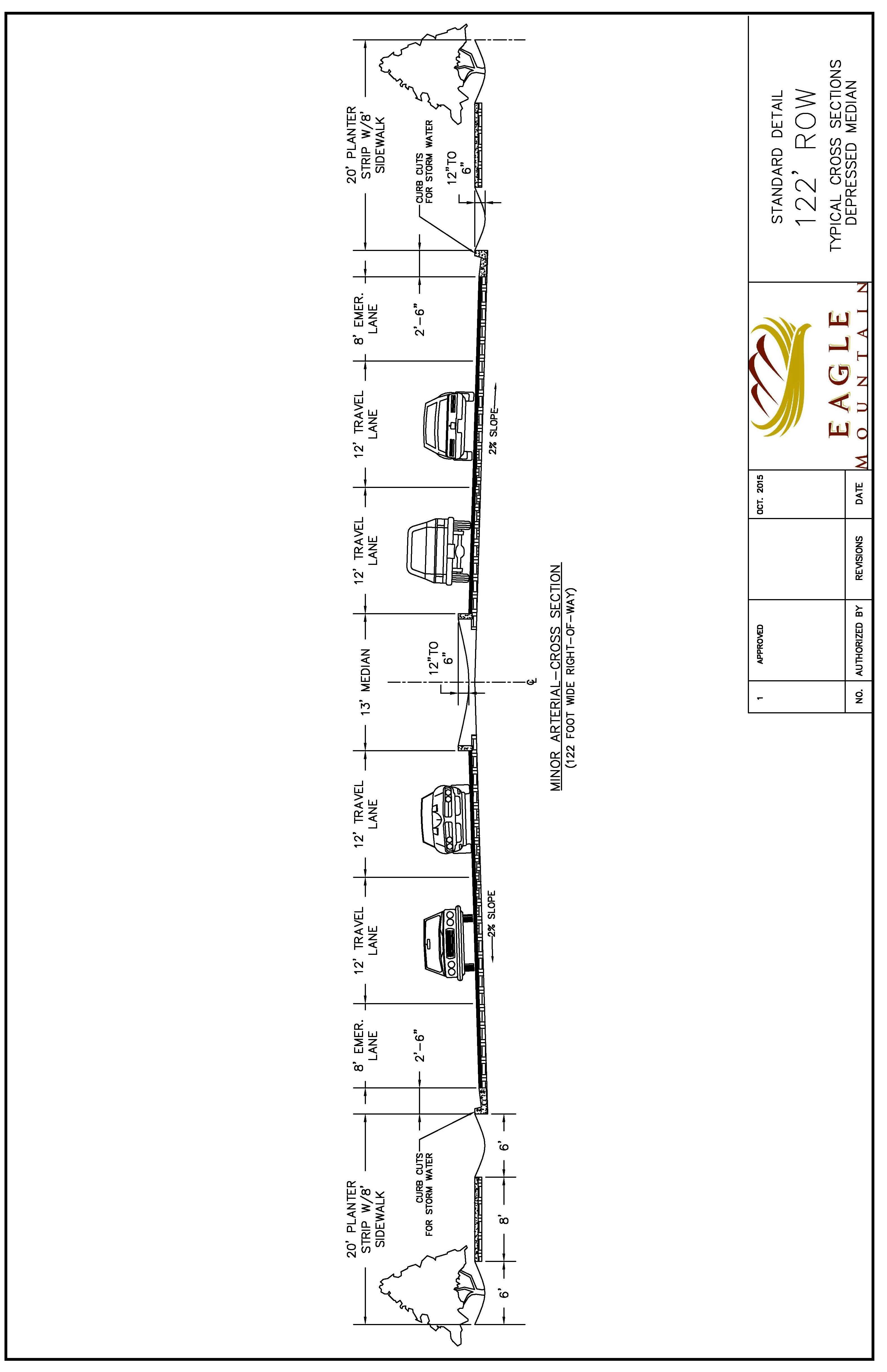
[Ord. O-09-2024 § 2 (Exh. A); Ord. O-23-2015 § 2 (Exh. A); Ord. O-13-2015 § 1 (Exh. A); Ord. O-03-2010 § 1 (Exh. A § 2.070)].
15.10.110 Intersection grades.
The maximum grade at intersections shall not exceed four percent for 100 feet measured from the edge of asphalt on the intersecting street.
The grade may be increased to a maximum of six percent on a collector road if there is no signalization or traffic control. In addition, detailed designs are required for the intersection design along with storm drain inlet boxes at each of the intersecting curb returns. [Ord. O-09-2024 § 2 (Exh. A); Ord. O-13-2015 § 1 (Exh. A); Ord. O-03-2010 § 1 (Exh. A § 2.080)].
15.10.120 Vertical curves.
Vertical curves shall be designed to meet the maximum sight distance and stopping sight distances required by AASHTO. [Ord. O-09-2024 § 2 (Exh. A); Ord. O-13-2015 § 1 (Exh. A); Ord. O-03-2010 § 1 (Exh. A § 2.081)].
15.10.130 Cul-de-sacs.
The maximum length of a cul-de-sac is 500 feet measured from the nearest right-of-way line of the adjoining street to the center of the cul-de-sac, and the minimum radius as defined by EMMC Titles 16 and 17 and the International Fire Code, unless otherwise approved by the city engineer and the fire chief. No reversed grade cul-de-sacs shall be allowed unless adequate storm and sewer facilities are designed and approved by the city engineer or his/her designee. Cul-de-sacs shall have a maximum of 15 lots unless stated otherwise in EMMC Titles 16 and 17. [Ord. O-09-2024 § 2 (Exh. A); Ord. O-06-2017 § 2 (Exh. A); Ord. O-13-2015 § 1 (Exh. A); Ord. O-03-2010 § 1 (Exh. A § 2.090)].
15.10.140 Temporary turnarounds.
Temporary turnarounds are to be provided on all streets which are more than one lot from intersections unless approved otherwise by the unified fire chief or his/her designee. These are to be recorded on the plat as easements: 60-foot diameter, four-inch-thick compacted road base and two inches of asphalt. If it is not anticipated that the temporary turnaround will be in place longer than a year, the developer may, at their discretion, forego installation of the asphalt in favor of bonding these improvements. If the temporary turnaround is still required at the end of the warranty period, and if asphalt has not been installed, the asphalt will be installed by the developer at his/her expense, or the city will make a claim against the bond. All temporary turnarounds must be approved by the unified fire chief or his/her designee. [Ord. O-09-2024 § 2 (Exh. A); Ord. O-13-2015 § 1 (Exh. A); Ord. O-03-2010 § 1 (Exh. A § 2.100)].
15.10.150 Offsetting intersections.
All intersections shall be at right angles, or within 10 degrees, extending a minimum of 150 feet along the centerlines from the center of the intersection to the point of tangency. Offset intersections will have a minimum offset of 100 feet between centerlines. [Ord. O-09-2024 § 2 (Exh. A); Ord. O-13-2015 § 1 (Exh. A); Ord. O-03-2010 § 1 (Exh. A § 2.120)].
15.10.160 Clear vision area.
A. The clear vision area is that triangular area of a corner lot or parcel formed by the street property lines and the line connecting them at points 30 feet from the intersecting right-of-way lines of the two streets. Fencing and planting is restricted within this area as follows:
1. No fence shall exceed a height of three feet.
2. Shrubs shall be pruned to a height not to exceed three feet.
3. Trees shall be pruned to maintain a clear area below eight feet.
B. A second clear vision area with 20-foot sides is also required where the rear of a corner lot adjoins an interior lot. The same restrictions for landscaping and fencing apply in this area unless the interior lot is already developed and has no existing driveway within 10 feet of the property line adjoining the corner lot. [Ord. O-09-2024 § 2 (Exh. A); Ord. O-13-2015 § 1 (Exh. A); Ord. O-03-2010 § 1 (Exh. A § 2.130)].
15.10.170 Curbs, gutters and sidewalks.
When required on Table 16.35.130(b), Right-of-Way Classifications, all curbs, gutters and sidewalks shall be built on all existing and proposed streets required by the subdivision in accordance with the APWA Standard Specifications as amended by the city. All curbs, gutters and sidewalks shall connect to existing curbs, gutters and sidewalks within a reasonable area as determined by the city engineer or his/her designee. [Ord. O-09-2024 § 2 (Exh. A); Ord. O-13-2015 § 1 (Exh. A); Ord. O-03-2010 § 1 (Exh. A § 2.140)].
15.10.175 Potholing.
Any potholing made within public rights-of-way must achieve minimum compaction. If mechanical compaction and testing cannot be achieved, flowable fill will be required to bottom of road base section. Potholing on underground utilities will be required to replace existing bedding materials around pipes prior to placing flowable fill. Replacement shall be inspected by city under the direction of the city engineer and streets manager or their designee(s). [Ord. O-21-2022 § 2 (Exh. A)].
15.10.180 Parking lots and driveways.
Parking shall meet the size and configuration requirements as shown in the standard drawings. Parking lots and drives shall be designed to meet appropriate engineering standards, including drainage and load capacity. All drive and parking lot drainage, asphalt, and base designs shall be reviewed by the city engineer or his/her designee prior to approval. Any trenches for installation of public utilities shall be backfilled and compacted using engineered fill (A1, A2) and be tested in accordance with Eagle Mountain City standards. [Ord. O-09-2024 § 2 (Exh. A); Ord. O-13-2015 § 1 (Exh. A); Ord. O-03-2010 § 1 (Exh. A § 2.150)].
15.10.190 Ground water.
Potential ground water or subsurface drainage problems may have additional requirements; further requirements will be reviewed and approved by the city engineer or his/her designee. Pumping of ground water across sidewalks or into the gutters or the sewer system will not be allowed. [Ord. O-09-2024 § 2 (Exh. A); Ord. O-13-2015 § 1 (Exh. A); Ord. O-03-2010 § 1 (Exh. A § 2.160)].
15.10.200 Underground utilities.
Utilities, including electrical and gas lines, shall be underground, except when the city feels that such underground lines are not in the best interest of the city. [Ord. O-09-2024 § 2 (Exh. A); Ord. O-21-2022 § 2 (Exh. A); Ord. O-13-2015 § 1 (Exh. A); Ord. O-03-2010 § 1 (Exh. A § 2.170)].
15.10.205 Abandoning underground utilities.
All disconnection and abandonment of existing utilities must be done at the mainline, per the city engineer or his/her designee. All existing utilities (stubs into job sites) must be used or abandoned. [Ord. O-09-2024 § 2 (Exh. A)].
15.10.210 Licensed contractor.
All work performed in accordance with this title shall be performed by a contractor licensed to perform such work by the state of Utah. [Ord. O-09-2024 § 2 (Exh. A); Ord. O-13-2015 § 1 (Exh. A); Ord. O-03-2010 § 1 (Exh. A § 2.180)].
15.10.220 Time limitation for completion.
All improvements within subdivisions listed herein must be completed within one year of the date of recording of the final plat, except for required corrections to defective work as found in the final walk-through and itemized in a punch list generated by Eagle Mountain City, which shall be completed at the end of the warranty period after asphalt installation. Improvements that are not completed within the time limitation imposed herein may be required to work a forfeiture of any bond or surety that shall have been posted by the owner or developer or may be allowed to post an additional bond for an additional amount reflective of increased construction costs. At no time will an unimproved recorded plat be allowed to constitute a risk or hazard to the public.
Approved construction drawings will only be valid for three years from the date of approval. After three years from the time of approval, drawings must be resubmitted prior to construction for a staff review to ensure adequate construction standards are reflected in said plans. [Ord. O-09-2024 § 2 (Exh. A); Ord. O-13-2015 § 1 (Exh. A); Ord. O-03-2010 § 1 (Exh. A § 2.190)].
15.10.230 Building permits.
See EMMC 16.60.050 for the building permit approval process. [Ord. O-09-2024 § 2 (Exh. A); Ord. O-13-2015 § 1 (Exh. A); Ord. O-04-2015 § 2 (Exh. A); Ord. O-03-2010 § 1 (Exh. A § 2.200)].
15.10.240 Security for improvements required.
In order to ensure the proper installation of the improvements required by this chapter and in order to ensure prompt payment of all persons supplying labor or materials to the subdividers or their contractors or subcontractors installing said improvements, the owners of property or the principal subdividers shall, prior to subdivision recordation or issuance of a building permit, deposit with the city, or a depository acceptable to the city, a cash escrow bond, or an improvement surety bond, furnished by a surety authorized to do business in the state of Utah and operating in good standing, conditioned on the requirements that installation of all required improvements are constructed within the required time and in accordance with the plans, specifications, time limitations and conditions relating thereto as approved by the city engineer or his/her designee.
The bond or cash escrow shall be established in a form acceptable to counsel for the city and shall be in an amount to be determined by the city engineer or his/her designee, and shall be filed in the office of the city recorder and shall amount to 110 percent of the estimated cost of improvements. The developer shall sign a development agreement agreeing to install and warrant the improvements required for approval of the subdivision or other project. [Ord. O-09-2024 § 2 (Exh. A); Ord. O-13-2015 § 1 (Exh. A); Ord. O-03-2010 § 1 (Exh. A § 2.210)].
15.10.250 Standards for construction drawings.
The following instructions are for the purpose of standardizing the preparation of drawings to obtain uniformity in appearance, clarity, size and style.
Following approval of the city council, four copies of the construction plans shall be submitted with three copies to be retained by the city engineer or his/her designee and one copy returned to the subdivider with the approval mark and signature of the city engineer or his/her designee. One approved copy shall be kept available at the construction site.
These plans and designs shall meet the standards defined in the specifications and drawings of the city described herein. The minimum information required on drawings for improvements are as follows:
All drawings and/or prints shall be clear and legible and conform to good engineering and drafting room practice. Size of drawings shall be 24-inch by 36-inch (trim line) with minimum borders of one-half inch on top, bottom and right sides, left side one and one-half inch.
A. Include the following with the construction drawings:
1. A copy of the proposed final plat.
2. A plan view of the entire project.
3. Plan and profiles of all curbs, gutters, storm drains, water, pressurized irrigation and sewer systems.
4. Detail drawings only for items not found in the APWA manual. Detail drawings shall be to scale and completely dimensioned and described. All structures shall be designed in accordance with minimum requirements established by this title or the APWA manual.
5. Complete plans for all off-site work to be done in conjunction with the project.
6. An SWPPP page with maps showing:
a. Storm drain system.
b. Topographical lines and flow arrows.
c. UPDES permit number with contact information.
d. Locations of BMPs and good housekeeping measures.
e. Permanent BMPs and high-priority sites.
B. Include the following on each drawing sheet:
1. North arrow.
2. Scale. Use a standard engineering scale between one inch equals 10 feet and 60 feet. Use a scale of one inch equals 100 feet on the plan view of the entire project if necessary to fit the project on one sheet.
3. Title block along right side of sheet with title of drawing in lower right corner. Include in title block:
a. Name of subdivision and plat.
b. Name of city.
c. Specific type of drawing (construction drawings, plan view, plan and profiles, off-site construction, detail drawings).
d. Space provided for approval signature of city engineer or his/her designee and date.
e. Name of engineer, surveyor or firm preparing drawings.
f. Drawing number of total number of drawings.
4. Also include the following with profile drawings:
a. Vertical scale of one inch equals one, two, three or four feet.
b. Reference to the vertical datum. The 1929 North American Vertical Datum (NAVD29) shall be used for all elevation data.
c. Benchmark location and elevation for checking construction.
d. Stationing aligned from plan view with the profile view.
e. Existing ground, ditch and utility lines.
C. Include the following for curbs, gutters, storm drains, drainage structures, sidewalks and street surfacing plans:
1. Plan and profile for top back of curb for each side of the street. Label profile line as top back of curb for both sides of street if it is the same.
2. Stationing and top back of curb elevations with curve data for curb returns.
3. Flow direction and type of cross drainage structures at intersections with adequate flow line elevations.
4. Type of curb and gutter if other than the standard 30-inch modified curb and gutter in the standard drawings.
5. Plan and profile of all new and existing storm drains and storm manholes and boxes.
6. Storm box and manhole size, location, and elevations of flow lines and rim.
7. Location, size, grade and type of pipe of new and existing storm drains.
8. Storm water calculations for a 25-year and 100-year storm.
9. Detail of ADA ramps with detectable warning pads.
D. Include the following for sewer plans:
1. Plan and profile of all new and existing sewer mains and manholes.
2. Manhole size, location, and elevations of flow lines and rim.
3. Location, size, grade and type of pipe of new and existing sewer mains.
4. Location of each lateral with distance stubbed back into property clearly drawn and dimensioned.
E. Include the following for culinary water plans:
1. Location, size and type of pipe of new and existing water mains.
2. Profile or detail showing separation at each conflicting utility crossing.
3. Location of valves, fittings, hydrants, boxes, meters and appurtenances.
4. Minimum cover.
5. Location of each lateral with distance stubbed back into property clearly drawn and dimensioned.
F. Include the following for the pressurized irrigation plans:
1. Location, size and type of pipe of new and existing irrigation mains.
2. Profile or detail showing separation at each conflicting utility crossing.
3. Location of valves, fittings, boxes, meters and appurtenances.
4. Minimum cover.
5. Location of each lateral with distance stubbed back into property clearly drawn and dimensioned. [Ord. O-09-2024 § 2 (Exh. A); Ord. O-13-2015 § 1 (Exh. A); Ord. O-03-2010 § 1 (Exh. A § 2.220)].
15.10.260 Landscape improvement standards.
Landscape improvements shall conform to APWA Construction Standards and Eagle Mountain City landscape construction standards. All landscape plans are to be approved by the Eagle Mountain City planning department and parks division prior to construction. [Ord. O-09-2024 § 2 (Exh. A); Ord. O-13-2015 § 1 (Exh. A); Ord. O-03-2010 § 1 (Exh. A § 2.230)].
15.10.270 Half-street width.
In certain conditions, and when special approval is given, half-road widths may be allowed. Half-road width requires all improvements to the centerline plus an additional 10 feet of asphalt. Adequate storm water control should be constructed for noncurbed roadside. All improvements must be made on subdivider’s property. [Ord. O-09-2024 § 2 (Exh. A); Ord. O-13-2015 § 1 (Exh. A); Ord. O-03-2010 § 1 (Exh. A § 2.240)].
15.10.280 Traffic control.
Traffic control shall be submitted to the city prior to any work in accordance with Utah MUTCD. Any road or lane closures or lane shifts must be approved, and fees paid, at a minimum of 48 hours in advance of the road closure. [Ord. O-09-2024 § 2 (Exh. A); Ord. O-21-2022 § 2 (Exh. A); Ord. O-13-2015 § 1 (Exh. A); Ord. O-03-2010 § 1 (Exh. A § 2.250)].
15.10.290 Construction safety.
Open pits and trenches left for an overnight period or longer shall be clearly marked with flashing barricades. All national and state standards must be maintained for open trenches. The city engineer or his/her designee may require additional barricades or road plates as determined in the field. Trenches may not be left open for an extended period of time.
If any subdivision is located such that there is no available construction access other than through existing subdivisions, an additional monetary amount to be determined by the city engineer or his/her designee shall be placed in the subdivision improvement bond to protect the city from damaged infrastructure. [Ord. O-09-2024 § 2 (Exh. A); Ord. O-21-2022 § 2 (Exh. A); Ord. O-13-2015 § 1 (Exh. A); Ord. O-03-2010 § 1 (Exh. A § 2.251)].
15.10.300 Excavation permit.
In order for a street excavation permit to be approved, Eagle Mountain City needs the following information: (A) copy of contractor’s license; (B) certificate of insurance; (C) performance bond of $5,000; and (D) detailed drawing of proposed work and traffic control (four copies).
The contractor is given a copy of the signed permit and the signed/approved plan after the city engineer or his/her designee has approved and signed the application. Time limits may be set, and the permit can be suspended for noncompliance.
Trenches left open for more than 24 hours may be required to be either covered or backfilled at the discretion of the city engineer or his/her designee. [Ord. O-09-2024 § 2 (Exh. A); Ord. O-13-2015 § 1 (Exh. A); Ord. O-03-2010 § 1 (Exh. A § 2.260)].
15.10.310 Survey.
All property corners shall be marked with a 30-inch rebar and licensed land surveyor’s cap before acceptance of subdivision improvements by Eagle Mountain City. These rebars must be offset one foot by a steel tee post four feet out of the ground. All property corners shall be in place at the time of final acceptance. Any survey in roadways that require collars (monuments) shall maintain city standards for street collars. [Ord. O-09-2024 § 2 (Exh. A); Ord. O-21-2022 § 2 (Exh. A); Ord. O-13-2015 § 1 (Exh. A); Ord. O-03-2010 § 1 (Exh. A § 2.270)].
15.10.320 Construction entrance.
All subdivisions shall include a separate entrance for construction traffic which is not in a city right-of-way. If no such access is available, an alternate cross-section designed specifically for the use of construction vehicles during the building phase of the project must be constructed within the city right-of-way and all construction must access the site from this point of access. The purpose of this requirement is to reduce damage caused by heavier vehicular traffic to new surfaces, and the existing adjacent roadways. Compliance with this requirement shall be overseen by the city engineer or his/her designee.
Construction entrances shall not disturb any pedestrian access routes. All construction entrances/exits must be kept ADA-compliant throughout construction. New road entrances must have an approved detour route that is also ADA-compliant before removal of any pedestrian access routes (sidewalks/trails).
If any subdivision is located such that there is no available construction access other than through existing subdivisions, an additional monetary amount to be determined by the city engineer or his/her designee shall be placed in the subdivision improvement bond to protect the city from damaged infrastructure. A truck route must be approved through the construction drawing approval before construction begins. [Ord. O-09-2024 § 2 (Exh. A); Ord. O-13-2015 § 1 (Exh. A); Ord. O-03-2010 § 1 (Exh. A § 2.280)].
15.10.330 Site cleanup.
The contractor is responsible to maintain a clean work environment within the limits of the city. A cobble track out pad consisting of three-inch to six-inch cobble eight inches thick minimum with width of 20 feet and extending 50 feet past existing asphalt road way or an approved equivalent alternative shall be placed at all locations where construction traffic enters paved roadways to prevent dirt and mud from being tracked onto city streets.
Additionally, vehicles may have to be hosed down prior to leaving the site. Dirt and debris tracked onto city roads must be cleaned by contractor each work day or be subject to fines as determined in the city fee schedule. Proper dust control measures must be exercised at all times. Noncompliance can result in all construction activities being shut down until corrective measures are taken. [Ord. O-09-2024 § 2 (Exh. A); Ord. O-13-2015 § 1 (Exh. A); Ord. O-03-2010 § 1 (Exh. A § 2.290)].
15.10.340 Noncompliance.
Noncompliance with this title can result in a stop work order issued by the city engineer or his/her designee, a forfeiture of bonds, or a hold on building permits until all improvements meet compliance. [Ord. O-09-2024 § 2 (Exh. A); Ord. O-21-2022 § 2 (Exh. A); Ord. O-13-2015 § 1 (Exh. A); Ord. O-03-2010 § 1 (Exh. A § 2.300)].
15.10.350 Hours of work.
Unless limited through city ordinance otherwise, construction activities shall be restricted to between the hours of 7:00 a.m. and 9:00 p.m., Monday through Friday, and 9:00 a.m. and 9:00 p.m. on Saturdays and Sundays in residential and commercial areas. [Ord. O-09-2024 § 2 (Exh. A); Ord. O-13-2015 § 1 (Exh. A); Ord. O-03-2010 § 1 (Exh. A § 2.310)].
15.10.360 Defensible space.
Property owners, including Eagle Mountain City and individual residential homeowners and/or homeowners’ associations, shall be responsible to maintain an adequate defensible space to act as a fire break as detailed in the applicable state fire ordinances. All construction and staging areas shall also maintain a defensible space of at least 30 feet throughout the construction process. [Ord. O-09-2024 § 2 (Exh. A); Ord. O-13-2015 § 1 (Exh. A); Ord. O-03-2010 § 1 (Exh. A § 2.320)].
15.10.370 Reimbursement agreements.
In instances when subdivisions are required to install improvements which may provide capacity in excess of the requirements of the subdivision, to meet conditions established as part of a master plan, or for the benefit of a third party, such increases in capacity may be eligible for reimbursement.
Reimbursements may be in the reduction of impact fees collected by the city for the particular type of improvement installed, a reduction in connection fees, or may be negotiated as a cash reimbursement collected by third parties at building permit and remitted to the original developer annually.
All reimbursement agreements are to be approved by the city council, and the city will not consider verbal agreements made by the city or staff to be valid. Requests for reimbursement must be made to the city prior to installation of the utilities for which reimbursement is sought. [Ord. O-09-2024 § 2 (Exh. A); Ord. O-13-2015 § 1 (Exh. A); Ord. O-03-2010 § 1 (Exh. A § 2.330)].
15.10.380 Improvements warranty.
All required improvements shall be placed into a warranty period following acceptance by the city for a minimum of one year. Should the completion of the one-year period occur during winter months, the warranty period may be extended for up to six months to allow the completion of any corrective requirements to be completed during reasonable weather.
A warranty bond for 10 percent of the estimated construction costs shall be maintained for the duration of the warranty period.
Prior to the expiration of the warranty period, Eagle Mountain City shall notify the developer that a warranty walk-through is to be performed on the subdivision. Said walk-through shall take place and all corrective actions as determined by this walk-through and as outlined in a punch list to be generated by Eagle Mountain City shall be completed prior to release from the warranty period. If items on the punch list are not completed within a 30-day time line, another walk-through may be required. [Ord. O-09-2024 § 2 (Exh. A); Ord. O-13-2015 § 1 (Exh. A); Ord. O-03-2010 § 1 (Exh. A § 2.340)].
15.10.390 Street lighting.
Eagle Mountain City shall contract with an independent consultant for street lighting design. Unless approved otherwise by the city’s consultant, street lighting will be installed throughout all developments using the following criteria:
A. Street lights will be installed at all intersections with the only exception being where a four-way intersection has an offset of less than 100 feet.
B. Streetlights will be installed at a minimum spacing of 300 feet and a maximum spacing of 600 feet. They will be installed at the closest property line to the midpoint between the lights on either side. Streetlights placed between corners will be shown on the electrical construction drawing, and will indicate the direction that the street light will be aimed. Streetlights at intersections may aim to the center of the intersection or may be set at a 90-degree angle along collector and larger roads.
C. Any street that extends more than 600 feet without an intersection will have a street light at approximately the midpoint.
D. Each street light will be installed so that the street light pole is located 24 inches from the top back of the curb to the center of the pole in a public utility easement or public right-of-way.
E. A ground wire shall be connected to the street light pole using NEC-approved methods and a separate ground wire shall be run from the pole base to the closest secondary pedestal or transformer. If the street light is fed from a secondary pedestal, an eight-foot by five-eighths-inch copper clad ground rod must be installed at the pedestal, and street light ground will be attached to the ground rod using the NEC-approved connector.
F. A ground wire shall be connected to the street light pole using NEC-approved methods and a separate ground wire shall be run from the pole base to the closest secondary pedestal or transformer. If the street light is fed from a secondary pedestal, an eight-foot by five-eighths-inch copper clad ground rod must be installed at the pedestal, and street light ground will be attached to the ground rod using the NEC-approved connector.
G. Pole. A 14-foot aluminum street light pole shall be used. The pole shall be manufactured by Holophane and shall be green with base. All bases must be embedded in concrete with a 20-inch-diameter hole and 4 feet.
H. Luminaire. A luminaire that reduces all sky ward light shall be 50-watt high pressure sodium light and shall have a shield to keep light off of houses. [Ord. O-09-2024 § 2 (Exh. A); Ord. O-08-2023 § 2 (Exh. A); Ord. O-13-2015 § 1 (Exh. A)].