


Chapter 17.10
DEFINITIONS
Sections:
17.10.010 What this chapter does.
17.10.010 What this chapter does.
This chapter provides definitions of important terms used in Eagle Mountain City’s Land Development Code (this title and EMMC Title 16, Subdivisions). [Ord. O-12-2009 § 2 (Exh. A); Ord. O-10-2007 § 2 (Exh. A § 2.1); Ord. O-23-2005 § 3 (Exh. 1(1) § 2.1)].
17.10.020 General purpose.
For the purpose of the land development code, the following terms and words and their derivations shall have the meaning as given herein. When not inconsistent with the context, words used in the present tense include the future; words in the singular number include the plural and the plural the singular. “Shall” is always mandatory. Words not included herein, but which are defined in the International Building Code, International Residential Code or in other city ordinances, shall be construed as defined therein. Words that are not included herein or in the International Building Code, International Residential Code or in other city ordinances shall be given their usual meaning as found in an English dictionary, unless the context of the words clearly indicates a different meaning. Definitions of words applicable particularly to certain sections or chapters may be included in those sections or chapters. Chapter 6.10 EMMC, Animal Zoning Regulations, and Chapter 17.80 EMMC, Sign Regulations and Sign Permits, both contain additional definitions specific to those chapters. [Ord. O-12-2009 § 2 (Exh. A); Ord. O-10-2007 § 2 (Exh. A § 2.2); Ord. O-23-2005 § 3 (Exh. 1(1) § 2.2)].
17.10.030 Definitions.
“Abandonment” means to cease or discontinue a use or activity for one year without intent to resume, but excluding temporary or short-term interruptions to a use or activity during periods of remodeling, maintaining, or otherwise improving or rearranging a facility, or during normal periods of vacation or seasonal closure.
“Accessory dwelling unit (ADU)” is an independent habitable living unit, with a kitchen, bath facilities, and its own entryway, which is (1) within or attached to an owner-occupied single-family residential dwelling, or (2) within a separate detached accessory structure, or above a detached garage, on a single-family lot. Does not include motor homes, fifth-wheels, travel trailers, campers, or other housing units on wheels.
“Accessory structure or building” means a subordinate structure detached from but located on the same lot as the principal structure, the use of which is incidental and accessory to that of the principal structure.
“Accessory use” means a use that (1) is clearly incidental to and customarily found in connection with a principal or main use; (2) is subordinate to and serves a principal or main use; (3) is subordinate in extent, area, or purpose to the principal or main use; (4) is located on the same lot as the principal or main use; and (5) contributes to the comfort, convenience, or necessity of occupants, business, or industry of the principal or main use. Home businesses shall be considered an accessory use. Accessory uses may occur within a principal structure and shall not necessarily take place in an accessory structure.
“Active recreation areas” means areas of the landscape dedicated to active recreation where lawn may be used as the playing surface (e.g., sports fields and play areas).
“Adjacent” or “adjoining” includes all lots or parcels that directly border the lot or parcel on which a development is proposed, and all lots or parcels separated from that lot or parcel by only a public or private easement or right-of-way, including streets and irrigation canals.
“Affected entity” means a county, municipality, independent special district under Title 17A, Chapter 2, Utah Code Annotated 1953, Independent Special Districts; local districts under Title 17B, Chapter 2, Utah Code Annotated 1953, Local Districts; school districts, interlocal cooperation entities established under Title 11, Chapter 13, Utah Code Annotated 1953, Interlocal Cooperation Act; specified public utilities, or the Utah Department of Transportation if: (1) the entity’s services or facilities are likely to require expansion or significant modification because of an intended use of land; (2) the entity has filed with the municipality a copy of the entity’s general or long-range plan; or (3) the entity’s boundaries or facilities are within one mile of land which is the subject of a general plan amendment or land use ordinance change.
“Agricultural use” means the use of a tract of land for growing crops in the open, dairying, pasturage, horticulture, floriculture, general farming uses and necessary accessory uses, including the structures necessary for carrying out farming and ranching operations and the residence of the person who owns or operates the farm, and the family thereof; provided, however, such agricultural use shall not include: the raising or keeping of fur-bearing animals, or the operation of commercial stockyards, or feed yards, slaughterhouses, rendering facilities, or concentrated animal production operations such as hog or poultry farms.
“Alley(way)” means a publicly dedicated and platted public thoroughfare not classified as a street, typically used to provide access to the rear or side yards of a property. The allowed or required dimension(s) for an alley is provided in this code.
“Alluvial fan” means an outward spreading, gently sloping mass of alluvium deposited by a stream, especially in an arid or semiarid region where a stream issues from a narrow canyon onto a plain or valley floor. Viewed from above it has the shape of an open fan, the apex being at the canyon mouth.
“Animal care service” means a commercial or nonprofit facility providing medical or surgical treatment, clipping, bathing or other services, including incidental boarding to dogs, cats, and other animals. Typical uses do not include kennels, short-term pet sitting, or hobby breeding; these uses shall comply with Chapter 6.05 EMMC.
“Appeal authority” means a person, board, commission, agency, or other body designated by ordinance to decide an appeal of a decision of a land use application or variance.
“Application” means an application required by this title or EMMC Title 16.
“Art gallery” means an establishment engaged in the sale, loan or display of paintings, sculpture or other works of art. This term does not include libraries or museums.
“Asphalt and concrete production” means the production of asphalt and/or concrete in one or more plants, including, but not limited to, batch plants, together with the excavation and storage of rock, sand, gravel, and other materials used in the production of asphalt and/or concrete. This term shall include the presence and operation of rock crushers, screens, shredders and other earth and plant sorting, moving, processing, and grading equipment and buildings, facilities and storage yards used to mix asphalt and concrete products.
“Assisted living facility” means a residential facility, licensed by the state of Utah, with a home-like setting that provides an array of coordinated supportive personal and healthcare services, available 24 hours per day, to residents who have been assessed under Utah Department of Health or the Utah Department of Human Services rules to need any of these services and who have a service plan based on the assessment, which may include: specified services of intermittent nursing care; administration of medication; and support services promoting residents’ independence and self-sufficiency. An assisted living facility does not include a residential facility for persons with a disability or an adult day care provided in conjunction with a residential facility for elderly persons or a residential facility for persons with a disability.
“Auditorium” means a multi-purpose assembly facility that is designed to accommodate conventions, live performances, trade shows, sports events and other similar public events.
“Auto service, major” means an establishment engaged primarily in the repair or maintenance of motor vehicles, trailers and similar large mechanical equipment, including paint, body and fender, and major engine and engine part overhaul, provided it is conducted within a completely enclosed building.
“Auto service, minor” means an establishment engaged primarily in the repair or maintenance of motor vehicles, trailers and similar large mechanical equipment, including brake, muffler, upholstery work, tire repair and change, lubrication, tune-ups and transmission work, provided it is conducted within a completely enclosed building.
“Automobile gas station” means an establishment for the retail sale of automotive fuels and lubricants and at which no vehicle repair or maintenance service is offered. Such an establishment may offer for retail sale other convenience items such as food, and may also include a car wash.
“Automobile, truck, recreational vehicle and equipment sales or rental” means sales or rental of both new or used motor vehicles and equipment from indoor or outdoor areas, but not to include nonserviceable or junk vehicles or equipment.
“Bank” means a business principally involved in the lending, borrowing, exchanging, issuing or safeguarding of money, under charter from an agency of the state of Utah or the United States.
“Bar” or “tavern” means a business principally involved in the sale of alcoholic beverages under license from the city and the state of Utah.
“Bed and breakfast facility” means a limited commercial activity conducted within a structure, which includes dining and bathroom facilities with sleeping rooms, on a residential scale for short-term guest rental. This definition will typically involve overnight accommodations, limited food services, parking facilities and open space in a natural setting.
“Berm” means a wall or landscaped bank of raised earth or stone that creates a ridge or embankment.
“Block” means the distance along any given road frontage between two intersections with three or more connecting links.
“Buildable land” means any land suitable for development or construction of any building or structure, and all other land not classified as unbuildable land. For the purposes of calculating improved open space acreage requirements, buildable land shall include all land incorporated within the boundaries of any lot.
“Buildable lot area” means that portion of a building lot not included within any required yard setbacks, public utility easement, or open space within which a main building may be located.
“Building” means any structure used or intended for supporting or sheltering of any use or occupancy.
“Building official, city” means the employee, contractor, individual or firm responsible for all building construction plan reviews, inspection of all building construction, enforcement of the city’s adopted building codes and policies and any other responsibilities required by the city relating to the construction of buildings.
“Car wash” means a facility engaged in cleaning or detailing motor vehicles, including cars, passenger trucks, and recreational vehicles, whether self-service, automatic or by hand. A car wash may be an accessory use to an automobile gas station or convenience store, or it may be a principal use on the lot.
“Caretaker dwelling” shall mean an accessory use where a caretaker is permitted to reside on site at the place of business for which they are charged to look after. The caretaker dwelling shall include cooking, sleeping, and sanitation facilities.
Certificate of Occupancy. A certificate of occupancy is issued upon the completion of a building and any accompanying improvements required by the city and its ordinances.
“Character” means the aggregate of all features and traits that form the individual nature of a person or thing.
“Check cashing and deferred deposit lender” means an organization involved in the providing of loans or consideration to customers in exchange for personal property, such as property titles or personal checks. Such services shall include check cashing businesses licensed and/or defined by the state pursuant to the Check Cashing Registration Act, car title loan businesses, deferred deposit loan businesses, and businesses of a similar nature offering such services as a primary function. The term “financial service” shall not include fully automated standalone services, such as automated teller machines, nor those used and defined herein as “bank.”
“Chicane” means a series of narrowings or curb extensions that alternate from one side of a street to the other forming S-shaped curves.
“Church” means a place of worship, synagogue, temple, mosque or other place of religious worship, including any accessory use or structure used for religious observances.
“City” means Eagle Mountain City, Utah.
“City council” means Eagle Mountain’s elected and governing body.
“Clear vision triangle” means a clear line of sight provided at intersections by delineating triangular areas adjacent to all intersections, within which no parking, building, structure, berm, or landscaping over three feet in height above the street shall be permitted. Single-trunk trees may be planted within such areas, but only where the tree will be pruned to eliminate all branches and foliage below eight feet. Driveways are prohibited within the clear vision triangle of local streets unless there is no other feasible placement of a driveway on a lot. Clear vision triangles may not be required if an approved chain link or other non-sight-obscuring fence is used. See Chapter 17.60 EMMC for more information.
“Cluster home” means a detached home that is generally located on a small lot or clustered near other detached homes with common open space between the homes. A cluster homes development will generally include a park, courtyard, or additional improved open space within the development. These are sometimes referred to as patio homes.
“Commercial riding arena” means commercial roping or other equestrian events and riding arenas (unlighted), as well as commercial roping and riding arenas and other equestrian events (lighted) which may or may not be totally enclosed within a structure.
“Communication facility” means a tower or structure used for transmitting a broadcast signal or for receiving a broadcast signal (or other signal) for retransmission.
“Community recreation center” means a place, structure, area or other facility used to provide social and recreational programs generally open to the public and designed to accommodate and serve some segment of the community.
“Compatible” or “compatibility” means consistent with, harmonious with, similar and complementary to the use and/or function of natural systems and/or existing land uses in an area.
“Concept plan” means a pre-application opportunity for the city manager and the planning commission to be made aware of an impending development proposal and for the developer to be made aware of possible issues and questions, as well as the applicable requirements of this title. Concept plans are not approved or denied, but are intended to only identify and raise relevant issues related to the proposed development.
Conditional Use. A conditional use allows certain structures in zones which may be acceptable under special conditions and in specific locations within the zoning district. Conditional uses require a special permit that is approved subject to the use meeting standards contained in this title.
“Conditional use permit” means a permit granted by the city that allows a use identified as requiring conditional use approval in the zoning district regulations or elsewhere in this title.
“Condominium” means a single unit in a multi-unit project or structure which is separately owned, which may be combined with an undivided interest in common areas and facilities of the property, and subject to the Utah Condominium Ownership Act.
“Conference center” means a facility designed for conventions, conferences, seminars, product displays, recreation activities, and entertainment functions, along with accessory functions including temporary outdoor displays, and food and beverage preparation and service for on-premises consumption.
“Connectivity index” means a ratio of roadway links and nodes that serve as a metric for measuring the level of connectivity.
“Constrained land” means all land with a slope greater than 25 percent or encumbered by floodplains.
“Construction office trailer” means a mobile home, travel trailer, truck trailer, or other temporary structure used as an office in conjunction with a construction project.
“Corner lot” means any lot that is bordered by more than one street where such streets are not parallel.
“Culinary water authority” means the person, department, agency, or public entity with responsibility to review and approve the feasibility of the culinary water system and sources for the subject property.
“Curb extension” means a traffic calming measure, primarily used to extend a sidewalk, reducing the crossing distance for pedestrians.
“Day care center, adult” means a nonmedical facility for the daytime care of adults who, due to advanced age, disability or impairment, require assistance and/or supervision during the day.
“Day care center – child, large” means an establishment providing care and maintenance to 50 or more children separate from their parents or guardians, and as licensed by the Office of Licensing of the Utah State Department of Human Services.
“Day care center – child, small” means an establishment providing care and maintenance to more than 12, but fewer than 50, children separate from their parents or guardians, and as licensed by the Office of Licensing of the Utah State Department of Human Services.
“Day care establishment – family, child” means an establishment providing care and maintenance to four or more, but fewer than 12, children separate from their parents or guardians, and as licensed by the Office of Licensing of the Utah State Department of Human Services to be provided within a single-family residence.
“Degree of nonconformity” means the measured extent to which an existing use or building fails to comply with a requirement of this title. For example, the degree of nonconformity of a parking lot that has four spaces, but serves a commercial use requiring nine, is five parking spaces. No change in the nonconforming use that would reduce the number of parking spaces could be permitted, because that would increase the degree of nonconformity.
“Density” means the gross number of dwelling units per acre. Gross acreage includes the entire development (roads, neighborhood parks and squares, neighborhood commercial centers, etc.). “Density” is not synonymous with “lot size.”
“Development” means any activity or construction, excluding normal agricultural activities, that changes the basic character or use of the land, including the division of land into two or more parcels; the construction, reconstruction, conversion, structural alteration, relocation, or enlargement of any structure; any regulated mining, excavation, landfill, or substantial land disturbance; and any use or extension of the use of land. The following operations or uses shall not be taken to be development for the purposes of this title:
1. Work by a highway or road agency for the maintenance of a road, if the work is carried out on land within the boundaries of the right-of-way;
2. Utility installations;
3. Landscaping for residential uses; and
4. Work involving the maintenance of existing landscaped areas and existing rights-of-way such as setbacks and other planted areas.
“Development agreement” means a form of contract between city and developer that establishes in detail the specific improvements required for some development approvals and which may contain other requirements on which the approval is conditioned. They may also vest certain additional rights with the developer or the city.
“Development density area acreage” means the total (gross) acreage of the development density area and approved project improvements.
“Drive-through service” means a feature or characteristic of a use involving sales or products or provision of services to occupants in vehicles, including drive-in or drive-up windows, that allows customers to transact business or receive services or goods while remaining in their motor vehicles.
“Drought-resistant grasses” means grasses that, once established, will require limited or no regular irrigation for adequate appearance, growth, and disease resistance.
“Earth products extraction” means the extraction and removal of sand, gravel, topsoil, and other earth products from underground mines or open pits. This term shall include the presence and operation of rock crushers, screens, shredders and other earth and plant sorting, moving, processing, and grading equipment and stockpiles, waste dumps, buildings, facilities and storage yards used in and relating to the extraction and removal of earth products.
“Electronics repair shop” means a use engaged in repair of household electronic items and appliances.
“Engineer, city” means the employee, contractor, individual or firm responsible for all municipal engineering activities including, but not limited to, design of public infrastructure, construction inspection of public infrastructure, long-range capital infrastructure planning, design and construction review services and any other responsibilities required by the city.
“Equestrian center” means (1) an establishment engaged in the boarding, feeding, or general care of horses or other large animals for personal or commercial purposes, and (2) includes uses such as agriculturally oriented gatherings, assemblies and shows, and the sale of feed, tack and other agricultural products.
“Equine assisted therapy center” means an outpatient facility that offers therapeutic equestrian riding, equine-assisted services, and equine-facilitated therapeutic services, and may offer licensed clinical therapy services.
Existing. The term “existing” is used to indicate a parcel of land, use, or building that was in existence on the effective date of the ordinance codified in this title.
“Family” is defined as follows:
1. One or more persons related by blood, marriage, adoption or legal guardianship, including foster children, living together as a single housekeeping unit in a dwelling unit; or
2. A group of not more than four persons not related by blood, marriage, adoption, or legal guardianship living together as a single housekeeping unit in a dwelling unit; or
3. Two unrelated persons and their children living together as a single housekeeping unit in a dwelling unit.
The term “family” shall not be construed to mean a club, group home, lodge, fraternity/sorority house or shelter.
“Fence” means a type of upright linear structure that serves as a barrier and/or boundary and is customarily used to mark a property boundary and/or to control access to/from a property, serve as a sight or protective screen or as a decorative element. Fences are made of varying materials and in varying styles. Common subtypes (with sample pictorial representations) include as follows:
“Board” means a fence that is mainly or wholly comprised of vertically arranged boards (often cedar wood) abutted together in a row.
“Board-on-board” (aka “shadowbox”) means a fence with alternating vertical boards over horizontal structures that give the fence a finished look on both sides.
“Chain-link” or “cyclone” means any fence that is constructed out of some type of woven wire fence, typically with a minimum gauge ranging from nine to 11.
“Chained fencing” means lengths of chain (usually heavy gauge) suspended between support poles/bollard or columns.
“Decorative” means any fence not specifically established to curtail access through or past the same. Decorative fences shall not include any form of chain link material.
“Gabion basket” means a wire mesh wrapped column of rock, usually river rock or similar materials to form an effectual basket.
“Lattice” means an open framework made of strips of wood or similar material overlapped or overlaid in a regular crisscross or decorative pattern.
“Non-site-obscuring” means a fence (e.g., picket, chain-link, solid fence with partial wire or lattice composition) that allows some view through the same.
“Ornamental” means wrought iron, tubular aluminum, or other decorative metal fence.
“Picket” means a fence with in-line boards with gaps between the same. Typically, the gaps are the same width as the boards and the boards are usually arranged vertically.
“Privacy screen, residential” means a type of fence or curtain wall placed on a property (typically along a patio, deck, courtyard, or swimming pool) not as a fence but rather a barrier to facilitate enhanced privacy or view screening on a property. Screens in this title are treated as a form of accessory structure instead of a fence, and are subject to accessory structure code standards.
“Site-obscuring” means a fence (e.g., board or vinyl) or wall that by its construct inhibits viewing through or past the same.
“Split-rail” means a fence typically featuring two or three cross-members between posts or supports.
“Vinyl” means a fence that is mainly or wholly comprised (typically) of vertically arranged vinyl panels abutted together in a row.
“Wire fencing” (aside from chain-link) means a fence comprised of strands of wire laced in varying ways. Such definition includes the following subtypes: barbed, chicken, hog, welded, hardware cloth, poultry netting, garden fence mesh or similar. Wire fencing may also include types of electric fencing. When a type of wire fencing is noted in this code, it shall refer to the common type available for sale commercially.
“Final plat” means a drawing recordable under the provisions of the Utah Code.
“Floor area ratio” means the total floor area of a building, including all floors, divided by the total lot size.
“Front yard” means any property extending across the full width of a lot from the front line of the lot to the nearest wall of the main building situated on the lot including but not limited to landscaping and driveway(s). 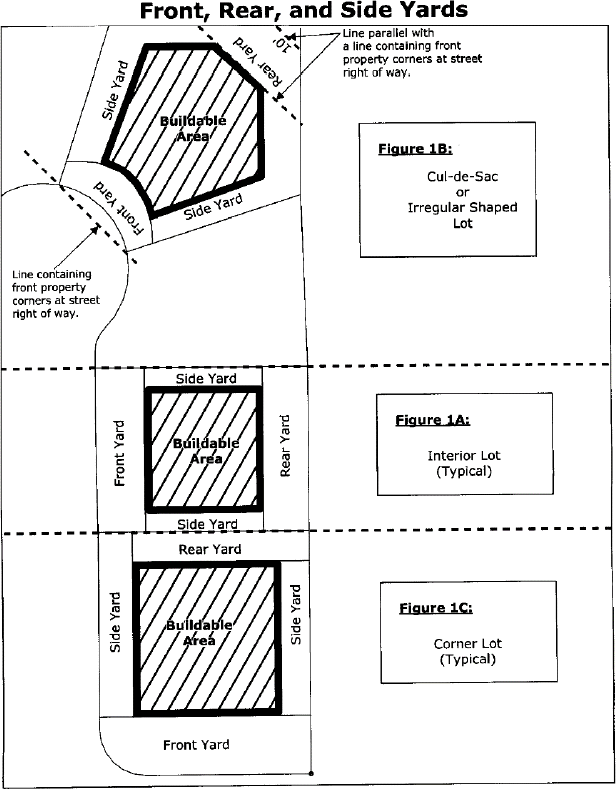
“Garden center” means an establishment for the growing, cultivation, storage, or sale of plants, flowers, trees, shrubs, garden plants, bushes, landscaping materials, or similar plantings, including materials, tools, implements, equipment, and packaged substances for the maintenance and care of such plantings intended for ornamental, garden, or landscaping purposes. Typical uses include greenhouses, plant and tree nursery, permanent tree lots, and garden supply stores. Typical uses do not include sod farms, storage sites for landscaping materials or cannabis production facilities.
“Garden court” means a detached housing development consisting of a courtyard or park surrounded on two or three sides by homes. These homes are generally facing/fronting the courtyard, are located on small lots or areas of common open space, and are accessed from a residential alley behind the homes.
“General plan” means the comprehensive, long-range strategic future development plan for the city, which includes elements such as future land uses, transportation, housing, parks and open space.
“Group home” means a residential facility established as a single housekeeping unit and shared by no more than eight unrelated persons, exclusive of staff, who require assistance and supervision. A group home is licensed by the state of Utah and provides counseling, therapy and specialized treatment through this temporary living arrangement, along with habilitation or rehabilitation services for physically or mentally disabled persons. See Chapter 17.75 EMMC for regulations concerning group homes.
“Hardscape” means durable landscape materials, such as concrete, wood, pavers, stone, or compacted inorganic mulch.
“Home business” means a nonresidential or business activity conducted in a dwelling or a building accessory to a dwelling. Home businesses, by definition, comply with the detailed performance standards of the city’s land development code.
“Hotel” or “motel” means a building or group of buildings containing individual sleeping units designed and used primarily for the accommodation of short-term guests, and with automobile parking or storage available. This definition includes restaurant, food service and group meeting facilities.
“Impact” means the direct or indirect effect or consequence resulting from a development upon land, the environment, the community or any part or segment thereof. The term shall include, but not be limited to, physical, environmental, economic, visual, or auditory effects.
“Improved open space” means park area that is improved as part of a residential development. Improved open space may include, but need not be limited to, lawns, landscape areas, paved trails, active recreation areas, children’s playgrounds, swimming pools, ball fields, multi-purpose courts, tennis courts, and other approved park improvements. The design and included elements in required improved open space are approved at the discretion of the planning commission and city council in accordance with Chapter 16.35 EMMC.
“Indoor shooting range” means a target range used for shooting, or for any other use involving the discharge of handguns, rifles, shotguns, or archery bows, which is open to the general public upon payment of a fee and which is located within the confines of a building.
“Interior lot” means any lot that is bordered by only one street.
“Kitchen” means any room and/or other place used, or intended or designed to be used, for cooking or the preparation of food that is at a minimum comprised of a set of fixed cooking facilities other than hot plates or other portable cooking units; includes kitchenettes. Second kitchens in a single-family dwelling are only allowed with a recorded deed restriction, or an approved accessory dwelling unit permit. Outdoor cooking facilities shall be excluded from second kitchen restrictions.
Land Use Application. See “Application.”
“Land use authority” means a person, board, commission, agency, or other body designated by the city council to act upon an application or land use application.
“Land use ordinance” means a planning, zoning, development, or subdivision ordinance of Eagle Mountain City, but not including the general plan.
“Landscaping” means the improvement of a lot, parcel or tract of land with rock material, grass, ground cover, shrubs and/or trees. Landscaping may include pedestrian walks, flower beds, ornamental objects such as fountains, statuary and other similar natural or artificial objects designed and arranged to produce an aesthetically pleasing effect.
“Lawn” means ground that is covered with grass or turf that is regularly mowed.
“Lot” means a parcel of land legally approved by the city for building purposes.
“Lot coverage” means the ratio of the portion of the lot covered by buildings, including accessory buildings, sidewalks, driveways, and other impervious surfaces, to the total lot area.
“Lot frontage” means that portion of a lot extending along a public or private street.
“Lot line adjustment” means the adjustment of a property lot line that meets the requirements of this title for the adjustment of lot lines.
“Lot of record” means a lot designated on a subdivision plat duly recorded in the county recorder’s office or other official record pursuant to statute. Sometimes, however, the county may refer to a metes and bounds parcel as a lot of record.
“Lot split” means the division of a single lot or parcel of land from an existing lot of record as of the date of the incorporation of Eagle Mountain City for immediate or future offer, sale, lease, or development that is not exempted by the city’s land development code and where both parcels will have access to a public street.
“Main entrance” means the entranceway of a residence or other building closest to the public street or sidewalk or one which would be reasonably perceived to be the entrance to the structure.
“Major development” means any proposed development process that requires a public hearing and review by the planning commission and city council; these processes generally include, but are not limited to, master development plans, rezoning of property, preliminary and final subdivision plats, site plans, conditional uses, and plat amendments.
“Manufactured home or dwelling” means a single-family dwelling complying with the National Manufactured Home Construction and Safety Standards Act (4 U.S.C. Section 5401), the International Building Code or the International Residential Code. Mobile homes, travel trailers, houses mounted on self-propelled or drawn vehicles, shipping containers and tents or other forms of temporary housing or portable housing are not included within this definition.
“Manufacturing, heavy” means the assembly, fabrication or processing of goods and materials using processes that ordinarily have greater than average effects on the environment, or that ordinarily have significant effects on the use and enjoyment of adjacent property through noise, dust, smoke, fumes, odors, glare or health or safety hazards or that otherwise do not constitute “light manufacturing.” This term includes processing and fabrication of large or bulky products, products made from raw or extracted materials, or products involving flammable or explosive materials and processes which require land area for fabrication or storage of products. This term shall include refineries and chemical manufacturing.
“Manufacturing, light” means the assembly, fabrication or processing of goods and materials using processes that ordinarily do not create noise, dust, smoke, fumes, odors, glare or health or safety hazards outside of the building or lot where such activities take place, where such uses are housed entirely within a building or where the area occupied by outdoor storage of goods and materials used in such processes does not exceed 25 percent of the floor area of all buildings on the property. Light manufacturing generally includes processing and fabrication of finished products, predominantly from previously prepared materials. This term shall include uses such as electronic equipment production and printing plants.
“Master development plan” means a plan that indicates, among other things, density ceilings, how property will be developed, phasing, utility service, financial feasibility, vehicular and pedestrian circulation, open space, parks and recreation, trails and all other requirements of master development plans found in the city’s land development code.
“Medical and health care offices” means offices or clinics which provide services for the prevention, treatment and care of illness or injury; medical, dental and chiropractic offices; offices devoted to the healing arts such as licensed, accredited massage therapists; licensed physical therapists; and psychotherapists; and which may include a pharmacy, drug store or laboratory intended to serve patients of the medical or dental professions as an accessory use.
“Meeting center” refers to the definition of “conference center.”
“Minor development” means any proposed development process that may be reviewed and approved by the planning director upon compliance with the provisions of this title and EMMC Title 16. A minor development may also be an element of a major development application for which the planning commission or city council has performed a previous review and delegated final approval to the planning director upon compliance with the conditions of approval.
“Mixed-use” means a land use accommodating two or more compatible land uses, typically residential and commercial uses.
Motel. See “Hotel.”
“Moving and storage facilities and businesses” means a facility or business engaged in the moving of household or office furniture, appliances, and equipment from one location to another, including the parking of moving vehicles.
“Mulch” means any materials left loose and applied to soil such as rock, bark, compost, wood chips, or other materials.
“Multifamily dwelling” means all attached housing products and types, including condominiums, apartments, townhomes, and twinhomes. Multifamily dwellings may include dwelling units intended to be rented and maintained under central ownership or management, or cooperative apartments, condominiums and the like. Any multifamily dwelling in which dwelling units are available for rental or lease for periods of less than one month shall be considered a short-term rental. See also “Family.”
“Museum” means an institution for the acquisition, preservation, study and exhibition of works of artistic, historical or scientific value and for which any sales relating to such exhibits are incidental and accessory to the exhibits presented.
“Nonconforming lot” means a separate parcel of land that existed on the effective date of the ordinance codified in this title but is too small to serve as a site for building in compliance with the requirements of this title.
“Nonconforming structure” means a structure that: (1) legally existed before its current land use designation; and (2) because of one or more subsequent land use ordinance changes does not conform to setback, height, restrictions, or other regulations, excluding those regulations that govern the use of land.
“Nonconforming use” means a use of land that: (1) legally existed before its current land use designation; (2) has been maintained continuously since the time the land use ordinance regulation governing the land changed; and (3) because of one or more subsequent land use ordinance changes does not conform to the regulations that now govern the use of the land.
“Nuisance” refers to the definitions as established in Sections 76-10-801, 76-10-803, and 78B-6-1101, Utah State Code.
“Off-street parking” means parking provided on public or private property, excluding public rights-of-way.
“Office use” means a type of business use, which may or may not offer services to the public, that is engaged in the processing, manipulation or application of business information or professional expertise. An office use is not materially involved in fabrication, assembly or warehousing of physical products for the retail or wholesale market, nor is an office engaged in the repair of products or retail services. Examples include accounting, investment services, architecture, engineering, legal services and real estate services.
“Open space” means an area which is completely free and unobstructed from any structure or parking areas. Landscaping, walkways, covered patio areas, light poles and other ornamental features shall not be considered as obstructions for the purposes of this definition.
“Outdoor sales and display” means a permanent outdoor area used for permanent display of merchandise or goods available for purchase from the business located within a permanent structure.
“Outdoor shooting range” means a target range used for shooting, or for any other use involving the discharge of handguns, rifles, shotguns, or archery bows, which is open to the general public upon payment of a fee and which is located outside the confines of a building.
“Outdoor storage” means the storing of materials, products, and equipment incidental to an allowed use in an outdoor setting that is not accessible to the public.
“Park, community” means one that is typically intended to serve a specific segment of the community, and is generally medium-sized. Park improvements are generally intended to provide a full range of passive and active recreational events. However, extensive lighting or parking will not be utilized in these parks.
“Park, neighborhood” is a smaller park that provides for the immediate family and neighborhood recreational needs of a residential area.
“Park, regional” is a park with a large area, or it can be constructed in the form of a community recreation facility. It is intended to serve large segments of the population.
“Parking garage” means a communal parking structure used primarily for parking and storage of multiple motor vehicles that is either attached to, incorporated into, or detached from the primary structure. This definition does not apply to single-family residential garages.
“Patio home” means a detached home that is generally located on a small lot or clustered near other detached homes with common open space between the homes. Patio homes may also be attached to one or more other patio homes, each with a small private patio or yard area. A patio home development will generally include a park, courtyard, or additional improved open space within the development. These are sometimes referred to as cluster homes.
“Permitted use” means a use which is authorized by definition in the zone.
“Phasing plan” means a plan that identifies the order and timing of the construction or completion of a development, subdivision, master development plan, site plan or other project.
“Planning director” means the employee, contractor, individual or firm responsible for coordination of all municipal planning activities including, but not limited to, long-range land use planning, ordinance preparation, administration and enforcement of the land development code, land use interpretation, major development review, coordination with the city planning commission and any other responsibilities required by the city relating to planning and development.
“Plant and tree nursery” refers to the definition of “garden center.”
“Planting beds” are areas of landscape that consist of plants, such as trees, ornamental grasses, shrubs, perennials, and other regionally appropriate plants.
“Plat amendment” means any change in the lot arrangement or routing of rights-of-way or easements within a recorded plat.
“Portable storage” means a container that is either rented or purchased that is specifically designed and manufactured for use as a temporary storage device, not exceeding eight feet in width by 40 feet in length or a total enclosed area of 320 square feet. This definition does not include truck trailers, used semi boxes, or other similar containers that have been modified from a previous use.
“Preliminary plat” means a map indicating the proposed layout of a development and related information that is submitted for preliminary plat approval.
“Private and public schools” means accredited schools for residential and nonresidential classroom instruction with state-approved curriculum.
“Property” means an area of land defined by legal boundaries being any of the following:
1. A single, platted, lot of record.
2. A portion of a lot of record.
3. A combination of complete lots of record, or portions of lots of record considered as a group.
4. A parcel of land described by metes and bounds.
5. A portion of a parcel.
6. A combination of parcels or portions of parcels considered as a group.
“Public hearing” means a hearing at which members of the public are provided a reasonable opportunity to comment on the subject of the hearing.
“Public meeting” means a meeting that is required to be open to the public under Title 52, Chapter 4, Utah Code Annotated 1953, Open and Public Meetings.
“Rear yard” means any property extending across the full width of a lot and is more or less opposite to the front lot line. The depth of the rear yard is the shortest distance from the rear line of the lot to the nearest wall of the main building situated on the lot. 
“Reception center” means a facility which is rented by individuals or groups to accommodate private functions including, but not limited to, banquets, weddings, anniversaries and other similar celebrations or gatherings. Such a use may or may not include on-site kitchen/catering facilities.
“Recreational water facility” means a permanent or temporary above-ground or in-ground swimming pool, hot tub, spa or other similar structure that is capable of holding water that is more than 24 inches deep.
“Religious or cultural meeting hall” means a building or buildings owned or maintained by organized religious organizations and nonprofit associations for social, civil or philanthropic purposes, or as a place of worship. Uses also include public nonprofit displays of art, historic or cultural artifacts or other inanimate exhibits, a building used as a lending library or reading room, seminaries (associated with schools), monasteries and convents. This definition shall not include tents or temporary structures.
“Residential, base density” means the residential zone category that consists of projects with gross densities less than or equal to 0.8 dwelling units per acre. All residential projects are allowed to develop at this density.
“Residential facility for persons with a disability” means a residence in which more than one person with a disability resides and which is licensed or certified by: the Utah Department of Human Services under Utah Code Annotated Title 62A, Chapter 2, Licensure of Programs and Facilities; or the Utah Department of Health under Utah Code Annotated Title 26, Chapter 21, Health Care Facility Licensing and Inspection Act.
“Residential juvenile group home” means a 24-hour-per-day group living environment for adolescents under the age of 18, unrelated to an owner or operator, that helps individuals who have emotional, psychological, developmental, or behavioral dysfunctions or impairments to acquire and strengthen the social and behavioral skills necessary to live independently in the community.
“Residential rehabilitation and treatment facility” means a facility licensed by or contracted by the state of Utah to provide temporary occupancy and supervision of adults or juveniles in order to provide rehabilitation, treatment, counseling, or educational services. Without limitation, such services may include rehabilitation, treatment, counseling, or assessment and evaluation services related to delinquent behavior, alcohol and drug abuse, sex offenders, sexual abuse, or mental health.
“Restaurant” means a building, property, or location where the primary purpose is to serve as an eating establishment with facilities in which food is prepared for either on- or off-site consumption. This definition also includes specialty food stores, such as ice cream parlors or delicatessens.
“Retail goods establishment” means a building, property, or activity, the principal use or purpose of which is the sale of physical goods, products, or merchandise directly to the consumer.
“Retail services establishment” means a building, property, or activity where the principal use or purpose is the provision of personal services directly to the consumer. This term shall include barber shops, beauty parlors, laundry and dry cleaning establishments (with off-plant premises), tailoring shops, shoe repair shops, and the like.
“Sanitary sewer authority” means the person, department, agency, or public entity with responsibility to review and approve the feasibility of sanitary sewer service or on-site wastewater systems.
“Service drive” means a nondedicated privately owned and maintained thoroughfare that functions like a driveway by providing an improved vehicular circulation path on a site as well as access to a parking area(s) and public rights-of-way. The allowed or required dimension(s) for a service drive (one-way or two-way) shall be as per requirements in EMMC 17.55.120.
“Setback” means the minimum required distance between the property line and the building, excluding porches, window wells, verandas, uncovered decks, and other similar structures. Currently recorded or approved subdivisions at the time of enactment of the ordinance codified in this title by the city council shall continue to be subject to side setback requirements of the development code of Eagle Mountain City adopted on September 28, 1999.
1. For interior lots:
a. Front. The front setback is the distance, at the nearest point, from the street right-of-way to the outer foundation wall of the principal building, or to any projection that extends more than two feet beyond the outer foundation wall, including basement stairwells.
b. Rear. The rear setback is the distance, at the nearest point, from the alley right-of-way or the property line that is parallel, or more or less parallel, to the street, to the outer foundation wall of the principal building, or to any projection that extends more than two feet beyond the outer foundation wall, including basement stairwells.
c. Side. The side setback is the distance, at the nearest point, from a property line that is perpendicular, or more or less perpendicular, to the street, to the outer foundation wall of the principal building, or to any projection that extends more than two feet beyond the outer foundation wall, including basement stairwells.
2. For corner lots:
a. Front. The front setback is the distance, at the nearest point, from the street right-of-way on which the principal building has its address to the outer foundation wall of the principal building, or to any projection that extends more than two feet beyond the outer foundation wall, including basement stairwells.
b. Rear. The rear setback is the distance, at the nearest point, from the property line opposite the street on which the principal building has its address to the outer foundation wall of the principal building, or to any projection that extends more than two feet beyond the outer foundation wall, including basement stairwells.
c. Side. The side setback is the distance, at the nearest point, from a property line that is perpendicular, or more or less perpendicular, to the street on which the building has its address, or to any projection that extends more than two feet beyond the outer foundation wall, including basement stairwells.
“Sexually oriented business” refers to the definition as provided in Chapter 5.20 EMMC.
“Shipping container” refers to the definition of “portable storage.”
“Shopping center” means a concentration of related commercial establishments with one or more major anchor tenants, shared parking, and unified architectural and site design. A shopping center normally has single or coordinated ownerships/operations/management control and may include separate stand-alone sites as well as architecturally connected units.
“Side yard” means any property between a building and the adjacent side lot line, encompassing any area not considered to be front or rear yard. On corner lots, the side yard adjacent to a street shall extend from the back line of the front yard to the rear lot line. The width of the required side setback shall be the shortest distance between the side of the main building and the side lot line. See “Front yard.”
“Sign” means any object or structure used to identify, advertise, or in any way attract or direct attention to any use, building, person, or product by any means, including, but not limited to, the use of lettering, words, pictures, and other graphic depictions or symbols.
“Single-family detached dwelling” means any detached single-family residence that averages 20 or more feet in width as measured across the front of the foundation, is attached to a permanent foundation, is permanently connected to the municipal utilities (where available), and is clearly designed, with one front door entrance, for occupancy by one family related by blood or marriage. This specifically includes manufactured homes that meet the foregoing definition and comply with the National Manufactured Home Construction and Safety Standards Act (40 U.S.C. Section 1504) and the International Building Code or the International Residential Code. Manufactured homes that do not comply with the standards set forth above, such as recreational vehicles and travel trailers, are multifamily dwellings. See also “Family.”
“Site plan review” means an approval process for commercial, industrial, institutional and multifamily dwelling development plans, proposed on property that has been previously zoned for that purpose. Locations of improvements, buildings, parking areas, landscaping, access points, open space, trails, signage, lighting or other site considerations and requirements are part of a site plan review process.
Slope. Slope shall be determined before any site clearing, excavation, or grading, and expressed as a percentage (rise/run x 100). Measurement shall be made perpendicular to the contours of the land, between natural (changes in slope as landforms change) or manmade (road cuts and similar breakpoints) breakpoints.
“Special district” means an entity established under the authority of Title 17A, Utah Code Annotated 1953, Special District, and any other governmental or quasi-governmental entity that is not a county, municipality, school district, or unit of the state.
“Stables” means a building in which horses are sheltered, which may be accessory to a residence or other use or a freestanding principal use.
“Story” means that portion of a building included between the upper surface of any floor and the upper surface of the next floor above, except that the topmost story shall be that portion of a building included between the upper surface of the topmost floor and the ceiling or roof above.
“Subdivision” means any land that is divided, re-subdivided or proposed to be divided into two or more lots, parcels, sites, units, plots, or other division of land for the purpose, whether immediate or future, for offer, sale, lease, or development either on the installment plan or upon any and all other plans, terms and conditions for the purposes of sale or development. The following are not considered subdivisions where no new streets or public infrastructure is created or is required to be created: (1) divisions of land for agricultural purposes where the resulting parcels are in excess of 160 acres in size; (2) divisions of property by testamentary provisions; (3) divisions of property by court order; (4) consolidation of existing properties by deed or other recorded instrument; (5) a legally approved lot split as defined in this title.
“Subdivision sales office” means a temporary or permanent structure used in a temporary fashion for the sales activity of properties within an under-construction or recently completed subdivision.
“Temporary use” means a land use that is less than 30 days in duration and is most commonly related to specific events such as Pony Express Days, festivals, special sales or other activities.
“Theater, concert hall” means a building used principally to present live performances of plays, operas, concerts and the like to the public.
“Theater, movie” means a building used principally to present showings of cinematic films to the public.
“Tiny home on wheels” means a detached self-contained unit which shall include permanent provisions for living, sleeping, eating, cooking and sanitation. A tiny home on wheels must have at least 140 square feet of first floor interior living space.
“Tobacco specialty business” means a retail establishment that derives 35 percent or more of its gross revenue from the sale of loose tobacco, plants, or herbs and cigars, cigarettes, pipes, and other smoking devices for burning tobacco and related smoking accessories, including e-cigarettes and vapor cigarettes, as defined by the Utah State Code Section 76-10-101.3, as may be amended from time to time, and in which the sale of other products is merely incidental.
“Total landscaped area” is the improved areas of the property that incorporate all the completed features of the landscape. The landscape area does not include footprints of buildings or structures.
“Towing yard” means an establishment engaged in the temporary storage of vehicles that have been towed, carried, hauled or otherwise moved from public or private property for impoundment in a public or private impound yard. This use includes vehicle transport companies engaged in similar activities. This use does not include vehicle rental or sales of new or used vehicles or parts (except for necessary sales of unclaimed impounded vehicles), vehicle repair, automobile wrecking yard, junk or salvage yard, or a freight terminal.
“Unbuildable land” means land with slopes in excess of 25 percent, land restricted by power lines, utility corridors, canyons and washes, streams, alluvial discharge areas, storm drain retention/detention areas, floodplains and floodways, geologically sensitive areas that require special engineering considerations for safe habitation, and wetlands. For the purpose of determining what land may qualify as improved open space only, unbuildable land is any land with slopes in excess of 15 percent.
“Uplighting” means where a landscape feature, sign, building, or architectural feature is illuminated by a luminary that is directed upward at an angle of more than 50 degrees.
“Use” means the activities occurring on a lot or parcel for which land or a building is arranged, designed or intended, for which land or a building is or may be occupied, including all accessory uses.
“Utilities” includes culinary water lines and systems, pressure and gravity irrigation lines and/or ditches, sanitary sewer lines, storm drain lines, subdrains, electric power, natural gas facilities, cable television, telephone transmission lines, data transmission lines, underground conduits and junction boxes.
Variance. Variances provide relief for landowners who, because of some unique physical characteristic of their property, would have no beneficial use of that property if the provisions of this title are strictly enforced. A variance is a deviation from the basic land use requirements that apply to the property and its structures.
“Vehicle storage” refers to the definition of “towing yard.”
“Warehouse” means a structure, or part thereof, or area used primarily for the storage of goods, inventory and merchandise.
“Wet bar” means a bar or serving counter, as in a recreation room, equipped with running water and sink. [Ord. O-15-2024 § 2 (Exh. A); Ord. O-10-2024 § 2 (Exh. A); Ord. O-52-2023 § 2 (Exh. A); Ord. O-46-2023 § 2 (Exh. A); Ord. O-35-2023 § 2 (Exh. A); Ord. O-04-2022 § 2 (Exh. A); Ord. O-41-2021 § 1 (Exh. A); Ord. O-36-2020 § 2 (Exh. A); Ord. O-27-2020 § 2 (Exh. A); Ord. O-09-2019 § 2 (Exh. A); Ord. O-02-2019 § 2 (Exh. A); Ord. O-21-2018 § 2 (Exh. A); Ord. O-21-2017 § 2 (Exh. A); Ord. O-17-2017 § 2 (Exh. A); Ord. O-02-2017 § 2 (Exh. A); Ord. O-25-2016 § 2 (Exh. A); Ord. O-16-2016 § 2 (Exh. A);
Ord. O-05-2016 § 2 (Exh. A); Ord. O-02-2016 § 2 (Exh. A); Ord. O-06-2015 § 2 (Exh. A); Ord. O-04-2015 § 2 (Exh. A); Ord. O-08-2012 § 3 (Exh. A); Ord. O-05-2011 § 2 (Exh. A); Ord. O-12-2009 § 2 (Exh. A); Ord. O-10-2007 § 2 (Exh. A § 2.3); Ord. O-23-2005 § 3 (Exh. 1(1) § 2.3)].