


4-4-040 FENCES, HEDGES, AND RETAINING WALLS:
A. PURPOSE:
These regulations are primarily intended to regulate the material and height of fences, hedges, and retaining walls, particularly in front yards and in yards abutting public rights-of-way, in order to promote public safety and to maintain or create aesthetically pleasing neighborhoods. The regulations are also intended to provide and maintain adequate sight distances at intersections, encourage safe ingress and egress from individual properties, encourage the feeling of spaciousness along neighborhood streets, promote crime prevention through environmental design, and reduce conflicting interests between abutting property owners. (Ord. 6047, 12-13-2021)
B. APPLICABILITY:
1. New or Replacement Fences, Hedges, and Retaining Walls: The standards contained in this Section shall apply to all proposals for new or replacement fences, hedges, and retaining walls.
2. Exceptions: The provisions and conditions of this Section regulating height and design of fences, retaining walls, or barriers to surround and enclose public safety installations, transportation facilities, waterways, storm drainage facilities, school grounds, public playgrounds, private or public swimming pools, and similar installations and improvements are not applicable if required by law.
3. Urban Separator Overlay: Fences, hedges, and retaining walls within the urban separator overlay are also subject to requirements of RMC 4-3-110, Urban Separator Overlay Regulations.
4. City May Require Modification: Where a traffic vision hazard is created or exists that endangers pedestrian and/or vehicular safety, the City may require a modification to the height limitations and location of fences, hedges or retaining walls to increase or enhance safety.
5. Permit Required:
a. Fences: A fence taller than seven feet (7') shall require a building permit or a written exemption from the Building Official.
b. Retaining Walls: A retaining wall that is four feet (4') or taller, as measured by the vertical distance from the bottom of the footing to the finish grade at the top of the wall (i.e., not measured by exposed retaining wall height), shall require a building permit. This determination does not account for other factors that may cause a building permit to be required for a retaining wall (e.g., the addition of a surcharge or fence). (Ord. 5132, 4-4-2005; Ord. 5798, 4-25-2016; Ord. 6047, 12-13-2021)
C. GENERAL FENCE, HEDGE, AND RETAINING WALL STANDARDS:
1. Height – Method of Measurement:
a. Fences: The height shall be measured from the top elevation of the top board rail or wire to the ground. In cases where a wall is used instead of a fence, height shall be measured from the top surface of the wall to the ground on the high side of the wall.
i. Grade Differences: Where the finished grade is a different elevation on either side of a fence the height may be measured from the side having the highest elevation.
ii. Fences on Berms: A berm shall not be constructed with a fence on it unless the total height of the berm plus the fence is less than the maximum height allowable for the fence if the berm were not present.
b. Hedges: The height shall be measured from the topmost portion of vegetation to the ground. Hedges designed as part of stormwater low impact development best management practices shall be designed consistent with the Surface Water Design Manual, and the Clear Vision Area defined in RMC 4-11-030, and avoid blocking public views to public places. (Ord. 5828, 12-12-2016)
c. Retaining Walls: The standards of this Section refer to exposed retaining wall height, as defined in RMC 4-11-180, Definitions R, which is the vertical distance measure from the finish grade at the bottom of the wall (i.e., lower soil grade) to the finish grade at the top of the wall (i.e., upper soil grade).
2. Retaining Wall Standards:
a. Fences on Retaining Walls: A fence shall not be constructed on top of a retaining wall unless the total combined height of the retaining wall and the fence does not exceed the allowed height of a standalone fence.
i. Exception – Guardrail: If the Building Official requires a guardrail, the combined height of the retaining wall and required guardrail shall not exceed nine feet (9') in residential zones, or twelve feet (12') in commercial and industrial zones.
ii. Exception – Fifty Percent (50%) Transparent Fences: Fences that provide at least fifty percent (50%) transparency, as viewed perpendicularly to the face of the fence, may be allowed directly on top of a retaining wall. However, chain link fencing shall not be installed. This exception shall not be applied to front yard setbacks, or clear vision areas, as defined by RMC 4-11-030, Definitions C.
b. Fences and Hedges Adjacent to Retaining Walls: Fences or hedges adjacent to retaining walls with a combined height that exceeds the allowed height of a standalone retaining wall shall be set back by a minimum of two feet (2'); this area shall be landscaped as if it were a terrace. If a fence is placed any distance within the property line, the property owner continues to be responsible for the property on both sides of the fence.
c. Materials: Retaining walls shall be composed of brick, rock, textured or patterned concrete, or other masonry product that complements the proposed building and site development. Other materials may be used with the Administrator’s approval.
d. Setback from Public Rights-of-Way: There shall be a minimum three-foot (3') landscaped setback at the base of retaining walls abutting public rights-of-way. Landscaping shall include a mixture of shrubs and groundcover (trees are optional) in conformance with the standards of RMC 4-4-070H4, Perimeter Parking Lot Landscaping.
e. Terracing: Terracing is the act of forming hillside into a number of level flat areas (terraces) between retaining walls, which is often used when the maximum height of a single retaining wall is insufficient. The following standards shall apply to terraced slopes:
i. Terrace Width: No portion of a retaining wall shall be measured as part of the terrace width. The width of a terrace shall be equal to the height of the tallest abutting retaining wall; however, the minimum terrace width shall be two feet (2'). Terrace width shall be measured from the back edge of a lower retaining wall to the foremost edge of the immediately succeeding and higher retaining wall. (Ord. 5828, 12-12-2016)
ii. Terrace Landscaping: Terraces created between retaining walls shall be permanently landscaped with a mixture of shrubs and groundcover (trees are optional) in conformance with the standards of RMC 4-4-070, Landscaping. Landscaping provided in front of retaining walls and within terraces shall contribute to any landscaping required by RMC 4-4-070F; the Administrator may grant exceptions for required trees based on land constraints.
f. Grading: For land area that is not between two (2) retaining walls (i.e., not a terrace), the lower soil grade (i.e., ground at the bottom of a retaining wall’s exposed surface) and the upper soil grade (i.e., ground at the top a retaining wall) abutting a retaining wall shall be level for a horizontal distance (measured perpendicularly to the wall) equaling one foot (1') for every one foot (1') in height of the retaining wall.
g. Modifications: Pursuant to RMC 4-9-250D, Modification Procedures, the Administrator may grant modifications to this Section’s retaining wall standards. Approval of a modifications permit may include conditions such as, but not limited to, increased setbacks, additional landscaping, a requirement to terrace or specific materials to be used. (Ord. 6047, 12-13-2021)
D. STANDARDS FOR RESIDENTIAL ZONES:
1. Maximum Height: In any residential zone, the maximum height of any fence, hedge or retaining wall shall be seventy-two inches (72"), subject to further height limitations as specified in subsection D2 of this Section.
2. Height Limitations within Setbacks:
a. Front Yard Setbacks: Fences, hedges, or retaining walls shall not exceed forty-eight inches (48") in height within any part of the front yard setback. In no case shall a fence, hedge, or retaining wall exceed forty-two inches (42") in height in any part of the clear vision area as defined by RMC 4-11-030, Definitions C.
b. Side Yard Setbacks: Fences, hedges, or retaining walls shall not exceed seventy-two inches (72") in height within any part of the interior side yard setback to the point where they intersect the front yard setback or a secondary front yard setback, in which case they shall be governed by the applicable limitations of the front yard or secondary front yard setbacks.
c. Secondary Front Yard Setbacks: Fences, hedges, or retaining walls shall not exceed forty-eight inches (48") in height within any part of the secondary front yard setback. In no case shall a fence, hedge, or retaining wall exceed forty-two inches (42") in height in any part of the clear vision area as defined by RMC 4-11-030, Definitions C.
d. Rear Yard Setbacks: Fences, hedges, or retaining walls shall not exceed seventy-two inches (72") in height within the rear yard setback except the fence, hedge, or retaining wall shall not exceed forty-eight inches (48") in height where the rear yard abuts a public or private street.
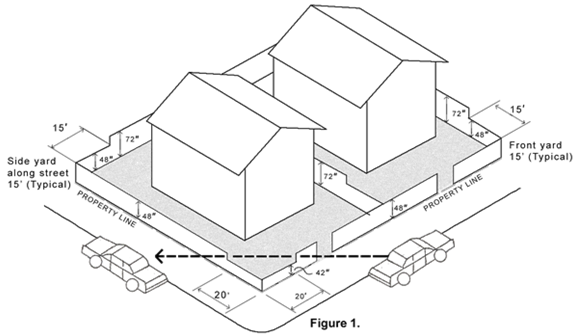
e. Fence Height Exception for Secondary Front Yard Setbacks and Rear Yard Setbacks Abutting a Street: Fences over forty eight inches (48") and up to seventy two inches (72") in height may be installed within secondary front yard setbacks and rear yard setbacks that abut a street, excepting any portion within a front yard setback or clear vision area, if all of the following criteria are met:
i. Fencing materials such as wrought iron, cedar wood, or similar shall be used. Chain link fencing is prohibited.
ii. The fence is set back at least eight feet (8') from the subject property line.
iii. Within the minimum eight feet (8') fence setback, irrigated or drought-tolerant landscaping that complies with the standards of RMC 4-4-070.(I-L.1)(P-Q) shall be installed and continuously maintained so that plantings provide total coverage of the area within three (3) years based on the following standards:
(a) Ground Cover: Eighteen (18) ground cover plants per five (5) linear feet of landscaping strip.
(1) Minimum four-inch (4") pots.
(2) Mulch must be confined to areas underneath plants and is not a substitute for ground cover plants.
(b) Shrubs: Eight (8) low shrubs per five (5) linear feet. Up to fifty percent (50%) of shrubs may be deciduous:
(1) Required Low Shrub: Mature size under three feet (3') tall. Minimum size at planting: one or two (2) gallon pot or balled and burlapped equivalent.
(2) Optional Medium Shrubs: Medium shrubs may be installed in place of required low shrubs. One medium shrub shall count as two (2) low shrubs. Mature size from three feet (3') to six feet (6') tall. Minimum size at planting: two (2) or three (3) gallon pot or balled and burlapped equivalent.
iv. The plants shall be planted in a triangular pattern with approximately even spacing, depending on the plant material.
v. Plants listed as a nuisance or prohibited by King County are prohibited in required landscaped areas.
vi. Planting of a hedge or plantings that will grow to become a hedge are prohibited to be within the required landscaping area between the property line and fence.
vii. The finished face of the fence shall be oriented to the street.
viii. No fence, hedge, or retaining wall shall exceed forty two inches (42") within any clear vision area, as defined by RMC 4-11-030, Definitions C.
ix. As an alternative to these standards, an applicant may apply for a special administrative fence permit per subsection G of this Section.
(Ord. 5518, 12-14-2009; Ord. 5798, 4-25-2016; Ord. 5841, 6-12-2017)
3. Gate Required: Residential fences, retaining walls or hedges along rear lot lines of interior lots abutting alleys shall have an access gate to the alley.
4. Electric and Barbed Wire Fences: Electric and/or barbed wire fences may be permitted by special administrative fence permit in all residential zones in cases where large domestic animals are being kept; provided, that additional fencing or an Administrator approved barrier is erected along the property lines. (Ord. 5578, 11-15-2010; Ord. 5702, 12-9-2013; Ord. 5798, 4-25-2016; Ord. 6047, 12-13-2021)
E. STANDARDS FOR COMMERCIAL AND INDUSTRIAL ZONES:
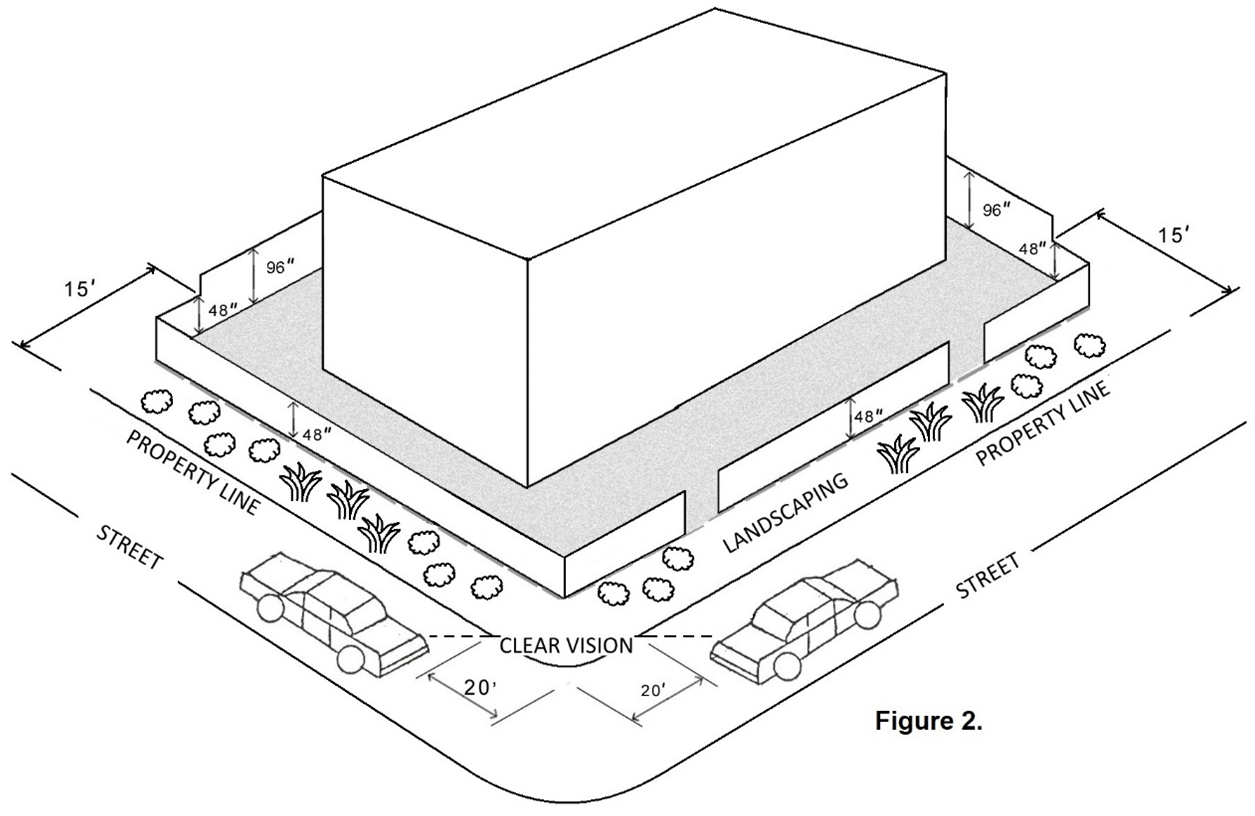
1. Maximum Height: The maximum height of any fence, hedge or retaining wall shall be eight feet (8'), subject to further height limitations as specified in subsection E2 of this Section, provided the fence, hedge, or retaining wall does not pose a traffic vision hazard.
2. Additional Height Limitations in Commercial Zones:
a. Front Yard: Fences, hedges, or retaining walls shall not exceed forty eight inches (48") in height within fifteen feet (15') of the front yard property line. In no case shall a fence, hedge, or retaining wall exceed forty two inches (42") in height in any part of the clear vision area as defined by RMC 4-11-030, Definitions C.
b. Secondary Front Yard: Fences, hedges, or retaining walls shall not exceed forty eight inches (48") in height within fifteen feet (15') of the secondary front yard property line. In no case shall a fence, hedge, or retaining wall exceed forty two inches (42") in height in any part of the clear vision area as defined by RMC 4-11-030, Definitions C.
c. Rear Yard: Fences, hedges, or retaining walls shall not exceed forty eight inches (48") in height within fifteen feet (15') of a rear yard property line that abuts a public street.
(Ord. 6094, 11-28-2022)
3. Material Limitations in Commercial Zones: Chain-link fencing within the Center Downtown (CD) Zone is prohibited. Chain-link fencing within all other commercial zones shall be coated with black, brown, grey, or green bonded vinyl.
4. Landscaping: Fences, hedges, and retaining walls shall not stand in or in front of any required landscaping. If a new or replaced fence is proposed within fifteen feet (15') of a public street on a site that is nonconforming with regard to street frontage landscaping requirements per RMC 4-4-070F1, the site shall be brought into compliance with street frontage landscaping requirements prior to fence installation.
5. Electric Fences: Electric fences are permitted in all industrial zones and may be permitted by special administrative fence permit in all commercial zones. All electric fences shall be posted with permanent signs a minimum of thirty six (36) square inches in area at intervals of fifteen feet (15') stating that the fence is electrified. Electric fences and any related equipment and appliances must be installed in accordance with the manufacturer’s specifications and in compliance with the National Electrical Code.
6. Barbed Wire Fences: Barbed wire fences are permitted in all industrial zones and may be permitted by special administrative fence permit in all commercial zones. Barbed wire may only be used on top of fences at least six feet (6') high.
7. Bulk Storage Fences: See RMC 4-4-110, Storage, Bulk. (Ord. 5153, 9-26-2005; Ord. 6047, 12-13-2021)
F. VARIATION FROM FENCE OR HEDGE STANDARDS:
1. A property owner proposing to vary the standards for a fence or hedge on a lot with special circumstances may submit an application to the Department for a special administrative fence permit or a variance. Requests shall be evaluated as follows:
a. A special administrative fence permit application shall be evaluated for any proposal to increase a permitted fence or hedge height allowance from forty eight inches (48") up to seventy two inches (72") within the setbacks of front yards, secondary front yards, or rear yards abutting a public or private street and/or proposals to modify fence height exception criteria set forth in subsection D2e of this Section. The written application shall include a letter of justification, site plan, and typical elevation, together with the current permit fee. The Department’s staff shall review the application and prepare a written determination based upon criteria listed in subsection G of this Section, Special Administrative Fence Permits.
b. A variance application shall be evaluated for any proposed fence or hedge greater than seventy two inches (72") in height anywhere within a residential zone or within fifteen feet (15') of the property lines of a front yard, secondary front yard, or rear yard abutting a public street in any commercial zone. A variance is also required for any proposed fence or hedge greater than eight feet (8') in height within commercial and industrial zones.
2. Clear Vision Area: The fence proposed for special permits shall have no portion in the clear vision area over forty two inches (42") in height. The location and height of the fence must not obstruct views of oncoming traffic, or views from driveways. (Ord. 5450, 3-2-2009; Ord. 6047, 12-13-2021; Ord. 6094, 11-28-2022)
G. SPECIAL ADMINISTRATIVE FENCE PERMITS:
1. Applicability: Proposals on lots with special circumstances, such as corner lots or lots with multiple street frontages, that seek to modify residential height limitations within setbacks, residential fence height exception for secondary front yard setbacks and rear yard setbacks abutting a street criteria, or additional height limitations in commercial zones may apply for a special administrative fence permit. Special lot circumstances may include lot orientation, multiple street frontages or other circumstances as determined by the Administrator.
2. Evaluation Criteria: The Administrator may approve the issuance of special fence permits; provided, that the following criteria can be met:
a. The proposed fence or hedge is not out of character with the surrounding neighborhood;
b. The proposed fence or hedge does not detract from the quality of the environment by being out of scale or creating vast blank walls along public roadways;
c. The proposed fence or hedge complements the environment it serves in an aesthetically pleasing manner;
d. The proposed fence or hedge does not present a hazard to vehicular or pedestrian traffic; and
e. The proposed fence or hedge is necessary due to special lot circumstances. (Ord. 5450, 3-2-2009; Ord. 5578, 11-15-2010)
3. Acceptable Measures to Meet Criteria: Acceptable measures to achieve these criteria include, but are not limited to, the following:
a. Permanent landscaping along the front of the fence;
b. Quality fence material, such as cedar fencing;
c. Modulation of the fence;
d. Similar design and material as other fences in the surrounding neighborhood;
e. Increased setbacks from the abutting sidewalk;
f. Ornamental materials or construction treatment, such as wrought iron;
g. Orientation of the finished face of the fence toward the street;
h. The fence is at least fifty percent (50%) transparent; and
i. Other comparable construction or design methods. (Amd. Ord. 5008, 4-28-2003; Ord. 5676, 12-3-2012; Ord. 6047, 12-13-2021; Ord. 6094, 11-28-2022)
H. COMPLIANCE:
Fences that do not comply with these regulations must be brought into compliance within six (6) months from the date of notice of a fence violation from the City. (Ord. 4056, 4-13-1987; Ord. 5747, 1-12-2015)