


4-4-080 PARKING, LOADING AND DRIVEWAY REGULATIONS:
A. PURPOSE:
It is the purpose of this Section to provide a means of regulating parking to promote the health, safety, morals, general welfare and aesthetics of the City of Renton by specifying the off-street parking and loading requirements for all uses permitted in this Code and to describe design standards and other required improvements. Furthermore, it is the intent of this Section to promote the efficient use of the City’s transportation facilities by incorporation into that system of alternative modes of transportation to the single occupancy vehicle to promote the movement of people from place to place. It is the goal of this Section to allow the provision of sufficient off-street parking to meet the needs of urban development while not providing an excess surplus of spaces. (Ord. 4517, 5-8-1995)
B. SCOPE OF PARKING, LOADING AND DRIVEWAY STANDARDS:
1. Applicability:
a. Within the Center Downtown Zone: This Section, except for subsections F1 through F9 and J of this Section, shall apply in the following cases:
i. New Buildings or Structures: If construction replaces an existing building, only the area exceeding the area of the original structure shall be used to calculate required parking.
ii. Building/Structure Additions: Only the area exceeding the area of the original structure shall be used to calculate required parking.
b. Outside the Center Downtown Zone: Off-street parking, loading areas, and driveways shall be provided in accordance with the provisions of this Section in the following cases:
i. New buildings or structures.
ii. Building/Structure Additions: The enlargement or remodeling of an existing building/structure by more than one-third (1/3) of the area of the building/structure.
iii. Paving or Striping: The paving of a parking lot with permanent surface, or striping a previously unstriped lot.
iv. Change in Use: Upon a change of use and except when located in a shopping center, if the number of stalls needed for the new use exceeds the actual number of legally existing stalls on site by a percentage equal or greater than shown in the table below, all of the stalls required of the new use shall be provided. However, upon a change of use to any of the following uses, the new use shall provide the total number of parking stalls required without the exception described above:
(a) Residential uses;
(b) Offices, general;
(c) Conference centers; and
(d) Movie theaters.
|
Existing Stalls |
Percentage Threshold |
|---|---|
|
1 – 10 |
140% |
|
11 – 30 |
130% |
|
31 – 60 |
120% |
|
61+ |
110% |
For example, if the calculated number of stalls needed for a retail store equals fifteen (15) and only ten (10) stalls legally exist on site, then all fifteen (15) stalls shall be provided because the percentage difference between the number of stalls needed for the new use and the number of existing stalls on site exceeds one hundred forty percent (140%) [1.40 x 10 = 14].
v. Activities Requiring Deliveries or Shipments: Uses requiring merchandise deliveries and/or shipments shall provide adequate permanent off-street loading space in addition to required parking for the use.
vi. Redevelopment Sites in the R-10 and R-14 Zones: When new dwelling units are created in the Residential Ten Dwelling Units per Acre (R-10) and Residential Fourteen Dwelling Units per Acre (R-14) zones, whether by subdivision or other means, any existing dwelling units included in the development shall comply with the standards of this Section. (Ord. 3988, 4-28-1986; Ord. 4517, 5-8-1995; Ord. 4999, 1-13-2003; Amd. Ord. 5087, 6-28-2004; Ord. 5675, 12-3-2012; Ord. 5869, 12-11-2017)
2. Conformance Required: It shall be unlawful for any person hereafter to erect, construct, enlarge, move or convert any parking lot, parking structure, loading area, or driveway in the City or cause or permit the same to be done contrary to or in violation of any of the provisions of this Section. Driveways shall be constructed to City standards. (Ord. 4517, 5-8-1995, Ord. 4351, 5-4-1992)
3. Plans Required: Where off-street parking is required, except for single family dwellings, a plan shall be submitted for approval by the Building Department. The plan must be accompanied by sufficient proof of ownership that indicates the spaces contemplated will be permanent.
4. Future Changes to Parking Arrangement: Any future changes in parking arrangements or number of spaces must be approved by the Department of Community and Economic Development. (Amd. Ord. 5087, 6-28-2004; Ord. 5729, 10-20-2014)
5. Timing for Compliance:
a. Building Permit Required: No construction, alteration or changes in uses are permitted until all the information in RMC 4-8-120D16p, Parking Analysis, and 4-8-120D19s, Site Plan, has been submitted and approved by the appropriate City departments and building permit has been issued.
b. Requirements Prior to Occupancy Permit: The premises shall not be occupied until the parking lot is paved, marked, landscaped and lighted (if the lot is to be illuminated) and an occupancy permit has been issued, unless a deferment has been granted. For developments in the R-10 and R-14 zones that include existing dwelling units in the site plan, the parking area for any existing units shall be paved, marked, landscaped and lighted (if the lot is to be illuminated), prior to the issuance of an occupancy permit for any of the newly constructed dwelling units. (Ord. 5675, 12-3-2012)
c. Requirements Prior to Business License Issuance: A business license shall not be issued until an occupancy permit has been issued. (Ord. 3988, 4-28-1986; Ord. 4351, 5-4-1992; Ord. 4517, 5-8-1995; Ord. 4999, 1-13-2003; Ord. 5357, 2-25-2008)
C. (Deleted by Ord. 5357, 2-25-2008)
(Ord. 4671, 7-21-1997; Ord. 4722, 5-11-1998; Amd. Ord. 5087, 6-28-2004)
D. ADMINISTRATION:
1. Authority: The Department of Community and Economic Development is hereby authorized and directed to enforce all the provisions of this Section. For such purpose, the Community and Economic Development Administrator shall have the authority of a police officer. (Ord. 4517, 5-8-1995; Ord. 5450, 3-2-2009; Ord. 5676, 12-3-2012)
2. Interpretation:
a. Calculation of Number of Parking Spaces – Fractions: When a unit of measurement determining the number of required parking spaces results in the requirement of a fractional space, any fraction up to but not including one-half (1/2) shall be disregarded and fractions one-half (1/2) and over shall require one parking space. (Ord. 3988, 4-28-1986)
b. Measurement of Distance – Method: Where a distance is specified, such distance shall be the walking distance measured from the nearest point of the parking facility to the nearest point of the building that such facility is required to serve. (Ord. 4517, 5-8-1995)
c. Measurement of Seat Width – Benches and Pews: In stadiums, sports arenas, churches and other places of assembly in which patrons or spectators occupy benches, pews or other similar seating facilities, each eighteen inches (18") of length of such seating facilities shall be counted as one seat for the purpose of determining requirements for off-street parking facilities under this Section. (Ord. 3988, 4-28-1986)
E. LOCATION OF REQUIRED PARKING:
1. On-Site Parking Required: Required parking as specified shall be provided upon property in the same ownership as the property upon which the building or use requiring the specified parking is located or upon leased parking. Off-street parking facilities shall be located as specified below:
a. Detached and Two (2) Attached Dwellings: On the same lot with the building they are required to serve. (Ord. 5520, 12-14-2009)
b. Attached Dwellings Three (3) or More Units: May be on lots contiguous with the lot upon which the building they are required to serve is located if compliance with the provisions of subsection E2 (Off-Site Parking) of this Section is attained. (Ord. 5355, 2-25-2008; Ord. 5369, 4-14-2008)
c. Boat Moorages: May have parking areas located not more than six hundred feet (600') from such moorage facility or closer than one hundred feet (100') to the shoreline (see subsection G of this Section). Accessible parking as required by the Washington State Barrier Free Standards can be allowed within one hundred feet (100') per subsection F8g of this Section.
d. Other Uses: On the same lot as the principal use except when compliance with the conditions in subsection E2 (Off-Site Parking) of this Section is attained. (Amd. Ord. 4790, 9-13-1999; Ord. 5729, 10-20-2014)
2. Off-Site Parking:
a. When Permitted:
i. If sufficient parking is not available on the premises of the use, a private parking area may be provided off site, except for single and two (2) family dwellings in the RC, R-1, R-4,
R-6, and R-8 zones. Accessory dwelling units (ADUs) may utilize an off-site private parking area if parking cannot be accommodated on site. (Ord. 5744, 1-12-2015)
ii. In the R-10 and R-14 zones, shared parking garages are allowed provided the design standards of RMC 4-2-115 are met.
iii. Guest parking associated with single family and attached dwellings in the R-10 and R-14 zones is also permitted to be provided off site provided it meets the following criteria:
(a) Parking is located on the neighborhood streets or in a parking court accessed by a public roadway, but not located more than one hundred sixty feet (160') from the home it is intended to serve.
(b) Parking is not located in a limited residential access lane right-of-way, except for perpendicular parking associated with private driveways or alleyways.
(c) Parking may be accommodated in a tandem driveway space, provided it is not accessed by a private alleyway. (Amd. Ord. 5330, 12-10-2007; Ord. 5518, 12-14-2009; Ord. 5960, 12-9-2019)
b. Agreement Required: A parking agreement ensuring that off-site parking is available for the duration of the use shall be approved by the Community and Economic Development Administrator, following review by the City Attorney. (Ord. 5676, 12-3-2012)
c. Additional Information Required: The following shall be reviewed as part of the permit process:
i. A letter of justification addressing the need for off-site parking and compatibility with the surrounding neighborhood.
ii. A site plan showing all dimensions of parking spaces, aisles, landscaping areas, abutting street improvements, curb cuts, and on-site and abutting uses and buildings. (Ord. 5676, 12-3-2012)
d. Fees: No charge for use of such parking area shall be made in any residential zone except on a weekly or monthly basis.
e. Maximum Distance to Off-Site Parking Area:
i. Within the Center Downtown Zone: No distance requirements apply when both the use and off-site parking are located within the Center Downtown.
ii. Within the UC Zone: Off-site parking shall be within five hundred feet (500') of the building or use if it is intended to serve residential uses, and within fifteen hundred feet (1,500') of the building or use if it is intended to serve nonresidential uses. (Ord. 5729, 10-20-2014)
iii. All Other Zones: Off-site parking shall be within five hundred feet (500') of the building or use if it is intended to serve residential uses (excluding ADUs) and within seven hundred fifty feet (750') of the building or use if it is intended to serve nonresidential uses.
iv. ADU Off-Site Parking: Off-site parking shall be located on an off-site easement on a property within one quarter (1/4) mile of the lot where the ADU is located. (Ord. 5960, 12-9-2019)
f. Transportation Management Plan Exception: The Department of Community and Economic Development may modify the maximum distance requirements if a Transportation Management Plan or other acceptable transportation system will adequately provide for the parking needs of the use and the conditions outlined in RMC 4-9-250D2 are met. (Ord. 3988, 4-28-1986; Ord. 4517, 5-8-1995; Ord. 5030, 11-24-2003; Amd. Ord. 5087, 6-28-2004; Ord. 5450, 3-2-2009; Ord. 5759, 6-22-2015)
3. Joint Use Parking Facilities:
a. When Permitted: Joint use of parking facilities may be authorized for those uses that have dissimilar peak-hour demands or when it can be demonstrated that the parking facilities to be shared are underutilized. (Amd. Ord. 5330, 12-10-2007)
b. Agreement Required: A parking agreement ensuring that joint use parking is available for the duration of the uses shall be approved by the Community and Economic Development Administrator, following review by the City Attorney. Notice of termination of the agreement shall be provided to the Administrator and additional parking must be provided if the agreement is terminated, consistent with subsection F10 of this Section. (Ord. 5676, 12-3-2012; Ord. 5828, 12-12-2016)
c. Maximum Distance to Joint Use Parking:
i. Within the Center Downtown Zone: No distance requirements apply when both the use and joint use parking are located within the Center Downtown.
ii. Within the UC Zone: Joint use parking shall be within seven hundred fifty feet (750') of the building or use if it is intended to serve residential uses, and within fifteen hundred feet (1,500') of the building or use if it is intended to serve nonresidential uses. (Ord. 5729, 10-20-2014)
iii. All Other Zones: Joint use parking shall be within seven hundred fifty feet (750') of the building or use it is intended to serve.
d. Special Provisions for Subdivision of Shopping Center: Parking areas in shopping centers may operate as common parking for all uses. If a shopping center is subdivided, easements and/or restrictive covenants must grant use and provide for maintenance of common parking and access areas. (Ord. 3988, 4-28-1986; Ord. 4517, 5-8-1995; Ord. 5030, 11-24-2003; Amd. Ord. 5087, 6-28-2004; Ord. 5357, 2-25-2008; Ord. 5759, 6-22-2015)
F. PARKING LOT DESIGN STANDARDS:
1. Maneuvering Space/Use of Public Right-of-Way: Maneuvering space shall be completely off the right-of-way of any public street except for parking spaces provided for single family dwellings and duplexes. Alleys shall not be used for off-street parking and loading purposes, but may be used for maneuvering space. Parallel parking stalls shall be designed so that doors of vehicles do not open onto the public right-of-way.
2. Maximum Parking Lot and Parking Structure Slopes: Maximum slopes for parking lots shall not exceed eight percent (8%) slope. The Administrator may allow a driveway to exceed eight percent (8%) slope but not more than fifteen percent (15%) slope, upon proper application in writing and for good cause shown, which shall include, but not be limited to, the absence of any reasonable alternative. (Ord. 5156, 9-26-2005; Ord. 5450, 3-2-2009; Ord. 5676, 12-3-2012)
3. Access Approval Required: The ingress and egress of all parking lots and structures shall be approved by the Department of Community and Economic Development. (Ord. 3988, 4-28-1986; Ord. 5729, 10-20-2014)
4. Linkages: The Department of Community and Economic Development shall have the authority to establish, or cause to be established, bicycle, high occupancy vehicle and pedestrian linkages within public and private developments. Conditions may include but are not limited to:
a. Reserving parking spaces for rideshare or other high occupancy vehicles.
b. Ensuring adequate on-site nonmotorized paths connecting to public non-motorized facilities.
c. Providing transit shelters, bus turnout lanes or other transit improvements.
Enforcement shall be administered through the normal site design review and/or permitting process. (Ord. 4517, 5-8-1995; Ord. 5450, 3-2-2009; Ord. 5729, 10-20-2014; Ord. 5828, 12-12-2016)
5. Lighting: Any lighting on a parking lot shall illuminate only the parking lot and shall be designed and located so as to avoid undue glare or reflection of light pursuant to RMC 4-4-075, Exterior On-site Lighting. Light standards shall not be located so as to interfere with parking stalls, stacking areas and ingress and egress areas. (Amd. Ord. 4963, 5-13-2002)
6. Fire Lane Standards:
a. Applicability: As required by the Fire Codes and the Fire Department, fire lanes shall be installed surrounding facilities which by their size, location, design or contents warrant access which exceeds that normally provided by the proximity of City streets.
Additional fire lanes may be required in order to provide access for firefighting or rescue operations at building entrances or exits, fire hydrants and fire protection system service connection or control devices.
The Fire Department may require that areas specified for use as driveways or private thoroughfares shall be designated as fire lanes and be marked or identified as required by this Section.
b. Minimum Width and Clearance: Lanes shall provide a minimum unobstructed continuous width of twenty feet (20') and provide a minimum vertical clearance of thirteen feet six inches (13'6"). (Ord. 3988, 4-28-1986)
c. Identification:
i. Lanes shall be identified by a four inch (4") wide line and curb painted bright red. The block letters shall state, “FIRE LANE – NO PARKING”, be eighteen inches (18") high, painted white, located not less than one foot (1') from the curb face, at fifty foot (50') intervals. (Ord. 4130, 2-15-1988)
ii. Signs shall be twelve inches by eighteen inches (12" x 18") and shall have letters and background of contrasting colors, readily readable from at least a fifty foot (50') distance. (Ord. 3988, 4-28-1966)
iii. Signs shall be spaced not further than fifty feet (50') apart nor shall they be placed less than five feet (5'), or more than seven feet (7') from the ground. The installation and use of fire lane signs will preclude the requirement for painting “FIRE LANE – NO PARKING”, in the lane only. The area shall be identified by painting the curb red or in the absence of a curb, a four inch (4") red line shall be used. (Ord. 4130, 2-15-1988)
d. Surfacing and Construction Requirements: Fire lanes shall be an all weather surface constructed of asphalt or concrete designed to be capable of supporting a thirty (30) ton fire apparatus vehicle. (Ord. 5729, 10-20-2014; Ord. 5806, 6-20-2016)
e. Clearances and Turning Radii: Where fire lanes connect to City streets or parking lots, adequate clearances and turning radii shall be provided.
f. Existing Buildings – Hazards: When the Fire Chief determines that a hazard due to inaccessibility of fire apparatus exists around existing buildings, he may require fire lanes to be constructed and maintained as provided by this Section. (Ord. 5676, 12-3-2012)
g. Modification by Fire Chief: When the required clearances outlined above cannot be physically provided, modification may be allowed upon written application and approval of the Fire Chief.
7. Residential Parking Location Requirements:
a. RC, R-1, and R-4 Zones: See RMC 4-2-115, Residential Design and Open Space Standards.
b. R-6 and R-8 Zones: For lots abutting an alley, all parking areas and/or attached or detached garages shall not occur in front of the building and/or in the area between the front lot line and the front building line; parking areas and garages must occur at the rear or side of the building, and vehicular access shall be taken from the alley. See RMC 4-2-115, Residential Design and Open Space Standards. (Ord. 5744, 1-12-2015)
c. R-10 and R-14 Zones: For lots abutting an alley, required parking shall be provided in the rear yard area for any unit, when alley access is available.
For flats, when alley access is not available, parking should be located in the rear yard, side yard or underground, unless it is determined through the modification process for site development plan exempt proposals or the site development plan review process for non-exempt proposals, that parking may be allowed in the front yard or that under building parking (ground level of a residential structure) should be permitted. See RMC 4-2-115, Residential Design and Open Space Standards.
d. RMF Zones:
i. For Lots Abutting an Alley: All parking shall be provided in the rear yard area for any unit, and access shall be taken from the alley.
ii. For Lots Not Abutting an Alley: No portion of covered or uncovered parking shall be located between the primary structure and the front property line. Parking structures shall be recessed from the front facade of the primary structure a minimum of two feet (2'). (Amd. Ord. 4999, 1-13-2003; Ord. 5087, 6-28-2004; Ord. 5100, 11-1-2004; Ord. 5529, 3-8-2010; Ord. 5841, 6-12-2017)
8. Parking Stall Types, Sizes, and Percentage Allowed/Required:
a. Standard Parking Stall Size – Surface/Private Garage/Carport:
i. Minimum Length in All Zones Except UC Zone: A parking stall shall be a minimum of twenty feet (20') in length, except for parallel stalls, measured along both sides of the usable portion of the stall. Each parallel stall shall be twenty three feet by nine feet (23' x 9') in size.
ii. Minimum Length in UC Zones: A parking stall shall be a minimum of nineteen feet (19') in length, except for parallel stalls, measured along both sides of the usable portion of the stalls. Each parallel stall shall be twenty three feet by nine feet (23' x 9') in size.
iii. Minimum Width: A parking stall shall be a minimum of nine feet (9') in width measured from a right angle to the stall sides.
iv. Reduced Width and Length for Attendant Parking: When cars are parked by an attendant, the stall shall not be less than eighteen feet long by eight feet wide (18' x 8'). (Ord. 5030, 11-24-2003; Ord. 5759, 6-22-2015)
b. Standard Parking Stall Size – Structured Parking:
i. Minimum Length: A parking stall shall be a minimum of fifteen feet (15'). A stall shall be a minimum of sixteen feet (16') for stalls designed at forty five degrees (45°) or greater. Each parallel stall shall be twenty three feet by nine feet (23' x 9') in size.
ii. Minimum Width: A parking stall shall be a minimum of eight feet, four inches (8'4") in width.
c. Compact Parking Stall Size and Maximum Number of Compact Spaces:
i. Stall Size – Surface/Private Garage/Carport: Each stall shall be eight and one-half feet in width and sixteen feet in length (8-1/2' x 16').
ii. Stall Size – Structured Parking: A parking stall shall be a minimum of seven feet, six inches (7'6") in width. A parking stall shall be a minimum of twelve feet (12') in length, measured along both sides for stalls designed at less than forty five degrees (45°). A stall shall be a minimum of thirteen feet (13') in length, for stalls designed at forty five degrees (45°) or greater.
iii. Maximum Number of Compact Spaces Outside of the UC Zones: Compact parking spaces shall not account for more than:
|
• |
Designated employee parking – not to exceed forty percent (40%). |
|
• |
Structured parking – not to exceed fifty percent (50%). |
|
• |
All other uses – not to exceed thirty percent (30%). (Ord. 5030, 11-24-2003) |
iv. Maximum Number of Compact Spaces in the UC Zones: The maximum number of compact spaces shall not exceed fifty percent (50%). (Ord. 5030, 11-24-2003; Ord. 5759, 6-22-2015)
d. Tandem Parking: Tandem parking is allowed for detached single family residential and townhouse developments. If tandem parking is provided the following standards shall apply:
i. Stall length shall conform to the standards of this subsection F8; and
ii. A restrictive covenant or other device acceptable to the City will be required to assign tandem parking spaces to the exclusive use of specific dwelling units. Enforcement of tandem parking spaces shall be provided by the property owner, property manager, or homeowners’ association as appropriate. (Ord. 5529, 3-8-2010)
e. Special Reduced Length for Overhang: The Department of Community and Economic Development may permit the parking stall length to be reduced by two feet (2'), providing there is sufficient area to safely allow the overhang of a vehicle and that the area of vehicle overhang does not intrude into required landscaping areas. (Ord. 5450, 3-2-2009)
f. Guest Parking: Required guest parking stalls shall be located in a common area accessible by guests. The area shall be set aside exclusively for guest parking. In mixed-used developments, the required guest parking shall be calculated using only the residential portion of the development.
g. Accessible Parking as Stipulated in the Americans with Disabilities Act (ADA): Accessible parking shall be provided per the requirements of the Washington State Barrier Free Standards as adopted by the City of Renton.
|
NUMBER OF ACCESSIBLE |
|
|---|---|
|
Total Parking Spaces in Lot or Garage |
Minimum Required Number of Accessible Spaces |
|
1 – 25 |
1 |
|
26 – 50 |
2 |
|
51 – 75 |
3 |
|
76 – 100 |
4 |
|
101 – 150 |
5 |
|
151 – 200 |
6 |
|
201 – 300 |
7 |
|
301 – 400 |
8 |
|
401 – 500 |
9 |
|
501 – 1,000 |
2% of total spaces |
|
Over 1,000 |
20 spaces plus 1 space for every 100 spaces, or fraction thereof, over 1,000 |
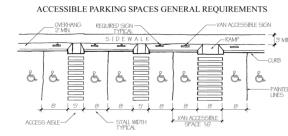
h. Assigned Parking: Developments with attached dwellings units in the R-10, R-14, and RMF zones shall provide a minimum of one assigned parking space to each dwelling unit. A restrictive covenant or other device acceptable to the City will be required to assign parking spaces to the exclusive use of specific dwelling units. Enforcement of assigned parking spaces shall be provided by the property owner, property manager, or homeowners’ association as appropriate. (Ord. 3988, 4-28-1986; Amd. Ord. 4854, 8-14-2000; Ord. 4963, 5-13-2002; Ord. 5909, 12-10-2018)
9. Aisle Width Standards:
a. Parallel Parking Minimum Aisle Width:
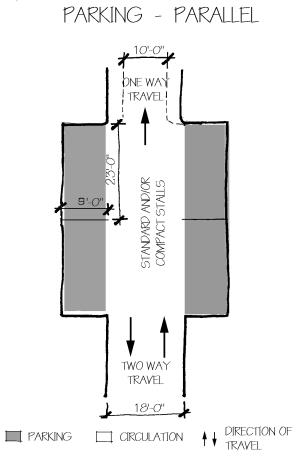
i. One Way Circulation: For one way circulation, the minimum width of the aisle shall be ten feet (10').
ii. Two Way Circulation: For two way circulation, the minimum width of the aisle shall be eighteen feet (18'). (Ord. 3988, 4-28-1986)
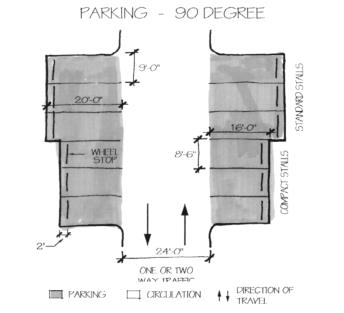
b. Ninety Degree (90°) Parking Aisle Width Minimums: For one row and two (2) rows of ninety degree (90°) parking using the same aisle in a one way or two (2) way circulation pattern, the minimum width of the aisle shall be twenty four feet (24'). (Ord. 5729, 10-20-2014)
c. Sixty Degree (60°) Parking Aisle Width Minimums:
i. For one row and two (2) rows of sixty degree (60°) parking using a one way circulation pattern, the minimum width of the aisle shall be seventeen feet (17').
ii. For two (2) rows of sixty degree (60°) parking using a two (2) way circulation pattern, the minimum width of the aisle shall be twenty feet (20'). (Ord. 3988, 4-28-1986; Ord. 5729, 10-20-2014)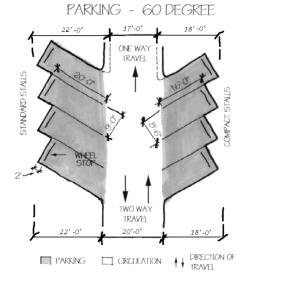
d. Forty Five Degree (45°) Parking Aisle Width Minimums:
i. One Way Circulation: For one and two (2) rows of forty five degree (45°) parking using a one way circulation pattern, the minimum width of the aisle shall be twelve feet (12').
ii. Two (2) Way Circulation: For two (2) rows of forty five degree (45°) parking using a two (2) way circulation pattern, the width of the aisle shall be twenty feet (20'). (Ord. 3988, 4-28-1986; Ord. 5729, 10-20-2014)
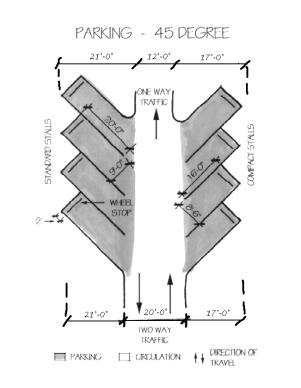
10. Number of Parking Spaces Required. The specified land use shall provide parking spaces as shown in the table in subsection F10e of this Section, except as provided in this Section:
a. Interpretation of Standards – Minimum and Maximum Number of Spaces.
i. When a maximum and a minimum range of required parking is listed in this Code, the developer or occupant is required to provide at least the number of spaces listed as the minimum requirement, and may not provide more than the maximum listed in this Code, unless exceptions are permitted as specified in this Section. (Ord. 5529, 3-8-2010)
ii. When a development falls under more than one category, the parking standards for the most specific category shall apply, unless specifically stated otherwise.
b. Alternatives:
i. Joint Parking Agreements: Approved joint use parking agreements and the establishment of a Transportation Management Plan (TMP) may be used as described in subsection E3 of this Section to meet a portion of these parking requirements. (Amd. Ord. 4790, 9-13-1999)
ii. Transportation Management Plans: A Transportation Management Plan (TMP) guaranteeing the required reduction in vehicle trips may be substituted in part or in whole for the parking spaces required, subject to the approval of the Department.
The developer may seek the assistance of the Department in formulating a TMP. The plan must be agreed upon by both the City and the developer through a binding contract with the City of Renton. At a minimum, the TMP will designate the number of trips to be reduced on a daily basis, the means by which the plan is to be accomplished, an evaluation procedure, and a contingency plan if the trip reduction goal cannot be met. If the TMP is unsuccessful, the developer or current property owner is obligated to immediately provide additional measures at the direction of the Department, which may include the requirement to provide full parking as required by City standards. (Ord. 5450, 3-2-2009)
c. Modifications: Modification of either the minimum or maximum number of parking stalls for a specific development requires written approval from the Department. (Ord. 5450, 3-2-2009)
i. A twenty five percent (25%) reduction or increase from the minimum or maximum number of parking spaces may be granted for nonresidential uses through site plan review if the applicant can justify the modification to the satisfaction of the Administrator. Justification might include, but is not limited to, quantitative information such as sales receipts, documentation of customer frequency, and parking standards of nearby cities.
ii. In order for the reduction or increase to occur the Administrator must find that satisfactory evidence has been provided by the applicant. Modifications beyond twenty five percent (25%) may be granted per the criteria and process of RMC 4-9-250D2.
d. Income Restricted and CD Zone Conversions: A conversion to a land use resulting in a greater parking requirement shall be required to provide the amount of parking required of the new use. This shall be applied to the following conversions:
i. When attached housing converts from affordable income restricted dwelling units to non-income restricted dwelling units; or
ii. When a commercial use in the Center Downtown (CD) Zone converts to residential, office, or convalescent center. Additionally, conversion to any of the following commercial uses: drive-through retail, drive-through services, hotels, mortuaries, indoor sports arenas, auditoriums, movie theaters, entertainment clubs, bowling alleys, dance halls, dance clubs, other recreational uses, or retail marijuana in the CD Zone. (Ord. 6099, 12-5-2022)
e. Parking Spaces Required Based on Land Use:
|
USE |
NUMBER OF REQUIRED SPACES |
|---|---|
|
GENERAL: |
|
|
Uses not specifically identified in this Section: |
Department staff shall determine which of the below uses is most similar based upon staff experience with various uses and information provided by the applicant. The amount of required parking for uses not listed above shall be the same as for the most similar use listed below. |
|
Bicycle parking: |
See minimum requirements in subsection F11 of this Section. |
|
Parking in Excess of Maximum Standards: |
Maximum ratios for off-street parking facilities may be exceeded by up to 10% if the applicant implements low impact development techniques that reduce stormwater runoff and manages stormwater on site in a way that exceeds the requirements of surface water management in RMC 4-6-030. |
|
COMMERCIAL MIXED USES OUTSIDE OF CENTER DOWNTOWN ZONE: |
|
|
Commercial mixed use with 2 or 3 individual establishments (except vertical mixed use developments): |
The total requirement for off-street parking facilities shall be the sum of the requirements for each use computed separately. |
|
Shopping centers (4 or more individual commercial establishments): |
A minimum of 2.5 per 1,000 square feet of net floor area and a maximum of 5.0 per 1,000 square feet of net floor area. In the UC-1 and UC-2 Zones, a maximum of 4.0 per 1,000 square feet of net floor area is permitted unless structured parking is provided, in which case 5.0 per 1,000 square feet of net floor area is permitted. Drive-through retail or drive-through service uses must comply with the stacking space provisions listed below. |
|
Commercial within vertical mixed-use developments: |
A minimum of 2.5 per 1,000 square feet of net floor area and a maximum of 5.0 per 1,000 square feet of net floor area. In the UC-1 and UC-2 Zones, a maximum of 4.0 per 1,000 square feet of net floor area is permitted unless structured parking is provided, in which case 5.0 per 1,000 square feet of net floor area is permitted. |
|
RESIDENTIAL USES OUTSIDE OF CENTER DOWNTOWN ZONE: |
|
|
Detached dwellings and townhouses: |
A minimum of 2.0 per dwelling unit, however, 1.0 per dwelling unit may be permitted for 1 bedroom or less dwelling units. Tandem parking is allowed. In addition, if the primary structure on a site where an accessory dwelling unit (ADU) is proposed does not meet the City’s minimum parking standards, 1.0 additional off-street parking space is required to obtain approval. |
|
Cottage house developments: |
A minimum and maximum of 1.6 per cottage house of 3 bedrooms or greater; 1.4 per 2-bedroom cottage house; 1.0 per 1-bedroom cottage house or studio. In addition to the minimum parking stalls required, a minimum 20% of the total number of required parking spaces in the cottage house development shall be provided for guest parking and located in a common area accessible by guests. |
|
Manufactured homes within a manufactured home park: |
A minimum of 2.0 per manufactured home site, plus a screened parking area shall be provided for boats, campers, travel trailers and related devices at a ratio of 1.0 screened space per 10 units. |
|
Congregate residences: |
A minimum and maximum of 1.0 per sleeping room and 1.0 for the proprietor, plus 1.0 additional space for each 4 persons employed on the premises. |
|
Assisted living: |
A minimum and maximum of 1.0 space per residential unit of assisted living, plus dedicated parking spaces for facility fleet vehicles. |
|
Attached dwellings in RMF, R-14 and R-10 Zones: |
A minimum and maximum of 1.6 per 3 bedroom or large dwelling unit; 1.4 per 2 bedroom dwelling unit; 1.0 per 1 bedroom or studio dwelling unit. In addition to the minimum parking stalls required, a minimum 10% of the total number of required parking spaces shall be provided for guest parking and located in a common area accessible by guests. |
|
Attached dwellings within all other zones: |
1.0 per dwelling unit is required. A maximum of 1.75 per dwelling unit is allowed. |
|
Attached dwelling, income restricted: |
A minimum of 1.0 for each 4 dwelling units is required. A maximum of 1.75 per dwelling unit is allowed. |
|
Live-work unit, residential unit: |
A minimum and maximum of 1.0 per unit. |
|
Accessory dwelling unit: |
When accessory to a single-family residence, 1.0 per unit is required. A maximum of 2.0 per unit is allowed. ADUs accessory to nonresidential uses are exempt from additional parking when current parking capacity exceeds the minimum parking requirement for the primary use, otherwise 1.0 per unit is required. ADUs located within 1/4 mile of a mass transit facility, as defined in RMC 4-2-080, shall be exempt from off-street parking requirements. |
|
RESIDENTIAL USES IN CENTER DOWNTOWN ZONE: |
|
|
Attached dwellings: |
A minimum and maximum of 1.0 per unit. |
|
Attached dwellings, income restricted: |
1.0 for every 4 dwelling units is required. A maximum of 1.75 per dwelling unit is allowed. |
|
Congregate residences: |
A minimum and maximum of 1.0 per 4 sleeping rooms and 1.0 for the proprietor, plus 1.0 additional space for each 4 persons employed on the premises. |
|
Assisted living: |
A minimum and maximum of 1.0 space per residential unit of assisted living, plus dedicated parking spaces for facility fleet vehicles. |
|
Detached dwellings (existing legal): |
A minimum of 2.0 per unit. |
|
COMMERCIAL ACTIVITIES OUTSIDE OF THE CENTER DOWNTOWN ZONE: |
|
|
Drive-through retail or drive-through service: |
Stacking spaces: The drive-through facility shall be so located that sufficient on-site vehicle stacking space is provided for the handling of motor vehicles using such facility during peak business hours. Typically 5.0 stacking spaces per window are required unless otherwise determined by the Administrator. Stacking spaces cannot obstruct required parking spaces or ingress/egress within the site or extend into the public right-of-way. |
|
Banks: |
A minimum of 2.5 per 1,000 square feet of net floor area and a maximum of 5.0 per 1,000 square feet of net floor area. |
|
Convalescent centers: |
A minimum and maximum of 1.0 for every 2 employees plus 1.0 for every 3 beds. |
|
Day care centers, adult day care (I and II): |
A minimum and maximum of 1.0 for each employee and 2.0 drop-off/pick-up spaces within 100 feet of the main entrance for every 25 clients of the program. |
|
Hotels and motels: |
A minimum and maximum of 1.0 per guest room plus 1.0 for every 3 employees. |
|
Bed and breakfast houses: |
A minimum and maximum of 1.0 per guest room. |
|
Mortuaries or funeral homes: |
A minimum and maximum of 10 per 1,000 square feet of floor area of assembly rooms. |
|
Vehicle sales (large and small vehicles) with outdoor retail sales areas: |
A minimum and maximum of 1.0 per 5,000 square feet. The sales area is not a parking lot and does not have to comply with dimensional requirements, landscaping or the bulk storage section requirements for setbacks and screening. Any arrangement of motor vehicles is allowed as long as: • A minimum 5-foot perimeter landscaping area is provided; • They are not displayed in required landscape areas; and • Adequate fire access is provided per Fire Department approval. |
|
Vehicle service and repair (large and small vehicles): |
A minimum and maximum of 2.5 per 1,000 square feet of net floor area. |
|
Offices, medical and dental: |
A minimum and maximum of 5.0 per 1,000 square feet of net floor area. |
|
Offices, general: |
A minimum of 2.0 per 1,000 square feet of net floor area and a maximum of 4.5 parking spaces per 1,000 square feet of net floor area. |
|
Eating and drinking establishments and taverns: |
A minimum and maximum of 10 per 1,000 square feet of dining area. |
|
Eating and drinking establishment combination sit-down/drive-through restaurant: |
A minimum and maximum of 1.0 per 75 square feet of dining area. |
|
Retail sales and wholesale retail sales: |
A minimum and maximum of 2.5 per 1,000 square feet of net floor area, except wholesale retail sales, which is allowed a maximum of 5.0 per 1,000 square feet of net floor area if shared and/or structured parking is provided. |
|
Retail marijuana: |
A minimum of 4.0 and a maximum of 5.0 per 1,000 square feet of net floor area. |
|
Services, on-site (except as specified below): |
A minimum and maximum of 3.0 per 1,000 square feet of net floor area. |
|
Clothing or shoe repair shops, furniture, appliance, hardware stores, household equipment: |
A minimum and maximum of 2.0 per 1,000 square feet of net floor area. |
|
Uncovered commercial area, outdoor nurseries: |
A minimum and maximum of 0.5 per 1,000 square feet of retail sales area in addition to any parking requirements for buildings. |
|
Recreational and entertainment uses: |
|
|
Outdoor and indoor sports arenas, auditoriums, stadiums, movie theaters, and entertainment clubs: |
A minimum and maximum of 1.0 for every 4 fixed seats or 10 per 1,000 square feet of floor area of main auditorium or of principal place of assembly not containing fixed seats, whichever is greater. |
|
Bowling alleys: |
A minimum and maximum of 2.0 per alley. |
|
Dance halls, dance clubs, and skating rinks: |
A minimum and maximum of 1.0 per 40 square feet of net floor area. |
|
Golf driving ranges: |
A minimum and maximum of 1.0 per driving station. |
|
Marinas: |
A minimum and maximum of 2.0 per 3 slips. For private marina associated with a residential complex, then 1.0 per 3 slips. Also 1 loading area per 25 slips. |
|
Miniature golf courses: |
A minimum and maximum of 1.0 per hole. |
|
Other recreational: |
A minimum and maximum of 1.0 per occupant based upon 50% of the maximum occupant load as established by the adopted Building and Fire Codes of the City of Renton. |
|
Travel trailers: |
A minimum and maximum of 1.0 per trailer site. |
|
COMMERCIAL ACTIVITIES WITHIN THE CENTER DOWNTOWN ZONE: |
|
|
Convalescent center, drive-through retail, drive-through service, hotels, mortuaries, indoor sports arenas, auditoriums, movie theaters, entertainment clubs, bowling alleys, dance halls, dance clubs, and other recreational uses: |
These uses follow the standards applied outside the Center Downtown Zone. |
|
Retail marijuana: |
A minimum of 4.0 and a maximum of 5.0 per 1,000 square feet of net floor area. |
|
All commercial uses allowed in the CD Zone except for the uses listed above: |
A maximum of 1.0 space per 1,000 square feet of net floor area, with no minimum requirement. |
|
INDUSTRIAL/STORAGE ACTIVITIES: |
|
|
Airplane hangars, tie-down areas: |
Parking is not required. Hangar space or tie-down areas are to be utilized for necessary parking. Minimum and maximum parking for offices associated with hangars is 5.0 per 1,000 square feet. |
|
Manufacturing and fabrication, laboratories, and assembly and/or packaging operations: |
A minimum of 1.0 per 1,000 square feet of net floor area and a maximum of 1.5 spaces per 1,000 square feet of net floor area (including warehouse space). |
|
Self service storage: |
A minimum and maximum of 1.0 per 3,500 square feet of net floor area. Maximum of 3.0 moving van/truck spaces is permitted. |
|
Outdoor storage area: |
A minimum and maximum of 0.5 per 1,000 square feet of area. |
|
Warehouses and indoor storage buildings: |
A minimum and maximum of 1.0 per 1,500 square feet of net floor area. |
|
PUBLIC/QUASI-PUBLIC ACTIVITIES: |
|
|
Religious institutions: |
A minimum and maximum of 1.0 for every 5 seats in the main auditorium; however, in no case shall there be less than 10.0 spaces. For all existing institutions enlarging the seating capacity of their auditoriums, 1.0 additional parking space shall be provided for every 5 additional seats provided by the new construction. For all institutions making structural alterations or additions that do not increase the seating capacity of the auditorium, see “outdoor and indoor sports arenas, auditoriums, stadiums, movie theaters, and entertainment clubs.” |
|
Medical institutions: |
A minimum and maximum of 1.0 for every 3 beds, plus 1.0 per staff doctor, plus 1.0 for every 3 employees. |
|
Cultural facilities: |
A minimum and maximum of 40 per 1,000 square feet. |
|
Public post office: |
A minimum and maximum of 3.0 for every 1,000 square feet. |
|
Secure community transition facilities: |
A minimum and maximum of 1.0 per 3 beds, plus 1.0 per staff member. |
|
Schools: |
|
|
Elementary and junior high: |
A minimum and maximum of 1.0 per employee. In addition, if buses for the transportation of students are kept at the school, 1.0 off-street parking space shall be provided for each bus of a size sufficient to park each bus. |
|
Senior high schools: public, parochial and private: |
A minimum and maximum of 1.0 per employee plus 1.0 space for every 10 students enrolled. In addition, if buses for the private transportation of children are kept at the school, 1.0 off-street parking space shall be provided for each bus of a size sufficient to park each bus. |
|
Colleges and universities, arts and crafts schools/studios, and trade or vocational schools: |
A minimum and maximum of 1.0 per employee plus 1.0 for every 3 student rooming units, plus 0.5 space for every full-time student not residing on campus. In addition, if buses for transportation of students are kept at the school, 1.0 off-street parking space shall be provided for each bus of a size sufficient to park each bus. |
(Ord. 4517, 5-8-1995; Amd. Ord. 4790, 9-13-1999; Ord. 4963, 5-13-2002; Ord. 4971, 6-10-2002; Ord. 4982, 9-23-2002; Ord. 5018, 9-22-2003; Ord. 5030, 11-24-2003; Ord. 5087, 6-28-2004; Ord. 5100, 11-1-2004; Ord. 5286, 5-14-2007; Ord. 5355, 2-25-2008; Ord. 5357, 2-25-2008; Ord. 5369, 4-14-2008; Ord. 5387, 6-9-2008; Ord. 5437, 12-8-2008; Ord. 5450, 3-2-2009; Ord. 5469, 7-13-2009; Ord. 5518, 12-14-2009; Ord. 5520, 12-14-2009; Ord. 5529, 3-8-2010; Ord. 5607, 6-6-2011; Ord. 5649, 12-12-2011; Ord. 5676, 12-3-2012; Ord. 5729, 10-20-2014; Ord. 5816, 10-3-2016; Ord. 5828, 12-12-2016; Ord. 5841, 6-12-2017; Ord. 5909, 12-10-2018; Ord. 5960, 12-9-2019; Ord. 6042, 12-13-2021; Ord. 6046, 12-13-2021; Ord. 6092, 11-28-2022; Ord. 6099, 12-5-2022)
11. Number of Bicycle Parking Spaces Required:
a. Bicycle Parking Spaces Required: Bicycle parking shall be provided for all residential developments that exceed five (5) residential units and/or all non-residential developments that exceed four thousand (4,000) gross square feet in size. When there are two (2) or more separate uses on a site, the required bicycle parking for the site shall be the sum of the required parking for the individual uses. Modification of these minimum standards requires written approval from the Department of Community and Economic Development.
|
USE |
NUMBER OF REQUIRED SPACES |
|---|---|
|
All uses, unless specifically specified below: |
The number of bicycle parking spaces shall be equal to ten percent (10%) of the number of required off-street vehicle parking spaces; for uses in the CD zone that do not require off-street vehicle parking, the number of bicycle parking spaces shall be equivalent to ten percent (10%) of off-street vehicle parking spaces required for the same use located outside of the CD zone. Spaces shall meet the requirements of subsection F11b of this Section, Bicycle Parking Standards. |
|
Office, general, medical and dental, manufacturing and fabrication, laboratories, and packaging operations: |
The number of bicycle parking spaces shall be equal to ten percent (10%) of the number of required off-street vehicle parking spaces; for uses in the CD zone that do not require off-street vehicle parking, the number of bicycle parking spaces shall be equivalent to ten percent (10%) of off-street vehicle parking spaces required for the same use located outside of the CD zone. Spaces shall meet the requirements of subsection F11c of this Section, Bicycle Parking Standards. |
|
Attached dwellings: |
One-half (0.5) bicycle parking space per one dwelling unit. Spaces shall meet the requirements of subsection F11c of this Section, Bicycle Parking Standards. |
(Ord. 5798, 4-25-2016)
b. Bicycle Parking Standards: The location of and access to bicycle parking areas for all uses except office, manufacturing and fabrication, laboratories, packaging operations, and attached dwellings, shall be in accordance with the following standards: (Ord. 5729, 10-20-2014)
i. Bicycle parking facilities shall include a rack that is permanently affixed to the ground and supports the bicycle at two (2) or more points, including at least one point on the frame. The user shall be able to lock the bicycle with a U-shaped lock or cable lock. Bicycle racks that only support a bicycle front or rear wheel are not permitted. Bicycle racks shall be installed to provide adequate maneuvering space and ensure that the requisite number of bicycle parking spaces remain accessible; and
ii. Each bicycle parking space shall be at least two feet (2') by six feet (6'), with no less than an overhead clearance of seven feet (7'). A maneuvering area of five feet (5') shall separate rows of bicycle parking spaces. Where the bicycle parking is abutting the sidewalk, only the maneuvering area may extend into the right-of-way; and (Ord. 5676, 12-3-2012)
iii. Areas set aside for bicycle parking shall be clearly marked and reserved for bicycle parking only; and
iv. Bicycle parking shall not impede or create a hazard to pedestrians or vehicles. Parking areas shall be located so as to not conflict with vehicle vision clearance standards; and
v. Bicycle parking shall be conveniently located with respect to the street right-of-way and must be within fifty feet (50') of at least one main building entrance, as measured along the most direct pedestrian access route; and
vi. Whenever possible, bicycle parking shall be incorporated into the building design and coordinate with the design of the street furniture when it is provided; and
vii. Bicycle parking shall be visible to cyclists from street sidewalks or building entrances, so that it provides sufficient security from theft and damage; and
viii. Bicycle parking shall be at least as well lit as vehicle parking for security.
c. Bicycle Parking Standards: The location of and access to bicycle parking areas for office, manufacturing and fabrication, laboratories, packaging operations, and attached dwellings shall be in accordance with the following standards: (Ord. 5729, 10-20-2014)
i. Bicycle parking standards i through iv in subsection F11b of this Section shall apply to this subsection; and
ii. Bicycle parking shall be provided for secure extended use and shall protect the entire bicycle and its components and accessories from theft and weather. Acceptable examples include bike lockers, bike check-in systems, in-building parking, and limited access fenced areas with weather protection.
iii. For in-building bike parking and limited access fenced areas, fixed structures for locking individual bikes, such as racks, must be provided within the facility. For fenced areas, the fence shall be either six feet (6') high, or be floor-to-ceiling.
iv. For attached dwellings, spaces within the dwelling units or on balconies do not count toward the bicycle parking requirement. However, designated bicycle parking spaces within individual garages can count toward the minimum requirement.
d. Modification: The Department of Community and Economic Development may authorize a modification from either of the minimum bicycle parking requirements for a specific development should conditions warrant as described in RMC 4-9-250D2. When seeking a modification from the minimum bicycle parking requirements, the developer or building occupant shall provide the Department of Community and Economic Development with written justification for the proposed modification. (Ord. 5529, 3-8-2010)
G. PARKING LOT CONSTRUCTION REQUIREMENTS:
1. Surfacing Requirements for Parking Areas: All off-street parking areas shall be paved with asphaltic concrete, cement or equivalent alternative material of a permanent nature as approved by the Public Works Department. Surfacing treatments that provide increased infiltration opportunities, such as permeable pavements, shall be used where feasible and to the extent required by the Surface Water Design Manual. (Ord. 5828, 12-12-2016)
2. Surfacing Requirements for Storage Lots: Storage lots may be surfaced with crushed rock or similar material approved by the Public Works Department.
3. Marking Requirements: All parking areas other than those for single family residential and duplex dwellings shall have stalls marked and access lanes clearly defined, including directional arrows to guide internal circulation.
a. All entrances and exits shall be designated as such by markings on the parking lot pavement in addition to any signs which may be used as entrance and exit guides.
b. All markings are to be of commercial traffic paint or equal material and are to be maintained in a legible condition.
c. All accessible (Americans with Disabilities Act, ADA), compact and guest parking spaces shall be marked.
4. Wheel Stops Required: Wheel stops shall be required on the periphery of the parking lot so the cars shall not protrude into the public right-of-way of the parking lot, or strike buildings. Wheel stops shall be two feet (2') from the end of the stall for head-in parking.
5. Drainage: Drainage shall meet City requirements, including the location of the drains and the disposal of water and shall be in compliance with the Surface Water Design Manual. (Ord. 5828, 12-12-2016)
H. LANDSCAPE MAINTENANCE REQUIREMENTS:
1. Maintenance Required: Landscaping shall be kept neat, orderly and of attractive appearance at all times. Such landscaping shall be maintained by the owner and/or occupant.
2. Periodic Inspection: Landscaped areas will be subject to periodic inspection by the Development Services Division to ensure maintenance. Said Division shall advise enforcing authority of noncompliance with Section requirements.
3. Maintenance Bonds and Charges Authorized: In the event that such landscaping is not maintained in a reasonable, neat, and clean manner, the City shall have the right to demand a proper performance or similar bond from the owner or occupant of the premises to assure proper and continuous maintenance, or alternately, the City reserves the right to cause such maintenance to be done and to charge the full cost thereof unto the owner. (Ord. 3988, 4-28-1986)
I. DRIVEWAY DESIGN STANDARDS:
1. Driveway Location – Hazard Prohibited: No driveway shall be constructed in such a manner as to be a hazard to any existing street lighting standard, utility pole, traffic regulating device, fire hydrant, abutting street traffic, or similar devices or conditions. The cost of relocating any such street structure when necessary to do so shall be borne by the abutting property owner. Said relocation of any street structure shall be performed only through the Department and person holding authority for the particular structure involved. (Ord. 4517, 5-8-1995; Ord. 5676, 12-3-2012)
2. Driveway Spacing Based Upon Land Use:
a. Industrial, Warehouse and Shopping Center Uses: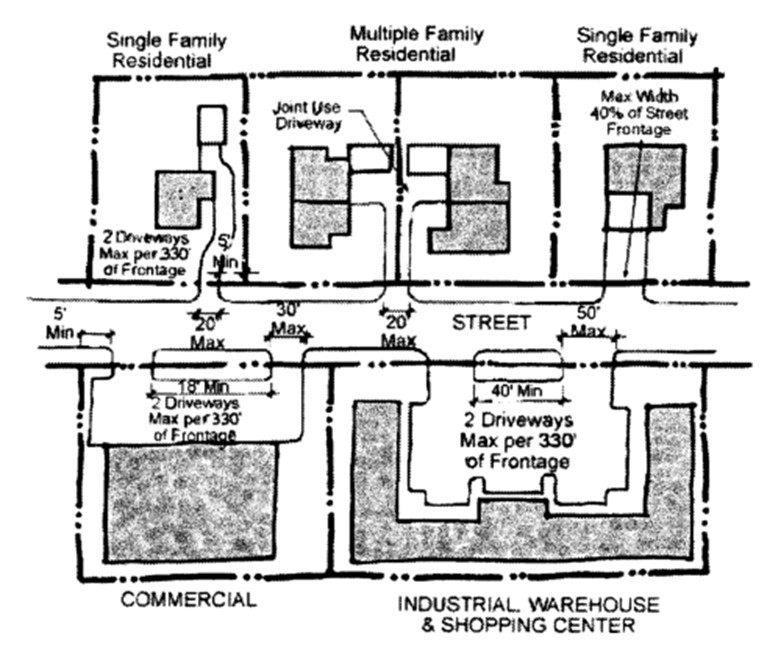
i. The location of ingress and egress driveways shall be subject to approval of the City under curb cut permit procedures.
ii. There shall be a minimum of forty feet (40') between driveway curb returns where there is more than one driveway on property under unified ownership or control and used as one premises.
iii. Driveways shall not be closer than five feet (5') to any property line (except as allowed under subsection I9 of this Section, Joint Use Driveways).
b. All Other Uses:
i. The location of ingress and egress driveways shall be subject to approval of the Department under curb cut permit procedures.
ii. Driveway width (aggregate width if more than one driveway exists) shall not exceed forty percent (40%) of the street frontage. (Ord. 3988, 4-28-1986)
iii. Driveways shall not be closer than five feet (5') to any property line (except as allowed under subsection I9 of this Section, Joint Use Driveways). (Ord. 4517, 5-8-1995)
iv. There shall be a minimum of eighteen feet (18') between driveway curb returns where there is more than one driveway on property under single ownership or control and used as one premises. (Ord. 5729, 10-20-2014)
3. Driveway Width Maximums Based Upon Land Use:
a. Industrial, Warehouse and Shopping Center Uses:
i. Driveway width (aggregate width if more than one driveway exists) shall not exceed forty percent (40%) of the street frontage.
ii. The width of any driveway shall not exceed fifty feet (50') exclusive of the radii of the returns or taper section, the measurement being made parallel to the centerline of the street roadway.
iii. The Administrator may grant an exception upon proper application in writing and for good cause shown, which shall include, but not be limited to, the absence of any reasonable alternative. (Ord. 5156, 9-26-2005; Ord. 5450, 3-2-2009; Ord. 5676, 12-3-2012)
b. Single Family and Duplex Uses: The maximum width of single loaded garage driveways shall not exceed nine feet (9') and double loaded garage driveways shall not exceed sixteen feet (16'). If a garage is not present on the subject property the maximum width of a driveway shall be sixteen feet (16'). (Ord. 5517, 12-14-2009)
c. All Other Uses: The width of any driveway shall not exceed thirty feet (30') exclusive of the radii of the returns or the taper section, the measurement being made parallel to the centerline of the street roadway. (Ord. 5729, 10-20-2014)
4. Maximum Number of Driveways Based Upon Land Use:
a. Industrial, Warehouse and Shopping Center Uses: There shall be no more than two (2) driveways for each three hundred thirty feet (330') of street frontage serving any one property or among abutting properties under unified ownership or control. For each additional one hundred sixty five feet (165') of street frontage an additional driveway may be allowed.
b. All Other Uses: There shall be no more than one driveway for each one hundred sixty five feet (165') of street frontage serving any one property or among properties under unified ownership or control; for each one hundred sixty five feet (165') of additional street frontage another driveway may be permitted subject to the other requirements of this Section. (Ord. 3988, 4-28-1986; Ord. 5729, 10-20-2014)
5. Driveway Angle – Minimum: The angle between any driveway and the street roadway or curb line shall not be less than forty five degrees (45°).
6. Driveway Grades – Maximum Based Upon Land Use:
a. Single Family and Two (2) Family Uses: Maximum driveway slopes shall not exceed fifteen percent (15%); provided, that driveways exceeding eight percent (8%) shall provide slotted drains at the lower end with positive drainage discharge to restrict runoff from entering the garage/residence entering public or private streets, alleys, sidewalks, and/or pedestrian pathways. To exceed fifteen percent (15%), a variance from the Administrator is required.
b. All Other Uses: Maximum driveway slope shall not exceed eight percent (8%). The Administrator may allow a driveway to exceed eight percent (8%) slope but not more than fifteen percent (15%) slope, upon proper application in writing and for good cause shown, which shall include, but not be limited to, the absence of any reasonable alternative. To exceed fifteen percent (15%), a variance from the Administrator is required. (Ord. 5157, 9-26-2005; Ord. 5450, 3-2-2009; Ord. 5676, 12-3-2012)
7. Surfacing Requirements for Driveways and Driveway Encroachments: Driveways and driveway approaches in the public right-of-way shall be paved with asphaltic concrete, cement, or equivalent alternative materials of a permanent nature as approved by the Public Works Department. Surfacing treatments that provide increased infiltration opportunities, such as permeable pavements, shall be used where feasible and consistent with the Surface Water Design Manual.
8. Two (2) Track Driveway Design: For single-family lots, driveways may provide a pervious strip in the center in order to reduce the impervious surface of driveways. A two (2) track driveway does not allow for an increase in allowed driveway width.
9. Joint Use Driveways:
a. Benefits: Joint use driveways reduce the number of curb cuts along individual streets and thereby improve safety and reduce congestion while providing for additional on-street parking opportunities. Joint use driveways should be encouraged when feasible and appropriate, particularly when there is existing underutilized parking proximate to a subject site. (Ord. 4517, 5-8-1995)
b. Where Permitted: Adjoining lots may utilize a joint use driveway accessed from a public street where such joint use driveway reduces the total number of driveways entering the street network, subject to the approval of the Department of Community and Economic Development. Joint use driveways must be created upon the common property line of the properties served or through the granting of a permanent access easement when said driveway does not exist upon a common property line. If the adjoining lots are residential, the joint use driveway shall provide access to no more than two (2) lots and each lot shall abut a public street. Joint use access to the driveway shall be assured by easement or other legal form acceptable to the City. (Ord. 3988, 4-28-1986; Ord. 4517, 5-8-1995; Ord. 5450, 3-2-2009; Ord. 5727, 10-20-2014; Ord. 5867, 12-11-2017)
10. Driveways Providing Access or Connection To and From the State Highway System: Any driveway providing access or connection to or from the state highway system shall be designed and installed pursuant to RMC 4-6-060F10. (Ord. 5413, 10-13-2008; Ord. 5828, 12-12-2016; Ord. 6090, 11-28-2022)
J. LOADING SPACE STANDARDS:
1. Loading Space Required: For all buildings hereafter erected, reconstructed or enlarged, adequate permanent off-street loading space shall be provided if the activity carried on in such building requires deliveries to it or shipments from it of people or merchandise. Loading space shall be in addition to required off-street parking spaces.
2. Plan Required: Loading space shall be shown on a plan and submitted for approval by the Department of Community and Economic Development. (Ord. 5729, 10-20-2014)
3. Projection into Streets or Alleys Prohibited: No portion of a vehicle taking part in loading or unloading activities shall project into a public street or alley. Ingress and egress points from public rights-of-way at designated driveways shall be designed and located in such a manner as to preclude off- site or on-street maneuvering of vehicles.
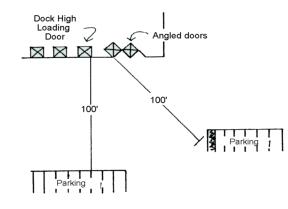
4. Minimum Clear Area for Dock High Loading Doors: Buildings which utilize dock-high loading doors shall provide a minimum one hundred feet (100') of clear maneuvering area in front of each door.
5. Minimum Clear Area for Ground Level Loading Doors: Buildings which utilize ground level service or loading doors shall provide a minimum of forty five feet (45') of clear maneuvering area in front of each door. (Ord. 3988, 4-28-1986)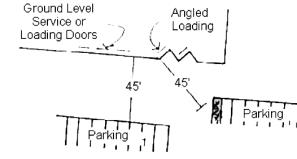
K. MODIFICATIONS:
1. Special Provisions for Use of Paved Recreation Space for Parking: The Building Department may authorize the use of space designated and primarily used for recreation purposes for a portion of the required parking space provided the space conforms to the following conditions: Such parking areas shall be subject to all locational and developmental provisions of this Section; such portions of the recreation area to be used for parking shall be paved with a durable, dustless surface of a permanent nature; and such parking space may be credited only to space requirements of the principal use which it is intended to serve. (Ord. 4517, 5-8-1995)
2. Modification of Standards: See RMC 4-9-250D.
L. DEFERRAL OF INSTALLATION OF REQUIRED IMPROVEMENTS:
See RMC 4-9-060. The requirement of a bond for landscape installation may be waived upon approval of the Department of Community and Economic Development and upon written application by the applicant. (Ord. 3718, 3-28-1983; Ord. 3988, 4-28-1986; Ord. 5729, 10-20-2014)
M. APPEALS:
To Hearing Examiner pursuant to RMC 4-8-110.