


Chapter 20.31
MX MIXED-USE ZONES
Sections:
20.31.010 Master site plan required – CMX zone.
20.31.011 Master site plan review – CMX zone.
20.31.012 Master site plan criteria – CMX zone.
20.31.014 Conditionally permitted uses.
20.31.016 Preexisting auto uses – RMX and CCX zones.
20.31.017 Permitted residential uses.
20.31.018 Commercial leasing – Clustering of sex offenders and felons.
20.31.021 Affordable housing incentives.
20.31.026 Building form standards.
20.31.027 Site plan design principles.
20.31.031 Off-street parking bonus palette.
20.31.032 Impervious surface coverage – RMX zone.
20.31.035 Design intent guidelines – CMX zone.
20.31.040 Performance standards.
20.31.005 Purpose and intent.
(1) The Shaw-Pioneer community mixed-use zone (CMX) is intended to provide an interspersed mix of multifamily residences at RM-10 densities, vertically and horizontally mixed-use buildings as well as some stand-alone commercial and residential uses. The zone allows for building heights between two and three stories. Master site plan development, as established through the planned development process, will provide a complementary mix of uses such as residential, retail, commercial, and professional uses at a scale that is compatible with surrounding neighborhoods. The intent of this district is to promote an intermixed, pedestrian-scale environment with specific performance standards that stress efficient circulation, consistent streetscape design and specific building form standards that create a consistent built environment as well as pedestrian street amenities and facilities that promote a distinct neighborhood character.
(2) The River Road mixed-use zone (RMX) is intended to create a vibrant pedestrian-oriented environment by providing for vertically and horizontally mixed-use buildings as well as some stand-alone residential and commercial uses. This zone is specifically intended to establish an urban form on internal streets through specific design and building form standards as well as integrate enhanced connections to the adjacent Riverwalk Trail. The zone will accommodate a wide variety of uses that can fit into the desired building forms including residential, retail, office, professional services, restaurants, bars/pubs, and others. The zone allows for building heights between five and seven stories. Large format stand-alone retail, road services, and manufacturing uses are detrimental to a pedestrian orientation and shall not be permitted in this zone.
(3) The community commercial mixed-use zone (CCX) is intended to be the most intensive mixed-use designation in South Hill, allowing the highest height limits, and is intended to accommodate commercial uses with a regional draw. The zone allows for building heights between six and 10 stories. This zone district is established to apply to a unique geographic area, encompassing the South Hill Mall and adjacent parcels, bounded by 9th Street SW, SR-512, Meridian and 39th Avenue S. This area, which enjoys visibility and close access to and from SR-512, includes economically significant development with existing commercial buildings. This includes more than 1,000,000 square feet of buildings on the site known as the South Hill Mall, a regional shopping center intended to draw visitors not only from within Puyallup but also from around the region. A full range of uses including residential, office, lodging, and retail uses should be encouraged in this designation. Higher building heights should also be allowed and accommodated, due to the area’s distance from low density residential uses and buffer of SR-512.
(4) The urban center mixed-use zone (UCX) is intended to allow a significant commercial component where standards to ensure pedestrian-oriented design are emphasized, and the constraints of large format retail are acknowledged and accommodated. To encourage and accommodate the greatest range of uses within this designation, high-density residential, pedestrian-oriented retail, large format retail and multi-story office uses are included. The zone allows for building heights between five and seven stories.
(5) The limited mixed-use zone (LMX) is intended to emphasize mixed-use, multi-story residential and office development and accommodate smaller-scale stand-alone retail development. The zone allows for building heights up to three stories.
(6) All mixed-use zones shall be referred to commonly as “MX zone districts.” (Ord. 3269 § 1, 2023; Ord. 3132 § 1 (Exh. D), 2017; Ord. 2993 § 3 (Exh. G), 2011; Ord. 2943 § 1 (Exh. A), 2009).
20.31.010 Master site plan required – CMX zone.
No property shall be developed in the CMX zone under the provisions of this section, unless a master site plan has been reviewed and approved by the hearing examiner. Said master site plan shall contain at least the following:
(1) The boundaries of the project site area;
(2) Prominent natural features including critical areas, topographical contours, forested areas and/or significant trees, and water bodies. Topographic information should also indicate preliminary grading contours;
(3) The gross land area of the development, the future land use designation, zoning classification(s) and existing land use of the area surrounding the proposed development, including the location of structures and other improvements;
(4) A comprehensive development site plan identifying the location, number and types of uses to be included in the development;
(5) The location and dimensions of all elements of the public realm, including proposed streets, pedestrian paths, trails, open areas, and parking facilities of the specific site, while demonstrating comprehensive pedestrian and vehicular accessibility and connectivity throughout the Shaw-Pioneer CMX zone;
(6) Plans and elevations of buildings and structures sufficient to indicate the architectural theme, massing, building materials and construction standards;
(7) Specific development standards to be applied to the project, including building heights, yard setbacks, lot coverage and individual lot sizes, widths, lengths and uniform shapes;
(8) A preliminary landscaping plan;
(9) Proposed development phasing if proposed;
(10) Open space calculations for common and private open space;
(11) Preliminary storm water management plan;
(12) Master parking plan;
(13) Documentation demonstrating compliance with CMX design intent guidelines as set forth by PMC 20.31.035;
(14) Such other information as may be required to enable complete analysis and appraisal of the planned development. (Ord. 3132 § 1 (Exh. D), 2017; Ord. 2993 § 3 (Exh. G), 2011; Ord. 2943 § 1 (Exh. A), 2009).
20.31.011 Master site plan review – CMX zone.
Upon submission of a master site plan concurrent with preliminary or short plat application, the planning director shall process the request in accordance with the provisions of this title. Any decision of the examiner approving a master site plan shall constitute a final decision consistent with the criteria set forth in Chapter 2.54 PMC.
Upon approval of a master site plan, the property shall be developed only in accordance with the approved master site plan, except that subsequent minor revisions which substantially comply with the overall approved master site plan may be approved by the planning director. (Ord. 3132 § 1 (Exh. D), 2017; Ord. 2993 § 3 (Exh. G), 2011; Ord. 2943 § 1 (Exh. A), 2009).
20.31.012 Master site plan criteria – CMX zone.
The following criteria shall apply to all new development projects in the CMX zone:
(1) Comprehensive Plan Compatibility. The development density and design shall be consistent with the goals, objectives and policies of the comprehensive plan.
(2) Density. The residential density of the project shall not exceed the minimum or maximum development density of the CMX zone.
(3) Open Space Requirements. Each individual residential unit shall provide private open space as set forth by MX building form standards. Open space shall be interspersed throughout to provide both passive and active open space opportunities for a full spectrum of age groups and household types.
(4) Compatible Architectural Theme. All buildings and structures in the project site area are to share a common architectural theme that, in the CMX zone, reflects the area’s agricultural heritage.
(5) Land Use Compatibility. The project site design shall be laid out in a manner which ensures compatibility and harmony with adjoining land uses and infrastructure both interior and exterior to the subject project.
(6) Design Character. Project site design shall comply with CMX design intent/purpose statements, principles and applicable standards per PMC 20.31.035.
(7) Pedestrian Connectivity. Site design shall facilitate internal walkability throughout and integrate connectivity between adjacent residential, surrounding trail systems and transit stops.
(8) Required Mix of Use Types. Master site plan shall demonstrate a creative intermixing of use types throughout. Vertical mixed-use buildings shall maintain residential components above ground floor commercial tenant space in perpetuity. (Ord. 3132 § 1 (Exh. D), 2017; Ord. 2993 § 3 (Exh. G), 2011; Ord. 2943 § 1 (Exh. A), 2009).
20.31.014 Conditionally permitted uses.
The following uses are conditionally permitted uses in the MX zones specified. A conditional use permit pursuant to Chapter 20.80 PMC, or administrative conditional use permit pursuant to Chapter 20.81 PMC, where specified, shall be required and in full force and effect in order to establish said uses.
(1) Public service uses proposed as a stand-alone project (all MX zones).
(2) Major commercial recreational uses (CCX).
(3) Congregate emergency shelters and congregate emergency housing, (all MX zones) subject to the standards and criteria of Chapter 20.72 PMC.
(4) Also refer to PMC 20.31.018 for other conditionally permitted uses in the MX zone districts. (Ord. 3275 § 5, 2023; Ord. 3132 § 1 (Exh. D), 2017; Ord. 3073 § 19, 2014).
20.31.015 Prohibited uses.
Since appropriate commercial uses to be allowed for future development in most of the MX zones are those that promote a pedestrian-oriented environment that minimizes the dependency on the automobile and encourages pedestrian accessibility by clustering a mix of uses that are accessible on foot, the following are prohibited uses:
(1) Motor vehicle sales, rental, storage, service and/or repair, body shops, gasoline or diesel service stations and recreational vehicle parks (prohibited in all MX zone districts, except that indoor vehicle displays or showrooms or an outdoor area for a limited number of vehicles used for car-share purposes (i.e., Zipcar) are permitted in the CCX zone);
(2) Any business with a drive-through window, including limited-service restaurants (prohibited in RMX, CMX, and LMX);
(3) Limited manufacturing/light industrial uses and warehousing/distribution (prohibited in all MX zones);
(4) Commercial retail with associated outdoor storage components (prohibited in RMX, CMX, and LMX);
(5) Major commercial recreational uses (prohibited in CMX, UCX, and LMX);
(6) Adult uses (prohibited in all MX zones);
(7) A use not listed here that the director determines, per the procedures outlined in Chapter 20.87 PMC, to be similar in nature to an otherwise prohibited use within the zone district (all MX zones). (Ord. 3132 § 1 (Exh. D), 2017; Ord. 2993 § 3 (Exh. G), 2011; Ord. 2943 § 1 (Exh. A), 2009).
20.31.016 Preexisting auto uses – RMX and CCX zones.
Preexisting auto dealerships, service centers, or drive-through uses within the RMX zone and service centers within the CCX zone district, established prior to the codification of this chapter, shall be allowed to develop, improve, maintain and expand as a permitted use under the development standards of the general commercial zone district. If an auto dealer use within the RMX zone is discontinued for a continuous period of one year or more (plus possible extensions in accordance with PMC 20.65.020), such discontinuation shall be deemed an abandonment of nonconforming use rights and PMC 20.31.015 shall apply. Conversion of a nonconforming use to another nonconforming use shall follow the criteria of PMC 20.65.015. (Ord. 3132 § 1 (Exh. D), 2017; Ord. 2993 § 3 (Exh. G), 2011).
20.31.017 Permitted residential uses.
Subject to the requirements of PMC 20.31.018, the following residential uses are permitted in the MX zone districts, subject to the minimum and maximum density requirements of PMC 20.31.020, where applicable:
(1) Apartments, either as a single stand-alone structure on a mixed-use development site or located within a single mixed-use structure as an upper floor use;
(2) Townhouse structures with a minimum of three attached units or more on a mixed-use development site; and
(3) Retirement apartments or senior housing complexes as either a stand-alone or mixed-use development proposal. (Ord. 3132 § 1 (Exh. D), 2017; Ord. 3044 § 5, 2013; Ord. 2993 § 3 (Exh. G), 2011).
20.31.018 Commercial leasing – Clustering of sex offenders and felons.
An owner, occupant, or other person or entity in control of a dwelling shall be required to submit and receive a conditional use permit prior to leasing a dwelling to or allowing two or more persons to reside in a dwelling located in the MX zone districts when such persons are required to register as a sex offender pursuant to RCW 9A.44.130 and/or have been convicted of any of the following offenses: a serious violent offense as defined in RCW 9.94A.030(45), a violent offense as defined in RCW 9.94A.030(54), residential burglary (RCW 9A.52.025), burglary 2 (RCW 9A.52.020), malicious mischief 1 (RCW 9A.48.070), or theft 1 (RCW 9A.56.030). (Ord. 3132 § 1 (Exh. D), 2017; Ord. 3044 § 6, 2013).
20.31.020 Density.
The following density requirements apply when a residential use(s) is proposed on a site in any mixed-use zone district.
(1) CMX. The minimum required density of dwelling units per net acre shall be four units for a development proposing residential use(s). The maximum allowable density for a development shall be 10 dwelling units per net acre.
(2) RMX and UCX. The minimum required density of dwelling units per net acre shall be eight units for a development proposing residential use(s). The maximum allowable density for a development shall be 22 dwelling units per net acre.
(3) CCX. The minimum required density of dwelling units per net acre shall be eight units for a development proposing residential use(s). No maximum density limits are imposed.
(4) LMX. The minimum required density of dwelling units per net acre shall be eight units for a development proposing residential use(s). The maximum allowable density for a development shall be 12 dwelling units per net acre. (Ord. 3132 § 1 (Exh. D), 2017; Ord. 2993 § 3 (Exh. G), 2011; Ord. 2943 § 1 (Exh. A), 2009).
20.31.021 Affordable housing incentives.
The following incentives are established in order to integrate the establishment of affordable “workforce” housing in the MX zone districts in addition to market rate housing. For the purposes of this chapter, “affordable housing” means dwelling units that are offered for sale or rent at a rate that is affordable to those individuals and families having incomes that are less than 80 percent of the median county income. An affordable housing covenant shall be recorded to ensure compliance with the requirements for the unit(s) to remain affordable in perpetuity.
(1) Density. For every one affordable dwelling unit created on a development project, an additional two bonus market rate units shall be allowed beyond the maximum density allowances of PMC 20.31.020.
(2) Parking. One-half stall may be provided for each affordable housing unit established.
(3) Tax Incentives. Chapter 3.70 PMC: multi-year tax exemption for affordable housing unit/development projects.
(4) Height. See PMC 20.31.028. (Ord. 3132 § 1 (Exh. D), 2017; Ord. 2993 § 3 (Exh. G), 2011).
20.31.025 Access standards.
Repealed by Ord. 3132. (Ord. 2993 § 3 (Exh. G), 2011).
20.31.026 Building form standards.
|
|
CCX |
RMX, UCX |
LMX |
CMX |
|---|---|---|---|---|
|
(1) Minimum project size area |
– |
– |
– |
4 acres |
|
(2) Site plan design principles |
– |
PMC 20.31.027 |
PMC 20.31.027 |
PMC 20.31.027 |
|
(3) Front yard setback |
20' |
12' – 20' BTA(1) |
12' – 20' BTA(1) |
12' – 20' BTA(1) |
|
(4) Interior side yard setback |
0' |
6' |
6' |
6' |
|
(5) Street side yard setback |
10' |
12' – 20' BTA(1) |
12' – 20' BTA(1) |
12' – 20' BTA(1) |
|
(6) Rear yard setback |
0' |
10' |
10' |
10' |
|
(7) Maximum building height |
75'; up to 125' with height bonuses. See PMC 20.31.028 |
68'; up to 90' with height bonuses. See PMC 20.31.028 |
40'. See PMC 20.31.028 |
40'. See PMC 20.31.028 |
|
(8) Minimum building height |
– |
– |
– |
24' |
|
(9) Maximum lot coverage |
85% |
65% |
50% |
85% |
|
(10) Maximum commercial floor space (in any one structure) |
– |
– |
50,000 square feet |
30,000 square feet |
|
(11) Maximum individual commercial tenant space |
– |
– |
– |
5,000 square feet |
|
(12) Vertically mixed-use building |
Ground floor public street frontage shall be commercial tenant space and access to upper floors only |
Ground floor public street frontage shall be commercial tenant space and access to upper floors only |
Ground floor public street frontage shall be commercial tenant space and access to upper floors only |
Ground floor public street frontage shall be commercial tenant space and access to upper floors only |
|
(13) Design standards |
See PMC 20.26.300, excluding PMC 20.26.300(3), for existing enclosed regional shopping center structure; see Chapter 20.52 PMC for all other structures |
See Chapter 20.52 PMC |
See Chapter 20.52 PMC |
10 feet depth x 15 feet width facade modulation per 75 feet |
|
(14) Private open space (ground floor dwelling unit) |
– |
– |
200 square feet |
200 square feet |
|
(15) Private open space (upper floor dwelling unit) |
10' x 8' |
10' x 8' |
10' x 8' |
10' x 8' |
(1) “Build-to area (BTA)” is defined as the line at which construction of a building facade is to occur on a lot, running parallel to the applicable property line without setback, and thus ensuring a uniform (or more or less even) building facade line on the street.
(Ord. 3269 § 1, 2023; Ord. 3132 § 1 (Exh. D), 2017; Ord. 2993 § 3 (Exh. G), 2011).
20.31.027 Site plan design principles.
The following standards apply in all MX zones, except the CCX zone. In order to encourage pedestrian movement and the use of public transit within mixed-use zone districts, and to promote development of an attractive streetscape, appropriate building orientation is needed to provide for convenient, safe, direct and enticing pedestrian access between commercial developments and the right-of-way. Site plans shall be subject to the following location and design criteria:
(1) Parking Area Location. The maximum width of a parking lot fronting on a public street shall not exceed 64 feet or 50 percent of the subject site frontage, whichever is greater, to the extent feasible;
(2) Street Orientation for New Buildings and Site Development. All site developments shall utilize the following standards in preparing site plan layouts:
(a) A pedestrian-oriented plaza space in front of the building at least eight feet deep running the full width of the building. This area shall be covered by awnings covering at least six feet of the plaza space. This plaza space shall include amenities:
(i) Covered bike parking, as required by Chapter 20.55 PMC;
(ii) Bench seating (one bench for every 50 feet of site frontage, to be evenly distributed);
(iii) Decorative planters;
(iv) Decorative pedestrian-scaled light fixtures, both freestanding and wall-mounted; or
(v) Optional features, if any, that are pedestrian-scaled in nature;
(b) Buildings on street corners shall locate the main entryway with a plaza space (200 square feet minimum) at or near (50 lineal foot maximum) the building corner, or establish a defined path (12-foot width minimum) leading from the public right-of-way directly to building entries using decorative/stamped paving;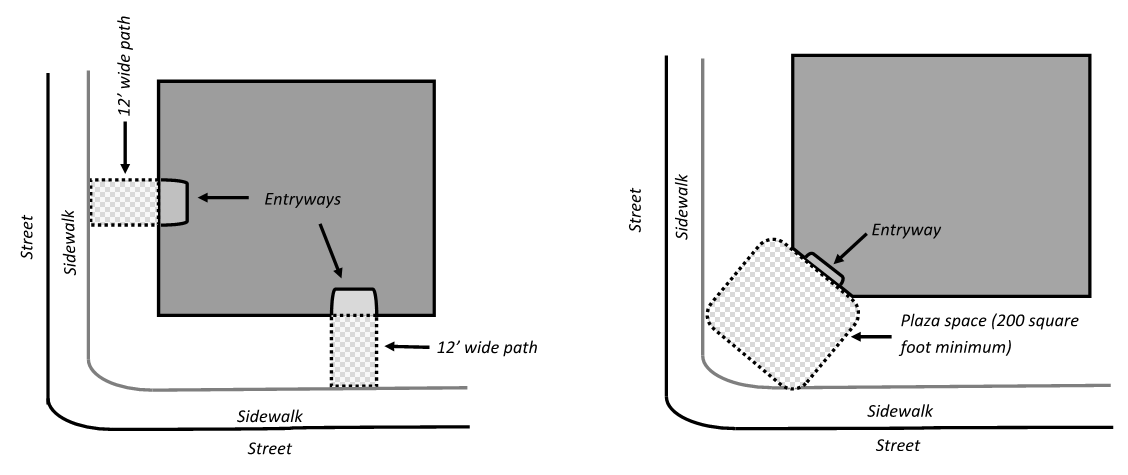
(c) New buildings shall be built 12 feet from the abutting front yard and street side yard right-of-way to improve pedestrian orientation and overall building design. Buildings may deviate from this setback under the following conditions:
(i) Buildings may be set back to a maximum of 20 feet to accommodate an eight-foot plaza space as required by subsection (2)(a) of this section;
(ii) Optionally, the pedestrian plaza space may project into the required front or street side yard landscape buffer (as required under PMC 20.58.005(2)) by a maximum of four feet; corner plaza spaces or outdoor cafes may project into the required landscape buffer by a maximum of six feet; and
(d) Site development plans shall be designed so that, to the greatest extent feasible, buildings and building entries are at street level and not elevated by retaining walls, particularly on sides of buildings where an entryway is oriented toward the abutting right-of-way;
(3) Interior Building Orientation. Once the site development has achieved at least 50 percent of the site frontage which is occupied by buildings in accordance with the street orientation standards above, or when panhandle/internal lots not fronting on a public right-of-way, or where existing buildings and/or improvements would physically prevent subsections (1) and (2) of this section from being achieved, other structures may be placed internal to the site but shall be oriented towards each other and in close proximity to the site’s street frontage buildings to allow for pedestrian movement between structures through pedestrian-scaled plaza areas without crossing parking areas;
(4) Building Entrances and Design. At least one building entrance for an individual building (or individual tenant spaces) shall face each public street frontage or be located within 50 lineal feet from a public street frontage. Directly linking pedestrian access shall be provided between the street right-of-way and each building entrance;
(5) Parking Lot Entrances and Driveways. The city may impose additional restriction on the width, number and location of driveways to and from the subject parcel to improve vehicle circulation or safety, or to enhance pedestrian movement or desirable visual characteristics; and
(6) Parking Lot Screening. Each side of a parking lot which abuts a street must be screened from that street using the appropriate landscaping as specified in the city’s vegetative management standards or by locating the building between the street and the parking lot.
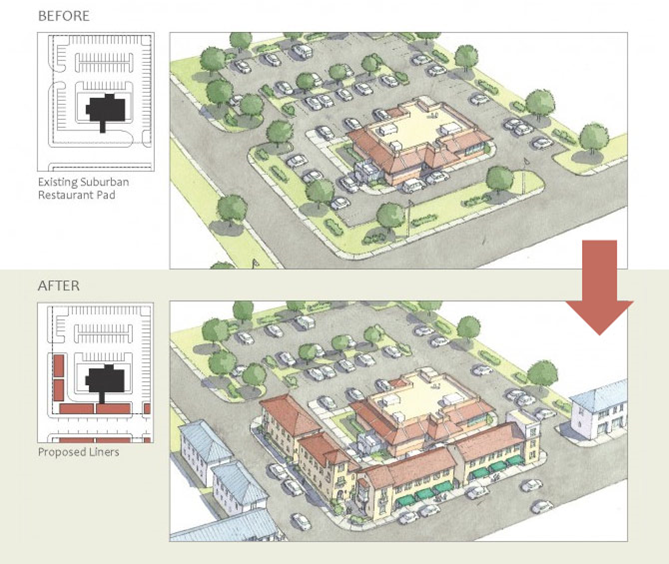
Example of site development standards outlined in PMC 20.31.027 – structures occupy in excess of 50 percent of site frontage, corner design emphasizes pedestrian orientation, structures internal to the site are close by to allow easy pedestrian movement and parking areas are to the rear.
(Ord. 3193 § 1, 2019; Ord. 3132 § 1 (Exh. D), 2017; Ord. 2993 § 3 (Exh. G), 2011).
20.31.028 Building height.
(1) All MX Zones. Rooftop mechanical equipment, antennas for commercial radio transmission facilities, elevator penthouses, parapets, roof forms and decorative elements not intended for occupancy shall be excluded from the total structural height in these zones where such features are screened or installed consistent with applicable design standards.
(2) RMX and UCX Zones. Maximum building height shall be 54 feet if the structure is within 300 feet of a single-family residential zone. Height may be increased up to 68 feet in RMX if the property is located more than 300 feet from a single-family residential zone. Building height may be increased up to 68 feet in UCX if the building site is located more than 300 feet from a single-family residential zone or is separated from a single-family residential zone by an arterial.
(3) UCX Zone. Building height may be increased up to 28 feet in height beyond the height established in PMC 20.31.026(7) to accommodate for the provision of an equivalent number of stories of structured parking, either above or below ground, where such parking area is equal to or exceeds 60 percent of the area of the building’s footprint.
(4) CCX Zone. Maximum building height shall be 75 feet. In order to achieve a building height greater than the maximum permitted building height, buildings located (a) 300 feet or further from any single-family residentially zoned property, and (b) within 400 feet of the south right-of-way boundary of SR-512 or 1,700 feet of the east right-of-way boundary of 9th Street SW shall be eligible for one or more of the height bonuses described by the subsections of this section, subject to the maximum bonus provisions of PMC 20.31.026(7). Any proposal that takes advantage of any height bonus allowance shall comply with applicable Downtown Design Guidelines.
(a) A height bonus of up to 28 feet shall be allowed when an equivalent number of stories of structured parking, either above or below ground, have been provided, where such parking area is equal to or exceeds 60 percent of the area of the building’s footprint.
(b) A height bonus of 42 feet shall be allowed for buildings which include residential use for at least 30 percent of a building’s floor area.
(c) A height bonus of up to 56 feet shall be allowed when at least 20 percent of residential units have been provided for households making less than 80 percent of area median income. In order to qualify, the affordable units shall meet all of the standards prescribed through the city’s multifamily property tax incentive program.
(d) A height bonus of up to 42 feet shall be allowed for use of transfer of development rights (TDR) from an identified TDR sending site (pending development of TDR program).
(e) A height bonus of 28 feet shall be allowed for buildings which provide a green roof that covers at least 60 percent of the building footprint, or total building footprints if multiple buildings are proposed. Green roofs shall be designed and installed under the direction of a professional with demonstrated expertise in the design and construction of such facilities. Green roofs shall conform to best available technology standards, such as those published by Leadership in Energy and Environmental Design (LEED).
(f) A height bonus of 14 feet shall be allowed for buildings which provide a solar energy collection on the site that is designed to provide at least 15 percent of the expected annual operating energy for the building. The system shall be designed and installed under the direction of a professional with demonstrated expertise in the design and construction of such systems.
(g) A height bonus of 14 feet shall be allowed for buildings which are designed to reduce energy usage beyond the prerequisite standards, as determined by the building code official, by at least 20 percent for new structures and 10 percent for existing structures or existing portions of structures. Project shall utilize an energy cost budget analysis to demonstrate energy savings over current standards. (Ord. 3269 § 1, 2023; Ord. 3132 § 1 (Exh. D), 2017).
20.31.030 Parking facilities.
Parking facilities and provisions shall follow the standards as defined in Chapter 20.55 PMC. The following section recognizes that limiting the number of spaces allowed promotes efficient use of land, enhances urban form in mixed-use centers, encourages use of alternative modes of transportation, provides for better pedestrian movement and protects air and water quality. The following establishes specific standards for the off-street parking facilities in the MX zone districts (except LMX) in accordance with this intent:
|
|
RMX, CCX, UCX |
CMX |
|---|---|---|
|
(1) Minimum spaces required |
85 percent of required as defined by PMC 20.55.010 |
65 percent of required as defined by PMC 20.55.010 |
|
(2) Maximum spaces |
100 percent of required as defined by PMC 20.55.010 Regional shopping centers: 150 percent of required as defined by PMC 20.55.010 Any increase beyond the established maximum may be permitted per the parking bonus amenities established in PMC 20.31.031 |
100 percent of required as defined by PMC 20.55.010 Any increase beyond the established maximum may be permitted per the parking bonus amenities established in PMC 20.31.031 |
|
(3) Residential |
Minimum of one per unit |
Minimum of 1.5 per unit |
|
(4) Bike facilities |
See PMC 20.55.016(2) for nonresidential/mixed-use structures. Each residential unit shall be provided a minimum of two weather-protected bike parking spaces |
See PMC 20.55.016(2) |
(Ord. 3132 § 1 (Exh. D), 2017; Ord. 2993 § 3 (Exh. G), 2011; Ord. 2943 § 1 (Exh. A), 2009).
20.31.031 Off-street parking bonus palette.
(1) Affordable Housing. A 20 percent off-street parking stall bonus may be granted when the applicant constructs a mixed-use structure or development site where at least 20 percent of the dwelling units are provided for households making less than 80 percent of area median income. These units shall be designated as affordable in perpetuity on title.
(2) Green Roofs. A 15 percent off-street parking stall bonus may be granted when the applicant provides a green roof that covers at least 40 percent of the building footprint. The green rooftop facility shall conform to best available technology standards.
(3) Structured Parking. A 10 percent off-street parking stall bonus may be granted when the applicant constructs a structured parking facility contained within the building footprint (above or below ground) that equals at least 60 percent of the area of the building’s footprint.
(4) Solar Energy Collection. A 10 percent off-street parking stall bonus may be granted when the applicant installs a solar energy collection system on the site which is designed to provide a minimum of 10 percent of the expected annual operating energy for the building. The system and energy collection calculations used in applying this bonus shall be designed and installed under the direction of a professional with demonstrated expertise in the design and construction of such systems.
(5) Energy Efficiency. A 10 percent off-street parking stall bonus may be granted when the site development structure is designed or upgraded to reduce energy usage beyond the prerequisite standards – as determined by the building code official – by at least 20 percent for new structures and 10 percent for existing structures or existing portions of structures. Project shall utilize an energy cost budget analysis to demonstrate energy savings over current standards.
(6) Vertical Development. A five percent off-street parking stall bonus may be granted for each additional vertical floor added beyond two stories, up to a maximum bonus of 20 percent. (Ord. 3132 § 1 (Exh. D), 2017).
20.31.032 Impervious surface coverage – RMX zone.
In accordance with the River Road subarea plan goals and policies, substantial reductions in the use and presence of impervious surfaces are envisioned. Low impact development techniques should be utilized to this end. The following establishes specific standards and incentives for reducing and removing impervious surfaces during site development and substantial redevelopment projects:
(1) No Net Increase of Impervious Surfaces. All building permits submitted for any new exterior construction or site alterations shall document all impervious site surfaces (e.g., rooftops, parking lots, walkways, severely compacted soil areas, etc.) relative to overall site area. No new site alterations or construction shall result in an increase in overall impervious surface.
(2) Maximum Impervious Surface Coverage Established. No site shall maintain or construct impervious surfaces that exceed 70 percent of total site area. Impervious surfaces beyond 70 percent shall be considered nonconforming; reduction and removal of impervious surfaces shall be required upon substantial site redevelopment.
(a) Substantial site redevelopment – defined for purposes of this subsection, “substantial” site redevelopment shall be any new development, addition, or exterior alterations with value, as determined by the building code official, totaling more than $150,000, within any two-year period – shall result in a site impervious surface coverage of no more than 70 percent.
(b) Multiple techniques may be utilized to achieve this reduction goal, including, but not limited to, the removal of impervious parking lot surfacing, replacement of impervious surfaces with pervious, installation of soil-amended landscape areas, etc. Given that the following techniques do not either infiltrate rain water or do not provide full interception and infiltration/transpiration of rain water, a credit for up to, but not more than, 50 percent of their site coverage area shall be provided in relation to impervious surface reductions:
(i) Green roof tops; and
(ii) Deciduous tree canopy coverage area.
(c) All pervious and landscaped areas disturbed or created by the project will have their soils amended with 10 percent compost by volume or replaced entirely with engineered soils meeting the requirements of DOE BMP T5.13. (Ord. 3132 § 1 (Exh. D), 2017; Ord. 2993 § 3 (Exh. G), 2011. Formerly 20.31.031).
20.31.033 Low impact development stormwater management.
Repealed by Ord. 3132. (Ord. 2993 § 3 (Exh. G), 2011).
20.31.035 Design intent guidelines – CMX zone.
Master plan design submittal shall demonstrate that the following intent guidelines are implemented into building and site design:
(1) Architectural Theme. The primary design objectives for the CMX zone are to reflect the area’s agricultural heritage while promoting the pedestrian-scale environment.
Toward this end, the overall architectural theme shall reflect a rustic, farmhouse-style design in residential, commercial and mixed-use buildings.
(a) Flat roof design, in conjunction with gabled parapets, strongly encouraged for commercial buildings.
(b) Use of high quality building materials (use of sustainable building materials and use of LEED building practices strongly encouraged).
(c) Building modulation to reinforce each building’s individual character and to reduce bulk.
(d) Incorporate multiple building features such as cornices, special wall-mounted lighting fixtures, window shutters, planter boxes, various window styles and other elements to reinforce the pedestrian scale, ground floor orientation and visual continuity to abutting buildings.
(2) Public Space.
(a) Public space design that enlivens the pedestrian experience through the extensive use of pedestrian amenities.
(b) Careful and deliberate design that buffers the pedestrian experience from auto travel.
(c) Building entrances shall orient toward the street.
(d) Implement transition design that provides compatibility to abutting land uses.
(3) Pedestrian Experience.
(a) Creative treatment of blank walls (i.e., wall art, multiple facade materials).
(b) Weather protection awnings.
(c) Varied glazing and framing designs that create an interface between ground floor retail and the public realm space.
(4) Building Orientation.
(a) Building design shall orientate toward the public realm. If applicable, buildings shall provide additional orientation toward natural features or open space.
(b) Locate building entrances and use prominent architectural elements at street intersections and key sidewalk locations.
(c) At least one building entrance shall face each public street frontage.
(5) Signage.
(a) Signage shall be pedestrian-scaled.
(b) Signage shall incorporate specific design themes from the associated building.
(6) Parking and Loading Facilities.
(a) Allow parking facilities to be efficiently designed and located to reduce visual prominence of visibility of parked vehicles.
(b) Parking and loading facilities shall be designed and located to enhance pedestrian safety through the use of pedestrian walkways delineated by distinctive pavements. (Ord. 3132 § 1 (Exh. D), 2017; Ord. 2993 § 3 (Exh. G), 2011; Ord. 2943 § 1 (Exh. A), 2009).
20.31.040 Performance standards.
The following special requirements and performance standards shall apply to properties located in the MX zone:
(1) Exterior Mechanical Devices. Large mechanical equipment shall be screened from surrounding residentially zoned properties and public rights-of-way. Minor utility equipment, such as small generators, utility meters, air conditioners, or junction boxes, which are less than three and one-half feet in height, shall be exempt from screening requirements. Alternative methods for screening may include the use of building or parapet walls, sight-obscuring fencing and/or landscaping, equipment enclosures, consolidation and orientation of devices towards the center of the rooftop, and/or the use of neutral color surfaces.
(2) Required Landscaping. Landscaping required by this title and/or by conditions of approval of discretionary applications required by this title shall be designed, installed and maintained in accordance with Chapter 20.58 PMC. Bioretention swales shall be incorporated into landscape areas where soils permit. In no event shall such landscaped areas be used for storage of materials, placement of temporary signs or parking of vehicles.
(3) Outdoor Lighting. Building-mounted lighting and aerial-mounted floodlighting shall shield direct lighting from other properties. Ground-mounted floodlighting or light projection above the horizontal plane is prohibited between midnight and sunrise. All lighting shall be shielded so that the direct illumination shall be confined to the property boundaries of the light source. Temporary outdoor lighting intended to advertise a temporary promotional event shall be exempt from this requirement.
(4) Trash and Recycling Receptacles. Trash and recycling receptacles shall be screened from adjacent properties and public rights-of-way by an opaque visual barrier no lower than the highest point of the receptacles. Except on trash pick up days, all trash receptacles shall be screened from neighboring properties and public rights-of-way by an opaque visual barrier no lower than the maximum height of the receptacles. For multiple-family uses of five or more dwelling units and commercial uses, trash receptacles shall be permanently maintained within such opaque visual barrier. Proposed multifamily residential projects of five or more dwelling units shall provide at least one on-site recycling area for each 25 dwelling units. Each recycling area shall be located not more than 200 feet from the intended user units and, at a minimum, shall include separate receptacles for glass, newspaper, aluminum and cardboard. All recycling areas shall be screened in a manner consistent with trash receptacles under this subsection.
(5) Dog Kennel/Veterinary Clinics. Dog kennels, whether operated as accessory to another use (e.g., veterinary clinic) or as a stand-alone operation, shall meet the following performance standards:
(a) Dog impound areas shall be interior to the building only. Exterior impound kennels are prohibited.
(b) All such kennel areas shall be designed and operated in a manner so as to produce no offensive odor or noise detectable on off-site properties.
(6) Yard Projections. Any required yard shall be open and unobstructed from the ground to the sky unless otherwise provided:
(a) Fences and walls as specified and limited under this section may project into any required yard.
(b) Cornices, sills, eaves projections, and awnings without enclosing walls or screening may project into a required yard but not more than two feet, provided the width of any required interior side yard is not reduced to less than two feet, six inches, and any yard abutting a street is not reduced to less than five feet.
(c) Open, unenclosed decks not covered by a roof may project into any required yard; providing, however, that said decks are constructed at grade elevation, or in no event exceed 18 inches above adjoining grade.
(7) Fences and Walls. Except as regulated under subsection (11) of this section, fences and walls constructed shall not exceed a maximum height above the adjacent grade as set forth in this subsection:
(a) Fences and walls located within the front yard BTA shall not exceed a height of three and one-half feet;
(b) Fences and walls located within the rear yard or interior side yard shall not exceed a total height of six feet;
(c) Fences and walls located within the street side yard shall not exceed a total height of six feet; provided, however, that any portion of a fence or wall lying between the front lot line and a parallel line extending from that point of a building nearest the front property line shall not exceed a height of three and one-half feet;
(d) Fences and walls constructed within the building area of a lot may be as high as the building existing within said area; and
(e) No fence or wall may include the use of barbed wire or razor wire.
(8) Vending stands or kiosks (e.g., espresso stands), either portable or permanent but intended as non-temporary uses, shall be permitted to site in existing commercial establishments within the MX zones, subject to the following standards:
(a) Portable vending stands permitted under this subsection shall not exceed 50 square feet in area. All vending stands shall provide adequate trash receptacles and shall not be located within any required landscape area.
(b) Placement of any vending stand or kiosk shall not be located on an established site which is nonconforming with this title’s parking standards as to required dimensions or access/egress configuration such that, in the opinion of the city engineer, siting the stand may exacerbate a substandard vehicle circulation situation. Further, no vending stand shall occupy any parking stall of an establishment which is now nonconforming with this title’s parking standards for number of stalls so as to result in a net loss of parking.
(c) All such vending stands shall comply with city licensing requirements under PMC Title 5. All stands shall further be subject to any applicable building or fire codes.
(9) Public Transit Facility Location and Design. In order to reduce the use and dependence on private vehicles and associated traffic congestion, and to encourage the use of public transit, adequate provision should be made for public transit facilities and supporting improvements. When formally recommended or requested by the local public transit authority, bus shelters, transit turnouts and supporting facilities shall be located and designed in accordance with the following provisions:
(a) Transit Facility Location Criteria. When required, transit facilities shall be located on or adjacent to arterial streets.
(b) Transit Facility Access. Convenient, safe and direct pedestrian access to and from transit facilities shall be provided between all building entrances, pedestrian plazas or walkways, and public rights-of-way.
(c) Transit Facility Design. All transit facilities shall be designed to the standards and specifications of the public transit authority and the city’s public works department.
(10) Truck Parking and Loading/Unloading Areas. Truck parking and loading/unloading as required under PMC 20.55.061 shall be screened from public right-of-way and any adjoining residential development. Said loading/unloading facilities shall be accessed from the alley or adjoining parking lot only.
(11) Sight Distance Requirements. At all street, alley and driveway intersections there shall be triangular yard area within which no tree, sight-obscuring fence, shrub, wall or other visual obstruction shall be permitted higher than 30 inches above the adjacent street, alley or driveway grade. This triangular area shall measure as follows:
(a) At any intersection of two street rights-of-way, two sides of the triangular area shall extend 20 feet along both right-of-way lines, measured from their point of intersection. For the purpose of this subsection, an alley shall be considered as a street.
(b) At any intersection of a driveway with a street or alley, the sides of the triangle shall extend 10 feet along the street or alley right-of-way and 15 feet along the edge of the driveway, measured from their point of intersection.
(c) The provisions of this subsection shall be in addition to any other site distance protection requirements of the city and in the event of conflict between requirements, the more restrictive shall apply.
(12) Pedestrian Access and Circulation. Subject to the limitations below in this subsection (12) on where the standards are intended to apply as a result of a project proposal, pedestrian walkways shall be constructed to provide safe, convenient and direct access to and from building entrances, transit facilities, passenger loading areas, public sidewalks, adjacent properties and pedestrian plazas. All parking lots which contain more than 90,000 square feet of paved area including driveways and traffic aisles shall include clearly defined pedestrian routes from parking stalls to main building entrances. The director, or designee, shall exercise discretion in the application of the standards in this subsection (12) as to the needed quantity and location of the pedestrian routes on a site as defined by the scope of work in the project proposal; pedestrian routes should provide accessible and reasonable access to site uses and structures.
These standards are intended to apply to the parking areas, walkways, and access drive aisles internal to a lot only where new development or redevelopment is proposed. Redevelopment is defined as exterior additions or tear-down and rebuild of existing structures. Applicable standards and locations are determined by the parcel lines encompassing the new development or redevelopment, the areas of the site substantially altered by the new development or redevelopment or the areas of the site necessary and intended to directly serve the proposed use or structure, all as defined by the scope of work in the project proposal.
All required walkways shall meet the following minimum requirements:
(a) All walkways shall be a minimum of five feet wide with no encroachments (vehicle overhangs, displays, etc.) permitted;
(b) All walkways shall be handicapped accessible and comply with the Washington State barrier-free design standards;
(c) Painted crosswalks may be required outside of the area altered by the project proposal to delineate walkways for pedestrians to adjacent building entrances on the same site, where warranted;
(d) All walkways and pedestrian crossings of parking lot drive aisles shall be delineated by painted markings, decorative stamped concrete or asphalt, decorative pavers, distinctive pavement, or by being raised a minimum of six inches above the parking lot pavement;
(e) Walkways within parking lots shall be located along major access corridors (primary driveway entrances between primary building entrances, etc.); and
(f) Walkways within parking lots shall be integrated into interior landscape areas, whenever possible, to separate pedestrian access and vehicular travel routes. Pedestrian walkways shall preferably be located in the “connector landscaping strip” area, as required by the Type IV parking lot landscaping design standards in the vegetation management standards manual. The pedestrian walkway shall not offset required landscaping as stipulated by the Type IV standard.
(13) Drive-Through Lanes. The following rules are defined in order to mitigate the potential negative impacts drive-through lanes may create on site design and to improve street corner building orientation for commercial development. All drive-through lanes shall be designed to mitigate negative visual/auditory effects and to improve site design principles, which should be to reduce the prominence of automobiles in general while still providing safe and convenient access to drive-through commercial establishments (where allowed). The following performance standards shall apply:
(a) In no event shall a drive-through lane be placed on the street corner of a commercial development site (see Figure 3). See subsection (13)(c) of this section for further design details related to drive-through lanes parallel to roadways;
(b) Drive-through lanes shall be located internal to a development site and designed in the following manner (see Figure 1):
(i) To eliminate the prominence of the drive-through or incidence of headlights shining directly toward an abutting or adjacent street right-of-way;
(ii) If oriented perpendicular to a public right-of-way, shall include landscape screening to shield headlights from shining directly into an abutting or adjacent street right-of-way;
(iii) Shall include appropriate signage encouraging motorists to turn headlights off while stacking in the drive-through lane;
(iv) Window lanes and facilities shall be oriented away from residential zones, and shall be screened from residential zones and public streets to obscure vehicle headlights from shining directly into public streets or residential zones; and
(v) Required screening shall be a minimum height of three feet above the grade of the drive, and shall be sufficiently dense to obscure at least 80 percent of vehicle headlights prior to occupancy and use, and 100 percent of vehicle headlights within one year of occupancy and use. Acceptable screening materials shall include the use of building walls, berms, landscaping and/or solid fencing;
(c) Drive-through lanes shall only be placed parallel to a road if separated by a distance of 30 feet, or if fully screened by a 15-foot Type IIb landscape setback with a designed landscape berm (six feet high at center of berm in 15-foot landscape setback) or three-and-one-half-foot decorative masonry wall;
(d) Pedestrian access from the abutting right-of-way shall be provided in a location safely away from drive-through lanes. In the event that direct pedestrian access cannot be provided in a location clear of the drive-through lane, direct pedestrian access shall be provided through the drive-through lane from a street-facing building entrance to the abutting roadway with a safe, ADA accessible raised pedestrian crosswalk, delineated by decorative stamped pavement/asphalt and appropriate pedestrian warning signs and adequate lighting (see Figure 4); and
(e) Appropriate queuing length, location of entry/exit points and separation from public streets and intersections shall be approved by the city traffic engineer. The traffic engineer shall require a technical analysis of all stacking lanes. Drive-through lanes shall, to the maximum extent feasible, gain access from internal driveways and parking lots and should not increase the number of driveways onto abutting public street rights-of-way, unless deemed warranted and acceptable by the traffic engineer or designee(s). Drive-through facilities shall be designed so that vehicles, while waiting in line to be served, will not block vehicle or pedestrian traffic in the right-of-way (see Figure 2).
Examples of preferred site designs: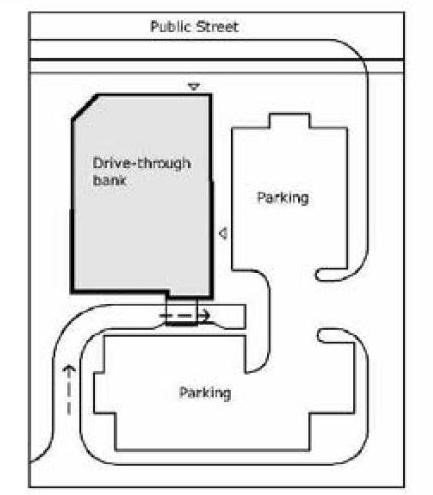
Figure 1 – Drive-through is located clearly internal to the site and not visible from the abutting public street right-of-way.
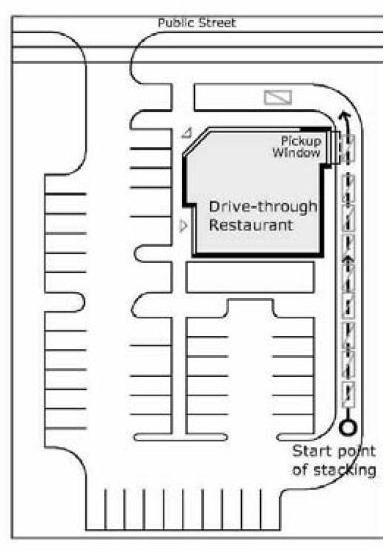
Figure 2 – Stacking lane starts toward the rear of the site to provide adequate queuing distance; landscaping along the street frontage will screen headlight glare onto the abutting street. A single consolidated access point reduces the number of driveways along the abutting street.
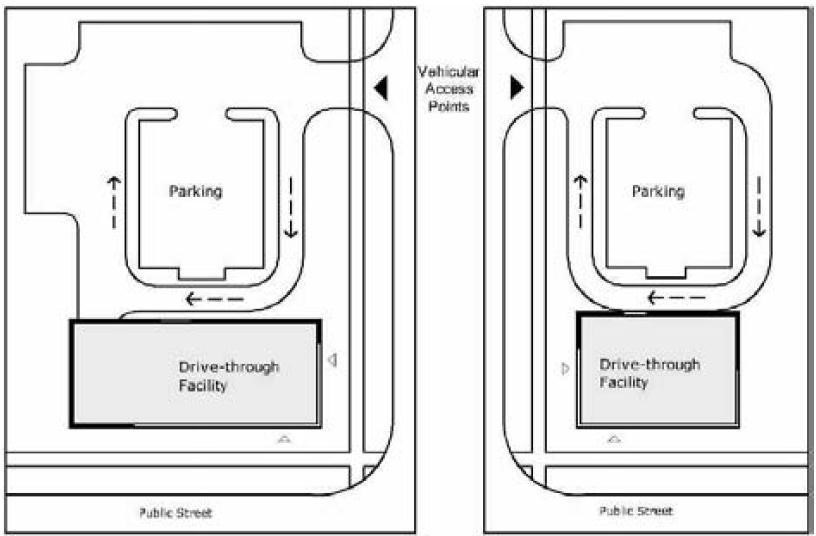
Figure 3 – Example shows preferred design on a street corner; note the building is the prominent feature on the street corner with parking and drive-through lane secondary and behind the structures. Landscaping and screening berm/wall would obscure drive-through lanes that are parallel to the abutting secondary street.
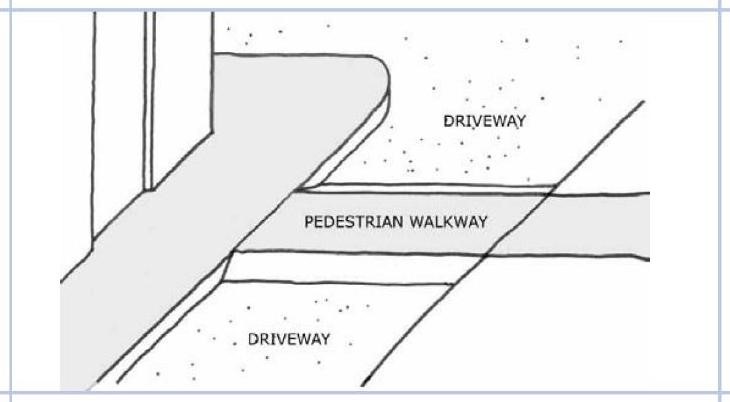
Figure 4 – Example of a pedestrian walkway through a drive-through lane. The walkway shall be constructed using distinctive stamped asphalt or concrete.
(Ord. 3132 § 1 (Exh. D), 2017; Ord. 3073 § 20, 2014; Ord. 2993 § 3 (Exh. G), 2011; Ord. 2943 § 1 (Exh. A), 2009. Formerly 20.31.045).