


Chapter 19.25
SUPPLEMENTAL DEVELOPMENT STANDARDS
Sections:
19.25.010 Supplemental residential (R) zone regulations.
19.25.020 Supplemental airport (A) zone regulations.
19.25.050 Supplemental industrial (I) zone development standards.
19.25.060 Supplemental open space (OS) zone development standards.
19.25.070 Supplemental R, CL, TC zone development standards for middle housing.
19.25.071 Supplemental regulations for courtyard buildings.
19.25.072 Supplemental regulations for cottage housing.
19.25.080 Supplemental R, CL, TC zone infrastructure standards for middle housing.
19.25.090 Accessory dwelling unit (ADU).
19.25.110 Special height restrictions.
19.25.120 Obstructions – Generally prohibited.
19.25.160 Design review guidelines.
19.25.180 Recreational vehicle parks.
19.25.190 Development and permit requirements for mobile food vans and espresso stands.
19.25.010 Supplemental residential (R) zone regulations.
(1) A manufactured home or modular home may be allowed to be placed on a single-family residential lot within any residential zone that allows single-family homes, provided the following conditions are met: mobile homes and manufactured housing not located within a sale lot nor within an approved mobile home park shall:
(a) Consist of at least two fully enclosed parallel sections each of not less than 12 feet wide by 36 feet long;
(b) Be placed on a poured or permanent concrete block foundation similar to that required for other residential construction;
(c) Have a roof which was originally constructed and is now pitched with a slope no less than three inches of rise to 12 inches of run, is constructed as an integral part of the home, and is made of either composition, shakes or shingles;
(d) Have exterior siding similar in appearance to siding materials commonly used on conventional site-built (per the Uniform Building Code) single-family residences;
(e) Have the tongue removed if designed to allow removal;
(f) Have a minimum of 18 inches crawl space;
(g) Have permanent steps affixed to all exits; and
(h) Be approved by and bear the insignia of the U.S. Department of Housing and Urban Development;
(i) All requirements of this title and other applicable regulations must be met.
(2) Rooms may be rented to no more than two persons, other than the family occupying a single-family dwelling, provided there is compliance with health and building code requirements.
(3) Accessory buildings as defined in Chapter 19.06 CMC are permitted; provided, that they are within the setbacks required of the main building, that they are at least 10 feet from each other and the main building if detached.
(4) Accessory buildings may be located in the rear yard but not nearer than five feet to rear or side property lines, except where on an alley, in which case they may be on the rear property line.
(5) Horses, beef cattle or other domestic farm animals are permitted on the condition that the number of animals not exceed a ratio of one per one-half acre of fenced pasture area. The keeping of mink, goats, foxes or hogs is prohibited.
(6) No recreational vehicle, trailer, bus, or van shall be used as a place of habitation.
(7) See Chapter 19.54 CMC for parking requirements.
(8) Junk storage and the keeping of any inoperable vehicle is prohibited outdoors unless in a solid fenced yard and not visible from the street. [Ord. 900 § 2 (Att. A (§ 7)), 2025]
19.25.020 Supplemental airport (A) zone regulations.
(1) Only uses and structures identified in CMC 19.20.020 and 19.20.030 are permitted;
(2) Proposed land uses shall not constitute a hazard to air navigation as defined in these regulations, including but not limited to wildlife attractants, light and glare, smoke and dust, and other airspace obstructions;
(3) Adjacent land uses, particularly new residential developments including single-family residences, may be subject to avigation easements as required by the town;
(4) Junk storage and junk vehicles, as defined by Concrete Municipal Code, are prohibited outdoors;
(5) Parking on taxiways or runways is not allowed. Parking is allowed within private hangars or on unoccupied portions of the leased lots;
(6) All development within the airport land use district shall be subject to a site plan review;
(7) Lawfully permitted uses that existed prior to the adoption of this chapter may continue either in compliance with these regulations or as legal nonconforming uses per Chapter 19.66 CMC, except that no such nonconforming uses shall be allowed to expand in height or bulk, and shall comply with FAA regulations. [Ord. 900 § 2 (Att. A (§ 7)), 2025]
19.25.030 Supplemental commercial/light industrial (CL) and town center (TC) zone development standards.
(1) All uses shall be conducted entirely within a building or structure except:
(a) Parking lots;
(b) Display or sales of goods that do not extend eight feet past the front of the building, do not block entrances or interfere with pedestrian travel, do not interfere with the parking areas and do not encroach upon public property;
(c) Outdoor seating for restaurants, theaters, or other entertainment;
(d) Temporary uses as permitted by the fire marshal, building official, planning director or town engineer pursuant to the applicable ordinances;
(e) Unloading and loading areas;
(f) Utility substations;
(g) Refuse containers;
(h) Play areas for day-cares.
(i) Mobile food vans and expresso stands in CL zone only.
(2) Any repairing done on the premises shall be incidental only, and limited to custom repairing of the types of merchandise or equipment sold on the premises at retail. The floor area devoted to such repairing shall not exceed 90 percent of the total floor area occupied by the particular enterprise, except that the limitations of this subsection shall not apply to dental work, shoe, radio, television, or other small appliance repair services.
(3) Storage shall be limited to accessory storage of commodities sold at retail on the premises or materials used in the limited fabrication of commodities sold at retail on the premises.
(4) Operations conducted on the premises shall not be objectionable beyond the property boundary lines by reason of noise, odor, fumes, gases, smoke, vibration, hazard, or other causes.
(5) No on-site hazardous substance processing and handling, or hazardous waste treatment and storage facilities shall be permitted, unless clearly incidental and secondary to a permitted use as regulated by the Uniform Fire Code.
(6) The above supplemental development standards shall not apply to the existing logging operation. [Ord. 900 § 2 (Att. A (§ 7)), 2025]
19.25.040 Town center (TC) historic design guidelines, review procedures and approval requirements for developments and signs.
(1) Town Center District Boundaries. The town of Concrete land use and zoning map dated December 11, 2006, shall establish the boundaries of the town center district.
(2) Purpose. The purpose of the illustrated historic downtown design guidelines is to:
(a) Promote awareness of the town’s heritage;
(b) Protect the town’s heritage by controlling alterations and demolitions;
(c) Rehabilitate and reuse historic structures;
(d) Encourage new construction in keeping with the town’s historic character; and
(e) Attract visitors to Concrete.
(3) Design Guidelines. The following design guidelines are hereby adopted in the town center district, copies of which shall be kept available in the office of the town planner:
(a) Historic Preservation.
(i) Historic Resources. Design of new or renovated buildings in the downtown area should be sensitive to the presence of historic buildings or landmarks. When built adjacent to one of these historic resources, size, bulk, building materials, window patterns, rooflines, orientation, setbacks, signage, and other design features of the new building should be compatible with and not overwhelm the historic resource.
(ii) Downtown Character. Development downtown should be accomplished so as to reinforce the historic character and pedestrian orientation and scale of downtown buildings and streetscapes. Each building should contribute to the character of the downtown environment in a manner consistent with the heights, facades, setbacks, roofline, signage and repeating design elements of other buildings found on the street.
(iii) Rehabilitation and Continuing Use. The continuing use of existing structures is a desirable feature of the downtown streetscape. The rehabilitation of existing buildings is encouraged. Within the downtown commercial area, the conversion of old homes into small businesses contributes to the accessible, “small town” atmosphere of downtown.
(b) Building Design.
(i) Commercial Design.
(A) General. Buildings should be designed in context with the surrounding area. All of the following design guidelines should be interpreted based on the area surrounding the site to be developed. For example, colors should be nongarish, with bold colors used for trim.
(B) Materials. Materials and colors used should complement what is used in the vicinity. Building material choices may include, but are not limited to, masonry, wood, stucco, prefab panel, metal and glazing. Roof material choices may include, but are not limited to, standing seam metal and flat asphalt.
(C) Context. Buildings should be designed to conform to the surroundings. A designer should not leave blank and uninteresting walls on sides of the building facing neighboring properties.
(c) Site Design. The designer should create a site design which allows for a consistent theme from the building to the site. Landscaping should be used to complement the building and the site design.
(i) Site Organization. The site design should be oriented toward the pedestrian. Storefronts should be encouraged adjacent to sidewalks. Where storefronts are not possible, other features of pedestrian interest should be created adjacent to the sidewalks.
(ii) Parking. Parking lots should be oriented toward pedestrian safety with well-defined access to sidewalks. Parking lots should be located behind or between buildings. Corner parking lots should be avoided.
(iii) Landscaping. Landscaping should be used to complement the building and site design. It may be used to buffer streets, buildings and/or parking areas and changes in use.
(iv) Screening. Utility vaults, propane tanks, heating and cooling equipment and other utility equipment should be screened from public view by vegetation or walls. Parking should be screened from residential areas with vegetation and fences and from streets with vegetation.
(v) Trash and Recycling Enclosures. Trash and recycling enclosures must be screened with a solid wood fence or masonry wall. Chain link fencing with slats may only be permitted for enclosure gates. Trash and recycling enclosures should be located off alleys if possible. Wherever they are located, they should be placed to allow for safe and convenient pick-up by trash and recycling service providers.
(d) Transportation Orientation. The downtown area is a pedestrian oriented area. The transportation orientation must therefore be primarily for pedestrians. Consequently, developments should promote pedestrian use. Buildings should be close to the street and parking in the rear or side and not the primary focus of the site.
(i) Landscaping. Existing mature trees and landscaping should be preserved where appropriate. Street tree plantings are recommended, and seasonal flower plantings are encouraged.
(4) References. In administering the design standards, the town may utilize the following references:
(a) Dictionary of Architecture, Henry H. Saylor, John Wiley and Sons, Inc., New York, 1952.
(b) The Visual Dictionary of American Domestic Architecture, Rachel Carley, Roundtable Press, 1994.
(5) Implementation of Design Guidelines – Reviewing Entity.
(a) Developments. In the town center district, the town planner shall review and make a recommendation to the town council on conformance with the design guidelines for all developments within the town center district; provided, that the town planner may request review by town staff and/or planning commission members if the application, though not exempt (see subsection (6) of this section), would result in only minor changes to the appearance of an existing building. The consulted town staff and planning commission member(s) may complete and issue a written recommendation to the town planner.
The town council, in consideration of the town planner’s recommendation, comments from the applicant and comments from the public may approve the application, approve the application with conditions, refer the application back to the applicant for modifications or deny the application.
(b) Signs. In the town center district, the town planner shall review all sign applications for conformance with the design standards. Any aggrieved party dissatisfied with the town planner’s permitting decision may appeal the decision to the town council.
(6) Exemptions. In the town center district, all town approvals of property improvements, including exterior signs or fences, or demolitions (see subsection (8) of this section) shall undergo design review as set forth in subsection (5) of this section except the following which are exempt:
(a) Development permits not immediately associated with building construction or landscaping, such as short plats, subdivisions, and land use designation changes unaccompanied by any actions related to site plans or building permit application.
(b) Construction activities which do not require a building permit (example: the repainting of buildings); and
(c) Modifications to existing structures which will not be visible from outside the structure.
(7) Submittal Requirements and Fees. The applicant shall complete the appropriate application forms and submit the application to the town planner. The city’s application forms shall be developed by the town planner and shall specify the submittal requirements, which requirements shall be consistent with the laws applicable to each specific permit, and which may include but not necessarily be limited to the information specified on the land use permit application form.
In an effort to support and encourage the development and redevelopment of the town center district, no fee will be charged for the town planner’s review of development of sign applications within the town center district.
(8) Building Demolitions.
(a) In reviewing a proposed demolition in the town center district, the town planner shall recommend approval, if it determines that preservation of the structure is physically or economically infeasible.
(b) If the town planner finds preservation of the structure to be feasible, the town shall notify persons or groups interested in historic preservation, who may encourage the owner to preserve the structure or find a buyer willing to preserve the structure. If the owner is not convinced to retain the structure, or no one agrees to purchase it within 90 days after the town planner’s first consideration of the proposal, the town planner’s findings shall cease to be cause for refusal to issue the demolition permit.
(c) Requests for additions and deletions to the list of officially designated historic structures shall be made by the town council.
(9) Conduct of Town Planner Review. The town planner may invite and solicit comments from town staff, applicants, consultants, planning commission members and the public when reviewing an application and preparing findings and a recommendation to the town council.
(10) Historic Downtown Design Guidelines. Illustrated examples of the above design principles have been prepared and have the same implementation requirements as the above. [Ord. 900 § 2 (Att. A (§ 7)), 2025]
19.25.050 Supplemental industrial (I) zone development standards.
Mobile food vans and espresso stands as permitted by the council, fire chief, building official, planning director or town engineer pursuant to applicable ordinances and regulations. [Ord. 900 § 2 (Att. A (§ 7)), 2025]
19.25.060 Supplemental open space (OS) zone development standards.
(1) Where open space zoning is established along a creek, or slough, and other property owners may continue mowing, gardening, or other normal maintenance activities.
(2) Protection and enhancement of water quality shall be required, including no excessive dumping of yard waste, no use of chemical pesticides or herbicides in wetlands or on water, and no dumping of hazardous waste, litter, rubbish, or any materials further regulated by Chapter 8.04 CMC.
(3) No on-site hazardous substance processing and handling, or hazardous waste treatment and storage facilities shall be permitted, unless clearly incidental and secondary to a permitted use, subject to the requirements of the Uniform Fire Code. [Ord. 900 § 2 (Att. A (§ 7)), 2025]
19.25.070 Supplemental R, CL, TC zone development standards for middle housing.
(1) Middle Housing. Middle housing includes accessory dwelling units (ADU), duplex, triplex, fourplex, fiveplex, sixplex, townhouse, courtyard buildings, stacked flats/multiplex, and cottage housing. The purpose of these standards is to:
(a) Promote compatibility of middle housing with other residential uses, including single-family houses.
(b) De-emphasize garages and driveways as major visual elements along the street.
(c) Provide clear and accessible pedestrian routes between buildings and streets.
(2) Design Review. The process used for reviewing compliance with middle housing design standards shall be administrative design review.
(3) Pedestrian Access. A paved pedestrian connection at least three feet wide is required between each middle housing building and the sidewalk (or the street if there is no sidewalk). Driveways may be used to meet this requirement.
(4) Vehicle Access, Carports, Garages, and Driveways. For lots abutting an accessible, open, and improved alley that meets the town’s standard for width, vehicular access shall be taken from the alley. Lots without acess to an improved alley and taking vehicular access from a street shall meet other standards of subsections (5)(a) through (5)(c) of this section.
(5) Garages, Driveways, and Off-Street Parking. Garages, driveways, and off-street parking areas shall be located between a building and a street, execpt when either of the following conditions are met:
(a) The combined width of all garages, driveways, and off-street parking areas does not exceed a total of 60 percent of the street frontage property line. This standard applies to buildings and not individual units: or
(b) The garage, driveway, or off-street parking area is separated from the street property line by a dwelling; or
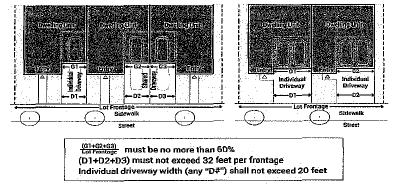
(c) The garage, driveway, or off-street parking is located more than 100 feet from a street.
(6) Garages. All detached garages and carports shall not protrude beyond the front building facade.
(7) Driveways. The total width of all driveway approaches shall not exceed 32 feet per frontage, as measured at the property line. Individual driveway approaches shall not exceed 20 feet in width.
(8) Collector Road Access. Town requirements for driveway separation and access from collector streets and arterial streets shall apply.
(9) Entries. Each building shall incorporate a primary building entry or one or more private unit entries, such as a covered porch or recessed entry. Each entry shall feature minimum weather protection of three feet by three feet.
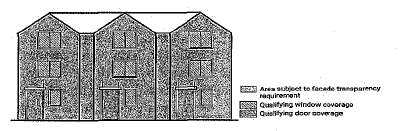
(10) Windows and Doors. A minimum of 15 percent of the area of the street-facing facade elevation shall include windows or doors. Facades separated from the street by a dwelling or located more than 100 feet from a street are exempt from this standard.
[Ord. 900 § 2 (Att. A (§ 7)), 2025]
19.25.071 Supplemental regulations for courtyard buildings.
(1) Provide at least one common open space (not including parking areas or vehicular areas) that is bordered by dwelling units on two or three sides.
(2) Common open space a minimum dimension of 15 feet on any side.
(3) Ground-related courtyard apartments feature a covered pedestrian entry, such as a covered porch or recessed entry, with a minimum weather protection of three feet, facing the street or common open space. [Ord. 900 § 2 (Att. A (§ 7)), 2025]
19.25.072 Supplemental regulations for cottage housing.
(1) Maximum net floor area of 1,600 square feet per cottage unit excluding attached garages.
(2) Minimum 20 percent or 300 square feet per cottage of common open space that may include private open space and setbacks that is not less than 15 feet on any side and bordered by cottages on at least two sides.
(3) At least half of the cottage units abut a common open space and have the primary entrance facing the common open space.
(4) A roofed porch per cottage unit at least 60 square feet in size with a minimum dimension of five feet on any side facing the street and/or common open space.
(5) Contain no more than one community building of no more than 2,400 square feet of net floor area excluding attached garages with no minimum off-street parking requirement. [Ord. 900 § 2 (Att. A (§ 7)), 2025]
19.25.080 Supplemental R, CL, TC zone infrastructure standards for middle housing.
(1) Transportation. Regulations for driveways, frontage improvements, alley improvements, and other transportation public works and engineering standards shall not be more restrictive for middle housing than for detached single-family residences, except as addressed by this chapter.
(2) Lot Access/Road Standards.
(a) Private driveway access shall be permitted for middle housing development with any number of units when a fire apparatus access road is within 150 feet of all structures on the lot and all portions of the exterior walls of the first story of the buildings, as measured by an approved route around the exterior of the buildings.
(b) When a fire apparatus road is not within 150 feet of all structures on the lot, subsection (2)(a) of this section does not apply and one of the following conditions must be met:
(i) The building is equipped throughout with an approved automatic sprinkler system meeting International Fire Code requirements.
(ii) No more than two units are accessed via the same private driveway.
(iii) Fire apparatus access roads cannot be installed because of location on property, topography, waterways, nonnegotiable grades or other similar conditions, and an approved alternative means of fire protection is provided.
(c) Private driveways shall not be required to be wider than 12 feet and shall not be required to have unobstructed vertical clearance more than 13 feet, six inches except when it is determined to be in violation of the International Fire Code or other fire, life, and safety standards, such as sight distance requirements.
(d) Private driveway access, separate from access to an existing home, shall be permitted unless it is determined to be in violation of the fire code or other fire, life, safety standards, such as sight distance requirements.
(e) This section is not intended to limit the applicability of the adopted fire code, except as otherwise presented in this section. [Ord. 900 § 2 (Att. A (§ 7)), 2025]
19.25.090 Accessory dwelling unit (ADU).
(1) ADUs may be allowed in any zone on a lot where a dwelling unit exists as a permitted use if the ADU complies with the requirements listed in this chapter. Two ADUs are permitted on all lots that are located in all zoning districts that allow for dwelling units. ADUs can be categorized as either attached or detached. An ADU may be created by any one or a combination of the following methods:
(a) A separate unit within an existing home (such as in an attic or basement); or
(b) An addition to the home (such as a separate apartment unit with a separate entrance); or
(c) In a separate detached structure on the lot (such as but not limited to a new or converted garage).
(2) The town shall not prohibit the sale or other conveyance of a condominium unit independently of a principal unit solely on the grounds that the condominium unit was originally built as an ADU.
(3) An ADU shall not be less than 400 square feet nor greater than 1,000 square feet in area.
(a) The ADU sizing is calculated per the 2021 (or currently adopted edition) International Building Code (IBC) which is the inside perimeter of the exterior walls of the building under consideration, exclusive of vent shafts and courts, without deduction for corridors, stairways, ramps, closets, the thickness of interior walls, columns or other features. Areas that are less than five feet in height are not counted in the ADU square footage. Additionally, garages are not counted in the ADU square footage.
(4) An ADU, and any accessory structures for the ADU such as but not limited to garages, carports, or workshops, shall comply with the underlying zoning district for the dwelling unit located on site, including height, setbacks, floor area, accessory buildings, and lot coverage, except as provided in this section.
(a) One on-site parking stall is required for an ADU. However, no parking is required when either improved public street parking is available on at least one side of the lot whereon the ADU is proposed, or the ADU is within one-half mile walking distance to a “major transit route.” If the lot abuts an alley or private access easement, parking shall be accessed from the alley or private access easement except when the town planner determines that such access is environmentally constrained.
(5) For detached ADUs, a minimum of five feet separation from the existing dwelling unit is required.
(6) Any utility lines being installed or altered must have their connections inspected as part of the building permit process.
(7) Attached ADUs may use the water meter and side sewer that was permitted for the existing dwelling unit. However, all detached ADUs shall have their own water meter and side sewer connection. If fire sprinklers are required, the property owner shall install a backflow prevention device behind the water meter.
(8) All water and sewer system charges shall apply for any new connection and/or modifications to the existing water and sewer system(s) for an ADU.
(9) ADUs are not permitted on lots that are not connected to and served by public water and sewer.
(10) Existing structures, including but not limited to detached garages, may be converted into ADUs even if they violate current code requirements for setbacks or lot coverage; provided, that the existing structure(s) proposed to be converted into an ADU may be required to be brought into conformance with current building and fire code requirements. Existing detached structures proposed to be converted to ADUs shall not be located across property lines or within the right-of-way.
(11) Addressing of the existing dwelling unit shall be changed to identify the existing dwelling unit as “Unit A” and the new ADU as “Unit B” prior to issuance of a certificate of occupancy (CO).
(12) An approved building permit is required to construct an ADU. The building permit must comply with the town’s adopted building code, fire code, zoning code, critical area regulations, environmental regulations, and stormwater regulations adopted at time permitting is sought.
(13) When property corners are not known, the town planner may require the applicant to hire a Washington State licensed land surveyor to reestablish property corners.
(14) Detached ADUs may be sited on a rear/side lot line only if the lot line abuts an open and accessible public alley pursuant to RCW 36.70A.681(1)(i).
(15) ADUs are permitted on any lot that meets the zone’s minimum lot size required for a dwelling unit.
(16) Eligible properties can have one dwelling unit and two ADUs, for a maximum total of three dwelling units. ADUs can be in any configuration of attached or detached units.
(17) Owner occupancy is not required for either the existing dwelling unit or any ADUs existing and/or proposed.
(18) All attached ADUs are required to have their own separate entrance(s) from the existing dwelling unit. Additionally, attached ADUs are required to be separated internally from the existing dwelling unit by solid wall construction that meets both building and fire code.
(19) ADUs shall be designed so that the appearance of the building containing the principal residence remains that of a single-family residence. At a minimum, the ADU shall match the exterior materials, design, and pitch of the roof of the principal residence.
(20) ADUs shall comply with the maximum permitted height for the underlying zone. In the residential zone however, attached ADUs shall not exceed 35 feet above average original grade. Detached ADUs in the residential zone shall not exceed 28 feet average original grade.
(21) Homeowners with existing nonpermitted ADUs must apply for a building permit to make them legal. Units that are not legalized will be subject to enforcement. Pre-existing units must meet the same requirements as new ADUs, including but not limited to zoning, parking, fire, and building code standards/regulations.
(22) RVs, including park model trailers, shall not be used as ADUs.
(23) ADUs are exempt from the density requirements of the underlying zone.
(24) If applicable, impact fees and connection fees associated with the construction of an ADU shall not be greater than 50 percent of the fees that would be imposed on the dwelling unit.
(25) Short Term Rental (STR) Regulations. ADUs shall not be used as short-term rentals (STR) for less than six months (180 days) within a calendar year.
(26) Appeals. There is no appeal of the town planner’s determination regarding whether to issue a building permit to construct an ADU on a subject property in accordance with CMC 18.08.030(3). [Ord. 900 § 2 (Att. A (§ 7)), 2025]
19.25.100 Preexisting lots.
Any lot of any size can be used for a building site, subject to the regulations governing the use district in which it is located, if it was officially recorded in town or county offices as a single lot prior to the adoption of the ordinance codified in this title, provided it has 30-foot frontage on a public street or access to a public street by a 20-foot-wide private lane. Once vacant adjacent substandard lots are considered in common ownership, they cannot revert to original lots of substandard size. [Ord. 900 § 2 (Att. A (§ 7)), 2025]
19.25.110 Special height restrictions.
(1) There shall not be anything constructed or reconstructed, and no obstruction permitted to grow, other than a post, column, or tree not exceeding one foot square or one foot in diameter, between a height three feet and 10 feet above the established grade within the triangular areas described below, without the express approval of the town engineer:
(a) The triangular area formed by a line 20 feet along the right-of-way lines of two intersecting streets, measured from the point of intersection of the right-of-way lines, and the line connecting the two ends of the two 20-foot lines;
(b) The triangular area formed by a line 15 feet along the street right-of-way line measured from the point of intersection of the alley right-of-way line and a line 15 feet along the alley right-of-way line measured from the point of intersection of the street and alley right-of-way lines and the line connecting the unconnected ends of the two lines.
(2) In general, no fence, hedge, structure, or other obstruction shall act as a sight hazard to traffic, and the town engineer may order the removal of such hazard whether or not such object otherwise complies with the provisions of this title. [Ord. 900 § 2 (Att. A (§ 7)), 2025]
19.25.120 Obstructions – Generally prohibited.
(1) In no case shall any fence and/or hedge be constructed or grown, within a distance of three feet, around any fire hydrant; as well as no fence or hedge shall deter or hinder the fire department from gaining access to any fire department connection, fire protection control valve, fire hydrant, or fire department appliance or device.
(2) In no case shall any fence and/or hedge obstruct the visibility of any fire hydrant from a distance of 150 feet, in any direction, of vehicular approach to the hydrant.
(3) In no case shall any fence and/or hedge be constructed or grown in a manner which interferes with access to storm or sanitary sewer manholes and other appurtenances which require access for maintenance purposes. [Ord. 900 § 2 (Att. A (§ 7)), 2025]
19.25.130 Marquees.
In the CL, TC, and I districts, the projection of marquees to the property line shall not be considered a violation of the building setback requirements. Marquees must conform to the construction requirements as set forth in the building code. [Ord. 900 § 2 (Att. A (§ 7)), 2025]
19.25.140 Fences.
(1) Fences providing a maximum six-foot sight obstruction from adjacent properties can be built on the side rear property lines and across the front of the property in line with the front of a building but not closer than 20 feet to the street right-of-way. Corner lots must observe the 20-foot setback on both streets. From the 20-foot line to the street right-of-way, solid fences a maximum of three feet high, measured from the ground on which the fence stands, are permitted and open rail fences a maximum of four feet, six inches high, measured from the ground on which the fence stands, are permitted in which the rails and posts constitute not more than one-third of the fence area.
(2) Electric fences are permitted in the R district by conditional use on approval only. [Ord. 900 § 2 (Att. A (§ 7)), 2025]
19.25.150 Yards.
(1) The following may project into required yards:
(a) Fireplace structures, bay windows, garden windows, enclosed stair landings, closets, framed fireplace shafts or similar projections not wider than eight feet measured in the general direction of the wall of which it is a part: 18 inches into any yard;
(b) Uncovered porches and platforms which do not extend above the floor level of the first floor: 18 inches into side yards and six feet into the front yard and rear yard, provided they may extend three feet into the side yard when they do not exceed 18 inches in height above the finished grade;
(c) Covered porches and entries may intrude five feet into the front and rear yards;
(d) Balconies and bay windows may extend three feet into the front and rear yards;
(e) Planting boxes or masonry planters not exceeding 42 inches in height may intrude into any required front yard;
(f) Eaves shall not protrude more than 24 inches into any minimum required yard;
(g) Required parking areas may be located in the side and rear yards.
(2) Special Front Yard Depth. If buildings occupy 50 percent or more of the frontage in any block, and are on one side of the street, then the depth of the front yard required by this title shall be disregarded on that side of the street in such block, and in lieu thereof the depth of front yard required on each lot therein shall be not less than average depth of the front yards. This shall apply to residentially zoned property only. [Ord. 900 § 2 (Att. A (§ 7)), 2025]
19.25.160 Design review guidelines.
The planning director, in consultation with the town council, shall adopt design review guidelines consistent with the comprehensive plan and other adopted town policies by administrative rule, which shall provide supplementary review criteria for land use decisions, no later than six months following the effective date of this title. [Ord. 900 § 2 (Att. A (§ 7)), 2025]
19.25.170 Home occupations.
(1) General. A “home-based business” means a lawful occupation carried on entirely within a residence as a clearly secondary use involving the occupant(s) and conducted in such a manner as to not manifest any outward appearance or characteristic of a business in the ordinary meaning of the term.
(2) Intent. It is the intent of this section to recognize the needs of citizens who are engaged in small-scale business ventures which could not be sustained if it were necessary to rent or lease commercial space, or which, in the nature of the home-based business, cannot be expanded to full-scale enterprise.
(3) Application. Home-based businesses are required to have a business license issued by the town clerk-treasurer, comply with all state, county, and federal laws and town ordinances. The license shall not be transferred, nor shall it be valid at any address other than the one appearing on the license. (Any home-based business dealing with used merchandise is advised to additionally obtain a second-hand license from the town clerk-treasurer for the owner’s protection from any potential liability for any items of undetermined origin. See Chapter 19.60 RCW and Chapter 5.08 CMC.)
(4) The use of the dwelling unit for a home-based business shall be clearly incidental and subordinate to its use for residential purposes.
(5) The home-based business shall be fully enclosed within the primary residential structure or its accessory building(s).
(6) No persons other than the current residents of the structure and one nonresident employee at any one time may be employed in the home-based business.
(7) There shall be no exterior window displays, storage of materials, or sample commodities displayed outside of the premises that take away from the residential nature of the neighborhood.
(8) No equipment or process shall be used in such home-based business which creates noise, vibration, glare, smoke, dust, fumes, odors, heat or electrical interference with any radio or television receivers, or causes fluctuation in line voltage off the premises which would exceed that normally produced by a single-family residence.
(9) No parking shall be allowed beyond that normal to a residential area and no excessive vehicular or pedestrian traffic shall be present as a result of the home-based business.
(10) Signs may be placed within the residential property operating a home-based business, informing others of the business, if no larger than two square feet and unlighted.
(11) Some examples of home-based businesses include, but are not necessarily limited to, the following:
(a) Dressmaking, seamstresses, upholstery, tailors;
(b) Artists and sculptors;
(c) Authors and composers;
(d) Resident owned and operated beauty and/or barbershop;
(e) Home crafts, such as model-making, rug weaving, lapidary work and cabinet making;
(f) Office facility of a salesperson, sales representative, or manufacturer’s representative;
(g) Office facility of an accountant, tax preparer or investment counselor;
(h) Repair shop for household items;
(i) Telephone answering or soliciting;
(j) Computer programming and small scale repair;
(k) Internet auctions;
(l) Home cooking and preserving;
(m) Musical instruction;
(n) Child care;
(o) Other similar uses may be permitted which the planning director finds compatible with the purpose and intent of this section.
(12) The following uses are deemed to be prohibited home-based businesses without the issuance of a conditional use permit from the town council:
(a) Clinics and hospitals;
(b) Mortuaries or funeral homes;
(c) Commercial print shops;
(d) Rental of trailers;
(e) Restaurants and cafes;
(f) Stables and kennels;
(g) Commercial vehicle repair, paint and body or detailing shops;
(h) Outdoor storage of building or construction materials not intended for immediate use in or on the premises;
(i) Uses involving the handling, treatment, or storage of hazardous waste, as defined in RCW 70.105.010; and
(j) All other uses which do not comply with the intent of subsection (2) of this section.
(13) For the purpose of this section, garage and yard sales shall not be considered a home-based business, so long as the sale involves only the sale of noncommercial items and the sale does not continue for more than four consecutive days in any calendar month and it is not in violation of any other provisions of the Concrete Municipal Code.
(14) Decisions of the town planner may be appealed to the town council. [Ord. 900 § 2 (Att. A (§ 7)), 2025]
19.25.180 Recreational vehicle parks.
(1) Purpose. The purpose of this section shall be to ensure that recreational vehicle parks are located, developed, and occupied in accordance with standards and regulations which will protect the health, safety, general welfare, and convenience of the occupants of such parks and the citizens of the town of Concrete.
(2) General Requirements.
(a) No recreational vehicle shall be occupied overnight unless the same is parked inside an approved recreational vehicle park or has an approved town of Concrete RV temporary visitor permit for locations outside of approved recreational vehicle parks.
(b) No recreational vehicle within a recreational vehicle park shall be occupied for commercial purposes.
(c) No recreational vehicle or site within a recreational vehicle park shall be occupied by more than six persons.
(d) No recreational vehicle, except for the on-site manager’s, shall be used as a permanent place of abode, or dwelling, for indefinite periods of time. No recreational vehicle shall remain in the park for more than 14 days in any 60-day period unless the town council approves an extended stay permit. Any action toward removal of wheels of a recreational vehicle, except for temporary purposes of repair, or placement of an on-site manager’s unit or a restroom unit on a foundation is hereby prohibited.
(e) No external appurtenances, such as carports, cabanas or patios, may be attached to any recreational vehicle while it is in a park.
(f) No space within a recreational vehicle park shall be rented for any purpose other than those expressly allowed by this section.
(g) No person, company or corporation shall establish or modify a recreational vehicle park without first complying with the provisions of this section.
(3) Criteria for Locating a Recreational Vehicle Park. Recreational vehicle parks may only be established on property within the town of Concrete which meets the following criteria:
(a) Recreational vehicle parks are allowed in the CL commercial/light industry and P public lands zoning district.
(b) The minimum site area of a park shall be two acres.
(c) After development, the conditions of the soil, groundwater level, drainage, and topography shall not create hazards to the property or to the health or safety of the occupants.
(d) Property under the jurisdiction of the Shoreline Management Act shall be excluded from development of recreational vehicle parks if it is designated as being in the natural environment.
(e) Parks shall be located with direct access to an arterial or collector street or a state highway and with appropriate frontage thereon to permit appropriate design of entrances and exits. No entrance or exit from a park shall be permitted through a residential district, nor require movement of traffic from the park through a residential district.
(4) Conditional Use Permit Required. A recreational vehicle park shall be allowed only upon the issuance of a conditional use permit (CMC 19.68.130) by the town council. The owner, operator and occupants of a recreational vehicle park shall develop and use the park in strict compliance with the conditions imposed by the permit. The town shall maintain continuing jurisdiction for the review and enforcement of said conditions.
(5) Health Department Approval Required. Prior to occupancy of a recreational vehicle park, the owner shall obtain all required permit(s) from the Skagit County health department and comply with all rules, regulations and requirements of said department. Said permit must be kept current at all times, subject to the park being closed. The rules, regulations and requirements of the health department shall be construed as being supplements to the provisions of this section.
(6) Final Site Plan. A site plan shall be submitted with all applications for a recreational vehicle park. Said site plan shall be subject to review, modification, approval or denial by the town council. An approved final site plan shall constitute an integral part of the permit for the recreational vehicle park and shall be binding upon the owner of the property, its successors and assigns. All development within the recreational vehicle park shall be consistent with the final site plan. Such plans may be modified or amended at the request of an owner upon receiving administrative approval by the town planner; provided, that if said modification or amendment affects the external impacts of the recreational vehicle park or is determined by the town planner to be substantial in nature, then such modification or amendment shall be resubmitted to the town council as a conditional use permit application/amendment pursuant to CMC 19.68.130(4)(b).
(7) Completion Prior to Occupancy – Phasing. All required site improvements and other conditions of the permit and final site plan shall be met prior to occupancy of any site by a recreational vehicle; provided, that completion may be accomplished by phases if such phases are identified and approved in the conditional use permit.
(8) Design Standards. The purpose of this subsection is to establish minimum design standards for recreational vehicle parks.
(a) Density. The number of recreational vehicles permitted in a park shall not exceed a density of 20 units per gross acre. The town council may limit density further to ensure compatibility with the surrounding areas.
(b) Space Size and Design. Each individual recreational vehicle site shall be not less than 800 square feet in size and shall not include any common areas, roadways, walkways, or landscape areas. Spaces may include:
(i) Pull-through spaces (20 feet in width and 60 feet in length); and
(ii) Back-in spaces (20 feet in width and 40 feet in length).
Tent areas may be provided in addition to the recreational vehicle spaces.
(c) Access Points. Entrances and exits to the park shall be designed for safe and convenient movement of traffic into and out of the park and to minimize friction with free movement of traffic on adjacent streets. All traffic into and out of the park shall be through such entrances and exits. No entrance or exit shall require a turn at an acute angle for vehicles moving in the direction intended, and radii of curbs and pavements at intersections shall be such as to facilitate easy turning movements for vehicles with trailers attached.
(d) Parking. At least one parking space shall be provided on each site including tent sites. At least one parking space for each 20 sites shall be provided for visitor parking in the park.
(e) Internal Park Roads. All internal park roads shall be privately owned and maintained. They shall be constructed to all-weather standards, as approved by the city engineer and public works director. Park roads shall have a minimum improved width as follows:
(i) One-way road, no parking, 15 feet;
(ii) Two-way road, 20 feet;
(iii) Where on-street parking may be allowed, add eight feet of width for each side of the street where parking is proposed.
(f) Open Space/Recreational Facilities. A minimum of 20 percent of the site shall be set aside and maintained as open space for the recreational use of park occupants. Such space and location shall be accessible and usable by all residents of the park for passive or active recreation. Parking spaces, driveways, access streets, and storage areas are not considered to be usable open space. The 20 percent requirement may be reduced if substantial and appropriate recreational facilities (such as recreational buildings, swimming pool or tennis courts) are provided.
(g) Setbacks. No recreational vehicle site shall be closer than 35 feet from any exterior park property line abutting upon an arterial or collector street, state highway, shoreline, or residential zone, or 10 feet from any other exterior park property line. Permanent structures within a park shall have minimum front and rear yards of 20 feet each, and minimum side yards of 10 feet each.
(h) Landscaping/Screening.
(i) The park shall provide visual screening and landscaping as required in perimeter setback areas and open space. Landscaping may consist of suitable groundcover, shrubs and trees; provided, that they are installed prior to the first occupancy of the park and are of such species and size as would normally fulfill a screening function within five years of being planted. Site development shall be sensitive to the preservation of existing vegetation;
(ii) The minimum width for perimeter landscaping and screening shall be 10 feet for all exterior park property lines. It shall be designed and maintained to be aesthetically pleasing, and functional for site screening and noise buffering;
(iii) Where needed to enhance aesthetics or to ensure public safety, recreational vehicle parks shall be enclosed by a fence, wall, earth mound or by other designs which will complement the landscape and assure compatibility with the adjacent environment;
(iv) All trees, flowers, lawns and other landscaping features shall be maintained by the park management in a healthy, growing condition at all times.
(i) Signs. Signs and advertising devices shall be prohibited in recreational vehicle parks except:
(i) If the park is visible from Highway 20, one on-site identification sign complying with the standards of Chapter 19.63 CMC;
(ii) One identifying sign at each entrance of the park which may be indirectly lit but not flashing. Said sign shall comply with Chapter 19.63 CMC;
(iii) Directional and information signs for the convenience of occupants of the park.
(j) Utilities. Electricity shall be provided to each recreational vehicle site and include 20, 30 and 50 amperages. All utility lines in the park shall be underground and shall be approved by the agency or jurisdiction providing the service.
(k) Storm Drainage. Storm drainage control facilities shall be subject to approval by the city engineer and shall comply with the city’s storm sewer code.
(l) Public Facilities. Recreational vehicle parks shall provide the following public facilities in such quantity, size and location as is approved by the town council in approving the conditional use permit:
(i) A water distribution system to all spaces connected to the city’s water utility;
(ii) A water station for filling recreational vehicle water storage tanks;
(iii) A sanitary waste station for emptying sewage holding tanks of recreational vehicles;
(iv) Refuse containers for solid waste in adequate quantity provided by the town’s solid waste collector. Park garbage shall be picked up daily by park personnel, who shall also maintain the path free of any uncontrolled garbage;
(v) Restroom Facilities. Restroom facilities containing showers and toilets, when provided in the park, shall connect to the town’s sewer utility. The minimum number of facilities provided shall be one commode and one shower for each 20 recreational vehicle sites.
Management headquarters (which may include a recreational vehicle), recreational facilities, restrooms, dumping stations, showers, coin-operated laundry facilities, and other uses and structures customarily incidental to operation of a recreational vehicle park are permitted as accessory uses to the park.
(9) Park Administration.
(a) The owner of a recreational vehicle park shall be responsible for the development and maintenance of the park in strict conformity with the site plan and the conditional use permit, and all applicable laws and town ordinances. Each park shall have an on-site manager available 24 hours per day, seven days per week.
(b) A written management plan shall be submitted for approval as a part of the conditional use permit process. It shall include, at a minimum, the proposed management structure, proposed park rules and regulations, and proposed methods to enforce occupancy limitations and other requirements of this section.
(10) Park Maintenance and Storage. Each RV park shall at all times keep a neat appearance. Except for the allowed vehicles, there shall be no outside storage of materials or equipment belonging to the park or to any of the guests. [Ord. 900 § 2 (Att. A (§ 7)), 2025]
19.25.190 Development and permit requirements for mobile food vans and espresso stands.
(1) Permit Required. Mobile food vans and espresso stands shall be allowed only upon the issuance of a temporary use permit, as set forth herein, by the town council. The permit is valid for a period of six months. If an extension is requested, the town council shall review the operation and may renew the permit if no complaints or adverse impacts have been identified. Problems identified with the operation shall be corrected prior to review and approval of the permit to renew.
(2) Application Process. Application for a temporary use permit shall be processed and reviewed by the town planner for completeness and recommendation, prior to the issuance of a permit by the town council.
(3) Application Contents. All applications shall include a detailed, scaled site plan indicating, at a minimum, the location of the mobile van or stand, the ingress/egress to the property, traffic pattern, etc., location of all utilities, restroom facilities, solid waste facilities, signage, and landscaping. All required improvements to the property shall conform to the regulations and standards adopted by the town, including those identified herein.
(4) Size. The maximum size for mobile vans and espresso stands, including accessory structures, shall not exceed 200 square feet.
(5) Setbacks. Setbacks for mobile vans, stands and accessory canopies and facilities are as follows: front yard setbacks shall conform to setbacks of the zoning district in which the use is located. Side yard and rear yard setbacks shall be 20 feet from property lines or buildings located on the property.
(6) Service Lanes. Service lanes and vehicular stacking for each drive-up lane shall provide for a minimum of three cars and shall not conflict with the existing parking or traffic patterns on the property or adjacent street.
(7) Restroom Facilities. Restroom facilities to be used by the mobile food van or espresso stand employees shall be contained within the unit or located within 200 feet of the unit and within the same zoning district. If tables and chairs are provided for customer use, on-site restroom facilities shall be provided meeting the standards of the Skagit County health department. Restrooms must be open at all times during operation of the van or stand. A letter from the property owner of the restroom facility shall be required with the application, and prior to issuance of the temporary permit.
(8) Health Department Approval Required. Skagit County health department approval and permit(s) for the operation of the van or stand and restroom facility shall be required with the application and prior to the issuance of the temporary permit.
(9) Building Permit. Any on-site construction shall be required to obtain a town of Concrete building permit.
(10) Business License Required. A town of Concrete business license shall be required prior to issuance of the temporary use permit.
(11) Conditions for Operation. All permits, on-site improvements and conditions of approval shall be completed prior to operation of the mobile van or stand.
(12) Cancellation of Permit. Temporary use permits may be cancelled by the town at any time, if violations of the permits or any conditions occur.
(13) Permit Fee. The fee for temporary use permits for mobile food vans and espresso stands is established at $25.00, with a renewal fee of $10.00. [Ord. 900 § 2 (Att. A (§ 7)), 2025]