


Chapter 23.58
PARKING
Sections:
23.58.030 Permit requirements.
23.58.040 General parking regulations.
23.58.050 Number of parking spaces required.
23.58.060 Parking reduction programs.
23.58.080 Compact car requirements.
23.58.090 Parking design and development standards.
23.58.100 Bicycle parking requirements.
23.58.110 Off-street loading requirements.
23.58.120 Electric vehicle charging.
23.58.010 Purpose.
This chapter establishes regulations which provide for safe, attractive, and convenient off-street parking and loading and ensure that parking areas are compatible with surrounding land uses. [Ord. 26-2006 §3, eff. 8-11-2006]
23.58.020 Applicability.
Except as otherwise provided in adopted development agreements, specific plans, or the like, off-street parking and loading provisions of this chapter shall apply as follows:
A. New Development. For all buildings or structures erected and all uses of land established after the effective date of the ordinance codified in this title, parking and loading facilities shall be provided as required by this chapter. Except as otherwise specifically conditioned, projects with unexpired land use and development approvals on the effective date of the ordinance codified in this title have the option of meeting the parking requirements of this title in effect on the project approval date or being subject to the provisions required herein.
B. Change in Use. When the use of any building, structure, or premises is changed, increasing the intensity such that the change creates an increase of more than ten (10%) percent in the number of off-street parking spaces required by the change, additional off-street parking spaces shall be provided in accordance with the requirements of this chapter.
C. Modification to Existing Structures. Whenever an existing building or structure is modified such that it creates an increase of more than ten (10%) percent in the number of off-street parking spaces required by the modification, additional off-street parking spaces shall be provided in accordance with the requirements of this chapter. However, if said building or structure was erected prior to the effective date of the ordinance codified in this title, additional parking or loading facilities shall be mandatory only in the amount by which the requirements for the new use would exceed those for the existing use if the latter were subject to the parking and loading provisions of this title. [Ord. 8-2011 §26(A), eff. 6-24-2011; Ord. 26-2006 §3, eff. 8-11-2006]
23.58.030 Permit requirements.
A. Building Permit. New parking lot design and modifications to existing parking lots in conjunction with a substantial change in use to an existing structure shall be reviewed in conjunction with the building permit and any other land use or development permit required for the project.
B. Zoning Clearance. Modification or improvement to an existing parking lot that impacts the parking space layout, configuration, or number of stalls shall require zoning clearance to authorize the change as consistent with this title. Specifically, the designated approving authority shall review proposed plans for initial paving, resurfacing, and/or restriping of off-street parking areas that alter the number and/or configuration of parking spaces or corresponding landscape planters for multifamily and nonresidential uses.
C. Exempt Activities. Parking lot improvements listed below shall be considered minor in nature in that they do not alter the number or configuration of parking stalls. Such improvements shall be exempt from permit requirements.
1. Repair of any defects in the surface of the parking area, including holes and cracks.
2. Resurfacing, slurry coating, and restriping of a parking area with identical delineation of parking spaces.
3. Repair or replacement in the same location of damaged planters and curbs.
4. Sprinkler line repair or refurbishment of landscaped areas with similar plant species. [Ord. 26-2006 §3, eff. 8-11-2006]
23.58.040 General parking regulations.
A. Location Requirements for Off-Street Parking Spaces.
1. Except as otherwise permitted herein, all required off-street parking spaces shall be accessible to and located on the same lot as the use and/or development requiring such spaces.
2. Required off-street parking spaces shall not be located within any required front yard or required street-side yard setback of any parcel. However, parking spaces in addition to the first two (2) required (pursuant to Table 23.58-2) may be allowed in the front and street-side side yards of single-family residential lots (including in residential, agricultural-residential, and agricultural zones) in compliance with all of the following conditions:
a. Vehicle parking (and access thereto) in residential areas shall be on permanent paved or other approved impervious surface that prevents the infiltration of stormwater consistent with EGMC Section 23.58.090. Exceptions may be granted when a pervious surface is required to reduce the impact within the dripline of a protected tree.
b. Parking is not permitted within any required side, rear, and street-side setback area pursuant to Division III, Zoning Districts, Allowable Uses, and Development Standards, of this title. Parking is permitted in the front yard setback area. Also see maximum impervious surface area for residential property in EGMC Chapter 23.54, Landscaping.
c. Parking may not occur within any required clear-vision triangle area on a corner lot.
3. Except as otherwise provided in this title, the City may, through approval of a special parking permit as provided in EGMC Section 23.16.037, allow for a portion or all of the vehicle parking required by this chapter to be provided by on-street parking spaces. Each on-street parking space, where permitted, shall be defined as twenty-five (25' 0") lineal feet of unrestricted curb.
B. General Use Provisions for Off-Street Parking Spaces.
1. Required off-street parking spaces shall not be used for any purpose that at any time would prevent vehicles from parking in required parking spaces, except as permitted by EGMC Chapter 23.92 (Temporary Uses).
2. Parking facilities shall be used for automobile parking only. No sales, dead storage, repair work, dismantling, or servicing of any kind shall be permitted without necessary permits for such use. The only exception to this rule is for temporary use of parking areas when the remaining number of unobstructed parking spaces complies with the minimum parking requirements for the permanent use(s) of the property in accordance with Table 23.58-2.
3. Residential Guest Parking. For residential tenant and guest parking, the spaces must be marked per the required minimum standards for tenant and guest parking.
C. Parking Regulations for Vehicles, Trailers, and Vessels.
1. Inoperable/Unregistered Vehicles, Trailers, and Vessels. Any vehicle, trailer, or vessel which is inoperable and/or unregistered shall be stored consistent with the following standards. These requirements do not apply to farm equipment located on property zoned for agricultural use or to auto vehicle dismantling facilities.
a. Operable vehicles, trailers, and vessels with registration expired three (3) months or less shall be stored either within an enclosed structure or shall be parked in designated parking areas of the lot (e.g., outside of required yard areas on permanent paved or other approved impervious surface consistent with the provisions of subsection (A)(2) of this section).
b. Inoperable vehicles, trailers, and vessels and those vehicles, trailers, and vessels with registration expired for a period greater than three (3) months shall be stored within an enclosed structure. No such vehicle shall be stored in any actual yard.
2. Commercial Vehicle Parking. Commercial vehicles weighing four (4) tons or more are prohibited on any street or parcel within a residential or agricultural-residential zoning district or neighborhood except long enough for typical residential delivery and pickup, moving, and towing. Commercial vehicles weighing less than four (4) tons may be permitted in residential zoning districts and neighborhoods consistent with applicable provisions of this title. See EGMC Chapter 23.82, Home Occupations.
3. Recreational Vehicle, Trailer, and Vessel Parking. Recreational vehicles, trailers, and vessels of an owner, tenant, guest, or visitor may be parked on any highway (street) for a maximum period of seventy-two (72) hours as provided in EGMC Section 10.24.070(B). Any request to extend this period for guests and visitors shall be submitted in writing to the Chief of Police for consideration and authorization. Recreational vehicle, trailer, and vessel storage is prohibited in required front and street side yards except as provided in EGMC Section 23.84.031. Vehicle owners are advised to verify that vehicles are parked consistent with any applicable covenants, conditions, and restrictions applicable to that subdivision.
However, recreational vehicle, trailer, and vessel parking is permitted outside of required front and street side yard setback areas and within interior side and rear yards when screened by a solid six (6' 0") foot tall fence, wall, and/or landscape barrier. Note, the street side yard shall extend the length of the lot all the way to the rear property line and shall take precedence over the required rear yard area. Screening shall be consistent with EGMC Chapter 23.52, Fences and Walls. The screening requirement does not apply to parcels with two (2) or more gross acres or within the Rural Area Community Plan area.
D. Tandem Parking. Tandem parking shall not be permitted to satisfy off-street parking requirements, except within mobile home parks and for single-family residential uses when located outside required yard setback areas with spaces and access paved in accordance with requirements of this chapter to the satisfaction of the designated approving authority. [Ord. 16-2021 §4 (Exh. B), eff. 9-10-2021; Ord. 28-2019 §3 (Exh. A), eff. 2-7-2020; Ord. 6-2019 §3 (Exh. A), eff. 4-26-2019; Ord. 14-2017 §3 (Exh. C), eff. 6-23-2017; Ord. 31-2014 §3 (Exh. A), eff. 2-13-2015; Ord. 19-2012 §3, eff. 11-9-2012; Ord. 12-2012 §9, eff. 7-27-2012; Ord. 8-2011 §26(B), eff. 6-24-2011]
23.58.050 Number of parking spaces required.
A. Off-Street Parking Requirements. The City’s off-street parking requirements are listed by land use classifications in Table 23.58-2. Except as otherwise specifically stated, the following rules apply to Table 23.58-2:
1. “Square feet” means “gross square feet” and refers to building area unless otherwise specified.
2. Where parking spaces are required based on a per employee ratio, this shall be construed to be the total number of employees on the largest working shift.
3. For the purpose of calculating residential parking requirements, dens, studies, or other similar rooms that may be used as bedrooms shall be considered bedrooms.
4. Where the number of seats is listed to determine required parking, seats shall be construed to be fixed seats. Where fixed seats provided are either benches or bleachers, such seats shall be construed to be not more than eighteen (18") linear inches for pews and twenty-four (24") inches for dining, but in no case shall seating be less than determined as required by the Uniform Building Code.
B. Minimum Parking Requirements. Unless off-street parking reductions are permitted consistent with EGMC Section 23.58.060 (Parking reduction programs) or subsection (I) of this section (Reduced parking ratio), the number of off-street parking spaces required in Tables 23.58-1 and 23.58-2 shall be considered the minimum necessary for each use. In conjunction with discretionary development permits, the designated approving authority may increase these parking requirements if it is determined that these requirements are inadequate for a specific project. By the same token, the designated approving authority may decrease the required parking for a specific use in accordance with EGMC Section 23.16.037, Parking reduction permit.
C. Uses Not Listed. The number of parking spaces required for uses not specifically listed in Table 23.58-2 shall be determined by the Development Services Director based on common functional, product, or compatibility characteristics and activities, as provided in EGMC Section 23.26.020(E), Uses Not Listed/Similar Uses.
D. Calculation/Rounding of Quantities. When the calculation of the required number of off-street parking spaces results in a fraction of a space, the total number of spaces shall be rounded to the nearest whole number (< 0.49 round down, > 0.50 round up).
E. Mixed-Use/Multiple Tenants. Except as otherwise provided in this chapter, for each separate use on a site with multi-tenants, or a combination of principal uses in any one facility, the development shall provide the aggregate number of parking spaces for each separate use. Shopping centers may include up to ten (10%) percent restaurant use parked at the retail ratio of four and one-half (4.5) spaces per one thousand (1,000 ft2) square feet. Any increase in restaurant use will require additional parking as listed in Table 23.58-1. Said calculation is made on an aggregate basis.
|
Percent of Total Square Footage for Restaurant |
Parking Ratio |
|---|---|
|
0 – 10% |
4.5 spaces/1,000 sf. |
|
10.1 – 25% |
5.0 spaces/1,000 sf. |
|
25.1 – 35% |
5.5 spaces/1,000 sf. |
Note:
1. Shopping centers with more than 35 percent restaurant use shall provide parking for the additional restaurant use in accordance with required parking standards.
F. New Buildings or Development Projects without Known Tenants. If the type of tenants that will occupy a nonresidential building are not known at the time of the development entitlement or building permit approval, the amount of parking shall be the minimum number of spaces required by Table 23.58-2 for the most intense land use allowed within the underlying zoning district that can reasonably be accommodated within the entire structure/project as determined by the Development Services Director. The designated approving authority may grant exceptions to this rule where the use or other restrictions ensure adequate parking is provided (e.g., rezone agreements).
G. Tenant Spaces with Multiple Functions. When a tenant of a building has several functions, such as retail and office space, the amount of parking for the tenant shall be calculated as required in Table 23.58-2 for the primary use, using the gross floor area of the building.
H. Tenant Spaces with Accessory Storage. When a tenant has enclosed accessory storage in excess of 2,000 square feet, the required parking for that portion of the tenant space dedicated to storage shall be calculated as specified in Table 23.58-2 for warehousing use (in addition to the parking requirements for the primary use of the building).
I. Reduced Parking Ratio. The designated approving authority may approve through a parking reduction permit (EGMC Section 23.16.037) a reduced parking ratio from that listed in Tables 23.58-1 and 23.58-2. Such reduced parking ratio shall be based upon a qualified parking study, prepared at the applicant’s expense and subject to City review and concurrence, of substantially similar use(s) in similar operational and locational conditions.
|
Land Use |
Minimum Required Parking Spaces |
|---|---|
|
Residential Uses |
|
|
Caretaker Housing |
1 space/bedroom |
|
Dwelling, Multiple Residential Unit |
|
|
Studio and one-bedroom units |
1.0 spaces/unit, plus 1 guest space/6 units |
|
Two-bedroom units |
1.75 spaces/unit, plus 1 guest space/6 units |
|
Three-bedroom units |
2.0 spaces/unit, plus 1 guest space/6 units |
|
Four- or more bedroom units |
2.5 spaces/unit, plus 1 guest space/6 units |
|
Senior product |
0.5 spaces/unit, plus 1 guest space/4 units |
|
Dwelling, Accessory Unit |
1 space/unit |
|
Dwelling, Junior Accessory Unit |
No additional parking required |
|
Dwelling, Single Residential Unit |
|
|
<5 bedrooms |
2 spaces/unit1 |
|
≥5 bedrooms |
3 spaces/unit1 |
|
Dwelling, Two (2) Residential Unit |
|
|
Generally |
2 spaces/unit1 |
|
When created pursuant to EGMC Chapter 23.30 or EGMC Section 22.20.100 |
1 space/unit2 |
|
Dwelling, Single and Two (2) Residential Unit Guest Parking in Development with Private Streets and No On-Street Parking |
1 space/unit |
|
Employee Housing, Large |
1 space/unit |
|
Employee Housing, Small |
1 space/unit |
|
Guest House |
1 space/unit |
|
Home Occupations |
None required |
|
Live-Work Facility |
1 space/unit, plus that required for nonresidential area |
|
Mobile Home Park |
2 spaces/unit, plus 1 guest space/8 home lots |
|
Organizational Houses |
1 space/bedroom |
|
Rooming and/or Boarding Houses |
1 space/bedroom |
|
Single Room Occupancy (SRO) Facilities |
1 space/bedroom |
|
Supportive Housing |
1 space/bedroom |
|
Transitional Housing |
2 spaces/unit1, 2, 3 |
|
Human Services Uses |
|
|
Adult Day Health Care Center |
1 space/employee, plus 1 space/facility vehicle, plus 1 space/8 persons at facility capacity |
|
Child Care Facility, Child Care Center |
1 space/employee, plus 1 space/facility vehicle, plus 1 space/8 persons at facility capacity |
|
Child Care Center, Family Day Care Home |
No requirement beyond single-family requirement |
|
Community Care Facility, Large |
1 space/employee, plus 1 space/facility vehicle, plus 1 space/8 persons at facility capacity |
|
Community Care Facility, Small |
1 space/employee, plus 1 space/facility vehicle, plus 1 space/8 persons at facility capacity |
|
Emergency Shelter |
1 space/40 beds |
|
Medical Marijuana Cultivation |
Not applicable |
|
Medical Marijuana Dispensary |
Not applicable |
|
Medical Services, Extended Care |
1 space/employee, plus 1 space/facility vehicle, plus 1 space/8 persons at facility capacity |
|
Medical Services, General (Clinics, Offices, and Labs) |
1 space/250 sf. |
|
Medical Services, Hospitals |
2 spaces/licensed bed |
|
Residential Care Facility for the Elderly, Large |
1 space/employee, plus 1 space/facility vehicle, plus 1 space/8 persons at facility capacity |
|
Residential Care Facility for the Elderly, Small |
1 space/employee, plus 1 space/facility vehicle, plus 1 space/8 persons at facility capacity |
|
Residential Care Facility for the Chronically Ill, Large |
1 space/employee, plus 1 space/facility vehicle, plus 1 space/8 persons at facility capacity |
|
Residential Care Facility for the Chronically Ill, Small |
1 space/employee, plus 1 space/facility vehicle, plus 1 space/8 persons at facility capacity |
|
Agriculture, Animal Keeping, and Resource Uses |
|
|
Animal Husbandry |
None required |
|
Animal Keeping – Exotic |
Not applicable |
|
Animal Keeping – Fowl |
Not applicable |
|
Animal Keeping – Household Pets |
Not applicable |
|
Animal Keeping – Livestock |
Not applicable |
|
Crop Production |
5 spaces/roadside stand |
|
Crop Production, Urban, < 1 Acre |
None required |
|
Crop Production, Urban, ≥ 1 Acre |
1 space |
|
Equestrian Facility, Commercial |
1 space/4 stables |
|
Equestrian Facility, Hobby |
None required |
|
Feed Lot |
4.5 spaces/1,000 sf. |
|
Hog Farm – Commercial |
3 spaces, plus 1 space/employee |
|
Kennels, Commercial |
1 space/250 sf. |
|
Kennels, Hobby |
None required |
|
Slaughterhouse |
3 spaces, plus 1 space/employee |
|
Veterinary Facility |
4.5 spaces/1,000 sf. |
|
Recreation, Open Space, Education, and Public Assembly Uses |
|
|
Assembly Uses |
Greater of: 1 space/3 fixed seats or 1 space/50 sf. for nonfixed seats in the main assembly area |
|
Cemeteries, Mausoleums |
Greater of: 1 space/3 fixed seats or 1 space/50 sf. for nonfixed seats in the main assembly area |
|
Community Garden |
1 space/5,000 sf. lot area |
|
Crematories |
Greater of: 1 space/3 fixed seats or 1 space/50 sf. for nonfixed seats in the main assembly area |
|
Golf Courses/Clubhouse |
10 spaces/hole, plus 1.5 spaces/driving range tee station |
|
Indoor Amusement/Entertainment Facility |
1 space/600 sf. |
|
Indoor Shooting Range |
1 space/range position, plus 1 space/250 sf. of retail area |
|
Fitness and Sports Facilities |
1 space/200 sf. |
|
Libraries and Museums |
1 space/400 sf. |
|
Mortuaries and Funeral Homes |
1 space/4 seats in main assembly area |
|
Outdoor Commercial Recreation |
Determined through design review |
|
Parks and Public Plazas |
For sites over 10 acres, 5% of the total site area; otherwise none required |
|
Private Residential Open Space |
For sites over 10 acres, 5% of the total site area; otherwise none required |
|
Recreational Vehicle Parks |
1.5 spaces/travel trailer/RV site |
|
Resource Protection and Restoration |
None required |
|
Resource-Related Recreation |
1 space/10,000 sf. land area, minimum 4 spaces |
|
Schools |
|
|
Academic – Charter |
Greater of: 2 spaces/classroom or 1 space/5 seats in the main assembly area |
|
Academic – Private |
Greater of: 2 spaces/classroom or 1 space/5 seats in the main assembly area |
|
Academic – Public |
Greater of: 2 spaces/classroom or 1 space/5 seats in the main assembly area |
|
Colleges and Universities – Private |
1 space/2 students (maximum student capacity, plus 1 space/employee) |
|
Colleges and Universities – Public |
1 space/2 students (maximum student capacity, plus 1 space/employee) |
|
Equipment/Machine/Vehicle Training |
1 space/2 students, plus 1 space/employee |
|
Specialized Education and Training/Studios |
1 space/2 students, plus 1 space/employee |
|
Theaters and Auditoriums |
Greater of: 1 space/3 fixed seats or 1 space/30 sf. |
|
Utility, Transportation, and Communication Uses |
|
|
Airport |
Determined through design review |
|
Broadcasting and Recording Studios |
1 space/250 sf. |
|
Bus and Transit Shelters |
None required |
|
Fuel Storage and Distribution |
2 spaces per 3 employees (during a maximum shift) plus space to accommodate all trucks and other vehicles |
|
Heliports |
Determined through design review |
|
Park and Ride Facility |
None required |
|
Parking Facility |
Not applicable |
|
Public Safety Facility |
Determined through design review |
|
Telecommunication Facility |
None required |
|
Transit Facilities |
Determined through design review |
|
Transit Stations and Terminals |
Determined through design review |
|
Utility Facility and Infrastructure |
None required |
|
Retail, Service, and Office Uses |
|
|
Adult-Oriented Business |
Greater of: 1 space/3 fixed seats or 1 space/250 sf. |
|
Agricultural Tourism |
4.5 spaces/1,000 sf. accessible to the public |
|
Alcoholic Beverage Sales |
4 spaces/1,000 sf. |
|
Ambulance Service |
1 space/250 sf., plus 1 space/service vehicle |
|
Animal Sales and Grooming |
1 space/350 sf. |
|
Art, Antique, Collectable |
1 space/350 sf. |
|
Artisan Shops |
1 space/350 sf. |
|
Banks and Financial Services |
|
|
Generally |
1 space/350 sf. |
|
Stand-alone ATMs |
1 space/machine |
|
Bars and Nightclubs |
1 space/3 fixed seats, plus 1 space/50 sf. assembly area |
|
Bed and Breakfast Inns |
1 space/guest room, plus 2 spaces/resident owner or manager |
|
Building Materials Stores and Yards |
4 spaces/1,000 sf. |
|
Business Support Services |
4 spaces/1,000 sf. |
|
Call Centers |
7 spaces/1,000 sf. |
|
Card Rooms |
1 space/2 seats in play area |
|
Convenience Stores |
4 spaces/1,000 sf. |
|
Drive-in and Drive-through Sales and Service |
|
|
Non-Restaurant use |
None required |
|
Restaurant, with sit-down dining |
See restaurant requirement |
|
Restaurant, no sit-down dining |
1 space/employee plus 1 space |
|
Equipment Sales and Rental |
1 space/350 sf. interior sales area, plus 1 space/1,000 sf. exterior sales and storage area |
|
Garden Center/Plant Nursery |
3 spaces/1,000 sf. |
|
Grocery Store |
4 spaces/1,000 sf. |
|
Hotels and Motels |
1 space/room |
|
Maintenance and Repair Service |
1 space/350 sf. |
|
Neighborhood Market |
4 spaces/1,000 sf. |
|
Offices Accessory Building Trade Contractors Business and Professional |
4 spaces/1,000 sf. |
|
Pawn Shop |
1 space/350 sf. |
|
Personal Services |
Greater of: 1 space/350 sf. or 2/chair |
|
Personal Services, Restricted |
Greater of: 1 space/350 sf. or 2/chair |
|
Restaurants |
Greater of: 1 space/3 fixed seats or 1 space/60 sf. dining area |
|
Retail Accessory General, large format General, medium format General, small format Superstore Superstore, large format Warehouse/club |
4 spaces/1,000 sf. |
|
Smoke Shops |
4 spaces/1,000 sf. |
|
Thrift Store |
4 spaces/1,000 sf. |
|
Automobile and Vehicle Uses |
|
|
Auto and Vehicle Rental |
1 space/500 sf., plus 1 space per rental vehicle |
|
Auto and Vehicle Sales |
1 space/500 sf. |
|
Auto and Vehicle Sales, Wholesale |
1 space/1,000 sf., minimum 2 spaces |
|
Auto and Vehicle Storage |
1 space/2,000 sf., plus one/company-operated vehicle |
|
Auto Parts Sales |
4 spaces/1,000 sf. |
|
Auto Vehicle Dismantling |
3 spaces, plus 1 space/employee |
|
Car Washing and Detailing |
|
|
Full-Service |
Greater of: 10 spaces or 3 times internal washing capacity |
|
Self-Service |
2 spaces/wash bay |
|
Fueling Station |
None required; see convenience stores and vehicle services as appropriate |
|
Vehicle Services |
2 spaces/service bay |
|
Major |
|
|
Minor |
|
|
Industrial, Manufacturing, and Processing Uses |
|
|
Agricultural Products Processing |
1 space/500 sf., plus one/company-operated vehicle |
|
Distribution, Logistics, and Delivery Center |
1 space per 2,000 sf., plus one/company-operated vehicle |
|
Freight Yard/Truck Terminal |
1 space/500 sf., plus one/company-operated vehicle |
|
Laundry and Dry Clean Plant |
1 space/500 sf., plus one/company-operated vehicle |
|
Manufacturing Major Minor Small Scale |
1 space/500 sf., plus one/company-operated vehicle |
|
Printing and Publishing |
1 space/500 sf., plus one/company-operated vehicle |
|
Recycling Facility Collection, Small Collection, Large Processing Scrap and Dismantling |
1 space/200 sf. of office space, plus 1 space/employee |
|
Research and Development |
4 spaces/1,000 sf. |
|
Storage |
|
|
Personal Storage Facility |
4 spaces |
|
Warehouse |
1 space per 2,000 sf. |
|
Yards |
2 spaces per facility, plus 1 space per 250 sf. of office |
|
Wholesaling |
1 space/2,000 sf., plus one/company-operated vehicle |
|
Wineries, Distilleries, and Brewery |
1 space/500 sf., plus one/company-operated vehicle; see retail, general for publicly accessible retail space |
Notes:
1. At least two (2) parking spaces shall either be enclosed or covered.
2. No parking is required if the lot is located within one-half (1/2) mile walking distance of either a high-quality transit corridor, as defined in subdivision (b) of Section 21155 of the Public Resources Code, or a major transit stop, as defined in Section 21064.3 of the Public Resources Code; or if there is a car share vehicle located within one (1) block of the lot.
[Ord. 13-20221 §3 (Exh. A), eff. 6-24-2022; Ord. 12-20221 §3 (Exh. A), eff. 6-24-2022; Ord. 16-2021 §4 (Exh. B), eff. 9-10-2021; Ord. 28-2019 §3 (Exh. A), eff. 2-7-2020; Ord. 6-2019 §3 (Exh. A), eff. 4-26-2019; Ord. 14-2017 §3 (Exh. C), eff. 6-23-2017; Ord. 24-2015 §11 (Exh. I), eff. 2-12-2016; Ord. 31-2014 §3 (Exh. A), eff. 2-13-2015; Ord. 23-2014 §3 (Exh. A), eff. 10-10-2014; Ord. 8-2011 §26(C), eff. 6-24-2011; Ord. 28-2007 §3, eff. 10-26-2007; Ord. 26-2006 §3, eff. 8-11-2006]
23.58.060 Parking reduction programs.
Qualifying development projects listed herein may request a reduction in the minimum number of parking spaces required, provided they include facilities, programs, or services that reduce the overall parking demand for the site, contingent upon approval of a parking reduction permit from the designated approving authority pursuant to EGMC Section 23.16.037.
A. Facilities and Programs. A proponent of an office, commercial or industrial project may provide alternative facilities or programs which serve to reduce parking demand in return for a reduction in vehicle parking requirements. Vehicle parking requirements may be reduced in accordance with the following provisions:
1. Shower/Locker Facilities. Developments with one hundred (100) or more employees may reduce their parking requirement by providing shower and clothing locker facilities for bicycle commuting employees. Maximum reduction: two (2%) percent of required parking.
2. Secure Bicycle Parking. Developments which provide additional secure bicycle parking facilities over and above the minimum requirement may reduce their parking requirement by one (1) vehicle space for every three (3) additional bicycle spaces provided. Maximum reduction: two (2%) percent of required parking if short-term bicycle parking spaces are provided, four (4%) percent of required parking if long-term/end-of-trip bicycle parking spaces are provided.
B. Preferred Carpool/Vanpool Parking Spaces. Office or industrial developments which guarantee preferred parking spaces (e.g., covered, shaded, or near building entrance) to employees who participate regularly in a carpool or vanpool may reduce their parking requirement by one (1) vehicle space for every one (1) space which is marked and reserved for carpools/vanpools at a preferred location. Maximum reduction: two (2%) percent of required parking.
C. Proximity to Alternative Modes. Off-street vehicle parking reductions may also be granted when the applicant for a single or combined use can prove to the designated approving authority that the proximity of the facility to alternative modes of transportation justifies the requested parking reduction.
D. Shared Parking. Shared parking solutions are encouraged. Multiple uses may use joint parking facilities when operations for the respective uses are not normally conducted during the same hours, or when hours of peak use differ. A request for the use of shared parking must meet the following conditions:
1. Located in a common parking lot or off site convenient to the use(s) requiring the parking; and
2. The applicant is able to show through a qualified parking study that there shall be no substantial conflicts between the subject uses with regard to principal hours of operation and periods of peak parking demand. A possible option for determining shared parking arrangements includes the Urban Land Institute publication “Shared Parking”; and
3. Right of joint use shall be evidenced by a deed, lease, contract, or similar written instrument that shall be approved as to form by the City Attorney upholding such joint use; and
4. In no instance shall the total parking required be less than would be required for any one (1) of the independent uses.
E. Vehicle Park-and-Ride Lot Requirements at Shopping Centers. Up to ten (10%) percent of the required number of parking spaces for retail stores/shopping centers may be contractually committed to be used for park-and-ride purposes without affecting the total parking requirement of the center. This parking reduction cannot be combined with any other parking reduction program and cannot be applied to parking lots that do not meet the minimum required parking requirements in accordance with EGMC Section 23.58.050, do not meet the parking design and development standards in accordance with EGMC Section 23.58.090, or have been issued any other approval that reduces the amount of parking on site.
F. A religious institution affiliated housing development project may take advantage of the following provisions. For purposes of this section, the terms “housing development project,” “place of worship,” “public transit,” “religious institution,” “religious institution affiliated housing development project,” and “religious-use parking spaces” shall have the same meaning as provided in Section 65913.6 of the Government Code. This parking reduction is separate and apart from any development concession or incentive provided under EGMC Chapter 23.50 (Density Bonus and Other Development Incentives).
1. A religious institution affiliated housing development project is not required to replace religious-use parking spaces that are eliminated as part of that housing development, provided the number of religious-use parking spaces being eliminated does not exceed fifty (50%) percent of the number of religious-use parking spaces that are available at the time of permit application.
2. Any parking spaces available for the remaining religious use may count towards the required parking for the housing development project. Notwithstanding the foregoing, the City shall not allow the remaining religious-use parking spaces to count toward the number of parking spaces otherwise required for approval of the housing development project as provided herein to the extent that application of subsection (E)(4) of this section would prohibit City from requiring up to one (1) parking space per unit.
3. The curing of any preexisting deficit in the number of religious-use parking spaces shall not be imposed as a condition of approval of the housing development and the City shall not deny the parking reduction solely on the basis of the reduction in the total number of parking spaces available at the place of worship provided the total reduction does not exceed fifty (50%) percent of the existing parking spaces.
4. The reduction in parking spaces shall not reduce the minimum parking standards below one (1) space per unit; provided, however, that this limitation shall not apply to any religious institution affiliated housing development project if either of the following is true:
a. The parcel is located within one-half (1/2) mile walking distance of public transit; or
b. There is a car share vehicle located within one (1) block of the parcel. [Ord. 16-2021 §4 (Exh. B), eff. 9-10-2021; Ord. 14-2017 §3 (Exh. C), eff. 6-23-2017; Ord. 15-2014 §3 (Exh. A), eff. 8-22-2014; Ord. 8-2011 §26(D), eff. 6-24-2011]
23.58.070 Handicapped parking requirements.
Repealed by Ord. 20-2018. [Ord. 26-2006 §3, eff. 8-11-2006]
23.58.080 Compact car requirements.
Up to thirty-five (35%) percent of the required number of parking spaces may be sized for compact cars, and shall be clearly marked, “COMPACT.” Compact parking spaces shall be distributed throughout the parking lot. [Ord. 26-2006 §3, eff. 8-11-2006]
23.58.090 Parking design and development standards.
A. Surface Parking. All surface parking areas, other than those provided in a garage or parking structure, shall have the following improvements:
1. Paving and adequate drainage facilities as specified by the City Engineer.
2. Clear signage and pavement markings to indicate entrances, exits, aisle directions, and other features required to ensure the safe movement of vehicles.
3. Parking areas for commercial, industrial, and multiple-family residential uses, not including duplexes and single-family residences, shall be designed so that vehicles are not permitted to back out of the parking area onto a public street.
4. Landscaping. Landscaping shall be provided in compliance with EGMC Chapter 23.54, Landscaping.
5. Lighting. Parking areas shall have lighting capable of providing adequate illumination for security and safety. Lighting fixtures shall be energy-efficient. Lighting standards shall be in scale with the height and use of the on-site structure(s). All illumination, including security lighting, shall be directed downward, away from adjacent properties and public rights-of-way in compliance with EGMC Chapter 23.56, Lighting.
6. Vehicle Overhang. Vehicular overhang is permitted, provided no vehicle shall overhang into a sidewalk which would reduce the unencumbered width of a sidewalk to less than four (4' 0") feet. A vehicle is permitted to overhang into a landscaped area by two (2' 0") feet; provided, that the required landscape area is extended by two (2' 0") feet.
B. Access to Parking. Access to parking areas and curb cuts for driveways shall be approved by the Development Services Director and City Engineer to ensure an efficient and safe traffic flow into the parking areas and along public streets.
C. Dead-End Aisles. Dead-end aisles are discouraged. When used, ninety (90) degree angle stalls are required and the aisle shall have a minimum five (5' 0") foot backing area.
D. Parking Space and Aisle Dimensions. All parking areas shall be designed so that the parking spaces are permanently maintained and have suitable maneuvering space and access to and from a public street or alley. The dimensions of each parking space shall be determined from Table 23.58-3 and Figure 23.58-1:
|
Parking Stall Type |
Minimum Stall Dimensions |
Minimum Width for Drive Aisle with Parking(c) |
Minimum Width for Emergency Access Drive Aisles(c) |
||
|---|---|---|---|---|---|
|
Width(a)1, 2 |
Length(b) |
One-Way |
Two-Way |
||
|
Standard parallel |
9 ft. |
24 ft. |
12 ft. |
20 ft. |
20 ft. |
|
Standard 45-degree |
9 ft. |
19 ft. |
16 ft. 4 in. |
20 ft. |
20 ft. |
|
Standard 60-degree |
9 ft. |
19 ft. |
19 ft. |
20 ft. |
20 ft. |
|
Standard 90-degree |
9 ft. |
19 ft. |
20 ft. |
25 ft. |
20 ft. |
|
Compact |
9 ft. |
16 ft. |
20 ft. |
25 ft. |
20 ft. |
Notes:
1. Where parking stalls abut each other such that they may create vehicular movement conflicts, as determined by the City, the minimum stall width shall be increased to eleven (11' 0") feet. Examples of such conflicts include, but are not limited to, stalls oriented at a ninety (90) degree angle to each other.
2. Accessible spaces shall be designed consistent with California Building Code requirements and EGMCTitle 16.
Figure 23.58-1
Parking Space and Drive Aisle Dimensions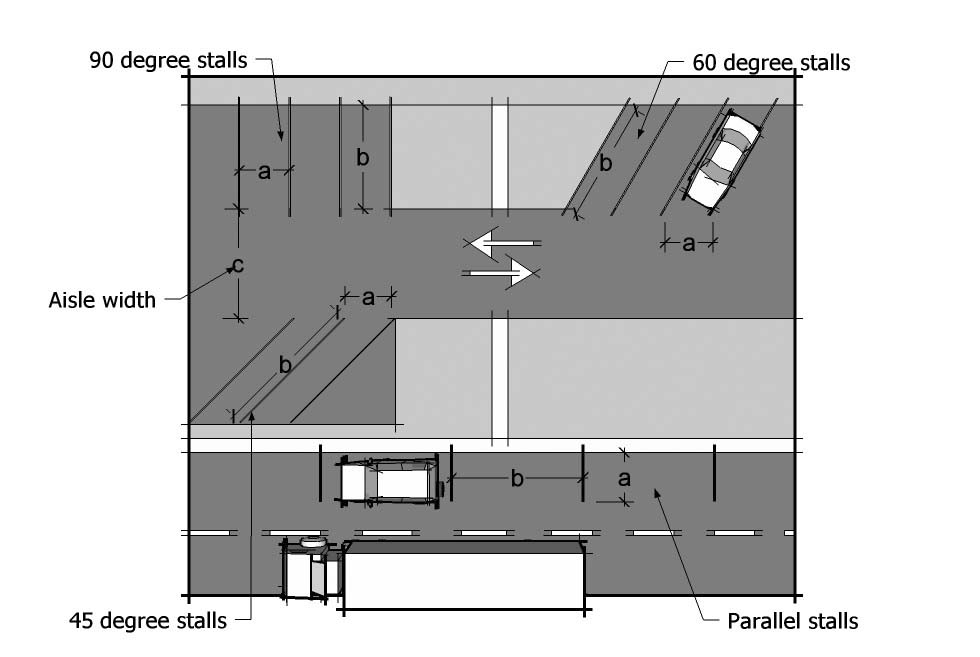
[Ord. 20-2018 §3 (Exh. A), eff. 11-9-2018; Ord. 24-2015 §11 (Exh. I), eff. 2-12-2016; Ord. 26-2006 §3, eff. 8-11-2006]
23.58.100 Bicycle parking requirements.
A. Bicycle parking shall be provided for all multifamily projects and nonresidential uses in compliance with this chapter. Except as otherwise provided herein, bicycle parking requirements apply to both short-term and long-term bicycle parking facilities as defined in EGMC Chapter 23.100 (Definitions). The City encourages the construction of long-term/end-of-trip bicycle parking facilities for large employment centers and uses with over fifty (50) employees. No minimum number of long-term/end-of-trip bicycle parking spaces is required, but if provided a development may receive additional reductions in required vehicle parking spaces, as outlined in EGMC Section 23.16.037. Generally, bicycle parking shall be located on a paved surface, within fifty (50' 0") feet of a primary building entrance and in a visibly secure and well-lit location either adjacent to or within the building. However, the designated approving authority may allow for exceptions to the minimum distance and/or alternative locations that meet the intent of providing short- and long-term bicycle parking that is convenient and highly visible.
B. Bicycle parking shall consist of at least a stationary bicycle rack, typically a vertical metal bar, where the cyclist supplies a padlock and chain or cable to secure the bicycle to a stationary object. Where located within a building, bike racks may also be wall mounted.
C. Bicycle parking is required for multifamily, public and civic facilities, schools, retail commercial, office and industrial uses in accordance with Table 23.58-4. In no case shall there be fewer than two (2) employee bicycle spaces and two (2) patron spaces, unless specifically exempt.
|
Land Use Type |
Required Parking Spaces |
|---|---|
|
Multifamily Residential |
|
|
Complexes of any size |
1 space/3 units |
|
Community Civic |
|
|
Public and civic facilities |
10% of required vehicle space |
|
Schools |
25% of enrollment capacity |
|
Commercial |
|
|
Retail |
5% of required vehicle spaces |
|
Office |
1 space/25 vehicle spaces |
|
Industrial |
|
|
Industrial |
1 space/25 vehicle spaces |
D. Bicycle Parking Facility Standards.
1. Short-Term Bicycle Parking. Short-term bicycle parking spaces are intended for short periods of time and are usually targeted to visitors, customers, and other short-term users.
a. Short-term bicycle parking may consist of floor, wall, or ceiling bike racks.
b. Bike racks should enable the bicycle frame and one (1) wheel to be locked to the rack with a standard U-shaped lock or cable.
c. Racks must be securely anchored to the ground, wall or ceiling.
d. The location and configuration of bike racks may not impede pedestrian or vehicular circulation.
e. Racks shall be configured to provide ease of use – racks shall not be placed too close to a wall or obstruction so as to make use difficult.
2. Long-Term Bicycle Parking. Long-term bicycle parking spaces are intended for periods of time longer than several hours and are targeted to employees, residents, and other long-term users.
a. Long-term bicycle parking may consist of storage lockers, locked rooms or enclosures, or bicycle parking areas internal to a building.
b. If long-term bicycle parking is located in an area not easily visible from the main entrance of a building, a safe access route from the main entrance to the bike parking facility, with adequate lighting and signage, shall be provided.
c. Long-term bicycle facilities shall be of sufficient width and length for parking of bicycles, with space for maneuvering. When located indoors in a dedicated room, bicycle racks may be wall mounted.
d. The location and configuration of long-term bicycle facilities may not impede pedestrian or vehicular circulation.
e. Long-term bicycle parking facilities within a vehicle parking garage shall be located to maximize security in a highly visible area or in proximity to a parking attendant.
E. Alternative Compliance. Upon written request by the applicant, the Development Services Director may approve alternative compliance from the provisions of this chapter, which may include, but is not limited to, a reduction or deviation in the number, type, or location of the required bicycle parking, and may include a waiver of the requirement. Considerations used in the determination may include, but are not limited to:
1. Physical site planning constraints;
2. Proximity to existing bicycle parking;
3. Projects that cannot be classified into the provided land use categories;
4. Provision of enhanced bicycle facilities provided in the development;
5. Inclusion of the site within a larger development for which adequate bicycle parking is already provided; or
6. Unforeseen circumstances or individual land use changes. [Ord. 24-2015 §11 (Exh. I), eff. 2-12-2016; Ord. 15-2014 §3 (Exh. A), eff. 8-22-2014; Ord. 26-2006 §3, eff. 8-11-2006]
23.58.110 Off-street loading requirements.
A. Purpose of Loading Area Requirements. The purpose of these regulations is to provide the number, size, location, and screening requirements for loading areas in various types of developments and uses. The intent of these regulations is to minimize disruptions of traffic flow and vehicular and pedestrian conflicts through adequate sizing and siting of these facilities.
B. Loading Areas for Goods and Materials. The following regulations shall apply to loading areas for goods and materials. Examples include, but are not limited to, loading docks and delivery areas.
1. When Loading Regulations Apply. This regulation applies to all industrial, commercial, office, and similar land uses. Buildings or tenant spaces smaller than ten thousand (10,000 ft2) square feet in size are exempt from the requirements of this section.
2. General Loading Area Requirements. The number of required loading spaces is based on the use of the building and the building size, minus any residential component square footage, as described in Table 23.58-5 (Required Minimum Loading Spaces). Where two (2) or more uses are located on the same premises, the number of loading area spaces required is the sum of the spaces required for each use.
|
Land Use |
Loading Spaces Required |
|---|---|
|
Industrial Uses |
1 space for the first 10,000 square feet and 1 space for each additional 20,000 square feet |
|
Commercial Uses |
1 space for the first 10,000 square feet and 1 space for each additional 35,000 square feet |
|
Office and Similar Uses |
1 space for each building 10,000 square feet or more |
3. Loading Area Standards.
a. The loading space(s) required by this section may be constructed as either a dock (where a truck may back up directly to a building or platform and goods may be unloaded from the floor of the truck to the floor of the building or platform without the use of a ramp or lift gate) or designated loading area (a paved area so designated with appropriate striping and/or signage), as appropriate for the use/development, subject to approval of the designated approving authority.
b. Loading spaces shall be at least ten (10' 0") feet in width and thirty-five (35' 0") feet in length, with fourteen (14' 0") feet of vertical clearance.
c. Loading areas shall comply with the setback and perimeter landscaping and screening standards as provided in EGMC Chapter 23.54, Landscaping.
d. Loading and maneuvering areas shall be hard-surfaced unless a permeable surface is required to reduce surface runoff, as determined by the City.
e. Parking of passenger vehicles may be allowed in off-street loading areas subject to specific time limits to prevent conflicts with off-street loading activities. If parking is allowed, the parking time limits shall be clearly posted. These parking spaces shall not count toward meeting the general parking requirements.
D. Passenger Loading Areas. Public parking areas for major development projects shall designate a passenger loading area or areas for embarking and disembarking passengers from ridesharing vehicles. Such passenger loading areas shall be located at the point(s) of primary pedestrian access from the parking area to the adjacent building, or buildings, and shall be designed in such a manner that vehicles waiting in the loading area do not impede vehicular circulation in the parking area. The passenger loading areas shall be designed as a turnout as indicated by Figure 23.58-2 and shall be large enough to accommodate the number of waiting vehicles equivalent to one-half (0.5%) percent of the required parking for the project.
Figure 23.58-2
Passenger Loading Area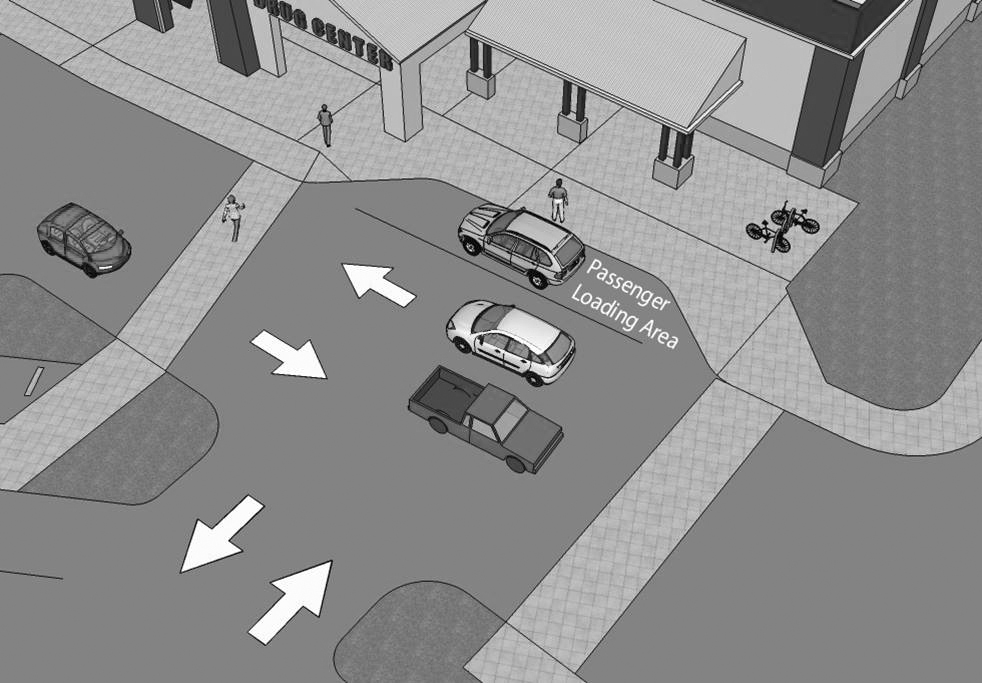
[Ord. 28-2019 §3 (Exh. A), eff. 2-7-2020; Ord. 26-2006 §3, eff. 8-11-2006]
23.58.120 Electric vehicle charging.
A. Requirements.
1. Electric vehicle (EV) parking for residential and nonresidential uses shall be provided in compliance with this section. The City requires the construction of parking spaces that are electric vehicle ready (EV ready), electric vehicle capable (EV capable), or that include electric vehicle supply equipment (EVSE), as further defined herein, installed for all new development, changes in use or modifications to existing structures as identified in EGMC Section 23.58.020.
2. All plans for applicable design review applications (major and minor) shall identify the proposed location(s) for EVSE, EV capable, and EV ready spaces, as applicable, consistent with the requirements of this section.
3. Installation of EV ready, EV capable, and EVSE shall conform to the requirements of EGMC Chapter 16.07, the California Green Building Code, including without limitation Sections 4.106.4, 5.106.5.3, and 5.106.5.4, as applicable, and the California Electrical Code, including without limitation Article 625.
4. The electric vehicle charging requirements set forth herein are intended to reflect the electric vehicle charging requirements set forth in the 2022 California Building Standards Code, Title 24 of the California Code of Regulations. State law shall govern in the event of any inconsistency relating to electric vehicle charging requirements between the 2022 California Building Standards Code and this chapter.
B. Exceptions. On a case-by-case basis, the City may determine EV charging and infrastructure are not feasible where there is no local utility power supply, the local utility is unable to supply adequate power or where the off-site power supply costs would be prohibitively expensive. Such determination shall be made by the designated approving authority for the subject project based upon a recommendation, if made, by the electrical service provider. Accessory dwelling units that are not subject to additional parking requirements are also exempt.
C. Residential, Single and Two (2) Residential Unit. To allow for the future installation of EVSE for use by the resident, a minimum of one (1) “EV ready” space is required per unit to be located in a garage or other parking area serving the new dwelling.
D. Multiple Residential Unit, Hotels/Motels, and Residential Parking Facilities. New multifamily residential projects, hotels/motels, and residential parking facilities shall be designed and constructed to include dedicated electric vehicle parking spaces, including a minimum number of spaces with EVSE installed, as well as dedicated “EV ready” and “EV capable” spaces for future installation of additional EVSE as demand for on-site electric vehicle charging increases, in accordance with Table 23.58-6. All parking space calculations shall be rounded up to the next full space. In no event shall there be less than two (2) “EV capable” parking spaces and two (2) “EV ready” parking spaces.
|
Development Size |
Minimum EV Capable Spaces1 |
Minimum Spaces EV Ready for Future Expansion of EVSE1 |
Level 2 EVSE Installed |
|---|---|---|---|
|
New multiple residential unit with less than 20 dwelling units; hotels/motels with less than 20 sleeping units or guest rooms |
10% of the total number of parking spaces are capable of supporting future Level 2 EVSE |
25% of the total number of parking spaces shall be equipped with low-power Level 2 EV charging receptacles |
N/A |
|
New multiple residential unit with 20 or more dwelling units, hotels/motels with 20 or more sleeping units or guest rooms |
10% of the total number of parking spaces are capable of supporting future Level 2 EVSE |
25% of the total number of parking spaces shall be equipped with low-power Level 2 EV charging receptacles |
5% of the total number of parking spaces shall be equipped with Level 2 EVSE |
|
Alterations of parking facilities serving existing multiple residential unit buildings |
10% of total number of parking spaces added or altered shall be capable of supporting future Level 2 EVSE |
|
N/A |
Notes:
1. Definition is provided in EGMC Section 23.100.020.
E. All Nonresidential (Uses Other Than Previously Provided). EV capable spaces shall be provided in accordance with Table 23.58-7 for all nonresidential uses not identified in Table 23.58-6.
|
Total Number of Actual Parking Spaces |
Minimum Number of Required EV Capable Spaces1 |
Minimum Number of EV Capable Spaces with EVSE Installed2, 3 |
|---|---|---|
|
0 – 9 |
0 |
0 |
|
10 – 25 |
4 |
0 |
|
26 – 50 |
8 |
2 |
|
51 – 75 |
13 |
3 |
|
16 – 100 |
17 |
4 |
|
101 – 150 |
25 |
6 |
|
151 – 200 |
35 |
9 |
|
201 and over |
20% of total parking spaces4 |
25% of EV capable spaces |
Notes:
1. The installation of each DCFC EVSE shall be permitted to reduce the minimum number of required EV capable spaces without EVSE (column 2) by five (5).
2. The EVSE may be provided by any combination of Level 2 and direct current fast charging (DCFC), except that at least one (1) Level 2 EVSE shall be provided.
3. The number of required EV capable spaces with EVSE installed (column 3) count toward the total number of required EV capable spaces (column 2).
4. Calculations for spaces shall be rounded up to the nearest whole number.
F. Medium- and Heavy-Duty EV Charging. Warehouses, grocery stores, and retail stores with planned off-street loading spaces shall comply with the California Green Building Code Section 5.106.4 for future installation of medium- and heavy-duty EVSE. [Ord. 34-2022 §3 (Exh. A), eff. 2-10-2023; Ord. 29-2019 §3 (Exh. A), eff. 2-7-2020]
Code reviser’s note: Ords. 13-2022 and 12-2022 both amended this section and passed on the same day. Per the city, Ord. 13-2022 supersedes Ord. 12-2022.