


4-6-060 STREET STANDARDS:
A. PURPOSE:
It is the purpose of this Section to establish design standards and development requirements for street improvements to ensure reasonable and safe access to public and private properties. These improvements include appropriately scaled sidewalks related to the urban context, a range of landscape buffers, curbs, gutters, street paving, monumentation, signage, and lighting, to be developed with complete streets principles. Complete streets principles are to plan, design, and operate streets to enable safe and convenient access and travel for all users including pedestrians, bicyclists, transit riders, and people of all ages and abilities, as well as freight and motor vehicle drivers, and to foster a sense of place in the public realm with attractive design amenities. (Ord. 4521, 6-5-1995; Ord. 5517, 12-14-2009)
B. ADMINISTERING AND ENFORCING AUTHORITY:
The Community and Economic Development Administrator is responsible for the general administration and coordination of this section. (Ord. 5450, 3-2-2009; Ord. 5517, 12-14-2009; Ord. 5676, 12-3-2012)
C. APPLICABILITY:
The standards in this section will be used for all public and private street improvements within the City of Renton. Whenever a building permit is applied for or application made for a short plat or a full subdivision, the applicant for such permit and/or application shall build and install certain street improvements, including, but not limited to: lighting on all abutting rights-of-way, and all private street improvements on access easements. The minimum design standards for streets are listed in the tables set forth in subsection F2 of this Section. These standards will determine specific street improvement requirements for development projects, including short plats and subdivisions. (Ord. 5450, 3-2-2009; Ord. 5517, 12-14-2009; Ord. 5676, 12-3-2012)
D. EXEMPTIONS:
The following exemptions shall be made to the requirements listed in this Section:
1. New construction or addition with valuation less than one hundred seventy five thousand dollars ($175,000.00) (the value of which shall be reviewed in conjunction with mandatory periodic updates of the Comprehensive Plan and based on the Seattle Construction Cost Index).
2. Interior remodels of any value not involving a building addition.
3. If demonstrated as necessary to mitigate an extreme hardship not caused by the requestor. (Ord. 5676, 12-3-2012; Ord. 5703, 12-9-2013; Ord. 5867, 12-11-2017; Ord. 5907, 12-10-2018; Ord. 6128, 12-11-2023)
E. RIGHT-OF-WAY DEDICATION REQUIRED:
1. Dedication Required for Development: Where the existing width for any right-of-way abutting the development site is less than the minimum standards listed in subsection F of this Section, additional right-of-way dedication will be required for the proposed development.
2. Amount of Dedication: The right-of-way dedication required shall be half of the difference between the existing width and the minimum required width as listed in subsection F of this Section. In cases where additional right-of-way has been dedicated on the opposite side of the right-of-way from the development site in compliance with this Section, then dedication of the remaining right-of-way width to obtain the minimum width as listed in subsection F of this Section shall be required.
3. Waiver of Dedication: The Administrator may waive the requirement for additional right-of-way dedication pursuant to RMC 4-9-250C, Waiver Procedures, where it is determined by the Administrator that construction of full street improvements is not anticipated in the future. (Ord. 5517, 12-14-2009; Ord. 5676, 12-3-2012)
F. PUBLIC STREET RIGHT-OF-WAY DESIGN STANDARDS:
1. Level of Improvements: The minimum level of street improvements required are listed in the following tables including but not limited to curbs, planting strips, sidewalks, and lighting.
a. Street Lighting Exemption: No street lighting is required for the following smaller project sizes: two (2) to four (4) units for residential; zero (0) to five thousand (5,000) square feet commercial; or zero (0) to ten thousand (10,000) square feet industrial.
b. Additional Walkway Requirement: A pedestrian walkway to the arterial is required for the following larger project sizes with more than: twenty (20) units residential; ten thousand (10,000) square feet commercial; or twenty thousand (20,000) square feet industrial.
2. Minimum Design Standards for Public Streets and Alleys: All such improvements shall be constructed to the City Standards for Municipal Public Works Construction. Standards for construction shall be as specified in the following table, and by the Administrator.
|
Minimum Design Standards1 (see notes) |
Functional Classifications: Public Streets and Alleys |
||||||
|---|---|---|---|---|---|---|---|
|
|
Principal Arterial |
Minor Arterial |
Commercial-Mixed Use, Industrial, & Neighborhood Collector Arterial |
Commercial-Mixed Use & Industrial Access |
Residential Access |
Limited Residential Access |
Alleys |
|
Structural Design |
See Standard Drawing or Pavement section and may be designed using procedures described in the WSDOT Design Manual, latest edition. |
||||||
|
Average Daily Vehicle Trips (ADT) |
14,000 – 40,000 |
3,000 – 20,000 |
3,000 – 14,000 |
0 – 3,000 |
0 – 3,000 |
0 – 250 |
N/A |
|
Right-of-Way (R-O-W) |
4 lanes – 91' 5 lanes – 103' 6 lanes – 113' 7 lanes – 125' |
4 lanes – 91' 5 lanes – 103' 6 lanes – 113' 7 lanes – 125' |
2 lanes – 83' 3 lanes – 94' |
2 lanes – 69' 3 lanes – 80' |
2 lanes – 53' |
1 lane – 45' |
Res. – 16' Com. – 16' |
|
Sidewalks2 |
8' both sides3 |
8' both sides3 |
8' both sides3 |
6' both sides |
5' both sides12 |
5' both sides12 |
None |
|
Planting Strips4 |
8' between curb & walk both sides |
8' between curb & walk both sides |
8' between curb & walk both sides |
8' between curb & walk both sides |
8' between curb & walk both sides |
8' between curb & walk both sides |
None |
|
Tree grates and hardscape may be substituted for planting strip area if approved by Administrator. |
May be reduced if approved by Administrator5 |
||||||
|
Street Trees |
Required, see Street Trees Standards RMC 4-4-070 |
N/A |
|||||
|
Curbs |
Curb both sides |
Curb both sides |
Curb both sides |
Curb both sides |
Curb both sides |
Curb both sides |
None |
|
Parking Lanes |
Allowed at 8' |
Allowed at 8' |
8' both sides |
8' both sides |
6' one side6 |
6' one side6 |
|
|
Bicycle Facilities7 |
All classifications of Arterials will have Class I, or Class II, or Class III bicycle facility. |
None |
None |
None |
N/A |
||
|
Paved Roadway Width, not including parking |
4 lanes – 54' 5 lanes – 66' 6 lanes – 76' 7 lanes – 88' |
4 lanes – 54' 5 lanes – 66' 6 lanes – 76' 7 lanes – 88' |
2 lanes – 30' 3 lanes – 41' |
2 lanes – 20' 3 lanes – 31' |
2 lanes – 20' |
1 lane – 12'8 |
Res. – 12' Com. – 16' |
|
Lane Widths9 |
11' travel lanes, 5' bike lanes, and 12' center left turn lanes. |
10' travel lanes, 5' bike lanes, and 11' center left turn lanes. |
10' travel lanes |
1 travel lane – 12'8 |
Res. – 12' Com. – 16' |
||
|
Center Median |
Center median allowed for boulevard treatment and center left turn lane. Width will be width of center left turn lane minus 1' from through traffic travel lanes on both sides. Pull-outs with a minimum 25' length required for maintenance and emergency vehicles within the median at intervals of 300 – 350' |
|
|
|
N/A |
||
|
Pedestrian Bulb-outs |
Curb bulb-outs required where on-street parking is located. |
N/A |
N/A |
||||
|
Intersection Radii10 |
35' turning radius |
35' turning radius |
35' turning radius11 |
25' turning radius11 |
25' turning radius |
25' turning radius |
N/A |
|
At the intersection of two classes of streets, the radius for the higher class street is to be used. Where larger trucks, transit and school buses are anticipated, further design will be required to determine an adequate radius. The minimum curb radius is 15'. |
|||||||
|
Cul-de-sacs |
Limited application per RMC 4-6-060H. |
Limited application. See RMC 4-6-060H for pavement and R-O-W widths when permitted. |
N/A |
||||
|
Maximum Grades13 |
0.5 – 8% |
0.5 – 8% |
0.5 – 10% |
0.5 – 15%, greater than 15% only allowed within approved hillside subdivisions.13 |
0.5 – 15% |
||
|
Site Access |
Determined on a case-by-case basis. |
125' from intersection |
125' from intersection |
N/A |
N/A |
N/A |
N/A |
|
Street & Pedestrian Lighting |
Street lighting required per RMC 4-6-060I, as it exists or may be amended. |
N/A |
|||||
|
|
NOTES AND CONDITIONS: MINIMUM DESIGN STANDARDS TABLE FOR PUBLIC STREETS AND ALLEYS: 1 Minimum design standards may be altered to allow alternative stormwater management and low impact development techniques within the R-O-W by the Department. 2 Sidewalk width will be 12 feet on both sides in the City Center Community Planning Area. This sidewalk width includes street tree grates for locating street trees. To accomplish low impact development best management practices, permeable pavement may be allowed by the Administrator. 3 Sidewalk areas may be required at a wider width to accommodate required multi-use path facilities when a Class I multi-use path is required within a street R-O-W by the Department. The width of a required 5-foot bicycle lane will be transferred to the sidewalk area to create a Class I multi-use path. To accomplish low impact development best management practices permeable pavement may be allowed by the Administrator. 4 Maintenance Responsibilities. Unless otherwise agreed upon by the City of Renton, maintenance of landscaping within the planting strip area, including but not limited to elements such as groundcover, turf, softscape, and hardscape, is the responsibility of the adjacent property owner. Maintenance for street trees within the public right-of-way shall be the responsibility of the City of Renton. 5 Planting strips may be reduced if one of the following conditions is met: (a) when R-O-W acquisition is problematic; or (b) when critical areas would be impacted. If approved, a permanent alternative landscaped area should be provided equal to or greater than the allowed planting strip area reduction that is in addition to any minimum existing code requirements. 6 A second parking lane may be required by the Administrator. 7 Class II bicycle facilities (bike lanes) included in roadway width for both sides. Bicycle facilities that are shared travel lanes, Class III bicycle facilities, require less roadway width. Class III travel lanes are a minimum of 14 feet. |
||||||
|
|
8 Requirement: Either fire sprinklers shall be provided as approved by the Fire Department or a clear roadway area shall be provided for emergency vehicles midblock. All of the clear area must be 20 feet in width for vehicular movement with a minimum length of 50 feet and maximum length of 100 feet, so as to provide emergency access to homes within 150 feet. Along the clear area only, the planting strip would not be required and the clear area will be in place of the landscaping area. 9 The City may require different lane width dimensions to address safety concerns or to meet state and federal requirements for state routes or grant funding. 10 Turning radius dimensions represent the vehicle turning path. The smallest curb radius should be used while maintaining the specified turning radius. Lane width and the presence of a bike lane and parking lane affect a vehicle’s turning path. On streets with more than one lane in that direction of travel, large vehicles may encroach into no more than one-half of the adjacent travel lane to complete the turn. On Arterials and Collector Arterials, encroachment into oncoming travel lanes is unacceptable. The minimum curb radius is 15 feet. 11 Turning radius for streets which include industrial access may increase to 50 feet. 12 Sidewalks shall be provided on both sides of the street; however, the Administrator may approve sidewalks on one side of the street pursuant to RMC 4-6-060G. 13 Sidewalks may be designed to be reverse sloped away from the street; provided, that the sidewalks have a maximum long slope of 2% and are designed to drain towards a publicly owned low impact development facility along the roadway instead of directly into the street. |
||||||
(Ord. 5675, 12-3-2012; Ord. 5676, 12-3-2012; Ord. 5806, 6-20-2016; Ord. 5828, 12-12-2016)
3. Length of Improvements: Such improvements shall extend the full distance of such property to be improved upon and sought to be occupied as a building site or parking area for the aforesaid building of platting purposes and which may abut property dedicated as a public street.
4. Additional Alley Standards: Alleys may be used for vehicular access, but are not to be considered as the primary access for emergency or Fire Department concerns. Alley access is the preferred street pattern except for properties in the Residential Low Density land use designation. Refer to RMC 4-7-150.
5. Pavement Thickness: New impermeable pavement shall be a minimum of four inches (4") of asphalt over six inches (6") of crushed rock. Permeable pavement design is governed by the Surface Water Design Manual. Pavement thickness for new or repaired arterial or collector streets or widening of arterials or collector streets must be approved by the Department of Community and Economic Development. Pavement thickness design shall be based on standard engineering procedures and weight/loading requirements for emergency response vehicles. For the purposes of asphalt pavement design, the procedures described by the “Asphalt Institute’s Thickness Design Manual” (latest edition) will be accepted by the Department. Alternate design procedures or materials may be used if approved by the Department through the process listed in RMC 4-9-250E. (Ord. 5828, 12-12-2016)
6. Minimum Sidewalk Measurements: New sidewalks must provide a minimum of four feet (4') of horizontal clearance from all vertical obstructions. Sidewalk widths include the curb width for those sidewalks constructed abutting or attached to the curb.
7. Curves:
a. Horizontal Curves: Where a deflection angle of more than ten degrees (10°) in the alignment of a street occurs, a curve of reasonably long radius shall be introduced, subject to review and approval of the Administrator.
b. Vertical Curves: All changes in grade shall be connected by vertical curves of a minimum length of two hundred feet (200') unless specified otherwise by the Administrator.
c. Tangents for Reverse Curves: A tangent of at least two hundred feet (200') in length shall be provided between reverse curves for arterials; one hundred fifty feet (150') for collectors and one hundred feet (100') for residential access streets. (Ord. 5676, 12-3-2012)
8. City Center Planning Area and Urban Design Districts – Special Standards: Greater sidewalk widths may be required in the City Center Planning Area and Urban Design Districts as part of site plan development review for specific projects. The Administrator may require that sidewalks be extended from the property line to the curb with provisions made for street trees and other landscaping requirements, street lighting, and fire hydrants. (Ord. 5676, 12-3-2012)
9. Downtown Business District – Special Standards: Required improvements to the public realm within the Downtown Business District as mapped in 4-2-080.D are identified in the adopted Downtown Streetscape Design Standards and Guidelines. Additional improvements that are encouraged are also identified in the document. A copy of the Downtown Streetscape Design Standards and Guidelines shall be kept on file by the Renton City Clerk. (Ord. 5851, 8-7-17)
10. Vehicular Access and Connection Points to and from the State Highway System:
a. Chapter 47.50 RCW, Highway Access Management, is hereby adopted by reference to provide for the regulation and control of vehicular access and connection points of ingress to and egress from the state highway system within the incorporated areas of the City of Renton.
b. Pursuant to Chapter 47.50 RCW, the provisions of Chapters 468-51 and 468-52 WAC, together with all future amendments, are hereby adopted and incorporated by reference.
c. At least one copy of each law, rule or regulation adopted hereby is on file with the City Clerk and available for inspection by the public. (Ord. 5413, 10-13-2008; Ord. 5517, 12-14-2009; Ord. 5851, 8-7-17)
G. COMPLETE STREETS:
1. Complete Streets: The City of Renton will plan for, design, and construct transportation projects to appropriately provide accommodations for pedestrians, bicyclists, and transit riders of all ages and abilities, and freight and motor vehicles, including the incorporation of such facilities into transportation plans and programs.
2. Exemptions: Pedestrian and bicycle facilities are not required to be established when it is concluded by the Administrator that application of complete streets principles is unnecessary or inappropriate:
a. Where their establishment would be contrary to public safety; or
b. When the cost would be excessively disproportionate to the need or probable use; or
c. Where there is no identified long-term need; or
d. Where the establishment would violate Comprehensive Plan policies; or
e. Where trails in common areas are provided in lieu of sidewalks, or when vegetated best management practices such as bioretention is proposed, or soil conservation or critical area protection is necessary; or
f. Where the Administrator grants a documented exemption which may only be authorized in specific situations where conditions warrant. Such site-specific exemptions shall not constitute general changes to the minimum street standards established in this Section. (Ord. 5517, 12-14-2009; Ord. 5676, 12-3-2012; Ord. 5828, 12-12-2016)
H. DEAD END STREETS:
1. Limited Application: Cul-de-sac and dead end streets are limited in application and may only be permitted by the Administrator where, due to demonstrable physical constraints, no future connection to a larger street pattern is physically possible.
2. Cul-de-Sacs and Turnarounds When Permitted – Minimum Requirements: Minimum standards for dead end streets, if approved by the Department of Community and Economic Development, are as follows:
|
LENGTH OF STREET |
TYPE OF TURNAROUND |
|---|---|
|
For up to 150' in length |
No turnaround required. |
|
From 150' to 300' in length |
Dedicated hammerhead turnaround or cul-de-sac required. |
|
From 300' to 500' in length |
Cul-de-sac required. |
|
From 500' to 700' in length |
Cul-de-sac required. Fire sprinkler system required for houses. |
|
Longer than 700' in length |
Two means of access and fire sprinklers required for all houses beyond 500'. |
3. Turnaround Design: The hammerhead turnaround shall have a design approved by the Administrator and the Fire Department. (Ord. 5806, 6-20-2016)
4. Cul-de-Sac Design: Cul-de-sacs shall have a minimum paved and landscaped radius of forty five feet (45') with a right-of-way radius of fifty five feet (55') for the turnaround. A landscaped center island with a radius of twenty feet (20') delineated by curbing shall be provided in the cul-de-sac. Low impact development best management practices shall be provided in the center island where feasible and consistent with City standard details and the Surface Water Design Manual. The landscaping shall be maintained by the homeowners’ association or adjacent property owners. The cul-de-sac turnaround shall have a design approved by the Administrator and the Fire Department. (Ord. 5806, 6-20-2016; Ord. 5828, 12-12-2016)
5. Secondary Access Requirement: Secondary access for emergency equipment is required when a development of three (3) or more buildings is located more than two hundred feet (200') from a public street.
6. Waiver of Turnaround: The requirement for a turnaround or cul-de-sac may be waived by the Administrator with approval of the Fire Department when the development proposal will not create an increased need for emergency operations pursuant to RMC 4-9-250C, Waiver Procedures. (Ord. 5517, 12-14-2009; Ord. 5676, 12-3-2012; Ord. 5806, 6-20-2016)
I. STREET AND PEDESTRIAN LIGHTING STANDARDS:
1. Lighting Design: Architectural street lighting standards will be established on a case-by-case basis for streets.
2. Lighting Location: Pedestrian lighting for sidewalks and pathways shall be installed between intersections along streets and at intersection corners for residential streets. All other streets shall meet the lighting levels listed in subsection I3 of this Section, as it exists or may be amended.
3. Average Maintained Illumination: The street lighting shall be constructed to provide average maintained horizontal illumination as illustrated below. The lighting levels shall be governed by roadway classification and area zoning classification. Residential streets shall have minimum light levels of 0.8 foot-candle within the intersections and 0.3 foot-candle along the sidewalks at a six to one (6:1) uniformity ratio. Values are in horizontal foot-candles at the pavement surface when the light source is at its lowest level.
|
|
Intersection |
Non-Intersection |
Crosswalk |
Uniformity |
|---|---|---|---|---|
|
Principal Arterial |
1.5 |
1.3 |
0.8 |
4:1 |
|
Minor Arterial |
1.5 |
1.2 |
0.8 |
4:1 |
|
Collector Arterial |
1.2 |
0.9 |
0.8 |
4:1 |
|
Commercial Access Street |
0.9 |
0.6 |
0.8 |
6:1 |
4. Uniformity Ratios: Uniformity ratios for the street lighting shall meet or exceed four to one (4:1) for light levels of more than 0.6 foot-candles and six to one (6:1) for light levels of 0.6 foot-candles and less.
5. Construction Standards: Street lighting systems shall be designed and constructed in accordance with the City publication, “Guidelines and Standards for Street Lighting Design of Residential and Arterial Streets.” (Ord. 5517, 12-14-2009; Ord. 5675, 12-3-2012)
J. SHARED DRIVEWAY STANDARDS:
1. Where Permitted: Shared driveways may be allowed for access to no more than four (4) residentially zoned lots, and no more than four (4) residential units, the types of which are listed in RMC 4-2-060C, provided:
a. At least one lot abuts a public right-of-way and the street frontage of the lot is equal to or greater than the lot width requirement of the zone;
b. The subject lots are not created by a subdivision of ten (10) or more lots;
c. A public street is not anticipated by the City of Renton to be necessary for existing or future traffic and/or pedestrian circulation through the short subdivision or to serve adjacent property;
d. The shared driveway would not adversely affect future circulation to neighboring properties;
e. The shared driveway is no more than three hundred feet (300') in length; and
f. The shared driveway poses no safety risk and provides sufficient access for emergency vehicles and personnel. (Ord. 6068, 6-13-2022)
2. Minimum Standards: Shared driveways shall be within a tract; the width of the tract and paved surface shall be a minimum of sixteen feet (16'); the Fire Department may require the tract and paved surface to be up to twenty feet (20') wide. If a shared driveway abuts properties that are not part of the subdivision, an eight foot (8') wide landscaped strip shall be provided between the shared driveway and neighboring properties. The landscape strip shall be within a tract and planted with a mixture of trees, shrubs, and groundcover, as required in RMC 4-4-070. The shared driveway may be required to include a turnaround per subsection H of this Section. No sidewalks are required for shared driveways; however, drainage improvements pursuant to City Code are required (i.e., collection and treatment of stormwater), as well as an approved pavement thickness. The maximum grade for the shared driveway shall not exceed fifteen percent (15%), except for within approved hillside subdivisions. (Ord. 5841, 6-12-2017)
3. Signage Required: Appurtenant traffic control devices including installation of “No Parking” signs, as required by the Department of Community and Economic Development, shall be provided by the applicant. Lots served by the shared driveway shall be addressed to the public street to which the shared driveway connects. (Ord. 5907, 12-10-2018)
4. Tract Required: The shared driveway shall be wholly within a tract. The tract shall be shown and recorded on the face of the plat to be preserved in perpetuity. The owners of the subject lots shall have an equal and undivided interest in the ownership of the tract.
5. Easement Required: An access easement shall be recorded with the King County Recorder’s Office and be shown on the face of the plat to encumber the entirety of the tract. The easement shall prohibit any temporary or permanent physical obstructions within the easement including, but not limited to, the parking of non-emergency vehicles.
6. Timing of Improvements: The shared driveway must be installed prior to recording of the plat unless approved for deferral.
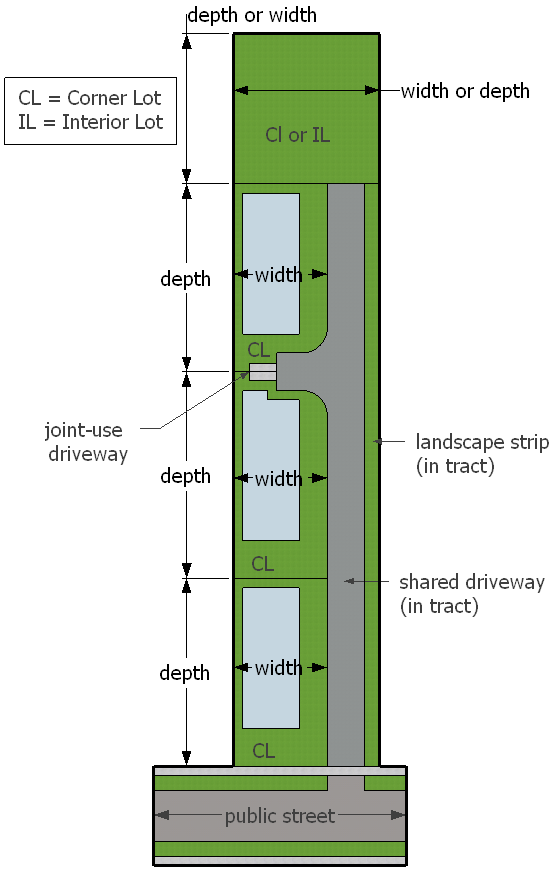
7. Lot Type and Orientation: The Administrator may permit lots that only front a shared driveway to be designated as a corner lot. If permitted by the Administrator, lot width, lot depth and yard setbacks shall be measured consistent with the corner lot designation (see illustration below).
8. Maintenance: The applicant shall ensure the shared driveway can be continually maintained to minimum standards listed in this section by the owners of the lots served by the driveway to the satisfaction of the City of Renton, prior to the recording of the short plat.
9. Covenants, Conditions and Restrictions: Covenants, conditions and restrictions, which are approved by the Administrator, shall be recorded with the King County Recorder’s Office. The applicant shall provide a copy of the recorded document. These covenants shall provide for, at a minimum, the following:
a. Maintenance, repair, operation, and payment of taxes for the commonly owned tract and facilities; and
b. These covenants shall run with the land and be irrevocable and binding on all the property owners, including their assigns, heirs, and successors.
10. Exception for Joint-Use Driveway Extending from Emergency Turnaround: A driveway that extends from the terminus of an emergency turnaround (excluding cul-de-sacs) and provides access to no more than two (2) lots shall be permitted as joint-use driveway that does not take access from a public right-of-way (see illustration below). The joint-use driveway shall be constructed to City standards prior to recording the short plat, and a reciprocal access easement for the benefit of the two (2) lots, in a form satisfactory to the City Attorney, shall be recorded with the King County Recorder.
(Ord. 5100, 11-1-2004; Ord. 5517, 12-14-2009; Ord. 5702, 12-9-2013; Ord. 5727, 10-20-2014; Ord. 5867, 12-11-2017)
K. UNIT LOT DRIVES:
1. Applicability: Unit lot drives may be constructed to serve unit lot subdivisions. Each unit lot drive may serve up to nine (9) unit lots. Each unit lot drive shall be accessed by a public street.
2. Design Standards: The design of each unit lot drive shall meet the following standards:
a. Roadway Width: The paved roadway shall be a minimum of sixteen feet (16') wide; the Fire Department may require the paved roadway to be up to twenty feet (20') wide.
b. Curb: Except for points of ingress/egress, curb shall be installed along the perimeter of the roadway.
c. Landscaping Strip and Sidewalk: There shall be an eight foot (8') wide landscaping strip between the curb and a five foot (5') wide sidewalk along one side of the unit lot drive.
3. Ownership: The City may elect to have a unit lot drive dedicated as a public roadway; however, the City may require the unit lot drive to be privately owned pursuant to RMC 4-7-090F6b, Maintenance of Common Facilities. (Ord. 5818, 10-17-2016)
L. TIMING FOR INSTALLATION OF IMPROVEMENTS:
No building shall be granted a certificate of final occupancy, or plat or short plat recorded, until all the required street improvements are constructed in a satisfactory manner and approved by the responsible departments unless those improvements remaining unconstructed have been deferred by the Administrator and security for such unconstructed improvements has been satisfactorily posted. (Ord. 5156, 9-26-2005; Ord. 5450, 3-2-2009; Ord. 5517, 12-14-2009; Ord. 5676, 12-3-2012)
M. PLAN DRAFTING AND SURVEYING STANDARDS:
The construction permit plans for street improvements shall be prepared and surveyed in conformance with the Department’s “Construction Plan Drafting Standards”, surveying standards and the City’s “Standard Specifications for Municipal Construction”, and standard detail documents.
N. REVIEW OF CONSTRUCTION PLANS:
1. Submittal: All street improvement plans prepared shall be submitted for review and approval to the Department of Community and Economic Development. All plans and specifications for such improvements are to be submitted at the time application for a building permit is made or, for plats, prior to construction (street/utility) permit issuance.
2. Fees and Submittal Requirements: All permits required for the construction of these improvements shall be applied for and obtained in the same manner and same conditions as specified in chapter 9-10 RMC, relating to excavating or disturbing streets, alleys, pavement or improvements. Fees shall be as stipulated in RMC 4-1-180. Money derived from the above charges shall be deposited to the General Fund. Half of the fee is due and payable upon submittal for a construction permit application, and the remainder is due and payable prior to issuance of the construction permit.
3. Cost Estimate Required: The applicant will be required to submit a cost estimate for the improvements. This will be reviewed by the Department of Community and Economic Development for accuracy. (Ord. 5517, 12-14-2009)
O. INSPECTIONS:
1. Authority and Fees: The Department shall be responsible for the supervision, inspection and acceptance of all street improvements listed in this Section, and shall make a charge therefor to the applicant.
P. LATECOMER’S AGREEMENTS:
1. Latecomer’s Agreements Authorized: Any party extending utilities that may serve other than that party’s property may request a latecomer’s agreement from the City. Where a development is required to construct street improvements that may also be required by other developments or by future development of other parcels in the vicinity, then the developer may request establishment of a latecomer’s agreement to reimburse the developer for all initial costs of the improvements.
2. Process for Latecomer’s Agreements: The procedure to follow in making application for the latecomer’s agreement and the steps to be followed by the City are as detailed in chapter 9-5 RMC.
Q. VARIATIONS FROM STANDARDS:
1. Alternates, Modifications, Waivers, Variances: See RMC 4-9-250.
2. Half Street Improvements:
a. When Permitted: Half street improvements may be allowed for a residential access street by the Administrator when it is determined that the adjacent parcel of property has the potential for future development and dedication of the right-of-way necessary for the completion of the street right-of-way. (Ord. 5676, 12-3-2012)
b. Minimum Design Standards: The right-of-way for the half street improvement must be a minimum of thirty five feet (35') with twenty feet (20') paved. A curb, planting strip area, and sidewalk shall be installed on the development side of the street according to the minimum design standards for public streets. If the street is permitted a cul-de-sac, then the right-of-way for the half of the cul-de-sac shall be dedicated, with installation of a temporary hammerhead turnaround. The property shall also dedicate easements to the City for street lighting and fire hydrants. Additional easements shall be provided for the franchise utilities outside of the dedicated right-of-way.
c. Standards for Completion of the Half Street: When the adjacent parcel is platted or developed, the additional right-of-way width needed to complete the type of street classification shall be dedicated from the developing property. The pavement shall then be widened to the width needed to complete the type of street classification, and curb, planting strip, and sidewalk shall be installed on the developing side of the street. If the street is a dead end street requiring a cul-de-sac, then the developing parcel shall dedicate the remainder of the right-of-way for the cul-de-sac and construct the final complete cul-de-sac, including curb, sidewalk, and other required improvements. (Ord. 5517, 12-14-2009)
3. Cul-de-Sac Modifications for Low Impact Development: The Administrator may modify cul-de-sac design standards to allow low impact development facility installation and reduce impervious surfaces; provided, that turnaround design modifications shall allow safe access and emergency response. (Ord. 5828, 12-12-2016)
R. DEFERRAL OF IMPROVEMENT INSTALLATION:
See RMC 4-9-060.
S. APPEALS:
Any decisions made in the administrative process described in this Section may be appealed to the Hearing Examiner pursuant to RMC 4-8-110.
T. VIOLATIONS OF THIS SECTION AND PENALTIES:
Unless otherwise specified, violations of this Chapter are misdemeanors subject to RMC 1-3-1. (Ord. 4521, 6-5-1995; Ord. 5159, 10-17-2005; Ord. 5457, 5-18-2009)