


Chapter 10.60
OFF-STREET PARKING
Sections:
10.60.030 General requirements.
10.60.040 Shared parking standards.
10.60.060 Parking reduction incentives – Public parking lots.
10.60.070 Parking reduction incentives – Transit.
10.60.075 Alternative parking analysis/transportation demand management (TDM).
10.60.080 Off-street parking requirements.
10.60.010 Purpose.
It is the purpose of this chapter to implement the goals and policies of the Wenatchee urban area comprehensive plan, specifically:
(1) Require off-street parking and loading facilities in proportion to the parking and loading demand of land uses, consider differences between employee and public/client parking, and mitigate adverse impacts associated with parking demands on the surrounding area.
(2) Enhance safety for pedestrians and motor vehicles, control access to sites, provide for efficient circulation within parking areas, and assure maneuverability of emergency vehicles.
(3) Provide for efficient land uses, maximize the use of existing parking and land available for development, and facilitate infill and adaptive reuses of existing sites.
(4) Consider the vision of the surrounding area in determining parking needs, utilize alternative compliance and shared parking methods to balance the area vision, economic development and parking demand, and reduce visual impacts of parking areas on the community.
(5) Reduce vehicle miles traveled and promote alternative transportation modes, minimize the amount of impervious surfaces, and protect water and air quality by addressing stormwater runoff and requiring dustless surfaces. (Ord. 2011-01 § 5; Ord. 2010-03 § 1 (Exh. A); Ord. 2007-34 § 2 (Exh. A))
10.60.020 Applicability.
These standards apply to all zoning districts and land uses within the city of Wenatchee, including any new construction, remodels, or substantial change in use (for example: from residential to commercial) as determined by the director. (Ord. 2010-03 § 1 (Exh. A); Ord. 2007-34 § 2 (Exh. A))
10.60.030 General requirements.
(1) Off-street parking shall be provided in the amount prescribed in this chapter, together with passageways sufficient for its reasonable use as detailed in the parking space and aisle dimensions charts below for surface parking and for structured parking, when constructed as part of a multifamily or commercial building or parking that is constructed as two or more levels as an independent structure/parking garage.
|
A |
B |
C |
D |
E |
F |
|---|---|---|---|---|---|
|
Parking Angle |
Stall Width |
Row Width |
Aisle Width |
Curb Length |
Bay Width |
|
Parallel compact car |
9 ft. 0 in. 8 ft. 0 in. |
9 ft. 0 in. 8 ft. 0 in. |
12 ft. 0 in. |
23 ft. 0 in. |
20 ft. 0 in. |
|
30 compact car |
9 ft. 0 in. 8 ft. 0 in. |
17 ft. 0 in. 16 ft. 6 in. |
11 ft. 0 in. 10 ft. 0 in. |
18 ft. 0 in. 17 ft. 0 in. |
27 ft. 6 in. 27 ft. 0 in. |
|
45 compact car |
9 ft. 0 in. 8 ft. 0 in. |
19 ft. 0 in. 18 ft. 4 in. |
13 ft. 0 in. 13 ft. 0 in. |
12 ft. 6 in. 11 ft. 3 in. |
32 ft. 0 in. 30 ft. 4 in. |
|
60 compact car |
9 ft. 0 in. 8 ft. 0 in. |
20 ft. 6 in. 19 ft. 6 in. |
18 ft. 0 in. 18 ft. 0 in. |
10 ft. 6 in. 9 ft. 2 in. |
38 ft. 6 in. 38 ft. 6 in. |
|
90 compact car |
9 ft. 0 in. 8 ft. 0 in. |
18 ft. 0 in. 16 ft. 0 in. |
25 ft. 0 in. 25 ft. 0 in. |
9 ft. 0 in. 8 ft. 0 in. |
43 ft. 0 in. 43 ft. 0 in. |
|
A |
B |
C |
D |
E |
F |
|---|---|---|---|---|---|
|
Parking Angle |
Stall Width |
Row Width |
Aisle Width |
Curb Length |
Bay Width |
|
Parallel compact car |
9 ft. 0 in. 8 ft. 0 in. |
9 ft. 0 in. 8 ft. 0 in. |
12 ft. 0 in. |
23 ft. 0 in. |
20 ft. 0 in. |
|
30 compact car |
9 ft. 0 in. 8 ft. 0 in. |
17 ft. 0 in. 16 ft. 6 in. |
11 ft. 0 in. |
18 ft. 0 in. 17 ft. 0 in. |
28 ft. 0 in. 27 ft. 6 in. |
|
45 compact car |
9 ft. 0 in. 8 ft. 0 in. |
19 ft. 0 in. 18 ft. 4 in. |
11 ft. 6 in. |
12 ft. 6 in. 11 ft. 3 in. |
30 ft. 6 in. 29 ft. 10 in. |
|
60 compact car |
9 ft. 0 in. 8 ft. 0 in. |
20 ft. 6 in. 19 ft. 6 in. |
13 ft. 6 in. |
10 ft. 6 in. 9 ft. 2 in. |
34 ft. 0 in. 33 ft. 0 in. |
|
90 compact car |
9 ft. 0 in. 8 ft. 0 in. |
18 ft. 0 in. 16 ft. 0 in. |
23 ft. 0 in. 22 ft. 0 in. |
9 ft. 0 in. 8 ft. 0 in. |
41 ft. 0 in. 38 ft. 0 in. |
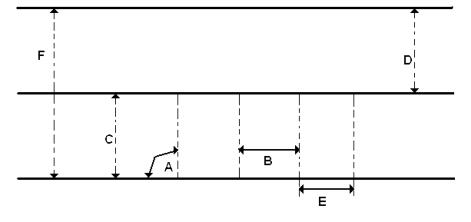
(2) In the case of mixed uses, the requirements for off-street parking shall be the sum of those required for the multiple uses computed separately. Off-street parking provided for one use shall not be considered as providing required parking for any other use, except as expressly provided for in this title.
(3) Any off-street parking area for six or more cars shall meet the following requirements:
(a) For commercial uses, the location and design of all access or egress points shall be no closer than 15 feet to any lot used for single-family residence purposes and is subject to approval of design and location by the city engineer.
(b) The parking facility and its accessways shall be developed with a durable, dustless surface of asphalt, grass-crete, or concrete, and shall be so graded and drained as to dispose of all surface water on site in a manner acceptable to the city engineer.
(c) Parking facilities located in or adjacent to residential zones shall have any illumination arranged so as to reflect the light away from adjacent residential structures.
(d) Parking facilities shall be developed in accordance with the standards of Chapter 10.62 WCC, Landscaping Standards.
(e) Surface parking shall provide safe pedestrian connections differentiated from vehicular areas. Pedestrian connections shall provide for safe pedestrian circulation to and from buildings and parking areas.
(f) On parking lots with six or more spaces, landscaping or fencing shall not exceed a height of three feet for a distance of 15 feet on either side of vehicle access points to public streets, except for trees limbed up to a minimum height of five feet.
(4) Parking facilities of commercial, industrial, and multifamily uses may have up to 40 percent of the stalls reduced in size to accommodate compact cars for surface parking lots and up to 50 percent for structured parking; provided:
(a) Compact car spaces shall be located so as not to be significantly more convenient to use than the standard size spaces; and
(b) Each compact car space or grouping of spaces shall be conspicuously identified as being suited for compact cars only.
(c) Grouping or clustering of compact stalls is encouraged to minimize surface lot and structure sizes.
(5) Unlisted Uses. Any use clearly similar to any of the uses in WCC 10.60.080 shall meet such parking requirements. If a similarity is not apparent, the director may require a parking demand study to determine the standards that should be applied to the use in question.
(6) Rounding of Fractions. When the number of required parking spaces for a particular use or building results in a fractional space, any fraction less than one-half shall be disregarded and any fraction of one-half or over shall be counted as one space. When calculating parking reduction incentives in WCC 10.60.060 and 10.60.070, reductions shall be calculated only in whole numbers.
(7) Except where otherwise provided by this title, off-street parking for new construction, including additions, must be within fully enclosed structures or located behind or to the side of buildings. Exceptions to this standard may be granted by the director, if site infeasibility can be demonstrated. Single-family residences and duplexes shall comply with WCC 10.48.120.
(8) All commercial and industrial uses located in an industrial (I) zoning district, which have a gross floor area of 5,000 square feet or more, shall provide off-street loading/unloading berths at least 10 feet wide and 50 feet long, in accordance with the following table:
|
Gross Floor Area |
Berths Required |
|---|---|
|
5,000 – 30,000 |
1 |
|
30,001 – 100,000 |
2 |
|
100,001 and over |
3 |
(9) Tandem parking space arrangements are allowed for residential developments when the following requirements are met:
(a) Both spaces are assigned to the same housing unit and are no more than two spaces in depth.
(b) Off-street parking shall be designed in a way that a parking space for one unit does not block access for another unit. The layout shall otherwise comply with this section. (Ord. 2020-35 § 3 (Exh. A); Ord. 2019-35 § 9; Ord. 2013-41 § 1 (Exh. B); Ord. 2010-03 § 1 (Exh. A); Ord. 2007-34 § 2 (Exh. A))
10.60.040 Shared parking standards.
Shared parking can be allowed when meeting the following standards and criteria, unless otherwise allowed by this code:
(1) Shared parking agreements may be established to meet code-required off-street parking where site infeasibility or change of use, requiring additional off-street parking, would otherwise prohibit the development of property in the city of Wenatchee.
(2) One hundred percent of the required parking of any single land use may qualify for shared parking.
(3) Required parking shall be based on:
(a) The combined total of the required parking for the separate land uses; or
(b) In the case when two or more land uses have distinctly different hours of operation (e.g., office and church), the land use that demands the greatest amount of parking.
(4) Location. The shared parking facility shall be located within a 500-foot radius of the off-site use.
(5) The following minimum safety requirements shall be met:
(a) There are sidewalks and paved pedestrian paths, including alleys between the shared parking facility and the land use using such shared parking facility.
(b) There is adequate street and parking lot lighting to provide safe walking to the off-site facility.
(6) The lot or part of a lot on which the parking is provided shall be legally encumbered by an easement or other means acceptable to the city to ensure continuous use of the parking facility.
(a) Any such easement shall be recorded with the Chelan County auditor so as to appear of record on the property title.
(b) The city of Wenatchee shall be named as a grantee to such easement, and the easement may not be released or terminated without the consent of the city. Release of the easement shall not be unreasonably withheld when one of the following conditions is met:
(i) The land use requiring the shared parking facility, including any potential future use, is discontinued negating the parking need;
(ii) The Wenatchee zoning code, as may be hereafter amended, does not require the shared parking facility for the associated land use;
(iii) Sufficient off-street parking is provided elsewhere meeting the provisions of this title; or
(iv) Application for an alternative parking analysis/transportation demand management is approved pursuant to WCC 10.60.075 demonstrating that the shared parking facility is unnecessary.
(c) The easement shall contain a provision which indemnifies and holds the city harmless from any and all claims or damages relating to the operation or maintenance of the parking facility. The city of Wenatchee shall be named as an intended third party beneficiary to the easement.
(d) In the case of parking spaces being shared between two or more land uses having distinctly different hours of operation, such easement shall include the hours of operation being granted to each land use.
(7) The owner of the property shall place and maintain permanent, weatherproof signs providing clear, usable directions for vehicle access to the off-site parking location.
(a) There shall be one sign at each site or parking lot entrance. The signs may be placed at building entrances or other appropriate locations, if it is demonstrated that such placement would provide superior information to parking users due to the characteristics of site traffic circulation.
(b) Information on the signs shall be readable by a person seated in a vehicle at the nearest driveway or access aisle. Use of graphics (e.g., maps and arrows) is encouraged to supplement written directions.
(c) Such signs shall be considered internal information signs under and subject to the requirements of WCC 10.50.020(3)(c).
(8) If sufficient parking is not provided, the use, or that portion of the use out of compliance, shall be terminated or the property owner(s) will be subject to city code enforcement in accordance with WCC Title 16. This requirement shall be established as a condition of approval for any uses relying on a shared parking agreement. (Ord. 2014-02 § 2; Ord. 2011-25 § 6; Ord. 2010-03 § 1 (Exh. A); Ord. 2007-34 § 2 (Exh. A))
10.60.050 Combined parking standards.
Repealed by Ord. 2011-25. (Ord. 2010-03 § 1 (Exh. A); Ord. 2007-34 § 2 (Exh. A))
10.60.060 Parking reduction incentives – Public parking lots.
A 20 percent reduction of the required parking set forth in WCC 10.60.080 will be granted when a development meets all of the following requirements:
(1) The project is located within a 700-foot radius of a public parking lot that is open to the public and is not dedicated to a particular building(s), use, or restricted to the patronage of a specific business(es). The applicant must provide written approval from the owner of the public lot confirming that the parking lot is open to the public and authorizing the perpetual use of the lot.
(2) The following minimum safety requirements are met:
(a) There are sidewalks and paved pedestrian paths, including alleys, between the public parking lot and the land use using such parking facility.
(b) There is adequate street and parking lot lighting to provide safe walking to the off-site facility.
(3) The reduction is not used to reduce off-street parking requirements below one parking space per housing unit. (Ord. 2020-35 § 3 (Exh. A); Ord. 2010-03 § 1 (Exh. A); Ord. 2007-34 § 2 (Exh. A))
10.60.070 Parking reduction incentives – Transit.
A 20 percent reduction of the required parking set forth in WCC 10.60.080 will be granted when a development meets all of the following requirements:
(1) The project is located within a 700-foot radius of a public bus shelter or transfer station. If a bus shelter is not within 700 feet, one can be provided by the applicant when it would be located and installed at a site as approved by the local transit authority, and the city.
(2) A commute trip reduction plan is developed by the applicant and approved by the director which demonstrates meaningful ways to reduce reliance on automobiles, such as carpooling, vanpools, transit enhancements, informational displays, and bicycle commuting.
(3) The proposed use would not be auto-dependent, such as a drive-in restaurant.
(4) The following minimum safety requirements are met:
(a) There are sidewalks and paved pedestrian paths, including alleys, between the transit facility and the land use using such transit facility.
(b) There is adequate street and parking lot lighting to provide safe walking to the off-site facility.
(5) The reduction is not used in combination with the reduction for proximity to public parking lots.
(6) The reduction is not used to reduce off-street parking requirements below one parking space per housing unit. (Ord. 2020-35 § 3 (Exh. A); Ord. 2010-03 § 1 (Exh. A); Ord. 2007-34 § 2 (Exh. A))
10.60.075 Alternative parking analysis/transportation demand management (TDM).
The alternative parking analysis/transportation demand management provisions as detailed in this section are applicable to all zoning districts within the city of Wenatchee.
(1) Purpose.
(a) To provide for an alternative method for calculating actual parking demand, based on an applicant-supplied professional analysis and methods for providing off-street parking associated with such demand.
(b) To provide for an alternative method of meeting the purpose of the off-street parking chapter.
(2) Standards. An alternative parking analysis shall:
(a) Be prepared by a professional engineer utilizing common industry standards such as the most current Institute of Transportation Engineers (ITE) manual; and any applicable published parking studies, by authors who are qualified professionals, that are applicable to the proposed use, region and community characteristics.
(b) Identify project uses and parking demand of each use. The parking demand should include an analysis of peak and off-peak use including employee, customer demand, and service demand (i.e., deliveries).
(c) Identify surrounding land uses and their associated parking demand within 500 feet of the project site including any available public parking, and quantify potential impacts to surrounding properties; such analysis shall acknowledge public parking issues (if any) in the vicinity of the project and such analysis does not constitute a right to use on-street parking.
(d) Include recommendations to ensure the long-term availability of off-street parking for the proposed use and protection from negatively impacting surrounding properties.
(3) Applications for alternative parking analysis/TDM shall be processed in accordance with WCC Title 13 as a Type III application for review by the planning commission in a public hearing. In addition to the requirements of WCC Title 13, the processing of the application shall include mailing a notice of application to all property owners within 500 feet of the subject property.
(4) If sufficient parking is not provided, the use or that portion of the use out of compliance shall be terminated or the property owner(s) will be subject to city code enforcement in accordance with WCC Title 16. This requirement shall be established as a condition of approval for any use relying on an alternative parking analysis/TDM.
(5) Reductions of minimum off-street parking requirements granted under this section shall not be combined with any other reduction incentive in this chapter. (Ord. 2020-35 § 3 (Exh. A); Ord. 2014-02 § 2; Ord. 2013-41 § 1 (Exh. B); Ord. 2011-25 § 8; Ord. 2010-03 § 1 (Exh. A); Ord. 2007-34 § 2 (Exh. A))
10.60.080 Off-street parking requirements.
The following requirements shall be met in all zoning districts, except when specifically regulated elsewhere in this code:
|
Land Use |
Standards |
|---|---|
|
Residential |
|
|
Accessory dwelling unit |
Refer to WCC 10.47.040(2)(d) |
|
Bed and breakfast, transient rental |
1 space per bedroom |
|
Boarding or lodging room |
1 space per bedroom |
|
Duplex; patio homes |
1 space per bedroom, but not more than 2 spaces per dwelling unit; refer to WCC 10.47.100(2)(a) |
|
Supervised living facilities, welfare or correction institution, group homes (7 or more) |
1 space per 5 beds |
|
Home occupation |
2 spaces per business |
|
Senior housing |
1 space per dwelling unit |
|
Multifamily dwelling; townhouses |
1 space per bedroom, but not more than 2 spaces per dwelling unit |
|
Student housing |
1.5 spaces per bedroom up to 3 bedrooms per unit. Above 3 bedrooms add 0.5 parking space per student. |
|
Single-family dwelling, adult family home, group home (6 or less) |
2 spaces per dwelling unit |
|
Infill-cottage housing (2 to 3 units) |
1 space per bedroom, but not more than 2 spaces per dwelling unit; refer to WCC 10.47.080(2)(h) |
|
Cottage housing (4+) |
1 space per bedroom, but not more than 2 spaces per dwelling unit; refer to WCC 10.47.090(2)(j) |
|
Courtyard housing |
1 space per bedroom, but not more than 2 spaces per dwelling unit; refer to WCC 10.47.120(2)(i) |
|
Live-work dwellings |
Refer to WCC 10.47.140(2)(e) |
|
Manufactured home community |
Refer to WCC 10.47.180(2)(k)(i) |
|
Medical Facilities |
|
|
Clinic |
4 spaces per 1,000 square feet of GFA |
|
Hospital |
1.5 spaces per bed |
|
Medical, veterinary or dental clinic/office |
4 spaces per 1,000 square feet of GFA |
|
Public Assembly |
|
|
Mortuaries/funeral parlor, place of worship, auditorium, convention center, sports and entertainment venue |
1 space per 3 seats or 6 feet of bench, or 10 spaces per 1,000 square feet of GFA of the main assembly area(s) when no seats/benches are designated |
|
Municipal buildings |
5 spaces per 1,000 square feet of GFA |
|
Library and museum |
2 spaces per 1,000 square feet of GFA |
|
Neighborhood center; outdoor recreational facilities, boat club |
2 spaces per 1,000 square feet of GFA; or per hearing examiner consistent with approved use level |
|
Child day care center, preschool nursery, kindergarten |
1 space per staff plus 3 drop-off spaces per 12 children |
|
School, institution of higher education |
1. Elementary and middle school: 2 spaces per classroom 2. High school, vocational and college: 1 space per 3 students and FTE |
|
General Commercial |
|
|
Outdoor commercial amusement (except golf courses and drive-in theaters) |
3.33 spaces per 1,000 square feet of ground area |
|
Archery, gun, tennis, swimming or similar athletic clubs, gymnastics, exercise facilities, indoor recreation facilities |
1. 4 spaces per 1,000 square feet of GFA, excluding tennis or racquetball courts 2. 2 spaces per tennis or racquetball court |
|
Bowling alleys |
4 spaces per lane |
|
Commercial amusement, stadium, arena, theater, horse race tracks, speedways, grandstands |
1 space per 4 seats or 8 feet of bench |
|
Golf course or golf driving range, public service facilities, essential public facilities, recreational vehicle park, transportation center |
Per hearing examiner and consistent with approved use level |
|
Mini-storage and boat storage facility |
1 space per 10 storage/boat units |
|
Roller skating rink and ice skating rink, swimming pools |
4 spaces per 1,000 square feet of activity surface |
|
Retail/Hotel/Restaurants |
|
|
Drive-through restaurants (no indoor seating), gasoline-dispensing facilities, drive-through coffee stands |
See office standards plus sufficient off-street loading for 6 vehicles |
|
Hotels, motels, lodges |
1 space per guest room |
|
Micro brewery, distillery, winery |
4 spaces per 1,000 square feet of GFA for retail or 10 spaces per 1,000 square feet of GFA for restaurant, plus 1 space per 1,000 square feet of nonretail GFA |
|
Restaurants, taverns, cocktail lounges, nightclubs, pool halls, studios for instruction |
10 spaces per 1,000 square feet of GFA |
|
Retail – food and merchandise, personal and professional services, offices, banks, radio and television studios, liquor stores, adult entertainment facilities, laundromats, service and repair shops (nonmotorized), farmers market |
1. 4 spaces per 1,000 square feet up to 2,000 GFA 2. 3.5 spaces per 1,000 square feet for 2,001 – 7,500 GFA 3. 2.85 spaces per 1,000 square feet for 7,501 – 40,000 GFA 4. 2.5 spaces per 1,000 square feet for 40,001+ GFA |
|
Retail – handling bulky merchandise, autos, furniture, machinery, construction materials, tires, fuels, feeds, repair shops, printers, newspapers, truck terminals, wholesale bakeries, boat sales and rentals, delivery services, rental services, recycling facilities |
1.5 spaces per 1,000 square feet of GFA |
|
Industrial |
|
|
Auto wrecking yards |
15 spaces up to 10 acres; 25 spaces over 10 acres |
|
Controlled atmosphere storage, warehouse, refrigeration, storage warehouse |
1 space per 5,000 square feet of GFA |
|
Manufacturing, fabricating, assembling, processing, packing, storage, wholesale, freight depot, brewery, distillery, winery |
2 spaces per 1,000 square feet of retail floor area plus 1 space per 1,000 square feet of GFA |
(Ord. 2022-33 § 3 (Exh. A); Ord. 2020-11 § 2 (Exh. A); Ord. 2019-35 § 9; Ord. 2011-49 §§ 3 (Exh. A), 5 (Exh. C), 6 (Exh. D) and 7 (Exh. E); Ord. 2010-03 § 1 (Exh. A); Ord. 2007-34 § 2 (Exh. A))