


Chapter 18.05
MIXED-USE DISTRICTS Revised 12/25
Sections:
18.05.020 Land use regulations. Revised 12/25
18.05.030 Development standards. Revised 12/25
18.05.040 Objective design standards for MU districts. Revised 12/25
18.05.010 Purpose.
The specific purposes of the mixed-use districts are to:
A. Provide for the orderly, well planned, and balanced development of mixed-use districts.
B. Encourage a mix of uses that promotes convenience, economic vitality, fiscal stability, and a pleasant quality of life.
C. Promote pedestrian- and transit-oriented, mixed-use commercial centers at appropriate locations.
D. Establish design standards that improve the visual quality of development and create a unified, distinctive, and attractive character along mixed-use streets.
E. Provide appropriate buffers and transition standards between commercial and residential uses to preserve both commercial and mixed-use feasibility and residential quality.
Additional purposes of each mixed-use district that follow, implement General Plan classifications of “Mixed Use, 30-40 du/ac,” “Mixed Use, 38-50 du/ac,” “Mixed Use, 75-100 du/ac,” “Mixed Use, 90-120 du/ac,” and “Neighborhood Retail/Mixed Use, 75-120.”
F. MU-DC-100 Mixed-Use Downtown Core. This district is intended to maintain the pedestrian-oriented environment in the heart of San Carlos’s downtown, with a focus on ground-level active storefronts and pedestrian- and transit-oriented development that encourages pedestrian activity and supports multimodal transportation. Physical form is regulated to reflect the urban character of the downtown core. Allowable uses include retail, commercial, and office uses, as well as residential development of up to one hundred (100) units per net acre.
G. MU-D-100 Mixed-Use Downtown. This district is intended to maintain the pedestrian-oriented environment around the downtown core and connect surrounding districts. Physical form is regulated to provide shopfront buildings that frame the street and support pedestrian- and transit-oriented development that encourages pedestrian activity and supports multimodal transportation. Allowable uses include retail, commercial, and office uses, as well as residential development of up to one hundred (100) units per net acre.
H. MU-D-120 Mixed-Use Downtown. This district is intended to maintain the pedestrian-oriented environment around the downtown core and connect surrounding districts. Physical form is regulated to provide shopfront buildings that frame the street and support pedestrian- and transit-oriented development that encourages pedestrian activity and supports multi-modal transportation. Allowable uses include retail, commercial, and office uses, as well as residential development of up to one hundred twenty (120) units per net acre.
I. MU-SA-50 Mixed-Use Station Area. This district is intended to provide for transit-oriented development to support vitality around transit centers and the historic San Carlos Train Depot and provide linkages to the downtown core and neighborhoods adjacent to Old County Road. Allowable uses include retail, commercial, and office uses, as well as residential development of up to fifty (50) units per net acre.
J. MU-SC-120 Mixed-Use San Carlos Avenue. This district is intended to allow one (1) or more of a variety of residential and nonresidential uses to encourage a greater mix and intensity of uses in a pedestrian-scaled environment at a scale and form that is appropriate to its neighborhood context and adjacent residential uses and forms. This district is also intended to provide transit-oriented development that supports multimodal transportation. Allowable uses include commercial and office uses, as well as residential development up to one hundred twenty (120) units per net acre.
K. MU-NB-120 Mixed-Use North Boulevard. This district is intended to facilitate the transformation of the northern portion of El Camino Real into a multimodal, mixed-use corridor. The physical form varies to reflect the urban character of the El Camino Real corridor and to transition to surrounding, lower-density districts. This district allows a mix of residential development of up to one hundred twenty (120) units per net acre and retail and commercial uses, as well as hotels and other commercial uses oriented toward a regional market.
L. MU-SB-100 Mixed-Use South Boulevard. This district is intended to facilitate the transformation of the southeastern portion of Laurel Street into a mixed-use corridor. The physical form varies to transition from MU-N-40 west of Laurel Street to MU-SB-120 on El Camino Real. This district allows a mix of residential development of up to one hundred (100) units per net acre and retail and commercial uses.
M. MU-SB-120 Mixed-Use South Boulevard. This district is intended to facilitate the transformation of the southern portion of El Camino Real into a multimodal, mixed-use corridor. The physical form varies to reflect the urban character of the El Camino Real corridor. This district allows a mix of residential development of up to one hundred twenty (120) units per net acre and retail and commercial uses, as well as hotels and other commercial uses oriented toward a regional market.
N. MU-N-40 Neighborhood Mixed-Use. This district is intended to provide an appropriate transition from mixed-use areas into the residential neighborhoods. This district allows a mix of residential and commercial development appropriately scaled to ensure a residential physical form to relate to adjacent single-family residential neighborhoods. Allowable uses include retail, commercial, and office uses, as well as residential development of up to forty (40) units per net acre.
O. MU-N-50 Neighborhood Mixed-Use. This district is intended to provide an appropriate transition from mixed-use areas into the residential neighborhoods. This district allows a mix of residential and commercial development appropriately scaled to ensure a residential physical form to relate to adjacent single-family residential neighborhoods. Allowable uses include retail, commercial, and office uses, as well as residential development of up to fifty (50) units per net acre.
P. MU-N-120 Neighborhood Mixed-Use. This district is intended to reflect the form of El Camino Real while providing a transition from MU-NB-120 to MU-N-50 and RM-100 zoning districts. This district allows a mix of residential and commercial development appropriately scaled to ensure a residential physical form to relate to adjacent single-family residential neighborhoods. Allowable uses include retail, commercial, and office uses, as well as residential development of up to one hundred twenty (120) units per net acre. (Ord. 1596 § 6 (Exh. A), 2023; Ord. 1438 § 4 (Exh. A (part)), 2011)
18.05.020 Land use regulations. Revised 12/25
Table 18.05.020 prescribes the land use regulations for mixed-use districts. Parcels located within an adopted Specific Plan area shall comply with the land use regulations as specified within the Specific Plan. The regulations for each district are established by letter designations as follows:
“P” designates permitted uses.
“M” designates use classifications that are permitted after review and approval of a minor use permit by the Zoning Administrator.
“C” designates use classifications that are permitted after review and approval of a conditional use permit by the Planning and Transportation Commission.
“(#)” numbers in parentheses refer to specific limitations listed at the end of the table.
“-” designates uses that are not permitted.
Use classifications are defined in Chapter 18.40, Use Classifications. In cases where a specific land use or activity is not defined, the Director shall assign the land use or activity to a classification that is substantially similar in character. Use classifications and subclassifications not listed in the table or not found to be substantially similar to the uses below are prohibited. The table also notes additional use regulations that apply to various uses. Section numbers in the right-hand column refer to other sections of this title.
|
Use Classifications |
MU-DC-100 |
MU-D-100 |
MU-D-120 |
MU-SC-120 |
MU-NB-120 |
MU-SB-100 |
MU-SB-120 |
MU-N-40 |
MU-N-50 |
MU-N-120 |
Additional Regulations |
|---|---|---|---|---|---|---|---|---|---|---|---|
|
Residential Uses |
|||||||||||
|
Residential Housing Types |
See subclassifications below |
||||||||||
|
Multi-Unit Residential |
P(1) |
P(1) |
P(2) |
P |
P(2) |
P |
P(2) |
P(3) |
P(2) |
P(2) |
|
|
Accessory Dwelling Unit |
P |
P |
P |
P |
P |
P |
P |
P |
P |
P |
Only if it includes a proposed or existing dwelling |
|
Junior Accessory Dwelling Unit |
- |
- |
- |
- |
- |
- |
- |
- |
- |
- |
|
|
Elderly and Long-Term Care |
- |
- |
- |
C |
- |
- |
- |
- |
- |
- |
|
|
Family Child Care |
See subclassifications below |
||||||||||
|
Small |
P |
P |
P |
P |
P |
P |
P |
P |
P |
P |
|
|
Large |
P |
P |
P |
P |
P |
P |
P |
P |
P |
P |
See Section 18.23.090, Day care centers and large family child care homes |
|
Residential Care Facilities |
See subclassifications below |
||||||||||
|
General |
- |
M(1) |
M(1) |
M |
- |
- |
- |
- |
- |
- |
See Section 18.23.200, Residential care facilities |
|
Limited |
P |
P |
P |
P |
P |
P |
P |
P |
P |
P |
|
|
Senior |
- |
M(1) |
M(1) |
M |
- |
- |
- |
- |
- |
- |
See Section 18.23.200, Residential care facilities |
|
Single Room Occupancy |
C(1) |
C(1) |
C(1) |
C |
C(1) |
C(1) |
C(1) |
C(3,14) |
C |
C |
See Section 18.23.220, Single room occupancy hotels |
|
Transitional Housing |
P |
P |
P |
P |
P |
P |
P |
P |
P |
P |
See Section 18.23.250, Transitional and supportive housing |
|
Supportive Housing |
P |
P |
P |
P |
P |
P |
P |
P |
P |
P |
See Section 18.23.250, Transitional and supportive housing |
|
Public and Semi-Public Uses |
|||||||||||
|
Colleges and Trade Schools, Public or Private |
- |
- |
- |
- |
P |
P |
P |
- |
- |
- |
|
|
Community Assembly, Less Than 3,500 Square Feet |
- |
P |
P |
P |
P |
P |
P |
M |
M |
M |
See Section 18.23.080, Community assembly facilities |
|
Community Assembly, 3,500 Square Feet or More |
- |
C |
C |
C |
M |
M |
M |
- |
- |
- |
|
|
Community Garden |
P |
P |
P |
P |
P |
P |
P |
P |
P |
P |
|
|
Cultural Institutions |
C(4) |
P |
P |
C |
M |
M |
M |
M |
M |
M |
|
|
Day Care Centers |
- |
P |
P |
P |
P |
P |
P |
P |
P |
P |
See Section 18.23.090, Day care |
|
Emergency Shelter |
- |
- |
- |
- |
P |
P |
P |
- |
- |
- |
See Section 18.23.110, Emergency shelters |
|
Government Offices |
- |
P |
P |
P |
P |
P |
P |
P |
P |
P |
|
|
Hospitals and Clinics |
- |
P |
P |
- |
P |
P |
P |
- |
- |
- |
|
|
Instructional Services |
M |
P |
P |
- |
P |
P |
P |
P |
P |
P |
See Section 18.23.260, Formula business uses |
|
Park and Recreation Facilities, Public |
P |
P |
P |
P |
P |
P |
P |
P |
P |
P |
|
|
Public Safety Facilities |
- |
C |
C |
- |
C |
C |
C |
C |
C |
C |
|
|
Schools, Public or Private |
- |
- |
- |
- |
C |
C |
C |
C |
C |
C |
|
|
Social Service Facilities |
- |
- |
- |
- |
C |
C |
C |
C |
C |
C |
|
|
Commercial Uses |
|||||||||||
|
Animal Care, Sales and Services |
See subclassifications below |
||||||||||
|
Grooming and Pet Stores |
- |
P |
P |
- |
P |
P |
P |
P(5) |
P(5) |
P(5) |
|
|
Veterinary Services |
- |
C(5) |
C(5) |
C(5) |
C(5) |
C(5) |
C(5) |
C(5) |
C(5) |
C(5) |
|
|
Artists’ Studios |
M |
P |
P |
- |
P |
P |
P |
P(5) |
P(5) |
P(5) |
|
|
Automobile/Vehicle Sales and Services |
See subclassifications below |
||||||||||
|
Automobile Rentals |
- |
- |
- |
- |
C(6) |
C(6) |
C(6) |
- |
- |
- |
See Section 18.23.050, Automobile/vehicle sales and services, and Section 18.23.260, Formula business uses |
|
Automobile/Vehicle Sales and Leasing |
P(6,7) |
P(6,7) |
P(6, 7) |
P(6,7) |
P(6,7) |
P(6,7) |
P(6, 7) |
- |
- |
- |
|
|
Automobile/Vehicle Washing |
- |
- |
- |
- |
C(6) |
C(6) |
C(6) |
- |
- |
- |
|
|
Service Station |
- |
- |
- |
- |
C(6) |
C(6) |
C(6) |
- |
- |
- |
|
|
Banks and Financial Institutions |
P(8) |
P |
P |
M |
P |
P |
P |
M(9) |
M(9) |
M(9) |
See Section 18.23.260, Formula business uses |
|
Business Services |
- |
P(9) |
P(9) |
P(9) |
P(9) |
P(9) |
P(9) |
P(9) |
P(9) |
P(9) |
|
|
Commercial Entertainment and Recreation |
See subclassifications below |
||||||||||
|
Cinema/Theaters |
C(17) |
C(17) |
C(17) |
- |
C(17) |
C(17) |
C(17) |
- |
- |
- |
See Section 18.23.260, Formula business uses |
|
Small-Scale |
- |
C(17) |
C(17) |
- |
C(17) |
C(17) |
C(17) |
- |
- |
- |
|
|
Large-Scale |
- |
C(17) |
C(17) |
- |
C(19) |
- |
- |
- |
- |
- |
|
|
Eating and Drinking Establishments |
See subclassifications below |
||||||||||
|
Bars/Night Clubs/Lounges |
C(17) |
C(17) |
C(17) |
- |
C(17) |
C(17) |
C(17) |
- |
- |
- |
See Section 18.23.140, Outdoor dining, and Section 18.23.260, Formula business uses |
|
Full Service |
P(17) |
P(17) |
P(17) |
P |
P(17) |
P(17) |
P(17) |
C(10, 17) |
C(10, 17) |
C(10, 17) |
|
|
Convenience |
P(18) |
P(18) |
P(18) |
P |
P(18) |
P(18) |
P(18) |
C(10) |
C(10) |
C(10) |
See Section 18.23.260, Formula business uses |
|
Food Preparation |
P |
P |
P |
P |
P |
P |
P |
P |
P |
P |
See Section 18.23.260, Formula business uses |
|
Funeral Parlors and Mortuaries |
- |
C |
C |
C |
C |
C |
C |
- |
- |
- |
|
|
Lodging |
See subclassifications below |
||||||||||
|
Bed and Breakfast |
P |
P |
P |
P |
P |
P |
P |
P |
P |
P |
See Section 18.23.070, Bed and breakfast lodging, and Section 18.23.260, Formula business uses |
|
Hotels and Motels |
P(11, 17) |
P(17) |
P(17) |
M |
P(17) |
P(17) |
P(17) |
M(14, 17) |
M(17) |
M(17) |
See Section 18.23.260, Formula business uses |
|
Nurseries and Garden Centers |
P(9, 20) |
P(9, 20) |
P(9, 20) |
- |
P(9, 20) |
P(9, 20) |
P(9, 20) |
P(9, 20) |
P(9, 20) |
P(9, 20) |
See Section 18.23.260, Formula business uses |
|
Offices |
See subclassifications below |
||||||||||
|
Business and Professional |
P(12) |
P |
P |
P |
P |
P |
P |
P |
P |
P |
See Section 18.23.260, Formula business uses |
|
Medical and Dental |
P(12) |
P |
P |
P |
P |
P |
P |
P(9) |
P(9) |
P(9) |
See Section 18.23.260, Formula business uses |
|
Walk-In Clientele |
P |
P |
P |
P |
P |
P |
P |
P |
P |
P |
See Section 18.23.260, Formula business uses |
|
Personal Services |
See subclassifications below |
||||||||||
|
General Personal Services |
(13) |
P |
P |
P |
P |
P |
P |
P |
P |
P |
See Section 18.23.170, Personal services, and Section 18.23.260, Formula business uses |
|
Tattoo or Body Modification Parlor |
- |
- |
- |
- |
M |
M |
M |
- |
- |
- |
|
|
Retail Sales |
See subclassifications below |
||||||||||
|
Cannabis Dispensary |
- |
- |
- |
- |
- |
- |
- |
- |
- |
- |
|
|
Convenience Markets |
P(18) |
P(18) |
P(18) |
P |
P(18) |
P |
P |
P(15) |
P |
P |
See Section 18.23.260, Formula business uses |
|
Food and Beverage Sales |
P(18) |
P(18) |
P(18) |
P |
P(18) |
P |
P |
P(16) |
P(16) |
P(16) |
See Section 18.23.260, Formula business uses |
|
General Retail |
P |
P |
P |
P |
P |
P |
P |
P |
P |
P |
See Section 18.23.260, Formula business uses |
|
Price Point Retail |
- |
- |
- |
- |
M |
M |
M |
- |
- |
- |
|
|
Second-Hand Store |
- |
- |
- |
- |
P |
P |
P |
P |
P |
P |
|
|
Retail Establishments Selling Ammunition or Firearms |
- |
- |
- |
- |
- |
- |
- |
- |
- |
- |
|
|
Industrial Uses |
|||||||||||
|
Recycling Facility, Reverse Vending Machine |
- |
- |
- |
P |
P |
P |
P |
P |
- |
- |
See Section 18.23.190, Recycling facilities |
|
Transportation, Communication, and Utilities Uses |
|||||||||||
|
Communication Facilities |
See subclassifications below |
||||||||||
|
Antenna and Transmission Towers |
See Chapter 18.24, Wireless Telecommunications Facilities |
||||||||||
|
Facilities within Buildings |
- |
P |
P |
P |
P |
P |
P |
P |
P |
P |
|
|
Transportation Passenger Terminals |
- |
- |
- |
- |
- |
- |
- |
- |
- |
- |
|
|
Utilities, Minor |
P |
P |
P |
P |
P |
P |
P |
P |
P |
P |
|
|
Other Applicable Types |
|||||||||||
|
Accessory Uses and Structures |
See Section 18.23.030, Accessory uses, and Section 18.15.020, Accessory buildings and structures |
||||||||||
|
Home Occupations |
P |
P |
P |
P |
P |
P |
P |
P |
P |
P |
See Section 18.23.120, Home occupations |
|
Drive-In and Drive-Through Facilities |
Prohibited in MU districts; see Section 18.23.100, Drive-in and drive-through facilities |
||||||||||
|
Nonconforming Use |
Chapter 18.19, Nonconforming Uses, Structures, and Lots |
||||||||||
|
Temporary Use |
Chapter 18.31, Temporary Use Permits |
||||||||||
Specific Limitations:
1. Not allowed on the ground floor along Laurel Street and San Carlos Avenue frontages. Parcels located within an adopted Specific Plan area shall comply with the requirements of the Specific Plan.
2. Residential-only development is subject to active ground floor use requirement, pursuant to Section 18.05.030(H). Parcels located within an adopted Specific Plan area shall comply with the requirements of the Specific Plan.
3. Not allowed on the ground floor along Old County Road.
4. Not allowed on Laurel Street or San Carlos Avenue. Parcels located within an adopted Specific Plan area shall comply with the requirements of the Specific Plan.
5. Provided that such use shall be completely enclosed in a building of soundproof construction.
6. For properties without frontage along El Camino Real, only retail sales consistent with the definition of “general retail” and five thousand (5,000) square feet or less.
7. Must be within an enclosed structure.
8. Limited to establishments with a gross floor area of two thousand five hundred (2,500) square feet or less. Limited to the ground floor of a building located on an interior lot a minimum of five hundred (500) feet from any other financial institution.
9. Limited to establishments with a gross floor area of five thousand (5,000) square feet or less.
10. Permitted after review and approval of a minor use permit by the Zoning Administrator if less than twelve (12) chairs.
11. Limited to upper stories unless at least fifty percent (50%) of ground floor street frontage is occupied by food service use.
12. Limited to upper stories.
13. Permitted if existing. Additions to existing facilities and establishment of new facilities are subject to Section 18.23.170, Personal services.
14. Not allowed along East San Carlos Avenue.
15. Limited to neighborhood groceries with less than one thousand five hundred (1,500) square feet of sales area when located along East San Carlos Avenue.
16. The sale of alcoholic beverages is prohibited.
17. Not permitted on sites where the shopfront of such nonresidential use faces onto R zoning districts.
18 Minor use permit required for sites adjacent to R districts.
19. On the east side of El Camino Real only; in all other areas this use is not permitted.
20. Uses that require a commercial cannabis business permit are not permitted.
(Ord. 1626 § 3 (Exh. A), 2025; Ord. 1612 § 1 (Exh. A), 2024; Ord. 1596 § 6 (Exh. A), 2023; Ord. 1568 § 1 (Exh. A), 2021; Ord. 1566 (Exh. B (part)), 2020; Ord. 1540 (Exh. A), 2019; Ord. 1525 § 2(1) (Exh. A (part)), 2017; Ord. 1518 § 3 (Exh. A), 2017; Ord. 1480 (Exh. B (part)), 2015; Ord. 1438 § 4 (Exh. A (part)), 2011)
18.05.030 Development standards. Revised 12/25
Tables 18.05.030-1 through 18.05.030-6 prescribe the development standards for mixed-use (MU) districts. Additional regulations are denoted in a right-hand column. Parcels located within an adopted Specific Plan area shall comply with the development standards as specified within the Specific Plan. Section numbers in this column refer to other sections of this title, while individual letters refer to subsections that directly follow the table. The numbers in each illustration in this section refer to corresponding regulations in the “#” column in the associated table.
|
District |
MU-DC-100 |
MU-D-100 |
MU-D-120 |
MU-SC-120 |
MU-NB-120 |
MU-SB-100 |
MU-SB-120 |
MU-N-40 |
MU-N-50 |
MU-N-120 |
Additional Regulations |
# |
|---|---|---|---|---|---|---|---|---|---|---|---|---|
|
Maximum Density (units/net acre) |
100 |
100 |
120 |
120 |
120 |
100 |
120 |
40 |
50 |
120 |
|
|
|
Minimum Density (units/net acre) |
75 |
75 |
90 |
90 |
90 |
75 |
90 |
30 |
38 |
90 |
|
|
|
Minimum Lot Size (sq. ft.) |
5,000 sq. ft. |
|
|
|||||||||
|
Minimum Lot Width (ft.) |
50 ft. |
|
|
|||||||||
|
Maximum Floor Area (FAR) for Commercial-Only Development |
2.5 |
3.0 |
3.0 |
3.0 |
3.0 |
3.0 |
3.0 |
3.0 |
2.5 |
3.0 |
|
|
|
Minimum and Maximum Commercial Floor Area in Mixed-Use Development When commercial floor area is provided within a mixed-use development, the commercial space shall be subject to the specified minimum and maximum commercial FAR as specified. |
0.1—0.7 |
A |
|
|||||||||
|
Residential Only Development |
n/a (no maximum FAR) |
|||||||||||
|
Residential Floor Area in Mixed-Use Development |
n/a (no maximum FAR) |
|||||||||||
A. Increased Nonresidential FAR for Mixed-Use Buildings. The maximum allowable FAR for nonresidential use may be increased by up to ten percent (10%) for buildings that contain a mix of residential and nonresidential uses through the provision of one (1) or more of the following elements beyond what is otherwise required, subject to conditional use permit approval:
1. Provision of Off-Site Improvements. This may include off-site amenities and/or infrastructure (other than standard requirements and improvements) such as right-of-way or streetscape improvements or funding for parks, public safety facilities, libraries, senior centers, community meeting rooms, child care or recreation or other community benefit. The Director may require a fiscal and economic impact report, or equivalent, as part of the conditional use permit application.
|
District |
MU-DC-100 |
MU-D-100 |
MU-D-120 |
MU-SC-120 |
MU-NB-120 |
MU-SB-100 |
MU-SB-120 |
MU-N-40 |
MU-N-50 |
MU-N-120 |
Additional Regulations |
# |
|---|---|---|---|---|---|---|---|---|---|---|---|---|
|
Street Frontage Setbacks, Commercial and Mixed-Use Development (ft) |
||||||||||||
|
Laurel Street |
Property line or 15 ft. from curb (the greater) for all MU districts
|
(C) |
1 |
|||||||||
|
El Camino Real |
Property line or 20 ft. from curb (the greater) shall apply to all mixed-use zones along El Camino Real |
(C) |
1 |
|||||||||
|
San Carlos Avenue |
Property line or 15 ft. from curb (the greater) |
n/a |
n/a |
Property line or 15 ft. from curb (the greater) |
n/a |
n/a |
n/a |
n/a |
n/a |
n/a |
(C) |
1 |
|
Elm Street |
0 min, 10 max |
n/a |
n/a |
n/a |
n/a |
n/a |
n/a |
n/a |
n/a |
n/a |
|
1 |
|
All Other Streets |
5 ft. min, 15 ft. max* |
5 ft. min, 15 ft. max |
5 ft. min, 15 ft. max |
5 ft. min, 15 ft. max |
5 ft. min, 15 ft. max |
0 ft. min, 5 ft. max |
0 ft. min, 5 ft. max |
5 ft. min, 15 ft. max |
5 ft. min, 15 ft. max |
5 ft. min, 15 ft. max |
|
1 |
|
Interior Side |
0 min; 10 min adjacent to RS district for all MU districts |
(A, B, D) |
2 |
|||||||||
|
Rear |
0 min; 20 ft. min adjacent to RS district for all MU districts |
(A, B, D) |
3 |
|||||||||
|
Corner Build Area |
20 ft.; ground floor building facades shall be located in accordance with the required setbacks within 20 ft. of every corner. Ground floor public plazas may be at the street corner provided buildings are built to the edge of the public plaza. |
4 |
||||||||||
* Applicable to 700 and 800 blocks of Walnut Street only.
FIGURE 18.05.030-A: BUILDING PLACEMENT KEY—MU DISTRICT
B. Transitional Standards. Where an MU district is adjacent to an RS district, the following standards apply:
1. Rear Transitions, MU Districts. For the MU zoning district, the maximum height at the rear setback line shall be twenty-eight (28) feet maximum to match the RS district height maximum. Above twenty-eight (28) feet, a stepback of at least six (6) feet shall be provided from the story below. If the building is five (5) stories or more, the upper stories shall step back from the fourth story by at least another six (6) feet. The maximum height at the rear setback line shall be twenty-eight (28) feet maximum to match the RS district height limit. Above twenty-eight (28) feet, the building shall step back by at least six (6) feet. If the building is five (5) stories or more, the upper stories shall step back from the fourth story by at least another six (6) feet.
2. Side Transitions, MU Districts. The maximum height at the side setback line adjacent to a RS district shall be twenty-eight (28) feet maximum to match the RS district height maximum. Above twenty-eight (28) feet, a stepback of at least six (6) feet shall be provided from the story below. If the building is five (5) stories or more, the upper stories shall step back from the fourth story by at least another six (6) feet.
3. A minimum ten (10) foot wide landscape buffer area shall be provided along all rear boundaries adjacent to a RS district (Type 2—Refer to Section 18.18.050, Areas to be landscaped, Table 18.18.050-B(1) and Table 18.18.050-B(2) for buffer types). Trees and shrubs shall be planted continuously in the landscape buffer along the site’s rear property line to create privacy screening between properties. Selected species shall be of a fast-growing, evergreen variety and capable of attaining a minimum height of twenty-five (25) feet at maturity. Trees shall be planted at a minimum interval of twenty to thirty (20—30) feet on center depending on the species and mature canopy width or growth habitat.
Continuous shrubbery planting is required between the trees and shall be a minimum six (6) feet in height within three (3) years of planting. Species selection and placement must be approved by the City Arborist. A minimum of fifteen (15) gallon planting stock shall be utilized, unless otherwise approved by the City Arborist.
a. Type 2 Buffers. Landscape buffers shall be ten (10) feet wide. For every one hundred (100) feet in rear property line length a minimum of three (3) trees and six (6) shrubs shall be planted.
b. For other landscaping buffer requirements, refer to Section 18.18.050, Areas to be landscaped.
c. All new proposed tree species shall adhere to the City’s most recent preferred tree list or as specified by the City Arborist.
Where conflict between this section and landscaping requirements of Section 18.18.050 occurs, the provisions of this chapter shall apply.
FIGURE 18.05.030-B: REAR TRANSITIONAL STANDARDS—MU DISTRICTS
FIGURE 18.05.030-C: SIDE TRANSITIONAL STANDARDS—MU DISTRICTS
C. Build-To Line. Buildings shall be constructed at the required setback for at least eighty percent (80%) of their linear street frontage. The remaining twenty percent (20%) of linear street frontage shall be further set back by at least two (2) feet, including building massing breaks, recessed entrances, service or utility areas, and/or vehicle access areas. The area between the building and property line shall be paved where possible so that it functions as a wider public sidewalk. For further requirements refer to Figure 18.05.030-A.
1. Street Frontage Improvements. This area is allowed to have landscaping and/or planters along ground-floor residential unit frontages and along nonactive frontages (i.e., frontages with no windows, openings, or fenestrations, etc.) to reduce the visual impact of blank walls, provided the landscaping and/or planters do not reduce the sidewalk pedestrian clearance width below the pedestrian clear zone requirement. Features including entry courtyards, plazas, building entries, and outdoor eating and display areas located between the build-to line and the building count towards the eighty percent (80%) build-to line requirement provided the buildings are built to the edge of these features.
D. Building Heights.
|
District |
MU-DC-100 |
MU-D-100 |
MU-D-120 |
MU-SC-120 |
MU-NB-120 |
MU-SB-100 |
MU-SB-120 |
MU-N-40 |
MU-N-50 |
MU-N-120 |
Additional Regulations |
# |
|---|---|---|---|---|---|---|---|---|---|---|---|---|
|
Building Maximum |
50 ft. |
60 ft. |
75 ft. |
75 ft. |
75 ft. |
60 ft. |
75 ft. |
50 ft.; 35 ft. along East San Carlos Avenue in MU-N-40 District |
75 ft. |
(D); See Section 18.15.060, Height and height exceptions |
|
|
|
Building Maximum Adjacent to RS District |
28 ft. along the rear and side setback lines (refer to Section 18.05.030(B) for side stepback requirements) Above 28 ft., the building shall step back by at least 6 ft. If the building is five (5) or more stories, the fifth story and above shall step back from the fourth story by at least another 6 ft. |
|
|
|||||||||
|
Building Minimum |
n/a |
25 ft.; Applicable only along Laurel Street and El Camino Real frontages |
n/a |
|
(2) |
|||||||
|
Maximum Stories |
4 |
5 |
6 |
6 |
6 |
5 |
6 |
4; 3 stories along E. San Carlos Ave. in MU-N-40 district |
4 |
6 |
|
|
|
Ground Floor Minimum Height |
||||||||||||
|
Ground Floor Uses |
12 ft. |
|
(3) |
|||||||||
FIGURE 18.05.030-D: BUILDING HEIGHTS KEY—MU DISTRICTS
E. Height Limitations and Exceptions.
1. Vertical Projections. Except along East San Carlos Avenue, a parapet wall, cornice or sloping roof may project up to five (5) feet above the height limit (see Section 18.15.060 for vertical projection allowances).
2. Towers. If the project site is greater than fifteen thousand (15,000) square feet and not located along East San Carlos Avenue, a tower or other projecting architectural elements may extend up to ten (10) feet above the top of the roof; provided, that the square footage of the element(s) does not total more than ten percent (10%) of the building footprint. The area above the uppermost permitted floor of the element(s) shall not be habitable space.
F. Upper Story Stepbacks. Upper story stepbacks help mitigate building height by providing visual and spatial relief more consistent with the context of San Carlos. All required upper story stepbacks shall occur for at least seventy percent (70%) of the facade length.
1. Laurel Street. The third story along the 600, 700, and 800 blocks of Laurel Street shall be set back a minimum of ten (10) feet from the story below. The fourth story along the 600, 700, and 800 blocks of Laurel Street may align with the third story below.
2. Fourth, Fifth, and Sixth Stories. The fourth, fifth, and sixth stories of all street-facing facades shall be stepped back a minimum of six (6) feet from the third story below, except as provided in this section.
3. San Carlos Avenue and El Camino Real. The fourth-, fifth-, and sixth-story front facades may align with the third story below along San Carlos Avenue in the MU-SC-120 District and along El Camino Real (exception: this provision does not apply to the 1100 and 1200 blocks of San Carlos Avenue).
FIGURE 18.05.030-E: STREET-FACING UPPER STORY STEPBACKS—MU DISTRICTS.1111125.png)
G. Building Projections into the Public Right-of-Way. Building projections, awnings, overhangs, and canopies shall project no more than three (3) feet into the public right-of-way. Building projections shall maintain a minimum twelve (12) foot clearance above sidewalk grade, and awnings, overhangs, and canopies shall maintain a minimum eight (8) foot clearance above the sidewalk. The total width of all projections into the public right-of-way along a building face shall not be more than twenty-five percent (25%) of the building frontage. Projecting balconies may account for up to an additional twenty-five percent (25%) of the building frontage. Refer to Table 18.05.030-4 for building projection allowable dimensions.
1. Blank walls along the building’s street-facing facades shall not exceed ten (10) feet in length along the ground floor and twenty-five (25) feet in length along upper floors. If a blank wall area includes vertical interior spaces such as elevator towers or trash chutes, a change in building material, color, or texture, or a change in facade plane depth shall be provided if those vertical interior spaces would otherwise cause the blank wall to exceed the length limits.
FIGURE 18.05.030-F: PROJECTIONS AND BLANK WALLS—MU DISTRICTS
|
District |
MU-DC-100 |
MU-D-100 |
MU-D-120 |
MU-SC-120 |
MU-NB-120 |
MU-SB-100 |
MU-SB-120 |
MU-N-40 |
MU-N-50 |
MU-N-120 |
Additional Regulations |
# |
|---|---|---|---|---|---|---|---|---|---|---|---|---|
|
Maximum Length of Blank Wall |
Ground floor: 10 feet Upper floors: 25 feet |
|
1 |
|||||||||
|
Maximum Building Projections Into the Public Right-of-Way |
3 feet; 12 feet minimum above sidewalk grade. |
(F) |
|
|||||||||
|
Awnings and Overhangs Into the Public Right-of-Way |
3 feet; 8 feet minimum above sidewalk grade. |
|
|
|||||||||
FIGURE 18.05.030-G: PARKING AND LOADING STANDARDS KEY—MU DISTRICTS
|
District |
MU-DC-100 |
MU-D-100 |
MU-D-120 |
MU-SC-120 |
MU-NB-120 |
MU-SB-100 |
MU-SB-120 |
MU-N-40 |
MU-N-50 |
MU-N-120 |
Additional Regulations |
# |
|---|---|---|---|---|---|---|---|---|---|---|---|---|
|
Surface Parking Setback from Street Property Line |
40 feet; parking shall be placed behind a building or on the interior side or rear of the site. |
(H) |
1 |
|||||||||
|
Surface Parking Setback from Buildings and Public Plazas |
8 feet: 5 feet walkway plus 3 feet landscaping; applicable only to above-ground parking. |
2 |
||||||||||
|
Parking Access Location |
Side street or alley wherever possible. |
3 |
||||||||||
|
Curb Cuts |
Prohibited on Laurel |
Refer to Chapter 12.04 for dimensional requirements. Curb cuts shall be minimized and shall be placed in areas least likely to impede pedestrian circulation. |
|
|
||||||||
|
Loading/Service Area |
Side or rear of lot; must be screened from public ROW. |
4 |
||||||||||
|
Parking Podium |
Maximum height of a parking podium visible from the street is five (5) feet above finished grade. |
5 |
||||||||||
H. Ground Floor Active Uses. Ground floor active uses in a mixed-use building shall occupy at least sixty-five percent (65%) of the public street frontage including any side street frontage. Commercial ground floor active uses shall have a depth of at least twelve (12) feet without walls or partitions, providing unobstructed views into the space. Distinct awning, canopy, or entry treatments shall be provided for commercial uses to distinguish from residential uses. Different treatments shall include, but are not limited to, doorway materials and recesses, signage, and paving in front of commercial entries.
1. New development in mixed-use districts shall comply with the window and transparency requirements of Section 18.05.040(K) and shall incorporate at least one (1) of the following active uses within the ground floor along public street frontages as permitted pursuant to Table 18.05.020: residential units with individual entrances oriented towards the street, retail, restaurant, office, business services, personal services, childcare center, theater, entertainment, indoor recreational uses, art gallery, maker space, live-work units, work-from-home shared work space, social gathering space, common residential lobbies, individual residential entrances, and residential common space such as fitness rooms, conference rooms, leasing and/or management offices.
FIGURE 18.05.030-H: GROUND FLOOR ACTIVE USES—MU DISTRICTS
I. Pedestrian Walkway Design.
1. Walkways shall have a minimum clear unobstructed width of five (5) feet, shall be hard-surfaced, and paved with concrete, stone, tile, brick, or comparable material.
2. Where a required walkway or sidewalk crosses driveways, parking areas, or loading areas, it shall be clearly identifiable through the use of a raised crosswalk, a different paving material, or similar method to prevent conflict between pedestrians and vehicles. Where a required walkway is parallel and adjacent to an auto travel lane, it must be raised or separated from the auto travel lane by a raised curb at least four (4) inches high, bollards, or other physical barrier.
J. Parking Setbacks. Parking shall be allowed within forty (40) feet of the street-facing property line, subject to the following standards:
1. Fully Undergrounded Parking. Fully undergrounded parking may be located anywhere on a subject property. If tiebacks or similar structures extend beyond the property lines, a tieback agreement with the affected property owner(s) shall be included upon initial planning application submittal.
2. Partially Submerged Parking. Parking located partially underground shall match the setbacks of the main structure. The maximum height of a parking podium visible from a street is five (5) feet from finished grade.
3. Surface Parking. Above-ground surface parking is allowed within forty (40) feet from a street-facing property line when all of the following occurs:
a. Buildings are built to setback standards and as close to the public sidewalk as feasible;
b. The parking area is at least eight (8) feet from the public right-of-way, screened from adjacent properties with a minimum four (4) foot tall wall, hedges or landscaping or a trellis along public rights-of-way, and six (6) foot tall wall, hedges or landscaping, or a trellis along side and rear property lines; and
c. The site is constrained such that underground, partially submerged, or surface parking located more than forty (40) feet from the street frontage is not feasible due to site-specific conditions. Fences, hedges, and similar structures shall meet sight distance triangle regulations and the requirements pursuant to Section 18.15.040.
|
District |
MU-DC-100 |
MU-D-100 |
MU-D-120 |
MU-SC-120 |
MU-NB-120 |
MU-SB-100 |
MU-SB-120 |
MU-N-40 |
MU-N-50 |
MU-N-120 |
Additional Regulations |
|---|---|---|---|---|---|---|---|---|---|---|---|
|
Minimum Common and/or Private Open Space (% of site) |
10%; Applicable to mixed-use and nonresidential development on lots greater than 15,000 square feet; and Applicable to all developments that are 100% residential regardless of lot size. |
|
|||||||||
|
Minimum Usable Area for Common Open Space (sq. ft.) |
200 square feet minimum, with a minimum width of 10 feet |
|
|||||||||
|
Minimum Usable Area for Private Open Space (sq. ft.) |
36 square feet minimum, with minimum 6 foot depth |
|
|||||||||
|
Minimum Amount of Landscaping (% of site) |
10% |
Refer to Chapter 18.18 for landscaping requirement. |
|||||||||
K. Commercial Loading and/or Service Areas. Commercial loading or service spaces shall not be located along the primary street frontage and shall be located either along the sides or rear of the structure. Loading and/or service areas shall only be allowed along the primary street frontage when the subject property fronts only one (1) street and where there is no internal on-site vehicle circulation and/or access points.
L. Landscaping and Residential Open Space. Landscaping and residential open space shall be provided as required by Table 18.05.030-6. Residential open space shall be usable space and may be common, private, or a combination thereof. Common open space areas consist of courtyards, plazas, terraces, lawns, patios, swimming pools, barbecue areas, playgrounds, or other usable outdoor areas. Private open areas consist of balconies, decks, patios, porches, or fenced yards. Private open areas when provided shall provide a minimum six (6) foot by six (6) foot clear area and be directly accessed from a residential unit. Landscaping consists of planting areas, stormwater management features, treed areas, gardens, and other vegetation areas not otherwise considered common or private open space.
1. Usability. A surface shall be provided that allows convenient use for outdoor living and/or recreation. Such surface may be any practicable combination of lawn, garden, flagstone, wood planking, concrete, or other serviceable, dust-free surfacing. The maximum slope shall not exceed ten percent (10%).
2. Accessibility.
a. Private Open Space. The space shall be accessible to only one (1) living unit by a doorway to a habitable room or hallway.
b. Common Open Space. The space shall be accessible to the living units on the lot. It shall be served by any stairway or other accessway qualifying as an egress facility from a habitable room. (Ord. 1626 § 3 (Exh. A), 2025; Ord. 1596 § 6 (Exh. A), 2023; Ord. 1485 (Exh. A), 2015; Ord. 1480 (Exh. B (part)), 2015; Ord. 1438 § 4 (Exh. A (part)), 2011)
18.05.040 Objective design standards for MU districts. Revised 12/25
The intent of the objective design standards is to ensure new buildings are compatible with the scale and character of San Carlos. To promote cohesive building design, quality craftsmanship, and compatible building scale, the following objective design standards apply to all multifamily residential buildings in MU districts. This includes all front, side, and rear building facades except for those not visible from public rights-of-way, such as internal courtyard facades.
Buildings on lots of widths seventy-five (75) feet or less shall be subject to modified requirements along side facades as described further in this section. Parcels located within an adopted Specific Plan area shall comply with the objective design standards per the Specific Plan.
A. Street Preservation. Existing public right(s)-of-way shall be preserved. Public right-of-way shall not be eliminated or abandoned unless substantial public benefits are provided, such as a new park, as determined by the review authority.
B. Street Frontage Improvements. New development shall provide street frontage improvements in accordance with the following:
1. Between the Property Line and Curb (Sidewalk Zone).
a. Sidewalks. Sidewalks shall be provided if none already exist or if the existing sidewalks are in poor condition as determined by the Public Works Director. Sidewalks shall be designed to be composed of two (2) zones, the pedestrian clear zone and the landscape and furniture zone. The pedestrian clear zone shall have a minimum width that varies based on the street within which no landscape, furniture, or any other obstructions may be located. The width of the landscape and furniture zone may vary, and shall include a combination of street trees, landscaping, planter boxes, benches, street lights, bike racks, trash receptacles, bus shelters, outdoor dining, utilities such as fire hydrants, and sidewalk paving. Sidewalk width and design within any adopted Specific Plan area shall meet the objective requirements of the Specific Plan. If minimum sidewalk dimensions cannot be accommodated in the public right-of-way, a sidewalk easement shall be required.
b. Street Furniture. Trash receptacles, benches, bike racks, and other street furniture from a list maintained by the Director shall be provided. These elements shall be located outside of the required pedestrian clear path and within the landscape and furniture zone.
c. Street Lights. Pedestrian-scaled street lights, including attachments from which banners may be hung, shall be located in the landscape and furniture zone and shall be provided from a list maintained by the Director.
d. Street Trees. Sidewalks shall include at least one (1) street tree from the City’s most recent Preferred Tree List for every thirty (30) feet of sidewalk length. Tree guards shall be provided. Street trees and other trees on site counted towards the minimum tree requirement shall be a minimum of twenty-four (24) inch box size. All new trees shall be a minimum of fifteen (15) gallons in size. When trees cannot be accommodated due to site constraints a minor deviation may be requested subject to the discretion of the City Arborist and Director.
2. Interior from Property Line (Frontage/Setback Zone). Except where occupied by a building, residential ground floor entrances, or areas necessary for parking access, the street frontage, for a depth of ten (10) feet from the property line, shall be utilized for active outdoor uses for at least sixty-five percent (65%) of the available frontage length, including but not limited to outdoor dining, paved for public uses so that it functions as part of a wider public sidewalk, stormwater management planters, or improved with landscaping, public art, and/or pedestrian amenities such as outdoor seating.
FIGURE 18.05.040-A: FRONTAGE ZONES—MU DISTRICTS
C. Building Entrances.
1. Orientation. All ground-floor commercial and residential active uses located along public rights-of-way shall have their primary entrance(s) facing this right-of-way. If ground-floor residential active uses are located on four (4) lane streets carrying high traffic volumes and/or streets that do not allow on-street parking, unit entrances may be oriented around courtyards.
2. Main Building Entrances. If a building has a main entrance to a commercial space or shared residential lobby, the main entrance shall incorporate either a canopy, recess, or combination thereof. A covered area a minimum of four (4) feet deep shall be provided. Refer to Table 18.05.030-3 for canopy projection standards. Entry canopies, stoops, patios, and balconies shall be constructed of all-weather, durable materials. If an entrance requires an accessible ramp, the ramp shall be integrated into the building and landscape design to minimize the visual impact of the ramp. Clear access to the ramp shall be maintained.
FIGURE 18.05.040-B: MAIN BUILDING ENTRANCE—MU DISTRICTS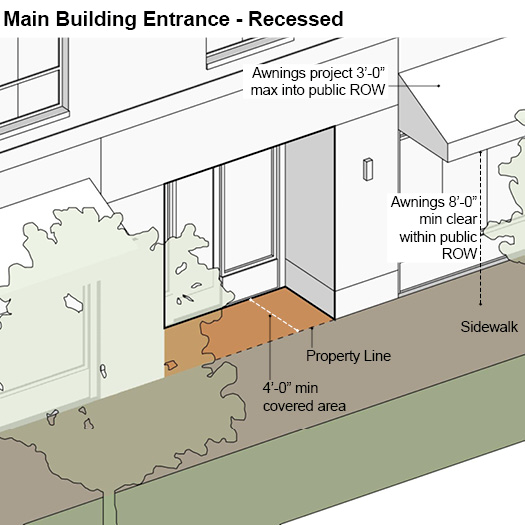
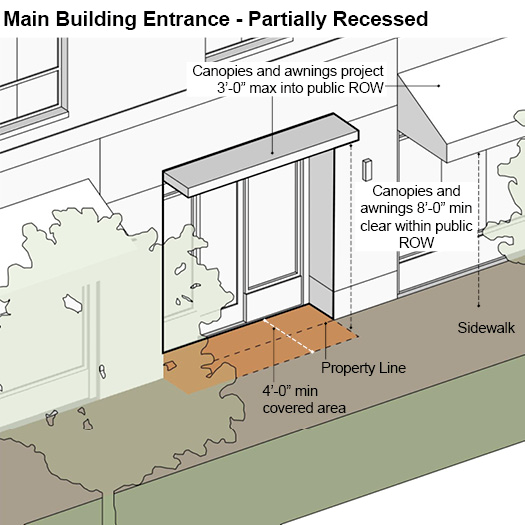
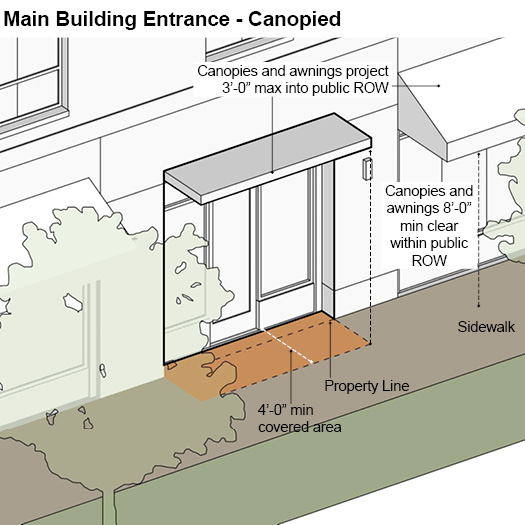
3. Ground Floor Dwelling Units. Exterior entrances to ground floor units shall be connected to the public sidewalk by a paved walkway with a minimum width of five (5) feet. An at-grade patio, a raised stoop, or a raised porch may serve as a ground floor unit entrance. Raised stoops or porches shall not exceed five (5) feet above grade. Patios, stoops, and porches shall provide a minimum six (6) foot by six (6) foot clear area. Ground floor patios shall be surrounded by a low wall, fence, railing, and/or landscaping no higher than forty-two (42) inches to distinguish private outdoor space from the public sidewalk area. Ground floor exterior unit entrances may be recessed or project no more than eight (8) feet from the building facade. Fences shall meet the requirements pursuant to Section 18.15.040.
FIGURE 18.05.040-C: RESIDENTIAL UNIT ENTRANCE—MU DISTRICTS 

4. Corner Entrances. Corner building entrances shall have a distinct architectural treatment to animate the intersection and facilitate pedestrian flow around the corner. Different treatments may include canopies, trellises, angled or rounded corners, arches, and/or other architectural elements. All building and dwelling units located in the interior of a site shall have entrances from the sidewalk that are designed as an extension of the public sidewalk and connect to a public sidewalk.
D. Massing Breaks. Massing breaks provide visual relief for longer buildings by breaking down the building scale into smaller elements more compatible with San Carlos. Massing break standards apply to all front, side, and rear building facades. Exceptions include: buildings on lots seventy-five (75) feet wide or less require only one (1) minor massing break on side facades; internal courtyard facades not visible from public rights-of-way.
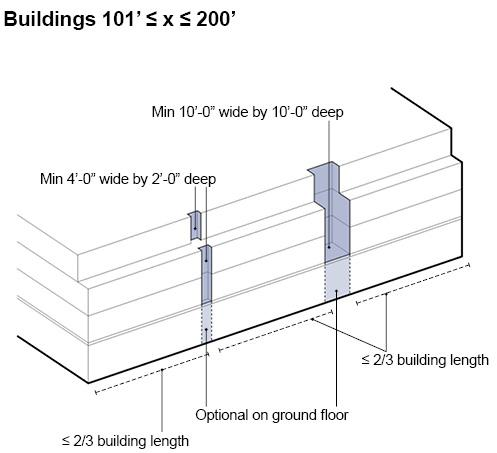
1. Buildings between fifty (50) feet and one hundred (100) feet in length shall include at least one (1) minor massing break, defined as a minimum of four (4) feet wide by two (2) feet deep extending the full height of the building above the ground floor and shall include a corresponding break in the roof line. The required minor massing break shall be positioned such that no more than two-thirds (2/3) of the total building length is without a massing break. When a building has an upper floor stepback, the minor massing break minimum dimensions shall also apply to the upper floors and shall include a corresponding break in the roof line.
2. Buildings greater than one hundred (100) feet and up to two hundred (200) feet in length shall include at least one (1) minor massing break (defined above) and one (1) major massing break, defined as a minimum of ten (10) feet wide by ten (10) feet deep extending the full height of the building above the ground floor and shall include a break in the roof line. The required major and minor massing breaks shall be positioned such that no more than two-thirds (2/3) of the total building length is without a massing break. When a building has an upper floor stepback, the minor massing break minimum dimensions apply to the upper floors and shall include a break in the roof line, and the major massing break may continue vertically to align with the walls below the stepback and shall include a break in the roof line.
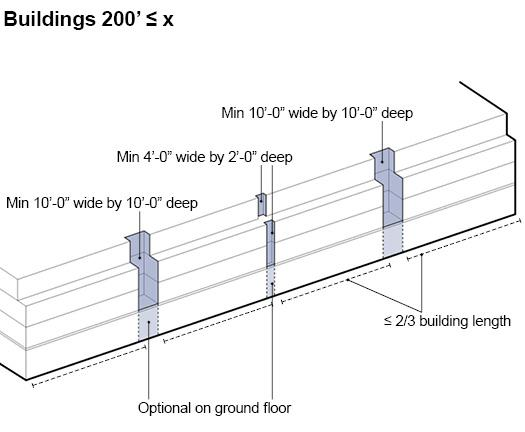
3. Buildings greater than two hundred (200) feet in length must include at least one (1) minor massing break and two (2) major massing breaks (defined above). The required minor and major massing breaks shall be positioned such that no more than two-thirds (2/3) of the total building length is without a massing break. When a building has an upper floor stepback, the minor massing break minimum dimensions shall also apply to the upper floors and shall include a corresponding break in the roof line. The major massing break may continue vertically to align with the walls below the stepback and shall include a corresponding break in the roof line.
FIGURE 18.05.040-D: MASSING BREAKS—MU DISTRICTS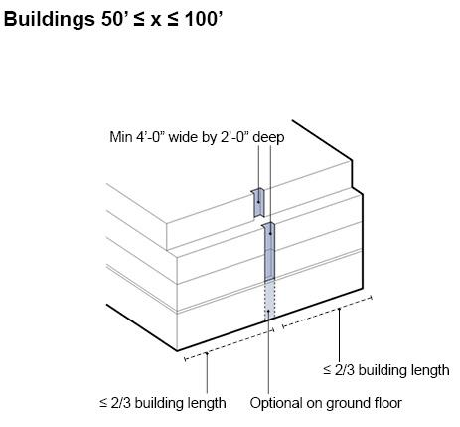
E. Corners. Corner buildings shall emphasize the street corner through a combination of building massing and facade variation.
1. All corners shall be defined for at least twenty (20) feet along each of the two street-facing facades. The corner portion shall either have a minimum two (2) foot change in building plane from its adjacent facades, or a minimum two (2) foot by two (2) foot recessed reveal where it meets the adjacent facades.
2. Building corners shall be further differentiated from the rest of the street-facing facades by at least one (1) of the following: a change in roof form with at least a five (5) foot difference in roof height, a change in building material, color, or texture, or a variation in fenestration placement.
3. Alternatively, the corner can either be a common roof terrace above the ground floor or a common plaza at the ground floor.
FIGURE 18.05.040-E: CORNERS—MU DISTRICTS


F. Roof Variety. Roof variety standards apply to all front, side, and rear building facades. Exceptions include: internal courtyard facades not visible from public rights-of-way.
1. Continuous roofs greater than seventy-five (75) feet shall be broken up using either varying parapet or roof heights, changes in plane along the facade, variation between flat and sloped roofs, overhangs with or without brackets, and/or a combination thereof. This standard does not apply to a top floor that is stepped back at least six (6) feet from the floors below.
2. Parapet caps/coping shall be at least six (6) inches deep and six (6) inches tall, and project at least three (3) inches from the building facade. Sloped roofs shall have overhangs extending a minimum of twelve (12) inches and a maximum of three (3) feet from the facade, including the eave and gutter profile.
3. Changes in roof height between parapets or differing roof types must be at least five (5) feet in height. Rooftop equipment shall be fully screened from public/street view pursuant to Section 18.15.090 using architectural elements including but not limited to parapets and screens. The screening elements shall be integrated into the overall building design.
4. Towers. If the project site is greater than fifteen thousand (15,000) square feet and not located along East San Carlos Avenue, a tower or other projecting architectural element(s) may extend up to ten (10) feet above the top of the roof; provided, that the square footage of the element(s) does not total more than ten percent (10%) of the building roof area. The area above the uppermost permitted floor of the element(s) shall not be habitable space.
FIGURE 18.05.040-F: ROOF VARIETY—MU DISTRICTS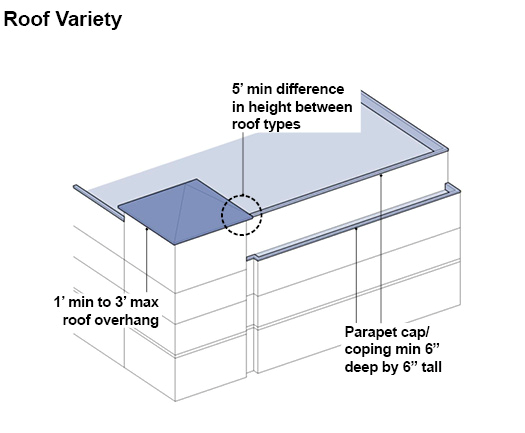

G. Base, Middle, and Top Treatment. All buildings three (3) stories and taller shall be composed of the following: a distinct base (in some cases this can be treated as the ground story or combined first two (2) stories), a middle (the majority of the building facade area), and a top (parapet cap/coping, cornice, sloped roof, or in some cases this can be treated as the top story or combined top two (2) stories). Each of these elements shall be distinguished from one another for at least seventy percent (70%) of its facade length by either a change in material, a change in color, and/or a facade plane change of at least two (2) feet. A ground floor or in some cases, a combined ground floor and second floor stepback of at least two (2) feet in addition to the required setback from floors above may be considered a base. Base, middle, and top treatment standards apply to all front, side, and rear building facades. Exceptions include: internal courtyard facades not visible from public rights-of-way.
1. A base for buildings of three (3) to five (5) stories must either be limited to thirty (30) inches in height from grade and project maximum of six (6) inches from the building facade, or be treated as the full height of the ground story. For a three (3) story building, the base is limited to thirty (30) inches if the top is treated as the full height of the top story.
2. A base for buildings of six (6) stories or more must either be limited to thirty (30) inches in height from grade and project maximum of six (6) inches from the building facade, or be treated as the full height of the ground story, or be treated as the height of the ground story and second story combined. If the top of the building is treated as the combined height of the top two (2) stories, the base is limited to the full height of the ground story.
3. The middle portion of buildings of three (3) or four (4) stories shall be a minimum of two (2) stories in height.
4. The middle portion of buildings of five (5) to six (6) stories shall be a minimum of three (3) stories in height.
5. The middle portion of buildings of greater than six (6) stories shall be a minimum of the total amount of stories minus three (3). For example, an eight (8) story building must have a middle portion that is at least five (5) stories in height.
6. The top of all buildings must have a parapet cap/coping, a cornice, or be a sloped roof.
7. A top for buildings of three (3) to five (5) stories may be treated as the full height of the top story. For a three (3) story building, the top is limited to a parapet cap/coping, a cornice, or a sloped roof if the base is treated as the full height of the ground story.
8. A top for buildings of six (6) stories or more may be treated as the full height of the top story. The top may also be treated as the full height of the top two (2) stories combined, only if the base is limited to the height of the ground story.
FIGURE 18.05.040-G: BASE, MIDDLE, AND TOP—MU DISTRICTS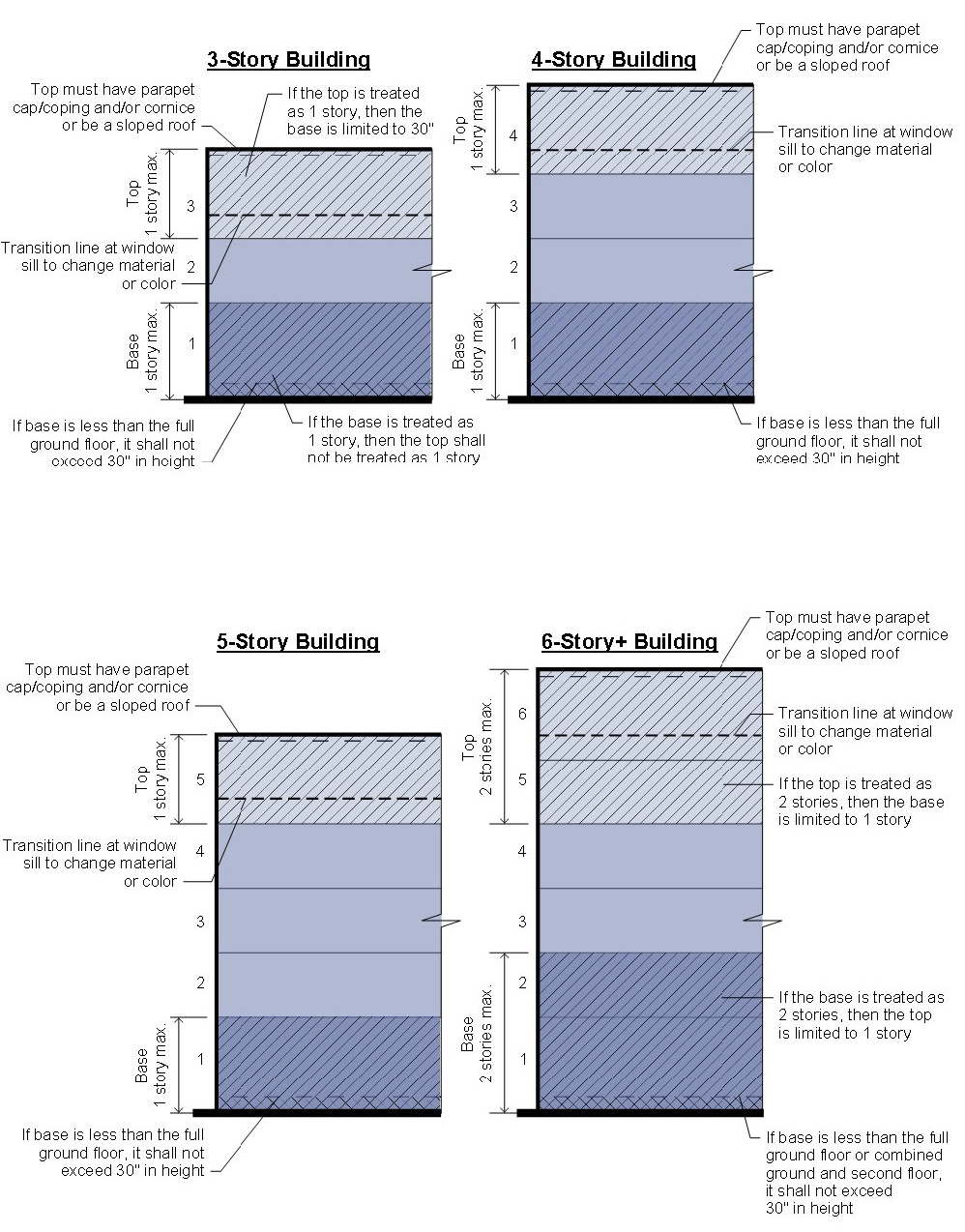
H. Fenestration Variety. To achieve the fenestration variety standard, buildings shall include rhythms of at least two (2) types of openings for at least seventy percent (70%) of its facade length—the required seventy percent (70%) length does not have to be continuous. Various types of distinct openings include storefront windows and doors, residential entry doors, living room windows, bedroom windows, bathroom windows, common hallway windows, and stairway windows. Windows may be grouped vertically or horizontally or designed with shading devices or other architectural features to achieve pattern variety. Fenestration standards apply to all front, side, and rear building facades. Exceptions include: internal courtyard facades not visible from public rights-of-way.
FIGURE 18.05.040-H: FENESTRATION VARIETY—MU DISTRICTS
I. Materials, Colors, and Texture Variety. To achieve this standard, buildings shall provide at least two (2) different materials, colors, or textures for at least seventy percent (70%) of its facade length. Material transitions along any facade shall only occur on the inside corner of a plane change. When material changes need to occur in the same plane, bands, trims, cornices, or other architectural elements shall project at least two (2) inches from the facade plane to create a corner for the material transition. Materials, colors, and texture variety standards apply to all front, side, and rear building facades. Exceptions include: internal courtyard facades not visible from public rights-of-way.
FIGURE 18.05.040-I: MATERIAL TRANSITIONS—MU DISTRICTS
J. Projecting and Recessed Elements. This standard may be applied in lieu of both the fenestration variety standard and the materials, colors, and texture variety standard. This standard applies only to facades facing public rights-of-way, not to side, rear, or internal courtyard facades. To achieve the projecting/recessed elements standard, buildings shall provide a rhythm of at least two (2) of the following elements for at least seventy percent (70%) of its facade length: projecting bays/bay windows, recessed areas containing windows, projecting or recessed balconies, ground floor stoops or porches, projecting frame/box elements containing at least one (1) window, projecting window shading devices, and ground floor awnings or canopies.
1. Projecting bays shall be between eighteen (18) inches and three (3) feet deep, and between six (6) feet and twelve (12) feet wide.
2. Usable balconies shall be a minimum of six (6) feet deep by six (6) feet wide. Balconies shall avoid a tacked-on look by being recessed at least twelve (12) inches into the building facade. When private balconies are provided, they shall have a transparency of no less than twenty-five percent (25%). Permanent storage boxes, condensers for air-conditioning units, or other mechanical equipment shall not be located on balconies. Decorative Juliet balconies shall be a minimum of twelve (12) inches deep and three (3) feet wide.
3. Recessed areas of a building containing windows shall be at least one (1) foot deep. Recessed panels shall be at least four (4) inches deep.
4. Screening devices, shading devices, and projecting frame elements shall be a minimum of eighteen (18) inches deep. Lattices, louvers, and/or perforated metal screens shall be a minimum of four (4) inches deep or set at least four (4) inches from the facade.
FIGURE 18.05.040-J: PROJECTING AND RECESSED ELEMENTS—MU DISTRICTS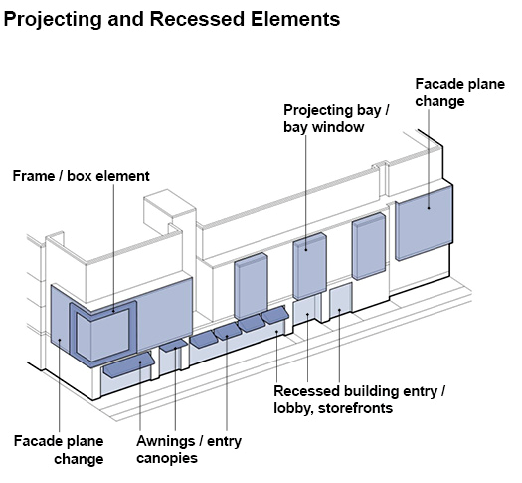
K. Windows and Ground Floor Transparency.
1. Windows without trim shall be recessed at least two (2) inches from the plane of the surrounding exterior wall to create a shadow line and visual interest. Windows with trim shall provide trim at least two (2) inches in depth with windows inset from the trim edge by at least two (2) inches. The window trim objective design standards do not apply to interior-facing windows such as those along an internal building courtyard and windows that are not seen from or facing public rights-of-way.
2. For double-hung and horizontal sliding windows, at least one (1) sash shall achieve a two (2) inch recess. Snap-in vinyl mullions between double pane glass are prohibited. If a divided light appearance is desired, mullions shall be made of dimensional material projecting in front of the panes on both the inside and outside of the window.
3. A minimum of ninety percent (90%) of upper floor windows on street- or public-open-space-facing building facades shall be designed such that:
a. Windows are at least twelve (12) inches apart.
b. Proportions of typical windows shall be vertically oriented and shall not exceed a width (x) to height (y) ratio of two to three (2:3). Proportions of picture windows (typically provided for living rooms) shall not exceed a width to height ratio of one to one (1:1)
4. Proportions of storefront windows shall also be vertically oriented not to exceed a width to height ratio of two to three (2:3). Storefront windows with a width to height ratio greater than two to three (2:3) shall include vertical mullions such that each window panel is not greater than a two to three (2:3) width to height ratio.
5. Mirrored or reflective glass is not allowed on a street- or public-open-space-facing building facade at any level. Only transparent glass shall be used for windows or glazing at the ground floor.
6. Facade transparency is important to provide visual interest, visibility for businesses, and an active sidewalk environment. For mixed-use buildings with commercial ground floors, a minimum sixty percent (60%) of the ground floor facade area between two (2) feet and ten (10) feet above the sidewalk shall be glazed with transparent windows and doors. For mixed-use buildings with noncommercial ground floors, such as office, institution, residential units, or residential active uses as further defined in Section 18.05.030(H)(1), a minimum fifty percent (50%) of the ground floor facade area between four (4) feet and ten (10) feet above the sidewalk shall be glazed with transparent windows and doors. For corner buildings, this standard also applies to the secondary street facade for at least twenty-five (25) feet from the corner.
7. Minor deviation from the window requirement may be granted through the design review process to accommodate alternative window design complementary to the architectural style of the structure.
FIGURE 18.05.040-K: WINDOWS—MU DISTRICTS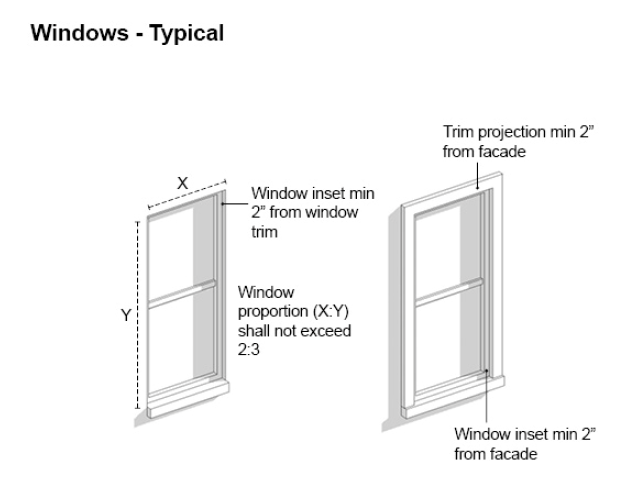

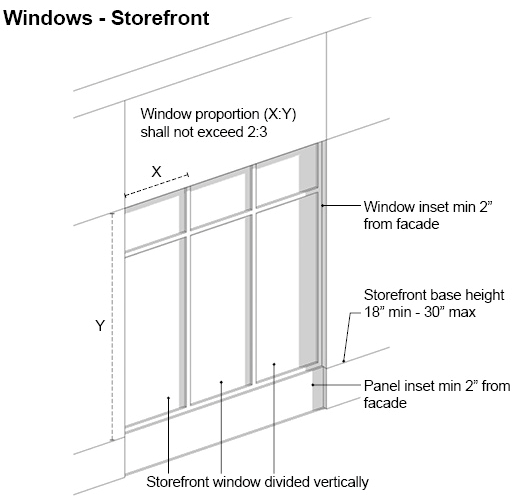
FIGURE 18.05.040-L: GROUND FLOOR WINDOW TRANSPARENCY—MU DISTRICTS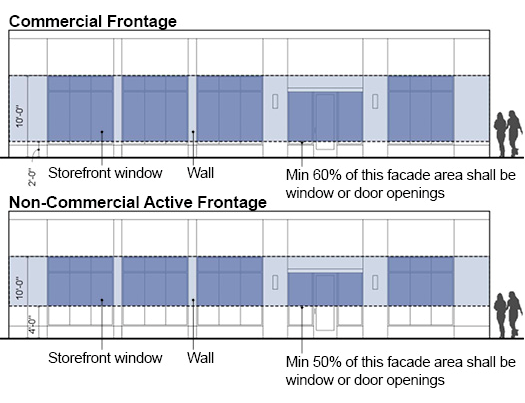
L. Building Materials. Building materials standards apply to all front, side, and rear building facades. Exceptions include: internal courtyard facades not visible from public rights-of-way. Ground floor building walls shall have high-quality materials and texture for all non-glass areas. High-quality materials include: stone, marble, granite, brick (real or thin veneers of natural color), ceramic tile, wood, terracotta, precast concrete, glass-fiber reinforced concrete, cast-in-place concrete, board-formed concrete, cement plaster, stucco (light sand or smooth trowel finish), cement fiber or similar synthetic siding resembling wood siding, steel (porcelain enamel panels, steel windows, steel exterior doors, steel rails and fences, painted, stainless, or pre-weathered steel are acceptable when limited to a maximum of fifty percent (50%) of the building treatment), aluminum (windows, panels, storefront, curtain wall, doors, aluminum should be natural finish anodized, powder-coated, or Kynar, no bronze anodized), high-density fiber cement panels, durable foam coating/window trims with smooth stucco finish. Prohibited materials include: unfinished or natural T1-11 siding, foam, spray stucco, vinyl. Entry canopies, stoops, patios, and balconies shall be constructed of all-weather, durable materials. The Planning Director shall maintain a list of approved facade and trim materials, with such a list accessible to the public.
M. Private Storage Space. Each unit shall have at least two hundred (200) cubic feet of enclosed, weather-proofed, and lockable private storage space with a minimum horizontal dimension of four (4) feet.
N. Paving. Differentiated paving materials shall be used for driveway aprons, entries, and pedestrian walkways. This may include, but not be limited to, textures or colors, concrete pavers, brick, or stamped concrete. The use of permeable materials to reduce runoff is strongly encouraged.
O. Pedestrian Access. On-site pedestrian circulation and access must be provided according to the following standards:
1. Internal Connections. A system of pedestrian walkways shall connect all buildings on a site to each other, to on-site automobile and bicycle parking areas, and to any on-site open space areas or pedestrian amenities.
2. To Circulation Network. Connections between on-site walkways and the public sidewalk and other existing or planned pedestrian routes, such as safe routes to school, shall be provided. An on-site walkway shall connect the primary building entry or entries to a public sidewalk on each street frontage.
3. To Neighbors. Direct and convenient access shall be provided from commercial and mixed-use projects to adjoining residential and commercial areas where feasible while still providing for safety and security.
4. To Transit. Safe and convenient pedestrian connections shall be provided from transit stops to building entrances.
5. Across Rail Corridor. Safe and convenient pedestrian connections shall be provided across the rail corridor. If an aerial viaduct or trench is used for rail alignment, the following standards shall apply where feasible given engineering requirements.
a. Extend the street grid below the aerial viaduct or above the trench to provide new street and pedestrian connections across the corridor.
b. Locate active commercial uses or public park and recreation space below the aerial viaduct to enhance connectivity and create safe, attractive connections across the rail corridor.
c. Enhance connections below the viaduct with lighting and public art.
6. Interior Pedestrian Walkway Design.
a. Walkways shall have a minimum clear unobstructed width of five (5) feet, shall be hard-surfaced, and paved with concrete, stone, tile, brick, or comparable material.
b. Where a required walkway crosses driveways, parking areas, or loading areas, it shall be clearly identifiable through the use of a raised crosswalk, a different paving material, or similar method.
c. Where a required walkway is parallel and adjacent to an auto travel lane, it must be raised or separated from the auto travel lane by a raised curb at least four (4) inches high, bollards, or other physical barrier.
P. Residential Notification. Residents of mixed-use development shall be informed by the applicant and/or property management of potential noise from refuse collection and other activities typically associated with commercial activity.
Q. Rail Station.
1. Rail stations shall be designed to have physical presence and visibility on both sides of the rail corridor, including key architectural features that are visible from major roadways and connections, as well as pedestrian-level entries and vehicle drop-off areas.
2. Rain-protected east-west pedestrian connections shall be provided at the ground level of the station to enhance pedestrian connectivity along the rail corridor. These connections should be extensions of the existing street grid and pedestrian network with a minimum clear width of eight (8) feet. (Ord. 1626 § 3 (Exh. A), 2025; Ord. 1612 § 1 (Exh. A), 2024; Ord. 1596 § 6 (Exh. A), 2023; Ord. 1480 (Exh. B (part)), 2015; Ord. 1438 § 4 (Exh. A (part)), 2011)