


Chapter 12.10
BUILDING REGULATIONS
Sections:
Article I. Title, Purpose and Scope
12.10.130 Amendments to chapter.
12.10.140 Voluntary compliance of exempted persons.
Article II. Adoption of Codes
12.10.210 Codes adopted by reference.
12.10.215 2022 California Building Code adopted.
12.10.216 Swimming pool enclosures amendment.
12.10.217 Appendix J of the 2022 California Building Code adopted.
12.10.218 Appendix C of the 2022 California Building Code adopted.
12.10.220 2022 California Residential Building Code adopted.
12.10.225 2022 California Historical Building Code adopted.
12.10.230 2022 California Mechanical Code adopted.
12.10.235 2022 California Plumbing Code adopted.
12.10.240 2022 California Electrical Code adopted.
12.10.245 2022 California Energy Code adopted.
12.10.246 2022 California Existing Building Code adopted.
12.10.250 2022 Green Building Standards Code adopted.
12.10.251 1997 Uniform Code for the Abatement of Dangerous Buildings adopted.
12.10.252 1997 Uniform Housing Code adopted.
Article III. Permits and Inspections
12.10.315 Work exempt from permit—Exempted work.
12.10.320 Application for permit.
12.10.321 Streamlined permitting process for small residential rooftop solar energy systems.
12.10.322 Streamlined permitting process for electric vehicle charging stations.
12.10.325 Architect or engineer of record.
12.10.335 Expiration of permits.
12.10.340 Suspension or revocation.
12.10.345 Permits voided for nonpayment.
12.10.360 Structural observation.
12.10.365 Connection to utilities.
12.10.375 Regulations for moving buildings and structures.
Article IV. Authority and Enforcement
12.10.415 Creation of an Enforcement Agency.
12.10.420 Powers and duties of Building Official.
12.10.425 Abatement of structural and geologic hazards.
Article I. Title, Purpose and Scope
12.10.100 Title of chapter.
This chapter shall be known as the Building Code of the County of Santa Cruz and may be cited by such title. [Ord. 5414 § 1, 2022; Ord. 5318 § 1, 2019; Ord. 5235 § 1, 2016; Ord. 5168 § 1, 2013; Ord. 5081 § 1, 2010; Ord. 4894 § 2, 2007].
12.10.110 Purpose of chapter.
The purpose of this chapter is to provide minimum standards to safeguard life or limb, health, property, and public welfare by regulating and controlling the design, site preparation and construction, alteration, repair, quality of materials, use and occupancy, location, moving and maintenance of all buildings, structures and/or property service equipment within this County and certain equipment specifically regulated herein, including installation, additions, alteration, and repairs of mechanical, plumbing and electrical systems. This chapter also contains local administrative, organizational and enforcement rules for such activities in the County of Santa Cruz. (See other chapters in this title for additional administrative provisions relating to building construction and related activities in Santa Cruz County.) [Ord. 5414 § 1, 2022; Ord. 5318 § 1, 2019; Ord. 5235 § 1, 2016; Ord. 5168 § 1, 2013; Ord. 5081 § 1, 2010; Ord. 4894 § 2, 2007].
12.10.120 Scope of chapter.
Any building or structure located on any land embraced in any unincorporated area of the County shall be automatically subject to the provisions of this chapter. [Ord. 5414 § 1, 2022; Ord. 5318 § 1, 2019; Ord. 5235 § 1, 2016; Ord. 5168 § 1, 2013; Ord. 5081 § 1, 2010; Ord. 4894 § 2, 2007].
12.10.130 Amendments to chapter.
All amendments to this chapter shall be initiated by the State of California periodic update of the California Building Standards Code or the Board of Supervisors. If a public hearing regarding a proposed amendment is considered by the Board of Supervisors to be in the best interests of the people, the Board may fix a time and place for hearing and direct that the substance of the proposed amendment be published in a newspaper of general circulation, printed and published in the County, said publication to be at least 10 days prior to the date fixed for the hearing. [Ord. 5414 § 1, 2022; Ord. 5318 § 1, 2019; Ord. 5235 § 1, 2016; Ord. 5168 § 1, 2013; Ord. 5081 § 1, 2010; Ord. 4894 § 2, 2007].
12.10.140 Voluntary compliance of exempted persons.
Any owner of a building exempted from the provisions of this chapter may obtain the service of the Building Official by applying for a building permit and paying the customary fees. [Ord. 5414 § 1, 2022; Ord. 5318 § 1, 2019; Ord. 5235 § 1, 2016; Ord. 5168 § 1, 2013; Ord. 5081 § 1, 2010; Ord. 4894 § 2, 2007].
12.10.150 Definitions.
General. Whenever in any of the codes adopted hereby the following names or terms are used, such name or term shall have the meaning ascribed to it by this section. If the same term is defined in Chapter 2 of the most recent edition of the California Building Code, then the definition in this chapter shall prevail. For any terms defined expressly for a particular chapter or section of the building standard codes adopted hereby, such terms shall have the meanings ascribed to them as in those chapters.
(A) “Building, Accessibility and Fire Code Appeals Board” means the Board of Supervisors of the County of Santa Cruz or the Board of Directors of the fire department serving the jurisdiction for the location of the project.
(B) “Building and/or property service equipment” refers to the plumbing, mechanical, electrical and elevator equipment including piping, wiring, fixtures and other accessories which provide sanitation, lighting, heating, ventilation, cooling, refrigeration, firefighting and transportation facilities essential to the occupancy of the building or structure for its designated use.
(C) “Building Department” means the section of the Community Development and Infrastructure Department that administers the building standards code.
(D) Building Official. “Building Official,” “Chief Building Inspector,” “Administrative Authority,” and all other terms and designations indicating the person authorized and directed to carry out, enforce, and exercise government rights, privileges, and duties shall, unless expressly indicated otherwise, mean the Building Official and their duly authorized deputies, assistants and inspectors. The “Building Official” is the Director of the Community Development and Infrastructure Department, or their appointed designee.
(E) “City” means the County of Santa Cruz when referring to a political entity or an incorporated area of said County when referring to area.
(F) “City Clerk” means the County Clerk; Ex Officio Clerk of the Board of Supervisors.
(G) “City Council” means the Board of Supervisors of the County of Santa Cruz.
(H) “Commencement of work” shall be the completion of the first permanent work (not including wells, septic tanks, grading or temporary power poles). Said permanent work shall include footings, foundations, and caissons, etc., signed off by the Building Inspector with the concrete to be poured within five days after the reinforcement inspection.
(I) “Department” means the Santa Cruz County Community Development and Infrastructure Department.
(J) “Director” means the Director of the Santa Cruz County Community Development and Infrastructure Department.
(K) “Fire Chief” means the Chief Officer of the Fire Department serving the jurisdiction for the location of a project, or a duly authorized agent.
(L) “Structure” means that which is built or structured, as edifice or building of any kind, or any piece of work artificially built up or composed of parts joined together in some definite manner.
(M) “Valuation” or “value,” as applied to a building and its building service equipment, shall be as noted in the County of Santa Cruz Community Development and Infrastructure Department’s adopted fee schedule. For purposes of calculating square footage, refer to the definition of “Area, Building” in Section 202 of the 2022 California Building Code. [Ord. 5414 § 1, 2022; Ord. 5318 § 1, 2019; Ord. 5235 § 1, 2016; Ord. 5168 § 1, 2013; Ord. 5081 § 1, 2010; Ord. 5050 § 4, 2009; Ord. 5024 § 7, 2008; Ord. 4894 § 2, 2007].
Article II. Adoption of Codes
12.10.210 Codes adopted by reference.
For the purpose of establishing proper regulations for building construction and for installation of mechanical, plumbing and electrical systems, the following codes or portions thereof hereinafter set forth, and any appendix or portion thereof that has been specifically adopted by a State agency or the County of Santa Cruz, are hereby adopted and made a portion of this chapter by reference without further publication or posting thereof. Except as otherwise specifically provided in this chapter, each and every provision, section, table, diagram, illustration, figure, phrase, and paragraph thereof are hereby adopted in the same manner as though set forth in full. The building code for the County of Santa Cruz shall be the latest printing of the codes adopted in this chapter, as amended below. Two copies of each of the adopted codes are and shall be maintained on file in the office of the Clerk of the Board of Supervisors, and one copy of each shall be maintained in the office of the Building Official for use and examination by the public. [Ord. 5414 § 1, 2022; Ord. 5318 § 1, 2019; Ord. 5235 § 1, 2016; Ord. 5168 § 1, 2013; Ord. 5081 § 1, 2010; Ord. 4894 § 2, 2007].
12.10.215 2022 California Building Code adopted.
The current printing of the 2022 Edition of the California Building Code (CBC), also known as Part 2 of Title 24 of the California Code of Regulations, is hereby adopted, including those appendices or portions thereof specifically adopted by a State agency or specifically adopted by the ordinance codified in this section, but excluding other appendices, subject to the following amendments:
(A) Exempt Work Amendment. Section 105.2 (1-13) of the 2022 California Building Code is hereby deleted. SCCC 12.10.315 continues to remain in effect as the list of exempt work.
(B) Appeals Board Amendment. Sections 1.8.8 and 113 of the 2022 California Building Code, Sections 1.8.8 and R112 of the 2022 California Residential Code, Sections 1.8.8 and 107.0 of the 2022 California Plumbing Code, Section 89.108.8 of the 2022 California Electrical Code, and Sections 1.8.8 and 107.0 of the 2022 California Mechanical Code, all relating to the “Appeals Board,” are deleted. The Board of Supervisors shall serve as the local appeals board required by Health and Safety Code Section 17920.5.
(C) Repealed by Ord. 5119.
(D) Fire Hazard Areas Amendment. Section 701A.3 of the 2022 California Building Code is hereby amended to delete Exceptions 1, 2, 4 and 5 and a new Section 701A.3.05 is added to read:
701A.3.05. All additions, and any replacements of building wood siding, windows, roofing, attic vents and foundation vents used in the exterior design and construction of existing buildings located within any High or Very High Fire Hazard Severity Zone within State Responsibility Areas must comply with the requirements noted in Chapter 7A of the 2022 California Building Code.
Exceptions:
1. Replacement of an area of wood siding not exceeding 100 sq. ft.
2. Replacement of a broken window or glass door.
3. Replacement of an area of roofing not exceeding 100 sq. ft.
4. Replacement of one attic or foundation vent.
(E) Emergency Escape and Rescue Window Replacement Amendment. Section 1031 of the 2022 California Building Code is hereby amended by adding Section 1031.7 to read:
1031.7 Replacement Windows. When a non-compliant window is replaced in a sleeping room of an R-2 or R-3 occupancy and it is required to be an emergency escape and rescue window, the replacement window must comply with the emergency escape and rescue provisions of the 2022 California Building Code, Section 1031.
(F) Toilet and Bathroom Requirements Amendment. Section 1210 of the 2022 California Building Code is hereby amended by adding Section 1210.4 to read:
1210.4 Prohibited toilet room location. Toilet rooms shall not open directly into a room used for the preparation of food for service to the public.
(G) Roof Assemblies Amendments. Section 1505.1 of the 2022 California Building Code is hereby amended to read:
(1) 1505.1 General. Roof assemblies shall be divided into the classes defined below. Class A and B roof assemblies and roof coverings required to be listed by this Section shall be tested in accordance with ASTME 108 or UL 790.
Table 1505.1 shall be amended to read:
TABLE 1505.1a
MINIMUM ROOF COVERING CLASSIFICATION FOR TYPES OF CONSTRUCTION
|
IA |
IB |
IIA |
IIB |
IIIA |
IIIB |
IV |
VA |
VB |
|
B |
B |
B |
B |
B |
B |
B |
B |
B |
For SI: 1 ft = 304.8mm, 1 square foot = 0.0929m2.
a. Unless otherwise required in accordance with Chapter 7A.
(2) 1505.1.2 Roof coverings within all other areas. The entire roof covering of every existing structure where more than 50% of the total roof area is replaced within any one-year period, the entire roof covering of every new structure, and any roof covering applied in the alteration, repair, or replacement of the roof of every existing structure, shall be a fire-retardant roof covering that is at least a Class B.
(H) Structural Amendments.
(1) Special Inspections for Concrete Construction Amendment. Section 1705.3 of the 2022 California Building Code is hereby amended to read:
1705.3 Concrete Construction. The special inspections and verifications for concrete construction shall be as required by this section and TABLE 1705.3. Exceptions: Special inspections shall not be required for:
(a) Isolated spread concrete footings of buildings three stories or less in height above grade plane that are fully supported on earth or rock, where the structural design of the footing is based on a specified compressive strength, f’c, no greater than 2,500 pounds per square inch (psi) (17.2 Mpa).
(2) Concrete Amendment. Section 1905.1.7 of the 2022 California Building Code is hereby amended to read:
1905.1.7 ACI 318, Section 14.1.4. Delete ACI 318, Section 14.1.4, and replace with the following:
14.1.4 - Plain concrete in structures assigned to Seismic Design Category C, D, E or F.
14.1.4.1- Structures assigned to Seismic Design Category C, D, E or F shall not have elements of structural plain concrete, except as follows:
(a) Left intentionally blank.
(b) Isolated footings of plain concrete supporting pedestals or columns are permitted, provided the projection of the footing beyond the face of the supported member does not exceed the footing thickness.
(c) Plain concrete footings supporting walls are permitted, provided the footings have at least two continuous longitudinal reinforcing bars not smaller than No. 4, with a total area of not less than 0.002 times the gross cross-sectional area of the footing. A minimum of one bar shall be provided at the top and bottom of the footing. Continuity of reinforcement shall be provided at corners and intersections.
(I) Shear Wall Amendments:
(1) Allowable Shear. Section 2306.3 of the 2022 California Building Code is hereby amended to delete Table 2306.3(3).
(2) Table 2308.6.1 of the 2022 California Building Code is hereby amended as follows: In Seismic Design Categories D0, D1 and D2, and E, Method GB is not permitted and the use of method PCP, DWB, PBS, HPS and SFB is limited to one-story single-family dwellings or the top story of two-story single-family dwellings, and accessory structures.
(3) Resistance to Shear. Sections 2505.1 and 2505.2 of the 2022 California Building Code are hereby deleted.
(J) Accessibility Amendment—Width Standards for Doorways. Exception 8 of Section 1010.1.1 of the 2022 California Building Code is hereby amended to read:
Except as required in R327.1.3, in other than Group R-1 occupancies, the minimum widths for all interior and exterior doors within a dwelling unit or sleeping unit that is not required to be adaptable or accessible as specified in Chapter 11A, or utilized as a required egress door per CBC, Section 1010.1.1, shall be no less than 30 inches in clear width. If, and to the extent that, this Subsection is inconsistent with any provision of the California Building Code currently or hereafter adopted by the County of Santa Cruz, the more restrictive provisions shall prevail.
Exception: Interior door openings to closets not more than 36” in depth.
(K) Accessibility Amendment—Alterations. Section 11B-202 of the 2022 California Building Code requires that building owners, property owners, and commercial landlords make buildings and facilities accessible to persons with disabilities when performing renovation, structural repair, alterations, and additions to existing buildings and facilities. The provisions of Section 11B-202 also apply to alterations to portions of the facility that are outside areas serving the building, including but not limited to parking lots, sidewalks, and walkways. For the purposes of Section 11B-202, slurry sealing, top dressing, overlaying, and restriping shall not be considered an alteration. However, repaving, reconstructing or replacing a parking lot shall constitute an alteration.
(L) Wood Foundation Amendment. Section 1807.1.4 of the 2022 California Building Code is hereby amended to read:
1807.1.4. The use of permanent wood foundation systems is prohibited.
(M) Embedded Posts and Poles and Retaining Walls and Cribs Amendments.
(1) Section 1807.4 of the 2022 California Building Code is hereby amended to read:
1807.4 Wood used in retaining walls and cribs. The use of wood support posts or poles in all required structural retaining walls located on private property that are associated with habitable structures, required access roads and driveways, and required slope stability walls that create or protect the development envelope, is prohibited. Although wood has the strength and can be calculated to show it can achieve the required safety factors, it does not possess the longevity or fire resistivity to more permanently resist natural forces and surcharges to maintain required safety factors for structural retaining wall supports in all locations and uses. Where using posts or poles as columns embedded in earth or in concrete footings in earth is allowed, such shall be designed to resist both axial and lateral loads in accordance with Sections 1807.3.1 through 1807.3.3. The prohibitions of this section do not apply to any retention system that may be used by public agencies.
(2) Section 2304.12.5 of the 2022 California Building Code is hereby added to read:
2304.12.5 Wood used in retaining walls and cribs. The use of wood support posts or poles in all required structural retaining walls located on private property that are associated with habitable structures, required access roads and driveways, and required slope stability walls that create or protect the development envelope, is prohibited. Although wood has the strength and can be calculated to show it can achieve the required safety factors, it does not possess the longevity or fire resistivity to more permanently resist natural forces and surcharges to maintain required safety factors for structural retaining wall supports in all locations and uses. Where using posts or poles as columns embedded in earth or in concrete footings in earth is allowed, such shall be designed to resist both axial and lateral loads in accordance with Sections 1807.3.1 through 1807.3.3 and shall be preservative treated in accordance with AWPA U1 (Commodity Specifications A or F) for soil and fresh water use. The prohibitions of this section do not apply to any retention system that may be used by public agencies.
[Ord. 5414 § 1, 2022; Ord. 5318 § 1, 2019; Ord. 5235 § 1, 2016; Ord. 5168 § 1, 2013; Ord. 5119 § 1, 2012; Ord. 5081 § 1, 2010; Ord. 5050 § 5, 2009; Ord. 5024 § 8, 2008; Ord. 4894 § 2, 2007].
12.10.216 Swimming pool enclosures amendment.
Section 3109 of the 2022 California Building Code is hereby deleted in its entirety and replaced with this section to read:
(A) Scope. The provisions of this section shall apply to the design and construction of barriers and entrapment avoidance devices for swimming pools, spas and hot tubs, located on the premises of Group R, Division 3 Occupancies, and to pool design and construction, pool decks, and pool drainage and disposal.
(1) Application to Facilities Regulated by Department of Social Services. This section does not apply to any facility regulated by the State Department of Social Services even if the facility is also used as a private residence of the operator. Pool safety in those facilities shall be regulated pursuant to regulations adopted by the State Department of Social Services.
(B) Definitions. For the purpose of this section, certain terms, words and phrases are defined as follows:
(1) Aboveground/On-Ground Pool. See definition of “swimming pool.”
(2) “ANSI” means the American National Standards Institute.
(3) “Approved safety pool cover” means a manually or power-operated safety pool cover that meets all of the performance standards of the ASTM, in compliance with Standard F 1346-91.
(4) “ASME” means the American Society of Mechanical Engineers.
(5) “ASTM” means the American Society for Testing and Materials.
(6) “Barrier” means a fence, wall, building wall or combination thereof that completely surrounds the swimming pool and obstructs access to the swimming pool.
(7) “Exit alarm” means a device or devices that make audible, continuous alarm sounds when any door or window that permits access from a residence to the pool area, that is without any intervening barrier, is opened or is left ajar.
(8) “Grade” means the underlying surface, such as earth or a walking surface.
(9) Hot Tub. See definition of “spa, nonself-contained” and “spa, self-contained.”
(10) In-Ground Pool. See definition of “swimming pool.”
(11) “Separation fence” means a barrier that separates all doors of a dwelling unit with direct access to a swimming pool from the swimming pool.
(12) “Spa, nonself-contained” means a hydromassage pool or tub for recreational or therapeutic use, not located in health-care facilities, designed for immersion of users and usually having a filter, heater and motor-driven blower. It may be installed indoors or outdoors, on the ground or on a supporting structure, or in the ground or in a supporting structure. A nonself-contained spa is intended for recreational bathing and contains water over 18 inches (457 mm) deep.
(13) “Spa, self-contained” means a continuous-duty appliance in which all control, water-heating and water-circulating equipment is an integral part of the product, located entirely under the spa skirt. A self-contained spa is intended for recreational bathing and contains water over 18 inches (457 mm) deep.
(14) “Swimming pool” means any structure intended for swimming or recreational bathing that contains water over 18 inches (457 mm) deep. This includes in-ground, aboveground and on-ground swimming pools, and fixed-in-place wading pools.
(15) “Swimming pool, indoor” means a swimming pool that is totally contained within a residential structure and surrounded on all four sides by walls of said structure.
(16) “Swimming pool, outdoor” means any swimming pool that is not an indoor pool.
(C) Barrier Requirements for Outdoor Swimming Pools. An outdoor swimming pool shall be provided with a barrier that shall be installed, inspected and approved prior to plastering or filling with water. The barrier shall comply with the following:
(1) Height of Barrier. The top of the barrier shall be at least 60 inches (1,524 mm) above grade measured on the side of the barrier that faces away from the swimming pool.
(2) Vertical Clearance. The maximum vertical clearance between grade and the bottom of the barrier shall be two inches (51 mm) measured on the side of the barrier that faces away from the swimming pool.
(3) Horizontal Members. When barriers have horizontal members spaced less than 45 inches (1,143 mm) apart, measured between the tops, the horizontal members shall be placed on the pool side of the barrier.
(4) Decorative Design Work. Any decorative design work on the side away from the swimming pool, such as protrusions, indentations, cutouts or other physical characteristics, that could serve as handholds or footholds, which renders the barrier easily climbable, is prohibited.
(5) Openings. Openings in the barrier shall not allow passage of a one-and-three-quarters-inch diameter (44.5 mm) sphere, except in the following circumstances:
(a) When vertical spacing between such openings is 45 inches (1,143 mm) or more, the opening size may be increased such that the passage of a four-inch-diameter (102 mm) sphere is not allowed; or
(b) For fencing composed of vertical and horizontal members, the spacing between vertical members may be increased up to four inches (102 mm) when the distance between the tops of horizontal members is 45 inches (1,143 mm) or more.
(6) Gauge of Chain Link Fence. Chain link fences used as the barrier shall not be less than 11 gauge.
(7) Mesh Size of Chain Link Fence. Maximum mesh size for chain link fences shall be a 1.75-inch square (44 mm square) unless the fence is provided with slats fastened at the top or the bottom which reduce the openings to no more than 1.75 inches (44 mm).
(8) Access Gates. Access gates shall comply with the requirements of subsections (C)(1) through (C)(7) of this section in addition to the following:
(a) Pedestrian access gates shall be self-closing and have a self-latching device;
(b) Where the release mechanism of the self-latching device is located less than 60 inches (1,524 mm) from the bottom of the gate:
(i) The release mechanism shall be located on the pool side of the barrier at least three inches (76 mm) below the top of the gate; and
(ii) The gate and barrier shall have no opening greater than one-half inch (12.7 mm) within 18 inches (457 mm) of the release mechanism;
(c) Pedestrian gates shall swing away from the pool;
(d) Any gates other than pedestrian access gates shall be equipped with lockable hardware or padlocks and shall remain locked at all times when not in use.
(9) Aboveground Pool as Part of Barrier. Where an aboveground pool structure is used as a barrier or where the barrier is mounted on top of the pool structure, and the means of access is a ladder or steps, then:
(a) The ladder or steps shall be capable of being secured, locked or removed to prevent access; or
(b) The ladder or steps shall be a barrier that meets the requirements of subsections (C)(1) through (C)(8) of this section;
(c) When the ladder or steps are secured, locked or removed, any openings created shall be protected by a barrier complying with subsections (C)(1) through (C)(8) of this section.
(D) Barrier Requirements for Indoor Swimming Pools. For an indoor swimming pool, protection shall comply with the requirements of subsection (F) of this section.
(E) Barrier Requirements for Spas and Hot Tubs. For a nonself-contained and self-contained spa or hot tub, protection shall comply with the requirements of subsection (F) of this section, except in the following circumstance:
(1) A self-contained spa or hot tub equipped with a listed safety cover.
(F) Drowning Prevention Safety Features. In accordance with section 115922 of the California Health and Safety Code, when a building permit is issued for the construction of a new swimming pool or spa or the remodeling of an existing swimming pool or spa at a private single-family home, the respective swimming pool or spa must be equipped with a barrier in compliance with SCCC 12.10.216(C), (D) and (E) and one other means of drowning prevention safety feature depending on the conditions listed below.
(1) Condition 1: When the single-family home forms part of the barrier, one of the following drowning prevention safety features must be in place:
(a) Self-closing and self-latching devices installed on all doors with direct access to the pool with the release mechanism located a minimum of 60 inches (1,524 mm) above the floor;
(b) A permanently installed exit alarm (listed in accordance with UL-2017) installed on all doors and windows with direct access to the pool. The alarm shall sound continuously within seven seconds after the door or window and its screen, if present, are opened, and be capable of providing a sound pressure level of not less than 85 dBA when measured indoors at 10 feet (3,048 mm). The alarm shall automatically reset under all conditions. The alarm system shall be equipped with a manual means, such as a touchpad or switch, to temporarily deactivate the alarm for a single opening. Such deactivation shall last no longer than 15 seconds. The deactivation switch shall be located at least 54 inches (1,372 mm) above the threshold of the door or window. Exit alarms may be battery operated or may be connected to the electrical wiring of the building; or
(c) An approved safety pool cover that meets all of the performance standards of the American Society for Testing and Materials (ASTM), in compliance with standard F1346-91.
(2) Condition 2: When the single-family home does not form part of the barrier, one of the following drowning prevention safety features must be in place:
(a) An approved safety pool cover that meets all of the performance standards of the American Society for Testing and Materials (ASTM), in compliance with standard F1346-91.
(b) An alarm that, when placed in a swimming pool or spa will sound upon detection accidental or unauthorized entrance into the water. The alarm shall meet and be independently certified to the ASTM Standard F2208 “Standard Safety Specifications for Residential Pool Alarms”.
(G) Entrapment Avoidance. Whenever a building permit is issued for the construction of a new swimming pool or spa, the pool or spa shall meet all of the following requirements:
(1) Suction Outlet. The suction outlet of the pool or spa for which the permit is issued shall be equipped to provide circulation throughout the pool or spa, to include:
(a) The swimming pool or spa shall have at least two circulation drains per pump that shall be hydraulically balanced and symmetrically plumbed through one or more “T” fittings, and that are separated by a distance of at least three feet in any dimension between the drains;
(b) Suction outlets that are less than 12 inches (306 mm) across shall be covered with anti-entrapment grates, as specified in the ASME/ANSI Standard A 112.19.8, that cannot be removed except with the use of tools. Slots or openings in the grates or similar protective devices shall be of a shape, area, and arrangement that would prevent physical entrapment and would not pose any suction hazard to bathers.
(2) Atmospheric Vacuum Relief System. All pool and spa single- or multiple-outlet circulation systems shall be equipped with an atmospheric vacuum relief should grate covers located therein become missing or broken. Such vacuum relief systems shall include at least one approved or engineered method of the type specified herein, as follows:
(a) Safety vacuum release systems conforming to ASME A 112.19.17; or
(b) Approved gravity drainage system.
(3) Pool Cleaner Fittings. Where provided, vacuum or pressure cleaner fitting(s) shall be located in an accessible position(s) at least six inches (152 mm) and not greater than 12 inches (305 mm) below the minimum operational water level or as an attachment to the skimmer(s).
(4) Additional Backup Safety System. Any backup safety system that an owner of a new swimming pool or spa may choose to install in addition to the requirements set forth in these subsections shall meet the standards as published in the document, “Guidelines for Entrapment Hazards: Making Pools and Spas Safer,” Publication Number 363, March 2005, United States Consumer Product Safety Commission.
(5) Upgrading Required. Whenever a building permit is issued for the remodel or modification of an existing swimming pool, spa or hot tub, the permit shall require that the suction outlet of the existing swimming pool, spa or hot tub be upgraded so as to be equipped with an anti-entrapment cover meeting current standards of the ASTM or the ASME.
(H) CPR (Cardiopulmonary Resuscitation) Signage Required.
Prior to the final approval of an outdoor swimming pool or spa, or an indoor swimming pool, in-ground or above-ground, a permanently installed CPR sign must be posted in a readily observable location in the pool or spa area. The sign shall be no smaller than 12 inches by 10 inches. The sign shall demonstrate and/or instruct proper CPR techniques utilized in water rescues.
(I) Applicability of Provisions.
(1) If Built or Erected Prior to August 14, 1992. Any property owner of a residential pool, spa or hot tub built or erected prior to August 14, 1992, shall:
(a) Comply with the current barrier regulations found in this section, including, but not limited to, obtaining any required permits;
(b) The barrier shall be maintained in compliant condition;
(c) Prior to the sale of residential property containing a swimming pool, spa or hot tub, the owner shall provide the buyer with a written certification, prepared by the Building Official or a certified home inspector, of compliance with the barrier requirements of this section.
(2) If Built or Erected on or After August 14, 1992. Any property owner of a residential pool, spa or hot tub built or erected on or after August 14, 1992, with a valid finaled building permit shall:
(a) Maintain the pool, spa or hot tub in compliance with the code requirements in effect when constructed or erected with the exception of subsection (I)(2)(b) of this section;
(b) Notwithstanding its compliance with the code requirements in effect when constructed or erected, the owner of a residential swimming pool without a barrier between the residence and the pool shall comply with the barrier regulations in effect on January 1, 2007, including, but not limited to, obtaining any required permits;
(c) Prior to the sale of residential property containing a swimming pool, spa or hot tub, the owner shall provide the buyer with a written certification, prepared by the Building Official or a certified home inspector, of compliance with the barrier requirements in effect when constructed or erected, with the exception of complying with subsection (I)(2)(b) of this section if there is no barrier between the residence and the pool.
(J) Pool Design and Construction.
(1) General. Pool design and construction shall be in accordance with accepted engineering practice, shall be in conformity with applicable provisions of the adopted building, electrical, plumbing, and mechanical codes, and shall be structurally suitable for the soil, topographic, and geologic conditions prevailing at the construction site.
(2) Expansive Soil Design. Pools constructed below grade shall be designed on the assumption that their construction is to be in an area of moderately expansive soil having an expansion index of 51 to 90 and an equivalent fluid pressure of not less than 45 pounds per cubic foot (45 p.c.f). Where tests indicate that soils at a pool site are non-expansive or have low expansion characteristics from the ground surface to the full depth of the pool, structural design may be based on an equivalent fluid pressure not less than 30 p.c.f.
In highly expansive soils having an expansion index of 91 to 130, pools shall be designed for not less than 60 p.c.f. equivalent fluid pressure.
In very highly expansive soils having an expansion index over 130, pool design shall be subject to special requirements based on a site investigation, soil testing, and engineering analysis by a registered civil engineer to determine appropriate design parameters for the site.
(3) Hydrostatic Uplift. In areas of anticipated high water table or moderate to highly expansive soil an approved hydrostatic relief system or device shall be installed.
(4) Thermal Protection for Plastic Piping. Between the inlet of pool water heating equipment and any plastic water piping connected thereto, a check valve shall be installed to prevent thermal damage to such piping due to backflow. When rapid or high-rate filters are employed a check valve may be omitted. Between the outlet of pool heating equipment and any plastic water piping connected thereto, not less than five feet of approved metal pipe shall be installed for the purpose of dissipating heat.
(K) Decks.
(1) General. A deck shall be provided around below-grade swimming pools except when special engineering design is furnished which indicates that such deck is not necessary for the purpose of maintaining the structural integrity of the pool and/or for controlling surface water and moisture content in the soil adjacent to the pool. Decks shall not be required for spas and hot tubs.
(2) Deck Design and Construction. Required decks shall be constructed of concrete or other approved impervious material and shall be sloped to provide positive drainage away from the perimeter of the pool. Except as provided below, decks shall have a minimum width of four feet and shall be at least three and one-half inches in thickness. Reinforcement shall be No. 3 bars spaced not over 24 inches on center each way, or equivalent reinforcing.
Approved joints shall be provided in the deck at corners, at maximum 10-foot intervals, and wherever necessary in order to control cracking, to allow for differential movement, and to minimize damage to the deck from such movement should it occur.
Joints in decks and coping shall be made watertight with an approved permanent resilient sealant.
(3) Cutoff Walls. At the outer perimeter of pool decks a cutoff wall of approved material shall be installed below-grade to a depth of at least 15 inches so as to form a permanent and effective vertical moisture barrier.
(a) Exception: A cutoff wall may be omitted when a deck at least six feet wide is installed.
(b) Exception: Decks less than four feet in width may be installed; provided, that the required cutoff wall is increased in depth beyond the minimum by an amount equal to the reduction in deck width.
(4) Pre-Saturation—Highly Expansive Soils. When the soil below a deck has an expansion index of 91 or greater it shall be saturated with water to a depth of at least 18 inches prior to installation of the deck.
(L) Drainage and Disposal.
(1) Surface Water. Surface water from pool decks shall be collected and conducted through noncorrosive devices to a street, storm drain, or other approved watercourse or disposal area.
(2) Wastewater. Pool wastewater shall be disposed of in accordance with the requirements of Environmental Health.
(3) Drywells. Drywells shall not be employed for pool wastewater disposal except when specifically approved for the purpose and when it has been determined that such installation is not likely to have an adverse effect on the structural stability of the pool or other structures on the site. The Building Official may require a percolation test, soils report, and/or geological report to make such a determination.
[Ord. 5414 § 1, 2022; Ord. 5318 § 1, 2019; Ord. 5235 § 1, 2016; Ord. 5168 § 1, 2013; Ord. 5081 § 1, 2010; Ord. 4894 § 2, 2007].
12.10.217 Appendix J of the 2022 California Building Code adopted.
Appendix J of the 2022 California Building Code is hereby adopted in its entirety, and is amended to read:
(A) General Amendments. Section J101 of Appendix J of the 2022 California Building Code is hereby amended to read:
J101.1 Scope. The provisions of this Appendix apply to grading, excavation, and earthwork construction, including fills and embankments, in the context of a Building Permit. Where conflicts occur between the technical requirements of this chapter and the soils or engineering geology report, the approved soils or engineering geology report shall govern. Where conflicts occur between this Appendix and the County Grading Regulations or Erosion Control Ordinance, the Code section that is more restrictive shall apply.
J101.1.1 The following sections of Appendix J have been modified to refer to the complementary sections of the County Grading Regulations (SCCC 16.20) and Erosion Control ordinance (SCCC 16.22). All other sections of SCCC 16.20 and 16.22 not specifically cited in this Appendix are incorporated as a part of this Appendix.
(B) Definitions Amendments. Section J102 of Appendix J of the 2022 California Building Code is hereby amended to read:
J102.1 Definitions. For the purposes of this Appendix, the terms, phrases and words used in this Section shall have the meanings indicated in this Section and in SCCC 16.20.030.
(C) Permits Required Amendments. Section J103 of Appendix J of the 2022 California Building Code is hereby amended to read:
J103.1 Permits required. Except as exempted in Section J103.2, no grading shall be performed without first having obtained a permit therefore from the Director or Building Official. A grading permit does not include the construction of retaining walls or other structures. A separate approval shall be required for each site and shall be obtained as specified in SCCC 16.20.040 “Approval Required.”
J103.2 Exemptions. See SCCC 16.20.050 “Exemptions.”
(D) Application and Submittals Amendments. Section J104 of Appendix J of the 2022 California Building Code is hereby amended to read:
J104.1 Submittal requirements. In addition to the provisions of Section 105.3, the Grading Permit application shall include all of the materials specified in SCCC 16.20.060 “Application.”
J104.2 Site plan requirements. See Section J104.1.
J104.3 Soils Report. See Section J104.1. In addition, the report shall contain the following:
1. Soil design criteria for any structures or embankments required to accomplish the proposed grading; and
2. Where necessary as determined by the Building Official, slope stability studies, and recommendations and conclusions regarding site geology.
Exception: A soils report is not required where the Building Official determines that the nature of the work applied for is such that a report is not necessary.
J104.4 Liquefaction study. For sites with mapped maximum considered earthquake spectral response accelerations at short periods (Ss) greater than 0.5g as determined by Section 1613, a study of the liquefaction potential of the site shall be provided, and the recommendations incorporated in the plans.
Exception: A liquefaction study is not required where the Building Official or County Geologist determines from established local data that the liquefaction potential is low.
(E) Inspections Amendments. Section J105 of Appendix J of the 2022 California Building Code is hereby amended to read:
J105.1 General. Inspections shall be governed by Section 110, Chapter 1, Division II of this Code, SCCC 16.20.200 and as indicated herein.
J105.2 Special and Supplemental inspections. The special inspection requirements of Section (1705.6) shall apply to work performed under a grading permit where required by the Building Official.
J105.3 Final Acceptance Letters. The Building Official may require final acceptance letters from the Civil Engineer, Geotechnical Engineer, Geologist and Earthwork Contractor certifying the project was constructed in conformance with the grading permit and approved project plans.
(F) Excavations Amendments. Section J106 of Appendix J of the 2022 California Building Code is hereby amended to read:
J106.1 Maximum slope. See SCCC 16.20.140 “Design Standards for Excavations.” The slope of cut surfaces shall be no steeper than is safe for the intended use and shall be no steeper than 2 units horizontal to 1 unit vertical (50 percent slope) unless the owner or authorized agent furnishes a soils report justifying a steeper slope.
Exceptions:
1. A cut surface may be at a slope of 1.5 units horizontal to 1 unit vertical (67 percent) provided that all the following are met:
1.1. It is not intended to support structures or surcharges.
1.2. It is adequately protected against erosion.
1.3. It is no more than 8 feet in height.
1.4. It is approved by the Building Official.
1.5. Groundwater is not encountered.
2. A cut surface in bedrock shall be permitted to be at a slope of 1 unit horizontal to 1 unit vertical (100 percent slope), if approved by the Building Official or County Geologist with appropriate geotechnical and, if required by the Building Official, engineering geology reports.
(G) General Amendments. Section J107 of Appendix J of the 2022 California Building Code is hereby amended to read:
J107.1 General. Unless otherwise recommended in the soils or geotechnical report, fills shall conform to provisions of this Section and with SCCC 16.20.150 “Design Standards for Fills.”
J107.2 Surface preparation. See SCCC 16.20.150 “Design Standards for Fills.”
J107.3 Benching. Where existing grade is at a slope steeper than 5 units horizontal to 1 unit vertical (20 percent slope) and the depth of the fill exceeds 5 feet, benching shall be provided in accordance with Figure J107.3. A key shall be provided which is at least 10 feet in width and 2 feet in depth.
J107.4 Fill material. See SCCC 16.20.150 “Design Standards for Fills.”
J107.5 Compaction. All fill material shall be compacted to 90 percent of maximum density as determined by ASTM D 1557, Modified Proctor, in lifts not exceeding 12 inches in depth.
J107.6 Maximum slope. See SCCC 16.20.150 “Design Standards for Fills.”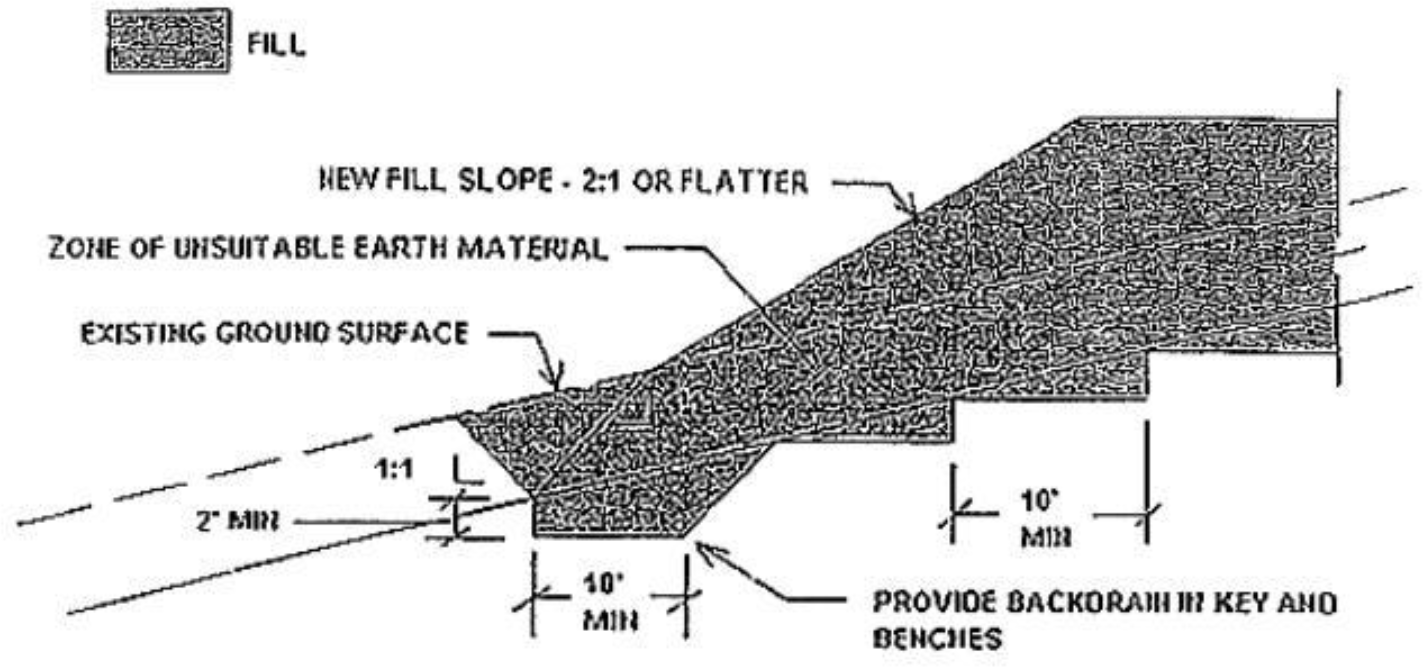
FIGURE J107.3
KEY AND BENCHING DETAILS
(H) Setbacks Amendments. Section J108 of Appendix J of the 2022 California Building Code is hereby amended to read:
J108.1 General. Cut and fill slopes shall be set back from the property lines in accordance with this section. Setback dimensions shall be horizontal distances measured perpendicular to the property line and shall be as shown in Figure J108.1, unless substantiating data is submitted justifying reduced setbacks.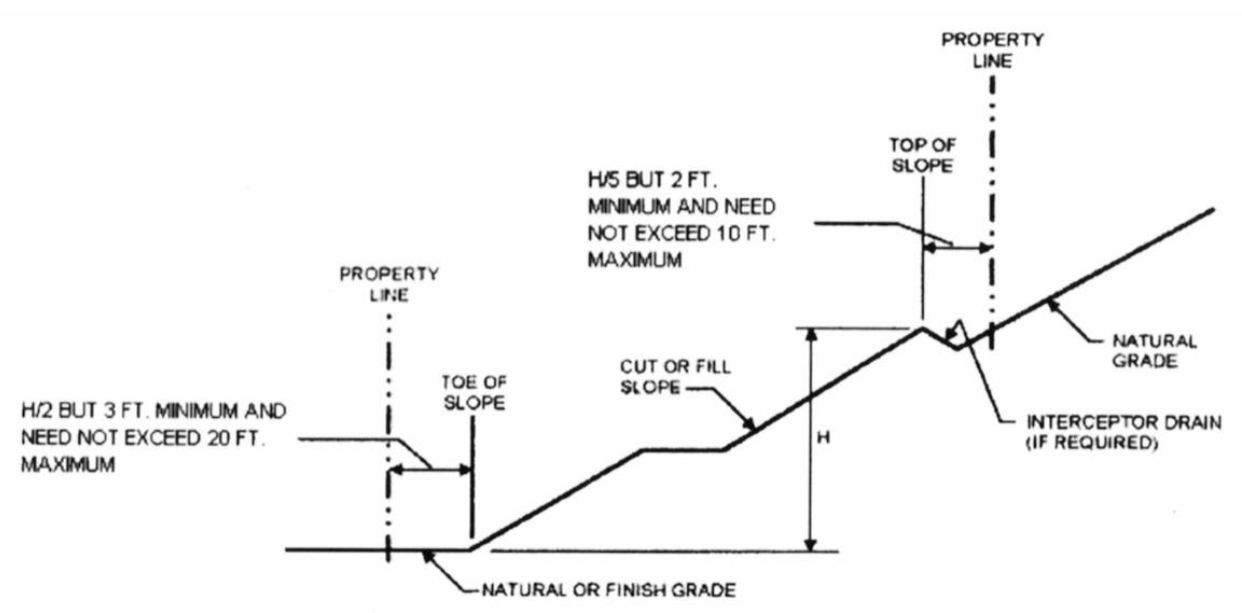
FIGURE J108.1
J108.2 Top of slope. The setback at the top of a cut slope shall not be less than that shown in Figure J108.1, or less than is required to accommodate any required interceptor drains, whichever is greater.
J108.3 Slope Protection. Where required to protect adjacent properties at the toe of a slope from adverse effects of the grading, additional protection, approved by the Building Official, shall be included. Such protection may include but shall not be limited to:
1. Setbacks greater than those required by Figure J108.1.
2. Provisions for retaining walls or similar construction.
3. Erosion protection of the fill slopes.
4. Provision for the control of surface waters.
(I) Drainage and Terracing Amendments. Section J109 of Appendix J of the 2022 California Building Code is hereby amended to read:
J109.1 General. Unless otherwise recommended by a registered design professional, drainage facilities and terracing shall be provided in accordance with the requirements of this section and SCCC 16.20.170 “Design Standards for Drainage Facilities and Terraces.”
J109.2 Terraces. Terraces at least 6 feet in width shall be established at not more than 30-foot vertical intervals on all cut or fill slopes to control surface drainage and debris. Suitable access shall be provided to allow for cleaning and maintenance.
Where more than two terraces are required, one terrace, located at approximately mid-height, shall be at least 12 feet in width.
Swales or ditches shall be provided on terraces. They shall have a minimum gradient of 20 horizontal to 1 vertical (5 percent) and shall be paved with concrete not less than 3 inches in thickness, or with other materials suitable to the application. They shall have a minimum depth of 12 inches and a minimum width of 5 feet.
A single run of swale or ditch shall not collect runoff from a tributary area exceeding 13,500 square feet (projected) without discharging into a down drain.
J109.3 Interceptor drains. Interceptor drains shall be installed along the top of cut slopes receiving drainage from a tributary width greater than 40 feet measured horizontally. They shall have a minimum depth of 1 foot and a minimum width of 3 feet. The slope shall be approved by the Building Official but shall not be less than 50 horizontal to 1 vertical (2 percent). The drain shall be paved with concrete not less than 3 inches in thickness, or by other materials suitable to the application and reinforced as required for drainage terraces.
Discharge from the drain shall be accomplished in a manner to prevent erosion and shall be approved by the Building Official.
J109.4 Drainage across property lines. Drainage across property lines shall not exceed that which existed prior to grading. Excess or concentrated drainage shall be contained on site or directed to an approved drainage facility. Erosion of the ground in the area of discharge shall be prevented by installation of nonerosive down drains or other devices.
(J) Erosion Control Amendments. Section J110 of Appendix J of the 2022 California Building Code is hereby amended to read:
J110.1 General. See SCCC 16.22 “Erosion Control.”
(K) Referenced Standards Amendments. Section J111 of Appendix J of the 2022 California Building Code is hereby amended to read:
|
ASTM D1557 - 12 |
Test Method for Laboratory Compaction Characteristics of Soil Using Modified Effort [56,000 ft-lb/ft3 (2.700 kN-m/m3)] |
J107.5 |
[Ord. 5414 § 1, 2022; Ord. 5318 § 1, 2019; Ord. 5235 § 1, 2016; Ord. 5168 § 1, 2013; Ord. 5081 § 1, 2010; Ord. 4894 § 2, 2007].
12.10.218 Appendix C of the 2022 California Building Code adopted.
Appendix C of the 2022 California Building Code is adopted in its entirety and is amended as follows:
(A) Allowable Height and Area Amendment. Section C102.2 of the 2022 California Building Code is hereby amended to read:
C102.2 One-story unlimited area. The area of a one-story Group U agricultural building shall not be limited if the building is surrounded and adjoined by public ways or yards not less than 60 feet (18,288mm) in width.
Exception: The area of a one-story Group U, Division 3 Occupancy greenhouse which is used exclusively for growing flowers, plants, fruits, vegetables, shrubs, trees, or similar horticultural produce shall not be limited if the setback from all properties zoned for primary agricultural use to the building, or the setback between horticultural buildings located on the same property, is not less than twenty (20) feet and if such setback area is maintained open and accessible for firefighting purposes. Setbacks between greenhouses as described above and an adjacent property with a zoning designation that is not for primary agricultural use shall not qualify for this exception. In no case shall the distance from property lines be less than that required by zoning regulations. The maximum travel distance to an exit may be increased by 100 feet if the building or structure is provided with an approved fire sprinkler system.
[Ord. 5414 § 1, 2022; Ord. 5318 § 1, 2019; Ord. 5235 § 1, 2016; Ord. 5168 § 1, 2013; Ord. 5081 § 1, 2010; Ord. 4894 § 2, 2007].
12.10.220 2022 California Residential Building Code adopted.
The Residential Building Code for the County of Santa Cruz shall be the current printing of the 2022 Edition of the California Residential Code, also known as Part 2.5 of Title 24 of the California Code of Regulations, including those appendices or portions thereof specifically adopted by a State agency or specifically adopted by the ordinance codified in this section, but excluding other appendices, subject to the following amendments:
(A) Exempt Work Amendment. Section R105.2 of the 2022 California Residential Code is hereby deleted. For a list of exempt work, see SCCC 12.10.315(A).
(B) Emergency Escape and Rescue Window Replacement Amendment. Section R310.5 is hereby deleted and a new section R310.5 is hereby added to the 2022 California Residential Code to read:
R310.5 Emergency escape and rescue window replacements. When a non-compliant window is replaced in a sleeping room of an R-2 or R-3 occupancy and it is required to be an emergency escape and rescue window, the replacement window must comply with the emergency escape and rescue provisions of 2022 California Residential Code Section R310.1.
(C) Egress Door Amendment. Section R311.2 of the 2022 California Residential Code is hereby amended to read:
R311.2 Egress door. Not less than one egress door shall be provided for each dwelling unit. The egress door shall be side-hinged and shall provide a clear width of not less than 32 inches (813 mm) where measured between the face of the door and the stop, with the door open 90 degrees (1.57 rad). The clear height of the door opening shall be not less than 78 inches (1981 mm) in height measured from the top of the threshold to the bottom of the stop. All other doors shall provide a clear width of not less than 30 inches where measured between the face of the door and the stop, with the door open 90 degrees. Egress doors shall be readily openable from inside the dwelling without the use of a key or special knowledge or effort.
Exceptions:
1. Interior door openings to closets not more than 36” in depth.
2. Shower doors.
3. Except as required in Sec. R327.1.3.
(D) Flood-Resistant Construction Amendments.
(1) General Amendments. Section R322.1 of the 2022 California Residential Building Code is hereby amended to read:
R322.1 General. Buildings and structures constructed in whole or in part in flood hazard areas, including A or V Zones and Coastal A Zones, as established in Table R301.2, and substantial improvement and repair of substantial damage of buildings and structures in flood hazard areas, shall be designed and constructed in accordance with the provisions contained in this section and the floodplain regulations in Santa Cruz County Code Chapters 16.10 and 16.13, whichever is more restrictive. Buildings and structures that are located in more than one flood hazard area shall comply with the provisions associated with the most restrictive flood hazard area. Buildings and structures located in whole or in part in identified floodways shall be designed and constructed in accordance with ASCE 24.
(2) Protection of Adjacent Properties. Section R322.1.11 is hereby added to Section R322 of the 2022 California Residential Code to read:
R322.1.11 Protection of Adjacent Properties. Construction in an A or V Zone shall not cause damage to adjacent properties. If requested, information from a registered design professional shall be submitted with supporting information that adjacent properties will not be damaged.
(3) Base Flood Elevation and Design Flood Elevation. Section R322.1.12 is hereby added to Section R322 of the 2022 California Residential Code to read:
R322.1.12 Base Flood Elevation and Design Flood Elevation. For the purposes of the Flood Resistant Construction sections of this code, base flood elevation and design flood elevation shall have the same meaning.
(4) Flood Hazard Areas (Including A zones). The first paragraph of Section R322.2 of the 2022 California Residential Code is hereby amended to read:
R322.2 Flood hazard areas (including A Zones). All areas that have been determined to be prone to flooding but that are not coastal high-hazard areas shall be designated as flood hazard areas. All buildings and structures constructed in whole or in part in flood hazard areas shall be designated and constructed in accordance with Sections R322.2.1 through R322.2.6, and the floodplain regulations in Santa Cruz County Code Chapters 16.10 and 16.13, whichever is more restrictive.
(5) Elevation Requirements. Section R322.2.1 of the 2022 California Residential Code is hereby amended to read:
R322.2.1 Elevation requirements.
1. Buildings and structures in flood hazard areas shall have the lowest floor elevated at least 2 feet (610 mm) above the base flood elevation.
2. In areas of shallow flooding (AO Zones), buildings and structures shall have the lowest floor elevated at least 2 feet (610 mm) above the highest adjacent grade plus the depth number specified in feet on the FIRM, or at least 2 feet (610 mm) if a depth is not specified. Non-residential structures, where elevation is not feasible, shall have the lowest floor completely floodproofed above the highest adjacent grade at least two feet higher than the depth number given on the FIRM.
3. Basement floors that are below grade on all sides shall be elevated at least two feet above the base flood elevation.
Exception. Enclosed areas below the base flood elevation, including basements whose floors are not below grade on all sides, shall meet the requirements of Section R322.2.2.
(6) Lowest Floor Elevations Amendment. Section R322.2.5 is hereby added to Section R322 of the 2022 California Residential Code to read:
R322.2.5 Lowest Floor Elevations. Upon placement of the lowest floor, including basement, and prior to further vertical construction, documentation verifying compliance with Section R322.2.1 shall be submitted to the Building Official.
(7) Elevation Certificate Amendment. Section R322.2.6 is hereby added to Section R322 of the 2022 California Residential Code to read:
R322.2.6 Elevation Certificate. For all new or substantially improved structures, an Elevation Certificate (FEMA Form 086-0-33 (7/15) or most recent update) based upon finished construction shall be submitted to the Department prior to receiving a final inspection. The Elevation Certificate must indicate compliance with applicable FEMA regulations.
(8) Placement of Fill Amendment. Section R322.2.7 is hereby added to Section R322 of the 2022 California Residential Code to read:
R322.2.7 Placement of Fill. Notwithstanding SCCC 16.10.070(F)(7), an application to place more than 50 cubic yards of fill in the flood fringe may be considered if: (i) a civil engineered grading plan is provided, (ii) an equal volume of material (soil) is taken out of the flood fringe on the same or immediately adjacent property, (iii) only the minimum amount of fill necessary is placed, (iv) the building site is raised a minimum of 1 foot above the Base Flood Elevation, and (v) the engineered grading plan (with supporting engineering documentation) demonstrates that both fill and related excavations are protected from stream erosion and that there are no cumulative or other adverse impacts. The applicant must apply for and receive a “Conditional Letter of Map Revision—Fill” (CLOMR-F) from FEMA prior to issuance of the building permit. The approved copy of the CLOMR-F must be supplied to the Department.
(9) Coastal High-Hazard Areas (Including V Zones and Coastal A Zones). Paragraph 1 of Section R322.3 of the 2022 California Residential Code is hereby amended to read:
R322.3 Coastal high-hazard areas (including V Zones and Coastal A Zones). Designate as coastal high hazard zones any areas that have been determined to be subject to high velocity wave action, wave-induced erosion or wave heights greater than 1.5 feet (914 mm). Buildings and structures constructed in whole or in part in coastal high-hazard areas shall be designed and constructed in accordance with Sections R322.3.1 through R322.3.9, and the floodplain regulations in Santa Cruz County Code Chapters 16.10 and 16.13, whichever is more restrictive.
(10) Location and Site Preparation Amendment. Section R322.3.1 of the 2022 California Residential Code is hereby amended to read:
R322.3.1 Location and site preparation.
1. New buildings and buildings that are determined to be substantially improved pursuant to Section R105.3.1.1, shall be located landward of the reach of mean high tide.
2. For any alteration of sand dunes and mangrove stands the Building Official shall require submission of an engineering analysis which demonstrates that the proposed alteration will not increase potential for flood damage or damage to adjacent properties.
3. For existing structures located within the reach of mean high tide, no alterations or additions shall be allowed in the seaward direction.
(11) Construction Documents Amendment. Section R322.3.9 of the 2022 California Residential Code is hereby amended to read:
R322.3.9 Construction documents. The construction documents shall include documentation that is prepared and sealed by a registered design professional that the design and methods of construction to be used meet the applicable criteria of this section. Santa Cruz County Form “V Zone Cert” shall be used for this purpose.
(12) Lowest Floor Elevations Amendment. Section R322.3.11 is hereby added to Section R322 of the 2022 California Residential Code to read:
R322.3.11 Lowest Floor Elevations. Upon placement of the lowest floor, including basement, and prior to further vertical construction, documentation verifying compliance with Section R322.3.2 shall be submitted to the Building Official.
(13) Final Documents Amendment. Section R322.3.12 is hereby added to Section R322 of the 2022 California Residential Code to read:
R322.3.12 Final Documents. Prior to receiving a final inspection for all new or substantially improved structures, the following documents shall be submitted to the Department.
1. An Elevation Certificate (FEMA Form 086-0-33 {7/15} or most recent update) based on finished construction.
2. A Final V-Zone Certificate (Santa Cruz County Form “Final V Zone Cert”).
3. A Final Non-residential Floodproofing Design Certificate (Santa Cruz County Form “Final Floodproofing Cert”)
(E) Lofts Amendment.
(1) Title Amendment. The title of Section 325 of the 2022 California Residential Code is hereby amended to read:
R325 Mezzanines and Lofts.
(2) Sleeping Lofts Amendment. Section R325.6 is hereby added to the 2022 California Residential Code to read:
R325.6 Sleeping Lofts. Sleeping lofts shall comply with the following:
1. Minimum code required headroom
2. Minimum room dimensions 7 feet in any horizontal dimension
3. Must comply with Energy Code
4. Must comply with Electrical Code for receptacles and lighting
5. Stairs are required
6. Emergency escape and rescue required
(3) Storage Lofts Amendment. Section R325.7 is hereby added to the 2022 California Residential Code to read:
R325.7 Storage Lofts. Storage lofts shall comply with the following:
1. Headroom to be less than 5 feet
2. At least one dimension may not exceed 7 feet.
3. No electrical
4. May be within heated space
5. No stairs required
6. No permanent stairs or ladders allowed
(4) Plant Shelfs or Display Shelfs Amendment. Section R325.8 is hereby added to the 2022 California Residential Code to read:
R325.8 Plant Shelfs, or Display Shelfs. Plant or Display shelfs shall comply with the following:
1. Not more than 3 feet deep
2. Unlimited headroom height
3. No permanent stairs or ladders allowed
(F) Sound Transmission Amendment. Section R329 is hereby added to the 2022 California Residential Code to read:
R331 Sound Transmission. Section 1206 of the 2022 California Building Code, relating to sound transmission, shall apply to attached dwelling units.
(G) Grading Amendment. Section R332 is hereby added to Chapter 3 of the 2022 California Residential Code to read:
R332 Grading. Grading shall be in accordance with the provisions of Appendix J of the 2022 California Building Code, as amended by Section 12.10.217 of this chapter.
(H) Fire Hazard Areas Amendment. Section R337.1.3 of the 2022 California Residential Code is hereby amended to delete Exceptions 1, 2, 4, and 5 and a new Section R337.1.3.05 is added to read:
R337.1.3.05. All additions, and any replacements of building wood siding, windows, roofing, attic vents and foundation vents used in the exterior design and construction of existing buildings located within any Moderate, High or Very High Fire Hazard Severity Zone within State Responsibility Areas must comply with the requirements noted in 2022 Sec R337 of the 2022 California Residential Code.
Exceptions:
1. Replacement of an area of wood siding not exceeding 100 sq. ft.
2. Replacement of a broken window or glass door.
3. Replacement of an area of roofing not exceeding 100 sq. ft.
4. Replacement of one attic or foundation vent.
(I) Soils Reports/Geotechnical Investigations Amendments.
(1) Soils Reports/Geotechnical Investigations Amendment. Section 401.4 of the 2022 California Residential Code shall be amended to read as follows:
R401.4 Soils tests. A Soils Report or Geotechnical Investigation shall be required as per Section 1803 of the 2022 California Building Code.
Exceptions: The Building Official shall be permitted to waive the requirement for a geotechnical investigation where satisfactory data or information is available that demonstrates that an investigation is not necessary; however, a report will be required for projects involving soils that are expansive, compressible, shifting, collapsible, alluvial, or undocumented fill; or for projects with conditions or locations that involve landsliding, debris flows, ridge top shattering, shallow groundwater, adverse drainage conditions, coastal bluff, FEMA floodplain, or on or adjacent to slopes in excess of 30%.
(2) Geotechnical Report Amendment. Section 401.4.1 of the 2022 California Residential Code shall be amended to read:
R401.4.1 Geotechnical Report. When a geotechnical report is not required, the load bearing values in Table R401.4.1 shall be assumed.
(3) Compressible or Shifting Soil Amendment. Section 401.4.2 of the 2022 California Residential Code shall be amended to read:
R401.4.2 Compressible or shifting soil. Instead of a complete geotechnical investigation, when top or subsoils are compressible or shifting, they shall be removed to a depth and width recommended by a soils engineer.
(J) Foundations Amendments.
(1) Section R403.2 of the 2022 California Residential Code is amended to read:
R403.2 Footings for Wood Foundations. Wood foundations are prohibited by SCCC 12.10.215(L).
(2) Section R404.2 of the 2022 California Residential Code is amended to read:
R404.2 Wood Foundation Walls. Wood foundation walls are prohibited by SCCC 12.10.215(L).
(3) Section R405.2 of the 2022 California Residential Code is amended to read:
R405.2 Wood Foundations. Wood foundations are prohibited by SCCC 12.10.215(L).
(K) Underfloor Amendment. Section R408.3 of the 2022 California Residential Code is amended to read:
R408.3 Unvented Crawl Space. The use of foam plastic in areas of “very heavy” termite infestation probability shall be in accordance with Section R318.4.
(L) Seismic Amendments.
(1) Seismic Reinforcing Amendment. Section R403.1.3 of the 2022 California Residential Code shall be amended to read:
R403.1.3 Footing and stem wall reinforcing in Seismic Design Categories D0, D1, and D2. Concrete footings located in Seismic Design Categories D0, D1, and D2, as established in Table R301.2(1), shall have minimum reinforcement of at least two continuous longitudinal reinforcing bars not smaller than No. 4 bars. Bottom reinforcement shall be located a minimum of 3 inches (76 mm) clear from the bottom of the footing.
In Seismic Design Categories D0, D1, and D2 where a construction joint is created between a concrete footing and a stem wall, a minimum of one No. 4 bar shall be installed at not more than 4 feet (1219 mm) on center. The vertical bar shall extend to 3 inches (76 mm) clear of the bottom of the footing, have a standard hook and extend a minimum of 14 inches (357 mm) into the stem wall.
In Seismic Design Categories D0, D1, and D2 where a grouted masonry stem wall is supported on a concrete footing and stem wall, a minimum of one No. 4 bar shall be installed at not more than 4 feet (1219 mm) on center. The vertical bar shall extend to 3 inches (76 mm) clear of the bottom of the footing and have a standard hook.
In Seismic Design Categories D0, D1, and D2 masonry stem walls without solid grout and vertical reinforcing are not permitted.
Exception: In detached one- and two-family dwellings which are three stories or less in height and constructed with stud bearing walls, isolated plain concrete footings supporting columns or pedestals are permitted.
(2) Seismic Design Methods. Section R602.10.2.1 of the 2022 California Residential Code shall be amended to add a new subsection R602.10.2.1.1 to read:
R602.10.2.1.1 Limits on methods GB and PCP. In Seismic Design Categories D0, D1, and D2, Method GB is not permitted for use as intermittent braced wall panels, but gypsum board is permitted to be installed when required by this Section to be placed on the opposite side of the studs from other types of braced wall panel sheathing. In Seismic Design Categories D0, D1, and D2, the use of Method PCP, DWB, PBS, HPS and SFB is limited to one-story single-family dwellings or the top story of two-story single-family dwellings, and accessory structures.
(3) Seismic Design Methods. Footnote “d” of Table R602.10.3(3) in the 2022 California Residential Code is hereby amended to read:
TABLE R602.10.3(3)a,b,c,d
d. In Seismic Design Categories D0, D1, and D2, Method GB is not permitted and the use of Method PCP, DWB, PBS, HPS and SFB is limited to one-story single-family dwellings or the top story of two-story single-family dwellings, and accessory structures.
(M) Roof Assemblies Amendment.
(1) Roof coverings within state responsibility areas. Section R902.1.2 of the 2022 California Residential Code is hereby amended to delete the exception.
(2) Roof coverings in all other areas. Section R902.1.3 of the 2022 California Residential Code is hereby amended to require “at least a Class B roof.” [Ord. 5414 § 1, 2022; Ord. 5318 § 1, 2019; Ord. 5235 § 1, 2016; Ord. 5168 § 1, 2013; Ord. 5081 § 1, 2010].
12.10.225 2022 California Historical Building Code adopted.
The 2022 California Historical Building Code, Part 8 of Title 24 of the California Code of Regulations, is hereby adopted by reference, and applies to the rehabilitation, preservation, restoration, or relocation of qualified historical buildings or structures. Historical buildings or structures which are included on the Historic Resources Inventory adopted by the Board of Supervisors are hereby qualified to use the State Historic Building Code. [Ord. 5414 § 1, 2022; Ord. 5318 § 1, 2019; Ord. 5235 § 1, 2016; Ord. 5168 § 1, 2013; Ord. 5081 § 1, 2010; Ord. 4894 § 2, 2007].
12.10.230 2022 California Mechanical Code adopted.
The Mechanical Code for the County of Santa Cruz shall be the latest printing of the 2022 Edition of the California Mechanical Code, also known as Part 4 of Title 24 of the California Code of Regulations, including those appendices or portions thereof specifically adopted by a State agency or specifically adopted by the ordinance codified in this section, but excluding other appendices, subject to the following amendments:
(A) Exempt Work Amendment. Section 104.2 of the 2022 California Mechanical Code is hereby deleted. For a list of exempt work, refer to SCCC 12.10.315(D).
(B) Gas Vents Amendment. Section 802.6.1(8) is hereby added to Section 802.6.1 of the 2022 California Mechanical Code to read:
802.6.1(8) Vent Terminals. Venting systems shall terminate at least four (4) feet from a property line, except a public way.
(C) Shutoff Valve Amendment. Section 1308.13.1 is hereby added to Section 1308.13 of the 2022 California Mechanical Code, to read:
1308.13.1 Earthquake-actuated gas shutoff valves. New gas piping systems, replacement gas piping systems, and new or replacement gas meter installations, shall have a listed and approved earthquake-actuated gas shutoff valve (sized for the BTU demand of the entire gas system) installed just prior to the meter connection or connection to a propane tank, prior to the release of utilities.
[Ord. 5414 § 1, 2022; Ord. 5318 § 1, 2019; Ord. 5235 § 1, 2016; Ord. 5168 § 1, 2013; Ord. 5081 § 1, 2010; Ord. 4894 § 2, 2007].
12.10.235 2022 California Plumbing Code adopted.
The Plumbing Code for the County of Santa Cruz shall be the latest printing of the 2022 Edition of the California Plumbing Code, also known as Part 5 of Title 24 of the California Code of Regulations, including those appendices or portions thereof specifically adopted by a State agency or specifically adopted by the ordinance codified in this section, but excluding other appendices, subject to the following amendments:
(A) Exempt Work Amendment. Section 104.2 of the 2022 California Plumbing Code is hereby deleted. For a list of exempt work, refer to SCCC 12.10.315(B).
(B) Shutoff Valves Amendment. Section 1208.14 of the 2022 California Plumbing Code is hereby amended by adding Section 1208.14.1 to read:
Section 1208.14.1 Earthquake-actuated gas shutoff valves. New gas piping systems, replacement gas piping systems, and new or replacement gas meter installations, shall have a listed and approved earthquake-actuated gas shutoff valve (sized for the BTU demand of the system) installed just prior to the meter connection or connection to a propane tank, prior to the release of utilities.
(C) Water Demand Calculator Amendment. Appendix M of the 2022 California Plumbing Code is hereby adopted. [Ord. 5414 § 1, 2022; Ord. 5400 § 1, 2022; Ord. 5318 § 1, 2019; Ord. 5235 § 1, 2016; Ord. 5168 § 1, 2013; Ord. 5081 § 1, 2010; Ord. 4894 § 2, 2007].
12.10.240 2022 California Electrical Code adopted.
The Electrical Code for the County of Santa Cruz shall be the latest printing of the 2022 Edition of the California Electrical Code, also known as Part 3 of Title 24 of the California Code of Regulations, including those appendices or portions thereof specifically adopted by a State agency or specifically adopted by the ordinance codified in this section, but excluding other appendices, subject to the following amendments:
(A) Exempt Work Amendment. Article 89.108.4.1(b) of the 2022 California Electrical Code is hereby deleted. For a list of exempt work, refer to SCCC 12.10.315(C).
(B) New Construction Amendment. The following requirement shall apply to all new construction:
All newly constructed commercial and residential buildings that have electrically supplied systems shall provide a concrete encased grounding electrode per CEC, Article 250.52(A)(3) to serve as the grounding means for the electrical system.
[Ord. 5414 § 1, 2022; Ord. 5318 § 1, 2019; Ord. 5235 § 1, 2016; Ord. 5168 § 1, 2013; Ord. 5081 § 1, 2010; Ord. 4894 § 2, 2007].
12.10.245 2022 California Energy Code adopted.
The 2022 California Energy Code, also known as Part 6 of Title 24 of the California Code of Regulations, is hereby adopted subject to the following amendments:
(A) Definitions Amendment. Subchapter 1, “All Occupancies – General Provisions,” Section 100.1(b) of the California Energy Code is amended to including the following definition:
ALL-ELECTRIC BUILDING OR ALL-ELECTRIC DESIGN is a building or building design that uses a permanent supply of electricity as the only source of energy for space conditioning (including heating and cooling), water heating (including pools and spas), cooking appliances, and clothes drying appliances, and has no natural gas or propane plumbing installed at the building.
(B) All-Electric Amendment. Subchapter 2 “All Occupancies – Mandatory Requirements for the Manufacture, Construction and Installation Of Systems, Equipment And Building Components” is amended to add a new Section 110.13 “All-Electric Buildings.” Section 110.13 “All-Electric Buildings” shall read as follows:
SECTION 110.13 ALL-ELECTRIC BUILDINGS. Building permit applications submitted on or after January 1, 2023 for all newly constructed residential developments, including residential mixed-use projects (residential components), multi-family, single-family and ADUs located within the Urban Services Line shall be designed, constructed, and equipped as All-Electric Buildings.
[Ord. 5414 § 1, 2022; Ord. 5318 § 1, 2019; Ord. 5235 § 1, 2016; Ord. 5168 § 1, 2013; Ord. 5081 § 1, 2010; Ord. 4894 § 2, 2007].
12.10.246 2022 California Existing Building Code adopted.
The 2022 California Existing Building Code, also known as Part 10 of Title 24 of the California Code of Regulations, is hereby adopted with the exception of:
(A) Section 402.3 is hereby deleted (see SCCC 12.10.220(B)). [Ord. 5414 § 1, 2022; Ord. 5318 § 1, 2019; Ord. 5235 § 1, 2016; Ord. 5168 § 1, 2013; Ord. 5081 § 1, 2010; Ord. 4894 § 2, 2007. Formerly 12.10.250].
12.10.247 Reserved.
[Ord. 5414 § 1, 2022; Ord. 5318 § 1, 2019; Ord. 5235 § 1, 2016; Ord. 5168 § 1, 2013; Ord. 5081 § 1, 2010].
12.10.250 2022 Green Building Standards Code adopted.
The 2022 California Green Building Standards Code (CALGreen Code), also known as Part 11 of Title 24 of the California Code of Regulations, including all residential and nonresidential mandatory measures but excluding those portions or appendices not specifically adopted by a State agency, is hereby adopted, subject to the following amendments:
(A) Green Building Amendments. Section 301.3 of the 2022 CALGreen Code is hereby amended to read:
301.3 Nonresidential additions and alterations. The provisions of individual sections of Chapter 5 apply to newly constructed buildings, building additions of 500 square feet or greater, and/or improvements to existing buildings with a permit valuation of $200,000 or above. Code sections relevant to additions and improvements shall apply only to the portions of the building being added or improved within the scope of the permitted work.
(B) Remodeling Amendments. Sections 4.201.1.2 and 4.201.1.3 are hereby added to Section 4.201 of the 2022 CALGreen Code to read:
4.201.1.2 Energy Star Appliances. New appliances installed as part of any remodel, addition or new construction shall be Energy Star appliances (When available for the appliance type.)
4.201.1.3 Insulation. For all remodels, insulation meeting the mandatory feature requirements in the California Energy Code shall be installed at ceilings, walls, floors and water pipes, when these areas are exposed during remodeling.
(C) Remodeling Amendments. Sections 5.201.1.2 and 5.201.1.3 are hereby added to Section 5.201 of 2022 CALGreen Code, to read:
5.201.1.2 Energy Star Appliances. New appliances installed as part of any remodel, addition or new construction shall be Energy Star appliances (When available for the appliance type.)
5.201.1.3 Insulation. For all remodels, insulation meeting the mandatory feature requirements in the California Energy Code shall be installed at ceilings, walls, floors and water pipes, when these areas are exposed during remodeling.
(D) Water Conservation Amendments. Section 5.303.7 is hereby added to the 2022 CALGreen Code, to read:
5.303.7 Water conserving systems. The following systems shall be required to meet the specifications indicated:
5.303.7.1 Food steamers shall be boiler-less or self-contained.
5.303.7.2 Ice machines shall be air-cooled.
5.303.7.3 Pre-rinse spray valves shall have a flow rate of not more than 1.3 gallons per minute.
5.303.7.5 Automatic vehicle wash facilities shall provide at least 75 percent of water that is recycled on site.
[Ord. 5414 § 1, 2022; Ord. 5318 § 1, 2019; Ord. 5235 § 1, 2016; Ord. 5168 § 1, 2013; Ord. 5081 § 1, 2010].
12.10.251 1997 Uniform Code for the Abatement of Dangerous Buildings adopted.
The 1997 Uniform Code for the Abatement of Dangerous Buildings is hereby adopted with amendments, as noted in SCCC 12.10.425. [Ord. 5414 § 1, 2022; Ord. 5318 § 1, 2019; Ord. 5235 § 1, 2016; Ord. 5168 § 1, 2013; Ord. 5081 § 1, 2010].
12.10.252 1997 Uniform Housing Code adopted.
The 1997 Uniform Housing Code, published by the International Conference of Building Officials, is hereby adopted with the following amendments:
(A) Section 203 is hereby deleted.
(B) Chapter 12 is hereby deleted.
(C) Chapter 13 is hereby deleted. [Ord. 5414 § 1, 2022; Ord. 5318 § 1, 2019; Ord. 5235 § 1, 2016; Ord. 5168 § 1, 2013; Ord. 5081 § 1, 2010].
Article III. Permits and Inspections
12.10.310 Permits required.
Except as specified in SCCC 12.10.315, no building, structure or building and/or property service equipment regulated by this chapter and the most recent edition of the California Building Code, the California Residential Code, the California Mechanical Code, the California Plumbing Code, California Electrical Code, California Energy Code, and the California Green Building Standards Code shall be erected, constructed, enlarged, altered, repaired, moved, improved, removed, converted or demolished unless a separate, appropriate permit for each building, structure or building and/or property service equipment has first been obtained from the Building Official. [Ord. 5414 § 1, 2022; Ord. 5318 § 1, 2019; Ord. 5235 § 1, 2016; Ord. 5168 § 1, 2013; Ord. 5081 § 1, 2010; Ord. 4894 § 2, 2007].
12.10.315 Work exempt from permit—Exempted work.
Exempt structures must meet all other applicable requirements of this jurisdiction, including required minimum distances from property lines. Unless otherwise exempted by the Santa Cruz County Building Code, separate plumbing, electrical and mechanical permits will be required for the exempted items below. Exemption from the permit requirements of the Santa Cruz County Building Code shall not be deemed to grant authorization for any work to be done in any manner in violation of the provisions of this code or any other laws or ordinances of this jurisdiction.
(A) Building Permits. A building permit shall not be required for the following:
(1) One-story detached accessory buildings used as tool and storage sheds, playhouses and similar uses, when located on a parcel which contains an existing Group R, and/or Group U Occupancy, provided the floor area does not exceed 120 square feet, and the height above grade as defined in the zoning ordinance does not exceed 10 feet.
(2) Fences, not over eight feet high, except that concrete and masonry fences more than six feet in height measured from the lowest grade to the top of the wall shall require a building permit.
(3) Movable cases, counters and partitions with no internal electrical wiring, not over five feet, nine inches high.
(4) Retaining walls, which retain not more than three feet of material unless supporting a surcharge or impounding Class I, II, or III-A liquids.
Unless specifically exempted by the Building Official, retaining walls retaining more than four feet of material shall be designed by an engineer licensed by the State of California to perform such design.
(5) Decks at one- and two-family dwelling units not exceeding 200 square feet in area, that are not more than 30 inches above grade at any point, are not attached to a dwelling and do not serve any exterior egress door exiting onto the deck.
(6) Painting, papering and similar finish work.
(7) Temporary motion picture, television and theater stage sets and scenery.
(8) Window awnings supported by an exterior wall of Group R, Division 3, and Group U Occupancies when projecting not more than 36 inches. However, window awnings on structures within a wildland-urban interface area as defined in Chapter 7A of the 2022 California Building Code and Section R327 of the California Residential Code are not exempt from permit requirements.
(9) Prefabricated swimming pools accessory to a Group R, Division 3 Occupancy in which the pool is less than 18 inches in depth, and the pool capacity does not exceed 5,000 gallons. Pool barriers, and anti-entrapment devices for all pools, whether below or at grade, must be in compliance with SCCC 12.10.216(C).
(10) Play structures, when constructed on a parcel which contains a single-family dwelling or a school or day care center, unless the Building Official finds that the structure poses a hazard to health or safety.
(11) Agricultural shade structures less than 12 feet in height constructed of light frame materials and covered with shade cloth or clear, flexible plastic with no significant associated electrical, plumbing, or mechanical equipment, other than irrigation equipment.
(12) Water tanks supported directly upon grade if the capacity does not exceed 5,000 gallons and the ratio of height to diameter or width does not exceed two-to-one.
(13) Prefabricated structures constructed of light frame materials and covered with cloth or flexible plastic, with no associated electrical, plumbing, or mechanical equipment, where the height above grade as defined in the zoning ordinance does not exceed 12 feet, and where the size does not exceed 300 square feet.
(14) Detached residential landscaping arbors, trellises, and gazebos, provided the floor area does not exceed 120 square feet, and the height above grade as defined in the zoning ordinance does not exceed 10 feet; and provided further, that a motor vehicle cannot be driven into the structure due to the configuration of the structure or its placement on the site.
(B) Plumbing Permits. A plumbing permit shall not be required for the following:
(1) The stopping of leaks in drains, soil, waste, water, or vent piping; provided, however, that should any trap, drainpipe, soil, waste, water, or vent pipe become defective and it becomes necessary to remove and replace the same with new material, the same shall be considered as new work and a permit shall be procured and inspection made as provided in this code.
(2) The clearing of stoppages or the repairing of leaks in pipes, valves or fixtures, or for the removal and reinstallation of water closets, provided such repairs do not involve or require the replacement or rearrangement of valves, pipes or fixtures. Note: Replacement water closets shall comply with the 2022 California Green Building Standards Code, Section 4.303.1.1.
(C) Electrical Permits. An electrical permit shall not be required for the following:
(1) Portable motors or other portable appliances energized by means of a cord or cable having an attachment plug end to be connected to an approved receptacle when that cord or cable is permitted by the electrical code.
(2) Temporary decorative lighting energized by cord or cable having an attachment plug end to be connected to an approved receptacle.
(3) The cord and plug wiring for temporary theater, motion picture or television stage sets.
(D) Mechanical Permits. A mechanical permit shall not be required for the following:
(1) A portable heating appliance, portable ventilating equipment, a portable cooling unit, or a portable evaporative cooler.
(2) A closed system of steam, hot, or chilled water piping within heating or cooling equipment regulated by this code.
(3) Replacement of a component part or assembly of an appliance that does not alter its original approval and complies with other applicable requirements of this code.
(4) A self-contained refrigeration system containing 10 pounds (five kg) or less of refrigerant and actuated by motors of one horsepower (746 W) or less.
Exemption from the permit requirements of this code shall not be deemed to grant authorization for work to be done in violation of the provisions of this code or other laws or ordinances of this jurisdiction. [Ord. 5414 § 1, 2022; Ord. 5318 § 1, 2019; Ord. 5235 § 1, 2016; Ord. 5168 § 1, 2013; Ord. 5081 § 1, 2010; Ord. 4894 § 2, 2007].
12.10.320 Application for permit.
(A) To obtain a permit the applicant shall first file an application. See Section 105.3 of the 2022 California Building Code for application requirements.
(B) Expiration of Permit Applications. An application for a building permit shall become null and void, and any rights or expectations pertaining to its position on the allocation waiting list shall be likewise nullified, if the building permit shall not have been approved, for whatever reason, within 24 months of the date of acceptance of the completed permit application by the Building Official, or not issued for whatever reason, prior to the expiration of the authorizing discretionary permit.
After the building permit application has been approved, the application shall become null and void and any rights or expectations pertaining to its position on the allocation waiting list shall be likewise nullified if the applicant has not accepted the building permit and paid the required fees for the building permit within six months of the date the applicant is notified that the application has been approved, or prior to the expiration of the authorizing discretionary permit, whichever comes first.
The Director may reduce the maximum times in the two preceding paragraphs when the application has been made to correct a violation of Federal, State, or County codes or to protect life, health, or safety.
If a building permit application becomes null and void pursuant to this section, the application shall be considered abandoned unless a new application is filed. If a new application is filed, all required reviews shall be performed again, and all appropriate review fees shall be paid again. The standards upon which the reviews are based shall be the standards in effect at the time the new application is submitted.
The Building Official may extend a building permit application which has become void pursuant to this section for increments of time not exceeding 180 days when the Building Official determines that such an extension is otherwise consistent with the intent of this chapter, and it is determined that project documents (plans, calculations, reports, etc.) are substantially in compliance with current code requirements, and upon a finding by the Building Official that the applicant is making a good faith attempt to comply with the requirements of the Department; provided, that the underlying discretionary permit has not expired. A fee as set forth in the Department adopted fee schedule shall be charged for the processing of applications for such extensions, unless specifically waived by the Building Official.
If it is determined that project documents (plans, calculations, reports, etc.) are not substantially in compliance with current code requirements, then the Building Official may request that the project documents be updated to current code requirements, and extension will be withheld until the project documents are reviewed and approved. [Ord. 5414 § 1, 2022; Ord. 5318 § 1, 2019; Ord. 5235 § 1, 2016; Ord. 5168 § 1, 2013; Ord. 5139 § 1, 2012; Ord. 5081 § 1, 2010; Ord. 4894 § 2, 2007].
12.10.321 Streamlined permitting process for small residential rooftop solar energy systems.
(A) Definitions. The following words and phrases used in this section are defined as follows:
(1) “Small residential rooftop solar energy system” means all of the following:
(a) A solar energy system that is no larger than 10 kilowatts alternating current nameplate rating for photovoltaic systems or 30 kilowatts thermal for solar water heating systems.
(b) A solar energy system that conforms to all applicable State fire, structural, electrical, and other building codes, as adopted and as may have been amended by the County, and paragraph (iii) of subdivision (c) of Section 714 of the Civil Code, as such section or subdivision may be amended, renumbered, or redesignated from time to time, relating to safety and reliability of solar energy systems.
(c) A solar energy system that is installed on a single-family or duplex dwelling.
(d) A solar panel or module array that does not exceed the maximum height for the zone district.
(e) A rooftop solar energy system installed on a permitted structure.
(2) “Solar energy system” has the same meaning set forth in paragraphs (1) and (2) of subdivision (a) of Section 801.5 of the Civil Code, as such section or subdivision may be amended, renumbered, or redesignated from time to time.
(3) “Specific, adverse impact” means a significant, quantifiable, direct, and unavoidable impact, based on objective, identified, and written public health or safety standards, policies, or conditions as they existed on the date the application was deemed complete.
(B) Checklist. In compliance with Section 65850.5 of the California Government Code regarding residential solar energy systems, the Building Official is hereby authorized and directed to develop and administratively adopt a checklist application for small residential rooftop solar energy systems. The County’s checklist application will include all requirements with which small rooftop solar energy systems shall comply in order to be eligible for the streamlined permitting process. The checklist application shall be published on the Department’s website.
(C) Application. Applicants must submit the completed checklist application and associated documentation to the Department with any required permit processing and inspection fees.
(D) Verifications. Prior to submitting an application, the applicant shall:
(1) Verify through the use of standard engineering evaluation techniques that the support structure for the small residential rooftop solar energy system is permitted, stable, and adequate to transfer all wind, seismic, and dead and live loads associated with the system to the building foundation; and
(2) Verify using standard electrical inspection techniques that the existing electrical system including existing line, load, ground and bonding wiring as well as main panel and subpanel sizes are adequately sized, based on the existing electrical system’s current use, to carry all new photovoltaic electrical loads.
(E) Application Completeness. An application that satisfies all the requirements in the application checklist, as determined by the Building Official, shall be deemed complete. If the Building Official determines that the permit application is incomplete, they shall issue a written correction notice to the applicant, detailing all deficiencies in the application and any additional information required to be eligible for expedited permit issuance. Applications that do not satisfy the requirements in the checklist will not be accepted for the streamlined process and applicants will be required to either resubmit an application that does satisfy the requirements or apply for plan review under the standard building permit process.
(F) Issuance. Upon confirmation by the Building Official that the checklist application and supporting documentation are complete, the Building Official shall administratively approve the application and issue all required permits or authorizations. Such approval does not authorize an applicant to connect the small residential rooftop energy system to the local utility provider’s electricity grid. The applicant is responsible for obtaining such approval from the County and the local utility provider, pursuant to SCCC 12.10.365(A).
(G) Inspection. For a small residential rooftop solar energy system eligible for the streamlined process described in this chapter, only one inspection shall be provided for and the inspection will be completed in a timely manner. If a small residential rooftop solar energy system fails the inspection, a subsequent inspection is authorized and additional fees shall be required.
(H) Administrative Use Permit. If the Building Official makes a finding, based on substantial evidence, that the solar energy system could have a specific, adverse impact upon the public health and safety, the city or county may require the applicant to apply for an administrative use permit.
(I) Small Residential Rooftop Solar Energy System Installation Requirements.
(1) Solar energy systems for heating water in single-family residences and solar collectors used for heating water in commercial or swimming pool applications shall be certified by an accredited listing agency as defined in the California Plumbing and Mechanical Codes.
(2) A solar energy system for producing electricity shall meet all applicable safety and performance standards established by the California Electrical Code, the Institute of Electrical and Electronics Engineers, and accredited testing laboratories such as Underwriters Laboratories and, where applicable, rules of the Public Utilities Commission regarding safety and reliability. [Ord. 5414 § 1, 2022; Ord. 5318 § 1, 2019; Ord. 5235 § 1, 2016; Ord. 5211, 2015].
12.10.322 Streamlined permitting process for electric vehicle charging stations.
(A) Definitions. The following words and phrases used in this section are defined as follows:
(1) “Electric vehicle charging station” or “charging station” means any level of electric vehicle supply equipment station that is designed and built in compliance with Article 625 of the California Electrical Code, as it reads on the effective date of the ordinance codified in this section, and delivers electricity from a source outside an electric vehicle into a plug-in electric vehicle.
(2) “Specific, adverse impact” means a significant, quantifiable, direct, and unavoidable impact, based on objective, identified, and written public health or safety standards, policies, or conditions as they existed on the date the application was deemed complete.
(B) Checklist. In compliance with Section 65850.7 of the California Government Code regarding electric vehicle charging stations, the Building Official is hereby authorized and directed to develop and administratively adopt a checklist application for electric vehicle charging stations. The County’s checklist application will include all requirements with which electric vehicle charging stations shall comply in order to be eligible for the streamlined permitting process. The checklist application shall be published on the Department’s website.
(C) Application. Applicants must submit the completed checklist application and associated documentation to the Department with any required permit processing and inspection fees.
(D) Verifications. Prior to submitting an application, the applicant shall:
(1) Verify that the installation of an electric vehicle charging station will not have specific, adverse impact to public health and safety and building occupants. Verification by the applicant includes but is not limited to: electrical system capacity and loads; electrical system wiring, bonding and overcurrent protection; building infrastructure affected by charging station equipment and associated conduits; areas of charging station equipment and vehicle parking.
(E) Application Completeness. An application that satisfies all the requirements in the application checklist, as determined by the Building Official, shall be deemed complete. If the Building Official determines that the permit application is incomplete, he or she shall issue a written correction notice to the applicant, detailing all deficiencies in the application and any additional information required to be eligible for expedited permit issuance. Applications that do not satisfy the requirements in the checklist will not be accepted for the streamlined process and applicants will be required to either resubmit an application that does satisfy the requirements or apply for plan review under the standard building permit process.
(1) An application shall be deemed complete if the Building Official has not issued a correction notice within five business days after submittal of an application for one to 25 electric vehicle charging stations at a single site or 10 business days after submittal of an application for more than 25 electric vehicle charging stations at a single site.
(F) Issuance. Upon confirmation by the Building Official that the checklist application and supporting documentation are complete, the Building Official shall, consistent with Government Code Section 65850.7, administratively approve the application and issue all required permits or authorizations. Such approval does not authorize an applicant to energize or utilize the electric vehicle charging station until inspection approval is granted by the County.
(1) If the Building Official has not made a finding of specific, adverse impact upon the public health or safety, or required an application for an administrative use permit, or denied the application, or if the application has not been appealed to the Planning Commission pursuant to Government Code 65850.7, an application shall be deemed approved 20 business days after the application was deemed complete for an application for one to 25 electric vehicle charging stations at a single site or 40 business days after submittal of an application for more than 25 electric vehicle charging stations at a single site.
(G) Administrative Use Permit. If the Building Official makes a finding, based on substantial evidence, that the solar energy system could have a specific, adverse impact upon the public health and safety, the city or county may require the applicant to apply for an administrative use permit.
(H) Electric Vehicle Charging Station Installation Requirements.
(1) Electric vehicle charging station equipment shall meet the requirements of the California Electrical Code, the Society of Automotive Engineers, the National Electrical Manufacturers Association, and accredited testing laboratories such as Underwriters Laboratories, and rules of the Public Utilities Commission or a municipal electric utility company regarding safety and reliability.
(2) Installation of electric vehicle charging stations and associated wiring, bonding, disconnecting means and overcurrent protective devices shall meet the requirements of Article 625 and all applicable provisions of the California Electrical Code.
(3) Installation of electric vehicle charging stations shall be incorporated into the load calculations of all new or existing electrical services and shall meet the requirements of the California Electrical Code. Electric vehicle charging equipment shall be considered a continuous load.
(4) Anchorage of either floor-mounted or wall-mounted electric vehicle charging stations shall meet the requirements of the California Building or Residential Code as applicable per occupancy, and the provisions of the manufacturer’s installation instructions. Mounting of charging stations shall not adversely affect building elements. [Ord. 5414 § 1, 2022].
12.10.325 Architect or engineer of record.
See Section 107.3.4 of the 2022 California Building Code for requirements. [Ord. 5414 § 1, 2022; Ord. 5318 § 1, 2019; Ord. 5235 § 1, 2016; Ord. 5168 § 1, 2013; Ord. 5081 § 1, 2010; Ord. 4894 § 2, 2007].
12.10.330 Permit issuance.
(A) Issuance. The application, plans, specifications, computations and other data filed by an applicant for permit shall be reviewed by the Building Official. Such plans may be reviewed by other departments of the County of Santa Cruz and other agencies with review authority to verify compliance with any applicable laws under its jurisdiction. If the Building Official finds that the work described in an application for a permit and the plans, specifications and other data filed therewith conform to the requirements of this code and other pertinent laws and ordinances, and that the fees specified in the Department adopted fee schedule have been paid, the Building Official shall issue a permit therefor to the applicant. Permits may be issued only to the homeowner, homeowner’s authorized representative or a licensed contractor.
When a permit is issued and when plans are required, the Building Official shall endorse in writing or stamp the plans and specifications “reviewed for code compliance.” Such approved plans and specifications shall not be changed, modified or altered without authorization from the Building Official, and all work regulated by this code and the most recent edition of the California Building Code, California Residential Code, the California Mechanical Code, the California Plumbing Code, California Electrical Code, the California Energy Code and the California Green Building Standards Code shall be done in accordance with the approved plans.
The Building Official may issue a permit for the construction of part of a building, structure or building service equipment before the entire plans and specifications for the whole building or structure or building and/or property service equipment have been submitted or approved, provided adequate information and detailed statements have been filed complying with all pertinent requirements of the most recent edition of the California Building Code, the California Residential Code, the California Mechanical Code, the California Plumbing Code, the California Electrical Code, the California Energy Code and the California Green Building Standards Code. The holder of a partial permit shall proceed without assurance that the permit for the entire building, structure or building service will be granted.
(B) Retention of Plans. One set of approved plans, specifications and computations shall be retained by the Building Official for a period of not less than 90 days from date of completion of the work covered therein; and one set of approved plans and specifications shall be returned to the applicant with the issuance of the associated permit, and said set shall be kept on the site of the building or work at all times and available for review during which work authorized thereby is in progress.
(C) Validity of Permit. The issuance of a permit or approval of plans, specifications and computations shall not be construed to be a permit for, or an approval of, any violation of any of the provisions of this code, or of the most recent edition of the California Building Code, the California Residential Code, the California Green Building Code, the California Mechanical Code, the California Plumbing Code, the California Electrical Code or the California Energy Code, or of any other ordinance of the jurisdiction. Permits presuming to give authority to violate or cancel the provisions of this code, or the most recent edition of the California Building Code, the California Residential Code, the California Green Building Code, the California Mechanical Code, the California Plumbing Code, the California Electrical Code or the California Energy Code, or of other ordinances of the County of Santa Cruz, shall not be valid. The issuance of a permit based on plans, specifications and other data shall not prevent the Building Official from thereafter requiring the correction of errors in said plans, specifications and other data, or from preventing building operations being carried as authorized by the building permit when in violation of these codes or of any other ordinances of this jurisdiction.
(D) Responsibility of Applicant. Building permits shall be presumed to incorporate the provision that the applicant and the applicant’s agents, employees and contractors shall carry out the proposed work in accordance with the approved plans and with all requirements of this code. No approval shall relieve or exonerate any person from the responsibility of complying with the provisions and intent of this code. [Ord. 5414 § 1, 2022; Ord. 5318 § 1, 2019; Ord. 5235 § 1, 2016; Ord. 5168 § 1, 2013; Ord. 5081 § 1, 2010; Ord. 4894 § 2, 2007].
12.10.335 Expiration of permits.
(A) Expiration of Building Permits Generally. Every permit issued by the Building Official under the provisions of this code shall expire by limitation and become null and void unless extended pursuant to subsection (C) of this section, if the building or work authorized by such permit is not commenced within one year from the date of such permit, or if a signed and dated approval of an inspection is not entered on the permittee’s job copy as to the building or work authorized by such permit at any time after the work is commenced for a period of 180 days, or if the requirements of another reviewing agency, as shown on the permit documents, are not met within 180 days of the date of the final inspection.
The Building Official may reduce the maximum times in the preceding paragraph when the permit has been issued to correct a violation of Federal, State, or County codes or to protect life, health, or safety.
(B) Expiration of Residential Building Permits Subject to Measure “J” (Chapter 12.02 SCCC). A residential building permit granted an allocation pursuant to Chapter 12.02 SCCC, rendered null and void by reason of the time limitations listed in subsection (A) of this section, but eligible for reissuance, may only be reissued; provided, that an allocation is available at the time of reissuance. If no allocation is available, the application for reissuance shall be placed on the allocation waiting list and shall be eligible for an allocation based upon the date of expiration of the original permit.
(C) Time Extension for Building Permit Expiration. A building permit rendered null and void by reason of the time limitations set forth in subsection (A) of this section may be extended for a period not to exceed six months; provided, that:
(1) An application for extension is received prior to the expiration date of such permit;
(2) The fee established by the Board of Supervisors and set forth in the Department adopted fee schedule has been paid by the applicant;
(3) An extension of a permit pursuant to this subsection shall be deemed to be issued under the original building permit allocation, if subject to the provisions of Chapter 12.02 SCCC;
(4) All other required permits, including any discretionary approvals, remain valid or are duly extended concurrently;
(5) It is determined that project documents (plans, calculations, reports, etc.) are substantially in compliance with current code;
(6) The work to be done under the permit continues to be consistent with the General Plan and all other County ordinances; and
(7) The applicant can demonstrate to the satisfaction of the Building Official that good cause exists for extending the building permit.
(D) Voided Building Permits. Voided building permits that have expired where no work has commenced shall not be reinstated if there is an underlying discretionary permit that has expired. Otherwise, voided building permits may be reinstated by the Building Official provided the following conditions are met:
(1) An approved job copy of the plans exists, unless this requirement is specifically waived by the Building Official.
(2) The approved plans are substantially consistent with current code requirements.
(3) The project as constructed is consistent with the approved plans.
(4) Required inspections have been obtained based on the current state of construction.
(5) An application is received requesting reinstatement of the building permit and the processing fee set forth in the Department adopted fee schedule is paid.
(6) The applicant is making a good faith effort to complete the project.
(7) The project is adequately secured and does not present a hazard to the surrounding properties. [Ord. 5414 § 1, 2022; Ord. 5318 § 1, 2019; Ord. 5235 § 1, 2016; Ord. 5168 § 1, 2013; Ord. 5139 §§ 2, 3, 2012; Ord. 5081 § 1, 2010; Ord. 4894 § 2, 2007].
12.10.340 Suspension or revocation.
The Building Official may, in writing, suspend or revoke a permit issued under the provisions of this code and the 2022 California Building Code, the 2022 California Mechanical Code, the 2022 California Plumbing Code, and the 2022 California Electrical Code when the permit is issued in error or on the basis of incorrect information supplied, or in violation of an ordinance or regulation or the provisions of the above referenced codes. [Ord. 5414 § 1, 2022; Ord. 5318 § 1, 2019; Ord. 5235 § 1, 2016; Ord. 5168 § 1, 2013; Ord. 5081 § 1, 2010; Ord. 4894 § 2, 2007].
12.10.345 Permits voided for nonpayment.
If any person, firm or corporation obtains a permit under this chapter and pays the permit fee by check, and that check is subsequently returned by the bank for insufficient funds, stop payment, or for any other reason, then said permit shall be suspended for a period not to exceed three months, after which time such permit shall be null and void and a violation may be issued. [Ord. 5414 § 1, 2022; Ord. 5318 § 1, 2019; Ord. 5235 § 1, 2016; Ord. 5168 § 1, 2013; Ord. 5081 § 1, 2010; Ord. 4894 § 2, 2007].
12.10.350 Fees.
(A) General. Fees shall be assessed as set forth in the Department adopted fee schedule.
(B) Exemption from Permit Fees. No permit fees shall be required to be paid by the County of Santa Cruz, School District, Special Districts, the State of California, or the United States Government, when work is being done on the official properties of such agencies and is to be used for a governmental or educational purpose and where such work is not inspected by the Building Official.
(C) Construction Unpermitted—Recovery of Enforcement Costs (CUREC) Fee. Any person, who commences work which requires a building permit and is issued a stop work order or notice of violation, shall be subject to the CUREC (Construction Unpermitted—Recovery of Enforcement Costs) fee, which is applied to any building and/or grading permit, processing, plan check and inspection fees. The CUREC fee shall be added to the basic fees associated with permitting the construction. Additional investigation and code enforcement fees may be added as warranted for zoning and environmental permits, county counsel time, court costs and other non-building permit costs related to the resolution of the violation. [Ord. 5414 § 1, 2022; Ord. 5318 § 1, 2019; Ord. 5235 § 1, 2016; Ord. 5168 § 1, 2013; Ord. 5081 § 1, 2010; Ord. 4894 § 2, 2007].
12.10.355 Inspections.
(A) Construction or work for which a permit is required shall be subject to inspections by the Building Official and the construction or work shall remain accessible and exposed for inspection purposes until approved by the Building Official. See Section 110 of the 2022 California Building Code.
(B) A reinspection fee may be assessed for each inspection or reinspection when such portion of work for which inspection is called is not complete or when inspections called for are not made.
This section is not to be interpreted as requiring reinspection fees the first time a job is rejected for failure to comply with the requirements of this code, but as controlling the practice of calling for inspections before the job is ready for such inspection or reinspection.
Reinspection fees may be assessed when the inspection record card is not posted or otherwise available on the work site, the approved plans are not readily available to the inspector, for failure to provide access on the date for which inspection is requested, or for deviating from plans requiring the approval of the Building Official.
To obtain a reinspection, the applicant shall first file an application in writing and pay a two-hour fee at the hourly rate adopted in the fee schedule. In instances where reinspection fees have been assessed, additional inspection of the work will not be performed until the required fees have been paid. [Ord. 5414 § 1, 2022; Ord. 5318 § 1, 2019; Ord. 5235 § 1, 2016; Ord. 5168 § 1, 2013; Ord. 5081 § 1, 2010; Ord. 4894 § 2, 2007].
12.10.360 Structural observation.
Structural observation shall be provided when so designated by the architect or engineer of record, or when such observation is specifically required by the Building Official. See Section 1704 of the 2022 California Building Code. [Ord. 5414 § 1, 2022; Ord. 5318 § 1, 2019; Ord. 5235 § 1, 2016; Ord. 5168 § 1, 2013; Ord. 5081 § 1, 2010; Ord. 4894 § 2, 2007].
12.10.365 Connection to utilities.
(A) Energy Connections. Persons shall not make connections from a source of energy, fuel or power to building service equipment or other service equipment which is regulated by this code and for which a permit is required, until approved by the Building Official.
(B) Temporary Connections. The Building Official may authorize the temporary connection of the building or other service equipment to the source of energy, fuel or power for the purpose of testing the service equipment, or for use under a temporary certificate of occupancy, or for construction purposes after first obtaining a building permit. [Ord. 5414 § 1, 2022; Ord. 5318 § 1, 2019; Ord. 5235 § 1, 2016; Ord. 5168 § 1, 2013; Ord. 5081 § 1, 2010; Ord. 4894 § 2, 2007].
12.10.370 Use or occupancy.
(A) Certificate of Occupancy. Buildings or structures shall not be used or occupied nor shall a change in the existing occupancy classification of a building or structure or portion thereof be made until the Building Official has issued a certificate of occupancy therefor as provided herein.
Exception: Group R, Division 3 and Group U Occupancies.
The final approvals noted on the inspection permit card for a residential project shall act as the certificate of occupancy provided all department holds are released.
Issuance of a certificate of occupancy shall not be construed as an approval of a violation of the provisions of this code or of other ordinances of the County of Santa Cruz. Certificates presuming to give authority to violate or cancel the provisions of this code or of other ordinances of the County of Santa Cruz shall not be valid.
(B) Residential Additions and Reconstruction of a Group R, Division 3 Occupancy. All newly constructed residential additions and reconstruction projects or areas, of a Group R, Division 3 occupancy shall not be occupied or utilized, nor shall any connections to a source of energy, fuel or power to building equipment or other service equipment be made to the additions or reconstruction areas until approval by the Building Official and other regulating agencies is obtained.
(C) Change in Use. Changes in the character, occupancy classification or use of a building shall not be made except as specified in the building code. [Ord. 5414 § 1, 2022; Ord. 5318 § 1, 2019; Ord. 5235 § 1, 2016; Ord. 5168 § 1, 2013; Ord. 5081 § 1, 2010; Ord. 4894 § 2, 2007].
12.10.375 Regulations for moving buildings and structures.
(A) Permit Required. No person or persons shall move or cause to be moved any building or structure without first obtaining a moving permit from the Building Official.
(B) Application—Fee. An application shall be filed with the Building Official, along with a fee established by resolution of the Board of Supervisors, showing the existing location of the structure to be moved, together with the proposed location.
(C) Compliance with Building Code and Zoning—Permit Issuance. If the proposed location and use comply with zoning regulations and all other County regulations, the Building Official shall issue the permit. The Building Official may require an inspection before issuing the moving permit, and may require the applicant to obtain a building permit to make the structure conform to such provisions of this chapter as the Building Official deems appropriate, before issuing the moving permit. Additionally, the moved building must comply with Section 409 of the 2022 California Existing Building Code.
(D) Inspections and tests may be required if deemed necessary by the Building Official to ensure the moved structure complies with all applicable provisions of this code. [Ord. 5414 § 1, 2022; Ord. 5318 § 1, 2019; Ord. 5235 § 1, 2016; Ord. 5168 § 1, 2013; Ord. 5081 § 1, 2010; Ord. 4894 § 2, 2007].
12.10.380 Emergency permits.
(A) Emergency building, electrical, plumbing, and/or mechanical permits may be granted at the discretion of the Building Official for repair or reconstruction of structures damaged or destroyed as a result of a natural disaster or to prevent imminent danger to occupants or property. The work authorized by the permit shall conform to the provisions of this chapter.
(B) Work authorized by the emergency permit shall commence within 45 days, and be completed within 90 days, of the permit issuance unless an extension is granted by the Building Official.
(C) The emergency work is considered to be temporary until a regular permit is granted unless the requirement for a regular permit is waived by the Building Official. Within 90 days of emergency permit issuance the property owner or their agent shall apply for the regular building, electrical, plumbing and/or mechanical permit. [Ord. 5414 § 1, 2022; Ord. 5318 § 1, 2019; Ord. 5235 § 1, 2016; Ord. 5168 § 1, 2013; Ord. 5081 § 1, 2010; Ord. 4894 § 2, 2007].
Article IV. Authority and Enforcement
12.10.410 Enforcement.
The Building Official and their delegated subordinates, pursuant to the provisions of Section 836.5 of the Penal Code of the State of California, are hereby authorized to arrest a person without a warrant whenever they have reasonable cause to believe that the person has committed a misdemeanor in the presence of an officer or employee which is a violation of any of the provisions of this chapter. Upon making such an arrest, the Building Official or their delegated subordinate shall prepare a citation and release the person arrested pursuant to Section 853.6 of the Penal Code of the State of California, the provisions of which are hereby adopted by reference as part of this section. [Ord. 5414 § 1, 2022; Ord. 5318 § 1, 2019; Ord. 5235 § 1, 2016; Ord. 5168 § 1, 2013; Ord. 5081 § 1, 2010; Ord. 4894 § 2, 2007].
12.10.415 Creation of an Enforcement Agency.
There is hereby established in the County of Santa Cruz a Code Enforcement Agency which shall be under the administrative and operational control of the Building Official. [Ord. 5414 § 1, 2022; Ord. 5318 § 1, 2019; Ord. 5235 § 1, 2016; Ord. 5168 § 1, 2013; Ord. 5081 § 1, 2010; Ord. 4894 § 2, 2007].
12.10.420 Powers and duties of Building Official.
(A) Section 104 of the 2022 California Building Code, and Section R104 of the California Residential Code, are hereby deleted in their entirety and replaced by this chapter’s provisions regarding authority and enforcement. The Building Official is hereby authorized and directed to enforce all the provisions of this code. For such purposes, the Building Official shall have the powers of a law enforcement officer. The Building Official shall have the power to render interpretations of this code and to adopt and enforce rules and supplemental regulations to clarify the application of its provisions. Such interpretations, rules and regulations shall be in conformance with the intent and purpose of this code.
(B) Deputies. In accordance with prescribed procedures and with the approval of the appointing authority, the Building Official may appoint such number of technical officers and inspectors and other employees as shall be authorized from time to time. The Building Official may deputize such inspectors or employees as may be necessary to carry out the functions of the Code Enforcement Agency.
(C) Right of Entry. When necessary to make an inspection to enforce the provisions of this code, or when the Building Official has reasonable cause to believe that there exists in any building or upon a premises a condition which is contrary to or in violation of this code that makes the building or premises unsafe, dangerous or hazardous, the Building Official may enter the building or premises at reasonable times to inspect or to perform the duties imposed by this code; provided, that if such building or premises be occupied, that credentials be presented to the occupant and entry requested. If such building or premises be unoccupied, the Building Official shall first make a reasonable effort to locate the owner or other persons having charge or control of the building or premises and request entry. If entry is refused or consent not granted, the Building Official shall have recourse to the remedies provided by law to secure entry.
(D) Authority to Disconnect Utilities. The Building Official shall have the authority to disconnect any utility service or energy supplied to a building, structure or building service therein regulated by this code, in case of an emergency where necessary to eliminate hazard to life or property. The Building Official shall, whenever possible, notify the serving utility, the owner and occupants of the building or structure of the decision to disconnect prior to taking such action, and shall notify such serving utility, owner and occupants of the building or structure, in writing, of such disconnection immediately thereafter.
(E) Stop Orders. Whenever any work is being done contrary to the provisions of this code, or other pertinent laws or ordinances implemented through the enforcement of this code, the Building Official may order the work stopped by notice in writing served on persons engaged in the doing or causing such work to be done, and any such persons shall forthwith stop such work until authorized by the Building Official to proceed with the work.
(F) Occupancy Violations. Whenever any building or structure or equipment therein regulated by this code is being used contrary to the provisions of this code, the Building Official may order such use discontinued and the structure, or portion thereof, vacated by notice served on any person causing such use to be continued. Such person shall discontinue the use within the time prescribed by the Building Official after receipt of such notice to make the structure, or portion thereof, comply with the requirements of this code.
(G) Alternate Materials, Methods of Design and Methods of Construction. The provisions of this code are not intended to prevent the use of any material, method of design or method of construction not specifically prescribed by this code, provided an alternate has been approved and its use authorized by the Building Official.
The Building Official may approve an alternate, provided the Building Official finds that the proposed design is satisfactory and complies with the provisions of this code and that the material, method or work offered is, for the purpose intended, at least the equivalent of that prescribed in this code in suitability, strength, effectiveness, fire resistance, durability, safety and sanitation.
The Building Official shall require that sufficient evidence or proof be submitted to substantiate claims that may be made regarding its use. The details of an action granting approval of an alternate shall be recorded and entered in the files of the Building and Safety Division (see also Chapter 1 of the 2022 California Building Code).
(H) Tests. Whenever there is insufficient evidence of compliance with the provisions of this code or evidence that materials or construction do not conform to the requirements of this code, the Building Official may require tests as evidence of compliance to be made at no expense to the jurisdiction.
Test methods shall be as specified by this code or by other recognized test standards. In the absence of recognized and accepted test methods, the Building Official shall determine test procedures.
Tests shall be made by an approved agency. Reports of such tests shall be retained by the Building Official for the period required for the retention of public records.
(I) Research Reports. Supporting data, where necessary to assist in the approval of materials or assemblies not specifically provided for in this code, shall consist of valid research or reports from approved sources.
(J) Cooperation of Other Officials and Officers. The Building Official may request, and shall receive, the assistance and cooperation of other officials of the County of Santa Cruz so far as is required in the discharge of the duties required by this code or other pertinent laws or ordinances. [Ord. 5414 § 1, 2022; Ord. 5318 § 1, 2019; Ord. 5235 § 1, 2016; Ord. 5168 § 1, 2013; Ord. 5081 § 1, 2010; Ord. 4894 § 2, 2007].
12.10.425 Abatement of structural and geologic hazards.
General. Pursuant to Section 1.1.8.1 of the 2022 California Building Code, the County of Santa Cruz hereby adopts the 1997 Uniform Code for the Abatement of Dangerous Buildings to regulate hazardous buildings and geologic hazards in the County.
(A) The 1997 Uniform Code for the Abatement of Dangerous Buildings promulgated by the International Code Council is hereby amended to retitle the code to read:
UNIFORM CODE FOR THE ABATEMENT OF STRUCTURAL AND GEOLOGIC HAZARDS.
(B) Section 201.1 of the 1997 Uniform Code for the Abatement of Structural and Geologic Hazards is hereby amended to read:
201.1 Administration. The Director or designee is hereby authorized to enforce the provisions of this code and to administer the abatement process.
The Director or designee shall have the power to render interpretations of this code and to adopt and enforce rules and supplemental regulations in order to clarify the application of its provisions. Such interpretations, rules and regulations shall be in conformity with the intent and purpose of this code.
The Building Official is responsible for making determinations as to whether buildings, structures, or portions thereof, are dangerous and unsafe.
The County Geologist is responsible for making determinations as to whether, due to geologic conditions, such conditions render a site, building, structure, or portions thereof, dangerous and unsafe.
(C) Section 202 of the 1997 Uniform Code for the Abatement of Structural and Geologic Hazards is hereby amended to read:
Whenever, in the judgment of the Director or the Director’s designee, it appears after inspection that a building or portion thereof is dangerous as defined in this code and a public nuisance; and/or whenever, in the judgment of the Director, it appears after inspection that a building or portion thereof is rendered dangerous as defined in this code and a public nuisance as the result of geologic conditions on a site; the Director or designee may initiate proceedings to abate the public nuisance by repair, rehabilitation, demolition or removal in accordance with the procedures specified in Section 401 of this code.
(D) Section 205 of the 1997 Uniform Code for the Abatement of Structural and Geologic Hazards is hereby amended to read:
205.1 General. The Hearing Officer(s) provided by the Board of Supervisors as established under Section 1.12.070 of the Santa Cruz County Code shall hear and decide appeals of orders, decisions or determinations made by the Director, or the Director’s designee, relative to the application and interpretations of this code. The Hearing Officer(s) shall adopt rules of procedures for conducting its business and shall render all decisions and findings in writing to the appellant, with copies to the Clerk of the Board of Supervisors and to the Director. Appeals to the Hearing Officer shall be processed in accordance with Section 501 of this Code. Copies of all rules or regulations used in the conduct of these hearings shall be made available to the public by the Department.
205.2 Limitations on Authority. The Hearing Officer(s) shall have no authority relative to interpretation of the administrative provisions of this code nor shall the Hearing Officer(s) be empowered to waive requirements of this code.
(E) Chapter 4 of the 1997 Uniform Code for the Abatement of Structural and Geologic Hazards is retitled to read:
NOTICES AND ORDERS OF THE DIRECTOR
(F) Paragraph 401.1 of Section 401 of the 1997 Uniform Code for the Abatement of Structural and Geologic Hazards is hereby amended to read:
401.1 Commencement of Proceedings. Whenever, in the judgment of the Director or the Director’s designee, it appears from an inspection that a building or site is dangerous as defined in Section 302, and constitutes a public nuisance, the Director or the Director’s designee may commence proceedings to cause the repair, vacation or demolition of the building, structure or site according to the procedures set forth in this Section.
(G) Paragraph 5 of Section 401.2 of the 1997 Uniform Code for the Abatement of Structural and Geologic Hazards is hereby amended to read:
5. Statements advising (i) that any person having any record title or legal interest in the building or site may appeal from the notice and order or any action of the Director or designee to the Hearing Officer, provided the appeal is made in writing as provided in this code and filed with the Director within 30 days from the date of service of such notice and order; and (ii) that failure to appeal will constitute a waiver of all right to an administrative hearing and determination of the matter.
(H) Section 402 of the 1997 Uniform Code for the Abatement of Structural and Geologic Hazards is hereby amended to read:
If compliance is not had with the order within the time specified therein, and no appeal has been properly and timely filed, the Director or designee may file in the office of the County Recorder a certificate describing the property and certifying (i) that the building or site or portion thereof is dangerous and (ii) that the owner has been so notified.
Whenever the corrections ordered shall thereafter have been completed or the building demolished and/or the geologic conditions mitigated to a level acceptable to the County so that it no longer exists as a dangerous building or site or portion thereof on the property described in the certificate, the Director or designee shall file a new certificate with the County Recorder certifying that the building has been demolished or all required corrections have been made so that the building or site or portion thereof is no longer dangerous, whichever is appropriate.
(I) Section 403 of the 1997 Uniform Code for the Abatement of Structural and Geologic Hazards is hereby amended to read:
Whenever a dangerous building, structure or site is ordered to be repaired, the owner shall either secure the building, structure or site from unauthorized entry, repair the building, structure or site in accordance with the current building code or demolish the building or structure at the option of the building owner.
(J) Section 501 of the 1997 Uniform Code for the Abatement of Structural and Geologic Hazards is hereby amended to read:
501.1 Form of Appeal. Any person entitled to service under Section 401(c) may appeal from any notice and order or any action of the Director, or the Director’s designee, under this code by filing at the Department a written appeal containing:
1. A heading with the words: “Before the Hearing Officer of the County of Santa Cruz.”
2. A caption reading “Appeal of ” giving the names of all appellants participating in the appeal.
3. A brief statement setting forth the legal interest of each of the appellants in the building or the land involved in the notice and order.
4. A brief statement in ordinary and concise language of the specific order or action protested, together with any material facts claimed to support the contentions of the appellant.
5. A brief statement in ordinary and precise language of the relief sought and the reasons why it is claimed the protested order or action should be reversed, modified or otherwise set aside.
6. The signature of all parties named as appellants and their official mailing addresses.
7. The verification (by declaration under penalty of perjury) of at least one appellant as to the truth of the matters stated in the appeal. The appeal shall be filed within 20 days from the date of the service of such order or action of the Director or designee; provided, however, that if the building or structure or site is in such condition as to make it immediately dangerous to the life, limb, property or safety of the public or adjacent property and is ordered vacated and is posted in accordance with Section 404, such appeal shall be filed within 10 days from the date of service of the notice and order of the Director or designee.
501.2 Processing of Appeal. Upon receipt of any appeal filed pursuant to this Section, the Director or designee shall submit it at the next regular or special meeting of the Hearing Officer.
501.3 Scheduling and Noticing Appeal for Hearing. As soon as practicable after receiving the written appeal, the Hearing Officer shall fix a date, time and place for the hearing of the appeal. Such date shall not be less than 15 days nor more than 60 days from the date the appeal was filed with the Department. Written notice of the time and place of the hearing shall be given at least 10 days prior to the date of the hearing to each appellant by the Hearing Officer either by causing a copy of such notice to be delivered to the appellant personally or by mailing a copy thereof, postage prepaid, addressed to the appellant at the address shown on the appeal.
(K) Section 504 of the 1997 Uniform Code for the Abatement of Structural and Geologic Hazards is hereby amended to read:
Except for vacation orders pursuant to Section 404, enforcement of any notice and order of the Director or designee issued under this code shall be stayed during the pendency of an appeal therefrom which is properly and timely filed.
(L) Chapter 6 of the 1997 Uniform Code for the Abatement of Structural and Geologic Hazards is hereby deleted.
(M) Chapter 7 of the 1997 Uniform Code for the Abatement of Structural and Geologic Hazards is retitled to read:
Enforcement of the Order of the Director or the Hearing Officer
(N) Sections 701.1 and 701.2 of the 1997 Uniform Code for the Abatement of Structural and Geologic Hazards are hereby amended to read:
701.1 General. After any order of the Director or designee or the Hearing Officer made pursuant to this code shall have become final, no person to whom any such order is directed shall fail, neglect, or refuse to obey any such order. Any such person who fails to comply with any such order is guilty of a misdemeanor.
701.2 Failure to Obey Order. If, after any order of the Director or designee or Hearing Officer made pursuant to this code becomes final, the person whom such order is directed shall fail, neglect or refuse to obey such an order, the County may (i) cause such person to be prosecuted under Subsection (a) of this section, (ii) proceed with abatement action pursuant to Section 701 et seq., or (iii) institute any appropriate legal action to abate such building or site as a nuisance.
(O) Paragraphs 1, 2 and 3 of Section 701.3 of the 1997 Uniform Code for the Abatement of Structural and Geologic Hazards are hereby amended to read:
1. The Director or Director’s designee may cause the building or site described in such notice and order to be posted at each entrance thereto a notice commensurate with the degree of hazard.
2. The finding and order shall remain in effect until the repairs, demolition or removal ordered by the Director or designee have been completed and a Certificate of Occupancy issued pursuant to the provisions of the Building Code.
3. The Director or designee may, in addition to any other remedy herein provided, cause the building or site to be repaired to the extent necessary to correct the conditions which render the building or site dangerous as set forth in the notice and order; or, if the notice and order required demolition, to cause the building or site to be sold and demolished or demolished and the materials, rubble and debris therefrom removed and the lot cleaned. Any such repair or demolition work shall be accomplished and the cost thereof paid and recovered in the manner hereinafter provided in this code. Any surplus realized from the sale of any such building or site, or from the demolition thereof, over and above the cost of demolition and of cleaning the lot, shall be paid over to the persons lawfully entitled thereto.
(P) Section 702 of the 1997 Uniform Code of the 1997 Uniform Code for the Abatement of Structural and Geologic Hazards is hereby amended to read:
Upon receipt of any application from the person required to conform to the order and by agreement of such person to comply with the order if allowed additional time, the Director or Director’s designee may grant an extension of time, not to exceed an additional 120 days, within which to complete said repair, rehabilitation or demolition, if the Director or Director’s designee determines that such an extension of time will not create or perpetuate a situation imminently dangerous to life or property. The Director’s or designee’s authority to extend time is limited to the physical repair, rehabilitation or demolition of the premises and will not in any way affect the time to appeal the notice and order.
(Q) Subsection 802.1 of Section 802 of the 1997 Uniform Code for the Abatement of Structural and Geologic Hazards is hereby amended to read:
802.1 General. The Board of Supervisors shall establish a special revolving fund to be designated as the repair and demolition fund. Payments shall be made out of said fund upon the demand of the Director or designee to defray the costs and expenses which may be incurred by the County in doing or causing to be done the necessary work or repair or demolition of dangerous buildings, structures or sites.
[Ord. 5414 § 1, 2022; Ord. 5318 § 1, 2019; Ord. 5235 § 1, 2016; Ord. 5168 § 1, 2013; Ord. 5081 § 1, 2010; Ord. 4894 § 2, 2007].
12.10.430 Violations.
(A) It shall be unlawful for any person, firm, or corporation to erect, construct, enlarge, alter, repair, improve or maintain any building or structure or to cause, permit, aid, abet or furnish any equipment or labor for such work, unless either (1) a building permit has first been obtained for each building or structure from the Building Official and is in effect which authorizes such work; or (2) the work is exempt from the requirements for a permit by the provisions of SCCC 12.10.315.
(B) It shall be unlawful for any person, firm, or corporation to proceed with work on a building or structure under a building permit beyond the work authorized by a previous inspection or without first obtaining the inspection approvals required by SCCC 12.10.355.
(C) It shall be unlawful for any person, firm, or corporation to erect, construct, enlarge, alter, repair, move, improve, convert or demolish any building or structure or to cause, permit, aid or abet such work contrary to or in violation of any of the provisions of the adopted California Building Code.
(D) It shall be unlawful for any person, firm or corporation to use or occupy a building or structure for any type of occupancy or to cause, permit, aid or abet the same without first obtaining a certificate of occupancy from the Building Official where required by SCCC 12.10.370.
(E) It shall be unlawful for any person, firm, or corporation to change the character of any occupancy or use of any building which would place the building in a different division of the same group of occupancy or in a different group of occupancy without first obtaining a certificate of occupancy from the Building Official where required by SCCC 12.10.370.
(F) It shall be unlawful for any person, firm, or corporation to erect, construct, reconstruct, install, relocate, alter or maintain in any building or structure or accessory building or structure any electrical, mechanical, or plumbing equipment, fuel gas equipment and installations or fire protection equipment or installations of or within a mobile home park or within a mobile home lot or to cause, permit, aid or abet such work unless a written construction permit has been first obtained from the Building Official and is in effect which authorizes such work.
(G) It shall be unlawful for any person, firm or corporation to locate or install a manufactured home on any site for the purpose of human habitation or occupancy as a dwelling or to cause, permit, aid or abet such location or installation unless a building permit has first been obtained from the Building Official and is in effect which authorizes such location or installation. (See also SCCC 13.10.682 and 13.10.683.)
(H) It shall be unlawful for any person, firm or corporation to erect, install, alter, repair, relocate, add to, replace, use, or maintain any mechanical, plumbing and electrical system or to cause, permit, aid or abet such work contrary to or in violation of any of the provisions of the California Mechanical Code, the California Plumbing Code, or the California Electrical Code.
(I) It shall be unlawful for any person, firm, or corporation to install, add to, alter, reconstruct, relocate, replace, or repair any mechanical, plumbing and electrical system or to cause, permit, aid or abet such work unless:
(1) The appropriate permit has first been obtained from the Building Official and is in effect which authorizes such work; or
(2) The work is exempt from the requirements for a permit under the California Mechanical Code, the California Plumbing Code, or the California Electrical Code.
(J) It shall be unlawful for any person to knowingly do, cause, permit, aid, abet or furnish equipment or labor for any work in violation of a stop work notice from and after the date it is posted on the site until the stop work notice is authorized to be removed by the Building Official.
(K) It shall be unlawful for any person or persons to occupy any space for which a building permit has been issued by the Building Official until a final inspection has been performed and the building or work is found to comply with all codes and ordinances. This subsection does not apply to “minor” permits for interior remodel or renovation of existing interior spaces.
(L) It shall be unlawful for any person, firm or corporation to locate, relocate, install or continue to service any propane or liquid gas to any structure, appliance or other device which has not been approved for connection by the Building Official.
(M) It shall be unlawful for any person, firm or corporation to erect, construct, enlarge, alter, repair, move, improve, convert, demolish, equip, use, occupy or maintain any building, bridge, or structure in the unincorporated area of Santa Cruz, State of California, or to cause the same to be done contrary to or in violation of any of the provisions of the codes adopted hereby. [Ord. 5414 § 1, 2022; Ord. 5318 § 1, 2019; Ord. 5235 § 1, 2016; Ord. 5168 § 1, 2013; Ord. 5081 § 1, 2010; Ord. 4894 § 2, 2007].
12.10.435 Appeals.
All appeals of actions taken pursuant to the provisions of this chapter shall be made in conformance with the procedures set forth in Chapter 12.12 SCCC. The Building and Fire Code Appeals Board shall have no authority relative to interpretation of the administrative provisions of this code nor shall the Board be empowered to waive requirements of this code. [Ord. 5414 § 1, 2022; Ord. 5318 § 1, 2019; Ord. 5235 § 1, 2016; Ord. 5168 § 1, 2013; Ord. 5081 § 1, 2010; Ord. 5050 § 6, 2009; Ord. 5024 § 9, 2008; Ord. 4894 § 2, 2007].