


Chapter 18.140
SIGNS
Sections:
18.140.010 Purpose and substitution.
18.140.020 General provisions.
18.140.080 Permitted use by district.
18.140.090 Maintenance and removal.
18.140.110 Off-premises signs – Examples.
Prior legislation: Ords. G-76-10, G-78-13, G-93-24, G-99-8, G-2004-5 and G-2011-7; 1962 Code Art. 9, Ch. 25, §§ 1 – 8 and Art. 9, Ch. 26 §§ 1 – 6; 1982 Code §§ 153.21, 153.22, 153.105 – 153.112, 153.120, and 153.123 – 153.125; 1983 Code §§ 15.153.105 – 15.153.112, 15.153.120 – 15.153.126 and Ch. 15.153 Exs. 1 – 3.
18.140.010 Purpose and substitution.
(A) The purpose of the following sign standards and regulations is to set forth provisions governing the installation and construction of signs and other advertising devices. In addition, it is the purpose of and intent of this chapter to: recognize the function and importance of signs for the business community and the City of Evansville; recognize the integral part played by signs in the overall appearance of the City; provide a reasonable set of controls that will allow and encourage creative and effective signs that adequately identify a business; and provide standards, guidance and direction for sign users and sign designers as to what constitutes appropriate signage within the jurisdiction of the City of Evansville.
(B) The owner of any sign which is otherwise allowed by this sign ordinance may substitute noncommercial copy in lieu of any other commercial or noncommercial copy. This substitution of copy may be made without any additional approval or permitting. The purpose of this provision is to prevent any inadvertent favoring of commercial speech over noncommercial speech, or favoring of any particular noncommercial message over any other noncommercial message. This provision prevails over any more specific provision to the contrary, with the exception of prohibitions against obscenity as defined by Indiana law. [Ord. G-2014-12 § 1, passed 7-16-2014.]
18.140.020 General provisions.
(A) Definitions.
(1) A “sign” means an identification, description, display, or illustration which is placed upon, affixed to, painted, or represented directly or indirectly on a building or land and which directs attention to a product, person, business or service. Different types and categories of signs are as follows:
(a) An “on-premises sign” is a sign directing attention to the use, business, or activity offered or sold as the primary use, business, or activity on the premises where it is located.
(b) An “off-premises sign” is a sign directing attention to a product, person, business, or service not offered or sold as the primary use, business, or activity on the premises where it is located.
(c) A “pole sign” is a sign supported by one or more poles which elevate the sign.
(d) A “monument sign” is a freestanding sign constructed upon a solid-appearing base or pedestal affixed to the ground. This definition applies to pole signs when the poles have been covered by cladding, and thus are not visible.
(e) A “banner” is a temporary sign constructed of cloth, canvas, plastic fabric or similar lightweight nonrigid material and fastened at all corners or edges to a building or other permanent structure.
(f) A “flashing” sign is one that employs a pattern of changing light where the sign illumination suddenly, instantaneously, rapidly and/or repeatedly changes for the purpose of drawing attention.
(g) A “feather banner,” sometimes also referred to as a “feather sign,” “bow sign,” or “bow banner,” is a sign that is constructed of cloth, canvas, plastic fabric or similar lightweight nonrigid material and that is supported by a single horizontal or vertical pole mounted into the ground or on a permanent structure.
(h) A “pennant” is a geometric shaped cloth, fabric or other lightweight nonrigid material normally fastened to a stringer and limited to a maximum sign area of one and one-half square feet which is secured or tethered to a building or other permanent structure so as to allow movement of the sign caused by movement in the atmosphere.
(i) A “construction sign” is a sign that contains a message relating to construction work that is in progress or upcoming on the premises where the sign is displayed, regardless of whether the sign relates to a contractor, financing provider, or the business being built.
(j) A “portable sign” is a sign that is not permanently attached or designed to be permanently attached to the ground, a building, or a pole or other temporary or permanent support. This includes a sign that is, or is designed to be, mounted on wheels or built to roll or slide or to be moved.
(k) An “electronic message sign (EMS)” is a sign capable of displaying words, symbols, figures or images that can be electronically or mechanically changed by remote or automatic means.
(2) A “sign permit” means an improvement location permit for a sign, issued in accordance with this chapter.
(3) “Copy” means any word, number, letter, picture or emblem that is a feature of a sign.
(B) Improvement Location Permit.
(1) Permit Required. Except as otherwise provided for in this chapter, it shall be unlawful for any person to erect, construct, enlarge or move any sign, or cause the same to be done without first obtaining an improvement location permit (also known as a “sign permit”) issued by the Planning Department.
(2) Application Requirements.
(a) On-Premises Signs. Items required for a sign permit for an on-premises sign include the following: a completed sign permit application detailing the existing and proposed signage; a site plan detailing the location of any signs not affixed to a building; and a frontal elevation showing the size of sign and height above street elevation.
(b) Off-Premises Signs. Items required for a sign permit for an off-premises sign include the following:
(i) Engineered structural plans, including elevation and plan views showing height above grade level, dimensions, spacing between faces, and degree of angle for V-type signs;
(ii) Commercial site plans meeting the requirements for commercial review by the Site Review Committee, including a surveyor certification of the exact location of sign from property lines; centerlines of abutting streets or rights-of-way; distance to the nearest point of any existing off-premises sign within a 500-foot radius; distance to the nearest point of any existing off-premises sign within a 600-foot radius along controlled access thoroughfares; distance to the nearest off-premises sign within 900 feet along the same side of the street; distance to the nearest off-premises sign within 1,100 feet along the same side of a controlled access thoroughfare; distance to the nearest residential district or residence within a 200-foot radius; and distance to the nearest property line of any public park, church, school, or museum within a 300-foot radius; distance to the centerline of any portion of the Greenway Passage path which has been purchased, leased or completed and for which a legal description has been placed of record;
(iii) Legal description or boundary description of the property where the sign is to be located;
(iv) Proof of consent from the owner of the site;
(v) Outline of the pole must be clearly indicated on the site at the time of application, prior to inspection of the site.
(3) Prior Conforming Use. Use of a sign which exists and conforms with all applicable ordinances prior to the effective date of the adoption or amendment of this title, but which is prohibited, regulated or restricted by this title as adopted or amended, may be continued; however, after the effective date of this title or the amendment thereof, any previously conforming sign or use of a sign that is removed or discontinued for any intentional or unintentional reason shall only be reconstructed or restored in accordance with this chapter, and no nonconforming usage may be enlarged, increased, extended, or transferred to another property, business or sign.
(C) Permission. No sign shall be placed on private or public property without the consent of the owner or agent thereof.
(D) Sign Placement in Right-of-Way. No sign shall be placed in or overhang any public right-of-way or thoroughfare setback except publicly owned signs, such as traffic control signs and directional signs, or as allowed by a recorded encroachment permit or thoroughfare permit issued pursuant to the requirements of EMC Title 12. The right-of-way dimension shall be determined by the City of Evansville Engineering Department and the thoroughfare setback dimension shall be determined per this title. In addition, signs must not block any type of accessibility including, but not limited to, sidewalks, driveways, etc.
(E) Measurement. The area of all signs shall be calculated by multiplying the maximum vertical dimension by the maximum horizontal dimension, otherwise known as the square footage.
(1) For on-premises signs, the area is that of the smallest rectangle that can be used to enclose the sign.
(2) For off-premises signs:
(a) The area is that of the smallest rectangle that can be used to enclose the sign. The apron of a sign is not included in the calculation of area.
(b) Temporary Embellishments. The total area of a temporary addition to the sign on which a continuation of the advertising message is placed may not exceed 10 percent of the total area of the sign to which it is added.
(c) Examples 1 and 2 in EMC 18.140.110 further illustrate and define the requirements.
(3) The height of all signs is measured from the average surface grade surrounding the base of a sign and includes any poles or other supports unless otherwise specified in this chapter. In no case is sign height measured from the top of any berm or artificial grade.
(4) Fees for off-premises signs are based on total display area of both faces.
(5) Off-premises tri-vision signs which consist of fixed advertising copy which is changed not more frequently than in eight-second intervals by a mechanical means to another fixed advertising copy shall be permitted, and only the actual display area shall be included in the requirements set forth in EMC 18.140.080(B).
(F) Double-Faced Signs.
(1) For all signs allowed by this chapter, a double-faced sign may be erected. For the purpose of calculating square footage of the sign, the face area of one of the two sides shall be considered face area of the entire sign if it meets the following requirements:
(a) The face used to calculate area shall be equal to or larger than the other face.
(b) The two faces shall be placed back-to-back and parallel in the case of on-premises signs.
(c) The maximum distance between the two faces shall not exceed:
(i) Two feet at any point for on-premises signs;
(ii) Ten feet for parallel back-to-back off-premises signs;
(iii) Fifteen feet at the farthest point between the two faces for V-type off-premises signs.
(2) Off-premises double-faced signs meeting the above requirements are considered to be one sign for purposes of the spacing requirements between two signs.
(3) For double-faced signs, the structural support shall not bear any message or additional signage, except as allowed as an embellishment under subsection (E)(2)(b) of this section.
(G) Illumination. Lights used to illuminate a sign shall be shielded from adjacent properties to prevent glare across property lines or into any thoroughfare.
(1) All electronic message signs shall either utilize automatic dimming technology which electronically adjusts the sign’s brightness in direct correlation with ambient light conditions, or from sunset to sunrise display only messages that have a dark colored background.
(2) Existing signs that do not have the automatic dimming ability and are determined to be a nuisance or safety hazard must be turned off from sunset to sunrise or otherwise be adjusted to comply with this chapter. [Ord. G-2016-28 § 1, passed 10-14-16; Ord. G-2014-12 § 1, passed 7-16-2014.]
18.140.030 Exempt signs.
(A) Exemptions provided under this section do not waive or alter requirements except as expressly identified in this section as they relate to sign permits, and do not create any exemptions from:
(1) Any requirement found outside of this title, including without limitation those found in EMC Title 12 relating to signs placed in the public right-of-way;
(2) Any requirement under the jurisdiction of any agency other than the Planning Department, the Area Plan Commission or the Board of Zoning Appeals; or
(3) Requirements in this chapter relating to public safety, owner consent, placement in the public right-of-way, maintenance, or removal.
(B) An exempt sign may be illuminated, except as provided for in this section, but may not be flashing or animated.
(C) Signs that meet the following descriptions and criteria do not require a sign permit, are exempt from all sign permit application requirements, are not taken into account when calculating the total number of signs or the total square footage of signs allowed for a property or business, and are not limited in number nor in the length of time they may be maintained, except as provided below.
(1) Name and Address Identification. Signs not exceeding two square feet in area which identify the names and addresses of occupants but do not denote commercial activity.
(2) Flags and Insignias. Flags and insignias of a governmental unit, not-for-profit organization, or church, except in connection with a commercial promotion.
(3) Integral Identification Features. Names of buildings, date of erection, monumental citations, commemorative tablets and the like when carved into stone, concrete or similar construction or similar material made of bronze, aluminum, or other permanent type construction and made an integral part of the structure.
(4) Public Signs. Public signs placed on-premises or off-premises by or at the instruction of public officer(s) in the performance of public duty, such as signs to promote safety, legal notices, no trespassing, or traffic signs; public memorial plaques; signs of public historical interest; signs directing people to public and quasi-public facilities; and signs no larger than 18 square feet, placed by a charitable county-wide beautification organization at a landscaped site identifying an adopter of an adopt-a-spot location.
(5) Emergency Signs. On-premises or off-premises emergency signs, such as those used by the fire or police departments.
(6) Political Signs. On-premises or off-premises political campaign signs.
(7) Utility Marker Signs. Utility signs necessary to mark cables and lines for public and private utilities unless such signs are determined to be a hazard by the Executive Director of the Planning Department or by any other governmental agency.
(8) Sandwich Board Signs. For commercial businesses only, one sandwich board sign per business use located on a property does not require a sign permit if it meets the following requirements:
(a) It must not exceed 12 square feet in area.
(b) It must not be illuminated.
(c) It must be removed from display at the close of business each day.
(d) It must not be placed in the public right-of-way except as permitted by the City Engineer pursuant to EMC Title 12.
(9) Directional Signs. On-premises directional signs are allowed without a sign permit if they meet the following requirements:
(a) The signs must be no more than four feet in height.
(b) Each sign must be no more than three square feet in area.
(10) Window Signs. Window signs are allowed without a sign permit; provided, that all window signs displayed at any one time do not cover more than 25 percent of the total window area for each business use.
(D) Signs that meet the following descriptions and requirements do not require a sign permit and are not taken into account when calculating the total number of signs or the total square footage of signs allowed for a property or business; however, only one category of exempt sign of the categories listed in this subsection (D) is allowed except as provided below, and no such exemptions are allowed when used in conjunction with an electronic message sign. Signs that meet the descriptions but that do not comply with the requirements for exemption will be allowed only with a sign permit, and are subject to all requirements and limitations for sign permits as to the property or business.
(1) Real Estate Signs. Real estate signs are not subject to sign permit requirements if they meet the following requirements:
(a) There must be no more than two signs advertising the sale, rental, or lease displayed on the premises it is intended to advertise.
(b) The sign face must not exceed nine square feet in area for residential districts and 50 square feet in area for commercial or industrial districts.
(c) The sign must not hide any traffic or roadway sign, signal or device from view.
(d) The sign must be removed within 14 days of the sale, rental, or lease of the property.
(e) The sign must not reflect advertising or promotional material other than to indicate the party or agency listing the property for sale, rental or lease; however, a dispenser box for flyers or handbills advertising the property in detail may be attached to the sign.
(f) Two off-premises directional signs for an open house are allowed without a sign permit if they meet the following requirements:
(i) Must not exceed four square feet in area;
(ii) Must not obstruct the line-of-sight for vehicular traffic;
(iii) Must not exceed a height of 30 inches;
(iv) Must not be erected more than three days prior to the open house; and
(v) Must not remain erected more than six hours after the end of the open house.
(g) One off-premises “lead in” sign is allowed to be placed at the intersection nearest to the property being sold. An off-premises “house for sale” sign that does not specifically advertise an open house is a “lead in” sign and not directional signage for an open house.
(2) Auction Signs. Auction signs do not require sign permits if they meet the following requirements:
(a) No more than two signs advertising the sale may be displayed on the premises being sold or the premises where the personal property being sold is located prior to the sale.
(b) The sign face must not exceed 16 square feet in area.
(c) The sign must not hide any traffic or roadway sign, signal or device from view.
(d) The sign must be removed within 14 days of the sale.
(e) The sign must not reflect advertising or promotional material other than to indicate the party listing the property for sale.
(f) Two off-premises directional signs for an auction are allowed without a sign permit if they meet the following requirements:
(i) They must not exceed nine square feet in area.
(ii) They must not obstruct the line-of-sight for vehicular traffic.
(iii) They must not exceed a height of 30 inches.
(iv) They must not be displayed more than three days prior to the auction.
(v) They must be removed no more than six hours after the end of the auction.
(g) One off-premises “lead in” sign is allowed to be placed at the intersection nearest to the property being sold or to the property where the auction is taking place.
(3) Banners. For commercial businesses and not-for-profit organizations, only one of the following banners (total) is allowed without a sign permit if it meets the following requirements:
(a) General Banners. For banners having a primary purpose other than advertising receipt of an award, one banner per property or organization is allowed without a sign permit and is not subject to time limitations, provided it does not exceed 32 square feet in face area. Additionally:
(i) An on-premises banner may not be used as a permanent sign except within the first six months of the opening of a new business.
(ii) An off-premises banner may not be used as permanent sign.
(b) Award Banners. For banners having the primary purpose of advertising receipt of an award, one banner per business or organization is allowed without a sign permit specific to the business or organization displaying the banner if it meets the following requirements:
(i) The banner face must not exceed 18 square feet in area.
(ii) The banner face must show the year for which the award was given.
(iii) The banner must be removed after the year for which the award was given.
(iv) Prior to display of the banner, the organization presenting the award must have obtained a determination by the Board of Zoning Appeals at a regularly scheduled meeting that the proposed banners for that award are exempt; the award event must receive this exempt determination for each time period for which the award is given.
(c) Feather Banners. A business or organization may display one feather banner without a permit for no more than 30 consecutive days within any given one-year period; once the display is removed, no further display is allowed within the same one-year period.
(4) Pennants, Streamers, Inflatables. A business or organization may display one pennant, streamer, wind dancer or other inflatable without a permit for no more than 30 consecutive days within any given one-year period; once the display is removed, no further display is allowed within the same one-year period.
(5) Garage Sale Signs. One on-premises sign advertising the sale of miscellaneous household items for the purpose of a residential garage or yard sale is allowed without a sign permit, and one off-premises “lead in” sign is allowed to be placed at the intersection nearest to the property where the garage sale is taking place, if they meet the following requirements:
(a) Each sign must not exceed four square feet in area.
(b) Each sign must be posted no earlier than one week in advance of the sale.
(c) Each sign must be removed within six hours after the sale ends.
(d) No sign may be posted on a utility pole.
(6) Construction Signs. Signs posted on construction sites are allowed without a sign permit to the following extent:
(a) No more than two construction signs are allowed per property.
(b) At single-family and duplex uses, signs must not exceed nine square feet per sign or 18 square feet if only one sign is used; at multifamily and nonresidential uses, signs must not exceed 50 square feet per sign.
(c) They must be removed upon issuance of a certificate of occupancy for the building.
(d) They must not be used in conjunction with other types of exempt signs.
(7) Sponsorship Signs. Sponsorship signs at a public or private recreational facility are allowed without a sign permit if they meet the following requirements:
(a) They must be placed on structures that are part of the facility, e.g., a scoreboard, fence, or spectator stands.
(b) They must be visible only to the participants or spectators at the facility by placing the sign to face the facility, field or complex.
(8) Special Event Signs. On-premises (at the location of the special event) and off-premises special event signs are allowed without sign permits if they meet the following requirements:
(a) The sign face area must not exceed:
(i) On-premises: 32 square feet.
(ii) Off-premises: six square feet; however, there is no size limitation if the sign is placed on a public structure or in a public way in accordance with an encroachment permit, thoroughfare permit, or similar permit issued by an authorized regulating authority.
(b) The number of signs must not exceed:
(i) On-premises: unlimited.
(ii) Off-premises: one sign per property.
(c) The sign must not hide any traffic or roadway sign, signal or device from view.
(d) The signs must be placed no more than 30 days prior to the event and removed no more than seven days after the event.
(e) The sponsoring organization for the special event must obtain a determination by the Site Review Committee that the special event qualifies for exemption for signage purposes. The special event must receive this classification only one time in its lifetime. To qualify for special event status for signage purposes the event must meet all of the following criteria:
(i) The event must occur no more than once per calendar year.
(ii) The event must be scheduled to occur over a limited and fixed duration of no more than seven consecutive days.
(iii) The event must be organized and controlled by one or more organizations, which may include not-for-profit organizations, and the event must not be utilized for a commercial purpose only.
(iv) Implementation of the event must be planned and controlled.
(v) The event must be a live audience other than the organizers present at the physical event location.
(vi) The nature and scope of the event must not be injurious to the public health, safety, morals, and general welfare of the community.
(9) Electronic/digital signs that display time and temperature or gas prices and do not otherwise advertise a product or service are not considered as electronic message signs. [Ord. G-2016-28 § 2, passed 10-14-16; Ord. G-2014-12 § 1, passed 7-16-2014.]
18.140.040 Prohibited signs.
The following types and placement of signs are prohibited in all zoning districts, whether on-premises or off-premises:
(A) Portable Signs. Any portable signs not defined in EMC 18.140.030, Exempt signs; provided, however, that arrow boards and other rigid portable signs and marquees may be used if a sign permit is obtained for the use, which is subject to the following conditions and restrictions in addition to those otherwise required for a sign permit:
(1) One sign per development site.
(2) Maximum area: 32 square feet.
(3) Maximum freestanding height: six feet.
(4) Setback from edge of pavement: 15 feet.
(5) Placement limitation: six times per year.
(6) Time limitation: 30 days per placement.
(7) Must not be used at the same time as any sign exempt under EMC 18.140.030(D).
(B) Emissions. Signs that emit audible sound, odor, or visible matter.
(C) Imitation of Official Signs. Signs that purport to be, are in imitation of, or resemble, but that are not, an official traffic sign or signal, or which bear words such as “Stop,” “Slow,” “Caution,” “Danger,” “Warning,” “Look,” or any other word, phrase, symbol or character in a manner that creates a danger of interfering with, misleading, or confusing motorists or other individuals; however, use of the words listed in this subsection is not prohibited if the use does not create such danger.
(D) Imitation of Emergency Vehicles or Lights. Signs or displays that may be mistakenly construed as a light of an emergency or road equipment vehicle, or lights resembling danger or emergency lights of any kind.
(E) Visual Impairment. Signs that hide any traffic or roadway sign, signal, or device from view.
(1) No sign or sign structure is allowed at any location where it may interfere with a motorist’s or pedestrian’s view of other traffic or pedestrians at any street or highway intersection, or in such a manner as to materially impede view at an intersection of a street or highway with a railroad grade crossing.
(2) On a corner lot, no sign is allowed in the area bounded by:
(a) Lines on each side of the corner, drawn along the edge of pavement on each side and extended toward the intersection to the point of intersection; and
(b) A line joining the points on each edge of pavement line 25 feet from the point of their intersection;
for purposes of illustration, this area is depicted as the “Sight Triangle” in Figure 1, below.
Figure 1.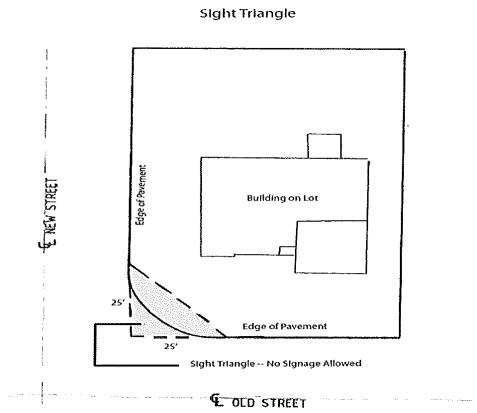
(F) Obscenity. Signs that contain statements, words or pictures which are obscene as defined by IC 35-49-2-1.
(G) Encroachment. Signs that are located in any right-of-way or thoroughfare setback including projecting signs and signs posted on utility poles or street signs, except pursuant to an encroachment permit approved by the City of Evansville Board of Public Works and the entity that owns the structure, and by the Executive Director of the Planning Department in the case of signs located in a thoroughfare setback.
(H) Obstruction. Signs that obstruct the visibility or use of any door, fire escape, stairway, or any opening intended to provide entrance or exit for any structure.
(I) Vehicle and Trailer Signs. Any sign attached to, or placed on, a vehicle or trailer moving or parked on public or private property except for signs meeting the following requirements:
(1) The primary purpose or use of the vehicle or trailer for any period of time must not be the display of signs.
(2) The sign must be:
(a) A magnetic sign attached to a steel body panel of the vehicle or trailer;
(b) An adhesive decal, including an adhesive vehicle wrap;
(c) Painted onto the vehicle itself;
(d) A delivery vehicle sign; or
(e) An integral part of the vehicle or equipment as originally designed by the manufacturer.
(3) The vehicle or trailer on which the sign appears is in operating condition, currently registered and licensed to operate on public streets when applicable, and actively used or available for use in the daily function of the business to which such signs relate.
(4) When not in use, the vehicle must be parked within a legal parking space on the premises where the business is located or where the business is being conducted.
(J) Temporary Signs. Properties that have an electronic message sign shall not be eligible to have temporary signs.
(K) Lighting. Signs that are improperly illuminated/shielded resulting in glare being shed across property lines creating a nuisance for any abutting property owner or into any thoroughfare creating a hazard or distraction for traffic.
(L) Flashing Signs. Signs that pose significant distraction to drivers by the rapid and repeated changes in the sign illumination.
(M) Parking Interference. Signs placed in such a manner as to displace, obstruct or interfere with the use of a required parking space, and signs placed in any parking or access aisle without approval by the Site Review Committee.
(N) Unplatted Lots, Partially Developed Subdivisions. Placement of off-premises signs on any unplatted lot prior to establishment of any fixed commercial or industrial improvement on the lot, built after obtaining all required improvement location permits, building permits, and after installation of all proper roadway, water, and waste disposal infrastructure. Notwithstanding anything above, on any subdivision plat recorded in the manner required by law with less than 10 lots, placement of off-premises signs is not allowed until construction work with all necessary permits has begun on at least 50 percent of the lots; on any subdivision plat recorded in the manner required by law with 10 or more lots, placement of off-premises signs is not allowed until construction work with all necessary permits has begun on at least 10 percent of the lots.
(O) Greenway Passage. Placement of off-premises signs within 300 feet of the center of a portion of the Greenway Passage path which has been purchased, leased or completed and for which a legal description has been placed of record.
(P) Electronic message signs are not allowed in a historic district established by ordinance or recognized by the National Register of Historic Places, except on a property that is:
(1) Located within a redevelopment area established pursuant to IC 36-7-14; and
(2) Subject to design review approval requirements established by the Redevelopment Commission. [Ord. G-2021-14 § 1, passed 9-15-21; Ord. G-2016-28 § 3, passed 10-14-16; Ord. G-2014-12 § 1, passed 7-16-2014.]
18.140.080 Permitted use by district.
(A) In all districts, on-premises signs must not be erected or maintained unless they conform to the requirements shown on the following Table 18.140.080(A).
|
DISTRICT |
A, CON, R-1, R-2 |
R-3 to CO-2 |
C-1 |
C-2 |
C-3 |
W-R, C-4 |
M-1 to M-3, W-I, AIR |
|---|---|---|---|---|---|---|---|
|
Max. Area of Signage |
10 sq.ft. |
200 sq.ft. |
300 sq.ft. |
500 sq.ft. |
150 sq.ft. |
500 sq.ft. |
500 sq.ft. |
|
Number of Signs per Street Frontage |
1 |
1 |
2 |
2 |
2 |
3 |
3 |
|
Special Restrictions |
100 sq.ft. if approved as a special use by the BZA |
Bed and breakfast and boarding house limited to a maximum of 6 sq.ft. sign; if lighted, must be externally illuminated |
Flat signs: Maximum coverage of wall area 50%; Canopy signs: maximum extension above canopy 6 ft. |
Same as C-1 |
Requires approval of Redevelopment Commission for all signs |
|
In the AIR district: all signs require approval of the EVAAD; and signs for commercial businesses unrelated to the airport must comply with these requirements |
|
Electronic Message Signs (EMS) |
Special Use 13 required, but will only be permitted as accessory to a different established special use.
See subsection (B)(2)(a) of this section |
Special Use 13 required
See subsection (B)(2)(b) of this section |
Special Use 13 required
See subsection (B)(2)(b) of this section |
Special Use 13 required
See subsection (B)(2)(b) of this section |
Permitted |
Permitted |
Permitted, but Special Use 13 required in AIR. See subsection (B)(2)(b) of this section |
|
Max. Area for EMS (see Figure 2) |
18 sq.ft. of 100 sq.ft. allowed in sp. use |
18 sq.ft. of max. area of signage allowed |
32 sq.ft. of max. area of signage allowed |
32 sq.ft. of max. area of signage allowed |
12.5 sq.ft. of max. area of signage allowed |
50 sq.ft. of max. area of signage allowed |
50 sq.ft. of max. area of signage allowed |
|
Max. Ht.* of EMS (Top of Electronic Screen, Measured from Grade) |
6 ft. (see Figure 2) |
6 ft. (see Figure 2) |
Subject to overall sign height. |
||||
* All signs are subject to overall height requirements in 18.130.010, Table A.
Figure 2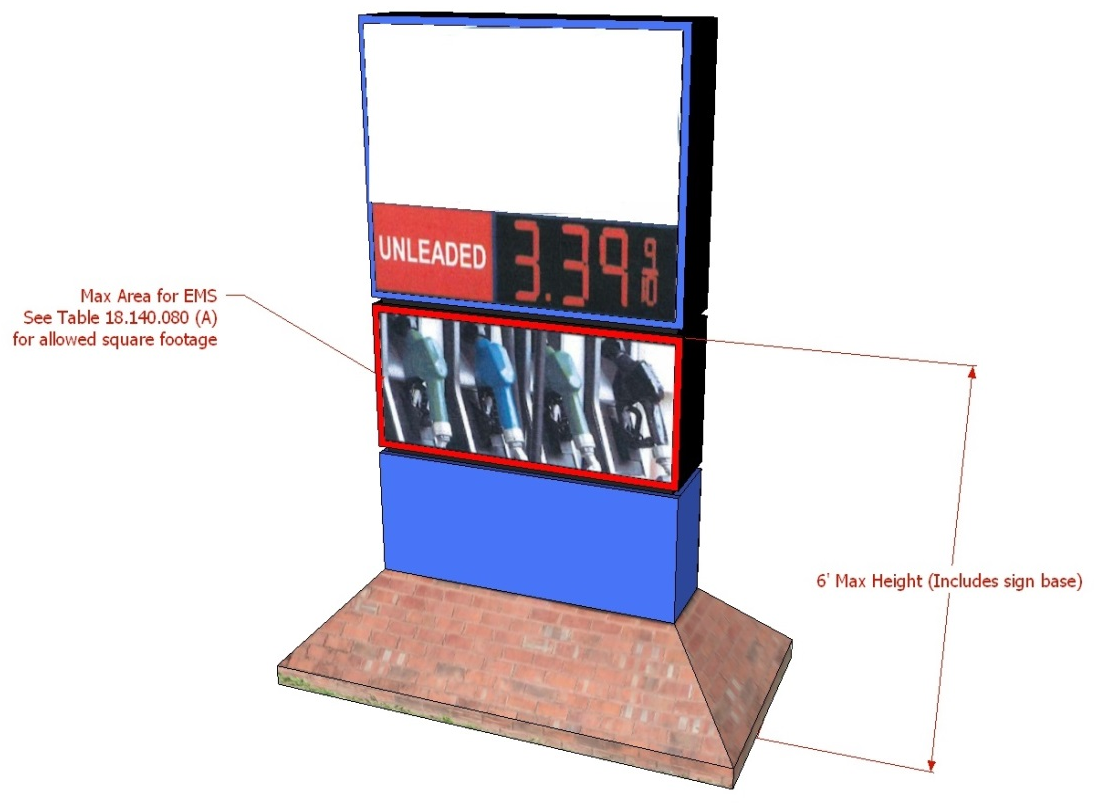
(B) The following requirements shall apply to electronic message signs:
(1) All electronic message signs shall be located at least 200 feet from any residence/dwelling.
(2) The specific requirements for on-premises electronic message signs including those located inside of a structure but designed or placed to advertise outside are:
(a) In agricultural, conservation, R-1 and R-2 districts, electronic message signs are not permitted unless a special use (other than for the electronic message sign) has been established on the site.
(b) In R-3, R-4, R-5, CO-1, CO-2, C-1, C-2 and AIR districts, electronic message signs must obtain Special Use 13 approval from the Board of Zoning Appeals.
(c) In the C-3, C-4, W-R, W-1, M-1, M-2 and M-3 districts, electronic message signs are a permitted use and Special Use 13 approval is not required.
(d) The size of an on-premises electronic message sign shall not exceed the maximum area for the EMS allowed in Table 18.140.080(A) for the district or use.
(e) Message Duration. Static message displays for on-premises electronic message signs shall display each message for at least four seconds before transitioning to another message; however, such messages displayed on an electronic message sign that is only capable of displaying one line of text at a time and that has a display area no more than 12 inches in height shall display each line of text for at least three seconds before transitioning to another line of text.
(f) Only one electronic message sign per business on single-use commercial lots/parcels; and for uses such as commercial shopping centers, institutional campuses, etc., which could incorporate multiple parcels under common ownership with unified, integrated development such as a shared roof, facade, parking, drainage or similar facilities.
(C) An off-premises advertising sign may be erected in C-2, C-4, M-1, M-2, and M-3 districts limited to the size, height, and setbacks as shown on the following Table 18.140.080(C).
|
DISTRICT |
C-2 |
C-4 |
M-1, M-2, M-3, AIR |
|---|---|---|---|
|
Maximum size of sign |
300 square feet |
700 square feet |
700 square feet |
|
Maximum height |
30 feet |
50 feet |
50 feet |
|
Minimum setback from right-of-way |
Equal to EMC 18.130.010 setbacks |
||
|
Minimum setback from right-of-way: controlled access thoroughfares* |
Equal to EMC 18.130.010 setbacks |
||
|
Minimum spacing between signs: controlled access thoroughfares* |
Minimum 500 feet; 1,000 feet along same side of street |
Minimum 500 feet; 1,000 feet along same side of street |
Minimum 500 feet; 1,000 feet along same side of street |
|
Minimum spacing between signs |
Minimum 400 feet; 800 feet along same side of street |
Minimum 400 feet; 800 feet along same side of street |
Minimum 400 feet; 800 feet along same side of street |
|
Minimum distance from residential property |
200 feet from a residential dwelling; 200 feet from property line of undeveloped residential district property; absolute minimum 60 feet from any residential property line |
||
|
Minimum distance from public park, school, church, or museum |
300 feet |
||
|
Electronic message signs |
Special Use 13 required
See subsection (D)(1) of this section |
Permitted |
Permitted, but Special Use 13 required in AIR
See subsection (D)(1) of this section |
|
300-foot spacing from a residential dwelling or undeveloped R district |
|||
|
Special provisions |
Nonilluminated signs only after 10:00 p.m. |
Height limit increased along elevated roads; Maximum 65 feet |
Height limit increased along elevated roads; Maximum 65 feet. Requires approval of the EVAAD in the AIR district |
* Streets defined within EMC 18.150.030, Classification of thoroughfares.
(D) The specific requirements for off-premises electronic message signs are:
(1) In the C-2 and AIR districts, electronic message signs require Special Use 13 approval.
(2) In the C-4, M-1, M-2 and M-3 districts, electronic message signs are a permitted use.
(3) Message Duration. Static message displays for off-premises electronic message signs shall display each message for at least eight seconds before transitioning to another message. [Ord. G-2016-28 § 4, passed 10-14-16; Ord. G-2014-23 § 1, passed 9-24-2014; Ord. G-2014-12 § 1, passed 7-16-2014.]
18.140.090 Maintenance and removal.
(A) When the product, business, or service that is advertised on a sign is abandoned or altered, or when the event or purpose advertised by the sign has passed or no longer exists, the sign and its structural elements must be removed or altered within 60 days to depict an existing product, person, business, service, or event, or to communicate an existing purpose. The owner and tenant of the land are equally responsible for removal or alteration of the sign and its structural elements.
(B) All off-premises signs must display copy encompassing the entire display face at all times. If copy is not displayed for a period exceeding 60 days, the permit for the off-premises sign may be revoked and the sign and structure may be removed, or required to be removed, pursuant to this section.
(C) Except in the case of a face change of an off-premises sign or as otherwise provided in this section, prior to the alteration of a sign or the erection of a previously removed or abandoned sign, an improvement location permit and compliance with EMC 18.140.020 are required.
(D) Every sign shall be maintained in a safe, presentable, and good structural condition at all times including the replacement of defective parts, painting, re-painting, cleaning, and other acts required for maintenance of the sign. Compliance shall be required with all standards of this chapter and with all standards in this code that are applicable to signs.
(E) A sign is considered not functional when any of the following conditions exist:
(1) Its essential elements are no longer readable or recognizable;
(2) It is physically obstructed from view;
(3) A condition of dilapidation or danger exists;
(4) The area that is leased for or within 25 feet of an off-premises sign is not kept free of weeds, debris, or refuse; or
(5) Copy is not displayed on an off-premises sign for a period of 60 days.
(F) The Building Commissioner, or the Executive Director of the Planning Department, or a designee of either official, has the right of entry to inspect signs to determine whether they are functional.
(G) If a sign is not made to comply with adequate safety standards, not kept in a presentable or good structural condition, is not functional, has been abandoned, or is not removed or altered as required under subsection (A) of this section, its removal will be required as follows:
(1) The Executive Director of the Planning Department or designee(s) thereof shall provide a 10-day written notice to the owner or lessee of the sign in violation to either remove the sign or to bring it into compliance.
(2) Upon failure to comply with the written notice of violation, the Executive Director of the Planning Department, the Building Commissioner, or the respective designee(s) of either, may do either or both of the following:
(a) Remove the sign, its structure, or both, with all cost of removal to be borne by all owner(s) or lessee(s) of the sign, jointly and severally;
(b) Issue a notice of violation with fines pursuant to Chapter 18.195 EMC.
(3) The Building Commissioner or designee(s) may remove a sign, its structure, or both, immediately and without notice and with all cost of removal to be borne by the owner(s) and lessee(s) of the sign, jointly and severally, if in the opinion of the Building Commissioner or designee the condition of the sign is such as to present an immediate threat to the safety of the public.
(H) When relocation or removal of an off-premises sign becomes necessary, and documentation is provided from the owner of the site that the relocation of the sign is necessary due to construction, expansion, or other development planned for the site where the sign is located, the sign may be moved by the sign owner to another location on that same site within 20 feet of the original location of the sign, providing the location within 20 feet of the original sign does not create nonconformity of the sign. Once the sign has been removed from its original location, it may remain removed for a period of up to 90 days without requiring a permit, and will be considered to remain in existence at its original location or within 20 feet thereof during that period for purposes of locating other signs. At or before the expiration of the 90-day period, a new sign permit must be obtained for the sign being relocated or replaced. Permit fees may be waived if the sign structure is the same configuration and erected in the same manner as the original sign and is of the same or smaller size than the original sign. Removal or relocation of a sign under this subsection does not waive or alter the need for permits required by the Planning Department, Building Commission or any other agency.
(I) When replacement of an off-premises sign becomes necessary, and documentation is provided from the Building Commissioner, OSHA or other governmental agency of competent jurisdiction that replacement of the sign is necessary due to the unsafe or dangerous condition of the off-premises sign, a safety upgrade by the sign owner is allowed on that same site within 20 feet of the original location of the sign, provided the safety upgrade or the location within 20 feet of the original location does not create nonconformity of the sign. Once the sign has been removed from its original location, it may remain removed for a period of up to 90 days without requiring a permit, and will be considered to remain in its existence at its original location or within 20 feet thereof during that period for purposes of locating other signs. At or before the expiration of the 90-day period, a new sign permit must be obtained for the sign being relocated or replaced. Permit fees may be waived if the off-premises sign structure is the same configuration and erected in the same manner as the original sign, is of the same or smaller size as the original structure, and documentation is provided from the Building Commissioner, OSHA or other governmental agency of competent jurisdiction that replacement of the sign is necessary due to the unsafe or dangerous condition of the off-premises sign. Removal or relocation of a sign under this subsection does not waive or alter the need for permits required by the Planning Department, Building Commission or any other agency.
(J) When a legal nonconforming sign is removed, no permit may be issued to replace the sign.
(K) Electronic message signs shall be immediately turned off in the event of a malfunction. [Ord. G-2016-28 § 5, passed 10-14-16; Ord. G-2014-12 § 1, passed 7-16-2014.]
18.140.100 Enforcement.
(A) Except as otherwise provided in this chapter, the enforcement of the requirements of this chapter shall be as follows:
(1) The Executive Director of the Planning Department or designee thereof will issue a warning letter to the person(s) committing, in whole or in part, a violation. The letter will identify the violation, set out required corrective measures, and specify the time frame for such corrective measures.
(2) In the event there is no response or action taken by the violator within 10 days of the notice of the violation, one additional violation letter shall be reissued explaining the violation and making demand that the violator comply or risk fine.
(3) If the violator fails to respond to the notice of violation after 30 days from the issuance of the original letter sent in subsection (A)(1) of this section, the Executive Director of the Planning Department or designee thereof shall issue a notice of violation with fines pursuant to Chapter 18.195 EMC.
(4) If at any time a person to whom a violation notice has been issued commits another signage violation in regards to this chapter, whether of the same section or otherwise, the Executive Director of the Planning Department shall issue a notice of violation along with fines pursuant to Chapter 18.195 EMC without any further warning or notice. This provision does not apply in the event the Board of Zoning Appeals or a court of competent jurisdiction has found that the person did not commit any of the alleged violations referred to in the prior notices.
(B) The enforcement procedures in this chapter are subject to modifications at the discretion of the Executive Director of the Planning Department to include additional notices, extensions of time limits, or expedited or delayed steps to address immediate threats to public safety. [Ord. G-2016-28 § 6, passed 10-14-16; Ord. G-2014-12 § 1, passed 7-16-2014.]
18.140.110 Off-premises signs – Examples.
EXAMPLE 1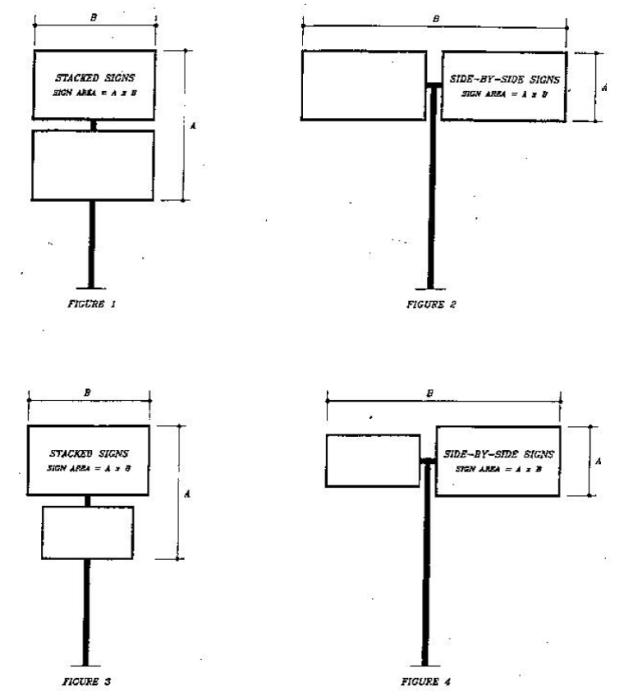
EXAMPLE 2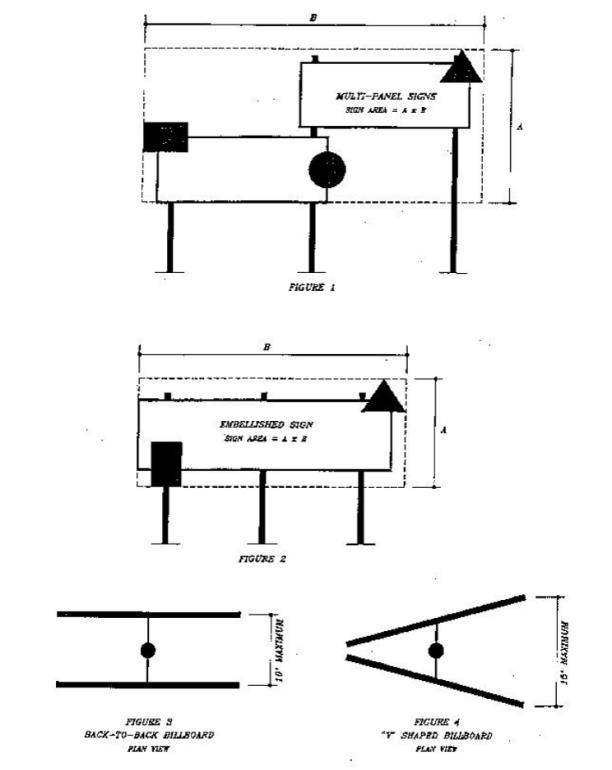
EXAMPLE 3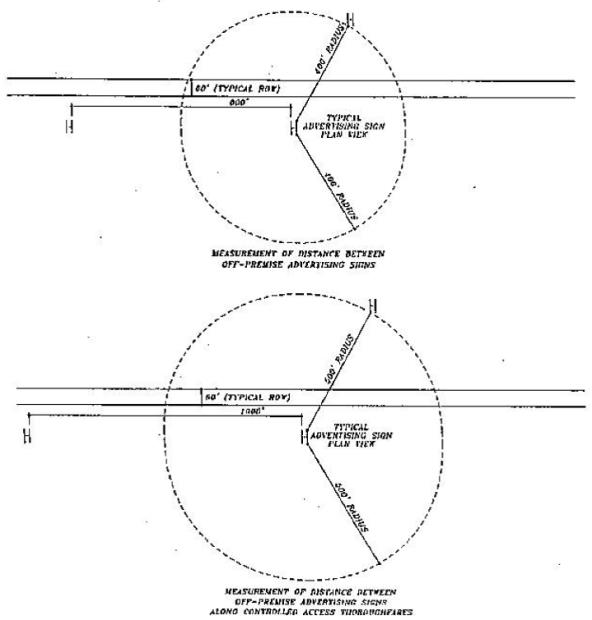
[Ord. G-2014-12 § 1, passed 7-16-2014.]