


Chapter 17.24
OFF-STREET PARKING AND LOADING
Sections:
17.24.010 Application of requirements.
17.24.030 Type and size of facilities.
17.24.040 Parking areas not in or adjacent to residential districts.
17.24.050 Parking areas in or adjacent to residential districts.
17.24.060 Mixed or multi-uses.
17.24.080 Amount of off-street parking.
17.24.090 Access and service drives.
17.24.110 Combining off-street loading spaces.
17.24.120 Interior parking area green space.
17.24.010 Application of requirements.
A. A person who constructs or structurally alters a building, or who initiates or alters a use after the effective date of the ordinance codified in this title shall provide and maintain off-street parking facilities as provided in this title.
B. The owner or operator of a building or use shall not discontinue or reduce the off-street parking facilities required by this title.
C. Permits. All parking areas shall be installed after issuance of an improvement location permit; site review committee approval required.
(Prior code § 153.090)
17.24.020 Location.
A. Off-street parking facilities shall be on the same lot as the principal use except as provided in subsection B of this section.
B. If the size or shape of the lot or the existence of a nonconforming building or use prevents providing the parking facilities on the lot, the owner may provide the facilities on an alternate lot within three hundred (300) feet if he files a copy of the deed or lease agreement to the alternate lot with the area plan commission. The alternate lot may not be subsequently used for any other use unless the subsequent use has been approved by the area plan commission.
C. Parking spaces for all uses may be in either garages or open parking areas; providing however, that garages must meet all requirements of Section 17.12.070.
D. Automotive vehicles, including campers and motor homes of any kind or type, without current license plates, shall not be parked or stored on any residential property other than in completely enclosed buildings.
(Prior code § 153.091)
17.24.030 Type and size of facilities.
A. A parking space must be a minimum of nine feet wide and eighteen (18) feet long.
B. Except on lots occupied by single-family or two-family residences, aisles shall be provided depending on the angle of parking from the curb as follows:
|
Angles in degrees from curb |
Aisles One-Way |
Two-Way |
|---|---|---|
|
0 |
10 feet |
18 feet |
|
15 |
8 feet |
18 feet |
|
30 |
10 feet |
18 feet |
|
45 |
12 feet |
18 feet |
|
60 |
18 feet |
22 feet |
|
90 |
24 feet |
24 feet |
C. Except on lots occupied by single- or two-family dwellings, access drives or driveways to or from any parking space or lot shall provide an access drive measured at right angles to the centerline of the drive, as follows: (Widths do not include required entrance and exit radii.)
|
Residential |
One-Way Min.-Max. |
Two-Way Min.-Max. |
|---|---|---|
|
1—2 units |
10 |
10—20 |
|
3—8 units |
10 |
20—30 |
|
8 or more |
12—20 |
24—40 |
|
Commercial |
12—20 |
24—40 |
|
Industrial |
12—20 |
24—40 |
A divided entrance drive must be between twenty (20) feet and thirty (30) feet for each divided section with a median width of four feet minimum.
(Ord. dated 5/17/93 § 1(b); prior code § 153.092)
17.24.040 Parking areas not in or adjacent to residential districts.
Parking areas shall be constructed and maintained in accordance with the following requirements:
A. Limitations on Use.
1. A building other than a parking garage shall not be constructed in a parking area.
2. The parking area must be designed to eliminate vehicles backing out into street right-of-way.
3. Off-street parking areas located on a lot separate from the lot occupied by the principal use shall not be used for the storage, display, advertisement, sale, repair, dismantling, or wrecking of any vehicle, equipment or materials.
B. Paving.
1. Parking area and access drives shall be installed and maintained with a hard and sealed surface except for residences and agricultural uses in R-1, R-2 and AG where any durable surface is permitted, and except as provided in paragraphs 2 and 3 of this subsection.
2. Commercial Exceptions.
a. This paragraph 2 applies only to parking for the following uses:
i. mini-storage facilities
ii. cell towers
iii. campgrounds
iv. inventory storage and display for the commercial sale or leasing of: agricultural and construction equipment, semi trucks and trailers, recreational vehicles (motor homes), manufactured / modular housing, and yard barns.
b. A hard and sealed surface is required for the portion of all entrance and exit drives within fifty feet (50') of the existing edge of pavement of the public way or private access easement to which the drive connects.
c. Any durable surface, such as gravel, is permitted for the remainder of the drive and lot not covered by subparagraph B.2.b.
d. Notwithstanding subparagraph B.2.b., any durable surface is permitted on any portion of the lot and drive(s) if the lot is only accessible from a non-paved public way or private access easement and the owner provides an executed use and development commitment requiring the installation of a hard and sealed surface as required by this section if and when the public way or private access easement becomes paved with a hard and sealed surface.
e. Gravel may be used as a durable surface only if it is Number 53 stone or larger, meeting the latest version of the Indiana Department of Transportation standard specifications, and is installed to a minimum depth of six inches (6").
f. Tree Buffer Zone. Except as provided in subparagraph B.3., for purposes of dust control, the use of any durable surface in lieu of hard and sealed paving for off-street parking and aisles must be accompanied by a tree buffer zone meeting the following requirements:
i. Tree buffer zones must be a minimum of ten feet (10') in depth adjacent to the front, side, and rear property lines, except where section 17.12.050 requires a front and rear yard setback of greater depth.
ii. Only non-invasive species of evergreen trees with a minimum height at maturity of 25' can be used.
iii. Trees must have a minimum height of 6', 1.5" trunk diameter, and 3' in spread at the time of planting.
iv. Trees must be spaced at a minimum of one tree for every 15 linear feet of buffer zone, with the exception of the front property line buffer zone on property used for inventory storage and display for commercial sales and leasing as described in subparagraph B.2.a.iv. above, in which trees must be spaced at a minimum of one tree for every 30 linear feet of buffer zone.
v. Prior to the issuance of the Improvement Location Permit, tree buffer zones must be incorporated in use and development commitments to be executed and recorded in the County Recorder’s office, defining the area as exclusively dedicated for the tree buffer zone with the exception of perpendicular crossings for access drives and utility lines only, unless and until the durable surface is replaced by hard and sealed paving;
vi. Tree buffer zones shall be perpetually maintained, including the replacement of any dead trees, unless and until the durable surface is replaced by hard and sealed paving.
vii. A tree planting plan must be provided on any site plan for new development or submitted separately with the site plan.
g. Except as provided in subparagraph B.3., if fencing is required or provided, it shall be located adjacent and interior to the site from the tree buffer zone. The planting of trees does not eliminate the fencing requirement of Paragraph 17.12.060.C.
3. Combined Residential and Commercial/Industrial Exception. Parcels containing a residence and a small non-residential use that has an off-street parking requirement of five spaces or less only need to comply with subparagraphs B.2.b through B.2.e of this subsection.
4. The parking area surface shall be graded and drained so that there will be no flow of water onto either adjacent properties or sidewalks.
5. When the front end of a parking space is adjacent to the perimeter of the parking area, a bumper guard shall be provided to prevent any part of a parked vehicle from extending beyond the parking area.
C. Maintenance. Off-street parking areas shall be maintained in good condition and be kept free of weeds, trash and debris.
D. Lighting. Lighting must be shaded and shall be located so that it does not cause glare onto adjacent properties or interfere with street traffic.
(Ord. 02-20-003 § 1, amended, 3/7/2023; Ord. 12-13-013 § 1, amended 12/17/2013; Ord. 03-10-004 § 1, amended 03/16/2010; prior code § 153.093)(Ord. 17.24.040, Amended, 04/17/1995)(17.24.040, Amended, 04/17/1995, amended D/1)
17.24.050 Parking areas in or adjacent to residential districts.
Off-street parking areas for all nonresidential uses located in or adjacent to residential districts are required to meet the provisions of Section 17.24.040 and also the following restrictions:
A. Limitations in residential districts.
1. The parking area shall be used only for parking of passenger motor vehicles.
B. Access.
1. Access to the parking area shall not be through a required front yard, unless no other access is reasonably available.
2. Access shall be through the principal use lot or from a public alley.
C. Yards.
1. Required yards shall be maintained in grass or natural ground cover.
2. If a setback line has already been established in the same block as the parking area, the minimum front yard shall be equal to the average setback of existing buildings on the same side of the street.
3. Required side and rear yards shall not be less than five feet.
(Ord. 02-20-003 § 1, amended, 3/7/2023; prior code § 153.094)(Ord. 17.24.050, Amended, 04/17/1995)(17.24.050, Amended, 04/17/1995)
17.24.060 Mixed or multi-uses.
A. In the case of mixed or multi-uses, the total requirements for off-street parking are the sum of the requirements of the various uses computed separately unless specifically listed.
B. Except as provided in Section 17.24.070, off-street parking spaces for one use may not be considered spaces for another use.
(Ord. 02-20-003 § 1, amended, 3/7/2023; prior code § 153.095)
17.24.070 Joint uses.
A. An off-street parking area for one use may be included in the requirements for another use if the area plan commission determines that the periods of usage are not concurrent.
B. Theaters and churches may reduce the off-street parking facilities by the number of spaces available in commercial or industrial parking areas within five hundred (500) feet of the theater or church, if the areas are not used during theater and church usage hours.
(Ord. 02-20-003 § 1, amended, 3/7/2023; prior code § 153.096)
17.24.080 Amount of off-street parking.
A. Off-street parking facilities are required for uses as follows:
1. Use group 1 (one-family dwelling): one space per dwelling;
2. Use group 2 (residential occupations): two spaces per dwelling;
3. Use group 3 (duplex): one space per dwelling unit;
4. Use Group 4 (Multiple-family dwelling):
a. Efficiency or bedroom unit-1 per unit
b. One-bedroom-1 per unit
c. Two-bedroom-1 per unit
d. 3-plus bedroom-2 per unit;
5. Use Group 5.
a. Nursery, nursery school, child care center: one space for each two employees of the largest working shift, plus one space for each company vehicle,
b. All other listed uses: one parking space for each five hundred (500) square feet of gross floor area;
6. Use Group 6.
a. Group home/community residential facility- one space for each staff member of the largest working shift,
b. Sorority and fraternity: 1 space for each two beds;
7. Use Group 7.
a. Restaurants and cafeterias: one parking space for each six customer seats,
b. Beauty and barber shops: one space per barber or beautician or one space for each two hundred (200) square feet of gross floor area, whichever is least restrictive,
c. All other listed uses: one parking space for each five hundred (500) square feet of gross floor area;
8. Use Group 8.
a. Business and commercial trade schools, dance/theatrical school or studio: one parking space for each classroom, plus one space for each three students of largest enrollment,
b. Nightclub, bar, tavern, and similar uses: one space for each six customer seats,
c. Archery range, trampoline center, pool or billiard room, arcade, skating rink, exercise or sports club and similar uses: one space for each thousand (1000) square feet of gross floor area,
d. Bowling alley: two parking spaces for each alley,
e. Theater: one parking space for each eight seats,
f. Automobile service station: two spaces for each service stall,
g. Tennis courts: two parking spaces for each court,
h. Party houses, lodges, private clubs, dancehall, and meeting halls: one-eighth parking space per person as calculated by building capacity,
i. Supermarkets, drug stores, package liquor stores, and department stores: two spaces for each one thousand (1,000) square feet of gross floor area for buildings over three thousand (3,000) square feet; all smaller buildings, one space for each five hundred (500) square feet,
j. Hotels and motels (exclusive of retail uses): one parking space for every five rental dwelling units,
k. Laundromat: one parking space for each seven washing or dry-cleaning machines,
l. Shopping centers over twenty-five thousand (25,000) square feet in size: two spaces for each one thousand (1,000) square feet of gross lease area; shopping centers less than twenty-five thousand (25,000) square feet in size-one space for each five hundred (500) square feet of gross floor area,
m. Mortuary: one space for each five hundred (500) square feet of gross floor area,
n. All other listed uses: one parking space for each five hundred (500) square feet of gross floor area;
9. Use Group 9. All listed uses: one parking space for each five hundred (500) square feet of gross floor area;
10. Use Group 10.
a. Retail uses: one space for each thousand (1000) square feet of gross floor area; minimum two spaces,
b. Service, storage, warehouse, and wholesale uses: one parking space for each two employees of the largest working shift, one space per company vehicle, minimum two spaces;
11. Use Group 11.
a. Plant and shrub nursery: an adequate number of spaces to serve the public,
b. Retail use: one space for each thousand (1000) square feet of gross floor or sales area;
c. Service, storage, warehouse and wholesale uses: adequate spaces for visitors;
d. Recreational uses: parking spaces in an amount to be determined by site review committee to be reasonably adequate to serve the public for customers, patrons, visitors, and employees;
12. Use Group 12.
a. Restaurants and refreshment stands: one space for each six customer seats,
b. All other listed uses: an adequate number of spaces to serve the public;
13. Use Group 13, 14, 15, and 16. All listed uses: an adequate number of spaces for visitors;
14. Use Group 17. Agricultural and forestry operations: one parking space for each employee on any given shift;
15. Use Group 18. All listed uses: an adequate number of spaces for visitors;
16. Use Group 19.
a. Drive-in theater: two parking spaces for each two hundred (200) square feet of gross floor area,
b. All other listed uses: an adequate number of spaces for visitors;
17. Use Group 20. Bed and breakfast, boardinghouse, and similar uses: an adequate number of spaces for visitors;
18. Use Group 21
a. Adult uses shall provide the following number of parking spaces:
b. Adult Arcade - One (1) parking space for each two (2) customer seats or arcade devises (whichever is greater) plus one (1) parking space for each employee of the largest working shift.
c. Adult Bookstore, Adult Novelty Store or Adult Video Store - One (1) parking space for each two hundred (200) square feet of floor space.
d. Adult Cabaret, Juice Bar, or Bikini Bar - One (1) parking space for each two (2) customer seats, plus one (1) parking space for each employee of the largest working shift.
e. Adult Motion Picture Theater - One (1) parking space for each four (4) seats, plus one (1) parking space for each employee of the largest working shift.
f. Adult Theater - One (1) parking space for each four (4) seats, plus one (1) parking space for each employee of the largest working shift.
g. Nude Model Studio - Two (2) parking spaces for each employee of the largest working shift.
h. Sexual Encounter Center - Two (2) parking spaces for each employee of the largest working shift.
i. Peep Show Facility - Two (2) parking spaces for each employee of the largest working shift.
B. Special Uses.
1. As provided by Chapter 17.28 and the special use approved by the board of zoning appeals parking spaces in an amount to be determined by the board of zoning appeals to be reasonably adequate to serve the public for customers, patrons, visitors, and employees.
C. Gross floor area for the purposes of this section means the total horizontal areas of the floors of the building or portion of the building, including accessory storage areas located within selling and working space and basement floors devoted to retail activities, production or processing of goods, or offices. Gross floor area does not include area devoted entirely and permanently to parking, loading, restrooms, utilities, elevator shaft, or stairwells.
D. Whenever a use is added to use groups as provided in Section 17.20.020, the off-street parking facilities are those for the use within that use group most similar to the added use, unless otherwise provided by the commission.
E. One-half or more of a fractional parking space in a computation requires providing one full parking space.
(Ord. 02-20-003 § 1, amended, 3/7/2023; Ord. 09-13-009 § 5, amended, 10/22/2013; 17.24.080(A (18) added & SU35 through SU 42 deleted, 7/15/2008; amended subsection (A)(4) 1/2/2007; Ord. dated 2/22/94 § 1(n); prior code § 153.097; portion amended 8/10/98)
17.24.090 Access and service drives.
A. An access or service drive for any use may not be constructed over a public sidewalk or right-of-way without approval from the county engineer as provided in Section 17.36.020.
B. All uses are subject to the following requirements:
1. Access drives are determined as follows:
a. Zero to two hundred (200) feet of road frontage: one access drive;
b. Two hundred (200) to four hundred (400) feet: two access drives;
c. Over four hundred (400) feet: access drives to be determined.
2. An access drive must be at least fifty (50) feet from any parallel access drive on the same property, provided that in Residential-1 districts, by a unanimous vote of the site review committee, that distance may be reduced on local streets only.
3. An access drive must be at least two hundred (200) feet from the base of a bridge incline, measured from the centerline of access drive to the base of the bridge incline.
4. An access drive must be at least four hundred (400) feet from an interchange ramp, measured from the centerline of access drive to the nearest edge of the ramp.
5. Access drives in Residential-1 must be at least thirty (30) feet from a parallel public street, provided that by a unanimous vote of the review committee the thirty (30) foot requirement may be reduced to not less than fifteen (15) feet on local streets only. The distance is measured from the nearest side line of the drive to the nearest right-of-way line of the street. Access drives in all other districts must be at least fifty (50) feet from any parallel public street, measured from the nearest curb line of the street.
6. All access drives shall be in conformance with the current Evansville urban transportation access standards manual.
7. Auxiliary lanes, such as passing blisters and turn lanes, shall be installed, when required, according to the current Evansville urban transportation access standards manual.
8. Where an access drive is located in front of a garage on a public street, the garage shall be setback a minimum of twenty (20) feet from the right-of-way or the driveway to the garage shall be at least twenty (20) feet long to provide enough space for a vehicle to park without overhanging into the right-of-way, if the garage door is closed. This shall not be interpreted to waive a larger required minimum setback required by the zoning district.
9. Access drives for a single-family residential use, located on a street classified as local, and that has a front or side load three (3) car garage may have an access drive of a maximum width of thirty (30) feet located directly in front of the garage door location. All access drive standards above still apply.
C. The site review committee shall also consider the following factors in approval of a site plan.
1. Automotive and pedestrian safety;
2. Traffic flow and control;
3. Accessibility for emergency vehicles; and
4. Effects of the access drives on abutting properties.
D. If the location or site of a lot prevents development in accordance with the above requirements, access shall be provided which most closely complies with these requirements. Access may not be denied to any property.
(Ord. 09-22-018 § 4, amended, 09/27/2022; prior code § 153.098)
17.24.100 Off-street loading.
A. A use shall provide space separate from off-street parking areas, streets, and alleys for loading and unloading, and shall not block off-street parking, streets, or alleys.
B. Vehicles may not be parked or stored in the required off-street loading areas during the time the use is in operation, except for loading and unloading purposes.
C. Off-street loading space shall be provided and maintained in accordance with the following schedule:
1. For each commercial and industrial use not specified in subsection (C)(3) of this section which has an aggregate floor area of the following:
a. Ten thousand (10,000) to twenty-five thousand (25,000) square feet: one space,
b. Twenty-five thousand one (25,001) to sixty thousand (60,000) square feet: two spaces,
c. Sixty thousand one (60,001) to one hundred twenty thousand (120,000) square feet: three spaces,
d. One hundred twenty thousand one (120,001) to two hundred thousand (200,000) square feet: four spaces,
e. Two hundred thousand one (200,001) to two hundred ninety thousand (290,000) square feet: five spaces,
f. For each additional ninety thousand (90,000) square feet or fraction thereof: one additional space;
2. For each apartment building with twenty-five (25) or more dwelling units: one space;
3. For each hotel or motel, office building or public use which has an aggregate floor area of the following:
a. Ten thousand (10,000) to forty thousand (40,000) square feet: one space,
b. For each additional forty thousand (40,000) square feet or fraction thereof: one additional space.
D. Each space must be at least twelve (12) feet by thirty-five (35) feet in an area with a fourteen (14) foot clearance to classify as a required space.
E. The site review committee may recommend the reduction of a space to twelve (12) feet by thirty (30) feet in an area with an eight-foot clearance if the use will not normally involve the service by vehicles requiring the larger space.
F. Plans for buildings or uses requiring off-street loading facilities by this title shall clearly indicate the location, dimensions, clearance, and loading facilities.
(Prior code § 153.099)
17.24.110 Combining off-street loading spaces.
Off-street loading spaces may be combined for two or more uses if the combined spaces are equal to the requirements of all the uses and may be used conveniently by all the uses.
(Prior code § 153.100)
17.24.120 Interior parking area green space.
A. Interior parking area green space shall be provided in landscaped islands, bumpouts and/or strips within all new surface parking areas or expansions of existing parking areas having 30 or more parking spaces to reduce the visual and environmental impact of large parking lots. The term “Landscaped Island” shall refer to this required parking area green space. These requirements are in addition to any required front, side and rear yard setbacks, and shall meet the following standards:
1. Parking lots shall provide one landscaped island for every 15 parking spaces. When computing results in a fraction of 0.5 of an island or higher, the fraction shall be rounded up to the next whole number. The parking area shall be considered as the pavement devoted to parking spaces and adjoining aisles. To the extent possible, islands should be dispersed throughout the parking area. Paved areas for site loading/unloading and opaque fenced storage areas are exempt from this Section.
2. The minimum size of a landscaped island that can be applied towards these requirements shall be 136 square feet. The minimum dimension for an island without a tree is 6 feet. The dimensions for an island shall be measured from the inside of the curb or other barrier provided.
3. Barriers such as permanent curbing or wheel stops shall be installed around islands to minimize damage to landscaping and for easier parking area maintenance. Pavement (at or below the surface) is prohibited inside the island barriers. However, light pole standards, storm inlets, electrical boxes and other utility/drainage facilities are allowed within landscaped islands provided they do not occupy more than 25% of the island area, do not block a drainage way and they meet any applicable drainage requirements.
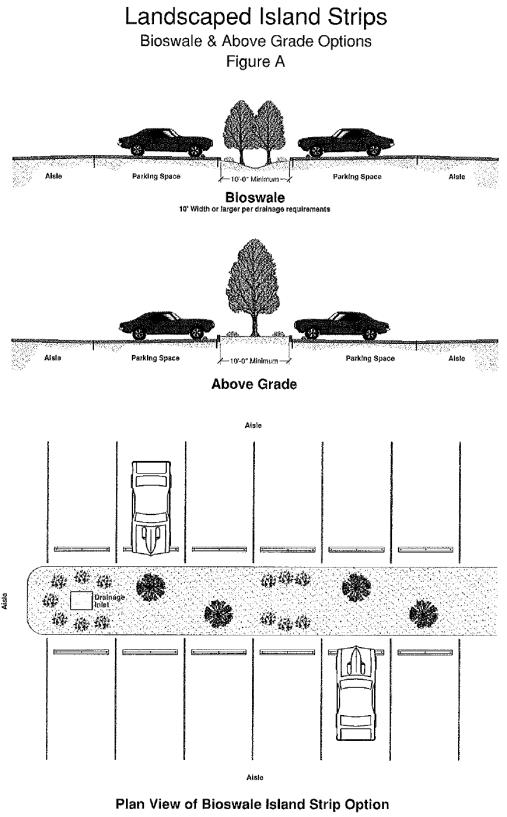
B. The preferred design option for landscaped islands is an island strip placed in the parking area between rows of head to head parking (see Figure A).
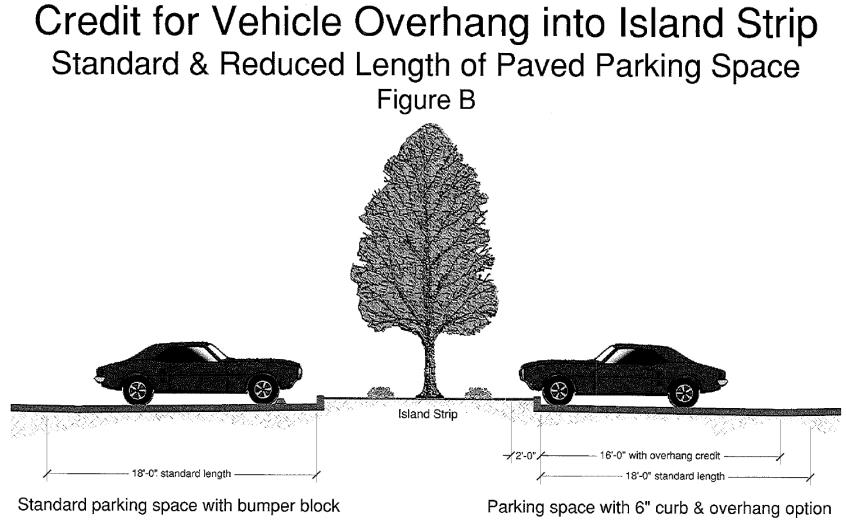
1. To encourage this form of landscaped island, a credit will be provided for the area where a vehicle could overhang the island strip as long as the strip is at least 10 feet wide. This credit allows two feet of the island adjacent to the front end of the parking spaces to be counted as part of the parking spaces, reducing the paved length of the spaces from 18' to 16' (see Figure B). Only ground cover plants are allowed within the overhang area.
2. The design grade of landscaped strips can be above or below the parking lot surface (see Figure A). Island strips with an elevation below the parking lot also function as bio-swales that can be integrated into the project drainage system. Gaps must be provided in curb or other barriers around this type of an island to allow for storm water flow into the area. Bio-swale islands are a best management practice for dealing with storm water and can lower drainage system cost. Design criteria for bio-swales must meet applicable drainage requirements.
C. Landscaped islands can also be used to safely separate parking spaces and pedestrians, and to define access drives that help direct vehicle circulation.
D. Each island shall contain plantings and be maintained as green space. Appropriate ground cover species, flowers, shrubs and/or trees shall be used to create an appealing landscape with shade and color. Trees are strongly encouraged, as well as use of native plantings. Lists of native trees by size recommended for planting can be obtained from the City of Evansville Arboricultural Specifications Manual. This document also offers guidance on planting procedures, soil treatment, irrigation and maintenance. Additional advice can be obtained from the City Arborist in the Evansville Urban Forestry Office, and from the County Extension Horticulture Educator.
1. Site plans for new development must show islands and indicate the species of trees to be planted.
2. The island plantings must be installed on a site of new or expanded development within 6 months of the date a Certificate of Occupancy (C of O) is issued. For attached multi-tenant businesses in a common structure, the 6 months shall start from the date a C of O is issued for the first business in the structure. After 6 months, enforcement actions will be taken including the possibility of fines if plantings have not been installed per these requirements.
3. In parking lots with 60 or more parking spaces, trees are required to be planted in islands at a rate of one tree for every 30 parking spaces. When computing results in a fraction of 0.5 of a tree or higher, the fraction shall be rounded up to the next whole number. All required trees are to be from the Medium and Large tree lists in the document referenced herein (no dwarf trees are allowed), unless other equivalent sized trees are approved by the City Arborist or the County Extension Horticulture Educator. At least 50% of required trees must be from the Large tree list. Any existing trees to be preserved that meet these requirements as shown on a site plan approved by the City Arborist or the County Extension Horticulture Educator shall also count toward the required tree total.
a. Minimum size of islands containing trees:
small/medium tree – 136 sq. ft. with a minimum dimension of 8 ft.
large tree – 315 sq. ft. with a minimum dimension of 10 ft.
b. Minimum distance from tree to pavement:
small tree – 3 feet
medium tree – 4 feet
large tree – 5 feet
c. The minimum sizes for islands with trees can be reduced upon approval by the City Arborist or the County Extension Horticulture Educator. To obtain approval, a site plan and island construction details must be submitted for commercial review indicating the use of structural soil, permeable pavement or an equivalent material or design (e.g. landscaped bumpouts adjacent to perimeter green space).
d. The size of the tree stock at the time of planting shall be as follows:
small tree – at least 1.5" caliper for single trunk
medium/large tree – 2.5" caliper for single trunk
|
evergreen or multi-stem trees: |
small – 10' in height |
|
|
medium/large – 12' tall |
e. Parking Deduction For Islands With Trees – For islands that contain Medium or Large trees, the amount of parking spaces that these required island areas represent shall be deducted from the total amount of the parking spaces needed to comply with the off street parking requirements as follows:
|
Island Size |
Island Parking Deduction |
|---|---|
|
136 to 314 square feet |
1 parking space deducted/island |
|
315 square feet or larger |
2 spaces deducted/island |
This parking deduction shall also be granted for parking areas smaller than 30 spaces as long as the islands meet these standards.
f. Islands in addition to those required to meet these standards are not eligible for the parking deduction unless they contain trees. This parking deduction shall not exceed 15 percent of the total required parking spaces before deductions are applied.
4. In areas where sight distance is needed, landscaping shall not obstruct visibility between 3 and 6 feet above the pavement surface (no evergreens).
E. The land owner and tenant, if any, of the parking area shall be jointly responsible for the ongoing maintenance of the islands and the landscaping to ensure the green space is kept in good condition. This shall include any necessary island repairs and replacement of landscaping as needed. If any trees die for which parking deductions were granted pursuant to this Section, they shall be replaced in kind with healthy specimens on the appropriate Medium or Large tree lists.
F. The Area Plan Commission Director may allow a land owner to retrofit islands into an existing parking lot provided that ample parking spaces will remain.
|
Requirement/Standard (parking lots smaller than 30 spaces are exempt)
Minimum Landscape Island Size – 136 square feet With Large Tree – 315 sq. ft.
Islands Required – 1 island/15 parking spaces Trees Required – 1 tree/30 spaces (in parking lots with 60 or more spaces)
Results with a fraction of 0.5 or higher shall be rounded up to the next whole number. |
(Ord. 03-10-004 § 2, added 3/16/2010)