


Article II - LAND USE DISTRICTS
Chapter 18.04
RESIDENTIAL DISTRICTS Revised 5/26 Revised 6/26
18.04.000 Chapter Contents
Sections:
18.04.020 Purposes. Revised 5/26
18.04.040 Permitted, conditional, and prohibited uses. Revised 5/26 Revised 6/26
18.04.060 Residential districts’ use standards. Revised 5/26 Revised 6/26
18.04.080 Residential districts development standards. Revised 5/26
18.04.090 Additional regulations.
(Ord. 7249 §7, 2020).
18.04.020 Purposes Revised 5/26
A. The general purposes of the residential districts contained in this chapter are as follows:
1. To provide a sustainable residential development pattern for future generations.
2. To encourage development of attractive residential areas that provide a sense of community and contain a variety of housing types to accommodate different lifestyles and household sizes.
3. To maintain or improve the character, appearance, and livability of established neighborhoods by protecting them from incompatible uses, excessive noise, illumination, glare, odor, and similar significant nuisances.
4. To establish a compact growth pattern to efficiently use the remaining developable land; enable cost effective extension and maintenance of utilities, streets and public transit; and enable development of affordable housing.
5. To enable community residents to reside and work within walking or bicycling distance of public transit, employment centers, and businesses offering needed goods and services in order to reduce traffic congestion, energy consumption, and air pollution.
6. To provide for development of neighborhoods with attractive, well-connected streets, sidewalks, and trails that enable convenient, direct access to neighborhood centers, parks, and transit stops.
7. To ensure adequate light, air, and readily accessible open space for each dwelling unit in order to maintain public health, safety, and welfare.
8. To ensure the compatibility of dissimilar adjoining land uses.
9. To protect or enhance the character of historic structures and areas.
10. To provide residential areas of sufficient size and density to accommodate the city’s projected population growth, consistent with Section 36.70A.110, RCW.
11. To preserve or enhance environmental quality and protect ground water used as a public water source from contamination.
12. To minimize the potential for significant flooding and allow recharge of ground water.
13. To allow innovative approaches for providing housing, consistent with the policies of the Comprehensive Plan.
14. To ensure that development without municipal utilities is at a density and in a configuration that enables cost effective urban density development when municipal utilities become available.
B. The additional purposes of each individual residential district are as follows:
1. Residential - 1 Unit Per 5 Acres. This designation provides for low-density residential development in designated sensitive drainage basins in a manner that protects aquatic habitat from degradation.
2. Residential Low Impact (RLI). To accommodate some residential development within sensitive drainage basis at densities averaging from two to four units per acre, provided that the development configuration avoids stormwater and aquatic habitat impacts.
3. Residential - 4 Units per Acre (R-4 and R-4CB). To accommodate residential development in areas sensitive to stormwater runoff in a manner and at a density (up to four units per acre) that avoids stormwater related problems (e.g., flooding and degradation of environmentally Critical Areas).
4. Residential 4-8 Units per Acre (R 4-8). To accommodate residential development at densities ranging from a minimum of four units per acre to a maximum of eight units per acre; to allow sufficient residential density to facilitate effective public transit service; and to help maintain the character of established neighborhoods.
5. Residential 6-12 Units per Acre (R 6-12). To accommodate residential development, at densities between six and twelve units per acre, in locations with frequent public transit service (existing or planned).
6. Mixed Residential 7-13 Units per Acre (MR 7-13). To accommodate a compatible mixture of single-family houses, middle housing units, and large multifamily dwellings in integrated developments with densities averaging between seven and 13 units per acre; to provide a broad range of housing opportunities; to provide a variety of housing types and styles; and to provide for development with a density and configuration that facilitates effective and efficient public transit service. This district generally consists of parcels along arterial or collector streets of sufficient size to enable development of a variety of housing types.
7. Mixed Residential 10-18 Units per Acre (MR 10-18). To accommodate a compatible mixture of single-family houses, middle housing units, and large multifamily dwellings in integrated developments close to major shopping and/or employment areas (at densities averaging between ten and 18 units per acre); to provide a variety of housing types and styles; to provide for development with a density and configuration that facilitates effective and efficient public transit service; to provide opportunities for people to live close to work and shopping in order to reduce the number and length of automobile trips; and to enable provision of affordable housing.
8. Residential Multifamily - 18 Units per Acre (RM-18). To accommodate predominantly large multifamily housing, at an average maximum density of 18 units per acre, along or near (e.g., one-fourth (¼) mile) arterial or major collector streets where such development can be arranged and designed to be compatible with adjoining uses; to provide for development with a density and configuration that facilitates effective and efficient public transit service; and to enable provision of affordable housing.
9. Residential Multifamily - 24 Units per Acre (RM-24). To accommodate predominantly large multifamily housing, at an average maximum density of 24 units per acre, in locations close (e.g., one-fourth (¼) mile) to major employment and/or shopping areas; to provide for development with a density and configuration that facilitates effective and efficient public transit service; and to enable provision of affordable housing.
10. Residential Multifamily - High Rise (RMH). To accommodate large multifamily housing in multistory structures near the State Capitol Campus; to provide opportunities for people to live close to work, shopping, services, and a major public transit hub; to create a desirable living environment for residents of the district; and to ensure that new high rise buildings incorporate features which reduce their perceived scale and allow sunlight to reach street level.
11. Residential Mixed Use (RMU). To accommodate attractive, high-density housing, pedestrian oriented commercial, and mixed-use development which reinforces downtown’s historic character; to provide for coordinated pedestrian amenities; to preserve viable downtown housing; to enable businesses to locate within walking distance of residences and offices; to provide a transition between commercial and residential districts; and to require new high rise buildings to incorporate features which reduce their perceived scale and allow sunlight to reach street level.
12. Urban Residential (UR). To accommodate large multifamily housing in multistory structures in or near the State Capitol Campus; downtown, High Density Corridor, or other activity center areas; to provide opportunities for people to live close to work, shopping, and services; to help achieve City density goals, to create or maintain a desirable urban living environment for residents of the district; and to ensure that new urban residential buildings incorporate features which encourage walking and add interest to the urban environment.
13. Manufactured Housing Park (MHP). To accommodate mobile homes and manufactured housing in mobile/manufactured housing parks; to accommodate manufactured housing on individual lots; to accommodate single-family houses and middle housing units at densities between five and 12 units per acre, in locations with frequent public transit service (existing or planned). This includes areas along or near (e.g., within one-fourth mile) arterial and major collector streets.
(Ord. 7444 §§18, 19, 2025; Ord. 7400 §1, 2024; Ord. 7267 §2, 2020; Ord. 6594 §4, 2008; Ord. 6517 §7, 2007; Ord. 6404 §1, 2006; Ord. 6323 §2, 2004; Ord. 6140 §16, 2001; Ord. 5661 §6, 1996; Ord. 5517 §1, 1995).
18.04.040 TABLES: Permitted and Conditional Uses Revised 5/26 Revised 6/26
|
DISTRICT |
R1/5 |
R-4 |
R-4CB |
RLI |
R 4-8 |
R 6-12 |
MR 7-13 |
MR 10-18 |
RM 18 |
RM 24 |
RMH |
RMU |
MHP |
UR |
APPLICABLE REGULATIONS |
|---|---|---|---|---|---|---|---|---|---|---|---|---|---|---|---|
|
District-Wide Regulations |
|
|
|
|
|
|
18.04.060(N,Q) |
18.04.060(N,Q) |
18.04.060(N) |
18.04.060(N) |
18.04.060(N) |
18.04.060(N,BB) |
|
18.04.060 (N) |
|
|
1. SINGLE-FAMILY HOUSING |
|
|
|
|
|
|
|
|
|
|
|
|
|
|
|
|
Accessory Dwelling Units |
P |
P |
P |
P |
P |
P |
P |
P |
P |
P |
P |
P |
P |
P |
18.04.060(A) |
|
Co-Housing |
P |
P |
P |
P |
P |
P |
P |
P |
P |
P |
P |
P |
P |
P |
18.04.060(F) |
|
Cottage Housing |
|
|
|
P |
P |
P |
P |
P |
P |
P |
P |
P |
P |
P |
18.04.060(H) |
|
Manufactured/Mobile Home Parks (Rental Spaces) |
|
|
|
|
|
|
|
C |
C |
C |
|
|
C |
|
18.04.060(P) |
|
Manufactured Homes |
P |
P |
P |
P |
P |
P |
P |
P |
P |
P |
P |
P |
P |
P |
18.04.060(O) |
|
Single-family Residences |
P |
P |
P |
P |
P |
P |
P |
P |
P |
P |
P |
P |
P |
P |
|
|
Townhouses |
P |
P |
|
P |
P |
P |
P |
P |
P |
P |
P |
P |
P |
P |
18.64 |
|
Short-Term Rentals |
P |
P |
P |
P |
P |
P |
P |
P |
P |
P |
P |
P |
P |
P |
18.04.060(JJ) |
|
2. MULTIFAMILY HOUSING |
|
|
|
|
|
|
|
|
|
|
|
|
|
|
|
|
Apartments |
|
|
|
P |
|
|
P |
P |
P |
P |
P |
P |
|
P |
18.04.060(N) |
|
Courtyard Apartments |
|
|
|
|
|
P |
|
|
|
|
|
|
|
|
18.04.060(II)
|
|
Boarding Homes |
|
|
|
P |
|
|
|
P |
P |
P |
|
|
|
|
|
|
Collegiate Greek system residences |
P |
|
|
P |
|
|
|
P |
P |
P |
|
|
|
|
|
|
Dormitories |
P |
|
|
P |
|
|
|
P |
P |
P |
P |
P |
|
P |
|
|
Duplexes - Existing |
P |
P |
|
P |
P |
P |
P |
P |
P |
P |
P |
P |
P |
P |
18.04.060(J) |
|
Duplexes |
P |
P |
P |
P |
P |
P |
P |
P |
P |
P |
P |
P |
P |
P |
|
|
Duplexes on Corner Lots |
P |
P |
P |
P |
P |
P |
P |
P |
P |
P |
P |
P |
P |
P |
18.04.060(HH) |
|
Triplexes |
|
|
P |
P |
P |
P |
P |
P |
P |
P |
P |
P |
|
P |
|
|
Fourplexes |
|
|
P |
|
P |
P |
P |
P |
P |
P |
P |
P |
|
P |
|
|
Sixplexes |
|
|
|
|
|
P |
|
|
|
|
|
|
|
|
|
|
Group Homes with 6 or Fewer (or up to 8 with DSHS approval) Clients and Confidential Shelters |
P |
P |
P |
P |
P |
P |
P |
P |
P |
P |
P |
P |
P |
P |
18.04.060(K) |
|
Group Homes with 7 or More Clients |
C |
|
|
C |
C |
C |
C |
C |
C |
C |
C |
C |
C |
C |
18.04.060(K) |
|
Lodging Houses |
|
|
|
|
|
|
|
|
|
P |
P |
P |
P |
|
P |
|
Nursing/Convalescent Homes |
C |
|
|
C |
C |
C |
C |
C |
C |
C |
C |
C |
C |
C |
18.04.060(S) |
|
Retirement Homes |
|
|
|
P |
|
|
P |
P |
P |
P |
P |
C |
|
P |
|
|
Transitional Housing, Permanent Supportive Housing |
P |
P |
P |
P |
P |
P |
P |
P |
P |
P |
P |
P |
P |
P |
|
|
3. COMMERCIAL |
|
|
|
|
|
|
|
|
|
|
|
|
|
|
|
|
Child Day Care Centers |
|
C |
C |
C |
C |
C |
C |
P |
P |
P |
P |
P |
C |
P |
18.04.060(D) 18.04.060(AA) |
|
Commercial Printing |
|
|
|
|
|
|
|
|
|
|
|
P |
|
|
|
|
Drive-In and Drive-Through Businesses -- Existing |
|
|
|
|
|
|
|
|
|
|
|
P |
|
|
18.04.060(J) |
|
Food Stores |
|
|
|
|
|
|
|
|
|
|
P |
P |
|
P |
18.04.060(AA) |
|
Hardware Stores |
|
|
|
|
|
|
|
|
|
|
|
P |
|
|
|
|
Home Occupations (including Adult Day Care, Elder Care Homes, Family Child Care Homes, Short-Term Rentals – Homestays, and Bed & Breakfast Houses) |
P |
P |
P |
P |
P |
P |
P |
P |
P |
P |
P |
P |
P |
P |
18.04.060(L) |
|
Hospice Care |
C |
|
|
C |
|
|
C |
C |
C |
C |
C |
C |
|
C |
18.04.060(M) |
|
Laundries |
|
|
|
|
|
|
|
|
|
|
P |
P |
|
P |
18.04.060(AA) |
|
Nursery (Retail and/or Wholesale Sales) |
C |
C |
C |
C |
C |
C |
C |
C |
C |
C |
|
|
C |
|
18.04.060(G)
|
|
Offices |
|
|
|
|
|
|
|
|
|
|
|
P |
|
P |
18.04.060(AA)(2) |
|
Personal Services |
|
|
|
|
|
|
|
|
|
|
|
P |
|
|
|
|
Pharmacies |
|
|
|
|
|
|
|
|
|
|
|
P |
|
|
|
|
Restaurants, without Drive-In and Drive-Through |
|
|
|
|
|
|
|
|
|
|
|
P |
|
|
|
|
Servicing of Personal Apparel and Equipment |
|
|
|
|
|
|
|
|
|
|
|
P |
|
|
|
|
Specialty Stores |
|
|
|
|
|
|
|
|
|
|
|
P |
|
|
|
|
Veterinary Clinics - Existing |
P |
P |
|
P |
P |
P |
|
|
|
|
|
|
P |
|
18.04.060(J) |
|
Veterinary Clinics |
P |
|
|
|
|
|
|
|
|
|
|
|
|
|
|
|
4. ACCESSORY USES |
|
|
|
|
|
|
|
|
|
|
|
|
|
|
|
|
Accessory Structures |
P |
P |
P |
P |
P |
P |
P |
P |
P |
P |
P |
P |
P |
P |
18.04.060(B) |
|
Electric Vehicle Infrastructure |
P |
P |
P |
P |
P |
P |
P |
P |
P |
P |
P |
P |
P |
P |
18.04.060(GG) |
|
Garage/Yard/Rummage or Other Outdoor Sales |
P |
P |
|
P |
P |
P |
P |
P |
P |
P |
P |
P |
P |
P |
5.24 |
|
Large Garages |
|
|
C |
|
C |
C |
C |
C |
C |
C |
C |
C |
C |
C |
18.04.060(B) |
|
Residence Rented for Social Event, 7 times or more in 1 year |
C |
C |
|
C |
C |
C |
C |
C |
C |
C |
C |
|
C |
C |
|
|
Satellite Earth Stations |
P |
P |
P |
P |
P |
P |
P |
P |
P |
P |
P |
P |
P |
P |
18.44.100 |
|
5. RECREATIONAL USES |
|
|
|
|
|
|
|
|
|
|
|
|
|
|
|
|
Community Parks & Playgrounds |
C |
C |
C |
C |
C |
C |
C |
C |
C |
C |
P |
P |
C |
P |
18.04.060(T) |
|
Country Clubs |
C |
C |
C |
C |
C |
C |
C |
C |
C |
C |
C |
C |
C |
C |
|
|
Golf Courses |
|
C |
C |
|
C |
C |
C |
C |
C |
C |
|
|
C |
|
|
|
Neighborhood Parks |
P/C |
P/C |
P/C |
P/C |
P/C |
P/C |
P/C |
P/C |
P/C |
P/C |
P/C |
P/C |
P/C |
P/C |
18.04.060(T) |
|
Open Space - Public |
P/C |
P/C |
P/C |
P/C |
P/C |
P/C |
P/C |
P/C |
P/C |
P/C |
P/C |
P/C |
P/C |
P/C |
18.04.060(T) |
|
Racing & Performing Pigeons |
|
C |
C |
C |
C |
C |
|
|
|
C |
C |
|
C |
C |
18.04.060(Y) |
|
Stables, Commercial and Private Existing |
|
C |
|
C |
C |
|
|
|
|
|
|
|
|
|
18.04.060(J) |
|
Trails - Public |
P/C |
P/C |
P/C |
P/C |
P/C |
P/C |
P/C |
P/C |
P/C |
P/C |
P/C |
P/C |
P/C |
P/C |
18.04.060(T) |
|
6. AGRICULTURAL USES |
|
|
|
|
|
|
|
|
|
|
|
|
|
|
|
|
Agricultural Uses |
P |
P |
P |
P |
P |
P |
P |
P |
P |
P |
P |
P |
P |
P |
18.04.060.KK |
|
Greenhouses, Bulb Farms |
C |
C |
C |
C |
C |
C |
C |
C |
C |
C |
C |
C |
C |
C |
18.04.060(G) |
|
7. TEMPORARY USES |
|
|
|
|
|
|
|
|
|
|
|
|
|
|
|
|
Emergency Housing |
P |
P |
P |
P |
P |
P |
P |
P |
P |
P |
|
|
P |
|
18.04.060(DD) |
|
Emergency Housing Facility |
P |
P |
P |
P |
P |
P |
P |
P |
P |
P |
P |
P |
P |
P |
18.50 |
|
Model Homes |
P |
P |
P |
P |
P |
P |
P |
P |
P |
P |
P |
|
P |
P |
18.04.060(DD) |
|
Residence Rented for Social Event, 6 times or less in 1 year |
P |
P |
P |
P |
P |
P |
P |
P |
P |
P |
P |
|
P |
P |
18.04.060(DD) |
|
Wireless Communication Facility |
P |
P |
|
P |
P |
P |
P |
P |
P |
P |
P |
P |
P |
P |
18.44.060 |
|
8. OTHER |
|
|
|
|
|
|
|
|
|
|
|
|
|
|
|
|
Animals |
P |
P |
P |
P |
P |
P |
P |
P |
P |
P |
P |
P |
P |
P |
18.04.060(C) |
|
Cemeteries |
|
C |
C |
|
C |
C |
C |
C |
C |
C |
|
|
C |
|
18.04.060(E) |
|
Community Clubhouses |
P |
P |
P |
P |
P |
P |
P |
P |
P |
P |
P |
P |
P |
P |
|
|
Crisis Intervention |
C |
C |
C |
C |
C |
C |
C |
C |
C |
C |
C |
C |
C |
C |
18.04.060(I) |
|
Historic House Museum |
|
C |
C |
C |
C |
C |
C |
C |
C |
C |
C |
C |
C |
C |
|
|
Parking Lots and Structures |
|
|
|
|
C |
|
|
|
|
|
P |
P |
|
|
18.38.220 and .240 |
|
Places of Worship |
C |
C |
C |
C |
C |
C |
C |
C |
C |
C |
C |
C |
C |
C |
18.04.060(U) |
|
Public Facilities |
C |
C |
C |
C |
C |
C |
C |
C |
C |
C |
C |
C |
C |
C |
18.04.060(V) |
|
Public Facilities – Essential |
C |
C |
C |
C |
C |
C |
C |
C |
C |
C |
C |
C |
C |
C |
18.04.060(W) |
|
Radio, Television and Other |
C |
C |
C |
C |
C |
C |
C |
C |
C |
C |
C |
C |
C |
C |
18.44.100 |
|
Communication Towers |
|
|
|
|
|
|
|
|
|
|
|
|
|
|
|
|
Schools |
C |
|
|
C |
C |
C |
C |
C |
C |
C |
C |
|
C |
C |
18.04.060(CC) |
|
Social Organizations |
|
|
|
|
|
|
|
|
|
|
P |
P |
|
C |
|
|
Mineral Extraction – Existing |
|
|
|
|
C |
|
C |
|
|
|
|
|
|
|
18.04.060(J) |
|
Utility Facility |
P/C |
P/C |
P/C |
P/C |
P/C |
P/C |
P/C |
P/C |
P/C |
P/C |
P/C |
P/C |
P/C |
P/C |
18.04.060(X) |
|
Wireless Communication Facilities |
P/C |
P/C |
P/C |
P/C |
P/C |
P/C |
P/C |
P/C |
P/C |
P/C |
P/C |
P/C |
P/C |
P/C |
18.44 |
|
Workshops for Disabled People |
C |
|
|
C |
C |
C |
C |
C |
C |
C |
C |
C |
C |
C |
18.04.060(R) |
|
LEGEND |
|||
|---|---|---|---|
|
P = Permitted Use |
C = Conditional Use |
|
|
|
R1/5 = Residential-1 Unit Per 5 Acres |
R-4 = Residential - 4 |
R-4CB = Residential - 4 Units per Acre |
RLI = Residential Low Impact |
|
R 4-8 = Residential 4-8 |
R 6-12 = Residential 6-12 |
MR 7-13 = Mixed Residential 7-13 |
MR 10-18 = Mixed Residential 10-18 |
|
RM 18 = Residential Multifamily - 18 |
RM 24 = Residential Multifamily - 24 |
RMH = Residential Multifamily High Rise |
RMU = Residential Mixed Use |
|
MHP = Manufactured Housing Park |
UR = Urban Residential |
|
|
(Ord. 7457 §1, 2026; Ord. 7444 §20, 2025; Ord. 7400 §24, 2024; Ord. 7310 §3, 2022; Ord. 7289 §4, 2021; Ord. 7267 §3, 2020; Ord. 7205 §1, 2019; Ord. 7187 §3, 2019; Ord. 7163 §2, 2018; Ord. 6759 §2, 2011; Ord. 6594 §5, 2008; Ord. 6592 §2, 2008; Ord. 6517 §8, 2007; Ord. 6404 §2, 2006).
18.04.040 Permitted, conditional and prohibited uses Revised 5/26 Revised 6/26
A. Permitted and Conditional Uses. Table 4.01, Permitted and Conditional Uses, identifies land uses in the residential districts that are permitted outright (P) or subject to a Conditional Use Permit (C). The applicable requirements for these uses and activities are identified by a number referencing the list of use regulations under Section 18.04.060, Use Standards. Numbers listed under the heading Applicable Regulations apply to the corresponding land use in all of the residential districts. Regulations that pertain only to a specific use in a specific district are identified by a number in the space corresponding to that use and district. (Also see Section 18.04.080, Development Standards, and Section 18.70.180, Conditional Uses.)
B. Prohibited and Unspecified Uses. Land uses which are not listed in Table 4.01 as permitted or conditional uses are prohibited. However, the Director of Community Planning and Development may authorize unlisted uses consistent with Section 18.02.080, Interpretations.
In addition to those uses prohibited by Table 4.01, the following uses are prohibited in these districts:
1. All Residential Districts.
a. Adult oriented businesses (see Chapter 18.02, Definitions).
b. Mobile homes, except in approved mobile home/manufactured home parks or when used as temporary housing consistent with Section 18.04.060(DD), Temporary Uses.
c. Habitation of recreational vehicles, except when used as temporary housing consistent with Section 18.04.060(DD) or as permanent housing within a mobile/manufactured housing park as outlined in Section 18.04.060(P) and Section 16.06.030(B).
d. Junk yards.
e. Uses which customarily create noise, vibration, smoke, dust, glare, or toxic or noxious emissions exceeding those typically generated by allowed uses.
f. Secure community transition facilities.
2. All Residential Districts Except RMU. Conversion of residences to a commercial use (not including home occupations).
3. RMU District.
a. Home improvement/hardware stores larger than ten thousand (10,000) square feet in size.
b. Garden stores.
c. Motor vehicle sales.
d. Service stations.
e. The sale of gasoline.
f. Drive-in and drive-through businesses and uses.
(Ord. 7457 §1, 2026; Ord. 7444 §21, 2025; Ord. 7257 §3, 2020; Ord. 6404 §2, 3, 2006; Ord. 6395 §25, 2006; Ord. 6323 §18, 2004; Ord. 6210 §2, 2002; Ord. 6143 §5, 2001; Ord. 6140 §20, §39, 2001; Ord. 6092 §4, 2001; Ord. 5661 §6, 1996; Ord. 5595 §15, 1996; Ord. 5569 §11, 1995; Ord. 5517 §1, 1995).
18.04.060 Residential districts’ use standards Revised 5/26 Revised 6/26
A. ACCESSORY DWELLING UNITS (ADU).
Accessory dwelling units (ADU) are permitted in all residential districts subject to the following requirements:
1. Number. Up to two ADUs are allowed per residential lot in conjunction with any principal unit.
2. Location. Each ADU(s) must be permitted as dwelling unit(s) added to, created within, or detached from the principal unit. The ADU(s) must be oriented in a way that maintains, to the extent practical, the privacy of residents in adjoining dwellings. (See chapter 18.100 OMC, Design Review, and chapter 18.175 OMC, Infill and Other Residential.)
3. Size. Each ADU must have a gross floor area of no more than 1,000 square feet. Covered porches or patios (or similar covered spaces) do not count toward the gross floor area of the ADU but are limited to a total of 120 square feet in size for each ADU and may not be enclosed (See OMC 18.02.180.G ”Gross Floor Area for Accessory Dwelling Unit(s)”).
4. Other structures. Accessory Dwelling Units may be attached to the principal unit, to accessory structures such as a garage or shop building, or to another ADU. In such circumstances, the ADU(s) may be up to 1,000 square feet in size and the accessory structure may be up to 800 square feet in size (or larger if the underlying zoning district allows or a conditional use permit for a large garage has been approved).
5. Converting Existing Structures. ADUs may be created by converting existing legally established structures constructed prior to December 22, 2025, or that were constructed at least 10 years prior to the application for conversion, including detached garages, even if they violate current code requirements for setbacks and/or lot coverage. The existing structure may be added onto as part of the conversion process, as long as the addition does not increase the nonconformity (e.g., encroachment into setback, amount of impervious surface, maximum building height). When converting an existing building to an ADU, the ADU portion of the building may not exceed 1,000 square feet of gross floor area, except as allowed by 18.04.060(A)(7).
6. Standards. Two ADUs can be constructed per lot with a principal unit. ADU(s) are subject to the same lot coverage standards and minimum tree density provisions of the underlying zone that would apply to the construction of a single-family residence.
7. Deviation From Requirements. The Director or the Director’s designee may allow deviation from the requirements of this section (OMC 18.04.060(A)) to allow use of the entirety of a single floor in a dwelling constructed two or more years prior to the date of application in order to efficiently use all floor area.
8. ADUs may be sold independently from the principal unit upon approval and completion of a condominium or unit lot subdivision.
9. For lots with an existing home of 1,200 square feet or less in size, the existing home may become the ADU if a new home is proposed as the new principal unit.
B. Accessory Structures
Accessory structures are detached structures and are permitted in all residential districts subject to the following requirements:
1. Time of Establishment. Accessory structures may not be built prior to commencing construction of the main building on the lot. However, lots may be created which contain an accessory structure (without an associated primary use) constructed prior to submission of the subdivision application.
2. Subordinance to Primary Use. Accessory structures must be clearly incidental and subordinate to the use of the lot (e.g., structures used for storage of personal property or the pursuit of hobbies) or used for agricultural purposes. In residential districts with a maximum density of twelve units or less per acre each accessory structure may not exceed 800 square feet in size, except for:
a. structures accessory to an agricultural use which are located on a parcel one acre or larger in size.
b. garages and carports as described below in OMC 18.04.060(B)(3) below.
3. Detached garages and carports must meet the following standards:
a. May not exceed a total of 1,200 square feet of floor space per dwelling unit, unless approved as a conditional use.
b. Detached garages or carports exceeding 1,200 square feet per dwelling unit may be permitted as conditional uses in the districts specified in Table 4.01 provided that they will not be adverse to the public interest and are compatible with the surrounding neighborhood. When visible from the right of way (other than an alley), the garage/carport appearance must be consistent with the primary structure and must be designed to use a similar roof pitch, building materials, and color of the primary unit as well as meeting OMC 18.175.060. The Director or Director’s designee shall establish a maximum size for garages receiving conditional use approval. See OMC 18.04.080.
4. See OMC 18.04.060(P)(4) regarding accessory structures in mobile home/manufactured home parks.
C. ANIMALS/PETS.
Animals are allowed in all residential districts subject to the following requirements:
No more than six pet animals are permitted per dwelling unit. Pet animals under four months of age are not subject to, and do not count towards, this limitation on the number of pet animals. Small pet animals, such as small mammals, aquarium fish, reptiles, spiders, and insects, that are kept in enclosures, such as pens, cages, aquariums, and terrariums, within the dwelling unit, are not subject to, and do not count towards, this limitation on the number of pet animals. The keeping of racing and performing pigeons is permitted as a conditional use. “Pet animal” means any animal that has commonly been kept as a pet in family households in the United States, such as dogs, cats, guinea pigs, rabbits, hamsters, and aquarium fish. This term also includes pet birds kept in indoor cages in the dwelling unit, such as canaries, cockatiels, lovebirds, budgerigar parakeets, and parrots. This term excludes exotic animals, wild animals, and farm animals as those terms are defined by the United States Department of Agriculture in 9 Code of Federal Regulations (CFR) 1.1.) All other animals are permitted in residential districts only if the requirements of agricultural uses as provided in 18.04.060 (KK) are met. The keeping of animals other than as permitted in this section is prohibited.
D. CHILD DAY CARE CENTERS.
1. Permitted Use. Child day care centers are permitted in the districts specified in Tables 4.01 and 5.01 subject to the following conditions:
a. Child day care centers located in residences must be separate from the usual living quarters of the family, or located in the portion of the residence used exclusively for children and their caregivers during the hours the center is in operation.
b. Compliance with state licensing requirements.
c. Prior to initiating child care services, each child care provider must file a Child Care Registration Form with the Department (forms are provided by the Department). The child care provider must demonstrate compliance with the applicable requirements of the code as listed on the Registration Form. No fee is required for registration.
2. Accessory Use. A child day care center must be considered an accessory use if it is sited on the premises of a community service use, such as a private or public school, grange, place of worship, community center, library, or similar adult gathering place and it is associated with that activity. Child care facilities for the exclusive use of employees of a business or public facility are allowed as an accessory use of the business or facility. Prior to initiating operation of a child day care center, the operator must register with the City as specified in Subsection 1.
3. Conditional Use. Child day care centers are allowed as a conditional use in the R-4, R4CB, RLI, R 4-8, R 6-12 and MR 7-13 districts, subject to the requirements contained in Subsection A, and the following standard:
No structural or decorative alteration is permitted which would alter the residential character of an existing residential structure used as a child day care center.
E. CEMETERIES AND CREMATORIUMS.
Crematoriums may be built and operated in conjunction with a cemetery, subject to conditional use approval.
F. COOPERATIVE-HOUSING.
Cooperative-housing developments are allowed in the districts specified in Table 4.01 and 6.01 subject to the following requirements:
1. Common Structure. The following provisions apply to co-housing developments in the residential districts listed in OMC 18.04.
a. Quantity, size, and use. Cooperative-housing projects may contain any number of common structures; however, no more than two common structures may exceed 800 square feet in size and none may exceed 5,000 square feet in size. At least one common structure must contain a dining room and kitchen large enough to serve at least 50 percent of the development’s residents at a time based upon occupancy of one person per bedroom, and at least one of the following: a children’s day care center, mail boxes for a majority of the residents, recreational facilities (such as pool tables or exercise equipment), laundry facilities, or a meeting room available for the use of all residents.
b. Location. Common structures may be located in all developable portions of the site (e.g., excluding critical areas and their associated buffers and required building setback areas). However, within 40 feet of the site’s perimeter or a public street extending through the site, no more than two common or accessory structures may be contiguous to one another (i.e., uninterrupted by a dwelling or a landscaped open space with no dimension less than 40 feet). This requirement does not apply to structures which would not be visible from the site’s perimeter or through streets (e.g., due to topography or vegetation) or which adjoin undevelopable property (e.g., critical areas) which will separate proposed structures by at least 40 feet from existing and potential dwelling sites. In no case may more than 50 percent of any street frontage be occupied by common and/or accessory structures.
2. Business Uses. Cooperative-housing developments may contain business uses allowed as home occupations (see Section 18.04.060(L)) in structures other than residential dwellings, subject to the conditions below:
a. The total building square footage devoted to business uses in the entire development may not exceed the rate of 500 square feet per dwelling unit.
b. Business uses may not occupy more than 50 percent of a common building. The proportion of dwellings devoted to business uses must comply with OMC 18.04.060(L), Home Occupations.
c. Structures containing a business which are visible from public rights-of-way adjoining the development may give no outward appearance of a commercial use, other than one sign mounted flush to the building in which the business is located. (See OMC 18.43, Signs.) No outdoor storage related to a business may be visible from public rights-of-way bordering the development.
d. Each business located in a cooperative-housing development may employ a maximum of two people who do not reside in the development. This limitation does not apply to seasonal agricultural employees.
e. Business uses may not emit noise, pollutants, waste products, or create impacts which would pose a nuisance or health risk for the occupants of abutting properties.
3. Dwelling Units. Dwelling units in cooperative-housing developments may only be required to contain minimal kitchen facilities (e.g., a sink and stove or hot plate), consistent with the Building Code, provided that a common structure provides a fully equipped kitchen (e.g., containing a stove, refrigerator, and sink) and dining area available to all residents of the development.
4. Approval Process. Applications for cooperative-housing projects are processed as land use reviews.
5. Common Areas. A note must be added to the plat or site plan, as applicable, which establishes common areas and precludes their conversion to another use. (See OMC 18.100, Design Review, for applicable design guidelines.)
6. Platting.
a. Dwellings in cooperative-housing developments (as allowed in Table 4.01 or 6.01 for the applicable district) are not required to be located on individual lots.
b. Perimeter setbacks. The minimum building setbacks for unplatted cooperative-housing developments in the R-4, R 4-8, and R 6-12 districts are as follows:
i. Five feet from the side property line of an adjoining parcel.
ii. 10 feet from public rights-of-way and five feet from the rear property lines of adjoining parcels.
The setbacks required in Subsections a. and b. above may be reduced per OMC 18.04.080(H)(2) and 18.04.080(H)(5).
c. Dwelling separation. Residential structures (i.e., single-family houses and middle housing units with up to six units) in cooperative-housing developments in an R-4, R 4-8, or R 6-12 district, which are not on individual lots, must be separated by at least 10 feet along the site’s perimeter and per the adopted building codes elsewhere. Dwellings on individual lots are subject to the applicable setback standards specified in Table 4.04 or 6.02.
(See OMC 18.100, Design Review, for applicable design guidelines.)
G. COMMERCIAL GREENHOUSES, NURSERIES AND BULB FARMS.
As a condition of approval, applicants for commercial greenhouses, nurseries or bulb farms shall demonstrate to the satisfaction of the Hearing Examiner that said development will not pose a significant nuisance for residents of the surrounding neighborhood. Consideration shall be given to odor, noise and traffic generation, pesticide and herbicide use, hours of operation, and other relevant factors. In the Professional Office/Residential Multifamily District (PO/RM), the maximum gross floor area of a retail sales building shall be five thousand (5,000) square feet except in the PO/RM area west of Yauger Road adjacent to Harrison/Mud Bay Road, maximum gross floor area shall be ten thousand (10,000) square feet.
H. COTTAGE HOUSING.
Cottage housing developments must comply with the following requirements:
1. Courtyard. The development must contain a courtyard or usable landscaped area owned in common by the owners of the dwellings. This open space must be at least 20 percent of the site. (See OMC 18.04.080(J), Development Standards.)
2. Site Design. Dwelling units must be located on at least two sides of the courtyard or common area. (See also OMC 18.175.100 Site Design: Cottage Housing.) A cottage may share a common wall with one other cottage.
3. Number of Units. The development must include no fewer than four and no more than 12 dwelling units per courtyard.
4. Dwelling Size. The first story of dwellings in cottage developments, including any garage, may not exceed 1,000 square feet in size. Two-story structures may not exceed 1,600 square feet in size. Dwelling size does not include the area of a private garage. An existing dwelling in a new Cottage Housing project is exempt from these size limitations.
5. Parking. On-site parking may be accommodated in a shared parking lot(s). (See chapter 18.38 OMC, Parking.)
6. Covenants. Covenants must be recorded which establish common areas and preclude their conversion to another use.
7. Platting. Dwellings in cottage housing developments may, but are not required to, be located on individual lots.
8. Phasing. A proposed cottage housing development may be developed in phases. The project as a whole must be portrayed on the site plan submitted for land use review, and proposed phases of development must be shown on the same site plan. The site plan will be reviewed in accordance with OMC Chapter 18.70 ADMINISTRATION – PROCEDURES FOR LAND USE PERMITS AND DECISIONS for compliance with all applicable requirements and standards. Each phase shown on an approved site plan must individually receive review and approval for engineering, building, and any other necessary permits in accordance with applicable standards and regulations. The site plan must address the duration of each phase prior to land use or plat approval. The phasing plan may not exceed five years, unless a development agreement specifying a longer time period has been approved and recorded in accordance with Chapter 18.53 OMC.
I. CRISIS INTERVENTION SERVICES.
Crisis intervention services do not require a public hearing by the Hearing Examiner due to the need for location confidentiality. Applications for such facilities will be reviewed administratively and are allowed subject to the provisions of OMC 18.70.180, Conditional Uses, upon licensing of the proposed facility by the State.
J. EXISTING USES.
Duplexes, parking lots (which are the primary use of the property), and drive-in and drive-through businesses which were legally established prior to June 19, 1995 are allowed as permitted uses in the districts specified in Table 4.01. Existing mineral extraction operations, veterinary clinics, and stables which were legally established prior to June 19, 1995 are allowed as conditional uses in the districts specified in Table 4.01. Such uses shall be treated the same as other allowed uses, consistent with applicable regulations and conditional use requirements. Other existing uses made nonconforming by this code are subject to the requirements of Chapter 18.37, Nonconforming Buildings and Uses.
K. GROUP HOMES. Group homes are subject to the following requirements.
1. License. Authorization for group homes is subject to the issuance of a license and/or certification by all appropriate local, state, and/or federal agencies. Use must be discontinued and vacated when local, state, or federal certification is withdrawn or expires. Uses not subject to such licensing and/or certification requirements may be operated only by government agencies or by organizations with a demonstrated capability to operate such programs (such as by having a record of successful operation of a similar program, or by maintaining a staff or board of directors with appropriate experience).
2. An application for a group home housing seven or more unrelated persons is a Type II application pursuant to OMC 18.70.040. The City shall process an application for a group home housing more than 20 unrelated persons as an essential public facility.
3. Lot Size. Group homes subject to conditional use approval with up to nine residents, exclusive of on-site staff, must have a minimum lot size of 7,200 square feet. An additional 500 square feet of lot area is required for each resident above nine residents.
4. Site Plan. The applicant shall submit a detailed site plan with the application. The Hearing Examiner may increase the Development Standards specified in Table 4.04 as necessary to ensure compatibility of the group home with surrounding uses.
5. Occupancy. Not more than 20 residents may be accommodated at one time, exclusive of required staff, in the R 4-8, R 6-12, MR 7-13, Neighborhood Center (NC), Urban Village (UV), Neighborhood Village (NV), and Community Oriented Shopping Center (COSC) districts.
6. Maintenance. The operator of a group home shall maintain the group home in reasonable repair and keep the grounds trimmed and trash free.
7. Confidential Shelters. An application for a confidential shelter housing seven or more unrelated persons is a Type II application pursuant to OMC 18.70.040. Neither Public Notice Requirements nor a public hearing is required.
[NOTE: Also see Section 18.04.060(W), Essential Public Facilities.]
L. HOME OCCUPATIONS.
The purpose of the home occupation provisions is to allow for the use of a residential structure for a non-residential use which is clearly an accessory use to the residential use and does not change the residential character of the neighborhood. Home occupations meeting the below requirements are allowed in any district in which residential uses are permitted.
1. Review. Prior to both initial occupancy and issuance of any business license, the business operator or the operator’s agent shall certify that the home occupation will conform with the applicable requirements.
2. General Standards. The following are the general requirements for home occupations. Also see specific standards for family child care homes, adult day care homes, bed and breakfast houses, short term rental - homestays, and counseling.
a. Home occupations must be conducted within the principal residence of the permit holder, or within an accessory structure on the same property. Permit holders shall provide evidence thereof through such means as voter registration, driver’s license, tax statement, or other evidence of residency and sign a notarized affidavit attesting to their principal residence at the site.
b. Home occupations are subject to inspections by City staff insofar as permitted by law. Permit holders shall execute a notarized affidavit agreeing to allow appropriate City staff the ability to conduct an inspection of the residence, after reasonable notice is given, to determine compliance with the home occupation permit.
c. No person(s) other than the family member(s) who resides in the residence may participate in the home occupation. The home occupation permit must list the names of each resident who is employed by the business. Furthermore, the residence may not be used as a place of congregation for work that occurs off the premises. This limitation does not apply to short-term rental – homestays or properties abutting the west side of the 300 and 400 blocks of West Bay Drive Northwest.
d. Home occupations may not occupy more than 25 percent of the total floor area of the dwelling or 500 square feet per dwelling unit, whichever is less; provided, however, that properties abutting the west side of the 300 and 400 blocks of West Bay Drive Northwest may not occupy more than 50 percent of the total floor area of the dwelling or 1,500 square feet per dwelling unit, whichever is less. This limitation does not apply to family child care homes, adult day care homes, elder care homes, short-term rental – homestays, or bed and breakfast houses.
e. The residential character of the lot and dwelling must be maintained. The occupation must be conducted entirely within a dwelling and/or accessory building by the occupant of the dwelling. A carport may not be used for home occupations, except for parking. There may be no structural alteration nor any exterior modification of the structure in order to accommodate the occupation.
f. The occupation must be conducted in such a manner as to give minimal outward appearance of a business, in the ordinary meaning of the term, that would infringe upon the right of the neighboring residents to enjoy peaceful occupancy of their homes.
g. Except for adult daycare, child daycare, and bed and breakfast businesses, and short-term rental – homestays, the hours of operation, as related to customer or client visitations, must be limited to no earlier than 7:00 a.m. and no later than 9:00 p.m.
h. The following types of uses are not permitted as home occupations:
i. Veterinarian, medical, and dental offices and clinics;
ii. Vehicle sales or repair;
iii. Contractors’ yards;
iv. Restaurants;
v. Exterminating services;
i. No stock in trade may be sold or displayed on the premises; provided, however, that this limitation does not apply to properties abutting the west side of the 300 and 400 blocks of West Bay Drive Northwest. No equipment or material may be stored on any exterior portion of the premises.
j. Home occupations may not emit noise, vibration, smoke, dust, odor, heat, glare, fumes, electrical interference, pollutants, or waste products detrimental to the environment, public safety, or neighborhood, beyond those normally emanating from residential uses.
k. Home occupations must comply with all applicable local, state, and federal regulations. Requirements or permission granted or implied by this section may not be construed as an exemption from such regulations.
l. A home occupation permit issued to one person residing in the dwelling is not transferable to any other person, nor is a home occupation permit valid at any address other than the one appearing on the permit.
m. Any person engaging in a home occupation shall register as a business under Chapter 5.04 of the Olympia Municipal Code, and is subject to the Business and Occupation Tax levied by the Olympia Municipal Code.
n. The applicant shall demonstrate compliance with all City and State licensing requirements, including those pertaining to building, fire safety, and health codes.
o. Parking of customer, employee, or client vehicles may not create a hazard or unusual congestion. No more than two off-street parking stalls may be provided in addition to any required for the residence. A driveway may be used as off-street parking. Except for commercial type postal carriers, traffic generated by the home occupation may not exceed two commercial vehicles per week. See OMC Chapter 18.38 for parking requirements for specific home occupations.
3. Specific Home Occupation Standards.
a. Family Child Care Home. Family child care homes are allowed in all districts permitting residences, provided that prior to initiation of child care services, each child care provider must file a Child Care Registration Form with the Department. The child care provider must demonstrate compliance with the applicable requirements of the code as listed on the Registration Form. No fee is required for registration.
b. Adult Day Care Homes. Adult day care homes are permitted in the districts specified in Table 4.01 and Table 5.01, subject to the following conditions.
i. No more than six adults (at least 18 years of age) may be cared for in an adult day care home.
ii. Adult day care homes may not operate for more than 12 hours per day.
iii. The primary care giver shall reside in the adult day care home.
iv. Emergency medical care may be provided in adult day care homes, but not routine care necessitating the services of a licensed health care professional (e.g., dispensing of medicine or convalescent care). The caregiver must be certified in basic First Aid and cardiopulmonary resuscitation. First Aid supplies, including bandages and an antiseptic, must be available on premises.
v. A smoke detector must be provided in each room occupied by people in day care. A fire extinguisher (rated 2A10 BC or the equivalent) must be installed in a readily accessible location. The day care operator shall maintain the smoke detectors and fire extinguisher in operating condition.
c. Bed and Breakfast Houses. Bed and breakfast houses are subject to the following conditions:
i. The owner shall operate the facility and shall reside on the premises.
ii. There may be no more than five guest (rental) rooms for persons other than the members of the operator’s immediate family.
iii. No bed and breakfast establishment may be located closer than 200 feet to another bed and breakfast establishment, as measured in a straight line from property line to property line.
d. Counseling. Counseling by single practitioners is permitted as a home occupation under the following conditions:
i. Counseling for sex offenders and substance abuse is prohibited.
ii. Group sessions are prohibited (i.e., more than two people per session). This limitation does not apply to home occupations in properties abutting the west side of the 300 and 400 blocks of West Bay Drive Northwest.
e. Short-Term Rental – Homestays. (See also JJ. Short-Term Rentals; OMC 18.38.100 Table 38.01; and OMC 18.43.130.B.)
i. The property owner, or a long-term rental tenant, must reside in a residence offered as a short-term rental – homestay as their primary residence, including whenever a guest is residing in the homestay.
M. HOSPICE CARE CENTER.
1. Size. No more than five (5) patients may be cared for in hospice care centers located in a Mixed Residential 7-13 or Mixed Residential 10-18 district.
2. The applicant shall submit proof of compliance with applicable state requirements (e.g., a license) as a condition of approval.
N. LARGE MULTIFAMILY HOUSING PROJECTS.
To ensure that large multifamily housing projects provide a transition to adjoining lower density development, large multifamily projects are subject to the following requirements:
1. Mix of Dwelling Types. Large Multifamily housing projects in the RMU districts on sites of five or more acres, which abut an existing or approved large multifamily development of five or more acres, must contain a mix of dwelling types such that no more than 90 percent of the total units in both projects (combined) are of one dwelling type. The Director (or Hearing Examiner if applicable) shall grant an exception to this requirement if the Director (or Hearing Examiner) determines that topography, permanent buffers, or other site features will sufficiently distinguish the developments.
2. Transitional Housing Types in the MR 7-13 and MR 10-18 districts. Detached single-family houses and/or middle housing units must be located along the perimeter (i.e., to the depth of one lot) of large multifamily housing projects over five acres in size that are directly across the street and visible from existing detached single-family houses. Single-family houses and/or middle housing units must be located along the boundary of large multifamily housing sites over five acres in size which adjoin, but do not directly face, existing detached single-family housing (e.g., back to back or side to side). The Director (or Hearing Examiner) may allow exceptions to these requirements where existing or proposed landscaping, screening, or buffers provide an effective transition between the uses. (See Chapters 18.170 Multi-Family Residential Design Guidelines and 18.36.140 Residential Landscape requirements.)
O. MANUFACTURED HOMES.
A manufactured home is allowed in all zoning districts that allow single family residences, if the home meets the following criteria:
1. Was originally constructed with and now has a composition or wood shake or shingle, coated metal, or similar roof of nominal 3:12 pitch; and
2. Has exterior siding similar in appearance to siding materials commonly used on conventional site-built single family residences that are built pursuant to the applicable Building Code.
P. MANUFACTURED OR MOBILE HOME PARKS.
The following requirements apply to all manufactured/mobile home parks subject to conditional use approval.
1. Site Size. The minimum size for a manufactured or mobile home park is one acre.
2. Utilities. Manufactured or mobile home parks must be completely and adequately served by City utilities.
3. Lot Sizes. Each space or lot upon which a manufactured or mobile home is to be located must be at least 2,500 square feet in area and have a minimum width of 30 feet, exclusive of common parking areas and driveways.
4. Accessory Buildings. Buildings and structures accessory to the primary residence (manufactured home, mobile home, or recreational vehicle) located on an approved pad within the manufactured/mobile housing park are allowed, provided at least 50 percent of the pad/site remains unencumbered by structures. An accessory roof or awning may be attached to a manufactured or mobile home and is considered a part thereof. Automobile parking spaces, which are not computed in the space or lot area, may be covered with a carport.
5. Access. All drives within the park must be hard surfaced. Sidewalks and paths must be provided consistent with applicable City Development Standards.
6. Clearance. There must be at least 10 feet clearance between manufactured or mobile homes. Manufactured or mobile homes may not be located closer than 10 feet from any building within the park or from any property line bounding the park.
7. Screening. There must be sight-obscuring fencing (see Section 18.40.060(C), Fencing), landscaping, or natural vegetated buffers at least eight feet wide on all sides of the park. Such screening must contain openings which provide direct pedestrian access to adjoining streets and trails.
8. Open Space. At least 500 square feet of ground area for each manufactured or mobile home space must be made available in a centralized location or locations for recreational uses. (See Section 18.04.080(J).) At least 50 percent of such open space must comply with soil and vegetation protection area standards.
9. Lighting. Access roadways and recreational areas must be provided with general area lighting at no less than five-tenths foot candle intensity as measured at ground level.
10. Site Plan. A complete and detailed plot plan must be submitted to the Hearing Examiner for approval. The plan must show the locations and dimensions of all contemplated buildings, structures, spaces, driveways, and roads and recreational areas. The City may require additional information as necessary to determine whether the proposed park meets all the above-mentioned conditions and other applicable provisions of this code.
Q. MIXED RESIDENTIAL DISTRICTS.
Development in Mixed Residential Districts must comply with the following requirements:
1. Mix of Dwelling Types. Each housing project in the Mixed Residential 7-13 and Mixed Residential 10-18 districts must contain a mix of housing types consistent with the following.
a. Mixed residential 7-13 district. A minimum of 25 percent of the authorized housing units must consist of single-family houses or middle housing units, or larger apartment buildings.
b. Mixed residential 10-18 district. A minimum of 25 percent of the authorized dwelling units must consist of single-family houses, middle housing units, or larger apartment buildings.
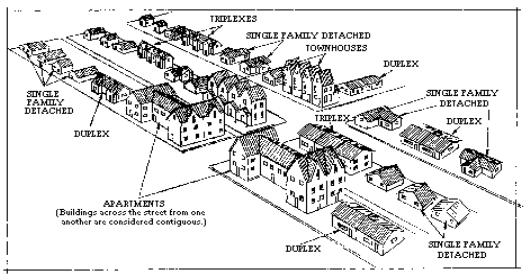
Housing types in MR Districts must be intermixed.
FIGURE 4-1
c. Housing developments in the MR Districts must intermix housing types rather than segregating them from one another. (Also see Section 18.04.060(N)(2).)
i. No more than two apartment buildings with more than five units may be contiguous to one another (uninterrupted by another housing type). Buildings separated by streets are considered contiguous.
ii. No more than three townhouse structures (contained a maximum of four units) may be contiguous to one another, consistent with Chapter 18.64, Townhouses.
2. Large or Phased Subdivisions. Proposed subdivisions in the MR 7-13 or MR 10-18 districts containing more than five acres or creating tracts for future subdivision are processed pursuant to Chapter 18.56. The master plan for the development must show how the entire site (in contiguous ownership) will be subdivided/developed consistent with the requirements contained in a. above and other relevant provisions of this Code.
R. WORKSHOP FOR DISABLED PEOPLE.
All nonprofit institutions serving the mentally or physically challenged which are subject to conditional use approval shall comply with the standards for commercial, business and trade schools (Section 18.06.060(X)).
S. NURSING OR CONVALESCENT HOME.
The Director or Hearing Examiner, as applicable, may increase the minimum lot size, screening, setback and other requirements for nursing and convalescent homes as necessary to ensure their compatibility with adjacent residential uses.
T. PARKS AND PLAYGROUNDS.
1. Neighborhood Parks. Neighborhood parks are allowed as permitted uses in the districts specified in Table 4.01, provided they comply with the following provisions. Proposed parks which do not comply with these provisions must be processed as conditional uses.
a. The proposed park will not contain athletic fields which are lighted or designed for organized, competitive team sports (e.g., regulation size softball or soccer fields).
b. The proposed park site does not abut a convalescent/nursing home or hospital, except where the facility’s administrator indicates in writing that such a park would be compatible with the use.
c. The park will close by 10:00 p.m.
d. The park will contain no more than 10 parking spaces.
e. The park will be no larger than 10 acres.
2. Public Trails. Public trails are allowed as permitted uses in all residential districts provided that the parking area at the trail head(s) contains space for no more than 10 motor vehicles. Trails served by parking lots with capacity for more than 10 motor vehicles are conditional uses.
3. Public Open Space. Public open space is allowed as a permitted use in all residential districts provided that any associated parking area contains space for no more than 10 motor vehicles. Public open spaces served by parking lots with capacity for more than 10 motor vehicles are conditional uses.
4. Conditional Use Requirements. The following requirements apply to all public parks, playgrounds, and recreation facilities subject to conditional use approval. [NOTE: Tennis, basketball, and similar recreational courts and facilities built in conjunction with a residential development are considered as an accessory use and do not require conditional use approval, provided the use of the facilities is limited to residents of that development and their guests. Athletic facilities are accessory to a place of worship if the use is limited to members and guests.]
a. Outdoor play areas must be sited and screened to protect the neighborhood from noise and other disturbances which would pose a nuisance for occupants of adjoining residences.
b. If food service facilities are proposed as part of the park, they must be noted separately in the plans and given specific consideration by the Decision Authority.
c. If the facility will contain food service facilities or is intended to be used for tournaments, the owner or operator shall provide additional parking as required by the Decision Authority.
d. The Decision Authority shall approve recreational facilities only if the proposed facility will not have a significant adverse effect on the immediate neighborhood.
U. PLACES OF WORSHIP.
The following requirements apply to all places of worship subject to conditional use approval.
1. Location. Before a place of worship may be located in an R-4, R 4-8, R 6-12, MR 7-13 or MR 10-18 district, at least one of the following locational criteria must be met:
a. The proposed place of worship must be located within 300 feet of an arterial street, major collector street, or an access point on a highway; or
b. The site is within 300 feet of a school and/or park; or
c. The place of worship was the legal owner of the property prior to June 20, 1961.
2. Plan Review. The applicant shall submit for approval plans showing the site layout and design of proposed buildings.
3. Size. The minimum lot size must be 20,000 square feet.
4. Dwelling Units. Any dwelling in conjunction with a place of worship must comply with the provisions governing residential uses in the district where it is located.
5. Conversion. No existing building or structure may be converted to a place of worship unless such building or structure complies or is brought into compliance with the provisions of this code and any other applicable City regulations.
6. Screening. There must be sight-obscuring screening along the perimeter of parking lots adjunct to a place of worship which are located across the street from or abutting a residential use. (See chapter 18.36 OMC, Landscaping and Screening.)
7. Associated Uses. Uses sponsored by a place of worship such as day-schools, auditoriums used for social and sports activities, health centers, convents, preschool facilities, convalescent homes, and others of similar nature must be considered separate uses subject to the provisions of the district in which they are located. (See OMC 18.04.060(D) which provides for child care centers as accessory uses.)
V. PUBLIC FACILITIES.
The following requirements apply to all public facilities in residential districts. (Also see Section 18.04.060(W), Public Facilities-Essential.)
1. Location. Public buildings, park-and-ride lots, and bus transfer stations shall be located along arterial or major collector streets.
2. Site Design. The Hearing Examiner may deviate from the development standards specified in Section 18.04.080, based on other developments within the neighborhood and the utilization and functions of the use being established. In no case, however, shall the lot size be less than the minimum lot size established by Table 4.04. Landscaping and screening shall meet the requirements for commercial uses, as specified in Chapter 18.36, Landscaping and Screening.
3. Ownership. If the facility is in a residential district (listed in Chapter 18.04 or 18.05), it must be owned or leased by a governmental agency. Property under lease to the government must be subject to an agreement establishing a clear intent to purchase, beyond an option to purchase.
4. Storage Facilities. If the facility is intended for storage of equipment or materials, it shall be limited to serving the section of the city in which it is located. Storage of park equipment and materials shall be considered accessory to the park and shall not be subject to this requirement.
W. PUBLIC FACILITIES, ESSENTIAL.
The following essential public facilities are allowed subject to the conditions below and any other applicable provisions of this code: Colleges; group homes (not including secure community transition facilities); sewage treatment facilities; communication towers and antennas; state highways; and railroad lines. An application for an Essential Public Facility is a Type III application pursuant to OMC 18.70.040.
1. Classification of Essential Public Facilities. Essential public facilities are classified as follows:
a. Type A: These are major facilities serving or potentially affecting more than one county. They include, but are not limited to, regional transportation facilities; state correction facilities; and colleges.
b. Type B: These are local or interlocal facilities serving or potentially affecting residents or property in more than one jurisdiction. They include, but are not limited to, county jails, county landfills, community colleges, sewage treatment facilities, communication towers, and group homes. [NOTE: Such facilities which would not have impacts beyond the jurisdiction’s boundary would be Type C facilities.]
c. Type C: These are facilities serving or potentially affecting only Olympia. In order to enable the City to determine the project’s classification, the applicant shall identify the approximate area within which the proposed project could potentially have adverse impacts, such as increased traffic, public safety risks, noise, glare, or emissions.
2. Notification. Prospective applicants for Type A or Type B essential public facilities shall provide early notification and involvement of affected citizens and jurisdictions as follows:
a. At least 90 days before submitting an application for a Type A or Type B essential public facility, the prospective applicant shall notify the affected public and jurisdictions of the general type and nature of the proposed project. This must include identification of sites under consideration for accommodating the proposed facility, and the opportunities to comment on the proposal. Applications for specific projects may not be considered complete without proof of a published notice regarding the proposed project in a local newspaper of general circulation. This notice must include the information described above and must be published at least 90 days prior to submission of the application. [NOTE: The purpose of this provision is to enable potentially affected jurisdictions and the public to collectively review and comment on alternative sites for major facilities before the project sponsor has made a siting decision. The Thurston Regional Planning Council may provide the project sponsor and affected jurisdiction(s) with their comments or recommendations regarding alternative project locations during this 90 day period.]
3. Critical Areas. Essential public facilities may not have any probable, unmitigatable, significant adverse impact on Critical Areas.
4. Proximity to Arterials. Essential public facilities which are expected to generate more than 500 motor vehicle trips during the hour of peak traffic generation must be sited within one-fourth (1/4) mile of a highway or arterial street served, or planned to be served, by mass transit.
5. Analysis of Alternative Sites. Applicants for Type A essential public facilities shall provide an analysis of the alternative sites considered for the proposed facility. This analysis must include the following:
a. An evaluation of the sites’ capability to meet basic siting criteria for the proposed facility, such as size, physical characteristics, access, and availability of necessary utilities and support services;
b. An explanation of the need for the proposed facility in the proposed location;
c. The sites’ relationship to the service area and the distribution of other similar public facilities within the service area or jurisdiction, whichever is larger;
d. A general description of the relative environmental, traffic, and social impacts associated with locating the proposed facility at the alternative sites which meet the applicant’s basic siting criteria. The applicant shall also generally describe proposed mitigation measures to alleviate or minimize significant potential impacts; and
e. A description of the process used to identify and evaluate the alternative sites.
X. UTILITY FACILITY.
1. Permitted and Conditional Facilities. All utility actions and facilities described in SEPA, WAC 197-11-800, Part Nine, Item 23, Categorical Exemptions, shall be permitted uses. In addition, Item 23(b) shall be modified for the purposes of this section to include any utility actions and facilities specifically addressed in any adopted water, sewer, stormwater, drainage basin, or similar plan that has been subject to a public hearing, and any utility actions and facilities needed to correct system deficiencies or to satisfy other ministerial requirements when performed in conjunction with minor road and street improvements as described in SEPA Rules, WAC 197-11-800, Part Nine, Item 2(c). All other non-exempt actions and facilities shall require a conditional use permit.
For purposes of this Section, SEPA WAC 197-11-800 Part Nine, Item 23(d) shall be modified as follows: All natural gas lines of twelve (12) inches in nominal diameter or less, and appurtenances, are allowed within a dedicated and opened public right-of-way (improved public access) or easement adjacent to such right-of-way. Twelve (12) inch nominal diameter lines or greater which are located elsewhere require conditional use approval.
2. Conditional Use Requirements. The following requirements apply to all public utilities subject to conditional use approval.
a. Demonstration of need. The applicant must demonstrate to the satisfaction of the Hearing Examiner, the need for the particular public utility in the proposed location.
b. Plans. The applicant shall submit complete plans showing the elevations and locations of the buildings and structures, together with locations of buildings and pertinent topographic features and adjoining properties. Approval of such plans shall be contingent upon compatibility with surrounding properties.
c. Nuisances. Rotary converters, generating machinery, or other equipment that would cause noise, electrical interference or similar disturbances beyond the property line are prohibited.
d. Storage. Outdoor storage of motor vehicles or materials is prohibited.
e. Screening. The site shall be screened; however, if the facility is entirely enclosed within a building, landscaping is sufficient. (See Chapter 18.36, Landscaping and Screening.)
Y. RACING PIGEONS.
1. Quantity. No more than fifty (50) performing or racing pigeons shall be maintained on any parcel less than one (1) acre in size. No more than one hundred (100) performing or racing pigeons shall be maintained on any parcel one (1) acre or larger in size.
2. Identification. Racing and performing pigeons shall be identified by a leg band containing the name or initials of the owner, or an identification number.
3. Maintenance. Racing and performing pigeons shall be maintained only in a loft which:
a. Is constructed in accordance with the standards for accessory structures.
b. Is located within the rear half of a lot and in accordance with the setback requirements for accessory structures.
c. Is maintained in a sanitary, hygienic condition so as not to create offensive odors, noise or nuisances.
i. Pigeons shall be maintained in a healthy, disease free condition.
ii. Loft scrapings, dead birds and other wastes shall be disposed of regularly and in a manner which does not create a health hazard or nuisance.
4. Release. Pigeons shall be released only for training and performing purposes, and shall not perch or linger on, or destroy or deface, the buildings or property of neighboring residents.
Z. RADIO, TELEVISION, AND OTHER COMMUNICATION TOWERS.
Radio, television, and other communication towers shall meet the requirements of Sections 18.04.060(W) and 18.44.100.F.
AA. RMH and UR DISTRICTS COMMERCIAL USE REQUIREMENTS.
1. Commercial uses in the RMH District (see Table 4.01) shall only be allowed in mixed use buildings and shall not exceed five thousand (5,000) square feet in size.
2. Commercial uses in the UR District (See Table 4.01) shall only be allowed in mixed use buildings and shall not exceed ten percent (10%) of gross floor area or five thousand (5,000) square feet in size, whichever is smaller.
3. In the UR District, on half block areas facing Union Street office/commercial or other allowed uses equivalent to one story may be built when part of a housing project.
BB. RMU DISTRICT REQUIREMENTS.
Projects in the RMU District shall comply with the following requirements:
1. Proportions of Residential and Commercial Development.
a. Residential development shall comprise at least fifty (50) percent of the gross floor area of any development permitted in this district after January 1, 1994. Non-residential conditional uses are exempt from this residential requirement. Housing required in this district must be located within the contiguous RMU District in which the proposed commercial component of the project is located.
b. Up to fifty (50) percent of the total building floor area for a development in the RMU District may consist of commercial development in the following configurations:
i. Mixed use buildings; or
ii. Commercial and residential uses in separate buildings on the same site; or
iii. Commercial and residential uses on separate sites within a contiguous district.
2. Occupancy. Housing constructed as part of a mixed-use project must receive final inspection at the same time as, or in advance of, issuance of an occupancy permit for non-residential portions of the project.
3. Conversion. Housing provided to satisfy this requirement shall not be converted to commercial use. [NOTE: A deed restriction may be used to satisfy this requirement.]
CC. SCHOOLS.
The following requirements apply to all academic schools subject to conditional use approval. Colleges are also subject to the following conditions when locating in a residential or village district (listed in this chapter and chapter 18.05 OMC).
1. Site Size. Middle and high schools in residential and village districts (listed in chapters 18.04 and 18.05 OMC) and elementary schools in all districts must have a minimum site size of one acre per 100 students (e.g., one to 100 students) requires a one acre site; a two acre site is needed for an enrollment of 101 students to 200 students. The Decision Authority may allow smaller school sites if the applicant demonstrates that:
a. The size of the site is sufficient to accommodate proposed facilities and activities without creating significant adverse impacts upon residents of adjoining properties; and
b. The proximity and typical impact (e.g., noise, glare, and emissions) of adjoining uses would not routinely disrupt students.
2. Outdoor Play Area. Sites accommodating elementary schools with 10 or more students must contain at least two square feet of open space (consistent with OMC 18.04.080(J)(1)) for every one square foot of floor area devoted to classrooms. This open space must contain an outdoor play area (open or covered) equipped with play equipment suitable for the students’ age group. No dimension of such play areas may be less than 20 feet.
3. Building Size. The building, or the portion of the building used as a school, must contain at least 80 square feet of gross floor area per student enrolled at the school. The Decision Authority may allow a smaller building size if the applicant demonstrates that less space is needed to accommodate the proposed school.
4. Screening. Any portion of the site which abuts upon a residential use must be screened. (See chapter 18.36 OMC, Landscaping and Screening.)
5. Portables. Portable classrooms are permitted as accessory uses for an existing school. However, installation of more than 10 portables per school requires type II conditional use approval. All portables and other accessory buildings must comply with screening requirements in 4. above.
6. Building Expansion. Building expansion depicted in a City-approved master plan or comprising no more than 10 percent of a preapproved floor plan is permitted.
DD. TEMPORARY USES.
1. Intent. Certain uses, when active for a limited period of time and when properly regulated, can be compatible, or otherwise limited in impact to neighboring properties and the general community. In accord with this intent, no temporary use shall be allowed unless a temporary use permit is approved by the City as prescribed by this section. Each separately proposed activity or use shall require a separate permit and payment of the fee required by OMC 4.40.010(A).
2. General Standards. Temporary uses are subject to the following regulations:
a. No temporary use shall be permitted on public rights-of-way, unless a rights-of-way obstruction permit is authorized by the Public Works Department.
b. Temporary uses not listed in the use table in this chapter may be authorized by the applicable approval authority, provided such temporary uses are similar to and no more intensive than other temporary uses permitted in the district in which the subject property is located.
c. The applicable approval authority may apply additional conditions to any temporary use permit in order to:
i. Ensure compliance with this chapter;
ii. Ensure that such use is not detrimental to neighboring properties and the community as a whole; and
iii. Ensure compliance with the International Building Code.
d. Within three (3) days after termination of the temporary use permit, such use shall be abated and all structures, signs and evidence of such use removed. The City may require a financial surety be posted by the applicant upon application to defray the costs of cleanup and repair of the property should the permittee fail to do so. The property owner is responsible for any abatement action and costs should the permittee fail to properly clean and repair the property.
e. Temporary use permits not exercised within thirty (30) days of issuance shall be null and void.
3. Specific Temporary Use Standards. The following temporary uses are permitted subject to the requirements below.
a. Use of mobile homes and recreational vehicles as emergency housing during reconstruction of a dwelling following damage sustained from earthquake, fire, storm or other natural disaster, not to exceed the period of reconstruction.
b. A recreational vehicle may be used as temporary housing during the construction of a primary residence, for a period not to exceed twenty four (24) months; provided all of the following criteria are met:
i. The recreational vehicle must be occupied by the property owner and cannot exceed manufacturer recommended occupant loads/levels. The owner of the property must be the registered owner of the recreational vehicle. The owner shall provide proof of current vehicle registration, insurance, and a valid driver’s license.
ii. Occupancy of the recreational vehicle is limited to the time necessary for construction in which occupation of the primary residence is prohibited by the scope of work and no other residence onsite is available.
iii. Occupation of the recreational vehicle may not exceed twenty four (24) months. Extensions are not permitted.
iv. The owner shall provide the building permit number for the construction at the time of application for the Temporary Use Permit and the building permit approval must be conditioned to ensure the recreational vehicle has been vacated, relocated to an approved storage location, and detached from the sewer/septic system prior to occupancy of the primary residence being constructed.
v. The recreational vehicle must contain at least one internal toilet and at least one internal shower and must include a Recreational Park Trailer or Recreation Vehicle label from Washington State Labor and Industries (or equivalent agency if from another state). The owner shall provide proof of compliance with these requirements with the Temporary Use Permit Application.
vi. The recreational vehicle must be connected to the sanitary sewer or an onsite sewage system in compliance with OMC 13.08.090 and all applicable Thurston County Regulations for the duration of the occupation and connection to the approved sewer/septic system. The recreational vehicle must be disconnected from the sewer/septic system prior to occupancy of the residence.
c. One model home per five acres may be constructed in each subdivision prior to final plat approval. Model homes shall contain a functional restroom served by City water. The applicant for a model home permit shall provide adequate parking and emergency access. The Director may authorize appropriate temporary provisions of water and sewer service and other utilities prior to final plat approval. Operation of model homes shall cease when building permits have been issued for ninety (90) percent of the subdivision’s lots.
d. Residences rented for personal social events, such as wedding receptions, private parties or similar activities. No more than six (6) such events may occur during any one (1) year.
e. Temporary, commercial wireless communications facilities, for the purposes of providing coverage of a special event such as news coverage or sporting event. Such facilities must comply with all federal and state requirements. Temporary wireless communications facilities may be exempt from the provisions of Chapter 18.44 up to one week after the duration of the special event.
4. Violations. At any time when such temporary use is operated in violation of required conditions of this section, or otherwise found to constitute a nuisance, the City may revoke the temporary use permit. The permittee shall be given notice of and an opportunity to contest the revocation prior to a final determination. If, in the opinion of the approval authority, the violation poses a life, health, or safety threat, the temporary use permit may be revoked immediately, and the permittee shall be given the opportunity to request reconsideration and/or appeal.
EE. GARAGE PLACEMENT AND WIDTH.
(Also see chapter 18.100 OMC, Design Review, and chapter 18.175 OMC, Infill and Other Residential.)
1. Applicability. The standards listed in Subsection 3 below apply only to:
a. All dwellings on lots of less than 5,000 square feet in size;
b. All dwellings on lots within the areas depicted by Figure 4-2a.
2. Exceptions. The dwellings listed in Subsection 1(a) above are exempt when located on one of the following types of lots:
a. Lots fronting on private access lanes (see the City of Olympia Engineering Design and Development Standards as adopted in chapter 12.02 OMC) or where the garage would not face or be visible from a public street;
b. Flag lots (see chapter 18.02.180 OMC, Definitions, Lots);
c. Wedge-shaped lots (see chapter 18.02.180 OMC, Definitions, Lots); and
d. Lots with trees or topography which preclude compliance with the provisions of this Section, as determined by the approval authority.
3. Garage Standards.
a. A garage may not protrude ahead of the dwelling’s ground floor front facade more than:
i. Eight feet on two story dwellings (i.e., dwellings with habitable space above the ground floor); or
ii. Four feet on single-story dwellings.
These requirements above (i. and ii.) do not apply to garages with doors that do not face the street (see OMC 18.175.060, Garage Design), or garages flush with the supporting posts of covered porches which span the remainder of the dwelling’s front facade.
b. Garage width may not exceed the following percentage of the dwelling’s front facade:
i. Two-story dwellings (containing habitable space above the ground floor): 60 percent.
ii. Single-story dwellings: 50 percent.
For purposes of the above measurements, garage width includes the garage doors facing the street plus any required supporting panel. The dwelling’s facade must be measured in a straight line, parallel to the building face, between the outermost ends of the facade facing the street. See Figure 4-2b.
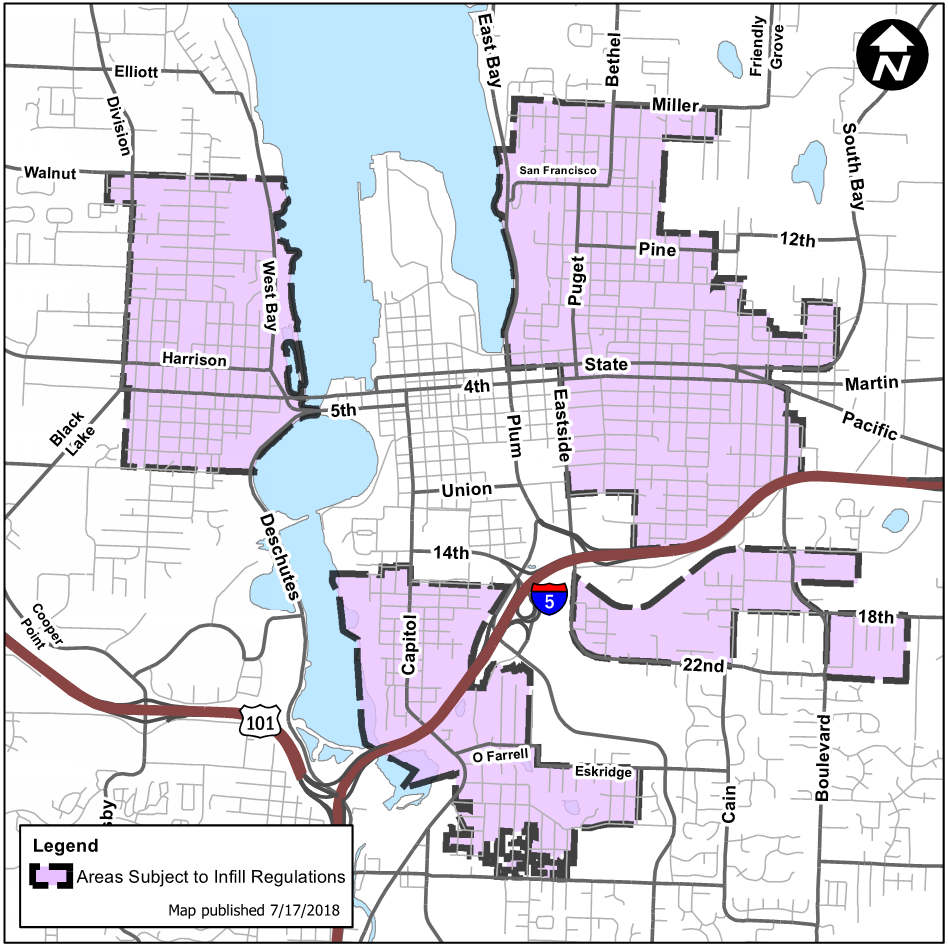
Areas Subject to Infill Regulations
FIGURE 4-2a

Measurement of Front Facade
FIGURE 4-2b
FF. RESERVED.
GG. ELECTRIC VEHICLE INFRASTRUCTURE (EVI).
Electric Vehicle Infrastructure is an accessory use when it meets any of the following criteria:
1. A battery charging station is sited on the premises of dwelling unit for residential use and not commercial use;
2. When any Level 1 or 2 charger is sited within a parking lot or parking structure; or
3. When any battery charging station or a single battery exchange station is sited on the premises of a service station.
HH. CO-LIVING HOUSING.
1. Co-Living Housing in the R 6-12 Zoning District is subject to the Infill and Other Residential Design Review provisions, chapter 18.175 OMC for properties in the area depicted within Figure 4-2a. Co-living housing projects are eligible for affordable housing incentive programs under RCW 36.70A.540, provided all applicable criteria are met.
II. COURTYARD APARTMENTS.
Courtyard Apartment housing developments shall comply with the following requirements:
1. Courtyard. The development shall contain a courtyard or usable landscaped open space area for the shared use and enjoyment of the residents of the dwellings. All residential units shall have direct access to the courtyard.
2. Site Design. Dwelling units shall be located on at least two (2) sides of the courtyard. Open space shall be provided as follows:
a. A minimum of four hundred fifty (450) square feet of private, contiguous, usable, open space shall be provided adjacent to each dwelling unit. No dimension of this open space area shall be less than ten (10) feet in any direction.
b. A minimum of fifteen hundred (1500) square feet or two hundred (200) square feet per unit, whichever is more, shall be provided in common open space (e.g., available for the use of all residents of the development). This open space shall be contained in a contiguous area with no dimension less than twenty (20) feet. A substantial portion of such open space shall be sufficiently level (e.g., less than five (5) percent slope) and well drained to enable active use, as determined by the City.
c. Parking and maneuvering areas for automobiles do not count toward open space areas.
3. Number of Units. The development shall include no less than four (4) and no more than twelve (12) dwelling units per courtyard. The units may be attached to or detached from each other.
JJ. SHORT-TERM RENTALS.
Short-Term Rentals are allowed in the districts specified in Tables 4.01, 5.01, and 6.01 subject to the following requirements. Violations are subject to civil penalties and suspension and/or revocation of a City license or permit.
1. The following requirements apply to all short-term rentals:
a. The number of overnight guests is limited to two adults per bedroom, except children under 12 years of age may occupy a bedroom with no more than two adults.
b. In any single short-term rental, the total number of overnight guests is limited to a maximum of 10 adults or the maximum provided by OMC 18.04.060.JJ.1.a, whichever is less. In a short-term rental – homestay, the property owner or long-term rental tenant is included in counting the maximum number of overnight guests.
c. A short-term rental operator shall obtain any required City and State business license(s).
d. A short-term rental operator shall comply with Revised Code of Washington Chapter 64.37, and all other applicable local, state, and federal laws and regulations and shall pay all applicable local, state, and federal taxes.
e. A short-term rental operator shall provide the City the name, phone number, and address of a person who resides within 15 miles of the short-term rental, or within Thurston County, who is responsible to represent the short-term rental operator to immediately respond to City requests to enforce applicable laws and rules.
f. A short-term rental operator shall post a copy of City of Olympia business license, and land use permit if applicable, in a conspicuous location in the short-term rental.
g. No short-term rental is allowed on a property for which there exists a Final Certificate of Tax Exemption issued under OMC 3.57.
h. No short-term rental is allowed in any dwelling unit to which any income restrictions are in effect under any local, state, or federal authority.
2. The following requirements apply to short-term rental-homestays only: (see also 18.04.060.L)
a. The property owner, or a long-term rental tenant, must reside in a residence offered as a short-term rental – homestay as their primary residence, including whenever a guest is residing in the homestay.
b. No land use permit is required for a short-term rental – homestay.
3. The following requirements apply to short-term rental-vacation rentals only:
a. In addition to other required permits and licenses, a land use permit is required from the Department for each vacation rental unit. Vacation rental permits are valid for two years from the date of issuance, and may be renewed by the City upon application.
b. No short-term rental operator may own, operate, or have any interest in more than two short-term rental – vacation rental units in the City of Olympia.
i. Existing short-term rental – vacation rentals. Operators that own, operate, or have any interest in more than two short-term rental – vacation rental units in the City of Olympia as of September 26, 2021 may be approved as long as those units are in continuous use as short-term rental – vacation rentals, and provided all other applicable requirements are met.
c. No more than two short-term rental - vacation rental units are permitted on any legal parcel of land containing a single-family home.
d. Notwithstanding OMC 18.04.060.JJ.3.c., a short-term rental - vacation rental unit may be permitted in one dwelling unit or three percent of the non-income-restricted dwelling units, whichever is greater, on a legal parcel of land, or adjacent parcels in common ownership, containing one or more buildings with two or more units.
KK. AGRICULTURE.
Agricultural uses, as defined in OMC 18.02.180, are allowed as a primary or accessory use in all zoning districts except Auto Services and Industrial zones, pursuant to the following:
1. Lots two acres in size and larger are allowed one USDA Animal Unit (AU) per acre.
2. Lots one-quarter acre and smaller are allowed up to five ducks or female chickens. Lots between one-quarter acre and one acre are allowed up to nine ducks or female chickens. Lots one acre and larger are allowed up to ten ducks or female chickens plus one additional duck or female chicken for every additional one thousand square feet of lot area up to two acres.
a. Chickens and ducks must be confined within a suitably fenced area large enough for appropriate exercise.
b. Roosters, geese, peacocks, and other similar loud fowl are prohibited.
3. Rabbits, quail, miniature goats, and turkeys are allowed in addition to the ducks and chickens allowed in subsection (KK)(2) of this section subject to the following restrictions:
a. Rabbits. Lots one-quarter acre and smaller are allowed up to five rabbits. Lots between one-quarter acre and one acre are allowed one additional rabbit for every additional one thousand square feet of lot area beyond one-quarter acre, up to ten rabbits. Lots one acre and larger are allowed ten rabbits plus one additional rabbit for every additional one thousand square feet of lot area beyond one acre.
b. Female Quail. Lots one-quarter acre and smaller are allowed up to five female quail. Lots between one-quarter acre and one acre are allowed one additional female quail for every additional one thousand square feet of lot area beyond one-quarter acre, up to ten rabbits. Lots one acre and larger are allowed ten female quail plus one additional female quail for every additional one thousand square feet of lot area beyond one acre.
c. Miniature Goats. Lots between 5,000 square feet and one acre in size are allowed up to two miniature goats. Lots one acre and larger are allowed one additional miniature goat for every additional 1,000 square feet of lot area beyond one acre, up to six miniature goats.
d. Up to four turkeys are allowed on lots at larger than one acre in size.
4. Agricultural animal enclosures, both temporary and permanent, must be no less than 10 feet from all property lines and are not permitted in setback areas.
5. Beekeeping is allowed outright as an agricultural use, when registered with the State Department of Agriculture according to provisions of RCW 15.60.021, provided that:
a. "Bees" means adult insects, eggs, larvae, pupae, or other immature stages of the species Apis mellifera.
b. A maximum of four hives, each with only one swarm, are allowed on lots of less than ten thousand square feet.
c. Hives may not be located within 25 feet of any lot line, provided this distance may be reduced to 10 feet if strategies are employed to require bees to gain elevation before crossing the property line. This may include elevation changes of eight feet or more above the grade immediately adjacent to the grade of the lot on which the hives are located or behind a solid fence or hedge six feet high parallel to any lot line within 25 feet of a hive and extending at least twenty feet beyond the hive in both directions.
6. Suitable sanitary enclosures (such as coops, barns, and hives) must be provided and must be designed to protect animals on all sides from weather, predators, and to prevent rodents. All animals must also be confined within a suitably fenced area large enough for appropriate exercise.
7. The acreage total includes contiguous parcels that are also being utilized by the same agriculture operation. In instances where agricultural uses utilize parcels that are not contiguous, they are to be considered separate uses for the size calculation. For the purposes of this calculation, lots on opposite sides of a public right-of-way are not to be considered contiguous.
8. Fences must meet the requirements listed in OMC Chapter 18.40.
9. The management of agricultural uses under this section must adhere to the required best management practices (BMPs) and other provisions described in the City of Olympia Drainage Design and Erosion Control Manual. In the event the city has determined the agricultural uses cause a detrimental impact to water quality, additional best management practices may be required, which may include the development of a farm conservation plan, at the direction of the public works director or designee, including cessation of uses, as necessary to restore water quality and protect public health.
10. The keeping of animals for agricultural uses as listed above is allowed provided that the keeping of such other animals does not constitute a nuisance or hazard to the peace, health, or welfare of the community in general and neighbors in particular. Nuisances include:
a. Excessive noise.
b. Excessive odors from poor care and clean-up of animal waste.
c. Pest problems from improper feeding techniques.
d. Other issues that are significantly disruptive to the neighborhood or significantly distract from the quality and enjoyment of the neighborhood environment.
(Ord. 7457 §§2, 3, 2026; Ord. 7444 §§22 – 34, 2025; Ord. 7400 §§2 – 7, 2024; Ord. 7364 §§20 – 25, 2023; Ord. 7321 §§5, 6, 2022; Ord. 7310 §4, 2022; Ord. 7289 §§5, 6, 2021; Ord. 7288 §§16, 17, 2021; Ord. 7267 §§4 – 8, 2020; Ord. 7257 §§4, 5, 2020; Ord. 7205 §§2, 3, 2019; Ord. 7187 §3, 2019; Ord. 7094 §§1 – 3, 2017; Ord. 7027 §§20, 21, 2016; Ord. 6973 §1, 2015; Ord. 6967 §17, 2015; Ord. 6842 §4, 2013; Ord. 6759 §3, 2011; Ord. 6592 §3, 2008; Ord. 6581 §2, 2008; Ord. 6517 §9-11, 2007; Ord. 6395 §16-21, 2006; Ord. 6323 §4, 2004; Ord. 6273 §12 §15, §17, 2003; Ord. 6261, §1, 2002; Ord. 6229 §2, 2002; Ord. 6210 §3, 2002; Ord. 6140 §17, §18, §19, 2001; Ord. 6092 §1, 2001; Ord. 5907 §2, 1999; Ord. 5830 §3, 1998; Ord. 5801 §2, 1998; Ord. 5787 §1, 1998; Ord. 5714 §5, 32, 1997; Ord. 5664 §3, 1997; Ord. 5661 §2, 1996; Ord. 5595 §3, §4, §5, 1995; Ord. 5535 § 1, 1995; Ord. 5517 §1, 1995).
18.04.080 TABLES: Residential Development Standards Revised 5/26
|
DISTRICT |
R1/5 |
R4 |
R-4CB |
RLI |
R 4-8 |
R 6-12 |
MR 7-13 |
MR 10-18 |
RM-18 |
RM-24 |
RMH |
RMU |
MHP |
UR |
ADDITIONAL REGULATIONS |
|---|---|---|---|---|---|---|---|---|---|---|---|---|---|---|---|
|
MAXIMUM HOUSING DENSITY (in units per acre) |
1/5 |
4 |
4 |
4 |
8 |
12 |
13 |
18 |
18 |
24 |
--- |
--- |
12 |
--- |
18.04.080(A) |
|
MINIMUM HOUSING DENSITY (in units per acre) |
--- |
--- |
--- |
2 |
4 |
6 |
7 |
10 |
18 Manufactured Housing Parks = 5 |
18 Manufactured Housing Parks = 5 |
--- |
--- |
5 |
--- |
18.04.080(B) |
|
MINIMUM LOT SIZE |
4 acres for residential use; 5 acres for non-residential use |
5,000 SF; except: Townhouse = 2,000 SF |
One acre; reduced to 12,000 SF if associated with a drainage dispersal tract of at least 65% in the same subdivision plat. |
4,000 SF; except: Townhouse = 2,000 SF |
4,000 SF; except: Cottages = 2,500 SF; Townhouse = 2,000 SF |
3,500 SF; except: Cottages = 2,000 SF; Townhouse = 1,600 use |
3,000 SF; except: Cottage = 1,600 SF; Townhouse = 1,600 SF |
3,000 SF; except: Cottage = 1,600 SF; Townhouse = 1,600 SF |
3,000 SF; except: Cottage = 1,600 SF; Townhouse = 1,600 SF |
Townhouse = 1,600 SF Mobile Home Parks = 2,500 SF |
Townhouse = 1,600 SF Mobile Home Parks = 2,500 SF |
Townhouse = 1,600 SF |
3,500 SF; except: Cottage =- 2,000 SF; Townhouse = 1,600 SF |
Townhouse = 1,600 SF minimum, 2,000 SF average; Mobile Home Park = 2,500 SF |
18.04.080(C) 18.04.080(D) 18.04.080(E) 18.04.080(F) Chapter 18.64 (townhouses) 18.04.060(P) (mobile home parks) |
|
MINIMUM LOT WIDTH |
30' except: 16' = townhouse |
50' except: 18' = townhouse |
100' |
30' except: 16' = townhouse 80' = large multifamily |
45' except: 35' = cottage; 18' = townhouse |
40' except: 30' = cottage; 16' = townhouse |
40' except: 30' = cottage 16' = townhouse
|
40' except: 30' = cottage; 40' = zero lot; 16' = townhouse |
30' = mobile home park |
30' = mobile home park |
--- |
--- |
40' except: 30' = cottage; 16' = townhouse; 30' = mobile home park |
--- |
18.04.080(D)(1) 18.04.080(F) 18.04.080(G) 18.04.060(P) (mobile home parks) |
|
MINIMUM FRONT YARD SETBACKS |
20' except: 5' for agricultural buildings with farm animals |
10' |
10' |
10', 5' for agricultural buildings with farm animals |
10', 5' for agricultural buildings with farm animals |
10', 5' for agricultural buildings with farm animals |
10', 5' for agricultural buildings with farm animals |
10', 5' for agricultural buildings with farm animals |
10' |
5' |
5' except: 10' for structures 35' or taller |
10' except: 20' along Legion Way |
20' except: 10' with side or rear parking; 5' for agricultural buildings with farm animals |
0-10' except: 10' on Capitol House Block |
18.04.080(H) 18.04.080(I)
Minimum of 20 feet from front property line adjacent to a street to vehicle access to garage or carport |
|
MINIMUM REAR YARD SETBACKS |
10' |
10' |
10' |
10' |
10' |
10' |
10' |
10' |
10' except: 15' for large multifamily |
10' except: 20' next to an R 4-8 or R 6-12 district |
5' except: 20' for structures 35' or higher |
5' |
5' |
5' except: 10' for structures over 42' |
18.04.080(D) 18.04.080(F) 18.04.080(H) 18.04.080(I) |
|
MINIMUM SIDE YARD SETBACKS |
5' except: 10' along flanking streets; provided garages are set back 20' |
5' except: 10' along flanking street; except garages must meet Minimum Front Yard Setbacks |
5' |
5' except: 10' along flanking streets; except garages must meet Minimum Front Yard Setbacks |
5' except: 10' along flanking streets; except garages must meet Minimum Front Yard Setbacks; 3' for cottages |
5' except: 10' along flanking streets; except garages must meet Minimum Front Yard Setbacks; 3' for cottages |
5' except: 10' along flanking streets; except garages must meet Minimum Front Yard Setbacks; 3' for cottages |
5' except: 10' along flanking streets; except garages must meet Minimum Front Yard Setbacks; 3' for cottages |
5' except: 10' along flanking streets; except garages must meet Minimum Front Yard Setbacks; 3' for cottages; 10' for large multifamily; 20' next to R 4-8, or R 6-12 district 10' - mobile home park |
5' except: 10' along flanking streets; except garages must meet Minimum Front Yard Setbacks; 20' next to R 4-8, R 6-12 district. 10' - mobile home park |
5' except: 10' along flanking streets |
--- |
5' except: 10' along flanking streets; 3' for cottages; 10' - mobile home park |
No minimum, except 10' on Capitol House Block |
18.04.080(H) |
|
MAXIMUM BUILDING HEIGHT |
40' |
40', except: 24' for detached accessory structures and dwelling units |
40' except: 24' for detached accessory structures and dwelling units |
40' except: 24' for detached accessory structures and dwelling units |
40', except: 24' for detached accessory structures and dwelling units; 25' for cottages; 35' on sites 1 acre or more, if setbacks equal or exceed building height |
40', except: 24' for detached accessory structures and dwelling units; 25' for cottages |
45', except: 25' for cottages; 24' for detached accessory structures and dwelling units |
45', except: 25' for cottages; 24' for detached accessory structures and dwelling units |
35', except: 24' for detached accessory structures and dwelling units; 25' for cottage |
42' except: 24' for detached accessory dwelling units |
60' except: 24' for detached accessory dwelling units |
See 18.04.080 (I); 24' for detached accessory dwelling units |
35' except: 24' for detached accessory structures and dwelling units; 25' for cottages |
42' or as shown on Figure 4-5A & 18.04.080 (I)(3); 24' for detached accessory structures and dwelling units |
18.04.080(I) |
|
MAXIMUM IMPERVIOUS SURFACE COVERAGE |
45% or 10,000sf (whichever is greater) = lots less than 4 acres; 6%=4.1 acre or more |
35% |
6% |
2,500 SF or 6% coverage whichever is greater. |
55% |
55% |
65% |
65% |
65% |
75% |
85% |
85% |
65% 25% = 3.01 + acres 70% = townhouses |
85% |
18.04.080(K) 18.64.080 |
|
MAXIMUM HARD SURFACE BONUS (not guaranteed, performance based) |
65% = lots less than 4 acres; 25%=4.1 acre or more |
55% |
26% |
55% or 3,500sf (whichever is greater) =.25 acre or less; 25% or 6,000sf (whichever is greater) = .26 acre or more. |
75% |
75% |
85% |
85% |
85% |
95% |
100% |
100% |
85% |
100% |
See OMC 18.04.080K for bonus criteria. Hard surfaces are treated as impervious unless shown workable through an approved design. |
|
MINIMUM OPEN SPACE |
220 tree units per acre required |
|
65% drainage dispersal area may be required; it may double as tree tract or critical areas buffer. |
|
|
|
25% for large multifamily requiring land use review |
25% for large multifamily requiring land use review |
25% for large multifamily requiring land use review |
20% for large multifamily requiring land use review; 500 SF/space for mobile home park |
10% for large multifamily requiring land use review |
10% for large multifamily requiring land use review; 500 SF/space for mobile home park |
500 SF/space for mobile home park |
15% |
18.04.080(J) 18.04.060(H) for Cottage Housing; 18.04.060(II) for Courtyard Apartments, |
|
LEGEND |
||
|---|---|---|
|
SF = Square Feet |
Zero Lot = A Lot with Only One Side Yard |
--- = No Regulation |
|
RL1 = Residential Low Impact |
|
R 6-12 = Residential 6-12 |
|
R-4 = Residential - 4 |
R 4-8 = Residential 4-8 |
RM 18 = Residential Multifamily - 18 |
|
MR 7-13 = Mixed Residential 7-13 |
MR 10-18 = Mixed Residential 10-18 |
RMU = Residential Mixed Use |
|
MR 7-13 = Mixed Residential 7-13 |
RMH = Residential Multifamily High Rise |
UR - Urban Residential |
(Ord. 7444 §35, 2025; Ord. 7400 §25, 2024; Ord. 7310 §5, 2022; Ord. 7267 §9, 2020; Ord. 7249 §5, 2020; Ord. 7094 §4, 2017; Ord. 7027 §22, 2016; Ord. 6842 §5, 2013; Ord. 6594 §6, 2008; Ord. 6517 §12, 2007).
18.04.080 Residential districts development standards Revised 5/26
Table 4.04 identifies the basic standards for development in each residential district contained in this chapter. The sections referenced in Table 4.04 refer to the list of additional regulations below.
A. Maximum Housing Densities.
1. Calculation of Maximum Density.
a. The maximum housing densities specified in Table 4.04 are based on the total area of the entire site, including associated and/or previously dedicated right-of-way, but not including streams, wetlands, landslide hazard areas, "important habitat areas," and "important riparian areas," and land to be dedicated or sold for public parks, schools, or similar non-residential uses. Density on individual lots may be exceeded to allow unit lot density as follows:
i. Allow up to four units per lot in all residential zoning districts;
ii. Allow up to six units per lot in all residential zoning districts for lots located within one-half mile of a frequent transit route (as defined in OMC 18.02.180);
iii. In locations where development is limited to four or fewer conventional dwelling types, up to six units per lot (or two additional units) are allowed on all lots zoned predominantly for residential use, if at least two units are designated as affordable housing (as defined in OMC 18.02.180) for a period of 50 years or more. (Note: The affordable units must be in a range of sizes comparable to other units in the development.) A covenant, approved as to form by the City Attorney or designee, and recorded with the Thurston County Auditor at the property owner’s expense, limiting the unit(s) to affordable housing is required prior to the issuance of building permits.
b. Convalescent homes. Convalescent homes and nursing homes containing dwelling units that rely on shared cooking/dining facilities count as one dwelling unit for purposes of the maximum density calculation. Independent dwelling units (i.e., containing a bed, bathroom, and a kitchen with a sink, stove, and refrigerator) in convalescent/nursing homes, however, are counted as individual dwelling units in the density calculation. The density for a site or parcel containing a convalescent/nursing home that is part of a larger project is calculated separately from other portions of the site under development (i.e., density may not be transferred from a site occupied by a nursing home to another portion of the development).
c. A sleeping unit in co-living housing is calculated as one-quarter of a dwelling unit for purposes of calculating density.
2. Mixed Residential and Multifamily Districts. The maximum housing densities shown in Table 4.04 refer to the maximum density of each project. Projects within multiple districts must conform with the density for the portion in each district.
3. Accessory Dwelling Units. Accessory dwelling units are not subject to the maximum density limits specified in Table 4.04. Accessory Dwelling Units do count toward the maximum unit lot density allowed in all zoning districts that have a maximum density of 12 units or fewer per acre.
4. Density Bonuses. The maximum housing densities identified in Table 4.04 may be increased and authorized by the Director or by the Hearing Examiner as noted below, provided, however, that in the R 4-8 District, Transfer of Developments Rights (TDRs) must be obtained (see OMC 18.04.080(A)(5)):
a. Restoration of Critical Areas. At the request of the applicant, the Approval Authority may grant a density bonus of up to 20 percent for sites on which damaged or degraded wetlands or stream corridors (e.g., streams and stream banks within the outer limits of any required buffer) will be restored and maintained according to specifications approved by the City. A Request for this density bonus must accompany the land use application pursuant to OMC 18.70.040, except as provided in OMC 18.04.080(A)(4)(b-d). Prior to taking action on a request for this density bonus, the Approval Authority shall consider the public’s comments, the expected public benefit that would be derived from such restoration, the probable net effect of the restoration, and the increased density on the site, the relative cost of the restoration and the value of the increased density, and the potential impact of increased density on surrounding land uses, traffic, infrastructure, schools, and parks. The City may require the applicant to provide an estimate of the cost of the proposed restoration and other information as necessary to make this determination. This bonus does not apply to site features that were damaged in the course of a current project (e.g., under an active permit) or as a result of an illegal or intentional action by the current property owner or someone acting at the current property owner’s direction.
b. Cottage housing. Cottage housing projects receive a 50 percent density bonus.
c. Townhouses. Townhouses receive a 15 percent density bonus in the R 4-8 and R 6-12 districts.
d. Low income housing. A density bonus is granted for low income housing (see Section 18.02.180, Definitions) at the rate of one additional housing unit allowed for each unit of low income housing provided, up to a maximum of a 20 percent bonus. This is different than the unit lot density increases allowed for affordable housing.
The applicant shall submit to the Department a document approved by the City Attorney or designee stating that the low income housing which is the basis for the density bonus will remain for a period of at least 20 years from the date the final inspection is conducted by the Building Official. This document must be recorded, at the applicant’s expense, at the Thurston County Auditor’s Office as part of the chain of title of the affected parcels.
5. Transfer of Development Rights. Development Rights must be obtained from an eligible property owner in a Thurston County Transfer of Developments Rights (TDR) Sending Zone in order to develop above eight units per acre in an R 4-8 District. However, this requirement does not apply to density bonuses granted in accordance with OMC 18.04.080(4). With one TDR credit, a density of nine units per acre can be achieved in the Residential 4-8 District.
6. City staff will review residential permitting in areas designated as Low Density Neighborhood in the adopted Comprehensive Plan Future Land Use Map on an annual basis to review the achieved density. If achieved density approaches or exceeds the density anticipated in the comprehensive plan, the City will make revisions as needed to maintain consistency between the Comprehensive Plan and development regulations.
B. Minimum Housing Densities.
1. Calculation of Minimum Density.
a. (Note: Table 5.05 in Section 18.05.) The total area of the entire site must be included in the minimum density calculation except streams, wetlands, landslide hazard areas, floodplains, "important habitat areas," and "important riparian areas" and their associated buffers; tracts accommodating stormwater facilities required in compliance with the Drainage Manual tracts provided for trees pursuant to chapter 16.60 OMC; existing, opened street rights-of-way; and land to be sold or dedicated to the public in fee (e.g., school sites and public parks, but not street rights-of-way to be dedicated as part of the proposed development).
b. Proposed future development of Accessory Dwelling Unit(s) cannot be used to meet the minimum density requirements of a short subdivision or subdivision unless the face of the plat contains a note that dictates that an ADU permit must be obtained at the same time as the building permit for the principal unit for all or the affected lots within the subdivision.
c. All dwelling units in convalescent homes/nursing homes and existing accessory dwelling units count toward the minimum density required for the site by Table 4.04.
d. A sleeping unit in co-living housing is calculated as one-quarter of a dwelling unit for purposes of calculating density.
e. Achieving minimum density is not required when projects are not subject to land use review. For projects that are subject to land use review, phased and clustered development that retains the opportunity to meet or exceed minimum density in the future is allowed and may contain conditions or restrictions to ensure it is retained for future development.
C. Minimum Lot Size.
1. Nonresidential Uses. The minimum lot size for non-residential uses (e.g., places of worship and schools) is larger than the minimum lot size identified in Table 4.04. Refer to Table 4.01 and Section 18.04.060 for regulations pertaining to non-residential uses. Also see Section 18.04.060(K) for the lot size requirements for group homes.
2. Undersized Lots. Undersized lots shall qualify as a building site if such lots were recorded prior to June 19, 1995 or they were approved as part of a Planned Residential Development, Master Planned Development (See Chapter 18.56) or clustered housing development, consistent with Section 18.04.080(F); provided, however, that any lot of record which does not comply with the width requirements of this code shall not be constructed upon unless (1) it is legally combined with undeveloped contiguous land in the same ownership which in combination create a lot of the size specified in Table 4.04 (or as modified by other provisions of this Article); or (2) it is approved by Design Review Board Staff, who shall perform an architectural review of the proposal for compliance with the criteria specified in Chapter 18.100, Design Review.
3. Clustered Lots. Lot sizes may be reduced by up to twenty (20) percent consistent with Section 18.04.080(F), Clustered Housing.
4. That portion of any lot which is less than thirty (30) feet in width shall not be considered part of the minimum lot area required in Table 4.04, unless such area conforms with the minimum lot width, e.g., townhouse lot.
D. Transitional Lots.
1. Lot Size. The square footage and width of lots in developments larger than five acres located in the MR 7-13, MR 10-18, or RM-18 districts, which immediately abut an R-4, R 4-8 or R 6-12 district, may be no less than 50 percent of the minimum lot size and width required in the adjoining lower density district.
2. Setbacks. The minimum rear yard building setback for lots in the MR 7-13, MR 10-18, and RM-18 districts which share a rear property line with a parcel in an R4, R 4-8, or R 6-12 district may be no less than the setback required for the adjoining lower density district.
E. Developments without Sewer Service. Residential developments which rely on on-site sewage disposal or water systems are subject to the following requirements:
1. Subdivisions.
a. Subdivisions, planned residential developments (PRD) and Master Planned Developments (see Chapter 18.56) which rely on on-site sewage disposal shall cluster the lots on a portion of the site and create a reserve tract which will not be available for subdivision or other development until municipal sewer and water are available.
The development shall be of a design and density (consistent with Environmental Health and other applicable regulations) so that the initial clustered lots and the subsequently subdivided reserve tract ultimately attain at least the minimum density specified for the district in Table 4.04. (Unless the Director determines that fewer lots are required, consistent with Section 18.04.080(B), Minimum Housing Densities.)
b. Approval of clustered subdivisions, short subdivisions, binding site plans, or PRDs relying on on-site sewage disposal shall be contingent upon approval of a future development plan which demonstrates that the reserve tract can be subdivided to create sufficient lots to comply with Subsection (1) above. Such plans shall depict a schematic lot layout, the approximate location of utility easements, and potential street access, consistent with the transportation policies and Map 6-3 contained in Chapter 6 of the Comprehensive Plan for Olympia and the Olympia Growth Area, 1994 (and as hereafter amended). Future development plans shall not be required to be stamped by an engineer or surveyor. (The purpose of the plan is to show that the undeveloped portion of the site can be ultimately developed at urban density, not to limit future development to a specific development scheme. However, the initial subdivision or site development must be consistent with the future development plan.)
2. Individual Lots.
a. Issuance of building permits for dwellings proposed for parcels five (5) or more acres in size without sewer service shall be contingent upon approval of a future development plan for the parcel. Such plans shall demonstrate, consistent with 1.b. above, how the parcel can be potentially developed at the minimum density established for the district (see Table 4.04) when public sewer and water are available. While this plan will not bind future development, the initial development, including the septic system location, must be consistent with it.
b. Issuance of building permits for dwellings without sewer service on parcels between one (1) and five (5) acres in size shall be contingent upon approval of a building site plan or future development plan which demonstrates that the parcel can potentially accommodate one (1) or more additional houses in the future. While future development will not be bound by this plan, the initial development shall be consistent with it. Developers of such lots shall locate individual or community sewage disposal systems, to the extent possible, where they can be efficiently converted to a public sewage collection system in the future.
F. Clustered Housing.
1. Mandatory Clustering. The Director or Hearing Examiner may require that the housing units allowed for a site be clustered on a portion of the site in order to protect ground water used as a public water source (e.g., wellhead protection areas), to enable retention of windfirm trees (which are appropriate to the site and designated for retention, consistent with Chapter 16.60, Tree Protection and Replacement, OMC), to accommodate urban trails identified on Map 7-1 of the Comprehensive Plan, to preserve scenic vistas pursuant to Sections 18.20.500 through 18.20.504 and Chapters 18.100 and 18.110, or to enable creation of buffers between incompatible uses (also see Chapter 18.36, Landscaping and Screening).
The Director or Hearing Examiner may allow up to a 20 percent reduction in lot dimensions, sizes, and/or setback requirements, to facilitate the clustering of the permitted number of dwelling units on the site. The required clustering may not result in fewer lots than would otherwise be permitted on the site (at the minimum density specified in Table 4.04), without written authorization by the applicant.
2. Optional Clustering. Applicants for housing projects may request up to 20 percent reduction in lot sizes, dimensions, and building setback requirements in order to cluster housing and retain land serving the purposes listed in 1. above; or to avoid development on slopes steeper than 20 percent; or to preserve natural site features such as critical areas or trees; or otherwise enable land to be made available for public or private open space. Applicants proposing to place 65 percent or more of a development site within a tree or vegetation protection or critical areas tract or tracts (see OMC chapter 16.60 and section 18.32.140) and not exceed 30 percent overall impervious coverage may request approval of housing forms not otherwise permitted in the zoning district so long as the number of resulting dwelling units does not exceed the standard maximum by more than 20 percent. Such alternative housing forms may exceed height and story limits otherwise applicable in the district, except for height and story limits specifically intended to soften transitions between zoning districts. The Director or Hearing Examiner, as applicable, may grant such requests only if the Director or Hearing Examiner determines that the development would not have a significant adverse impact on public facilities and surrounding land uses.
G. Lot Width.
1. Measurement. The minimum lot width required by Table 4.04 shall be measured between the side lot lines at the point of intersection with the minimum front setback line.
H. Setbacks.
1. Measurement. The required setback area is measured from the outermost edge of the building foundation to the closest point on the applicable lot line.
2. Front Yard Setbacks. Front yard setbacks are a minimum of 10 feet under the following conditions:
a. When garage or parking lot access is from the rear of the lot;
b. When the garage is located at least 10 feet behind the front facade of the primary structure on the lot; or
c. When the driveway will be aligned to provide at least a 20 foot long parking space between the sidewalk edge (closest to lot) and the garage’s vehicle access door(s). (See OMC 18.100 Design Review and OMC 18.175 Infill and Other Residential.)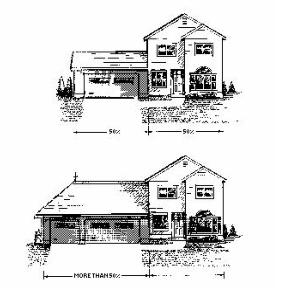
FIGURE 4-3
3. Rear Yard Setbacks. See OMC 18.04.080(H)(5), Encroachments into Setbacks, Section 18.04.080(D)(2), Transitional Lots, and Table 4.04.
4. Side Yard Setbacks.
a. Reduced side yard setbacks. A side yard building setback is not required for a lot, provided it meets the following conditions:
i. Provision for reduced or zero setbacks specifically appears upon the face of a final short or long plat. Such plat must provide that the minimum distance between residences is three feet. If the distance between a proposed dwelling and a property line is less than three feet, the applicant shall provide evidence of a maintenance easement, at least three feet in width, which provides sufficient access for the owner of the dwelling to maintain the applicable exterior wall and roof of the dwelling. (Except as expressly provided, any reduced side yard provision appearing on a final plat must withstand later amendments of this Title and must be considered conforming.)
ii. Side yard setbacks may not be less than five feet along a property line adjoining a lot which is not developed or approved for reduced setbacks (e.g., a conventional lot with two five foot wide side yard setbacks). Side yard setbacks may not be less than 10 feet along a property line that abuts a public rights-of-way.
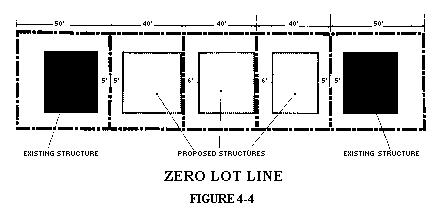
b. The minimum side yard setback from bikepaths and walkways must comply with the side yard setback from the lot line as specified for the district in Table 4.04.
5. Encroachment Into Setbacks. The buildings and projections listed below are allowed outside of utility, access, or other easements. See OMC 18.40.060(H)(2) for additional exceptions.
a. Except for Accessory Dwelling Units, any accessory structures may be located anywhere in the rear 40 feet of a lot, provided building and fire code provisions are satisfied; however, if a garage’s vehicle access door(s) or carport’s vehicular entrance faces a rear or side property line, the garage or carport must be setback at least 10 feet from that property line.
b. An accessory dwelling unit may not encroach into a required side yard setback. An accessory dwelling unit must be set back five feet from the rear property line, unless the lot abuts an alley, in which case the rear yard setback may be reduced to zero. Any garage attached to any accessory dwelling unit must conform with this section.
c. Garages may share a common rear property line provided that access for interior lots is from a single common driveway to not more than one public street entrance.
6. Front yard setbacks for through lots. A through lot has two front lot lines parallel or approximately parallel to each other. The front yard setback must apply to each front lot line, except the Director may designate one of the front lot lines as a rear lot line, provided the following criteria are met:
a. Orientation of the lot or structure is considered; and
b. At least 60 percent of the lots or structures within the neighborhood block, or area being considered, are oriented in a similar direction away from the lot line being designated as a rear lot line.
I. Height.
1. Roof Projections. The following structures may exceed the height limits specified for the district in Table 4.04 by 18 feet, provided that such structures do not contain floor space: roof structures housing elevators, stairways, tanks, ventilating fans or similar equipment required to operate and maintain the building; fire or parapet walls; skylights; towers; flagpoles; chimneys; smoke stacks; wireless masts; television antennas; steeples; and similar structures. Use of this provision must be kept to the minimum amount of space needed to accommodate the allowed roof projection. For the UR zoning district, see view protection provisions in OMC 18.04.080(I)(3) below for additional parameters.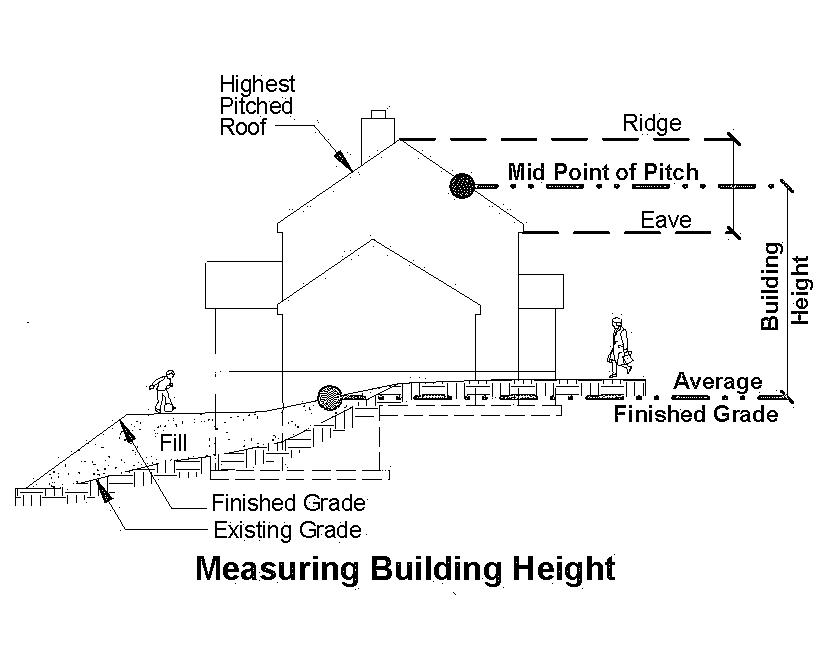
FIGURE 4
2. RMU District Height Regulations.
a. Base building heights. The base building heights allowed in the RMU District are specified in Figure 4-5.
b. Sculptured building tops. The following sculptured building top regulations apply only where the permitted building height is 60 feet.
Buildings with sculptured tops may exceed the permitted height (60 feet) by two building stories if they meet the following conditions:
i. The gross floor area of all of sculptured stories is at least one-third less than the gross floor area of the first floor of the building; and
ii. The roof form is sculptured (e.g., pitched roof, hip roof, dome, chateau roof, tower, turret, pediment, dormers, or other similar form); and
iii. The added two stories are setback from the street wall at least eight feet; and
iv. The roof structure is designed to hide all mechanical and communications equipment located there.
3. UR District Height Regulations. The building heights allowed in the UR District are specified in Figure 4-5 and 45-A. Also see 18.10.060, Capitol Height District.
a. Roof Projection Allowances: If the City determines that the proposed development is located on a site in the UR zone where use of the roof projection allowance is proposed and that it may impact a protected landmark view (as listed in Appendix B of the Land Use and Urban Design chapter of the Comprehensive Plan), a view analysis must be submitted that demonstrates, as determined by the city, that the proposed roof projection will not block or substantially impact the protected view from its designated observation point in order to make use of the roof projection allowances of OMC 18.04.080(I).
4. R4-8 District Height Regulations. Existing State Community College Education Facilities. A maximum 60’ building height is allowed with a 100’ setback from adjacent residentially zoned property.
5. Places of Worship. Places of worship may exceed the height limits specified in Table 4.04, except in the State Capitol Group Height District, provided that the side yard width equals at least fifty (50) percent of the building’s proposed height (including spires and towers).
6. Radio, Television and other Communication Towers. The height of radio, television, and other communication towers may exceed the maximum building height allowed in the district, subject to approval of the Decision Authority consistent with OMC 18.04.060(W) and 18.04.060 (X) and processed as a type II application.
7. Tall Buildings in the MR Districts. Buildings between 35 and 45 feet in height are permitted in the MR 7-13 and MR 10-18 districts, subject to compliance with the following requirements:
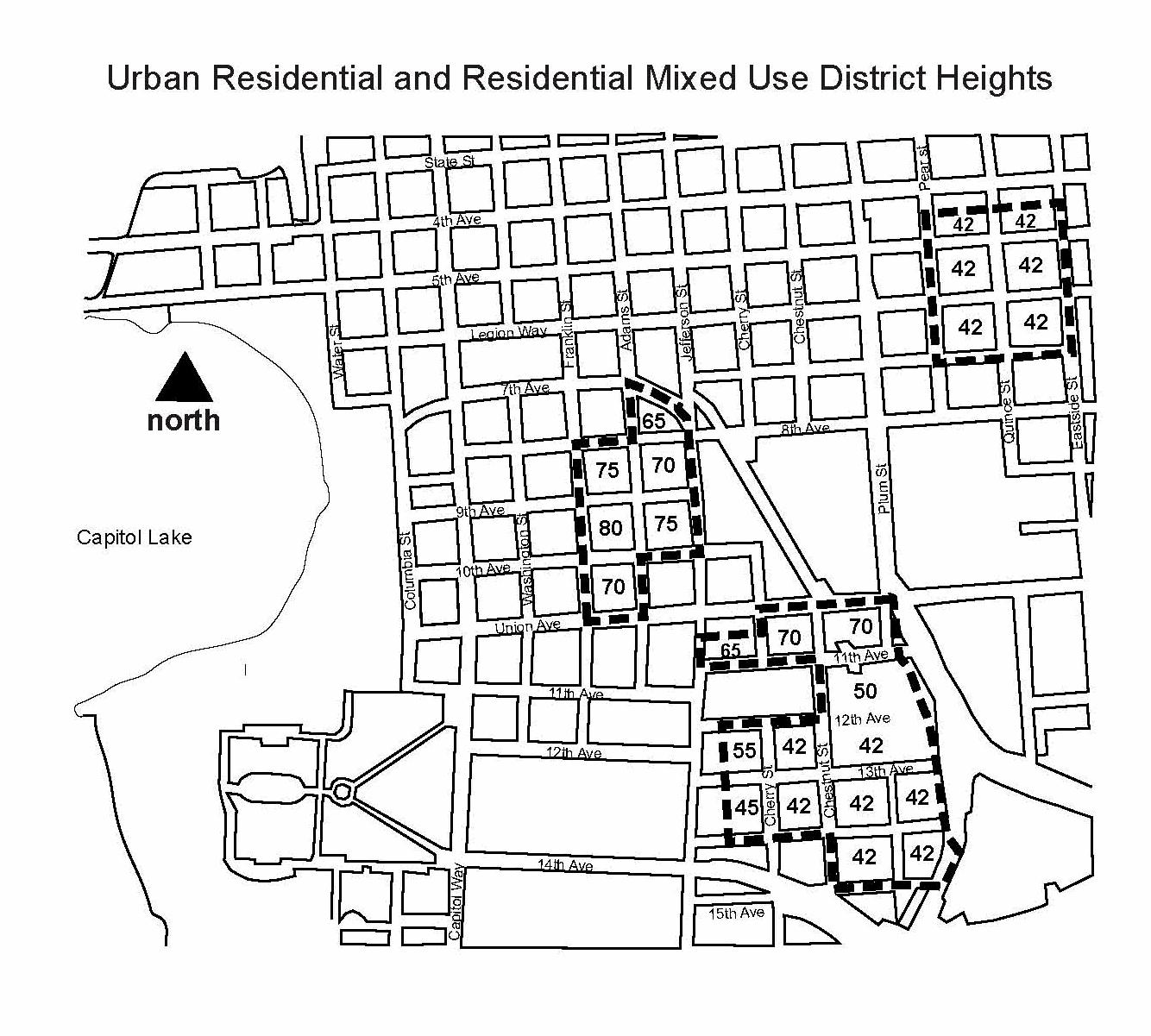
FIGURE 4-5
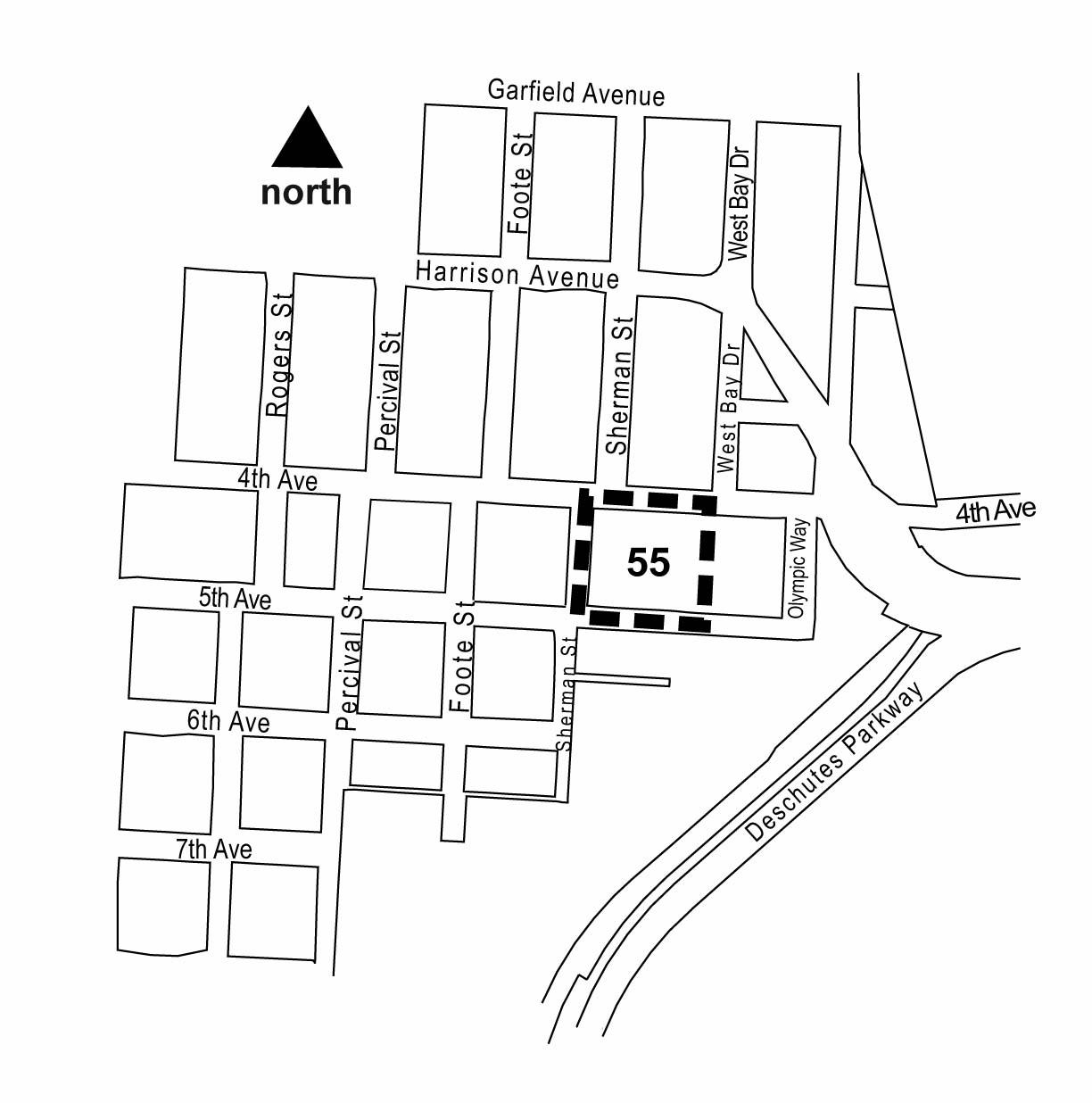
FIGURE 4-5A
a. The proposed building will not be located within 100 feet of the boundary of the property under development (this may include several parcels under a single development proposal). Exceptions to this requirement will be granted where topography, stands of trees (deemed appropriate for retention by the City, consistent with chapter 16.60 OMC, Tree Protection and Replacement), or other site features block the visibility of the section of the building above 35 feet in height from existing or potential residential areas (zoned and available for residential use) adjoining the site; and
b. Existing evergreen trees, which the City deems are appropriate to the site (e.g., which do not pose significant risks for proposed site improvements or public safety, consistent with chapter 16.60 OMC, Tree Protection and Replacement) are retained where possible to help screen the building from the view of residents of dwellings abutting the property.
8. Water Towers. Water towers may exceed the height limits specified in Table 4.04.
[NOTE: Refer to Article III, Height Overlay Districts, for additional restrictions.]
J. Private and Common Open Space.
1. Development of Open Space. Open space (e.g., private yard areas and common open space) required by Table 4.04 must be devoted to undisturbed native vegetation, landscaping (consistent with chapter 18.36 OMC, Landscaping and Screening), and/or outdoor recreational facilities. Driveways, loading areas, maneuvering space, and parking lots are not considered open space. Required open space may not be covered with impervious surfaces, except for stoops, porches, or balconies, walkways, tennis courts, swimming pools, or similar uses which require an impervious surface. Up to a five percent increase in impervious surface coverage may be allowed to accommodate such hard surfaced facilities.
2. Cottage Housing Developments. Cottage housing developments must provide open space as follows:
a. A minimum of 20 percent must be provided in common open space (i.e., available for the use of all residents of the development). This open space must be contained in a contiguous area with no dimension less than 30 feet. A substantial portion of such open space must be sufficiently level (e.g., less than five percent slope) and well drained to enable active use in summer.
3. Mixed Density Districts. Parcels or sites accommodating seven units or more in a MR 7-13 or MR 10-18 district must contain at least 30 percent open space. At least 50 percent of such open space must be available for the common use of the residents of the multi-family housing. Such open space must be developed consistent with Section 18.04.080(J)(1) above. This open space requirement may be reduced to 20 percent if the multi-family housing adjoins a park, school, or open space site of at least 10,000 square feet.
4. Manufactured or Mobile Home Parks. At least 500 square feet of common open space must be provided per dwelling unit (see Section 18.04.060(P)(8)). At least 50 percent of such open space must comply with soil and vegetation protection area standards.
5. Residential - 4 Chambers Basin District. Within the Residential – 4 Chambers Basin District, required open space for stormwater dispersion may be provided in a common area or within each individual private lot of a development. All required drainage dispersal areas must be protected from filling and grading and all other activities which would decrease the ability of such areas to disperse and infiltrate stormwater. Side yard setback areas must be designed to disperse roof runoff to the maximum extent practical. To qualify as a "drainage dispersal tract" (required to create lots of less than one acre) such area must be held in common or deeded to the homeowners association and otherwise conform with the requirements of stormwater tracts as set forth in the Olympia Stormwater Drainage Manual.
K. Surface Coverage Limits:
1. Increased Impervious Coverage: Projects may be eligible for up to a 20 percent increase in impervious surface coverage (above what is listed in table 4.04) provided that all of the following are met:
a. Eligibility: The increase must be for one, or more, of the following (note: the following types of projects are ineligible: a stand-alone single-family unit on a lot; a project in the Residential Low Impact Zone):
i. A non-residential use such as a school, park, place of worship, etc. that is permitted within the residential zone.
ii. A development that includes ADUs and/or middle housing units that exceeds minimum density on the underlying lot.
iii. A land division that achieves the maximum allowed density within the zone in which it is located.
b. An engineered drainage design must be submitted that includes the following:
i. The area in excess of that allowed by Table 4.04 must meet the Drainage Design and Erosion Control Manual (DDECM) core requirement #5 (or as amended) for onsite stormwater treatment, and core requirement #7 for flow control, regardless of minimum area thresholds. Plans must address the following:
1. Projects that would otherwise be exempt from DDCEM requirements for flow control must demonstrate compliance, regardless of the exemption, in order to obtain the bonus.
2. Flood control systems to be included might include pervious pavement, pervious geogrid, bioretention, infiltration, green roofs, or micro-detention systems. If compliance cannot be provided, the bonus will be denied.
3. Permeable pavement and geogrid on Type D soils are ineligible.
ii. Maintenance agreements are required prior to permit issuance for the flood control system.
2. Hard Surface Coverage Bonus: The coverage identified in table 4.04 indicates the allowed maximum increase in hard surfaces. To gain approval for these increases, all of the following must be met:
a. All criteria outlined in OMC 18.04.080.k.1 are satisfied.
b. In addition to the ineligible projects in K.1.a.IV, projects on type D soils are also ineligible.
c. The total hard surface coverage may not exceed the site area minus the minimum open space requirement.
3. Existing Surfaces: An existing lot, that was legally built under regulations applicable at the time of its building, but that exceeds current impervious or hard surface coverage limits, may be replaced within the existing lot footprint, but may not be expanded in a way that would increase the nonconformity. Replacement of such surfaces must comply with the Drainage Design and Erosion Control Manual, including providing stormwater control measures.
4. Calculation Exclusions: The following are excluded from the impervious and hard surface coverage limit calculations. Note: these exclusions do not apply to calculations or requirements related to the Drainage Design and Erosion Control Manual.
a) Ingress/egress easements serving a neighboring property;
b) Areas excluded from the minimum lot area calculations (OMC 18.04.080(c)(4)), such as the panhandle of a flag lot;
c) Portions of the driveway that extend beyond the required setback area when the additional length is caused by compliance with municipal code requirements, such as critical area and buffer protections.
L. Building Entries. To ensure safe access of emergency responders, each residential dwelling unit must have a clearly defined building entrance that is easily accessible from the primary street, sidewalk, or driveway by a well-lit paved walkway that is at least 3 feet wide. The walkway cannot be combined with driveway unless it is clearly differentiated from the areas where vehicles will park.
(Ord. 7444 §§36 – 43, 2025; Ord. 7400 §§8 – 10, 2024; Ord. 7364 §§26, 27, 2023; Ord. 7288 §§18, 19, 2021; Ord. 7267 §10, 2020; Ord. 7249 §§6, 7, 2020; Ord. 7244 §2, 2020; Ord. 7205 §§3, 4, 2019; Ord. 7187 §3, 2019; Ord. 7094 §§5, 6, 2017; Ord. 7027 §§23-25, 2016; Ord. 6594 §9, 2008; Ord. 6594 §8, 2008; Ord. 6594 §7, 2008; Ord. 6426 §11, 2006; Ord. 6408 §17-19, 2006; Ord. 6404 §2, 3, 2006; Ord. 6323 §4, §19, 2004; Ord. 6273 §10, §16, §18, §20, 2003; Ord. 6140 §28, §40, 2001; Ord. 5830 §4, 1998; Ord. 5777 §1, 1998; Ord. 5664 §4, 13, 1997; Ord. 5661 §6, 10, 1996; Ord. 5595 §6, 16, 1996; Ord. 5569 §6, 1995; Ord. 5544 §1, 1995; Ord. 5517 §1, 1995).
18.04.090 Additional regulations
Refer to the following Chapters for additional related regulations.
Chapter 18.36, Landscaping and Screening
Chapter 18.38, Parking and Loading
(Ord. 5517 §1, 1995)