


Chapter 20.55
PARKING REGULATIONS
Sections:
20.55.005 Off-street parking required.
20.55.010 Number of parking spaces required.
20.55.011 Number of parking spaces required – Downtown planned action area.
20.55.012 Parking required for vehicles associated with use.
20.55.013 Stacking space requirements for drive-up windows.
20.55.015 Parking requirements for uses not specified.
20.55.016 Motorcycle/bicycle parking requirements.
20.55.018 Reduced parking requirements for low impact development.
20.55.020 Computation of fractions.
20.55.025 Compact parking spaces.
20.55.030 Location of required parking and leased parking.
20.55.035 Aisle and driveway dimensions.
20.55.040 Conflict with use of street or alley.
20.55.042 Parallel parking maneuverability in off-street parking lots.
20.55.045 Use of common parking facilities.
20.55.050 Joint use of parking facilities.
20.55.055 Improvement and maintenance of parking areas.
20.55.057 Parking facilities not associated with a specific use.
20.55.060 Parking in residential zones.
20.55.061 Off-street loading facilities.
20.55.065 Off-street parking in CBD and CBD-Core zone.
20.55.001 Scope and purpose.
This chapter is intended to prevent traffic congestion and to promote traffic safety by ensuring adequate off-street parking. (Ord. 2147 Exh. A, 1987).
20.55.005 Off-street parking required.
(1) Every building or structure hereafter erected, shall provide and permanently maintain parking spaces as required by this chapter.
(2) Whenever an existing use which does not provide all of the off-street parking spaces required by this chapter is enlarged by an increase in dwelling units, floor area or otherwise, there shall be provided concurrently with such enlargement, the number of parking spaces that is necessitated by the magnitude of such enlargements. Further, whenever an existing use ceases to actively occupy a building and within one year is replaced by another use that would require an increased number of parking spaces, there shall be provided an additional number of parking spaces that is equal to the difference between that required by the existing use and that required by the other use.
(3) Whenever a new use seeks to occupy an existing building which has not been actively occupied by another use for a period exceeding one year, the new use shall provide permanently maintained parking spaces as required by this chapter. (Ord. 2147 Exh. A, 1987).
20.55.010 Number of parking spaces required.
This section establishes the minimum number of parking spaces required for each use of land. Mixed uses shall provide the sum of the parking spaces required for each individual use, except where joint use of parking is permitted pursuant to PMC 20.55.050. These standards shall apply except within the downtown planned action area, which is addressed in PMC 20.55.011.
(1) Automobile sales, boat sales, retail nurseries, and other open sales and rental yards, as follows:
(a) Properties with less than 10,000 square feet of open sales or rental area shall provide one space for each 1,000 square feet of gross floor area, plus one space for each 2,500 square feet of open sales or rental area.
(b) Properties with 10,000 square feet or more of open sales or rental area shall provide one space for each 1,000 square feet of gross floor area, plus four spaces, plus one space for each 10,000 square feet of open sales or rental area in excess of 10,000 square feet;
(2) Automobile service stations and repair garages: three spaces for each service bay;
(3) Bowling alleys: four spaces for each alley;
(4) Banks, savings and loans and other financial institutions: one space for each 300 square feet of gross floor area;
(5) Churches, mortuaries and assembly halls: one space for each five seats. A “seat” shall mean 18 lineal inches of bench seating or seven square feet of seating floor area where there are no permanent seats;
(6) Dancehalls and ballrooms: one space for each 30 square feet of dance floor area;
(7) Day care centers: one space for each 100 square feet of indoor play area and classroom space;
(8) Delicatessens, retail bakeries and other similar establishments whose business is the sale of food and beverages normally consumed both on- and off-site: one space for each 300 square feet of gross floor area, plus open space for every 50 square feet of indoor seating area provided. Such required parking shall not exceed one space per 90 square feet of gross floor area;
(9) Dwellings, single-family: two spaces for each dwelling unit;
(10) Dwellings, multiple-family, including apartments, condominiums, duplexes and townhouses: two spaces per unit, except that in the RM-Core zone, the following parking standards shall apply:
(a) In the RM-Core zone there shall be 1.5 parking spaces per unit;
(11) Dwellings, integrated accessory: one space per unit;
(12) Golf courses, not including miniature golf and driving ranges: eight spaces for each hole. No additional spaces shall be required for accessory clubhouse and pro shop facilities;
(13) Hospitals: three spaces for each bed the facility is designed to accommodate;
(14) Hotels, motels and auto courts: one space for each sleeping or dwelling unit with or without kitchen facilities, plus one space each per two employees on the largest work shift, and one space per 90 square feet of gross floor area for meeting/banquet rooms and restaurants;
(15) Libraries and museums: one space for each 250 square feet of gross floor area;
(16) Manufacturing and industrial uses: one space for each 500 square feet of employee work area, plus open space for each 1,000 square feet of floor area devoted exclusively to storage and/or housing of accessory mechanical equipment;
(17) Miniature golf courses and golf driving ranges: three spaces for each hole or tee;
(18) Manufactured home parks: two spaces shall be provided within the confines of each manufactured home space. Additional parking shall be provided as required by PMC 20.53.035;
(19) Motorcycle and small engine vehicle sales and service: one space for each 400 square feet of gross floor area, plus one space for each 1,000 square feet of open sales lot;
(20) Professional offices: one space for each 200 square feet of gross floor area for medical, clinical and dental offices or one space for each 300 square feet of gross floor area for other professional and business offices;
(21) Public utilities: one space for each two employees on the largest shift;
(22) Restaurants, bars, taverns and other similar establishments whose primary business is the on-site sale and consumption of food and beverages: one space for each 100 square feet of gross floor area;
(23) Retail commercial, general sales, personal service, shopping centers, malls and other similar establishments shall provide one space for each 300 square feet of gross floor area;
(24) Rest homes, nursing homes, children’s homes and homes for the elderly: one space for each three beds the facility is designed to accommodate;
(25) Retirement apartments: one space for each two dwelling units;
(26) Roominghouses, lodginghouses, clubs and fraternity houses having sleeping rooms but not individual kitchen facilities: one space for each two sleeping rooms;
(27) Public and private educational institutions, including schools and classroom facilities associated with churches, as follows:
(a) Elementary and junior high level schools shall provide one and one-half spaces for each classroom plus one space for each 300 square feet of office space. Paved playground area available for parking may be used to satisfy additional school auditorium parking requirements.
(b) High schools shall provide one space for each 65 square feet of classroom space, plus one space for each 300 square feet of office space.
(c) Colleges, universities, vocational schools and adult extension schools shall provide one space for each 50 square feet of classroom space, plus one space for each 300 square feet of office space, plus auditorium parking as required in subsection (29) of this section, if auditorium facilities are provided;
(28) Swimming pools and skating rinks for commercial or public use: one space for each 100 square feet of swimming pool or skating rink surface area;
(29) Theaters and auditoriums: one space for each five seats. A “seat” means 18 lineal inches of bench seating or seven square feet of seating floor area where there are no permanent seats;
(30) Uncovered storage: one space for each 5,000 square feet of uncovered storage area;
(31) Veterinarians and animal hospitals: one space for each 200 square feet of gross floor area, exclusive of overnight animal-holding areas;
(32) Warehouse and storage facilities: one space for each 2,000 square feet of gross floor area.
(a) Establishments having not more than 20,000 square feet of gross floor area, on a single parcel of land and/or within a single development, shall provide one space for each 2,000 square feet of gross floor area.
(b) Establishments having more than 20,000 square feet but not more than 100,000 square feet of gross floor area shall provide one space for each 2,500 square feet of gross floor area.
(c) Establishments having more than 100,000 square feet of gross floor area shall provide one space for each 3,000 square feet of gross floor area.
(d) Mini-warehouse or commercial storage locker establishments shall provide off-street parking to the extent required for office space or other uses accessory to the primary use;
(33) Recreational vehicle park: one automobile parking space for every five recreational vehicle sites; provided, that each recreational vehicle site shall be of a size and configuration to accommodate the size and type of vehicle for which it is intended;
(34) Health and physical fitness clubs: one parking space per 200 square feet of gross floor area;
(35) Fraternal clubs and organizations: one parking space per 100 square feet of gross floor area;
(36) Stadiums and athletic fields with seating: one space for each five seats. A “seat” means 18 lineal inches of bench seating or seven square feet of seating floor area. (Ord. 3172 § 1, 2018; Ord. 2954 § 15, 2010; Ord. 2851 § 7, 2006; Ord. 2615 § 1, 1999; Ord. 2542 § 1, 1998; Ord. 2513 § 1 (Att. A § 4), 1997; Ord. 2454 § 1, 1995; Ord. 2346 § 1(13), 1993; Ord. 2213 § 1, 1989; Ord. 2196 § 6, 1989; Ord. 2147 Exh. A, 1987).
20.55.011 Number of parking spaces required – Downtown planned action area.
Within the downtown planned action area, the following minimum parking standards shall apply except where joint use of parking is permitted pursuant to PMC 20.55.050.
(1) Dwellings, multiple-family, including apartments, condominiums, duplexes and townhouses: one parking space per dwelling unit.
(2) Office or retail uses:
(a) Within 0.25 miles of the Puyallup Sounder Station, measured from parcel boundaries, and where a parcel area is at least 50 percent contained in the radius: one parking space per 650 square feet of gross floor area;
(b) Greater than 0.25 miles of the Puyallup Sounder Station, measured from parcel boundaries, and where a parcel area is less than 50 percent contained in the radius of subsection (2)(a) of this section: one parking space per 400 square feet of gross floor area;
(c) Exception from parking standards: Parking is not required for the first 5,000 square feet of gross floor area in the CBD and CBD-Core zones. If the gross floor area exceeds 5,000 square feet, but is less than 5,650 square feet in the location described in subsection (2)(a) of this section or less than 5,400 square feet in the location described in subsection (2)(b) of this section, the number of stalls shall be rounded up to one parking stall.
(3) Other uses: Parking standards from PMC 20.55.010 shall apply to uses not listed above. The planning and development services director may modify such standards if an applicant provides a parking demand analysis that demonstrates to the satisfaction of the director that parking demand can be met with a reduced parking requirement.
(4) At the time of development, planned action applicants shall prepare and submit a parking management plan to the city for review and approval prior to approval of necessary land use and building permits. Said parking management plan shall be in place prior to the occupancy of the development. The plan shall:
(a) Describe relationship of the parking management plan to the overall center plan, including how the proposed parking fits into the overall access and mobility plans for the center.
(b) Address parking comprehensively for the range of users and times of day:
(i) Encourage shared parking among neighboring businesses and document shared parking agreements and conditions consistent with the municipal code.
(ii) Demonstrate the requested supply of parking for the mix and range of uses will meet the demand for parking at different times and for different events consistent with the Puyallup Municipal Code.
(iii) Take into account the parking patterns for different user groups in the center – employees, customers, and residents – throughout the course of the day.
(iv) Address freight and truck access and parking.
(v) Be attentive to workers, customers and visitors traveling to the center by modes other than automobile, such as bicycle and transit.
(vi) Design parking facilities to accommodate pedestrian movement, including safety and security.
(vii) Take into account any traffic control management programs, such as parking restrictions during peak commuting periods.
(viii) Develop parking strategies for special events or for infrequent peak demands.
(c) Establish goals and objectives for parking, to support short-term and long-term development plans for the center, during construction and post-construction.
(d) Include measures to ensure parking is shared, reduce drive alone commute trips, and prevent parking from being used by commuters to other adjacent sites or as an unsanctioned park and ride lot. Such measures could include:
(i) Establishing a parking manager to manage site parking;
(ii) Charging for daytime parking;
(iii) Validating parking;
(iv) Providing a segmented parking garage or facility so that some parking is reserved for certain uses at certain times of day;
(v) Reserve areas for short-term parking by customers and visitors;
(vi) Allow nonpeak shared parking (e.g. office parking used for retail parking on nights and weekends).
(e) Identify wayfinding measures, such as signage directing visitors and customers to parking facilities, electronic signage with parking availability information, mobile phone applications, or other measures.
(f) Provide contingency measures such as monitoring, enforcement, and other adaptive management techniques to promote access to parking on site and avoid parking encroachment into adjacent neighborhoods. (Ord. 3172 § 1, 2018).
20.55.012 Parking required for vehicles associated with use.
Except for residential uses, in addition to the parking requirements set out in PMC 20.55.010, one space for each vehicle operated or kept in connection with the use shall be provided. Each such space shall be sized to safely accommodate the specific vehicle operated or kept. (Ord. 2147 Exh. A, 1987).
20.55.013 Stacking space requirements for drive-up windows.
Restaurant enterprises involving drive-up windows shall provide at least six stacking spaces for each window, equal to 15 linear feet for each stacking space. Bank facilities involving drive-up windows shall provide at least three stacking spaces for each window, equal to 15 linear feet for each stacking space. Other drive-up facilities shall provide stacking spaces to the determination of the community development director. (Ord. 2393 § 1, 1994; Ord. 2147 Exh. A, 1987).
20.55.015 Parking requirements for uses not specified.
Where ambiguity exists in the application of off-street parking requirements, or where the parking requirements for a use are not specifically defined herein, the parking requirements for such use shall be determined by the planning director or the director’s designee and such determination shall be based upon the requirements for the most comparable use specified in this chapter. All such determinations pursuant to this section may be appealed to the hearing examiner, in which case such appeal will be considered as an interpretation review pursuant to Chapter 20.87 PMC. (Ord. 2268 § 38, 1991; Ord. 2147 Exh. A, 1987).
20.55.016 Motorcycle/bicycle parking requirements.
(1) Parking spaces for motorcycles shall be provided as follows:
(a) All multiple-family developments and nonresidential uses may provide one motorcycle space for every 25 required automobile spaces in lieu of a required automobile space.
(b) Each motorcycle space shall be easily accessible and have adequate space for a standard-size motorcycle.
(c) Motorcycle parking areas shall be clearly identified with appropriate striping.
(2) All commercial, industrial, institutional, and recreational uses which require 25 or more parking spaces pursuant to this title shall provide a designated bicycle parking area to accommodate a minimum of five bicycle spaces. Such bicycle parking areas shall provide a secure facility (e.g., rack, posts) to which to lock bicycles and shall be located so as to be reasonably convenient to the on-site use and not interfere with pedestrian and automobile traffic. Prior to issuing permits for facilities requiring 100 or more parking spaces pursuant to this title and/or uses with high expected bicycle traffic (e.g., schools) the city may require reasonable additional bicycle parking capacity over and above the minimum five spaces. (Ord. 2393 § 1, 1994; Ord. 2316 § 1, 1992).
20.55.018 Reduced parking requirements for low impact development.
A reduction in parking requirements from what is required in this title may be requested for a specific development or redevelopment project as part of a comprehensive project approach to incorporating low impact development principles, consistent with PMC 20.05.070 and Chapter 20.10 PMC. A 10 percent maximum reduction in parking requirements may be approved for parking areas composed of pervious pavement or where the reduced parking area is used for a low impact development storm water facility. A 20 percent maximum reduction in parking requirements may be approved for clustered site design where the reduced parking area is used for tree retention or native landscaping. Reduced parking requirements are subject to approval from the planning director or the director’s designee upon review of potential adverse impacts. (Ord. 3130 § 3 (Exh. A), 2016).
20.55.020 Computation of fractions.
When the application of this chapter requires a fractional part of an automobile parking space, a remaining fraction of one-half space or more shall be construed as one space; a remaining fraction of less than one-half space shall be disregarded. (Ord. 2147 Exh. A, 1987).
20.55.025 Compact parking spaces.
Whenever five or more spaces are required, 30 percent of the required parking spaces should be compact parking spaces and up to 50 percent may be compact parking spaces. (Ord. 3073 § 25, 2014; Ord. 2147 Exh. A, 1987).
20.55.030 Location of required parking and leased parking.
(1) Off-street parking required by this chapter shall be located:
(a) On the same site as the use necessitating such parking; or
(b) Within a 300-foot walking distance measured from the nearest point of the parking facility to the nearest point of the building that such parking is required to serve; or
(c) Within the downtown planned action area: within a 1,000-foot walking distance measured from the nearest point of the parking facility to the nearest point of the building that such parking is required to serve.
(2) Application of subsection (1)(b) or (c) of this section shall be subject to approval of an agreement by the city attorney which assures that the property is owned or leased by the owner or lessee of the lot or parcels containing the building or uses to be served and which assures the property will be maintained in parking lot use in conformance with this chapter as long as the building or use that it serves is continued. The city attorney shall not approve such an agreement unless he finds that the proposed parking lot will adequately serve the parking needs for which it is intended without adversely affecting neighboring properties or the use of other public and private parking facilities in the vicinity. An approved agreement shall be recorded by the applicant with the Pierce County auditor and a conformed copy shall be provided prior to issuance of any building permits for a proposed project. (Ord. 3172 § 1, 2018; Ord. 2704 § 1, 2001; Ord. 2147 Exh. A, 1987).
20.55.035 Aisle and driveway dimensions.
Aisle and driveway dimensions shall conform to the dimensions set forth in Table 20.55.035 and Figure 20.55.035. The public works director may approve variations to these dimensions if special circumstances exist which prohibit strict compliance provided that such variations do not result in a traffic safety hazard, hinder vehicle access and egress and are designed in conformance with good engineering practices. If a two-foot vehicle overhang is provided, an associated two-foot reduction in parking space length shall be allowed.
|
(1) |
Stall angle: |
0° |
30° |
45° |
60° |
90° |
|
(2) |
Stall width: |
|
|
|
|
|
|
|
Regular space |
9′0′′ |
18′0′′ |
12′9′′ |
10′5′′ |
9′0′′ |
|
|
Compact space |
8′0′′ |
16′6′′ |
11′3′′ |
9′4′′ |
8′0′′ |
|
(3) |
Stall depth: |
|
|
|
|
|
|
|
Regular space |
22′0′′ |
17′10′′ |
20′7′′ |
21′10′′ |
20′0′′ |
|
|
Compact space |
19′0′′ |
15′6′′ |
17′6′′ |
18′7′′ |
17′0′′ |
|
(4) |
Driveway: |
|
|
|
|
|
|
|
One-way |
12′0′′ |
14′0′′ |
14′0′′ |
18′0′′ |
24′0′′ |
|
|
Two-way |
17′0′′ |
17′0′′ |
17′0′′ |
18′0′′ |
24′0′′ |
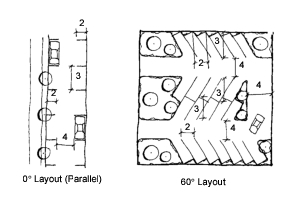
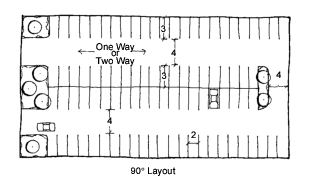
(Ord. 3073 § 26, 2014; Ord. 2147 Exh. A, 1987).
20.55.040 Conflict with use of street or alley.
In no case shall any portion of a street or alley be counted as a part of a required parking space. All parking spaces and driveways shall be so located and designed as to avoid undue interference with the public use of streets. Alleys may be used as primary access for any single-family, multifamily residential or mixed-use development or a maximum of eight nonresidential parking spaces, upon approval by the development services and/or public works director or designee. (Ord. 3119 § 41, 2016; Ord. 3073 § 27, 2014; Ord. 2147 Exh. A, 1987).
20.55.042 Parallel parking maneuverability in off-street parking lots.
All parallel parking spaces in off-street parking areas or lots shall provide space adjacent to every parking space in order to allow a vehicle to go forward and back into a parking space. (Ord. 2615 § 1, 1999).
20.55.045 Use of common parking facilities.
Common parking facilities for two or more uses may be provided in lieu of individual requirements. Total parking requirements for common facilities shall be the sum of all uses computed separately, provided that the number of spaces may be decreased by 10 percent where common parking facilities provide no more than two access drives to any public street. (Ord. 2147 Exh. A, 1987).
20.55.050 Joint use of parking facilities.
Joint use of all or portions of the same parking spaces by two or more uses may be allowed by the community development director; provided, however, that:
(1) The applicant(s) shall show that there is no substantial conflict in the principal operating hours of the buildings or uses for which the joint use of off-street parking facilities is proposed. For purposes of this subsection, no substantial conflict shall mean:
(a) Up to 75 percent of the required parking for daytime use may be provided in the parking facilities of a nighttime or weekend use; or
(b) Up to 75 percent of the required parking for a nighttime or weekend use may be provided in the parking facilities of a daytime use; or
(c) Within the downtown planned action area: An applicant shall document proposed joint-use parking proposals through the use of the Urban Land Institute Shared Parking Model (ULI Shared Parking, Second Edition); or
(d) Typical daytime uses include banks, business and professional offices, retail stores, and manufacturing use. Typical nighttime uses include auditoriums, dinner-trade-only restaurants, theaters, dance halls, and bars. Weekend uses include churches, and church school not open during weekdays.
(2) The concerned parties shall execute a legal agreement binding for as long as such joint use of parking facilities is necessary pursuant to this chapter and acceptable to the city attorney, and recorded with the office of the county recorder, mutually agreeing to such joint use.
(3) The proposed location of all required parking shall conform to the provisions of PMC 20.55.030. (Ord. 3172 § 1, 2018; Ord. 2468 § 1, 1996; Ord. 2268 § 39, 1991; Ord. 2147 Exh. A, 1987).
20.55.055 Improvement and maintenance of parking areas.
No parking area shall obtain access from an unpaved alley or street. All parking areas, including parking spaces, access aisles, and driveways, shall be developed and maintained in the following manner:
(1) Off-street parking areas and pedestrian and vehicular access to them (including unimproved alleys) shall be paved using permeable paving (asphalt, concrete, pavers) in accordance with city standards, unless technical feasibility demonstrates infeasibility and other traditional forms of detention/retention or direct discharge are alternatively permitted, as approved by the city engineer in accordance with city standards and the storm water management manual most recently adopted by the city. All paved areas shall be so graded and drained as to dispose of all surface water per the storm water management standards most recently adopted by the city. The design and improvement of parking areas shall prevent runoff water from draining across public sidewalks or on to abutting properties. The city engineer shall require oil separation facilities be included in the parking lot drainage system to prevent oil and petroleum products from entering the municipal storm drainage system.
(2) Automobile parking spaces and access aisles shall be designed and/or marked or otherwise made clearly identifiable to assure safe and convenient automobile circulation.
(3) Walls, fences, and vegetation within or adjacent to required parking areas shall be protected by permanently affixed curbing or wheel stops located not closer than three feet from such wall, fence, or tree to be protected.
(4) Any lighting shall be arranged and designed so as to reflect the light away from any public street or from any property used for residential purpose.
(5) All portions of the required parking area not devoted to parking spaces, interior driveways, and pedestrian facilities shall be landscaped pursuant to Chapter 20.58 PMC. (Ord. 3203 § 16, 2019; Ord. 3073 § 28, 2014; Ord. 2662 § 2, 2000; Ord. 2147 Exh. A, 1987).
20.55.057 Parking facilities not associated with a specific use.
Surface parking lots or multilevel parking structures not intended to serve a specific building or use, or group of buildings or uses under the provisions of PMC 20.55.045 and 20.55.050, shall be allowed only by conditional use permit or as otherwise provided by this title. (Ord. 2147 Exh. A, 1987).
20.55.060 Parking in residential zones.
Parking areas serving commercial or industrial uses may be permitted in any RS or RM zone; provided, however, that a conditional use permit for such parking has first been obtained and is in full force and effect subject to conditions as may be attached thereto. Such parking area shall be located not more than 300 feet distance from the commercial or industrial use for which it is accessory. Such parking areas shall be used solely for the parking of licensed automobiles. (Ord. 2196 § 7, 1989; Ord. 2147 Exh. A, 1987).
20.55.061 Off-street loading facilities.
In all zone districts, those buildings to be occupied by manufacturing, storage, retail/wholesale stores, lodging facilities, hospitals and other uses similarly requiring the receipt of or distribution of bulk materials and merchandise, shall provide off-street loading spaces as follows:
(1) Commercial structures of 10,000 square feet gross floor area or greater shall provide one loading space.
(2) Manufacturing/industrial uses of 10,000 square feet or greater shall provide one loading space, with an additional loading space required for each additional 100,000 square feet over and above this base amount.
(3) Each loading space shall not be less than 10 feet in width, 30 feet in length, with an overhead clearance of at least 14 feet.
(4) Such space(s) shall be designed to avoid interference with vehicular circulation or parking (including emergency vehicles), either on or off public rights-of-way, nor with pedestrian circulation.
(5) Such space(s) shall not be located in any part of the required front yard. (Ord. 2346 § 1(13), 1993).
20.55.065 Off-street parking in CBD and CBD-Core zone.
Nonresidential new development, or expansion or changes in use to existing development in the CBD and CBD-Core zone which exceeds 5,000 net new structural square feet shall be subject to the off-street parking standards of PMC 20.55.010. (Ord. 3073 § 29, 2014; Ord. 2851 § 7, 2006; Ord. 2354 § 1, 1993; Ord. 2147 Exh. A, 1987).
20.55.070 In-lieu parking fee in CBD zone.
Repealed by Ord. 2354. (Ord. 2147 Exh. A, 1987).