


Chapter 18.04
DEFINITIONS
Sections:
18.04.005 Generally.
A. Words, terms and phrases not specifically defined in this chapter shall have the meaning as defined in any standard American dictionary of the English language.
B. Words, terms and phrases defined in this chapter may have meanings more specific than their meanings in common usage, standard dictionaries or other ordinances.
C. Rules of Construction.
1. Illustration. In any case of any difference of meaning or implication between the text of any provision and any illustration, the text shall control.
2. Shall and May. “Shall” is always mandatory and not discretionary. “May” is discretionary.
3. Tenses and Numbers. Words used in the present tense include the future and words used in the singular include the plural and the plural the singular, unless the context clearly indicates the contrary.
D. General Terms.
1. “Planning commission” or “commission” means the city planning commission of the city of Tumwater. The planning commission is appointed by and advisory to the city council on all land use and zoning matters. Their actions are in the form of recommendations to the city council who must ultimately make the final decisions.
2. “Council” means the city council of the city of Tumwater. The city council is an elected body which makes all legislative decisions for the city.
E. Meanings Generally. For the purposes of this title, certain terms, words and phrases shall, whenever used in this title, have the meanings defined in this chapter.
(Ord. O2013-013, Amended, 10/01/2013; Ord. O95-035, Amended, 12/19/1995; Ord. 883, Added, 05/06/1984.)
18.04.010 A definitions.
“A-board sign” or “sandwich board sign” means a portable sign consisting of two sign faces hinged at the top and separated at the bottom to make itself standing.
“Accessory building, structure, use” means the use of land, a subordinate building or structure, or a portion of a principal building or structure, such use being secondary or incidental to a permitted use, building, or structure.
“Accessory dwelling unit” means a dwelling unit located on the same lot as a single-family detached dwelling, duplex, triplex, townhouse, or other principal residential structure subject to the general land use regulations found in TMC 18.42.010.
“Accessory wireless communication antenna” means a ground mounted (freestanding) or building mounted (attached) antenna for the sole use of residents, patrons of a business, or other occupants of property for the original transmission or final reception of communications or data as an accessory to a permitted use on the property on which the antenna is located. Types of accessory wireless communication antennas include:
A. “Category I (radio and television)” means “receive-only” radio and television antennas, or parabolic (“dish”) antennas not exceeding one meter (approximately thirty-nine and one-half inches) in diameter, usually supported by a single pole, post, or mast, with an antenna height not exceeding fifteen feet above grade for freestanding antennas or ten feet above the height of the building upon which mounted for attached antennas;
B. “Category II (amateur radio antenna)” means “send and receive” citizen band radio antennas or similar antennas operated by a federally licensed amateur (“ham”) radio operator at a dwelling, with an antenna height not exceeding the maximum height for buildings on the property upon which the antenna is located, except as provided otherwise in TMC 11.20.070(F);
C. “Category III (accessory mobile antenna device)” means an antenna including, but not limited to, mobile test antennas and global positioning satellite (GPS) equipment, or mobile radio or television antennas which are less than twelve inches in height or width, excluding the support structure; or
D. “Category IV (minor telecommunications antenna)” means “send and receive” data transmission or communication antennas or parabolic (dish) antennas (other than Category I and II antennas) not exceeding one meter (approximately thirty-nine and one-half inches) in diameter, usually supported by a single pole, post, or mast, with an antenna height not exceeding fifteen feet above grade for freestanding antennas or the height of the building upon which mounted for attached antennas, and including small cell wireless facility antennas that meet the size requirements set forth in TMC Chapter 11.20.
Provided, however, that accessory wireless communications antennas or support structures shall be subject to the provisions of TMC Chapter 11.20, Wireless Communication Facilities, generally, and specifically to the location and landscaping requirements of TMC 11.20.070.
“Administrative design review” means a land use permit review process whereby a design review application is reviewed, approved, or denied by the director of community development or their designee based solely on objective design standards found in the citywide design guidelines without an open recording hearing, unless such review is part of a consolidated review and decision process pursuant to TMC Title 14, Development Code Administration, otherwise required by state or federal law, or the structure is a designated landmark or historic district established under the city’s preservation ordinance. A city will utilize the process found in the citywide design guidelines to consider, recommend, or approve requests for deviations.
“Administrative official” means a duly appointed officer of the city or his appointed representative charged with the administration of building and occupancy permits, and for the interpretation and enforcement of this title.
“Adult family home” means the regular family abode of a person or persons who are providing personal care, room and board, under a license issued pursuant to RCW 70.128.060, to more than one but not more than six adults who are not related by blood or marriage to the person or persons providing the services; except that a maximum of eight adults may be permitted if the Washington State Department of Social and Health Services determines that the home and the provider are capable of meeting standards and qualifications provided for by law (RCW 70.128.010).
“Advertising vehicle” means any vehicle or trailer placed on a public right-of-way, on public property, or on private property, having attached thereto or located thereon any sign or advertising device which advertises a product, business or service, or directs people to a business or activity located on the same or nearby property or any premises. This provision is not to be construed as prohibiting the identification of a firm or its principal products on a vehicle operated during the normal course of business. Franchised buses or taxis are specifically excluded from this definition.
“Affordable housing” means, unless the context clearly indicates otherwise, residential housing whose monthly costs, including utilities other than telephone, do not exceed thirty percent of the monthly income of a household whose income is: (A) for rental housing, sixty percent of the median household income adjusted for household size, for the county where the household is located, as reported by the United States Department of Housing and Urban Development; or (B) for owner-occupied housing, eighty percent of the median household income adjusted for household size, for the county where the household is located, as reported by the United States Department of Housing and Urban Development.
“Agriculture” means the use of land for agricultural purposes, including farming, dairying, pasturage agriculture, horticulture, floriculture, viticulture, beekeeping, and animal and poultry husbandry and the necessary accessory uses for selling, packing, treating, or storing the produce; provided, however, that the operation of any such accessory uses shall be secondary. The term “agriculture” shall not include the operation or maintenance of a commercial stockyard or feed lot.
“Airport fueling facility” means a centralized aviation fuel storage facility where aviation fuel is transferred to aboveground storage tanks and various types of aircraft are fueled.
“Alley” means a public or private way, at the rear or side of property, permanently reserved as a secondary means of vehicular or pedestrian access to a property. Alleys are not considered streets for the purpose of calculating setbacks.
“Alterations” means any repair, reconstruction, or improvement of a structure, the cost of which does not equal or exceed fifty percent of the market value of the structure.
“Amendment” means any change, modification, deletion, or addition to the wording, text, or substance of the zoning ordinance, or any modification, deletion or addition to the application of the zoning ordinance to property within the city, including any alteration in the boundaries of the zone when adopted by the city council.
“Animal clinic” or “animal hospital” means any medical facility except those designed and used for the care of human beings, maintained by or for the use of licensed veterinarians in the diagnosis, treatment, and prevention of animal diseases and ailments.
“Aquaculture” means activities relating to the fishing or harvesting of wild and planted fish stock for recreational and commercial purposes.
“Arcade” means a covered walk with shops along one side and a line of arches or columns on the other side.
“Articulation” means a design emphasis placed on a particular architectural feature through the use of one or more of the following: special details or materials; changes in building plane (recessed or extended from building surface); contrasting materials; or decorative artwork.
“Attached wireless communication facility” is a wireless communication facility that is affixed to an existing structure other than a wireless communication support structure. Examples of attached wireless communication facilities include antennas affixed to or erected upon existing buildings, water tanks, or other existing structures.
“Auto repair facilities” means any area of land, including the structures thereon, that is used for major auto repairs including, but not limited to, engine or transmission overhaul and replacement, collision services such as auto body and frame repair and painting, and the general servicing and replacement of parts. “Auto repair facilities” shall not include businesses which exclusively perform minor servicing such as oil changes, car washes, tire installation services, stereo installation, etc.
“Automobile service station” means any area of land, including the structures thereon, that is used for the sale of gasoline or other motor fuels, oils, lubricants, and auto accessories, including but not limited to transmission and lube service, tire sales, electric vehicle charging stations, and car washes as an accessory use; and which may or may not include washing, lubricating, and other minor servicing as accessory uses with the exception of automobile body work.
“Automobile wrecking” means the dismantling or wrecking of used motor vehicles or the storage, sale or dumping of dismantled or wrecked vehicles or their parts. The presence on any lot or parcel of land of five or more motor vehicles, which for a period exceeding thirty days have not been capable of operating under their own power, and from which parts have been or are to be removed for reuse or sale, shall constitute prima facie evidence of an automobile wrecking yard.
“Aviation use” means any runway, taxiway, connector, apron or heliport designed for the landing and taking off of aircraft, transfer of passengers and/or cargo, surface access, and other support facilities typically associated with airports, including: hangars, control towers, communication and maintenance facilities, operations area, airport fueling facilities, fixed-based operators (FBO) and passenger and cargo terminals (including retail and eating and drinking establishments located within a terminal or FBO building).
“Awning” means a rigid structure affixed to a building that extends over windows, sidewalks, or doors.
“Awning, illuminated” means a structure affixed to a building that extends over windows, sidewalks, or doors, which is designed to be illuminated from within.
(Ord. O2026-002, Amended, 05/05/2026; Ord. O2025-011, Amended, 12/16/2025; Ord. O2022-013, Amended, 10/04/2022; Ord. O2021-019, Amended, 01/18/2022; Ord. O2020-005, Amended, 03/16/2021; Ord. O2018-025, Amended, 12/18/2018; Ord. O2017-007, Amended, 11/05/2018; Ord. O2018-007, Amended, 10/16/2018; Ord. O2017-022, Amended, 12/05/2017; Ord. O2017-014, Amended, 07/18/2017; Ord. O2013-013, Amended, 10/01/2013; Ord. O2010-029, Amended, 06/07/2011; Ord. O2008-017, Added, 10/21/2008; Ord. O2004-009, Added, 12/07/2004; Ord. O2002-019, Amended, 01/07/2003; Ord. O97-019, Added, 06/17/1997; Ord. O95-037, Added, 12/05/1995; Ord. O95-035, Amended, 12/19/1995; Ord. 1289, Added, 06/04/1991; Ord. 883, Added, 05/06/1984. Formerly 18.04.010 – 18.04.042)
18.04.020 B definitions.
“Banner” means any sign of lightweight fabric or similar material with no enclosing framework or electrical components that is supported or anchored on two or more edges or at all four corners, or along either one edge or two corners with weights installed that reduce the reaction of the sign to wind.
“Base flood elevation” means the elevation above mean sea level, expressed in feet, as published on flood insurance rate maps produced by the Federal Emergency Management Agency, which represents the crest of a flood that has a one percent chance of occurring in any given year.
“Bed and breakfast” means a lodging facility where four or fewer guest rooms are provided to travelers and guests by a resident operator for a fee by prearrangement for a period of less than two weeks. A breakfast and/or light snacks may be served to those renting rooms in the bed and breakfast. No cooking facilities are provided in the individual rooms. Not included in this definition are institutions housing persons under legal restraint or requiring medical attention or care.
“Buffer” means an area of land or a structure used or created for the purpose of insulating or separating a structure or land use from other land uses or structures, in such a manner as to reduce or mitigate any adverse impacts of one or the other.
“Buildable area” means that portion of the land that remains after the required yards have been excluded from the building site.
“Building” means any structure having a roof, but excluding all forms of vehicles, even though immobilized. (See “structure,” TMC 18.04.180.)
“Building code” means the code promulgated by the International Conference of Building Officials, as adopted by the city council of the city.
“Building coverage” means the amount or percentage of ground area covered or occupied by buildings, usually expressed in square feet or percentage of the lot.
“Building height” or “structure height” means the vertical distance from grade plane elevation as determined by the International Building Code according to TMC Chapter 15.04 to the average height of the highest roof surface excluding any chimney, antenna or other similar vertical appurtenances.
“Building line” means the outer edge of that portion of a building or structure nearest a property line.
“Building site” means a total horizontal area within the property lines, excluding external streets, public or private.
“Business” means any person, firm or corporation which operates any store or place for the sale of goods, services, wares or merchandise, at retail or at wholesale, within the corporate limits of the city. Each such store or place shall be considered a separate business, even though more than one such store or place is owned by the same person, firm or corporation.
“Business day” means any day other than Saturday, Sunday, or a legal holiday.
(Ord. O2025-011, Amended, 12/16/2025; Ord. O2017-007, Amended, 11/05/2018; Ord. O2017-022, Amended, 12/05/2017; Ord. O2017-003, Amended, 04/18/2017; Ord. O2013-013, Amended, 10/01/2013; Ord. O2001-012, Amended, 03/19/2002; Ord. O2000-024, Amended, 02/06/2001; Ord. O95-035, Amended, 12/19/1995; Ord. 883, Added, 05/06/1984. Formerly 18.04.045 – 18.04.100)
18.04.030 C definitions.
“Camp facility” means an area or tract of land on which accommodations for temporary occupancy are located or may be placed, including cabins, lodges, tents, amphitheaters and areas and equipment for active and passive recreational uses, and which is primarily used for recreational purposes and retains an open air or natural character.
“Campground” or “recreational vehicle park” means any parcel of land under private or public ownership in which any sites are offered for rent or lease for the purpose of overnight camping in a recreational vehicle, tent, teepee, shelter or other accommodations for enjoying an outdoor experience. A campground designed to accommodate recreational vehicles may be considered to be a recreational vehicle park. A campground or recreational vehicle park shall not be considered to be a facility designed to accommodate mobile homes as defined in TMC 18.04.130.
“Canopy” means a permanent roof-like structure that projects outwards from a building and is attached to and supported by a building.
“Caretaker dwelling” means a single-family dwelling unit accessory to a park, cemetery, golf course or camping facility use for occupancy by the owner/caretaker.
“Carwash” means a lot on which motor vehicles are washed and waxed, either by the patron or by others using machinery specially designed for that purpose.
“Cemetery” means land used or intended to be used for the burial of human and animal remains and dedicated for cemetery purposes, including columbariums, crematories, mausoleums, and mortuaries when operated in conjunction with and within the boundaries of such cemetery.
“Child care center” means a person or agency that provides care for thirteen or more children during part of the twenty-four-hour day.
“Church” means a building wherein persons regularly assemble for religious worship and which is primarily used for such purposes, and those accessory activities as are customarily associated therewith.
“Civic center complex” means a prominent land development within the city that is constructed to be a public focal point or center containing two or more public and/or governmental buildings.
“Club” means an organization of persons for some common purpose but not including groups organized primarily to render a service which is customarily carried on as a business, or which is operated for profit.
“Clustered subdivision” means a subdivision development in which building lots are smaller and placed closer together than conventional development in order to preserve the remaining undeveloped land as open space and/or recreational land. Density requirements for clustered subdivisions are described in the text for the applicable zone district.
“Co-living housing” means a type of residential development with sleeping units that are independently rented and lockable and provide living and sleeping space, and residents share kitchen facilities with other sleeping units in the building. Also known as congregate living facilities, single-room occupancy, rooming house, boarding house, lodging house, and residential suites.
“Commercial park” or “industrial park” means a multiple building complex.
“Community center” means a city-owned facility that provides recreational activities and programs for senior citizens, youth, general community and similar groups. The facility may contain classroom/multipurpose areas, a gymnasium, kitchen facilities, conference room, swimming pool (indoor or outdoor), office and administration space, and outdoor facilities similar to those found in parks (sports courts/fields, picnic areas, trails, parking, etc.).
“Community development department” means the department charged with the administration of the building and occupancy permits and for the interpretation of the zoning ordinance codified in this title. The director of the community development department will also be recognized as the administrative official and city planner.
“Community garden” means land managed by a public or nonprofit organization, or a group of individuals, that is used to grow edible plants and harvest food or ornamental crops from them for donation, sale, or use by those cultivating the land and their households. The majority of the products grown and produced from the community garden must be edible. “Community garden” does not include “collective garden” under Chapter 181, Laws of 2011 (E2SSB 5073).
“Conditional uses” means certain uses which because of special requirements or unusual characteristics related to the subject property, or because of possible detrimental effects on surrounding properties, may be permitted in use districts if found under the conditional use section, and after the granting of a conditional use permit by the hearing examiner. Conditional uses require a special degree of control to make such uses consistent with and compatible to other existing or permissible uses in the same zone district or zone districts.
Convalescent Center. See “rest home,” “co-living housing” and “group foster home,” TMC 18.04.170, this section and TMC 18.04.070.
Corner Lot. See “lot, corner,” TMC 18.04.120.
“Cornice” means a horizontal projection that crowns or completes a building or parking structure.
“Corporate flag” means a flag that carries a logo, trademark, or corporate seal of a company or organization and does not carry another commercial message.
“Correctional facility” means: (A) a state or local government operated facility which provides for physical restriction of residents; (B) a facility to which persons are sentenced for a specific period of time by the court.
“Cottage housing” means detached residential units on a lot with a common open space that either: (A) is owned in common; or (B) has units owned as condominium units with property owned in common and a minimum of twenty percent of the property as open space.
“Crematory” means a furnace or place of incineration of a corpse, whether human or animal.
“Cross-dock facility” means a type of motor freight terminal or warehouse distribution center with loading docks on opposite sides of a relatively shallow structure designed for the purpose of quick loading, sorting, or unloading from one vehicle to another (i.e., materials from one truck at a loading dock are unloaded, sorted, and reloaded onto one or more trucks).
“Cultural resources” is physical evidence or place of past human activity, site, object, landscape, structure; or a site, structure, landscape, object or natural feature of significance to a group of people traditionally associated with it.
(Ord. O2026-002, Amended, 05/05/2026; Ord. O2025-011, Amended, 12/16/2025; Ord. O2017-007, Amended, 11/05/2018; Ord. O2017-023, Amended, 07/17/2018; Ord. O2017-022, Amended, 12/05/2017; Ord. O2017-008, Amended, 09/05/2017; Ord. O2017-006, Amended, 07/18/2017; Ord. O2013-013, Amended, 10/01/2013; Ord. O2010-029, Added, 06/07/2011; Ord. O2002-019, Amended, 01/07/2003; Ord. O2001-020, Added, 05/07/2002; Ord. O95-035, Amended, 12/19/1995; Ord. 883, Added, 05/06/1984. Formerly 18.04.105 – 18.04.150)
18.04.040 D definitions.
“Density” means the permissible number of dwelling units that may be developed on a specific amount of land area measured in number of dwelling units per acre.
“Designated manufactured home” means a manufactured home constructed after June 15, 1976, in accordance with state and federal requirements for manufactured homes, which: (A) is comprised of at least two fully enclosed parallel sections each of not less than twelve feet wide by thirty-six feet long; (B) was originally constructed with and now has a composition or wood shake or shingle, coated metal, or similar roof of nominal three-to-twelve pitch; and (C) has exterior siding similar in appearance to siding materials commonly used on conventional site-built single-family detached dwellings. See also “manufactured home” and “new manufactured home.”
“Detached dwelling” means a dwelling surrounded on all sides by open space.
“Development” means any manmade change to improved or unimproved real estate, including, but not limited to, buildings or other structures, mining, dredging, filling, grading, paving, excavating or drilling operations.
“Director of community development” means the department manager who is responsible for all aspects of city development services. The director of community development is responsible for all actions of the community development department, including the administration of the city’s land use and related ordinances, interpreting laws on a case-by-case basis, and preparing reports for policy making bodies.
“District” or “zone district” means a portion of the incorporated area of the city within which certain regulations and requirements or various combinations thereof apply under the provisions of this title.
“Duplex” means a building designed for and used exclusively for occupancy by two families independent of each other where both dwelling units are located on the same lot and are completely separated from each other by an unpierced wall extending from ground to roof or an unpierced ceiling and floor extending from exterior wall to exterior wall, except for common stairwell or garage exterior to both dwelling units.
“Dwelling” or “dwelling unit” means a building or a portion thereof designed for occupancy by one family for residential purposes, having kitchen and bathroom facilities, and on a permanent foundation. A dwelling used as a rental unit shall not be rented for less than thirty consecutive days at a time.
“Dwelling unit allowance” means the total number of dwelling units, including accessory dwelling units, allowed on a lot, regardless of lot size.
(Ord. O2025-011, Amended, 12/16/2025; Ord. O2020-005, Amended, 03/16/2021; Ord. O2017-022, Amended, 12/05/2017; Ord. O2013-013, Amended, 10/01/2013; Ord. O2011-002, Amended, 03/01/2011; Ord. O2010-017, Amended, 12/21/2010; Ord. O2005-011, Added, 07/05/2005; Ord. O2000-004, Amended, 07/18/2000; Ord. O95-035, Amended, 12/19/1995; Ord. 883, Added, 05/06/1984. Formerly 18.04.155 – 18.04.190)
18.04.050 E definitions.
“Easement” means a recorded right of interest in the land of another which entitles the holder thereof to some use, privilege or benefit out of or over such land.
“Electric vehicle infrastructure” means structures, machinery, and equipment necessary and integral to support an electric vehicle, including battery charging stations, rapid charging stations, and battery exchange stations.
“Emergency communication towers and antennas” means any structure not entirely within an enclosed building or vehicle, including antennas, guy wires, microwave dishes or horns, structures or towers to support receiving and/or transmitting devices, accessory buildings, i.e., equipment storage buildings, energy power generating housing, and the land on which they are situated, that is used for the transmission or reception of electromagnetic waves for emergency communication purposes including but not limited to the Capitol Communications system (CAPCOM) or other public emergency communication systems.
“Emergency housing” means temporary indoor accommodations for individuals or families who are homeless or at imminent risk of becoming homeless that are intended to address the basic health, food, clothing, and personal hygiene needs of individuals or families. Emergency housing may provide individual rooms for sleeping and may have communal bathrooms and kitchen and dining areas. Emergency housing may or may not require occupants to enter into a lease or an occupancy agreement.
“Emergency shelter” means a facility that provides a temporary indoor shelter for individuals or families who are currently homeless. Emergency shelter may provide a mixture of individual rooms and common areas for sleeping and may have communal bathrooms and kitchen and dining areas. Emergency shelter may not require occupants to enter into a lease or an occupancy agreement. Emergency shelter facilities may include day cooling and warming centers that do not provide overnight accommodations.
“Energy systems” means those systems which serve to produce energy from nondepletable energy sources.
A. These sources of energy (excluding minerals) are derived from:
1. Incoming solar radiation, including, but not limited to, natural daylighting and photosynthetic and photovoltaic processes;
2. Energy sources resulting from wind, waves and tides, lake or pond thermal differences; and
3. Energy derived from the internal heat of the earth, including nocturnal thermal exchanges.
B. Neither natural gas, oil, coal, liquefied petroleum gas, nor any utility-supplied electricity shall be considered a nondepletable energy source. (See “solar energy system,” TMC 18.04.180.)
“Entertainment facility” means any establishment that is operated, maintained, or devoted to amusement of the general public, whether privately or publicly owned, where entertainment is offered by the facility. Entertainment facilities shall include, but not be limited to, the following: bowling alleys, theaters, dance halls or clubs, video arcades, skating rinks, batting cages, and miniature golf courses. Entertainment facilities shall not include sexually oriented businesses, taverns, pubs, golf courses, or parks.
“Equipment rental and sales facility” means any business establishment whose primary focus is the rental, leasing, and/or selling of tools and equipment.
“Essential public facilities” are those public facilities that are typically difficult to site, such as airports, state education facilities, state or regional transportation facilities, solid waste handling facilities, and in-patient facilities including substance abuse facilities, mental health facilities and group homes.
(Ord. O2021-019, Amended, 01/18/2022; Ord. O2019-007, Amended, 09/03/2019; Ord. O2013-013, Amended, 10/01/2013; Ord. O2010-015, Added, 09/07/2010; Ord. O2003-001, Amended, 02/18/2003; Ord. O2000-004, Added, 07/18/2000; Ord. O95-035, Amended, 12/19/1995; Ord. 883, Added, 05/06/1984. Formerly 18.04.195 – 18.04.203)
18.04.060 F definitions.
“Facade” means any portion of an exterior elevation of a building extending from the grade of the building to the top of the parapet wall or eaves, for the entire width of the building elevation or parking structure.
“Family” means an individual or two or more persons, related by blood, marriage or adoption, or two or more persons with functional disabilities as defined in TMC Chapter 18.53, or a group of unrelated persons, living together to share a single dwelling unit.
“Family child care home” means a facility in the family residence of the licensee providing regularly scheduled care for twelve or fewer children, within a birth-through-eleven-years-of-age range exclusively, for periods less than twenty-four hours.
“Farmers market” means a group of individual vendors primarily selling locally grown produce and products. This use typically is seasonal, may be temporary, and set up on closed streets or on portions of sites used for other primary uses.
“Fascia” means any relatively narrow vertical surface that is projected, or cantilevered, or supported on columns, or on an element other than a wall below.
“Feather flag” means a freestanding vertical sign consisting of a semi-rigid membrane or a loose poly knit, cloth, plastic, or similar material sign face that is attached to a harpoon-style pole or staff driven into the ground for support, or having a crossbar base suitable for standing or weighting the sign securely on a hard surface.
“Fence” means a wall or barrier for the purpose of enclosing space or separating parcels of land. “Fence” includes hedges and/or similar plantings.
“Fenestration” means the arrangement and design of windows and doors in a building or parking structure.
“Flag” means a piece of cloth hoisted on a pole permanently affixed to the ground or displayed using a pole bracket permanently affixed to a building. If any single dimension of a flag is more than three times greater than any other single dimension, for the purposes of this chapter such flag is classified and regulated as a banner, regardless of how it is anchored or supported.
Flood. As related to a stream, “flood” means a temporary rise in a stream’s flow, accompanied by a rise in water level that results in water overtopping its banks and inundating areas adjacent to the channel.
“Floodplain” means the area (usually lowlands) adjoining the channel of a river, stream or watercourse, or ocean, lake, or other body of standing water, which has been or may be covered by floodwater.
“Floodplain, five-hundred-year” or “five-hundred-year floodplain” means the areas which are subject to a 0.2 percent or greater chance of flooding in any year. These areas are identified as the “B” and “X” zones on the Flood Insurance Rate Maps from the Federal Emergency Management Agency. The “five-hundred-year floodplain” is usually lowlands adjoining the channel of a river, stream or watercourse, or ocean, lake, or other body of standing water.
“Floodplain, one-hundred-year” or “one-hundred-year floodplain” means the areas outside of the floodway which are subject to a one percent or greater chance of flooding in any given year. These areas are identified as the A, AE, AH, AO, A1-30, or A99 zones on the Flood Insurance Rate Maps produced by the Federal Emergency Management Agency. The “one-hundred-year floodplain” is usually located within the lowlands adjoining the channel of a river, stream or watercourse, or ocean, lake, or other body of standing water.
“Floodproofing” means a combination of structural provisions, changes or adjustments to properties and structures subject to flooding, primarily for the reduction or elimination of flood damages to properties, water and sanitary facilities, structures and contents.
“Floodway” means the channel of a stream and adjacent land areas which are required to carry the discharge of a flood event that has a one percent chance of being equaled or exceeded in any given year. The “floodway” is designated on Flood Boundary and Floodway Maps from the Federal Emergency Management Agency. The “floodway” is usually characterized by water moving with a definite velocity and current during a flood event and a difference in soil conditions or vegetative ground cover when compared to other portions of the floodplain.
“Floor area ratio (FAR)” is determined by dividing the gross floor area of all buildings on a lot by the area of that lot. For example, a floor area ratio of two to one means two square feet of floor area for every one square foot of site area.
“Food truck or trailer” means a truck or trailer that is licensed as a vehicle, approved by the Washington State Department of Labor and Industries, and bears their insignia to serve, vend, or provide food or nonalcoholic beverages for human consumption, where people work inside, customers stand on the outside and do not go inside, is self-contained, is no more than eight and one-half feet wide, has an electrical system one hundred twenty volts or greater, has a self-contained water or drain system, and has a propane gas piping system.
“Food truck or trailer court” means one permanent location, such as a parking lot, plaza, or lot, where four or more food trucks or trailers are approved to operate at one time.
“Freestanding sign” means any sign that is supported by one or more uprights, poles, or braces permanently in or upon the ground and not an integral part of, or attached to, a building.
(Ord. O2025-011, Amended, 12/16/2025; Ord. O2021-019, Amended, 01/18/2022; Ord. O2020-005, Amended, 03/16/2021; Ord. O2019-020, Amended, 11/19/2019; Ord. O2017-007, Amended, 11/05/2018; Ord. O2013-013, Amended, 10/01/2013; Ord. O2010-029, Added, 06/07/2011; Ord. O2003-001, Amended, 02/18/2003; Ord. O2002-019, Added, 01/07/2003; Ord. O2000-024, Amended, 02/06/2001; Ord. O95-035, Amended, 12/19/1995; Ord. 1289, Amended, 06/04/1991; Ord. 1288, Added, 06/04/1991; Ord. 883, Added, 05/06/1984. Formerly 18.04.204 – 18.04.240)
18.04.070 G definitions.
“Gable” means the portion, above eave level, of an end wall of a building with a pitched or gambrel roof. In the case of a pitched roof, this takes the form of a triangle.
“Garage or carport, private” means an accessory structure for parking or storage of no more than the number of vehicles required in connection with the permitted use of the principal building. In residential areas, the storage of no more than one commercial vehicle is permitted.
“Garage, public” means any garage, other than a private garage, available to the public, operated for gain and used for storage, repair, rental, washing, sales, or general servicing of automobiles or other motor vehicles.
“General aviation” means that portion of civil aviation which encompasses all facets of aviation except certified air carriers and military aircraft.
“Generator – hazardous waste” means any person, by site, whose act or process produces dangerous waste or whose act first causes a dangerous waste to become subject to regulation under the Dangerous Waste Regulations, WAC 173-303-040, or as amended after the effective date of the ordinance from which this section derives.
“Grade” means a ground elevation established for the purpose of regulating the height of the structure. The building grade shall be the level of the ground adjacent to the walls of the building if the finished grade is level. If the ground is not entirely level, the grade shall be determined by averaging the elevation of the ground for each face of the building.
“Group foster home” means a facility which provides board, domiciliary care and social services to a group of five or more dependent children.
(Ord. O2013-013, Amended, 10/01/2013; Ord. O2002-019, Added, 01/07/2003; Ord. O95-035, Amended, 12/19/1995; Ord. 1289, Amended, 06/04/1991; Ord. 1166, Added, 09/20/1988; Ord. 883, Added, 05/06/1984. Formerly 18.04.242 – 18.04.260)
18.04.080 H definitions.
“Habitable floor” means any floor usable for living purposes, which include working, sleeping, eating, cooking, recreation, or a combination thereof. A floor used only for storage purposes is not a habitable floor.
“Hazardous waste” means and includes all dangerous and extremely hazardous waste as defined by RCW 70.105.010.
“Home occupation” means an occupation carried on entirely within a residence by the occupants thereof, which activity is clearly incidental to the use of the residence as a dwelling and does not change the residential character thereof, is conducted in such a manner as to not give any outward appearance or manifest any characteristic of a business, and does not infringe upon the right of neighboring residents to enjoy a peaceful occupancy of their homes, for which purpose the zone district was created and primarily intended.
“Homeless encampment” means an outdoor area used for emergency shelter to homeless persons, hosted by a church or other organization.
“Host agency” means the owner of the site property, being a church or other faith based organization, that joins a sponsoring agency in an application for a city temporary use permit for providing basic services and support to temporary emergency homeless encampment residents, such as hot meals and coordination of other needed donations and services.
“Hotel” or “motel” means a building, or group of buildings, containing, designed or used for transient rental of five or more guestrooms, which may or may not contain cooking facilities. A central kitchen and dining room and accessory shops and services catering to the general public can be provided. Motels are designed to accommodate the automobile tourist or transient, and parking spaces or garages are conveniently located near each guestroom. Not included in this definition are institutions housing persons under legal restraint or requiring medical attention or care.
“Hours of operation” means the actual hours when the building is open for business or in preparation of opening or closing.
“Household pet” means animals or fowl customarily permitted in the house and kept for company or pleasure, including dogs, cats, canaries and similar pets.
(Ord. O2017-007, Amended, 11/05/2018; Ord. O2013-013, Amended, 10/01/2013; Ord. O2007-017, Added, 12/18/2007; Ord. O95-035, Amended, 12/19/1995; Ord. 1166, Added, 09/20/1988; Ord. 883, Added, 05/06/1984. Formerly 18.04.265 – 18.04.280)
18.04.090 I definitions.
“Imaginary surfaces” means the imaginary airspace designated by the Federal Aviation Administration and as defined in 14 C.F.R. Part 77 for the protection of the imaginary surfaces for the airport.
“Impervious surface” means a nonvegetated surface area that either prevents or impedes the entry of water into the soil mantle as under natural conditions prior to development. In addition, nonvegetated surface area which causes water to run off the surface in greater quantities or at an increased rate of flow from the flow present under natural conditions prior to development. Common impervious surfaces include, but are not limited to, rooftops, walkways, patios, driveways, parking lots or stormwater areas, concrete or asphalt paving, gravel roads, packed earthen materials, and oiled, macadam or other surfaces which similarly impede the natural infiltration of stormwater.
“Impound yards” means the private or public storage in a secure facility of a vehicle legally taken under Chapter 46.55 RCW for thirty days or less that does not involve the sale of vehicles and their parts.
“Inadvertent discovery” is unanticipated discovery of protected cultural material during ground-disturbing or other activities related to development.
“Indirect lighting” means a method of illuminating signs in which light shines onto the sign from a light source not visible from public view.
“Inflatable signs” means balloons or other gas-filled figures. For purposes of TMC Chapter 18.44, inflatable signs shall be treated as temporary signs.
“Inpatient facilities” means medical facilities offering assistance to persons suffering from substance abuse problems including but not limited to: intensive inpatient facilities; long-term residential drug treatment facilities; recovery house facilities and substance abuse facilities.
Interior Lot. See “lot, interior,” TMC 18.04.120.
“Ionizing radiation” means gamma rays and x-rays, alpha and beta particles, high-speed electrons, neutrons, protons, and other atomic or subatomic particles; but not sound or radio waves, or visible, infrared, or ultraviolet light.
(Ord. O2022-013, Amended, 10/04/2022; Ord. O2017-007, Amended, 11/05/2018; Ord. O2017-008, Amended, 09/05/2017; Ord. O2016-037, Amended, 01/03/2017; Ord. O2013-013, Amended, 10/01/2013; Ord. O2004-009, Amended, 12/07/2004; Ord. O95-035, Amended, 12/19/1995; Ord. 883, Added, 05/06/1984. Formerly 18.04.282 – 18.04.286)
18.04.100 J definitions.
“Jail” means a public facility for the incarceration of people under warrant, awaiting trial on felony or misdemeanor charges, convicted but not yet sentenced, or serving a sentence of three hundred sixty-four days or less. This definition does not include facilities for programs providing alternatives to imprisonment such as prerelease, work release, or probation.
“Junkyard” means an open area where used or secondhand materials are bought and sold, exchanged, stored, baled, packed, disassembled, or handled, including but not limited to: scrap iron and other metals; paper; rags; rubber tires; and bottles. “Junkyard” includes automobile wrecking yards and any area of more than two hundred square feet for storage or keeping of abandoned junk, but does not include uses established entirely within enclosed buildings. (See “automobile wrecking,” TMC 18.04.010.)
“Juvenile detention facility” means a public facility or institution exclusively for the incarceration of people under twenty-one years of age awaiting trial or sentencing or serving a court imposed sentence.
(Ord. O2013-013, Amended, 10/01/2013; Ord. O2011-007, Amended, 07/19/2011; Ord. O95-035, Amended, 12/19/1995; Ord. 883, Added, 05/06/1984. Formerly 18.04.287 – 18.04.293)
18.04.110 K definitions.
“Kennel” means any place where more than three dogs and/or cats or other canines and/or felines beyond the age of four months are kept. This definition includes pet daycare facilities. (See “animal clinic” or “animal hospital,” TMC 18.04.010.)
“Kitchen” means any room or rooms or portion of a room or rooms used, intended or designed to be used for cooking or the preparation of food. A kitchen design would include plumbing and electrical hookup for normal kitchen appliances.
(Ord. O2017-006, Amended, 07/18/2017; Ord. O2013-013, Amended, 10/01/2013; Ord. O95-035, Amended, 12/19/1995; Ord. 883, Added, 05/06/1984. Formerly 18.04.295 – 18.04.300)
18.04.120 L definitions.
“Loading space” means an off-street space on the same lot with a building or group of buildings for temporary parking of a commercial vehicle while loading or unloading merchandise or materials.
“Lot” means a parcel of land occupied or intended to be occupied by a main building or group of such buildings and accessory buildings, or utilized for the principal use and uses accessory thereto, together with such open spaces as are required under the provisions of this title.
“Lot area” means the total land space or area contained within the boundary lines of any lot, tract, or parcel of land, and may be expressed in square feet or acres.
“Lot, corner” means a lot that has frontage on or abuts two or more intersecting streets. (See TMC 18.04.230.)
“Lot coverage” means the amount or percentage of ground area covered or occupied by impervious surface(s) usually expressed in square feet or percentage of land on the lot.
“Lot depth” means the horizontal distance between the front lot line and the rear lot line measured within the lot boundaries.
“Lot, interior” means a lot that has frontage on one street only. (See TMC 18.04.230.)
“Lot of record” means a lot as shown on an officially recorded plat or subdivision, or a parcel of land officially recorded as a unit of property, and is described in metes and bounds.
“Lot, panhandle” means an interior lot having at least ten feet of frontage on one street only. (See TMC 18.04.230.)
“Lot, through” means a lot that fronts on two parallel or nearly parallel streets, other than a corner lot. (See TMC 18.04.230.)
“Lot width” means the width of the lot measured at the front building line.
“Low impact development” means a stormwater and land use management strategy that strives to mimic predisturbance hydrologic processes of infiltration, filtration, storage, evaporation and transpiration by emphasizing conservation, use of on-site natural features, site planning, and distributed stormwater management practices that are integrated into a project design.
“Low-income households” mean households with income less than or equal to eighty percent and more than fifty percent of Thurston County’s median household income as determined by the Office of Financial Management.
“Lowest floor” means the lowest floor of the lowest enclosed area (including basement). An unfinished or flood-resistant enclosure, useable solely for parking of vehicles, building access or storage, in an area other than a basement area, is not considered a building’s lowest floor; provided, that such enclosure is not built so as to render the structure in violation of all applicable nonelevation design requirements.
(Ord. O2025-011, Amended, 12/16/2025; Ord. O2017-022, Amended, 12/05/2017; Ord. O2017-003, Amended, 04/18/2017; Ord. O2016-037, Amended, 01/03/2017; Ord. O2013-013, Amended, 10/01/2013; Ord. O2005-011, Amended, 07/05/2005; Ord. O95-035, Amended, 12/19/1995; Ord. 883, Added, 05/06/1984. Formerly 18.04.305 – 18.04.355)
18.04.130 M definitions.
“Major transit stop” means (A) a stop on a high-capacity transportation system funded or expanded under the provisions of Chapter 81.104 RCW; (B) commuter rail stops; (C) stops on rail or fixed guideway systems; (D) stops on bus rapid transit routes, including those stops that are under construction, or (E) stops for a bus or other transit mode providing actual fixed-route service at intervals of at least fifteen minutes for at least five hours during the peak hours of operation on weekdays. Section E of the definition is applicable only to accessory dwelling units and co-living housing.
“Mansard roof” means a roof or roof-like facade with a slope of sixty degrees or more from the horizontal and architecturally able to be treated as a building wall.
“Manufactured home” means a single-family dwelling built according to the Department of Housing and Urban Development Manufactured Home Construction and Safety Standards Act, which is a national, preemptive building code. A manufactured home does not meet the criteria to be classified as a “designated manufactured home.” See also “designated manufactured home” and “new manufactured home,” TMC 18.04.040 and 18.04.140.
“Manufactured home park” means any real property lot which is rented or held out for rent to others for the placement of three or more manufactured homes, designated manufactured homes, or new manufactured homes for the primary purpose of production of income, except where such real property lot is rented or held out for rent for seasonal recreational purposes only and is not intended for year-round occupancy.
“Marijuana processor” means a person licensed by the State Liquor and Cannabis Board to process marijuana into useable marijuana and marijuana-infused products, package and label useable marijuana and marijuana-infused products for sale in retail outlets, and sell useable marijuana and marijuana-infused products at wholesale to marijuana retailers.
“Marijuana producer” means a person licensed by the State Liquor and Cannabis Board to produce and sell marijuana at wholesale to marijuana processors and other marijuana producers.
“Marijuana retailer” means a person licensed by the State Liquor and Cannabis Board to sell useable marijuana and marijuana-infused products in a retail outlet.
“Marquee” means a roof-like structure made of solid materials, projecting over an entrance to a building and connected to the wall with no columnar support. The front of the marquee is often hung from chains or rods extending out from the face of the building.
“Massing” means the physical bulk or volume of a building or parking structure. In architectural terms, a single mass building is a single geometric form such as rectangular or square, and may include a simple roof form with no variation in the roofline. Massing refers to variation in the mass and may involve multiple masses joined together.
“Mean sea level” means the average height of the sea for all stages of the tide.
“Medical clinic” means a place where medical or dental care is provided to persons on an outpatient basis by professionals in the health care field.
“Mental health facilities” means medical facilities offering assistance to persons afflicted with mental disease including but not limited to congregate care facilities; adult residential treatment facilities; evaluation and treatment centers.
“Middle housing” means buildings that are compatible in scale, form, and character with single-family detached dwellings that contain two to four attached or stacked dwelling units, including duplexes, triplexes, quadplexes, and stacked flats, as well as townhouses or cottage housing with three or more dwelling units.
“Mineral extraction” means the removal of minerals, including, but not limited to, sand, gravel, shale, rock, coal, soil, peat or clay, from an excavation in the earth. This shall not include the following:
A. Excavation and grading at building construction sites where such construction is authorized by a valid building permit; or
B. Excavation and grading in public rights-of-way for the purpose of on-site road construction, or in private rights-of-way for the same purpose if authorized by the public works department.
“Mini child care center” means a person or agency providing care during part of the twenty-four-hour day to twelve or fewer children in a facility other than the family abode of the person or persons under whose direct care the children are placed.
“Ministorage facilities” means a storage facility providing garages, rooms, closets and lockers for rent on an individual basis, usually by month.
“Mixed use” is characterized by:
A. Complementary land uses – land uses that are at least compatible and, preferably, work together for mutual benefit (e.g., personal commercial services that serve adjacent residences).
B. Convenient pedestrian connections.
“Mixed use development” means the development of a parcel or structure with one or more different land uses, such as a combination of residential, office, manufacturing, retail, public, or entertainment in a single or physically integrated group of structures.
“Mixed use structure” means a building that includes an appropriate combination of multiple uses located inside a single structure. A mixed use structure is characterized as a structure where a variety of different living activities (live, work, shop and play) are in close proximity (walking distance) to residents. A mixed use structure can be vertical in nature, meaning a single structure with retail, service or commercial and office uses on the ground floor, and residential, senior housing facilities and office uses on the floors above. A mixed use structure can also be horizontal in nature, meaning a single structure that provides retail, service, commercial or office uses in the portion of the building fronting the street with attached residential, senior housing facilities or office uses behind.
“Mobile home” means a factory-built dwelling built prior to June 15, 1976, to standards other than the United States Department of Housing and Urban Development (HUD) Code, and acceptable under applicable state codes in effect at the time of construction or introduction of the home into the state. Mobile homes have not been built since introduction of the HUD Manufactured Home Construction and Safety Standards Act.
“Mobile home park” means any real property lot which is rented or held out for rent to others for the placement of three or more mobile homes for the primary purpose of production of income, except where such real property lot is rented or held out for rent for seasonal recreational purposes only and is not intended for year-round occupancy.
“Modular unit” means a factory-fabricated transportable building unit designed to be used by itself or to be incorporated with similar units at a building site into a modular structure to be used for residential, commercial, educational, or industrial purposes. A modular unit shall be built to comply with the building code as adopted in TMC Title 15.
“Monument sign” means a freestanding sign in which the entire bottom of the sign is mounted on and permanently attached to the ground. A monument sign shall not be more than six feet in height.
Motel. See “hotel” or “motel,” TMC 18.04.080.
“Motor freight terminal” means a facility used for either (A) the loading, unloading, dispensing, receiving, interchanging, gathering, or otherwise physically handling freight for shipment or (B) exchanging freight by motor carriers between vehicles. Motor freight terminals include but are not limited to cross-dock operations. Motor freight terminals do not include mail or package delivery services and buildings with twelve or fewer loading docks.
“Motor vehicle sales facility” means any area of land, including the structures thereon, that is used for the display, sale, rental, or leasing of operable motorized vehicles, including but not limited to automobiles, RVs and boats, and related nonmotorized vehicles such as trailers, and which may or may not include on-site service and repair facilities. This definition does not include motorsport vehicles, which are defined separately in this section.
“Motorsports facility” means any area of land, including the structures thereon, that contains a raceway, racetrack, or course for motorized vehicles.
“Motorsports sales facility” means any area of land, including the structures thereon, that is used for the display, sale, rental, or leasing of motorsport vehicles; and which may or may not include on-site service and repair facilities. Motorsport vehicles include, but are not limited to: all-terrain vehicles (ATVs), motorcycles (both street legal and off-road), three-wheelers, four-wheelers, jet skis and other similar personal watercraft, and snowmobiles.
“Multifamily dwelling” means a building containing five or more residential dwelling units and where all dwelling units are located on the same lot.
“Multiple building complex” means a group of two or more commercial or industrial structures sharing a common development plan.
“Multiple tenant building” means a single structure housing two or more commercial or industrial businesses that share the same lot, access and/or parking facilities.
(Ord. O2026-002, Amended, 05/05/2026; Ord. O2025-011, Amended, 12/16/2025; Ord. O2017-007, Amended, 11/05/2018; Ord. O2017-023, Amended, 07/17/2018; Ord. O2013-013, Amended, 10/01/2013; Ord. O2012-003, Added, 07/17/2012; Ord. O2010-017, Amended, 12/21/2010; Ord. O2008-017, Added, 10/21/2008; Ord. O2008-016, Added, 09/16/2008; Ord. O2005-011, Amended, 07/05/2005; Ord. O2003-001, Added, 02/18/2003; Ord. O2002-019, Added, 01/07/2003; Ord. O95-035, Amended, 12/19/1995; Ord. 1157, Amended, 06/21/1988; Ord. 883, Added, 05/06/1984. Formerly 18.04.356 – 18.04.390)
18.04.140 N definitions.
“Neighborhood community center” means a facility which shall provide services of a social and cultural nature to the neighborhood in which it is located. It shall be owned and operated by a public agency or by an association which is organized and operated on a nonprofit basis. Although food, meals and beverages may be served on such premises, provided adequate facilities are available, this definition shall not include dormitories.
“Neighborhood-oriented commercial center” means no more than three commercial land uses located on one lot or contiguous lots within a predominantly residential area. A neighborhood-oriented commercial center consists only of retail and/or service uses oriented to serve residents of the immediate neighborhood and is designed and operated to minimize impact on surrounding residences.
“New construction” means structures for which the start of construction commenced on or after the effective date of the ordinance codified in this title, as amended.
“New manufactured home” means any manufactured home required to be titled under RCW Title 46, which has not been previously titled to a retail purchaser, and is not a used mobile home as defined in RCW 82.45.032(2). See also “designated manufactured home” and “manufactured home,” TMC 18.04.040 and 18.04.130.
“Nonconforming building” or “nonconforming use” means a building or use, lawfully existing on the effective date of the ordinance codified in this title, which does not conform with the regulations of the zone district in which is it located.
“Nonionizing electromagnetic radiation (NIER)” means electromagnetic radiation unable to cause ionization, emitted at frequencies between one-hundredth MHz and one hundred thousand MHz.
“Nurseries or greenhouses” means land or greenhouses used to raise flowers, shrubs, trees and plants for retail or wholesale.
“Nursery school” means an institution primarily engaged in educational work with preschool children and in which no child is enrolled on a regular basis for more than eight hours per day.
Nursing Home. See “co-living housing,” “group foster home,” and “rest home,” TMC 18.04.030, 18.04.070 and 18.04.170.
(Ord. O2025-011, Amended, 12/16/2025; Ord. O2013-013, Amended, 10/01/2013; Ord. O2005-011, Added, 07/05/2005; Ord. O95-035, Amended, 12/19/1995; Ord. 1144, Amended, 01/05/1988; Ord. 883, Added, 05/06/1984. Formerly 18.04.395 – 18.04.410)
18.04.150 O definitions.
“Obstruction” (stream) means any dam, wall, wharf, embankment, levee, dike, pile, abutment, projection, excavation, channel rectification, bridge conduit, culvert, building wire, fence, rock, gravel, refuse, fill, structure or matter in, along, across or projecting into any channel, watercourse, or regulatory flood hazard area which may impede, retard, or change the direction of the flow of water, either in itself or by catching or collecting debris carried by such water, or that is placed where the flow of water might carry the same downstream to the damage of life or property.
“Off-premises sign” means any sign used for the purpose of identifying or directing attention to a business, product, or service not located on the lot where such sign is displayed.
“Off-site hazardous waste treatment and storage facility” means a facility that treats and/or stores hazardous waste from generators on properties other than the property on which the off-site facility is located.
“On-site hazardous waste treatment and storage facility” means a facility that treats and/or stores hazardous waste from generators on the same, geographically contiguous or bordering property as the waste is generated.
“Open space” means unoccupied land that is open to the sky and which may or may not contain vegetation and landscaping structures. A cemetery shall not mean open space under this definition.
“Optometry clinic” means a health-care professional office concerned especially with examining the eye for defects and faults of refraction, with prescribing correctional lenses or eye exercises, with diagnosing diseases of the eye, and with treating such diseases or referring them for treatment.
“Overlay zone” means a secondary set of zoning regulations which is applied to a zoning district and shown on the zoning map, and subsequently imposed in addition to regulations of the underlying district. Developments within an overlay zone must conform to the requirements of both zones.
(Ord. O2022-013, Amended, 10/04/2022; Ord. O2017-007, Amended, 11/05/2018; Ord. O2013-013, Amended, 10/01/2013; Ord. O95-035, Amended, 12/19/1995; Ord. 1166, Added, 09/20/1988; Ord. 883, Added, 05/06/1984. Formerly 18.04.415 – 18.04.425)
18.04.160 P definitions.
Panhandle Lot. See “lot, panhandle,” TMC 18.04.120.
“Parapet” means a low protective wall along the edge of a roof or balcony.
“Parcel” means a tract or plot of land of any size, which may or may not be subdivided or improved.
“Park and ride facility” means a parking structure or surface parking lot intended primarily for use by persons riding transit or carpooling and that is owned or operated by either Intercity Transit or another entity with the concurrence of Intercity Transit.
“Parking lot” means an open area, other than a street or alley, whether privately or publicly owned, which is used for the parking of more than four automobiles and is available to the public.
“Parking space” means an area that is improved, maintained, and used for the sole purpose of temporary accommodation of a motor vehicle, and having access to a public street or alley. (See Figure 18.50.060(A) for parking space design standards.)
“Parking structure” means a structure of two or more stories, whether privately or publicly owned, which is used for the parking of more than four automobiles.
“Pedestrian-oriented sign” means any sign intended to attract pedestrian traffic that is at a ninety-degree angle to the adjacent building face. The sign may either be suspended beneath a pedestrian weather protection structure or be attached to and project from the building wall.
“Pedestrian plaza or courtyard” means an area between a building or parking structure and a public right-of-way which promotes visual and pedestrian access onto the site and which provides pedestrian-oriented amenities and landscaping to enhance the public’s use of the space.
“Pennants” means any lightweight plastic, fabric, or other material, whether or not containing a message of any kind, suspended from a rope, wire, string, or other device, usually in series, designed to move in the wind.
“Pergola” means an open structure usually consisting of parallel colonnades supporting a roof of beams and crossing rafters or trellis work (similar to an arbor).
“Permanent affordable housing” means a project in which all or a portion of the residential dwelling units within the project are set aside for or are occupied by low-income households for a term of at least fifty years. Permanent affordable housing shall have costs, including utilities other than telephone, that do not exceed thirty percent of the monthly income of a household whose income does not exceed sixty percent of median household income for rental housing and eighty percent of the median household income for owner-occupied housing adjusted for household size in Thurston County, as reported by the United States Department of Housing and Urban Development. The applicant shall record a covenant or deed restriction that ensures the continuing rental or ownership of units subject to these affordability requirements consistent with the conditions in Chapter 84.14 RCW for a period of no less than fifty years. The covenant or deed restriction shall address criteria and policies to maintain public benefit if the property is converted to a use other than that which continues to provide for permanently affordable housing.
“Permanent supportive housing” means subsidized, leased housing with no limit on length of stay that prioritizes people who need comprehensive support services to retain tenancy and utilizes admissions practices designed to use lower barriers to entry than would be typical for other subsidized or unsubsidized rental housing, especially related to rental history, criminal history, and personal behaviors. Permanent supportive housing is paired with on-site or off-site voluntary services designed to support a person living with a complex and disabling behavioral health or physical health condition who was experiencing homelessness or was at imminent risk of homelessness prior to moving into housing to retain their housing and be a successful tenant in a housing arrangement, improve the resident’s health status, and connect the resident of the housing with community-based health care, treatment, or employment services. Permanent supportive housing is subject to all of the rights and responsibilities defined in Chapter 59.18 RCW, Residential Landlord-Tenant Act.
“Permitted use” means any authorized use allowed alone or in conjunction with other uses in a specified zone district and subject to the limitations of the regulations of such use district.
“Personal service” means a business which is neither the practice of a profession, nor dealing primarily with the sale of products as stock-in-trade on the premises. Such businesses include, but are not limited to, barber and beauty shops, tailoring, shoe repairing, photographic studios, tanning parlors, and pet grooming and obedience training.
“Planned unit development” means any development, whether residential, commercial, or industrial, which is approved and developed in accordance with the terms of this title.
“Point-of-purchase sign” means any exterior sign placed at the location of purchase.
“Precision instrument runway” means a runway that is designed to provide an approach path for exact alignment and descent of an aircraft on final approach using vertical and horizontal navigational aid equipment.
“Preschool/child care facility” means an activity which would regularly provide care, whether for compensation or not, to a group of four or more but less than twelve children, twelve years of age or under, who are not related to the occupant of the facility.
“Principal residential structure” means the single-family detached dwelling or middle housing located on the same lot as an accessory dwelling unit. If the single-family detached dwelling meets the accessory dwelling unit size provisions in TMC 18.04.010, it can be reclassified as an accessory dwelling unit, and a new single-family detached dwelling or middle housing can be designated as the principal residential structure during or after subsequent development.
“Prisons and prerelease facilities” means a public facility for the incarceration of people convicted of felony crimes serving a court imposed sentence. This includes minimum security facilities which house inmates with less than three years remaining to serve who meet stringent public safety placement criteria established by the Department of Corrections, medium security facilities which have strict security standards including a fenced and patrolled perimeter, and high security facilities which offer the greatest level of security to minimize the potential for escape.
“Private clubs and lodges” means a building in which members of a community or association may gather for social, educational, or cultural activities.
“Private post-secondary education facility” means a privately owned facility that provides a curriculum of post-secondary academic instruction including technical schools, junior colleges, colleges, and universities.
“Profession” means an occupation which is distinguishable from other occupations by virtue of characteristics traditionally associated with its practice and/or with the conduct of the practitioner. A profession is the body of such qualified persons of one specific occupation or field. It conducts business on a client/appointment rather than customer/sales basis. A professional client relationship would stress the professional in an advisory and counseling rather than purely transacting role.
“Professional office” means an office used or suitable for use by a profession or professional having great skill in that particular profession and who receives compensation for the performance of that profession.
“Professional service” means a business which is operated by a profession or professional who receives compensation for the performance of that profession on an appointment/client basis rather than customer/sales basis. A professional client relationship would stress the professional in an advisory and counseling rather than purely transacting role. Such businesses include, but are not limited to, law firms, architecture and/or engineering firms, real estate agencies, mortgage brokerages, accounting firms, and insurance agencies.
“Public building” means any structure or facility owned or leased, and principally used, by a governmental agency.
“Public facade” means any side of a commercial building having a doorway open for regular ingress and egress by customers. For purposes of determining sign size allowances on multiple tenant facilities having individual entrances for businesses, the “public facade” of a particular business shall mean that portion of the total public facade upon which the business has frontage.
“Public utility” means any person, firm or corporation, municipal department, board or commission, duly authorized to furnish to the public, under federal, state or municipal authority, services such as gas, steam, electricity, sewage disposal, water supply, communication or telegraph facilities.
(Ord. O2025-011, Amended, 12/16/2025; Ord. O2022-013, Amended, 10/04/2022; Ord. O2021-019, Amended, 01/18/2022; Ord. O2017-007, Amended, 11/05/2018; Ord. O2017-006, Amended, 07/18/2017; Ord. O2013-013, Amended, 10/01/2013; Ord. O2004-009, Amended, 12/07/2004; Ord. O2002-019, Amended, 01/07/2003; Ord. O2001-012, Amended, 03/19/2002; Ord. O98-009, Amended, 10/20/1998; Ord. O95-035, Amended, 12/19/1995; Ord. 1399, Added, 11/16/1993; Ord. 883, Added, 05/06/1984. Formerly 18.04.430 – 18.04.490)
18.04.165 Q definitions.
“Quadplex” means one building designed for and used exclusively for occupancy by four families independent of each other where all four dwelling units are located on the same lot and are completely separated from each other, except for common stairwells or garages.
(Ord. O2025-011, Added, 12/16/2025)
18.04.170 R definitions.
“Radiation machine” means any device capable of producing ionizing radiation except those which produce radiation only from radioactive material.
“Radioactive material” means any material (solid, liquid or gas) which emits radiation spontaneously.
“Recreation, active” means leisure activities, usually performed with others, often requiring equipment and taking place at prescribed places, sites or fields. The term “active recreation” includes, but is not limited to, swimming, tennis and other court games, baseball and other field sports, golf and playground activities.
“Recreation facilities” means public or private facilities for use by the general public such as boat or yacht clubs, docks, swimming pools, athletic clubs, golf and country clubs. Recreation facilities shall not include intensive recreation uses such as race tracks or amusement parks.
“Recreation, passive” means low-intensity recreational uses or activities including, but not limited to, viewpoints, unpaved trails, limited picnic facilities, hiking, nature study, photography and fishing.
“Recycling collection center” means a collection point for small recyclable items and materials, such as cans, bottles, newspapers, secondhand goods and used motor oil. Activities of a recycling collection center are limited to sorting, compacting and transferring.
“Religious organization” means the federally protected practice of a recognized religious assembly, school, or institution that owns or controls real property and includes, but is not limited to, churches, mosques, synagogues, temples, nondenominational ministries, interdenominational and ecumenical organizations, mission organizations, faith-based social agencies, and other entities whose principal purpose is the study, practice, or advancement of religion.
“Residential care facility” means a facility, licensed by the state, that cares for at least five but not more than fifteen people with functional disabilities, that has not been licensed as an adult family home pursuant to RCW 70.128.060.
“Rest home,” “convalescent home,” “nursing home,” etc., mean a home operated similarly to co-living housing but not restricted to any number of guests or guest rooms, and the operator of which is licensed by the state to give special care or supervision to his or her charges; and in which nursing, dietary, and other personal services are furnished to convalescents, invalids and aged persons. (See TMC 18.04.030 and 18.04.070.)
“Retail sales” means the selling of goods or merchandise and related services to the general public for personal or household consumption. Services shall be secondary to the sale of goods and merchandise at the establishment. The retail sales establishment is usually a place of business and is engaged in activity to attract the general public to buy goods.
“Rezone” means a change in zoning classification of an area from one use district to another.
“Ribbons” has the same meaning as pennants.
“Riding academy” means any establishment where horses are kept for riding, driving, or stabling for compensation, or as an accessory use in the operation of a club, association, ranch, or similar establishment.
“Risk potential activity” or “risk potential facility,” in accordance with RCW 71.09.020, means an activity or facility that provides a higher incidence of risk to the public from persons conditionally released from the special commitment center. Risk potential activities and facilities include: public and private schools, school bus stops, licensed child care and licensed preschool facilities, public parks, publicly dedicated trails, sports fields, playgrounds, recreational and community centers, churches, synagogues, temples, mosques, public libraries, and others identified by the Department of Social and Health Services following the hearings on a potential site required in RCW 71.09.315. For purposes of this chapter, “school bus stops” does not include bus stops established primarily for public transit.
“Roof” means a structural covering over any portion of a building or structure including projections beyond the walls or supports of the building or structure.
“Roofline” means where a wall meets the roof.
(Ord. O2026-002, Amended, 05/05/2026; Ord. O2025-011, Amended, 12/16/2025; Ord. O2017-007, Amended, 11/05/2018; Ord. O2017-022, Amended, 12/05/2017; Ord. O2013-013, Amended, 10/01/2013; Ord. O2003-001, Amended, 02/18/2003; Ord. O2002-013, Added, 08/20/2002; Ord. O2001-012, Amended, 03/19/2002; Ord. O95-035, Amended, 12/19/1995; Ord. 1307, Amended, 11/05/1991; Ord. 1289, Added, 06/04/1991; Ord. 883, Added, 05/06/1984. Formerly 18.04.491 – 18.04.520)
18.04.180 S definitions.
“School” means an institution of learning, whether public or private, which offers instruction in those courses of study required by the Washington Education Code or which is maintained pursuant to standards set by the State Board of Education. This definition includes a nursery school, kindergarten, elementary school, junior high school, senior high school or any special institution of education, but it does not include a vocational or professional institution of higher education, including a community or junior college, or university.
“Screening” means a continuous fence or wall supplemented with landscaping, or an evergreen hedge, or combination thereof, that effectively provides a sight-obscuring and sound-absorbing buffer.
“Secure community transition facility” means a residential facility for persons civilly committed and conditionally released to a less restrictive alternative pursuant to Chapter 71.09 RCW. A secure community transition facility has supervision and security, and either provides or ensures the provision of sex offender treatment services. Secure community transition facilities include but are not limited to the facilities established pursuant to RCW 71.09.250 and any community-based facilities established under Chapter 71.09 RCW and operated by the Secretary of Social and Health Services or the Secretary’s designee or under contract with the Secretary.
“Senior housing facility, assisted” or “assisted senior housing facility” means an assisted living facility, which is an establishment which provides living quarters and a variety of limited personal care and supportive health care to persons fifty-five years of age or older in accordance with 42 U.S.C. 3607 who are unable to live independently, but who do not need the skilled nursing care of a rest home, nursing home, or convalescent center. These facilities may consist of individual dwelling units of a barrier-free design, with separate bathroom facilities and a full kitchen. The facility may provide a minimal amount of supportive health care monitoring, such as assistance with medication, but is limited to health care services that do not require state or federal licensing. These facilities may have a communal dining area, recreation facilities (such as a library, lounge, or game room), laundry facilities, and open space.
“Senior housing facility, independent” or “independent senior housing facility” means an independent living facility consisting of dwellings designed for and occupied by persons fifty-five years of age or older in accordance with 42 U.S.C. 3607. These facilities may consist of individual dwelling units of a barrier-free design, with separate bathroom facilities and a full kitchen. These facilities may have a communal dining area, recreation facilities (such as a library, lounge, or game room), laundry facilities, and open space. No nursing staff or assisted living staff is provided in an independent living facility.
Service Station. See “automobile service station,” TMC 18.04.010.
“Setback” means the minimum required distance between the property line and building line subject to the limitations provided in TMC 18.42.040.
“Sewage treatment facilities” means sanitary sewer treatment services provided by a municipality or a special purpose district not including individual or community wastewater treatment systems.
“Sexually oriented businesses” means adult arcades, adult bookstores, adult novelty stores, adult video stores, adult cabarets, adult motion picture theaters, adult theaters, sexual encounter establishments, semi-nude model studios, escort agencies and adult motels. “Sexually oriented businesses” includes those businesses defined as follows:
A. “Adult arcade” means an establishment where, for any form of consideration, one or more still or motion picture projectors, slide projectors, or similar machines, or other image producing machines, for viewing by five or fewer persons each, are used to show films, motion pictures, video cassettes, slides, or other photographic reproductions which are characterized by the depiction or description of specified sexual activities or specified anatomical areas.
B. “Adult bookstore, adult novelty store, or adult video store” means a commercial establishment which has as a significant or substantial portion of its stock-in-trade or a significant or substantial portion of its revenues or devotes a significant or substantial portion of its interior business or advertising to the sale or rental for any form of consideration of any one or more of the following:
1. Books, magazines, periodicals or other printed matter, or photographs, films, motion pictures, video cassettes, slides, or other visual representations which are characterized by the depiction or description of specified sexual activities or specified anatomical areas; or
2. An establishment may have other principal business purposes that do not involve the offering for sale or rental of materials depicting or describing specified sexual activities or specified anatomical areas, and still be categorized as an adult bookstore, adult novelty store, or adult video store. Such other business purposes will not serve to exempt such establishments from being categorized as an adult bookstore, adult novelty store, or adult video store so long as one of its principal business purposes is offering for sale or rental, for some form of consideration, the specified materials which depict or describe specified anatomical areas or specified sexual activities.
3. Video stores that sell and/or rent only video tapes or other photographic reproductions and associated equipment shall come within this definition as specified by Ordinance No. O94-020 if twenty percent or more of its stock-in-trade or revenues comes from the rental or sale of video tapes or other photographic reproductions or associated equipment which are characterized by the depiction or description of specified sexual activities or specified anatomical areas.
C. “Adult cabaret” means a nightclub, bar, restaurant, or similar commercial establishment, whether or not alcoholic beverages are served, which features: (1) persons who appear nude or semi-nude; (2) live performances which are characterized by the exposure of specified anatomical areas or by specified sexual activities; or (3) films, motion pictures, video cassettes, slides, or other photographic reproductions which are characterized by the depiction or description of specified sexual activities or specified anatomical areas.
D. “Adult motel” means a hotel, motel or similar commercial establishment which:
1. Offers accommodation to the public for any form of consideration and provides patrons with closed-circuit television transmissions, films, motion pictures, video cassettes, slides, or other photographic reproductions which are characterized by the depiction or description of specified sexual activities or specified anatomical areas, and has a sign visible from the public right-of-way which advertises the availability of this adult type of photographic reproductions; or
2. Offers a sleeping room for rent for a period of time that is less than twenty-four hours; or
3. Allows a tenant or occupant of a sleeping room to subrent the room for a period of time that is less than twenty-four hours.
E. “Adult motion picture theater” means a commercial establishment where films, motion pictures, video cassettes, slides, or similar photographic reproductions characterized by the depiction or description of specified anatomical areas or specified sexual activities are regularly shown for any form of consideration.
F. “Adult theater” means a theater, concert hall, auditorium, or similar commercial establishment which, for any form of consideration, regularly features persons who appear nude or semi-nude, or live performances which are characterized by the exposure of specified anatomical areas or specified sexual activities.
G. “Escort agency” means a person or business association who furnishes, offers to furnish, or advertises to furnish escorts as one of its primary business purposes for a fee, tip, or other consideration.
H. “Nude or semi-nude model studio” means any place where a person, who appears nude or semi-nude or displays specified anatomical areas, is provided for money or any form of consideration to be observed, sketched, drawn, painted, sculptured, photographed, or similarly depicted by other persons; provided, however, such uses if exempt under Ordinance No. O94-020 shall also be exempt from the provisions of the ordinance codified in this section.
(Note: Ordinance No. O94-020 which regulates the operation of sexually oriented businesses provides exemptions for the following activities:
1. Persons appearing in a state of nudity or semi-nudity in a modeling class operated by:
a. A proprietary school, licensed by the state of Washington; a college, junior college, or university supported entirely or partly by taxation.
b. A private college or university approved by a national accrediting association, which maintains and operates educational programs in which credits are transferable to a college, junior college or university supported entirely or partly by taxation.)
I. “Sexual encounter establishment” means a business or commercial establishment that, as one of its primary business purposes, offers for any form of consideration a place where two or more persons may congregate, associate, or consort for the purpose of specified sexual activities or the exposure of specified anatomical areas or activities when one or more persons are semi-nude. The definition of a sexually oriented business shall not include an establishment where a medical practitioner, psychologist, psychiatrist, or similar professional person licensed by the state engages in medically approved and recognized sexual therapy.
“Shopping center” means a group of retail and service establishments clustered on a contiguous site, designed and built as a unit or organized as a unified and coordinated shopping area.
“Shoreline” means a line determined by the ordinary high-water mark, as defined in the Shoreline Management Act of 1971 as follows:
Ordinary high-water mark on all lakes, streams, and tidal water is that mark that will be found by examining the beds and banks and ascertaining where the presence and action of waters are so common and usual, and so long continued in ordinary years, as to mark upon the soil a character distinct from that of the abutting upland, in respect to vegetation, as that condition exists on the effective date of this chapter or as it may naturally change thereafter; provided, that in any area where the ordinary high-water mark cannot be found, the ordinary high-water mark adjoining saltwater shall be the line of mean higher high tide and the ordinary high-water mark adjoining freshwater shall be the line of mean high water.
(Or, as shown by markings of water surface contaminants on rocks, bulkheads, pilings, or other relatively permanent structure or natural feature.)
“Sign” means any visual communication device, structure, or fixture that generally utilizes graphics, symbols, numbers, or words to convey information.
“Sign of an official nature” means any sign posted by or required to be posted by a governmental agency that is necessary to protect and regulate the public health, safety, or welfare. Examples of such signs include traffic or pedestrian directional and control signs, public safety warnings or hazards signs, street banners and street pole banners in compliance with the Tumwater street banner and street pole banner policies, and official public notice signs.
“Sign structure” means any structure that supports or is capable of supporting any sign defined in this code.
“Single-family detached dwelling” means a building that is not attached in any way to another dwelling unit or structure that provides complete, independent living facilities for a family.
Solar Energy System.
A. “Solar energy system” means any device or combination of devices or elements which rely upon direct sunlight as an energy source, including, but not limited to, any substance or device which collects sunlight for use in:
1. The heating or cooling of a structure or building;
2. The heating or pumping of water;
3. Industrial, commercial, or agricultural processes; or
4. The generation of electricity.
B. A solar energy system may be used for purposes in addition to the collection of solar energy. These uses include, but are not limited to, serving as a structural member or part of a roof of a building or structure and serving as a window or wall. (See TMC 18.04.050.)
“Solid waste handling facilities” means facilities that receive, process, transfer, collect, or dispose of residential, industrial and commercial solid waste as defined by Chapter 70.95 RCW.
“Source of nonionizing electromagnetic radiation” means an RF facility emitting between one-hundredth MHz and one hundred thousand MHz of effective radiated power of more than or equal to one thousand watts.
“Sponsoring agency” means a church or faith based organization that joins in an application with a host agency for a city temporary use permit and assumes responsibility for providing basic services and support to temporary emergency homeless encampment residents, such as hot meals and coordination of other needed donations and services.
“Stacked flat” means a residential building of no more than three stories in which each floor is one dwelling unit and the dwelling units may be separately rented or owned.
“State education facilities” means education facilities that are of a statewide nature including but not limited to state colleges, universities and community colleges.
“Story” means that portion of a building represented by space between the top surface of any floor and the top surface of the floor next above, except the topmost story shall have the ceiling or roof above as the top surface of the floor next above. The height of a story shall be measured by the vertical distance between the top surfaces.
“Stream” shall mean all types of natural surface watercourses, including but not limited to rivers and creeks, that convey perennial or intermittent flows derived from precipitation runoff and/or groundwater discharge.
“Streamers” has the same meaning as pennants.
“Street” means any public thoroughfare or right-of-way which affords the principal means of access to abutting property.
“Street banner” means a banner that is suspended over a city street and mounted on either side to city-owned banner mounting facilities in compliance with the Tumwater street banner and street pole banner policies.
“Street pole banner” means a banner that protrudes over a public walkway or street and that is mounted to a government-owned pole located within the public right-of-way such as a light pole. Such banners must comply with the Tumwater street banner and street pole banner policies.
“Structure” means a manmade object of any kind, which is built or constructed, or any piece of work built up or composed of parts joined together in some definite manner and affixed to the earth. (See TMC 18.04.020.)
“Structure, landscaping” means a fence, wall, trellis, statue or other similar landscaping or ornamental object.
Substantial Improvement.
A. “Substantial improvement” means any repair, reconstruction, or improvement of a structure, the cost of which equals or exceeds fifty percent of the market value of the structure, either:
1. Before the improvement or repairs are started; or
2. Before the damage occurred, if the structure has been damaged and is being restored.
B. This definition does not apply to:
1. Any project for improvement of a structure to comply with existing state or local health, sanitary or safety code specifications which are solely necessary to assure safe living conditions; or
2. Any alteration of a structure listed on the National Register of Historic Places or State Inventory of Historic Places.
“Support facilities” means facilities such as streets, roads, highways, sidewalks, street lighting systems, traffic signals, fire stations, electrical switching substations, electrical power transmission towers, natural gas pipelines, telephone exchanges, natural gas gate stations and regulating stations, domestic water systems, storm and sanitary sewer systems, and wells or well fields, all of which are continuously related to public (or private) services.
“Supportive housing facilities” means a collective term for the following housing types: emergency housing, emergency shelters, permanent supportive housing, and transitional housing, as defined in TMC Chapter 18.04.
(Ord. O2025-011, Amended, 12/16/2025; Ord. O2021-019, Amended, 01/18/2022; Ord. O2020-005, Amended, 03/16/2021; Ord. O2019-007, Amended, 09/03/2019; Ord. O2017-007, Amended, 11/05/2018; Ord. O2017-022, Amended, 12/05/2017; Ord. O2013-013, Amended, 10/01/2013; Ord. O2007-017, Added, 12/18/2007; Ord. O2006-019, Amended, 08/15/2006; Ord. O2002-013, Added, 08/20/2002; Ord. O98-001, Added, 09/15/1998; Ord. O95-035, Amended, 12/19/1995; Ord. O94-014, Added, 07/09/1994; Ord. 1144, Amended, 01/05/1988; Ord. 883, Added, 05/06/1984. Formerly 18.04.525 – 18.04.595)
18.04.190 T definitions.
“Tavern” means an establishment where beer and/or wine is served to the public in accordance with a tavern license issued by the Washington State Liquor Control Board pursuant to RCW 66.24.330.
“Temporary sign” means any sign, banner, pennant, valance, or advertising display constructed of cloth, canvas, light fabric, cardboard, or other light materials, with or without frames, not permanently mounted to the ground or a structure and displayed for a limited period.
Through Lot. See “lot, through,” TMC 18.04.120.
“Townhouse” means one of a line or row of three or more dwelling units attached one to the other, having common walls between individual units, generally two stories in height (and sometimes three). Each unit occupies the space between common walls from the lowest level to the roof, where common walls are the property lines between units and that have a yard or public or private street, alleys, pathways, or similar feature on not less than two sides.
“Tract” means a lot usually held in common ownership by an association, or reserved for future development.
Trailer. See “mobile home” and “travel trailer,” TMC 18.04.130 and this section.
“Transitional housing” means housing providing stability for residents for a limited time period, usually two weeks to twenty-four months, to allow them to recover from a crisis such as homelessness or domestic violence before transitioning into permanent housing. Transitional housing often offers supportive services, which enable a person to transition to an independent living situation.
“Translucent panels” means a method of illuminating signs in which the light source is obscured from view by a panel that allows light to pass through but diffuses it so that the lighting source cannot be distinguished.
“Transmission tower” means a structure that is constructed above ground or water, or is attached to or on top of another structure, and is intended to support an antenna and accessory equipment, or which is itself an antenna.
“Transportation facilities, large scale or regional,” means transportation facilities that are meant to serve Thurston County and/or the Puget Sound region as a whole that include but are not limited to heavy rail terminals, storage and maintenance facilities and large scale bus terminals, storage and maintenance facilities.
“Transportation terminal” means a facility which serves primarily as a transfer point for changing from one mode of transportation to another.
“Travel trailer” means a vehicular, portable structure built on a chassis and designed to be used for temporary occupancy for travel, recreational or vacation purposes, or for intermittent road use, but not for permanent residential use. It shall have a visible manufacturer’s certification tag showing it to be a travel trailer. A travel trailer is a structure that will not meet the requirements of the building code as adopted by TMC Title 15, and for the purpose of this title, a travel trailer shall not be deemed a mobile home.
“Triplex” means a building designed for and used exclusively for occupancy by three families independent of each other where all three dwelling units are located on the same lot and are completely separated from each other, except for common stairwells or garages.
“Truck stop” or “travel center” means a commercial facility that provides refueling, rest area, day or overnight parking and/or accommodation, maintenance of commercial vehicles, food, and other services for drivers traveling on the interstate highway system for personal, business, commercial, recreational, or other purposes. The vehicles serviced by a truck stop or travel center may include but are not limited to semi-trucks, haulers, recreational vehicles, campers, and automobiles.
(Ord. O2025-011, Amended, 12/16/2025; Ord. O2021-019, Amended, 01/18/2022; Ord. O2020-005, Amended, 03/16/2021; Ord. O2020-003, Amended, 09/15/2020; Ord. O2019-019, Amended, 07/23/2019; Ord. O2019-018, Amended, 04/02/2019; Ord. O2017-007, Amended, 11/05/2018; Ord. O2013-013, Amended, 10/01/2013; Ord. O2010-017, Amended, 12/21/2010; Ord. O2001-020, Added, 05/07/2002; Ord. O95-035, Amended, 12/19/1995; Ord. 1144, Amended, 01/05/1988; Ord. 883, Added, 05/06/1984. Formerly 18.04.597 – 18.04.620)
18.04.200 U definitions.
Unit. See “dwelling” or “dwelling unit,” TMC 18.04.040.
“Use district” means a specific zoned area or district, designated on the official zoning map. Such area is subject to all the regulations contained in this title that are applicable to the district.
“Utility support facilities” means facilities such as water and sewer transmission and distribution lines or pipes and their appurtenances, telephone and fiber optic cable and electrical transmission and distribution facilities, and streets or roads.
(Ord. O2013-013, Amended, 10/01/2013; Ord. O2000-024, Added, 02/06/2001; Ord. O95-035, Amended, 12/19/1995; Ord. 883, Added, 05/06/1984. Formerly 18.04.630 – 18.04.637)
18.04.210 V definitions.
“Valance” means the leading edge or vertical surface of an awning or canopy.
“Variance” means a modification of the regulations because of the unusual nature, shape, exceptional topographic conditions, or extraordinary situation or conditions connected with a specific piece of property, where the literal enforcement of this title would pose undue hardship on the applicant in carrying out the spirit or intent of this title.
“Very low-income households” mean households with income less than or equal to fifty percent of Thurston County’s median household income as determined by the Office of Financial Management.
“Visual runway” means a runway intended solely for the operation of aircraft using visual approach procedures.
(Ord. O2025-011, Amended, 12/16/2025; Ord. O2017-007, Amended, 11/05/2018; Ord. O2013-013, Amended, 10/01/2013; Ord. O2004-009, Amended, 12/07/2004; Ord. O95-035, Amended, 12/19/1995; Ord. 883, Added, 05/06/1984. Formerly 18.04.640 – 18.04.641)
18.04.220 W definitions.
“Wall sign” means any sign attached to or painted directly on a wall, or erected against a wall of a building being parallel to said wall; and does not exceed a distance of fifteen inches from said wall.
“Warehouse distribution center” means a building or premises primarily used for the distribution of materials, goods, and merchandise for retailers and wholesalers, including order fulfillment for online retailers and e-commerce businesses. Warehouse distribution centers may include office and maintenance areas as accessory uses. A warehouse distribution center is not intended to include “big box” discount or warehouse stores that sell retail goods, merchandise, or equipment or storage and ministorage facilities that are offered for rent or lease to the public, or warehousing that is accessory to a manufacturing use. This use does not include cross-dock facilities or motor freight terminals.
“Warehousing, accessory to another use” means storage that is located on the same site as the primary nonwarehouse use, and is secondary to and supports the primary use.
“Warehousing, nondistribution” means a facility whose primary use is long-term storage, where products are typically stored for more than a month with a low number of dock positions to overall facility, 1:20,000 square feet or lower. This use does not include cross-dock facilities, motor freight terminals, warehouse distribution centers, or similar short-term storage facilities.
“Wayfinding sign” means a government-owned sign of an official nature that is used, as part of an organized plan, to direct, welcome, and orient people toward destinations and attractions.
“Window sign” means a sign that is affixed to a window or a sign displayed within twenty-four inches of the inside of a window in such a manner as to be visible from any public place.
“Wireless communication facility” or “WCF” means a facility used to provide personal wireless services as defined at 47 U.S.C. Section 332 (c)(7)(C); or wireless information services provided to the public or to such classes of users as to be effectively available directly to the public via licensed or unlicensed frequencies; or wireless utility monitoring and control services. A WCF does not include a facility entirely enclosed within a permitted building where the installation does not require a modification of the exterior of the building; nor does it include an accessory wireless communications antenna, used for serving that building only and that is otherwise permitted under other provisions of the TMC. A WCF includes an antenna or antennas, including without limitation, direction, omni-directional and parabolic antennas, support equipment, alternative tower structures, and wireless communication towers. It does not include the support structure to which the WCF or its components are attached if the use of such structures for WCFs is not the primary use. The term does not include mobile transmitting devices used by wireless service subscribers, such as vehicle or hand-held radios or telephones and their associated transmitting antennas, nor does it include other facilities specifically excluded from the coverage of TMC Title 11. (See also TMC Chapter 11.20, Wireless Communication Facilities.)
“Work release facility” means a facility providing work/training release programs as an alternative to imprisonment, which is under the supervision of a court or a federal, state, or local agency, including electronic house arrest program management.
Wrecking Yard. See “automobile wrecking” and “junkyard,” TMC 18.04.010 and 18.04.100.
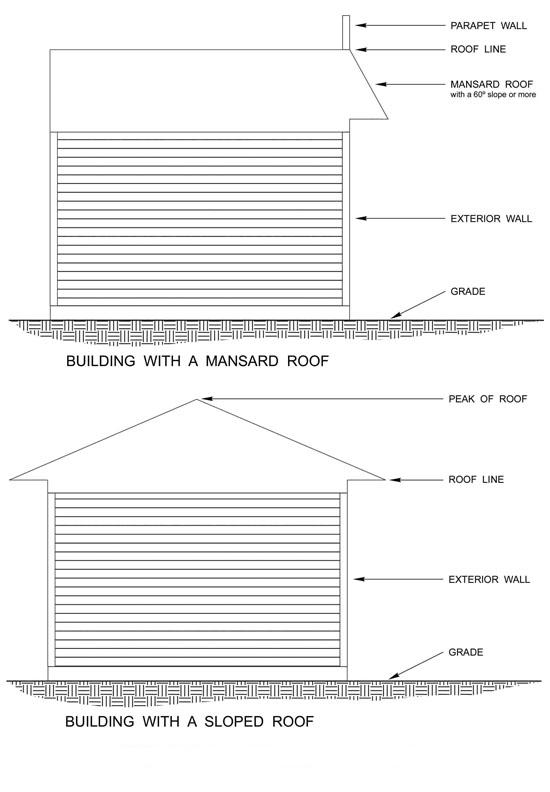
DIAGRAM 18.04.220 Walls and Roofs
(Ord. O2018-025, Amended, 12/18/2018; Ord. O2017-007, Amended, 11/05/2018; Ord. O2017-023, Amended, 07/17/2018; Ord. O2013-013, Amended, 10/01/2013; Ord. O2006-037, Added, 03/04/2008; Ord. O2000-004, Amended, 07/18/2000; Ord. O97-019, Amended, 06/17/1997; Ord. O95-035, Amended, 12/19/1995; Ord. 1144, Added, 01/05/1988; Ord. 883, Added, 05/06/1984. Formerly 18.04.642 – 18.04.645)
18.04.230 Y definitions.
“Yard” means an open, unoccupied space on a lot which is unobstructed from the ground upward by buildings or structures except as provided in TMC 18.42.040.
The yard determination diagram is set out in Diagram 18.04.670.
“Yard, front” means a yard lying between the front line of a lot or front property line and the front setback line and extending across the full width of a lot. (See Diagram 18.04.670.)
“Yard, rear” means a yard lying between the rear line of a lot or rear property line and the rear setback line and extending across the full width of a lot.
“Yard, side” means a yard between the side line of a lot or side property line and extending from the front setback line to the rear setback line. In the case of a corner lot, there would be no rear yard, just the two side yards. (See Diagram 18.04.670.)
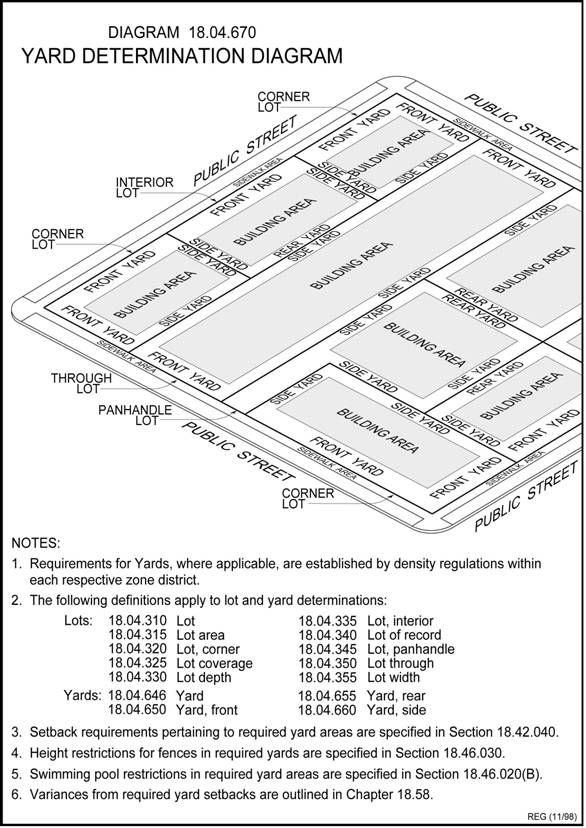
(Ord. O2013-013, Amended, 10/01/2013; Ord. O95-035, Amended, 12/19/1995; Ord. 883, Added, 05/06/1984. Formerly 18.04.646 – 18.04.660, 18.04.670)
18.04.240 Z definitions.
“Zone” means a land use area or district established by the city council.
(Ord. O2013-013, Amended, 10/01/2013; Ord. O95-035, Amended, 12/19/1995; Ord. 883, Added, 05/06/1984. Formerly 18.04.665)