


Chapter 8.521
FIRE SAFETY REGULATIONS
Sections:
ARTICLE I. GENERAL REQUIREMENTS
8.52.020 Fire hydrants--General requirements.
8.52.030 Fire hydrants--Water mains.
8.52.040 Fire hydrants--Residential areas.
8.52.050 Fire hydrants--Commercial areas.
8.52.060 Fire service connection.
ARTICLE II. REQUIREMENTS FOR NEW CONSTRUCTION WITHIN THE WUI AND VHFHSZ
8.52.100 Buildings destroyed by fire.
8.52.110 Owner to remove weeds and maintain defensible space.
8.52.120 Owner to keep premises clean.
8.52.130 Declaration of public nuisance.
ARTICLE III. FIRE PREVENTION
8.52.150 Adopted by reference.
8.52.160 Authorization to designate very high fire hazard severity zone.
8.52.180 New materials, processes or occupancies which may require permits.
8.52.190 Violation--Penalties.
ARTICLE I. GENERAL REQUIREMENTS
8.52.010 Definitions.
A. "Defensible space" means the area within the perimeter of a parcel, development, neighborhood or community where basic wildland fire protection practices and measures are implemented, providing the key point of defense from an approaching wildfire or defense against encroaching wildfires or structure fires.
B. "Driveway" means a vehicular pathway that serves no more than four residential units and any number of noncommercial or nonindustrial utility or miscellaneous Group U buildings, as defined by the California Building Code, on each parcel. A driveway shall not serve commercial or industrial uses at any size or scale.
C. "Enforcement officer" means the fire chief and shall include any official or officials in such department duly appointed by the fire chief or city council to administer the provisions of this chapter. For the purposes of the provisions of this chapter dealing with removal and destruction of weeds and waste, "enforcement officer" shall include any person who, pursuant to contract with the city, is authorized to abate nuisances.
D. "Fire apparatus" means a vehicle designed to be used under emergency conditions to transport personnel and equipment or to support emergency response, including but not limited to the suppression of fires.
E. "Fire chief" means the city fire chief or any authorized representative.
F. "Fire hazard" means any condition which increases or may cause an increase in the degree of danger from fire over that which is customarily recognized as normal by persons in the public service of preventing or extinguishing fire. It shall also mean any condition or any act which may obstruct, delay or hinder, or may become the cause of an obstruction, delay or hindrance, to the prevention, suppression or extinguishment of fire.
G. "Fire hazard severity zones (FHSZ)" are designated areas that are assessed based on their susceptibility to wildfires and the potential severity of those fires. These zones are typically identified through risk assessment and mapping processes, taking into account factors such as topography, vegetation types, weather patterns, historical fire data, and infrastructure, and are categorized into three different levels: moderate, high, and very high. Within the city of Angels, vegetation management is undertaken in accordance with this code on all parcels in the city limits regardless of designated FHSZ.
H. "Fire hydrant" means a valved connection on a water supply or storage system for the purpose of providing water for fire protection and suppression operations.
I. "Fuel break" means a strategically located area where the volume and arrangement of vegetation has been managed to limit fire intensity, fire severity, rate of spread, crown fire potential, and/or ember production.
J. "Fuel modification area" shall mean an area where the volume of flammable vegetation has been reduced, decreasing fire intensity and duration.
K. "Nuisance" means any condition which is or may become a potential health, safety or fire hazard, including, but not limited to:
"Nuisance" means any condition or use of premises or of building exterior which is detrimental to the property of others or which poses an immediate or potential health, safety or fire hazard. This includes, but is not limited to, the keeping of, or depositing on, or the scattering over the premises of the following:
1. Weeds, grass, dead trees, lumber;
2. Rubbish, refuse, junk, trash, debris, garbage;
3. Flammable materials;
4. Abandoned, discarded or unused objects or equipment of any type, including, but not limited to, furniture, stoves, refrigerators, freezers, vehicles, cans, or containers;
5. Obstructions to ingress or egress during emergencies;
6. Any condition as defined in Chapter 1.17.
L. "One-way road" means a road that provides a minimum of one traffic lane width designed for traffic flow in one direction only.
M. "Owner" means as shown on current tax roll, or legal representative parcel, tract, or piece of land.
N. "Shoulder" means a vehicular pathway adjacent to the traffic lane.
O. "Tax collector" shall mean the person collecting property taxes levied on real property for the city.
P. "Traffic lane" means the portion of a road or driveway that provides a single line of vehicle travel.
Q. "Turnaround" means an area which allows for a safe opposite change of direction for fire apparatus at the end of a road or driveway.
R. "Turnout" means a widening in a road or driveway to allow vehicles to pass.
S. "Vertical clearance" means the minimum specified height of a bridge, overhead projection, or vegetation clearance above the road or driveway.
T. "Very high fire hazard severity zone (VHFHSZ)" means an area designated as a very high fire hazard severity zone by the State Fire Marshal pursuant to California Government Code Section 51178 that is not a state responsibility area.
U. "Weeds" as used in this chapter means any of the following:
1. Vegetation that is or may become a fire hazard as determined by the enforcement officer;
2. Accumulation of dry grass, stubble, brush, litter, garden refuse, cuttings, and other combustible trash which endangers the public safety by creating a fire hazard.
V. "Wildfire" shall mean a fire burning on lands covered wholly or in part by timber, brush, grass, grain, or other flammable vegetation with such velocity or intensity that it could not be readily controlled with those ordinary tools available to private persons at the fire scene.
W. "Wildland-urban interface (WUI)" refers to areas where human-made structures and development meet or intermingle with undeveloped wildland vegetation. These areas are particularly susceptible to wildfires because they combine the potential for wildland fire ignition and the presence of structures or communities. The WUI includes both the structures and the surrounding vegetation that can act as fuel for wildfires.
X. "Zone 0--ember resistant zone" shall mean the area within zero to five feet around all structures and attached decks and requires the most stringent wildfire fuel reduction.
Y. "Zone 1--fuel break zone" shall mean the area between five to thirty feet around all structures and attached decks or to the property line, whichever is closer, in which all flammable vegetation or other combustible growth must be removed. The creation of the fuel break shall not require removal of single specimens of trees or other vegetation that is well-pruned and maintained so as to effectively manage fuels and not form a means of rapidly transmitting fire from other nearby vegetation to any structure.
Z. "Zone 2--reduced-fuel zone" shall mean an area between thirty to one hundred feet of all structures and attached decks or to the property line, whichever is closer, in which all brush, flammable vegetation or combustible growth must be removed. The creation of the reduced-fuel zone shall not require removal of single specimens of trees or other vegetation that is well-pruned and maintained so as to effectively manage fuels and not form a means of rapidly transmitting fire from other nearby vegetation to any structure. Grass and other vegetation located more than thirty feet from the structure and less than eighteen inches in height above ground may be maintained where necessary to stabilize the soil and prevent soil erosion, or to be maintained as grazing pasture at the discretion of the fire chief.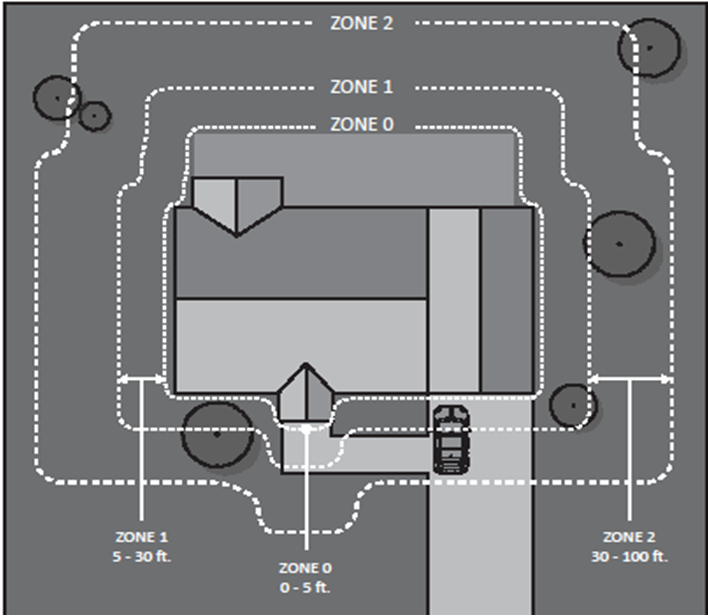
Zones 0, 1, and 2 as described above.
(Ord. 546 (Att. A), 2025)
8.52.020 Fire hydrants--General requirements.
Where land is developed or improved, the land shall conform to the minimum standards set out in this chapter.
A. Fire protection devices shall be provided as set forth and shall be approved by the city fire chief.
B. Fire hydrants, distribution lines and appurtenances to provide adequate fire protection shall be furnished in place by the developer.
C. Fire protection facilities shall be furnished in accordance with the standards of the city and as approved by the fire chief.
D. Fire hydrants are provided for the sole purpose of extinguishing fires and are to be opened and used only by city or authorized personnel.
E. A person authorized to open fire hydrants shall use an approved spanner wrench and shall replace the caps on the outlets when not in use.
F. If temporary service is supplied through a fire hydrant, a permit for the temporary service shall be obtained from the commercial office. The permit shall be exhibited upon the work while water is taken. The city engineer shall approve the permit.
G. Any person who desires the removal or change in location of a fire hydrant shall make a request in writing to the city. If the fire chief approves the proposed removal or relocation, the owner shall cause to be prepared plans to be approved by the city engineer, with design and installation costs to be borne by the project proponent.
H. Lots one acre or less in size for residential use and lots or parcels for commercial use, regardless of size, shall have fire protection water systems complying with the California Fire Code. (Ord. 546 (Att. A), 2025)
8.52.030 Fire hydrants--Water mains.
A. Water mains in residential areas shall not be less than six inches in diameter.
B. Water mains in mercantile and manufacturing districts shall not be less than eight inches in diameter.
C. No feeder line, or main, from the water source, or supply, in residential or commercial areas shall be less in diameter size than the main which it serves.
D. Water main, in residential or commercial areas, shall be looped into a gridiron system to avoid deadends, unless otherwise approved by the city engineer. (Ord. 546 (Att. A), 2025)
8.52.040 Fire hydrants--Residential areas.
A. Shall comply with city standards.
B. Lines connecting residential area hydrants to main water lines shall not be less than six inches in diameter, except as provided in this chapter.
C. Hydrant spacing in residential areas shall comply with the California Fire Code.
D. Gate valves not less than six inches in diameter shall be installed between every residential area fire hydrant and the main line. Where gate valves on main lines will permit mainline or hydrant repairs without eliminating full water flow to more than one hydrant, no valve between the main line and hydrant will be required in accordance with city standards.
E. Water source and/or storage, for residential fire protection, shall provide for an uninterrupted water flow, for a sustained period of at least two hours, of the minimum flow requirements as set forth in the California Fire Code. (Ord. 546 (Att. A), 2025)
8.52.050 Fire hydrants--Commercial areas.
A. Fire hydrants in mercantile and manufacturing districts shall have two two-and-one-half-inch fire hose thread male outlets, with caps and chains, and one four-and-one-half-inch steamer outlet, with cap and chains, and with a full four-and-one-half-inch valve opening, and shall be of dry-barrel, breakaway design.
B. Lines connecting commercial area fire hydrants to main water lines shall not be less than six inches in diameter.
C. Hydrant spacing in commercial areas shall comply with the California Fire Code.
D. Gate valves not less than six inches in diameter shall be installed between every commercial area fire hydrant and the main line. Where gate valves on main lines will permit mainline or hydrant repair without eliminating full water flow to more than one hydrant, no valve between the hydrant and the main line will be required in accordance with city standards.
E. Water source and/or storage for commercial areas shall provide for an uninterrupted water flow, and residual pressure of twenty pounds per square inch, as specified in the California Fire Code. At times of peak demand, residual pressure and minimum gallonage per minute shall be maintained over and above the normal consumptive use for a minimum duration of two hours. (Ord. 546 (Att. A), 2025)
8.52.060 Fire service connection.
A. Any sprinkler and fire service installation shall be per NFPA 13 and as approved by the fire chief.
B. Each fire service shall have a detector check valve of a pattern and design approved by the city. A detector check valve is a spring-loaded or weight-loaded swing check valve equipped with a metered bypass.
C. Water furnished through a fire service shall be used only for extinguishing fires or for authorized testing of the firefighting system. If a consumer wishes a test, he shall notify the public works department at least two working days before making the test. (Ord. 546 (Att. A), 2025)
8.52.070 Posting addresses.
A. Pursuant to California Residential Code, Title 24, Part 2.5, Chapter 3, Section R319.1, Address identification, buildings shall be provided with approved address identification. The address identification shall be legible and placed in a position that is visible from the street or road fronting the property. Address identification characters shall contrast with their background. Address numbers shall be Arabic numbers or alphabetic letters. Numbers shall not be spelled out. Each character shall be not less than four inches (one hundred and two mm) in height with a stroke width of not less than 0.5 inch (12.7 mm). Where required by the fire code official, address identification shall be provided in additional approved locations to facilitate emergency response. Where access is by means of a private road and the building address cannot be viewed from the public way, a monument, pole or other sign or means shall be used to identify the structure. Address identification shall be maintained. (Ord. 546 (Att. A), 2025)
ARTICLE II. REQUIREMENTS FOR NEW CONSTRUCTION WITHIN THE WUI AND VHFHSZ
8.52.080 Access gates.
A. Gate installations shall have a minimum opening clearance width of not less than that required for fire department access, in accordance with Appendix D of the California Fire Code.
B. A fire department approved key operated switch, Knox Box, or keypad shall be installed at a location to allow for emergency response access for all electronically operated access gates, as approved by the fire chief.
C. All security gates shall have a means of auxiliary back-up power in the event of an electrical power outage and shall be maintained operational at all times to ensure a means of egress for residents and for fire response access in accordance with the code.
D. Gates shall be positioned to allow for a minimum thirty-foot setback from the public right-of-way and shall open inward unless otherwise approved by the fire chief.
E. Gate entrances shall be at least two feet wider than the width of the traffic lane(s) serving that gate and a minimum width of fourteen feet unobstructed horizontal clearance for residential uses, and twenty-six feet horizontal clearance for commercial uses, and unobstructed vertical clearance of fifteen feet. (Ord. 546 (Att. A), 2025)
8.52.090 Fire sprinklers.
A. An automatic sprinkler system shall be installed and maintained in all newly constructed buildings or structures not meeting the exceptions established by Section 701A.3 of Chapter 7A of the California Building Code.
B. An automatic sprinkler system shall be installed in all buildings in excess of three thousand square feet which have ten percent or more floor area added within any thirty-six-month period.
C. An automatic sprinkler system shall be installed in all buildings which have fifty percent or more floor area added, or any "substantial remodel" as defined in this code, within any thirty-six-month period.
D. An automatic sprinkler system installed in accordance with California Building Code Section 903.3.1.3 shall be permitted in Group R-3 occupancies and shall be provided throughout all one- and two-family dwellings regardless of square footage in accordance with the California Residential Code. An automatic sprinkler system shall be installed in all mobile homes, manufactured homes and multifamily manufactured homes with two or more dwelling units in accordance with Title 25 of the California Code of Regulations.
E. Change of Occupancy or Use. For any change of occupancy or use, when the proposed new occupancy classification is more hazardous based on a fire and life safety evaluation by the fire chief, including but not limited to conversion of buildings to single-family residences, accessory dwelling units, bed and breakfast, inns, lodging houses or congregate residences or other similar uses, an automatic sprinkler system shall be installed throughout. (Ord. 546 (Att. A), 2025)
8.52.100 Buildings destroyed by fire.
Buildings all or partially destroyed by fire are subject to Chapter 15.06. (Ord. 546 (Att. A), 2025)
8.52.110 Owner to remove weeds and maintain defensible space.
A. It shall be the duty of the owner of land, improved or unimproved, to immediately remove, upon notice by the enforcement officer, any nuisance from the sidewalk abutting or adjoining such parcel of land, including, but not limited to, all grass, weeds, dead trees, tin cans, rubbish, refuse, and waste material or other unsanitary or dangerous substances or objects.
B. All combustible weeds shall be removed from parcels less than one acre in size. Parcels larger than one acre shall be clear of all weeds within one hundred feet of any structure and thirty feet of any street, driveway and all property lines on improved property. Zones 0, 1, 2 shall apply to improved parcels.
C. Unimproved parcels larger than one acre shall be cleared of all combustible weeds within thirty feet of any public access point including, but not limited to, public streets, public roads, trails, parking lots, and sidewalks. Unimproved parcels larger than one acre shall create a defensible space clear of all weeds a minimum of one hundred feet from any building or structure. Structures less than one hundred twenty square feet with no electricity or plumbing (i.e., do not require a building permit) are exempt. Owners of unimproved parcels larger than one acre may present, in writing, an individual vegetation management plan to the fire chief that creates defensible space to protect structures and buildings. Individual management plans will be reviewed and may be approved at the discretion of the fire chief.
D. The fire chief may exclude cultivated grasses and pastures where grazing or equivalent practices clearly demonstrate that vegetation is subject to ongoing best agricultural management practices and removal is unnecessary to protect adjacent improved property or ingress/egress routes from fire exposure. If active grazing land must be removed to provide defensible space, compensation will be made to landowners. Compensation shall be based on the square footage of clearance required for defensible space. Per-acre compensation shall be established by the total production value, in dollars, of "cattle and calves" produced for the year divided by the total acres of "rangeland" in production for the year (generally holds steady at one hundred ninety-eight thousand(±) acres) as reported in the Calaveras County annual crop report for the most recent year available. Total compensation to property owners citywide shall not exceed two thousand dollars annually unless otherwise authorized by the city council. "Active grazing land" for the purpose of this section means land where the primary use is or has been livestock grazing for commercial purposes within the preceding three-year period. The landowner would remain responsible for costs associated with providing the necessary defensible space.
E. Abatement may be accomplished in any manner that reduces weeds, as defined in Section 8.52.010, to less than four inches above the soil line and is not in violation of any environmental rules, regulations or statutes applicable within the city.
1. Fire Hazard Reduction Requirements Within the City Limits. Property shall be maintained in accordance with the defensible space requirements contained in Government Code Section 51182 (unless exempted by Government Code Section 51183 or 51184) and Public Resources Code Section 4291, as applicable, and this section, whichever is more restrictive.
2. The existence of any of the following conditions is prohibited:
a. Tree branches within ten feet of a chimney outlet or stovepipe outlet;
b. Dead or dying tree branches adjacent to or overhanging a building;
c. Leaves, needles, or other dead vegetative growth on the roof of any structure;
d. Brush or other flammable material within ten feet of a propane tank.
3. Clearance and Treatment. Fire apparatus access roads shall have a minimum width of twenty-four feet unobstructed horizontal clearance and fifteen feet unobstructed vertical clearance. The fuel modification area is required from the point at which the access intersects the road to the structure.
4. Vegetation Management Plans Required for New Development. Vegetation management plans shall be required for any new subdivision or commercial development within the WUI or VHFHSZ. The plans shall be submitted to the planning department and fire department concurrently with any plans or documents required as part of the entitlement application, and shall be consistent with the requirements of Section 4906 of the California Fire Code, Title 24, Part 9.
F. This chapter shall not be construed to hold the city or any officer, employee, or agent thereof responsible for any damage to persons or property by reason of any inspection authorized herein or for any action or omission in connection with the application or enforcement of this chapter. By adopting the provisions of this chapter, the city does not intend to impose on itself, its employees or agents any mandatory duties of care toward persons and property within its jurisdiction so as to provide a basis of civil liability for damages. (Ord. 546 (Att. A), 2025)
8.52.120 Owner to keep premises clean.
It shall be the duty of the owner of any parcel of land, improved or unimproved, to keep such parcel of land free from all public nuisances as defined in Chapter 1.17. (Ord. 546 (Att. A), 2025)
8.52.130 Declaration of public nuisance.
Whenever any condition exists upon the streets, sidewalks, parkways, or private property within the city which is defined as a public nuisance pursuant to Chapter 1.17, the enforcement officer may declare the same to be a public nuisance. (Ord. 546 (Att. A), 2025)
8.52.140 Enforcement.
Enforcement of this chapter shall be in accordance with Chapters 1.16, 1.17, 1.18 and 1.19. (Ord. 546 (Att. A), 2025)
ARTICLE III. FIRE PREVENTION
8.52.150 Adopted by reference.
That edition of the Uniform Fire Code, sponsored by the International Conference of Building Officials and Western Fire Chiefs Association, and adopted by the State Fire Marshal, will also be adopted by the city on January 1st following the date adopted by the state. Copies will be on file in the office of the city clerk and fire chief. The city council may amend such code by resolution. Such adoption refers to all regulations and requirements contained therein including the issuance of permits and collection of fees. (Ord. 546 (Att. A), 2025)
8.52.160 Authorization to designate very high fire hazard severity zone.
A. The fire chief is authorized to designate very high fire hazard severity zones within one hundred twenty days of receiving recommendations from the California Department of Forestry and Fire Protection.
B. The fire chief may designate areas not identified by the California Department of Forestry and Fire Protection following a finding supported by substantial evidence in the record that the requirements for very high fire hazard severity zones are necessary for effective fire protection within the area.
C. The fire chief may decline to designate areas identified by the California Department of Forestry and Fire Protection as very high hazard severity zones following a finding supported by substantial evidence in the record that the requirements for very high hazard severity zones are not necessary for effective fire protection within the area.
D. The building official shall enforce the provisions of Section 3203, Title 24 of the California Code of Regulations, in all very high hazard severity zones designated by the fire chief. (Ord. 546 (Att. A), 2025)
8.52.170 Appeals.
Whenever the chief disapproves an application or refuses to grant a permit applied for, or when it is claimed that provisions of the code do not apply or that the true intent and meaning of the code have been misconstrued or wrongly interpreted, the applicant may appeal from the decision of the chief to the city council within thirty days from the date of the decision appealed. Such appeal shall be in writing and explain in what particulars the appellant alleges such portions of the code do not apply, and in which respect such portions of the code have been misconstrued or wrongly interpreted. Such written appeal shall be filed with the city clerk. The review of the appeal shall include findings of fact, any potential setting of precedence, and any legal or liability issues. (Ord. 546 (Att. A), 2025)
8.52.180 New materials, processes or occupancies which may require permits.
The city council may, as the need arises, select a committee to determine and specify, after giving affected persons an opportunity to be heard, any new materials, processes or occupancies for which permits are required in addition to those now enumerated in said code. The chief of the bureau of fire prevention shall post such list in a conspicuous place in his office and distribute copies thereof to interested persons. (Ord. 546 (Att. A), 2025)
8.52.190 Violation--Penalties.
A. Any person who violates any of the provisions of the code or standards adopted by the ordinance codified in this chapter, or who fails to comply therewith, or who violates or fails to comply with any order made thereunder, or who builds in violation of any detailed statement of specifications or plans submitted and approved thereunder, or any certificate or permit issued thereunder, and from which no appeal has been taken, or who fails to comply with such an order as affirmed or modified by the city or by a court of competent jurisdiction, within the time fixed by the code and standards adopted by the ordinance codified in this chapter, shall severally for each and every such violation and noncompliance, respectively, be guilty of a misdemeanor.
B. The imposition of one penalty for any violation shall not excuse the violation or permit it to continue, and all such persons are required to correct or remedy such violations or defects within a reasonable time, and when not otherwise specified, each ten days that prohibited conditions are maintained constitute a separate offense.
C. The application of the above penalty shall not be held to prevent the enforced removal of prohibited conditions. (Ord. 546 (Att. A), 2025)
Code reviser’s note: Ordinance 546 adds the provisions of this chapter as Chapter 8.50. The chapter has been editorially renumbered to prevent duplication of numbering.