


Chapter 15.05
WILDLAND-URBAN INTERFACE CODE
Sections:
15.05.015 Deletions, revisions and additions.
15.05.040 Wildland-urban interface areas.
15.05.050 Fire protection requirements.
15.05.010 Adoption of the 2025 California Wildland Urban Interface Code, Part 7, Title 24 of the California Code of Regulations.
The City of Poway adopts by reference the 2025 California Wildland-Urban Interface Code, to include Appendices B, F, and G as published by the International Code Council, except those portions that are deleted, modified, or amended by this chapter. One copy of the above-mentioned code has been and is now filed in the office of the City Clerk or the fire code official, City of Poway, and the same is adopted and incorporated as fully as if set out at length herein. From the effective date of the ordinance codified in this chapter, the provisions thereof shall be controlling within the limits of the City of Poway. (Ord. 878 § 5, 2025)
15.05.015 Deletions, revisions and additions.
A. Deletions, Revisions and Additions to the 2025 California Fire Code. Deletions, revisions and additions to the 2025 California Fire Code shall be set forth in PMC 15.05.020 through 15.05.050. (Ord. 878 § 5, 2025)
15.05.020 Administration.
Section 102.9, Repeal of conflicting ordinances, resolutions or motions, is added to read:
102.9 Repeal of conflicting ordinances, resolutions or motions. All former ordinances, resolutions, motions or parts thereof that are conflicting or inconsistent with the provisions of this Ordinance or of the Code or standards hereby adopted are repealed.
Section 104.2.3, Modifications, is added to read:
104.2.3 Modifications. Where there are practical difficulties involved in carrying out the provisions of this code, the code official shall have the authority to grant modifications for individual cases, provided that the code official shall first find that one or more special individual reasons make the strict letter of this code impractical, that the modification is in conformance with the intent and purpose of this code, and that such modification does not lessen health, life and fire safety requirements. The details of the written request and action granting modifications shall be recorded and entered into the files of the code enforcement agency.
Section 108.1, Fees, is added and modified to read:
108.1 Fees. A permit shall not be valid until the fees have been paid, nor shall an amendment to a permit be released until the additional fee, if any, has been paid.
Section 109.3, Compliance with orders and notices, is added and modified to read:
109.3 Compliance with orders and notices. A notice of violation issued or served as provided by this code shall be complied with by the owner, the owner’s authorized agent, operator, occupant or other person responsible for the condition or violation to which the notice of violation pertains. It is unlawful for any person to fail to comply with any lawful order issued pursuant to this Code by the City Attorney or by a court of competent jurisdiction.
Section 109.3.7, Violation penalties, is added and modified to read:
109.3.7 Violation penalties. A violation of any provision of this Code, or failure to comply with orders or conditions issued pursuant to this Code, shall constitute a misdemeanor or (in the discretion of the prosecuting attorney) an infraction, in any event as set forth in Chapter 1.08 PMC. In addition to any criminal penalties any violation may also be enforced by civil action, and shall be subject to civil and administrative penalties, as set forth in Chapters 1.08 and 1.10 PMC.
Section 112.1, Means of appeals, is added and modified to read:
112.1 Means of appeals. Whenever the fire code official has denied a permit or other entitlement, or when it is alleged that a mistake has been made in the interpretation or application of the code, the applicant may appeal the decision of the fire code official to the City Manager by filing a written appeal with the City Clerk within 30 days of the decision. If the appeal is denied by the City Manager, the City Manager’s decision may be appealed to the City Council by filing a written appeal with the City Clerk within 30 days of the City Manager’s decision and paying of the appeal fee set forth in the City’s Master Fee Schedule for administrative appeals.
Section 113.4, Failure to comply, is modified to read:
113.4 Failure to comply. It is unlawful for any person to continue any work after having been served with a stop-work order, except such work expressly identified in the stop-work order as necessary to correct a violation or unsafe condition.
Section 114.1, Cost recovery, is added to read:
114.1 Cost recovery. The purpose of this section is to establish authority to obtain reimbursement from responsible individuals for the expenses of any emergency response and/or enforcement action by the City of Poway to protect the public from criminal or negligent activities, and from fire or hazardous substances.
Section 114.2, Reimbursement, is added to read:
114.2 Reimbursement. In accordance with Health and Safety Code Section 13000 et seq., an individual who acts negligently or in violation of the law and thereby requires the jurisdiction to provide an emergency response to a danger posed by a fire or hazardous substance shall be liable for reimbursement to the agency for the costs incurred. In accordance with Government Code Sections 53150 through 53158, any individual who is under the influence of an alcoholic beverage, or any drug, or the combined influence of an alcoholic beverage or any drug, and whose negligent operation of a motor vehicle, boat or vessel, or civil aircraft caused by that influence, proximately causes any incident and thereby requires the agency to provide an emergency response, shall reimburse the agency for the cost incurred.
Section 114.3, Expense recovery, is added to read:
114.3 Expense recovery. The fire code official may impose a fee for recovery of expenses incurred to enforce the fire prevention provisions of this code. Such expense recovery fees shall be established by a resolution of the City Council.
(Ord. 878 § 5, 2025)
15.05.030 Definitions.
The following definitions are added or modified to Section 202:
Fire Hazard. Anything that increases or could cause an increase of the hazard or menace of fire to a greater degree than customarily recognized as normal by persons in the public service regularly engaged in preventing, suppressing, or extinguishing fire; or anything or act, which could obstruct, delay, hinder, or interfere with the operations of the fire department; or egress of occupants in the event of fire.
Fire Protection Plan (FPP). The FPP is a document prepared for a specific project or development proposed in the wildland-urban interface fire area that describes ways to minimize and mitigate potential loss from wildfire exposure, with the purpose of reducing impact on the community’s fire protection delivery system.
Fuel Break. A strategically located area where the volume and arrangement of highly flammable native vegetation has been permanently modified or replaced to limit fire intensity, fire severity, rate of spread, crown fire potential and/or ember production. Fuel breaks may divide fire-prone areas into smaller areas for easier fire control and to provide access for firefighting.
Fuel Modification Zone. A strip of land where combustible vegetation has been thinned or modified or both and partially or totally replaced with approved fire-resistant and/or irrigated plants to provide an acceptable level of risk from vegetation fires. Fuel modification reduces the radiant and convective heat on a structure and provides valuable defensible space for firefighters to make an effective stand against an approaching fire front.
Heritage Tree. Any mature tree or mature stand of trees designated by the City Council as having historic or cultural significance.
Highly Flammable Native Vegetation. Species that provide large fuel loads such as sumac, native oak, chamise, grassland, chapparal, coastal sage scrub and sage. It does not include low-fuel-load species such as toyon, yucca, lemonade berry and other similar types of plants.
(Ord. 878 § 5, 2025)
15.05.040 Wildland-urban interface areas.
Section 301.3, Local Responsibility Area Fire Hazard Severity Zones, is added to read:
301.3 Local Responsibility Area Fire Hazard Severity Zones. The City of Poway designates the fire hazard severity zones as recommended by the Office of the State Fire Marshal pursuant to Government Code Section 51178.
Section 301.3.1, Parcel identification, is added to read:
301.3.1 Parcel identification. Any parcel that is within one or more fire hazard severity zones or is partially included in a fire hazard severity zone shall be considered to be entirely within the most restrictive of the fire hazard zones identified.
Section 301.3.2, Display of Fire Hazard Severity Zones and identified Wildland Urban Interface (WUI) Areas, is added to read:
301.3.2 Display of Fire Hazard Severity Zones and identified Wildland Urban Interface (WUI) Areas. The maps have been duly noticed and posted as required by law and are available for public viewing at the office of the City Clerk or on the City of Poway website.
(Ord. 878 § 5, 2025)
15.05.050 Fire protection requirements.
Section 602.1, General, is modified to read:
602.1 General. The Development Services Department or the FAHJ may require an applicant to include a parcel map, subdivision map, minor development review application, development review, specific plan or major use permit in order to submit a Fire Protection Plan (FPP) as part of the approval process.
The Fire Protection Plan shall be prepared by a registered design professional, qualified landscape architect, qualified fire safety specialist or similar specialist acceptable to the code official and shall analyze the wildfire risk of the building, project, premises or region to recommend necessary changes.
The code official is authorized to require a preliminary fire protection plan prior to the submission of a final fire protection plan.
Section 602.2, Contents, is modified to read:
602.2 Contents. The Fire Protection Plan shall be based on a project-specific wildfire hazard assessment that includes considerations of location, topography, geography, aspect, fuel types, climatic and fire history.
The plan shall identify conformance with all applicable state wildfire protection regulations, statues and applicable local ordinances, whichever are more restrictive.
The plan shall address fire department access, egress, road and address signage and water supply in addition to fuel reduction in accordance with Public Resources Code (PRC) 4290; the defensible space requirements in accordance with PRC 4291 or Government Code 51182; and the applicable building codes and standards for wildfire safety. Additionally, the plan shall address travel time to nearest serving fire station, structural ignitability, structure setback and fire protection systems and equipment. The plan shall identify mitigation measures to address the project’s specific wildfire risk and recommend measures to reduce the ignitability of structures throughout the area being addressed. The plan shall include the information required in Sections 602.3 through 602.3.2.
603.1, General, is modified to read:
603.1 General. Planting of vegetation for new landscaping shall be selected to reduce vegetation in proximity to a combustible structure and to maintain vegetation as it matures. Where conflicts occur between the provisions of this section, the most restrictive shall apply.
603.2, Application, is modified to read:
603.2 Application. All new plantings of vegetation in State Responsibility Area (SRA) and Local Responsibility Areas (LRA) designated as a Very High Fire Hazard Severity Zone and/or Wildland Urban Interface (WUI) Area shall comply with Sections 603.3 through 603.4.2.1.
603.3, Landscape plans, is modified to read:
603.3 Landscape plans. Landscape plans are required for new residential developments, residential custom homes, production tract homes, multi-family residential, and commercial buildings. Landscape plans may be required whenever there is a change in the building footprint. The landscape plan shall include development and maintenance requirements for the fuel modification zones adjacent to combustible structures and roadways and provide significant fire hazard reduction benefits for public and firefighting safety. The fire code official is permitted to expand the distance of the fuel modification zones based on project location, surrounding vegetation, and topography. The fire code official is also permitted to reduce the distance of the fuel modification zones based on implemented fire mitigation measures.
The landscape plan shall be submitted and approved prior to the issuance of a building permit.
603.3.1, Contents, is modified to read:
603.3.1 Contents. Landscape plans shall contain all the following:
1. A Vegetation Management Plan.
2. Identification of all parcel boundaries.
3. Identification of all structures.
4. Identification of parcel boundary and top of slope setbacks.
5. Identification of biological conservation and open space easements.
6. Delineation of the 5-foot, 30-foot, and 100-foot fuel modification zones from all combustible structures.
7. Identification of noncombustible ground covering within the 0 to 5-foot Zone 0.
8. Identification of fire-smart vegetation ground covering / vegetation and irrigation within the 5 to 30-foot Zone 1.
9. Identification of the trimmed and maintained vegetation within the 30 to 100-foot Zone 2.
10. Identification of existing vegetation to remain and proposed new fire-smart vegetation.
11. Identification of all roadways and driveways.
12. Identification of 10-foot roadway / driveway clearing with either noncombustible ground covering or fire-smart vegetation.
13. Identification of irrigated areas.
14. Identification of fire mitigation measures.
15. A plant legend with botanical and common names, and identification of all plant material symbols.
16. Identification of fire hydrants and water tanks with standpipe connections.
17. Identification of the water meter and lateral location and sizes.
18. Identification of the Liquified Petroleum Gas (LPG) tank.
19. Identification of a scale.
20. Identification of a compass.
603.4, Vegetation, is modified to read:
603.4 Vegetation. All new vegetation shall be fire-smart vegetation in accordance with this section.
Exception: Trees classified as non fire-smart vegetation complying with Section 603.4.2.1.
To be considered fire-smart vegetation, vegetation must meet at least one of the following:
1. Be identified as fire-smart vegetation in an approved book, journal or listing from an approved organization.
2. Be identified as fire-smart vegetation as a licensed landscape architect with supporting justification.
3. Plants considered fire-smart vegetation and approved by the local enforcing agency.
4. Plants identified as fire-resistant in the City of Poway Landscape and Irrigation Design Manual.
603.4.2, Trees, is modified to read:
603.4.2 Trees. Trees shall be managed as follows within the 30-foot zone (9144mm) of a structure:
1. New trees shall be planted and maintained so that the tree’s drip line at maturity is a minimum of 10 feet (3048 mm) from any combustible structure.
2. The horizontal distance between canopies of new trees and canopies of adjacent trees shall not be less than 20 feet (6096mm).
3. Existing trees shall be trimmed to provide a minimum separation of 10 feet (3048 mm) away from chimney and stovepipe outlets per California Code of Regulations, Title 14, Section 1299.03.
603.5, Fuel modification zones, is added to read:
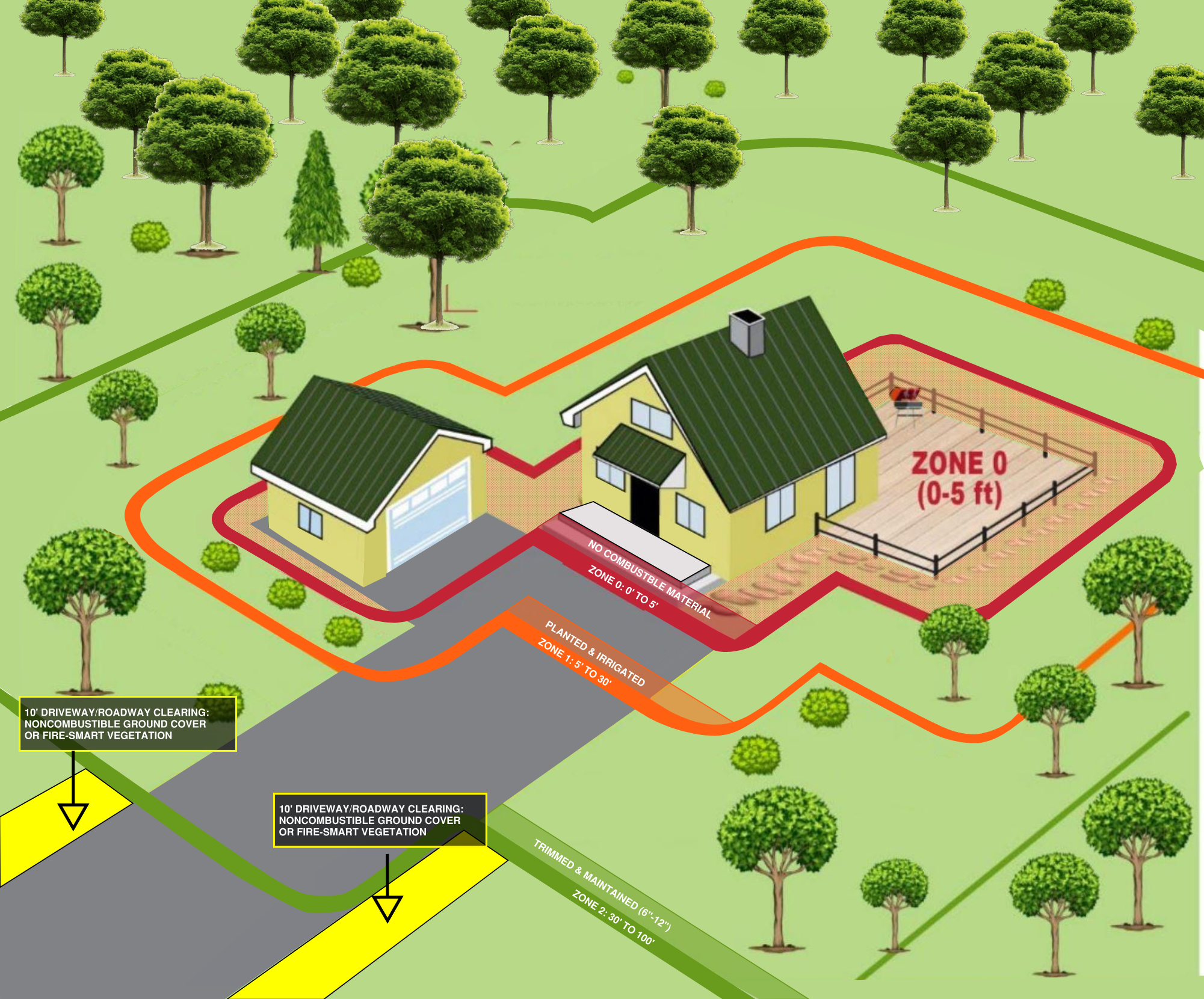
603.5 Fuel modification zones. Within 100 feet of each combustible building or structure, or as determined by the fire code official, all new vegetation shall be planted and irrigated fire-smart vegetation and all existing vegetation shall be modified as described below:
Zone 0. (0 to 5 feet). This zone shall consist of the area under and around combustible buildings or structures and measures from the exterior wall surface or edge, patio, deck, or other attachments and extending out to 5 feet. This zone shall be constructed of continuous hardscape or non-combustible ground covering materials. The use of natural mulch and other combustible materials shall be prohibited.
Zone 1. (5 to 30 feet). This zone shall consist of 25 feet of planted and irrigated fire-smart vegetation from 5 to 30 feet or to the property line, whichever is closer. Vegetation in this zone shall be planted and irrigated in accordance with Section 603.4 and the City of Poway Landscape and Irrigation Design Manual. The fire code official is authorized to require extended zone 1 planting and irrigation as fire mitigation when 100-feet of fuel modification cannot be achieved.
Zone 2. (30 to 100 feet). This zone shall consist of 70 feet of trimmed and maintained vegetation from 30 to 100 feet, or to the property line, whichever is closer. Highly flammable native vegetation in this zone shall be trimmed and maintained 6 to 12 inches maximum in height with the required tree canopy spacing and in accordance with the Section 603.4 and the City of Poway Landscape and Irrigation Design Manual.
Figure 603.5 Fuel Modification Zone Measurements and Criteria is added to read:
Exceptions:
Single specimens of trees, ornamental shrubbery or similar plants used as ground cover, provided that they do not form a means of rapidly transmitting fire from the native growth to any structure.
At the discretion and with the review and approval of the fire code official, the dimensions of fuel modification zones may be reduced and or modified where construction with non-combustible materials in accordance with CWUIC Chapter 5 or other approved fire mitigation measures are implemented.
Section 603.6, Fuel modification of combustible vegetation from sides of roadways, is added to read:
603.6 Fuel modification of combustible vegetation from sides of roadways. Combustible vegetation in the area within 10 feet from each side of a driveway or of a public or private road adjacent to the property shall be modified to be cleared, covered in a noncombustible ground covering, or planted and irrigated with fire-smart vegetation to establish safe fire apparatus access.
604.1, General, is modified to read:
604.1 General. Hazardous vegetation and fuels shall be managed to reduce the severity of potential exterior wildfire exposure to buildings and to reduce the risk of fire spreading to buildings as required by applicable laws and regulations.
Defensible space shall be managed around all buildings and structures in the Local Responsibility Area (LRA) as described in Sections 604.2 through 604.5.
604.2, Application, is modified to read:
604.2 Application. Buildings and structures located in the following areas shall maintain the required hazardous vegetation and fuel management:
1. Land designated as a Very High Fire Hazard Severity Zone
2. Land designated as a Wildland Urban Interface Area
604.3, Requirements, is modified to read:
604.3 Requirements. Hazardous vegetation and fuels around all buildings and structures shall be maintained in accordance with the following laws are regulations:
1. Public Resources Code, Section 4291
2. California Code of Regulations, Title 14, Division 1.5, Chapter 7, Subchapter 3, Article 3, Section 1299.03
3. California Government Code, Section 51182
4. California Code of Regulations, Title 19, Division 1, Chapter 7, Subchapter 1, Section 3.07
Section 604.3.1, Good Neighbor / Neighborhood Protection, is added to read:
604.3.1 Good Neighbor / Neighborhood Protection. When a structure is less than 100 feet from a property line and hazardous vegetation on an adjacent improved or unimproved parcel is deemed to be a fire hazard to the structure, the responsible person where the fire hazard exists shall be responsible for removing the fire hazard in that area that is within 100 feet of the structure. The determination for appropriate clearance distances will be made by the fire code official based upon a visual inspection of the parcel and shall consider all factors that place the property or structure at risk from an approaching fire. These factors shall include local weather conditions, fuel types, topography, and the environment where the property or structure is located.
Section 604.3.2, Highly Flammable Native Vegetation, is added to read:
604.3.2 Highly Flammable Native Vegetation. Highly flammable native vegetation shall only be reduced by mowing or trimming the vegetation to a height of 6 to 12 inches, leaving the plant root intact to stabilize the soil. Native vegetation may not be reduced by clearing, brushing or grubbing and may not be removed to bare soil. Native vegetation may not be removed beyond the fuel modification zone without a permit.
Section 604.3.3, Exceptions, is added to read:
604.3.3 Exceptions. The following types of vegetation may require an administrative clearing permit and shall not be subject to reduction or removal pursuant to this chapter without the prior approval of the fire code official:
1. Heritage Trees.
2. Vegetation within streambeds, banks, and vernal pools.
3. Vegetation located within a recorded Biological Conservation Easement. In the case of vegetation that is within any habitat area that is required to be removed pursuant to this chapter shall be mitigated in kind by the property owner at a 1:1 ratio.
605.1, General, is added and modified to read:
605.1 General. Chimneys serving fireplaces, barbecues, or decorative heating appliances shall be provided with an approved spark arrestor.
606.2, Location of containers or tanks, is added and modified to read:
606.2 Location of containers or tanks. LP-gas containers or tanks shall not be located within fuel modification zones 0 or 1.
Exceptions:
1. LPG tanks are permitted to be placed within fuel modification zone 1 when fire mitigated with CMU block fire wall or fire rated metal or precast fence.
608.2, General, is modified to read:
608.2 General. All parcels shall provide a minimum 30-foot (9144 mm) setback for all buildings or structures from property lines, biological conservation easements, open space easements, and the center of a road, except as provided for in Sections 608.2.1.
Exceptions:
1. If a legally permitted building or structure is located within 30 feet of the property line and does not meet current setback requirements (legal nonconforming), the existing setback distance of that structure may be used as the required setback for any new attached accessory structures or additions to the building or structure.
2. No other exceptions to the Building Sitting and Setbacks are permissible except for where local setbacks are pre-empted by State law.
608.2.1, Setback reduction, is modified to read:
608.2.1 Setback reduction. A reduction in the minimum setback shall be based upon practical reasons, which may include but are not limited to parcel dimensions or size; topographic limitations; Development density requirements or other Development patterns that promote low-carbon emission outcomes; sensitive habitat; or other site constraints and shall provide for an alternative method to reduce structure-to-structure ignition.
At the discretion, and with review and approval of the fire code official, the setback dimensions may be reduced where construction with non-combustible materials in accordance with CWUIC Chapter 5 or other approved fire mitigation measures are implemented such as, but not limited to:
1) Noncombustible CMU block fire walls; or
2) Metal or precast fire rated fencing; or
3) Extended hardscape landscaping; or
4) Noncombustible construction per CWUIC Chapter 5.
608.3, Structure setback from slope, is added to read:
608.3 Structure setback from slope. Single-story structures shall be set back a minimum of 15-feet horizontally from top of slope to the farthest projection from a roof. A single-story structure shall be less than 12-feet above grade.
A two-story structure shall be setback a minimum of 30-feet horizontally from top of slope to the farthest projection from a roof.
Structures greater than two stories may require a greater setback when the slope is greater than 2 to 1.
Exceptions:
1. At the discretion, and with review and approval of the fire code official, the setback dimensions may be reduced where construction with non-combustible materials in accordance with CWUIC Chapter 5 or other approved fire mitigation measures are implemented such as, but not limited to:
1) The structure is constructed with a noncombustible exterior wall adjacent to the slope, no openings adjacent to the slope, no combustible attachments to the exterior wall adjacent to the slope, and no roof eaves adjacent to the slope.
2) Noncombustible CMU block fire wall is installed at the top of slope; or
3) Metal or precast fire rated fencing is installed at the top of slope; or
4) There exists no open wildland fuel area directly adjacent to the structure and the slope is directly adjacent to developed parcels with fuel management principles in place.
5) The fire code official determines the hazard to be minimal.
(Ord. 878 § 5, 2025)