


Chapter 18.68
SUBDIVISIONS
Sections:
Article I. Intent – Plats Required
18.68.020 Subdivision plats required – To be recorded.
18.68.025 Subdivision land use authority.
18.68.027 Subdivision appeal authority.
Article II. Procedure for Approval of a Subdivision
18.68.029 Subdivision application process overview.
18.68.030 Presubmission conference.
18.68.040 Prepare and submit concept plan.
18.68.050 Obtain planning commission approval of concept plan.
18.68.060 Prepare preliminary plan and improvement drawings.
18.68.070 Obtain planning commission approval of preliminary plan.
18.68.080 Prepare and submit final plat, engineering drawings and documents to planning commission.
18.68.085 Notice to affected entities.
18.68.090 Planning commission takes action on final plat.
18.68.100 Subdivider posts performance guarantee.
18.68.110 SRC takes action on final plat.
18.68.120 Final plat to be recorded in office of county recorder.
18.68.125 Exceptions to specific application requirements and plats.
18.68.130 Release of performance guarantees.
18.68.140 Release of durability retainer.
Article III. Documentation Requirements
18.68.170 Final plat and engineering drawings.
Article IV. Design Standards and Requirements
18.68.190 Streets and roads – General criteria.
18.68.200 Streets and roads – Right-of-way width.
18.68.210 Streets and roads – Width of pavement and other requirements.
18.68.220 Streets and roads – System design standards.
18.68.230 Blocks – Design standards.
18.68.240 Lots – Design standards.
Article V. Improvements
18.68.270 List of required improvements.
Article VI. Costs and Charges
Article VII. General Requirements
18.68.290 Standards and specifications.
18.68.300 Streets to be dedicated.
18.68.310 Lots must abut on public street.
18.68.330 Work to be done by engineer or surveyor.
18.68.340 Drawings of record required.
Article I. Intent – Plats Required
18.68.010 Intent.
The intent of this chapter is as follows:
A. To facilitate the orderly development of the town.
B. To implement the town’s major street plan.
C. To facilitate the development of a safe and efficient street system.
D. To facilitate the orderly transfer of the ownership of building sites in a manner consistent with state law.
E. To ensure the providing of adequate water, sewer, drainage, utilities, and other services to developing areas of the town. To establish the rights, duties, and responsibilities of subdividers with respect to the development of land within the town. [Ord. 2024-1 § 1 (Exh. A); Ord. 1998-99-A § 10-7-1.]
18.68.020 Subdivision plats required – To be recorded.
No person shall subdivide any tract of land within the incorporated limits of the town; nor shall any person sell, exchange, purchase or otherwise convey a parcel of land which is part of a larger tract, if such sale or agreement would have the effect of creating a subdivision as defined by this code, unless and until a final plat, prepared in accordance with the provisions of this code, shall have been first approved by the planning commission and town council and recorded in the office of the county recorder. [Ord. 2024-1 § 1 (Exh. A); Ord. 1998-99-A § 10-7-2.]
18.68.025 Subdivision land use authority.
A. The land use authority for preliminary applications under this chapter is the planning commission. For purposes of subdivision applications, the planning commission shall be ultimately responsible for the following but may delegate any task to the town engineer, town staff, or members of the planning commission:
1. Rendering land use decisions related to preliminary applications under this chapter, including approving or denying preliminary applications.
2. Reviewing all preliminary applications under this chapter in an impartial manner and according to the standards and deadlines described in this chapter.
3. Holding public meetings for reviewing preliminary applications as required by this chapter.
4. Providing feedback to applicants on their preliminary applications in the manner required by this chapter.
5. Scheduling and holding a presubmission conference (and reviewing concept plans) with potential applicants as required by this chapter.
6. Keeping subdivision application forms (both preliminary and final) and related informational material up to date and publicly accessible and distributing such forms and materials to potential applicants. This task is delegated to town staff by default.
B. The land use authority for final applications under this chapter is the subdivision review committee (SRC). The SRC shall consist of the planning commission chair, the town engineer, and the town attorney. For purposes of subdivision applications, the SRC shall be responsible for the following, but may delegate any task to the town engineer, town staff, or members of the SRC:
1. Rendering land use decisions related to final applications under this chapter, including approving or denying final applications.
2. Reviewing all final applications under this chapter in an impartial manner and according to the standards and deadlines described in this chapter.
3. Providing feedback to applicants on their final applications in the manner required by this chapter.
4. Providing notice to entities and parties as required by this chapter.
5. Signing final application approvals as required by this chapter.
6. Ensuring that documents are properly recorded with the county as required by this chapter.
C. As subdivision application decisions are administrative, not legislative, the land use authorities are authorized to make land use decisions described by this chapter without town council approval.
D. Except when operating as the appeal authority, the town council shall not require the land use authority to approve or deny an application under this chapter. [Ord. 2024-1 § 1 (Exh. A).]
18.68.027 Subdivision appeal authority.
A. The appeal authority for town decisions relating to this chapter, except where otherwise noted, is the town council.
B. The appeal authority shall hear appeals on final decisions made by the land use authority and shall hear complaints about the conduct of the land use authority in administering the provisions of this chapter.
C. A party appealing or complaining of a land use authority decision under this chapter must exhaust its remedies under this section (by appealing or complaining to the appeal authority) before bringing an action against the town in a court of law.
D. A party who has submitted a subdivision application or petition may appeal or complain to the appeal authority under this chapter. A party desiring to appeal or complain of a land use authority decision shall submit to the appeal authority the following in writing:
1. A brief explanation of the relief the party is seeking, the reason the party submitted its application or petition, the land use authority’s decision and treatment of the application or petition, and why the applicant believes the land use authority misapplied the provisions of this chapter or abused the discretion given it by this chapter.
2. The most recent version of the application or petition the party submitted.
3. Any supplemental documentation or information that the appeal authority requests.
4. All appeals and complaints must be emailed or mailed to the town clerk using the clerk’s official town address and/or email account listed on the town website.
E. After receiving a complete appeal or complaint in accordance with this section, the appeal authority shall deliver a decision to the applicant, in writing, no later than 45 calendar days after the appeal authority receives the appeal or complaint. [Ord. 2024-1 § 1 (Exh. A).]
Article II. Procedure for Approval of a Subdivision
18.68.029 Subdivision application process overview.
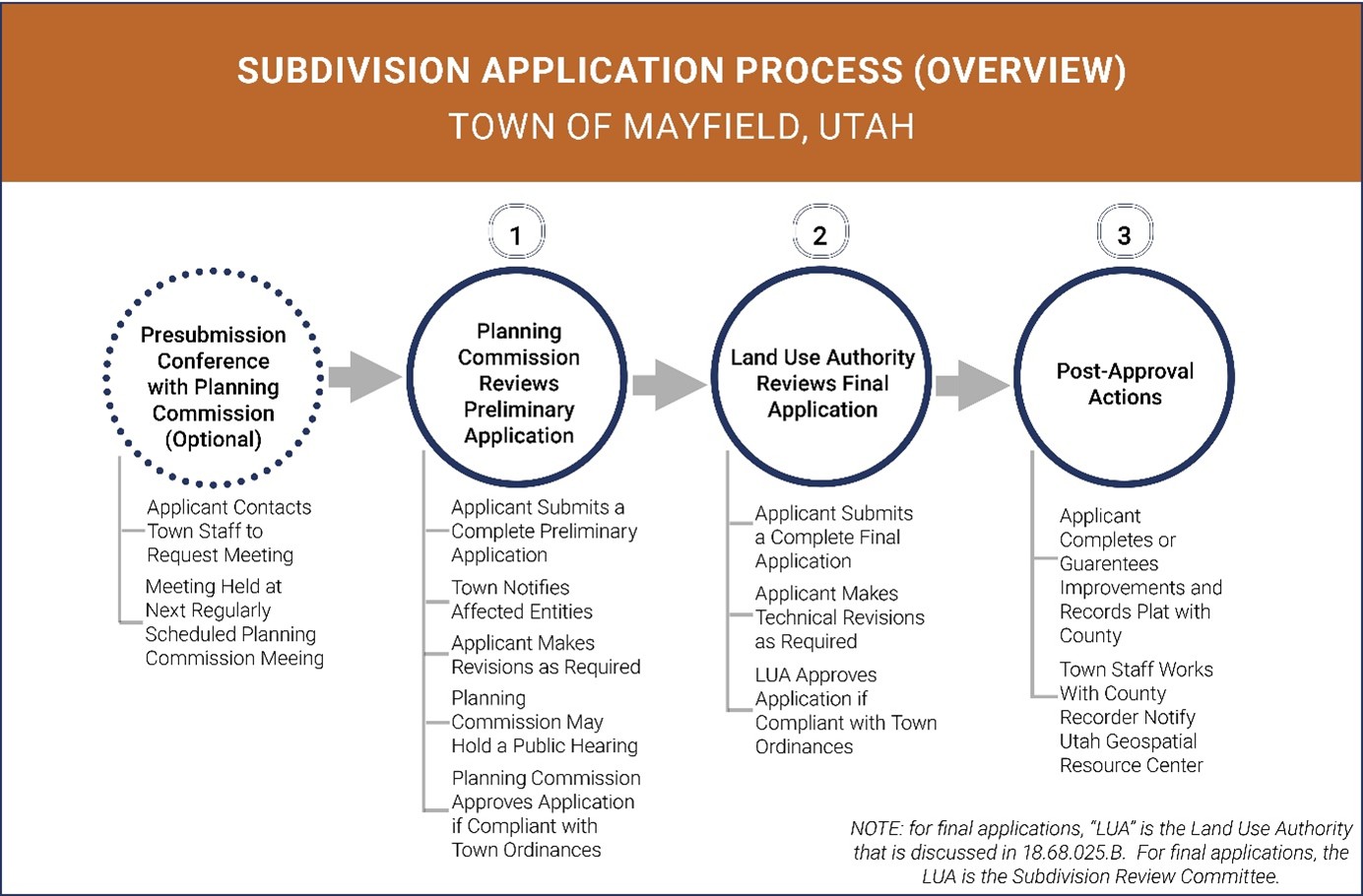
[Ord. 2024-1 § 1 (Exh. A).]
18.68.030 Presubmission conference.
Any person wishing to subdivide land within the town may request a presubmission conference to secure from the planning commission or their designated representative information pertaining to the requirements for subdivisions and the town’s plan of streets, parks, drainage, zoning and other master plan requirements affecting the land to be subdivided. If requested, the planning commission shall, within 15 business days after the request, schedule the meeting to review the concept plan and give initial feedback. [Ord. 2024-1 § 1 (Exh. A); Ord. 1998-99-A § 10-7-3.1.]
18.68.040 Prepare and submit concept plan.
The subdivider shall then prepare a concept plan and shall submit seven copies of the same to the zoning administrator, who will submit them to the planning commission not less than seven days prior to the next regularly scheduled planning commission meeting. Said plan shall be prepared in accordance with town standards. Where a subdivider owns or controls more land than he proposes to submit for preliminary approval, the planning commission may require that a concept plan for the larger area be submitted. Said plan shall indicate the portion proposed to be submitted initially for preliminary approval and the portion to be held for future submission. [Ord. 2024-1 § 1 (Exh. A); Ord. 1998-99-A § 10-7-3.2.]
18.68.050 Obtain planning commission approval of concept plan.
The planning commission shall review the concept plan and shall act to: (A) approve the plan, (B) disapprove the plan, (C) approve the plan subject to modification, or (D) where considered necessary or desirable, act to table further consideration of the plan. Approval of the concept plan shall not be construed to constitute approval of the subdivision but shall be deemed as an expression of acceptance of the basic concept and feasibility of the proposed subdivision which the subdivider may use as a guide in the preparation of the preliminary plan. [Ord. 2024-1 § 1 (Exh. A); Ord. 1998-99-A § 10-7-3.3.]
18.68.060 Prepare preliminary plan and improvement drawings.
Upon approval of the concept plan by the planning commission, the subdivider shall prepare a preliminary plan of the subdivision and shall submit seven copies of the same to the planning commission not less than seven days prior to the next regularly scheduled planning commission meeting. The preliminary plan shall be prepared in accordance with the provisions of MMC 18.68.160. The concept plan and preliminary plan may be submitted concurrently. [Ord. 2024-1 § 1 (Exh. A); Ord. 1999-2000-B § 1; Ord. 1998-99-A § 10-7-3.4.]
18.68.070 Obtain planning commission approval of preliminary plan.
The planning commission shall review the preliminary plan and shall act to: (A) approve the plan, (B) disapprove the plan, (C) approve the plan subject to modification, or (D) where considered by the planning commission to be necessary or desirable, act to table further consideration of the plan.
Approval by the planning commission shall be granted upon a finding that:
A. All plans and other materials required for consideration have been submitted in a form suitable for evaluation, and all preliminary plan review and processing fees have been paid.
B. The plan conforms to the design standards for subdivision.
C. The design adequately recognizes the natural and man-caused conditions on or in the vicinity of the proposed subdivision.
D. Each lot conforms to the requirements of the zone and will be adequately serviced.
E. The arrangement of roads, lots, easements, and other elements will provide adequate circulation and access and will result in a healthy, safe and attractive living environment.
F. The utility systems serving the area have sufficient capacity to provide adequate utility service to the development.
G. The subdivision layout will be consistent with the major street plan and other applicable elements of the major plan for the area.
The action of the planning commission shall be written on the face of two copies of the plan, one of which shall be retained in the files of the planning commission, and one of which shall be returned to the subdivider. If the plan is disapproved, the planning commission shall express its reasons therefor to the subdivider. Upon approval of the preliminary plan, the planning commission shall be committed to grant approval of the final plat, subject to full compliance with any conditions attached, unless in the opinion of the planning commission, the preliminary approval was given based on inaccurate or incomplete representations or that changes have occurred in conditions relating to the property which were not known or present at the time preliminary approval was given, and which would result in a significant detrimental effect to the public if the project were carried out as initially presented. Approval of the preliminary plan shall remain valid for a period of one year. Said approval may be extended or reaffirmed by the planning commission, for a period not to exceed one year, upon receipt of a written request from the owner. [Ord. 2024-1 § 1 (Exh. A); Ord. 1998-99-A § 10-7-3.5.]
18.68.080 Prepare and submit final plat, engineering drawings and documents to planning commission.
Upon approval of the preliminary plan by the planning commission, the subdivider shall prepare the final plat, final engineering drawings and documents and shall submit the same to the SRC, or the planning commission in the case of 1-2 family subdivision applications, not less than seven days prior to the next regularly scheduled meeting. The final plat and other required drawings and documents shall include the materials set forth in MMC 18.68.170 and shall be prepared in accordance with town standards. Failure to submit the final plats and material in accordance with said standards shall be grounds for denial. [Ord. 2024-1 § 1 (Exh. A); Ord. 1998-99-A § 10-7-3.6.]
18.68.085 Notice to affected entities.
A. Within 15 calendar days after receiving a complete subdivision application under this chapter, town staff shall provide written notice of the proposed subdivision to the facility owner of any water conveyance facility located, entirely or partially, within 100 feet of the subdivision plat.
1. To determine whether any water conveyance facility is located within 100 feet of a proposed subdivision, the land use authority shall review information:
a. From the facility owner under Utah Code Section 10-9a-211, using mapping-grade global positioning satellite units or digitized data from the most recent aerial photo available to the facility owner;
b. From the State Engineer’s inventory of canals; or
c. From a licensed surveyor who has consulted with a representative of an existing water conveyance facility that services an area near the land the application concerns.
B. To give water conveyance facilities time to provide feedback on subdivision applications, the land use authority shall not approve a subdivision application under this chapter sooner than 20 calendar days after the applicant submits a complete application. This waiting period does not apply to revised applications the applicant may submit during the application review process.
1. A water conveyance facility owner’s failure to provide comments to the land use authority about a subdivision application does not affect or impair the land use authority’s authority to approve the subdivision application. [Ord. 2024-1 § 1 (Exh. A).]
18.68.087 Review.
A. The land use authority shall review all subdivision applications under this chapter in accordance with the requirements of this section before approving or denying a subdivision application.
B. The review process begins when an applicant submits a complete application.
1. The land use authorities shall not review an incomplete subdivision application, except to determine whether the application is complete.
2. If the land use authorities determine that an application is not complete, it shall notify the applicant of the incompleteness, highlighting any insufficiencies and explaining that the application will not be reviewed until completed.
C. After the applicant submits a complete application, the land use authorities shall review and provide feedback to the applicant in a series of “review cycles.”
1. A review cycle consists of the following phases:
a. Phase No. 1. The applicant submits a complete application (or, if after the first cycle, submits a revised version of the complete application).
b. Phase No. 2. The land use authorities review the application in detail and assess whether the application conforms to local ordinances.
c. Phase No. 3. The land use authorities respond to the applicant, citing any missing requirements or areas of noncompliance and providing a detailed list of necessary revisions to the applicant, within the time frame specified in Table 18.68.087. For any required modification or addition to the application or request for more information, the land use authority shall be specific and include citations to ordinances, standards, or specifications that require the modification and shall provide the applicant with an index of all requested modifications or additions.
d. Phase No. 4. The applicant revises the application, addressing each comment or requirement the land use authorities made. The applicant must submit both revised plans and a written explanation in response to the town’s review comments, identifying and explaining the applicant’s revisions and reasons for declining to make revisions, if any. If the applicant fails to respond to a comment made by the land use authorities in its review, the review cycle is not complete, and will remain open until the applicant addresses all comments.
|
Use Type |
Approval Stage |
Max Review Phases |
Max Public Hearings |
Town Turnaround Deadline** |
Applicant Turnaround Deadline*** |
|---|---|---|---|---|---|
|
1-2 Family Residential* |
Preliminary |
4 |
1 |
30 Business Days |
180 Calendar Days |
|
Final |
1 |
0 |
30 Business Days |
180 Calendar Days |
|
|
All Other Uses |
Preliminary |
6 |
2 |
30 Business Days |
180 Calendar Days |
|
Final |
1 |
0 |
30 Business Days |
180 Calendar Days |
|
|
* Includes single-family homes, duplexes, and townhomes. ** Describes the total time (per review cycle) the town may take to complete both Phase No. 2 and Phase No. 3. *** Describes the total time (per review cycle) the applicant may take to submit a revised application before the application expires. |
|||||
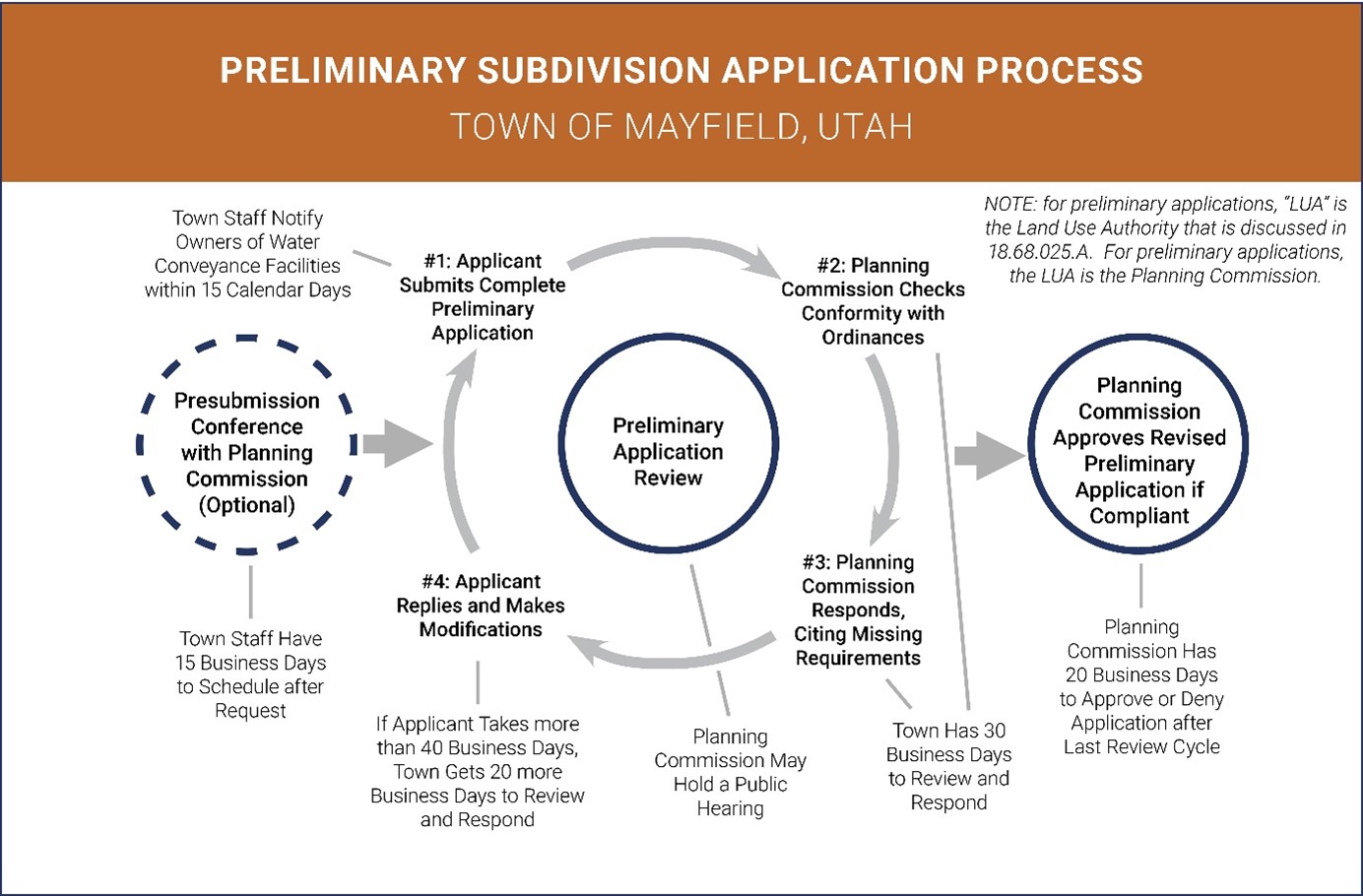
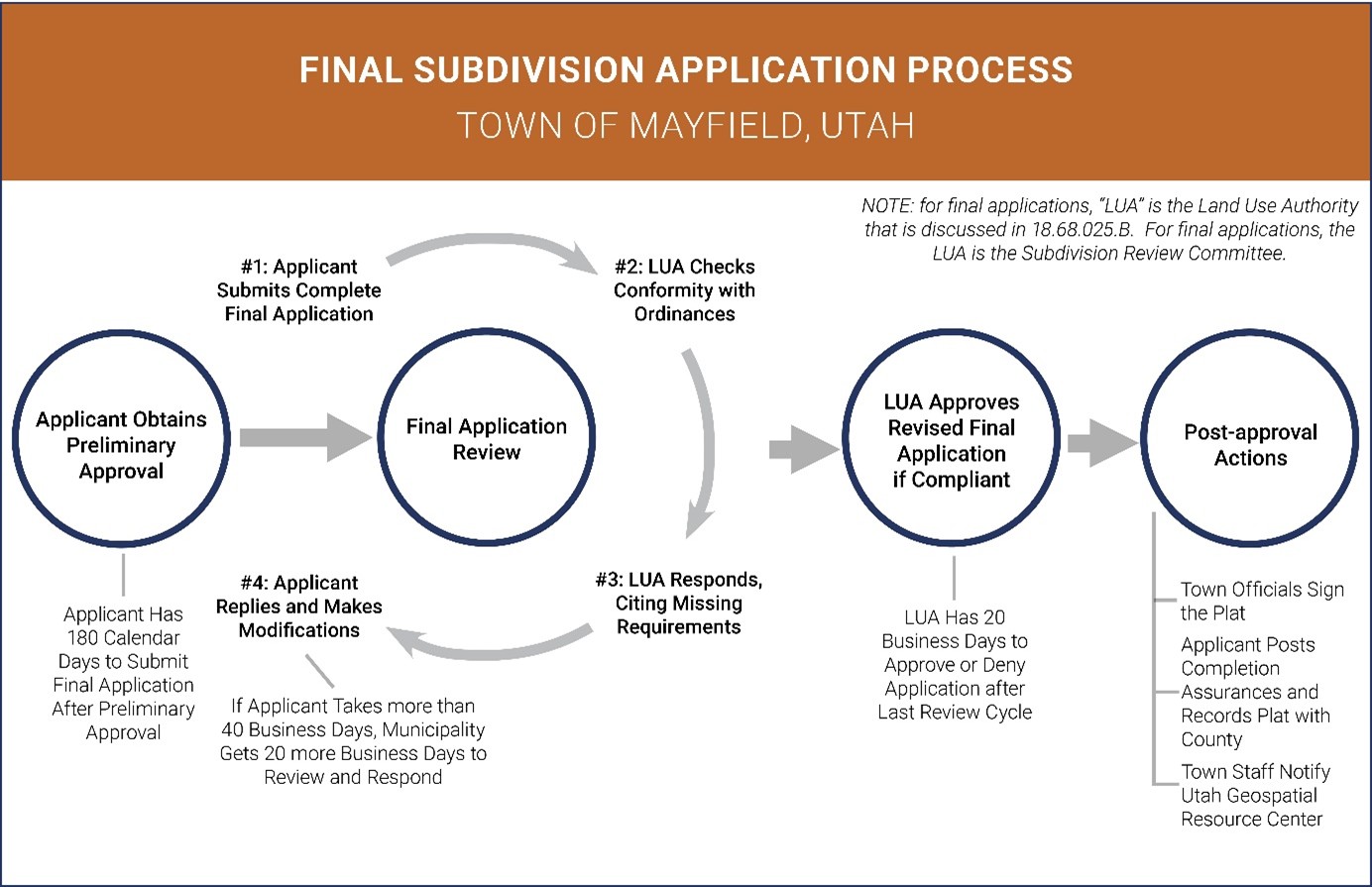
D. The land use authorities shall not (nor shall any other representative of the town) exceed the number of review cycles of the deadlines in Table 18.68.087. If no further revisions are needed, the land use authorities may end the review period early and approve or deny the application.
1. This provision notwithstanding, for any subdivision application that affects property within an identified geological hazard area, the town is exempt from limits on the number of permitted review cycles and the town’s deadlines for reviewing and responding (Phases No. 2 and No. 3).
2. If the applicant makes a material change to an application not requested by the town at any point in the review process, the land use authority may restart the review process, but only with respect to the portion of the application that the material change substantively affects.
3. If an applicant takes longer than 40 business days to submit a revised subdivision improvement plan responding to the town’s requests for modifications and additions (in Phases No. 1 and No. 4), the town shall have an additional 20 business days to review and respond to the revised application (Phases No. 2 and No. 3 of the next review cycle or issuing an approval decision).
4. If an applicant takes longer than 180 calendar days to submit a revised application and respond to the town’s requests for modifications and additions (Phases No. 1 and No. 4), the application shall, at the option of the land use authority, expire. If an application expires, the applicant must restart the subdivision application process.
E. After the last review cycle is complete, the land use authorities shall approve or deny the application within 20 business days.
1. If the land use authorities have not approved or denied the application within 10 business days after the last review, the applicant may request a final decision. After such a request, the town shall, within 10 business days:
a. For a dispute arising from the subdivision improvement plans, assemble an appeal panel in accordance with Utah Code Section 10-9a-508(5)(d) to review and approve or deny the final revised set of plans; or
b. For a dispute arising from the subdivision ordinance review, advise the applicant, in writing, of the deficiency in the application and of the right to appeal the determination to the designated appeal authority.
F. After the land use authorities provide comments in the last review cycle, the town shall not require further modifications or corrections in that review phase unless those modifications or corrections are needed to protect public health and safety or to enforce state or federal law or unless the review cycle reset due to the applicant making a material change that the land use authorities did not request.
1. With the exception of modifications or corrections that are needed to protect public health and safety, that are needed to enforce state or federal law, or that arise from the review cycle being reset, the municipality waives noncompliant subdivision-related requirements that the land use authorities do not identify during the review process.
2. The applicant shall make reasonable changes, unless prohibited otherwise by a contract or deed, to the subdivision application to accommodate the water conveyance facility to the extent required by Utah Code Section 73-1-15.5.
G. The planning commission may conduct one (but no more than one) public hearing for the purpose of asking questions of the applicant and receiving commentary on the technical aspects of the application from affected entities, interested parties, and the public. If the planning commission elects to hold this public hearing, the hearing must occur before the end of the planning commission’s review period in the last review cycle of the preliminary review phase. Scheduling issues shall not extend the review and approval deadlines in this chapter.
H. Other sections of this chapter notwithstanding, the land use authorities shall approve or deny a subdivision application under this chapter after reviewing a complete subdivision application as described in this section. [Ord. 2024-1 § 1 (Exh. A).]
18.68.090 Planning commission takes action on final plat.
Upon approval by the planning commission, the chairman shall approve and sign the plat and forward it to the SRC with the recommendation that the plat be approved and the proposed dedications accepted. However, for 1-2 family residential subdivision applications, the planning commission’s approval constitutes final approval of the subdivision. [Ord. 2024-1 § 1 (Exh. A); Ord. 1998-99-A § 10-7-3.7.]
18.68.100 Subdivider posts performance guarantee.
Upon approval by the planning commission, the subdivider shall proceed to post or make arrangements suitable to the town for posting a bond or other financial assurance guaranteeing construction of the required improvements. Said performance guarantee shall be in conformance with the provisions of Chapter 18.72 MMC. [Ord. 2024-1 § 1 (Exh. A); Ord. 1998-99-A § 10-7-3.8.]
18.68.110 SRC takes action on final plat.
Upon receipt of the final plat, bearing all required signatures, and also submission of evidence of ability to satisfy the performance guarantee requirements, the SRC shall consider the plat and performance guarantee and shall act to approve or disapprove the plat or approve it with modifications. If disapproved, the SRC shall state its reasons therefor to the subdivider. If modifications are required, such modifications must first be referred to and accepted by the planning commission. If approved, the plat shall be signed by the SRC and retained for recording. The signature of the SRC on the final plat shall constitute final approval. The town’s approval of a plat functions as an acceptance of the dedication of any streets or public places as long as funding is available. However, a plat that dedicates public streets and other public places does not impose liability upon the municipality for the dedicated street or places for them being unimproved unless (A) adequate financial assurances have been provided; and (B) the town has accepted the dedication.
For 1-2 family residential subdivision applications, the planning commission’s “preliminary” approval constitutes final approval. The SRC’s approval is not required for these subdivisions’ final plat application.
The town must approve a condominium plat that complies with the requirements of Utah Code Section 57-8-13 unless the condominium plat violates a separate land use regulation of the town. [Ord. 2024-1 § 1 (Exh. A); Ord. 1998-99-A § 10-7-3.9.]
18.68.120 Final plat to be recorded in office of county recorder.
A. The applicant shall record the approved subdivision plat with the county recorder’s office within 365 calendar days after the town approves the subdivision application; provided, that the applicant has provided all improvement guarantees required by this chapter. The applicant shall not record the approved subdivision plat until the applicant has provided all such required guarantees.
B. An approved plat not properly recorded within the timeline specified in subsection (A) of this section is void, unless the planning commission approves an extension.
C. An approved plat, the required improvements for which are not completed or guaranteed before recording, is void, unless the planning commission approves an extension.
D. Town staff shall work with the county recorder to submit, within 30 calendar days after a final plat is approved, to the Utah Geospatial Resource Center either:
1. An electronic copy of the approved plat; or
2. Geospatial data that depict any new streets and site addresses proposed for construction within the bounds of the approved plat.
3. If requested by the Utah Geospatial Resource Center, town staff shall:
a. Coordinate with the Utah Geospatial Resource Center to validate the information the town submitted about the final plat; and
b. Assist the Utah Geospatial Resource Center in creating electronic files that contain the information described in the final plat for inclusion in the unified statewide 911 emergency service database. [Ord. 2024-1 § 1 (Exh. A); Ord. 1998-99-A § 10-7-3.10.]
18.68.125 Exceptions to specific application requirements and plats.
A. Agricultural Land.
1. Applications to subdivide agricultural land are exempt from the preliminary and final plat requirements, but not the other application requirements of Article II of this chapter if the resulting parcels:
a. Qualify as land in agricultural use under Utah Code Section 59-2-502;
b. Meet the minimum size requirement of applicable town land use ordinances; and
c. Are not used and will not be used for any nonagricultural purpose.
2. For subdivision applications for which this exception applies, an applicant may submit to the town – in place of a plat – a record of survey map that illustrates the boundaries of the parcels.
3. If the town approves a subdivision application based on a record of survey map, the applicant shall record the map, signed by the town, with the county recorder’s office. This shall be done in the same manner as is done for a plat under MMC 18.68.120.
4. If a parcel resulting from a subdivision under this exception ever ceases to be used for agriculture, the subdivision shall no longer be exempt under this section and shall be required to conform to typical plat requirements. The town may, in its discretion, impose the penalty in MMC 18.80.040 and/or require a subdivision amendment before issuing a building permit.
B. Minor Subdivisions.
1. Applications to subdivide land are exempt from the preliminary and final plat requirements, improvement plan requirements, and the studies/reports requirements (but not the other application requirements) if the subdivision:
a. Results in no more than 10 parcels;
b. Is not traversed by the mapped lines of a proposed street (as shown in the Mayfield general plan), town easement, or any other land required for or intended to be dedicated for public purposes;
c. Has been approved by the culinary water authority, the sanitary sewer authority (if applicable), and the local health department;
d. Is located in a zoned area; and
e. Is already serviced by an existing and improved street such that no public improvements are required.
2. For subdivision applications for which this exception applies, an applicant may submit to the town – in place of a plat – both:
a. A record of survey map that illustrates the boundaries of the parcels; and
b. A legal metes-and-bounds description that describes the parcels illustrated by the survey map.
3. If the town approves a subdivision application based on a record of survey map and metes-and-bounds description, the applicant shall record the map and description, signed by the town, with the county recorder’s office. This shall be done in the same manner as is done for a plat under MMC 18.68.120, except that the town shall also provide the notice required in Utah Code Section 10-9a-605(1).
C. Development Agreements.
1. Subdivisions platted in a valid development agreement are exempt from the application and review and approval requirements of this chapter.
2. Clauses in a valid development agreement with the town superseded all conflicting requirements in this chapter, except where a clause in the development agreement poses a substantial danger to the health and safety of town residents. [Ord. 2024-1 § 1 (Exh. A).]
18.68.130 Release of performance guarantees.
All partial and final releases of performance guarantees shall be approved by action of the town in accordance with MMC 18.72.040 or 18.72.050 as applicable. The granting of the final release by the council shall constitute the acceptance of the improvements by the town. [Ord. 2024-1 § 1 (Exh. A); Ord. 1998-99-A § 10-7-3.11.]
18.68.140 Release of durability retainer.
At the conclusion of the durability guarantee period and subject to compliance with the provisions of MMC 18.72.070, the council shall authorize the release of the improvements durability retainer and the subdivider shall thereafter be released from any obligation with respect to the improvements. [Ord. 2024-1 § 1 (Exh. A); Ord. 1998-99-A § 10-7-3.12.]
Article III. Documentation Requirements
18.68.150 Concept plan.
The concept plan shall consist of the following:
A. A plan of the entire project area drawn at a scale of not smaller than one inch equals 200 feet and showing the general layout of the proposed subdivision and its relationship to the adjacent properties; the location of each proposed lot; the location, width and general configuration of proposed roads in the subdivision, and their relationship to the existing road system and major street plan; and major canals and watercourses in the vicinity.
B. A written or verbal statement indicating the intent and manner for complying with the improvement guarantee, pressurized irrigation system and similar requirements.
C. Evidence of payment of the subdivision application fee (see fee resolution posted on town website). [Ord. 2024-1 § 1 (Exh. A); Ord. 1998-99-A § 10-7-4.1.]
18.68.160 Preliminary plan.
The preliminary plan shall consist of the following:
A. The proposed subdivision name, which must be distinct from any subdivision name on a plat recorded in the county recorder’s office.
B. The location of the property proposed to be subdivided.
C. Total acreage of the entire proposed subdivision.
D. A layout plan, drawn at a scale of not less than one inch equals 100 feet and showing the following:
1. The boundary lines of the tract proposed to be subdivided.
2. A contour map at appropriate intervals when required by the planning commission.
3. The boundaries, course, and dimensions of all proposed lots, streets, easements, open space areas and indicating all territory proposed for dedication to the town.
4. Location, principal dimension, and names of all existing or recorded streets, alleys, and easements, both within the proposed subdivision and within 500 feet of the boundary thereof, showing whether recorded or claimed by usage; the location and principal dimensions for all watercourses, including ditches, canals, and natural drainage channels, public utilities, and existing structures within the land and adjacent to the tract to be subdivided, including railroads, and exceptional topography.
5. The size and location of all existing and proposed water mains, fire hydrants, storm drainage facilities, curb, gutter and sidewalk improvements, irrigation lines and ditches and appurtenant improvements, and any other proposed or required facilities within the subdivision or within 500 feet thereof.
6. Location of the nearest elevation benchmark and survey control monument.
7. Landowners adjoining the land to be subdivided and the boundary lines of adjacent tracts of unsubdivided land, showing ownership and property monuments.
8. Existing contours at two-foot intervals for predominant ground slopes within the tract between level and five percent grade and five-foot contours for predominant ground slopes within the tract over five percent grade. Elevations shall be based on national geodetic survey sea level data. In cases of level topography through a subdivision, one-foot contours may be required.
9. Where the plat submitted covers only a part of the developer’s land, or is part of a larger vacant area, the plat shall show the location of the subdivision as it forms part of a larger tract or parcel. In such a case, a sketch of the prospective future street system of the unplanned parts shall be submitted and the street system of the part submitted shall be considered in the light of adjustments and connections with the future street system of the larger area.
10. Signature blocks (for use after final approval) for the owners of the land to be subdivided, the planning commission chair, and the mayor.
11. A vicinity map, drawn at a scale not less than one inch equals 2,000 feet, showing the perimeter of the plat, access points, abutting subdivision outlines and names, and other relevant information within one-half mile of the perimeter of the proposed plat.
12. The proposed location of the building setback lines.
13. Any parcels of ground intended to be used as a street or for any other public use or purpose.
14. The lot or unit reference; block or building reference; street or site address; street name or coordinate address; acreage or square footage for all parcels, units, or lots; and length and width of the blocks and lots intended for sale.
E. An approved land use application that describes how the property will be used after it is subdivided.
1. If the intended use is permitted by right under town ordinances, the land use application must include citations to the specific ordinance(s) that the applicant believes authorizes the intended use.
2. If the intended use requires a conditional use permit or is otherwise conditioned on town approval, the land use application must include an approved, town-issued permit authorizing the intended use. Should an applicant seek a use permit concurrently with a related subdivision application, the subdivision application shall be considered incomplete until the use permit is issued.
3. If the intended use is prohibited under town ordinances and requires a variance or rezoning, the land use application must include an approved, town-issued variance or rezoning authorizing the intended use. Should an applicant seek a variance or rezoning concurrently with a related subdivision application, the subdivision application shall be considered incomplete until the variance is issued.
F. Preliminary engineering drawings showing the proposed cross-section for all streets within or adjacent to the subdivision, including the placement of blacktop, curb, gutter, sidewalk, water lines, and other street improvements, the proposed road grades (when required by the planning commission), irrigation pipes and ditches and the proposed engineering treatment of any proposed canal or ditch piping and any culverts and bridges, storm water retention facilities or other significant engineering features.
1. The plat must describe every existing right-of-way and recorded easement located within the plat for:
a. An underground facility;
b. A water conveyance facility; or
c. Any other utility facility.
2. The plat must also describe any water conveyance facility located, entirely or partially, within the plat that:
a. Is not recorded; and
b. Of which the owner of the land has actual or constructive knowledge, including from information made available to the owner of the land:
i. In the State Engineer’s inventory of canals; or
ii. From a surveyor under Utah Code Section 10-9a-603(6)(c).
G. An improvement plan for all public improvements proposed by the applicant or required by the town’s ordinances. The plan must contain:
1. An engineer’s estimate of the cost of completing the required improvements.
2. A description of proposed water facilities, including pipe diameters, valve locations, fire hydrant locations, water sources, water rights, reservoirs, pumps and design calculations.
3. A description of planned excavation or grading of areas requiring in excess of three-foot cuts or fills.
4. Street plans showing proposed grades, curb-gutter, sidewalks, and typical street cross sections.
5. A site plan showing proposed dwelling locations and driveway locations for each lot where sensitive or special topographic and geologic conditions exist. The planning commission may determine, after review of the preliminary application or concept plan, that lot site plans are required because existing conditions merit more specific details or requirements for developing specific lots.
6. A feasibility study that demonstrates the feasibility of the proposed water and septic systems necessary to meet the requirements of this chapter.
7. A traffic study, if one is required by an applicable UDOT Access Management Plan, for any subdivision touching Highway 117 or any other road built or maintained by UDOT.
H. A statement indicating the type of performance guarantee proposed to be offered as security for construction of the required public improvements.
I. Evidence of ability to satisfy the pressurized irrigation system and water rights conveyance requirements.
J. Notice of acceptability of the area to accommodate septic tanks, as evidenced by a letter from the town-county health department, where applicable.
K. Evidence of payment of all preliminary plan submission and processing fees found on the town’s website.
L. Signatures of each owner of record of land described on the plat, signifying their dedication and approval of the plat.
M. Letters of approval from the culinary water authority, sanitary sewer authority, fire department, and local health department.
N. A tax clearance from the owner indicating that all taxes, interest, and penalties owing on the land have been paid.
O. Certifications that the surveyor who prepared the plat:
1. Holds a license in accordance with Utah Code Chapter 58-22; and
2. Either:
a. Has completed a survey of the property described on the plat in accordance with state requirements and has verified all measurements; or
b. Has referenced a record of survey map of the existing property boundaries shown on the plat and verified the locations of the boundaries; and
c. Has placed monuments as represented on the plat.
P. If a variance is required for the land use application, an explanation of what elements or ordinances the variance is for, along with a showing that the application meets all the other elements/ordinances.
Q. An affidavit from the applicant certifying that the submitted information is true and accurate.
R. Copies of any agreements with adjacent property owners relevant to the proposed subdivision and the substance of all other covenants, grants of easements, or restrictions to be imposed upon the use of the land, buildings, and structures.
S. Any other material or information required by the planning commission.
T. If the applicant intends the plat to be or if the plat is a part of a community association subject to Utah Code Chapter 57-8a, Community Association Act, the plat includes language conveying to the association, as that term is defined in Utah Code Section 57-8a-102, all common areas, as that term is defined in Utah Code Section 57-8a-102.
U. Required Copies of Plans.
1. One electronic copy of the final plat in AutoCAD format (DWG or DXF), Geodatabase format (GDB), or Shapefile format (SHP), with a projection assigned to the file(s) and with the proper metadata that describes what coordinate system/projection the data is assigned to.
2. An electronic copy of all plans in PDF format.
3. Six printed copies of the application.
4. Two printed copies of all full-scale drawings, application and plat. The full-scale drawings should be 24 by 36 inches.
5. One copy of each drawing on 11-inch-by-17-inch sheets or eight and one-half by 11 inches if the project is small and the plans are legible at that size.
V. If the application is for a condominium, the plat must include the additional elements required in Utah Code Section 57-8-13.
Failure to submit the required material in accordance with the above standards and requirements shall be grounds for denial. [Ord. 2024-1 § 1 (Exh. A); Ord. 1998-99-A § 10-7-4.2.]
18.68.170 Final plat and engineering drawings.
The final plats and plans shall consist of the following:
A. The original final plat mylar, prepared on the forms approved by the county recorder for use in the county.
B. One duplicate mylar of the final plat together with the required number of paper copies.
C. Copies of the final engineering drawings.
D. Documents indicating full compliance with the pressurized irrigation system and water rights conveyance requirements.
E. An itemized estimate of the cost of constructing all required improvements. This estimate shall be used as the basis for setting the amount of the performance guarantee.
F. Final copies of the performance guarantee documents.
G. A title report, covering the property within the final plat area, to identify all interests in the property which have an effect on the title, and to establish that the land proposed for subdivision is free of boundary conflicts (when required by the town council).
H. Final copies of all other required documentation, as applicable.
I. Evidence of payment of final plat checking and recording fees.
Failure to submit the above final plat material shall be grounds for denial. [Ord. 2024-1 § 1 (Exh. A); Ord. 1998-99-A § 10-7-4.3.]
Article IV. Design Standards and Requirements
18.68.180 Layout and design.
The layout and design of all subdivision developments and the content of all plats, engineering plans, documentation, and other required submissions shall be in accordance with the standards as contained herein and/or as may be adopted by the town pursuant to the provisions of MMC 18.68.290. [Ord. 2024-1 § 1 (Exh. A); Ord. 1998-99-A § 10-7-5.]
18.68.190 Streets and roads – General criteria.
A. Subdivision Plans to Be Consistent with Street Plan. Subdivision plans shall be consistent with the master street plan as adopted by the town, as follows:
1. Collector Streets (Feeder). Where the area of a proposed subdivision includes any collector class streets, as shown on the major street plan, the subdivision plan shall incorporate such streets in the location shown on the street plan and the approval of the final plat shall include the dedication of the right-of-way and its improvement in accordance with the applicable town standards.
2. Minor Streets (Local Service). Where the area of a proposed subdivision includes any minor class streets, as shown on the major street plan, the subdivision plan shall provide for such street in the approximate location shown on the street plan and the approval of the final plat shall include the dedication of the right-of-way and its improvement in accordance with the applicable town standards.
3. No subdivision plan which proposes the deletion or significant realignment of any street shown on the major street plan shall be given preliminary approval unless and until the plan shall have been amended in accordance with state law.
B. Relationship to Adjacent Streets. The proposed street system shall properly align and be compatible with adjacent streets.
C. Access to Adjacent Properties. In order to facilitate the development of an adequate and convenient circulation system within the town and to provide access for the logical development of adjacent vacant properties, the town may, as a condition of approval, require the subdivision plan to include one or more temporary dead-end streets (stub streets) which extend to the boundary of the subdivision. All such stub streets shall be fully developed to the boundary of the subdivision. Any plan for the subsequent development of the adjacent property shall provide for the continuation of any such stub street. [Ord. 2024-1 § 1 (Exh. A); Ord. 1998-99-A § 10-7-5.1.]
18.68.200 Streets and roads – Right-of-way width.
The minimum width of right-of-way for streets shown on the major street plan shall conform to the width as designated on the plan. The minimum right-of-way width for streets not shown on the plan shall be as follows:
|
Class of Street |
Right-of-Way Width |
|---|---|
|
Minor class |
50 feet |
|
Collector class |
60 feet |
[Ord. 2024-1 § 1 (Exh. A); Ord. 1998-99-A § 10-7-5.2.]
18.68.210 Streets and roads – Width of pavement and other requirements.
All streets within and adjacent to the subdivision shall be hard surfaced. The width of the hard surfacing and the location and type of other required street improvements shall be in accordance with the applicable street cross-section standard adopted by the town council. [Ord. 2024-1 § 1 (Exh. A); Ord. 1998-99-A § 10-7-5.3.]
18.68.220 Streets and roads – System design standards.
A. Reverse Curves. Reverse curves shall have a tangent of at least 100 feet, unless in the opinion of the planning commission such is not necessary.
B. Street Intersection. Streets shall intersect each other as nearly as possible at right angles. Minor streets shall approach the major or collector streets at an angle of not less than 80 degrees. Offsets in street alignment of more than 15 feet or less than 120 feet shall be prohibited.
C. Street Grades. The maximum grade of any street in the subdivision shall be eight percent. Where the observance of this standard is not feasible, the town council, subject to the prior recommendation of the planning commission, shall have the power to grant an exception when special pavement surfaces and adequate leveling areas are installed and in the opinion of the town the best subdivision of the land is thereby secured.
D. Street Curves. Where the street lines within a block deflect from each other at any one point more than 10 degrees, there should be a connecting curve. The radius of the curve for the inner street line should be not less than 350 feet for collector class streets, 250 feet for an important minor class street, and 100 feet for minor streets.
E. Curbs. Where curbs are required, said curbs at intersections shall be rounded with curves having a minimum radius of 15 feet for minor streets and 25 feet for collector streets. Property lines at street intersections should be rounded with a curve where necessary to fit the curb radius.
F. Street Names. New street names should not duplicate those already existing. A street obviously a continuation of another already in existence should bear the same name. Before the street is named, the proposed name must be submitted to and approved by the town.
G. Cul-de-Sacs. Cul-de-sacs (dead-end streets) shall be used only where unusual conditions exist which make other designs undesirable. Each cul-de-sac shall have a minimum right-of-way width of 50 feet in diameter. The minimum length of a cul-de-sac street shall be not less than 400 feet. Surface water must drain away from the turnaround, except that where surface water cannot be drained away from the turnaround along the street, due to grade, necessary catch basins and drainage easements shall be provided.
H. Easements. Easements of not less than eight feet or 10 feet on each side of rear lot lines and side lines will be required where necessary for poles, wire, conduits, sewers, gas and water mains, and other public utilities. Easements of greater width may be required along property lines where necessary for surface overflow or for the extension of main sewers or similar utilities. [Ord. 2024-1 § 1 (Exh. A); Ord. 1999-2000-B § 1; Ord. 1998-99-A § 10-7-5.4.]
18.68.230 Blocks – Design standards.
A. Length. The maximum length of blocks, generally, shall be 1,200 feet and the minimum length of blocks shall be 500 feet. In blocks over 800 feet in length, the subdivider may be required to dedicate a walkway through the block at approximately the center of the block. Such walkway shall not be less than 10 feet in width.
B. Width. The width of blocks generally shall be sufficient to allow two tiers of lots.
C. Use. Blocks intended for business or industrial use shall be designed especially for such purposes with adequate space set aside for off-street parking and delivery facilities. [Ord. 2024-1 § 1 (Exh. A); Ord. 1998-99-A § 10-7-5.5.]
18.68.240 Lots – Design standards.
A. Building Sites. The lot arrangement, design, and shape shall be such that lots will provide satisfactory and desirable sites for buildings, be properly related to topography and conform to requirements set forth herein. Lots shall not contain peculiarly shaped elongations solely to provide necessary square footage which would be unusable for normal purposes.
B. Lots to Conform to Zoning Provisions. All lots shown on the subdivision plat must conform to the minimum requirements of the zone in which the subdivision is located.
C. Corner Lots. Corner lots shall have 10 feet extra width to accommodate the additional setback requirements.
D. Angle of Lot Lines. Side lot lines shall be approximately at right angles, or radial to the street line, except where topographic conditions make it advisable to have side lot lines deflect at sharper angles.
E. Parts of Lots. All remnants of lots below minimum size left over after subdividing of a larger tract must be attached to adjacent lots rather than allowed to remain as unusable parcels. Protection strips shall not be permitted.
F. Multiple Ownership of Lots. Where the land covered by a subdivision includes two or more parcels in separate ownership and the lot arrangement is such that a property ownership line divides one or more lots, the land in each lot so divided shall be transferred by deed to single ownership before approval of the final plat, and such transfer recorded in the county recorder’s office before being certified to the planning commission by the subdivider or the subdivision shall be considered as a joint project and the final plat shall be signed by all affected property owners.
G. Water, Sewer and Pressurized Irrigation Utilities. Each lot within the subdivision shall be served by the owner’s water system through lines providing flow for both culinary and fire purposes. Each lot within the subdivision shall be served by the owner’s septic collection system, except that the town may authorize the development of a subdivision project utilizing septic tanks or other individual disposal facilities where it is determined that connection of the subdivision project to the sewer system is not reasonably feasible. [Ord. 2024-1 § 1 (Exh. A); Ord. 1998-99-A § 10-7-5.6.]
Article V. Improvements
18.68.250 Improvements required in subdivision projects – To meet town specifications – To be shown on preliminary plan.
The improvements set forth under MMC 18.68.270 shall be required to be installed for all areas shown on the final plat and at all off-site locations designated at the time of final plat approval. The required improvements shall meet minimum town standards for design and quality of materials and shall be installed in accordance with minimum town standards and specifications (see MMC 18.68.290) as directed by the town. The placement and design of required improvements shall be shown on the preliminary plan. [Ord. 2024-1 § 1 (Exh. A); Ord. 1998-99-A § 10-7-6.1.]
18.68.260 Required improvements to be installed in a timely manner – Performance guarantees required.
All required improvements not in place prior to the approval of the final plat by the town council shall be installed by the subdivider within one year from the date of final approval; provided, however, that upon a showing of good and sufficient cause, the town council may approve a longer period of time for completing construction of part or all of the uncompleted improvements.
A performance guarantee securing the installation of all required improvements which have not been completed and accepted by the town council prior to final plat approval shall be required as a condition of final plat approval. The performance guarantee shall be in accordance with the provisions of Chapter 18.72 MMC. [Ord. 2024-1 § 1 (Exh. A); Ord. 1998-99-A § 10-7-6.2.]
18.68.270 List of required improvements.
The minimum improvements required for subdivisions within the town shall be as follows:
A. Streets and Roads. All streets, roads and vehicular travelways shall be dedicated to the town for use by the public and shall be improved in conformance with the town standards, except that curb, gutter and sidewalk improvements will not be required for subdivisions or portions thereof adjacent to streets which are owned by the town and which have been improved as of the effective date of this code.
B. Culinary Water. Culinary water service shall be provided to the subdivision and each lot therein, as follows:
1. Where the subdivision is not adjacent to an existing town water main which is adequate to supply the development, the subdivider shall install one or more lines connecting the subdivision with the closest adequate town line. Said off-site line(s) shall be considered as part of the required subdivision improvements.
2. Both off-site and on-site water mains and appurtenant valves and facilities shall be adequate to meet both culinary and fire flow requirements. In no case shall the water mains be less than six inches in diameter.
3. To the maximum extent possible, water mains shall be located in the right-of-way lines of public streets in the locations specified by town standards. Said mains shall be extended to the boundary of the territory shown in the final plat, including any stub streets required to provide for future access to adjacent property.
4. Water service laterals shall be installed to each lot within the subdivision. The lateral shall extend from the main line to the outer edge of the right-of-way and shall include the installation of a meter box and meter setter.
C. Fire Hydrants. All subdivisions shall have fire hydrants installed in such a manner that no dwelling unit on a lot will be more than 500 feet distance from the closest hydrant, measured along the street.
D. Sewers. Each lot within the subdivision shall be served by the owner’s septic collection system. When a sewage collection system is installed in the town, each lot within a subdivision shall be served as follows:
1. Where the subdivision is not adjacent to an existing town sewer main which is adequate to serve the development, the subdivider shall install one or more mains connecting the subdivision with the closest adequate main. Any required off-site mains shall be considered as part of the required subdivision improvements.
2. Both off-site and on-site sewer mains and appurtenant manholes and facilities shall be adequate to meet both existing and future needs for the area. In no case shall the sewer main be less than eight inches in diameter.
3. To the maximum extent possible, sewer mains shall be located in the right-of-way lines of public streets in the locations specified by town standards. Said mains shall be extended to the boundary of the territory shown in the final plat, including any stub streets required to provide for future access to adjacent property.
4. Sewer service laterals shall be installed to each lot within the subdivision. The lateral shall extend from its connection to the sewer main to the outer edge of the right-of-way.
E. Electric and Telephone. Electric power and telephone lines shall be provided to each lot. All lines and appurtenant facilities shall be located underground, except when the subdivider can show that the placement underground is not practically feasible.
F. Street Signs. Street signs shall be installed at all locations indicated on the preliminary plan. The location and design of said signs shall conform to minimum town standards.
G. Storm Drains and Facilities. To the maximum extent possible, surface water produced from the subdivision development shall be properly disposed of within the boundaries of the subdivision through the use of sumps or other on-site techniques. All sumps, culverts, drains and other facilities for the collection and disposal of surface water and irrigation water shall be installed as directed by the town engineer.
H. Environmental Hazards. Adverse environmental conditions must be eliminated or accommodated as follows:
1. Soils.
a. The placement of streets, buildings and the designation of building sites on areas of unstable soil shall be prohibited.
b. Soils with a significant erosion hazard shall be protected. Revegetation or other erosion control measures may be imposed as a condition of subdivision approval.
2. Flooding.
a. All subdivision proposals shall be consistent with the need to minimize flood damage and in accordance with the town’s flood hazard mitigation ordinance.
b. The subdivision layout shall make adequate provision for natural drainage channels and floodways.
c. All water, sewer and other utility systems and facilities located in designated flood areas shall be designed and constructed to minimize flood damage including the infiltration of flood water into the system, or discharge of the system into the flood waters.
3. Other. Where applicable, other adverse environmental conditions must also be eliminated or adequately accommodated. The additional conditions shall include but not be limited to seismic, land slide, and ground water.
I. Street Lights. Within subdivisions the responsibility for providing street lights lies with the developer of the subdivision, not the town. If a subdivision plan does not provide for street lights, it shall be so written on the plat for that subdivision. If street lights are desired by the future property owners, the cost of installing these improvements will be the responsibility of the property owners themselves and not the town.
J. Permanent Survey Monuments. No less than two permanent survey monuments shall be installed in each subdivision. The location of the monuments shall be shown on the final plat. Also, all corners on the subdivision and all lot corners in the subdivision shall be marked.
K. Irrigation water pipes shall be installed at the locations indicated on the approved improvement plan. [Ord. 2024-1 § 1 (Exh. A); Ord. 1998-99-A § 10-7-6.3.]
Article VI. Costs and Charges
18.68.280 Costs and charges.
Costs and charges in connection with the planning and development of subdivisions shall be borne by the subdivider. [Ord. 2024-1 § 1 (Exh. A); Ord. 1998-99-A § 10-7-7.]
Article VII. General Requirements
18.68.290 Standards and specifications.
The planning commission shall prepare standards and specifications for the content of subdivision plans and for the layout, design and construction of subdivisions and required improvements. Said standards and specifications shall be adopted by resolution of the town council. All such requirements shall be considered the minimum standards which must be met and shall apply to all subdivisions. [Ord. 2024-1 § 1 (Exh. A); Ord. 1998-99-A § 10-7-8.1.]
18.68.300 Streets to be dedicated.
All streets shall be dedicated for public use and shall conform to the minimum standards for width and improvement, except that the town council may accept the dedication of partial width streets, provided:
A. That said street is located at the border of the subdivision.
B. That the width proposed for dedication shall be sufficient to accommodate the minimum travel way and all utility systems as set forth in town standards.
C. That there are not existing conditions which would prevent the subsequent development of the remaining portion of the street.
D. That construction of a partial width street at the proposed location will not create an unsafe or hazardous condition. [Ord. 2024-1 § 1 (Exh. A); Ord. 1998-99-A § 10-7-8.2.]
18.68.310 Lots must abut on public street.
Each lot in a subdivision shall abut on a street dedicated to the town by the subdivision plat or an existing public street, either dedicated or which has become public by right of use, and is more than 50 feet wide. Interior lots having frontage on two streets are prohibited except in instances where topographic conditions make such design desirable. [Ord. 2024-1 § 1 (Exh. A); Ord. 1998-99-A § 10-7-8.3.]
18.68.320 Amended plats.
No change shall be made in a plat which has received final approval unless and until approval for said change has been given by both the planning commission and town council.
Any proposed vacation, alteration or amendment of a subdivision or portion of a subdivision for which a final plat has been recorded in the office of the county recorder, or of any street, lot or alley contained in the plat shall require: (A) that the entire plat or portion affected by the proposed change be vacated in accordance with the procedure set forth in Section 10-9a-609.5, Utah Code Annotated 1953, as amended, and (B) that a new plat of the affected area showing the proposed changes shall have been approved by the planning commission and council and filed in accordance with the procedures and requirements of this code. [Ord. 2024-1 § 1 (Exh. A); amended during 2010 recodification; Ord. 1998-99-A § 10-7-8.4.]
18.68.330 Work to be done by engineer or surveyor.
All engineering work must be done by, or under direction of, a professional engineer registered in the state of Utah. All land survey work must be done by, or under the direction of, a land surveyor registered in the state of Utah. [Ord. 2024-1 § 1 (Exh. A); Ord. 1998-99-A § 10-7-8.5.]
18.68.340 Drawings of record required.
Plans showing the location, size, grade and depth of all water and sewer mains, valves, manholes and other subsurface utility and service lines and facilities shall be required prior to the release of performance guarantees. [Ord. 2024-1 § 1 (Exh. A); Ord. 1998-99-A § 10-7-8.6.]
18.68.350 Variances.
Variances to the strict application of the standards and specifications adopted pursuant to MMC 18.68.290 may be authorized by the town council after recommendation from the planning commission. Such variances will be granted only upon a finding that, because of topographic or other unique physical condition, the standard appealed from:
A. Is unnecessary for the proper development of the subdivision and will not be required in the future;
B. Would cause an unreasonable hardship if adhered to; and
C. May be granted without destroying the intent of the standard of this code.
D. The appeal authority may grant a variance only if:
1. Literal enforcement of the ordinance codified in this chapter would cause an unreasonable hardship for the applicant that is not necessary to carry out the general purpose of the land use ordinances;
2. There are special circumstances attached to the property that do not generally apply to other properties in the same zone;
3. Granting the variance is essential to the enjoyment of a substantial property right possessed by other property in the same zone;
4. The variance will not substantially affect the general plan and will not be contrary to the public interest; and
5. The spirit of the land use ordinance is observed and substantial justice done.
Any variance so authorized shall be stated on the final plat. [Ord. 2024-1 § 1 (Exh. A); Ord. 1998-99-A § 10-7-8.7.]
18.68.360 Review fees.
See MMC 18.20.040. [Ord. 2024-1 § 1 (Exh. A); Ord. 1998-99-A § 10-7-8.8.]