


Chapter 9.45
STAY OUT OF DRUG AREA – SODA Revised 5/25 Revised 1/26
Sections:
9.45.010 Definitions. Revised 5/25
9.45.020 Issuance of SODA order. Revised 5/25
9.45.030 Violation of order. Revised 5/25
9.45.040 Creation, evaluation, modification, and termination of SODA zone. Revised 5/25 Revised 1/26
9.45.050 Modification and termination of SODA order. Revised 5/25
9.45.010 Definitions. Revised 5/25
Unless the context clearly requires otherwise, the definitions in this section apply throughout this chapter.
A. “Prohibited area” means, for a court order issued under this chapter, an area in which a defendant has been directed to not enter.
B. “SODA” means stay out of drug area.
C. “SODA order” means a court order issued under this chapter that specifically orders, as a condition of pretrial release and/or a condition of deferred prosecution, sentence, or deferred sentence, that the defendant stay out of one or more SODA zones.
D. “SODA zone” means a zone established under this chapter due to repeat and ongoing incidents of illegal drug activity or illegal activity involving or relating to drugs in that area.
(Ord. No. 4514, § 1, 4-1-25)
9.45.020 Issuance of SODA order. Revised 5/25
A. A judge or judge pro tempore of the Kent municipal court may issue a SODA order to anyone charged with or convicted of any criminal violation of KCC 9.12.030 or any misdemeanor or gross misdemeanor violation of the Controlled Substances Act under Chapter 69.50 RCW as adopted by KCC 9.02.520, as a condition of pretrial release, deferred prosecution, sentence, or deferred sentence.
B. A judge or judge pro tempore of the Kent municipal court may also issue a SODA order as a condition of pretrial release, deferred prosecution, sentence, or deferred sentence to anyone charged with any misdemeanor or gross misdemeanor crime if the court finds a nexus between the offense and illegal drug activity.
C. A SODA order may prohibit the defendant from entering areas designated in this chapter, individual locations within such designated areas, or such other areas as the court may deem appropriate based upon the facts and circumstances of the case. In issuing a SODA order, a judge or judge pro tempore of the Kent municipal court shall consider where a defendant is housed, employed, or receives services, based on substantiating evidence provided by the defendant, and may narrowly excise these specific locations, and reasonable ingress and egress, from the scope of the SODA order by defining permissive days and times when particularly defined locations may be visited for a particularly stated purpose.
D. A person is deemed to have notice of the SODA order when:
1. The signature of either the person named in the order or that of his or her attorney is affixed to the bottom of the order, which signature shall signify the person named in the order has read the order and has knowledge of the contents of the order; or
2. The order recites that the person named in the order, or his or her attorney, has appeared in person before the court at the time of issuance of the order.
E. Upon issuance, modification, or termination of any SODA order, the court shall promptly provide the Kent police department with a copy of the SODA order for entry into local law enforcement records.
F. Any SODA order shall describe the prohibited SODA zone determined by the court and shall conspicuously state:
WARNING: Violation of this order is a gross misdemeanor subject to a maximum penalty of 364 days in jail and/or a $5,000 fine under KCC 9.45.030. A person found in violation of this order is subject to arrest.
G. Nothing in this section shall be construed as precluding the court from issuing any other order that is not specifically a SODA order.
(Ord. No. 4514, § 1, 4-1-25)
9.45.030 Violation of order. Revised 5/25
A. If a police officer has probable cause to believe that a person is subject to an order issued under this chapter, and that a willful violation of that order is occurring in the officer’s presence, the officer may arrest that person without a warrant or other process.
B. A person who knowingly violates the terms of a SODA order by entering or remaining within a prohibited area when the order is in effect is guilty of a gross misdemeanor, punishable by a fine not to exceed $5,000 or imprisonment not to exceed more than 364 days in jail, or both such jail and fine. Further the following violations, upon conviction, carry a mandatory minimum penalty of 30 days in jail:
1. A violation that occurs at or within 1,000 feet of a playground, daycare, or school;
2. A violation that occurs within 50 feet of a transit facility or transit location, including a park and ride lot; parking structure; transit center; designated bus, trolley, light rail, or train stop and waiting area; and transit vehicle maintenance or storage facility;
3. A violation that involves any assault or other act of violence against another person or persons;
4. A violation that involves the use or possession of illegal drugs within a SODA zone while a SODA order is in effect; or
5. A third or subsequent conviction for violation of a SODA order.
C. Nothing in any provision of this chapter related to SODA orders shall prohibit a person from transiting through a SODA zone on public transportation if the person who is subject to a SODA order does not enter or exit the public transportation in a SODA zone except as the court may otherwise allow in accordance with KCC 9.45.020(C).
(Ord. No. 4514, § 1, 4-1-25)
9.45.040 Creation, evaluation, modification, and termination of SODA zone. Revised 5/25 Revised 1/26
A. SODA zones may be created, modified, or terminated by ordinance. However, a judge or judge pro tempore of the Kent municipal court may also identify additional or different areas of the city to which a defendant may not travel in an individual case and nothing within this chapter is intended to limit this judicial discretion.
B. The geographic boundaries of SODA zones shall be narrowly tailored to encompass areas of significant illegal drug activity. Unless otherwise specified, SODA zones shall include both sides of the streets, including sidewalks, that demarcate the geographic perimeter of a particular SODA zone.
C. From time to time, the Kent police department will review the areas defined in this chapter as SODA zones and will recommend to the city council any needed adjustments based on relevant data, including crime trends within and immediately surrounding each SODA zone and other areas of the city where drug activity occurs.
D. SODA Zone 1 – West Meeker Corridor. Due to high levels of significant drug activity, SODA Zone 1 (illustrated by Map A below) is established as the area of West Meeker, which is bordered on the north by Smith Street, on the south by Kent-Des Moines Road, on the east by SR 167, and on the west by Russell Road.
Map A for SODA Zone 1 – West Meeker Corridor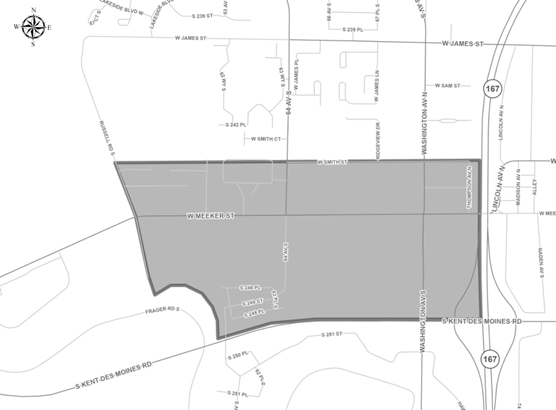
E. SODA Zone 2 – Downtown Corridor. Due to high levels of significant drug activity, SODA Zone 2 (illustrated by Map B below) is established as the area of the Downtown Corridor, which is bordered on the north by Smith Street, on the south by S. 259th Street, on the east by Central Avenue, and on the west by 3rd Avenue.
Map B for SODA Zone 2 – Downtown Corridor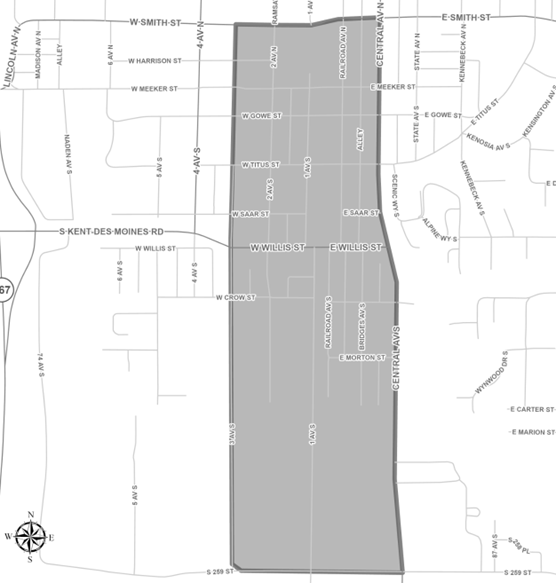
F. SODA Zone 3 – 104th and 240th Corridor. Due to high levels of significant drug activity, SODA Zone 3 (illustrated by Map C below) is established as the area of the 104th and 240th Corridor, which is bordered on the north by 236th Street, on the south by 244th Street, on the east by 11200 Block of 240th Street, and on the west by 100th Avenue.
Map C for SODA Zone 3 – 104th and 240th Corridor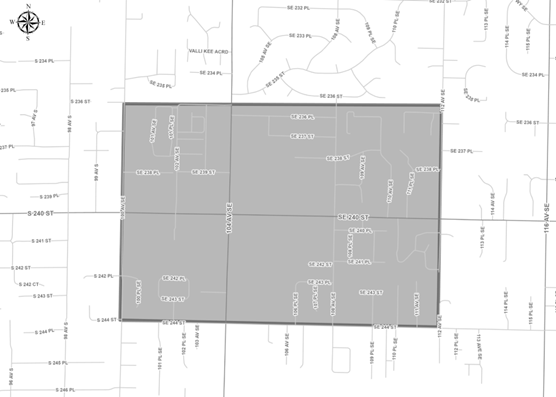
G. SODA Zone 4 – Pacific Highway South Corridor. Due to high levels of significant drug activity, SODA Zone 4 (illustrated by Map D below) is established as the area of Pacific Highway South, which is bordered on the north by S. Kent-Des Moines Road, on the south by S. 244th Street, on the east by Interstate 5, and on the west by the western border of Kent’s city limits.
Map D for SODA Zone 4 – Pacific Highway South Corridor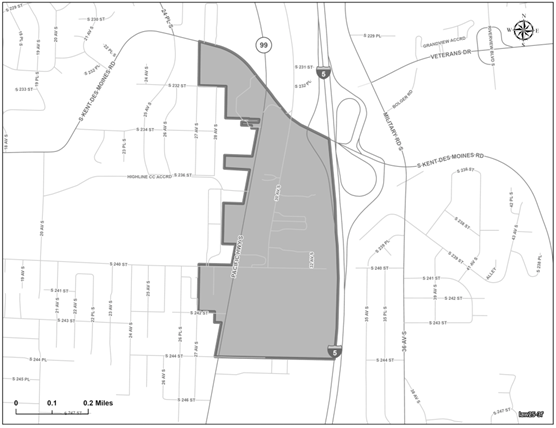
9.45.050 Modification and termination of SODA order. Revised 5/25
A. Upon request for modification or termination of any order issued under this chapter, the court shall consider the requested modification or termination by allowing for a process by which the person subject to the order can provide relevant testimony or other evidence in support of the request.
B. Unless otherwise ordered by the court, a SODA order issued under this chapter as a condition of sentence shall terminate two years from the date of issuance. SODA orders issued as pretrial conditions of release shall terminate upon dismissal of the criminal charge, upon conviction, or such other date as determined by the court.
C. Upon request for termination of any order issued under this chapter, the court may consider the requested termination by allowing for a process by which the order’s subject can provide relevant testimony or other evidence in support of the request.
(Ord. No. 4514, § 1, 4-1-25)