


Chapter 14.06
CAPITAL MALL TRIANGLE SUBAREA PLANNED ACTION ORDINANCE
14.06.000 Chapter Contents
Sections:
14.06.010 Planned Action Area
14.06.020 Transportation Limits
14.06.030 Elements of the Environment
14.06.040 Changed Conditions
14.06.010 Planned Action Area
A. The Capital Mall Triangle Subarea Planned Action is limited to those properties located within the boundaries of the Capital Mall Triangle Subarea as shown in Figure 1. Capital Mall Triangle Subarea (the Planned Action Area).
Figure 1. Capital Mall Triangle Subarea.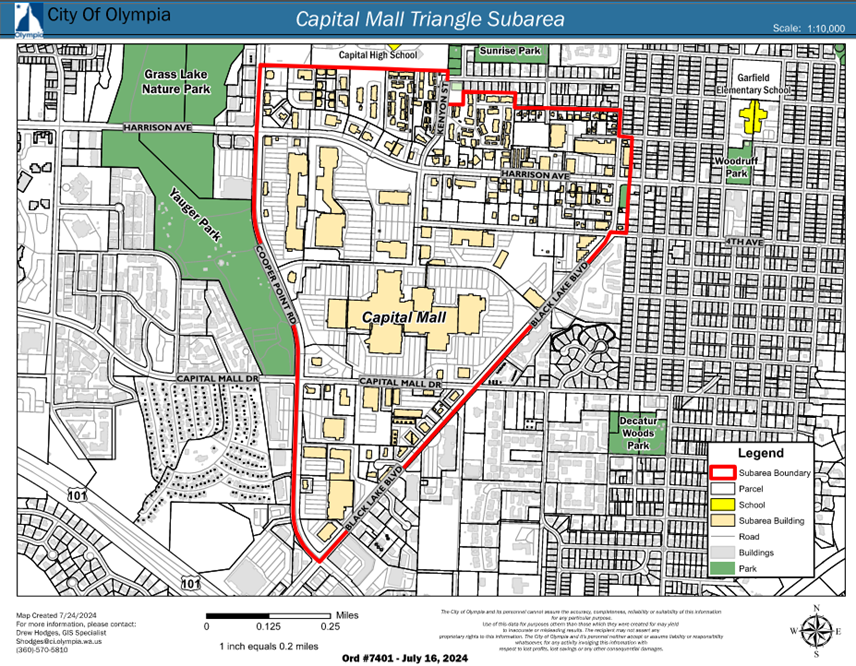
(Ord. 7430 §2, 2025).
14.06.020 Transportation Limits
A. The City has identified a net new vehicle trip end cap for the Planned Action Area, as reviewed in the Preferred Alternative of the Planned Action EIS. This trip cap was developed by reviewing both the Planned Action Area trip generation assumed in previous planning studies and the Planned Action Area trip generation as assumed in the Planned Action EIS. The net new vehicle trip end cap end is: 1,025 AM peak hour trip ends, or 1,900 PM peak hour trip ends.
1. In no case may net new vehicle trip ends exceed the trip cap established for the AM or PM peak hour. The City shall conduct monitoring to determine when the trip cap is reached. Development that results in the trip cap being exceeded will be required to conduct SEPA review in accordance with OMC Title 14 Environmental Protection.
2. All planned actions must be consistent with subsections (B) to (F) of this section.
B. SEPA Requirements
1. Up until the trip cap is reached, the SEPA Responsible Official, or designee, shall require a limited trip generation and distribution analysis prepared by any Planned Action Project applicant that must include the following elements:
i. Brief project description
ii. Expected AM Peak, PM Peak, and Daily vehicle trip ends generated
1. Vehicle trip ends must account for pass-by trips and trips that are internal to the subarea. Pass-by and internal trips will not count against the trip cap.
iii. Anticipated trip distribution, including percentage of trip generation accessing US 101 via the Black Lake Boulevard interchange
iv. Assessment of site circulation and accesses that summarizes:
1. Location of accesses, including both accesses to the internal road network of the Subarea and principal accesses to the surrounding arterial streets (Cooper Point Road, Black Lake Boulevard, Harrison Avenue, and/or Capital Mall Drive).
a. Arterial access points must be confirmed in coordination with City staff
b. Layout of internal road network serving the Planned Action Project must be confirmed with City staff to ensure consistency with the alignments and access spacing documented in the Subarea Plan and the City of Olympia Comprehensive Plan.
2. Number of AM peak hour, PM peak hour and daily trips expected to enter and exit each access.
3. Anticipated turn storage lane requirements for both internal access points and arterial access points, including number of lanes and dimensions.
4. Conformity with City standards for safe and efficient circulation and site access
v. Safety analysis including crashes from the most recent complete five-year period. The number of locations to be analyzed under this safety analysis must be confirmed with City staff, but must at minimum include all proposed access points onto existing roadways and any signalized or roundabout intersection adjacent to these access points. This safety analysis must summarize the following:
1. Crashes by severity
2. Detailed crash trends for all serious or fatal crashes, including contributing circumstance and crash type trends.
3. Detailed crash trends for all pedestrian and bicycle crashes. including contributing circumstance and crash type trends.
4. Implications of these trends on implementation of the proposed access points and Planned Action Project.
2. The SEPA Responsible Official, or designee, shall track that cumulative added vehicle trip ends (not including pass-by or internal trips) do not exceed the trip caps identified in Subsection A.
i. Once the trip cap is reached for either peak hour (consistent with the steps outlined in Subsection A), unless categorically exempt, a complete SEPA analysis will be required for any subsequent Planned Action Project. Depending on the scope of the development, this may include a traffic impact analysis consistent with the Traffic Impact Analysis guidelines contained in Chapter 4, Appendix 7 of the City of Olympia Engineering Design and Development Standards.
3. The SEPA Responsible Official, or designee, shall confirm the adequacy of the site access and circulation and safety analyses identified above.
C. Concurrency. All Planned Action Projects must meet the City’s transportation concurrency requirements standards per Chapter 15.20 of the Olympia Municipal Code.
D. Impact Fee. The applicant for a Planned Action Project shall pay applicable impact fees for improvements addressed in the impact fee ordinance, Title 15 of the Olympia Municipal Code.
E. Mitigation. Each Planned Action Project must provide its proportionate share of transportation capital improvements considered in the Planned Action EIS, so long as those improvements are not already captured in the impact fee program.
1. Definitions of mitigation measures include:
i. Mitigation Measure: Means to prevent, reduce, or control adverse environmental effects of the Planned Action Project consistent with WAC 197-11-768, as described in the Planned Action EIS and incorporated in Section 14.06.020.E.2. of this Ordinance.
ii. Performance Measure: A criterion that a Planned Action Project must adhere to in order to demonstrate mitigation is achieved consistent with the Planned Action EIS.
2. Mitigation Measures:
i. Transportation:
1. Performance Measure: A Planned Action Project applicant shall demonstrate consistency with frontage, street design, and network connectivity standards established in the Subarea Plan, the Olympia Comprehensive Plan, the Olympia Transportation Master Plan, and the City of Olympia’s Engineering Design and Development Standards, Chapter 4.
2. Mitigation Measure: A Planned Action Project application shall implement motorized and nonmotorized transportation improvements mitigating a Planned Action Project’s impacts consistent with Table E-1, the Transportation Master Plan, and City standards. The City shall condition all Planned Action Project permits to:
a. Implement system improvements related to growth in the Subarea. A Planned Action Project applicant’s responsibility to provide for system improvements is based on the payment of citywide impact fees for improvements included in the Subarea. In addition, the Planned Action Project applicant shall pay the Project’s fair share of system improvements not included in the citywide impact fee in proportion to the vehicle trips generated to support necessary improvements identified in the Planned Action EIS (proportionate share).
b. Provide site specific mitigation consistent with City standards. The City shall require safe and efficient circulation and site access and improvements attributable to each individual Planned Action Project in order to meet City standards based on the results of the Trip Generation and Distribution analysis documented in Section 14.06.020.B.
3. Mitigation Measure: Where a Planned Action Project would implement new roadways internal to the Subarea, these roadways must be consistent with the alignments and access spacing requirements documented within the Subarea Plan, the Olympia Comprehensive Plan, the Olympia Transportation Master Plan, and the Engineering Design and Development Standards, or as amended by the Director of Public Works or designee. The Planned Action Project applicant shall coordinate with the SEPA Responsible Official, or designee, to confirm consistency with the most recent City plans and expectations for the Subarea.
4. Mitigation Measure: Pending the review of the site access and circulation evaluation and safety evaluation defined in section B above, the Planned Action Project applicant shall implement any necessary improvements to facilitate access or mitigate potential safety hazards identified in these studies. These mitigations can be achieved either through construction of required improvements or through a proportionate mitigation payment, to be determined by the SEPA Responsible Official, or designee, as noted in F(3), below.
5. Mitigation Measure: Where a Planned Action Project’s street frontage includes an existing or planned transit stop, including those plans documented in the Planned Action EIS, such development must be conditioned to install transit stops and transit supportive infrastructure to the standards of the City and Intercity Transit.
6. Mitigation Measure: The SEPA Responsible Official, or designee, shall condition all Planned Action Projects to ensure the proposed use or development contributes to the Subarea achieving the desired reduction in vehicle travel, as documented in the Planned Action EIS. Planned Actions must implement transportation demand management (TDM) measures consistent with the Subarea Plan and the Transportation Master Plan. The City will record conditions of approval applicable to future tenants to ensure the TDM measures are implemented.
Table E-1. Transportation Improvements
|
Assumed ID |
Project Name |
Description |
Mode Priority |
|---|---|---|---|
|
CROSSWALK IMPROVEMENTS ON ARTERIALS |
|||
|
1 |
Harrison Avenue and Kenyon Street Pedestrian Safety Improvements |
Improve Harrison Avenue and Kenyon Street intersection for greater pedestrian safety |
Pedestrian |
|
2 |
Harrison Avenue east of Kenyon Street Mid-Block Crossing(s) |
Add mid-block crossing(s) on Harrison Avenue east of Kenyon Street. Consider any future Bing St connection. |
Pedestrian |
|
3 |
Harrison Avenue and Division Street Pedestrian Safety Improvements |
Improve the Harrison Avenue and Division Street intersection for greater pedestrian safety |
Pedestrian |
|
4 |
Cooper Point Road north of Skate Park Mid-block Crossing |
Add a mid-block crosswalk on Cooper Point Road north of the Skate Park crosswalk and south of Harrison Avenue |
Pedestrian |
|
5 |
Cooper Point Road north of Capital Mall Drive Mid-block Crossing |
Add mid-block crossing(s) on Cooper Point Road just north of Capital Mall Drive |
Pedestrian |
|
6 |
Cooper Point Road south of Capital Mall Drive Mid-block Crossing |
Add mid-block crossing(s) on Cooper Point Road just south of Capital Mall Drive |
Pedestrian |
|
BICYCLE FACILITIES |
|||
|
7 |
Cooper Point Road and Harrison Avenue Bicycle Safety Improvements |
Implement safety improvements at the Intersection of Cooper Point Road and Harrison Avenue |
Bicycle |
|
8 |
Capital Mall Drive SW Enhanced Bike Lane |
Implement enhanced bike lane along 7th Ave SW/Capital Mall Drive/9th Ave SW between Kaiser Road SW and Fern Street SW and along Fern St between 9th Ave SW and the 11th Ave Pathway |
Bicycle |
|
ROUNDABOUTS |
|||
|
9 |
9th Avenue and Black Lake Boulevard Roundabout |
Construct a roundabout at 9th Avenue and Black Lake Boulevard |
Multimodal |
|
10 |
Harrison Ave Roundabouts |
Design and construct roundabouts (or other intersection improvements) as determined by the Harrison Ave corridor study. |
Multimodal |
|
11 |
Black Lake Boulevard Roundabouts |
Design and construct roundabouts (or other intersection improvements) as determined by the Black Lake Boulevard corridor study. |
Multimodal |
|
12 |
Cooper Point Roundabouts |
Consider designing and constructing roundabouts on Cooper Point Rd SW at Capital Mall Dr SW and Mall Loop Dr and other locations along Cooper Point Rd SW within the subarea consistent with the Transportation Master Plan. |
Multimodal |
F. Discretion.
1. The City’s SEPA Responsible Official, or designee, shall determine incremental and total vehicle trip generation, consistent with the version of the Institute of Transportation Engineers (ITE) Trip Generation Manual that is in effect at the date of application submittal, or an alternative method accepted by the responsible City official, or designee, at their sole discretion, for each Planned Action Project application proposed under this Planned Action.
2. The City’s SEPA Responsible Official, or designee, shall condition all Planned Action Project applications to meet the provisions of this Planned Action Ordinance and the Olympia Municipal Code.
3. The City’s SEPA Responsible Official, or designee, shall condition all Planned Action Project applications to either:
i. Pay for the full cost of implementation of pertinent mitigations identified in Table E-1 or to satisfy access or mitigate safety impacts if the SEPA Responsible Official, or designee, determines that the Planned Action Project is fully responsible for impacts necessitating the given mitigation; or,
ii. Pay a proportionate share of cost of the project improvements outlined in Table E-1 or to satisfy access or mitigate safety impacts. Proportionate share will be contingent on the timeline of when the project files for building permit, and shall be calculated in coordination with the SEPA Responsible Official, or designee.
G. Frontage Improvements: Nothing in this Chapter may be construed to mean that any project is exempt from frontage improvements required in the Engineering Design and Development Standards. (Ord. 7430 §2, 2025).
14.06.030 Elements of the Environment
A project that would result in a significant change in the type or degree of adverse impacts to any element(s) of the environment analyzed in the Planned Action EIS will not qualify as a Planned Action Project. (Ord. 7430 §2, 2025).
14.06.040 Changed Conditions
Should environmental conditions change significantly from those analyzed in the Planned Action EIS, the City’s SEPA Responsible Official, or designee, may determine that the Planned Action Project designation is no longer applicable until supplemental environmental review is conducted. (Ord. 7430 §2, 2025).