


Chapter 20.56
OFF-STREET PARKING AND LOADING
Sections:
20.56.010 New and existing facilities to provide parking and loading.
20.56.020 Diminution of parking area prohibited.
20.56.040 Off-site parking facilities control.
20.56.050 Joint use of parking facilities.
20.56.060 Off-street automobile parking requirements.
20.56.070 Off-street loading requirements.
20.56.080 Parking and loading areas—Development requirements generally.
20.56.090 Downtown parking exemption—Conditional use permit required.
20.56.010 New and existing facilities to provide parking and loading.
Off-street automobile parking areas and off-street loading areas as hereinafter set forth shall be provided and maintained:
(1) For any new building or structure erected;
(2) For additional seating capacity, floor area, or guest rooms or dwelling units added to any existing building or structure. (Ord. 1002 (Attachment A) (part), 1989)
20.56.020 Diminution of parking area prohibited.
Off-street parking and loading areas which existed on the effective date of the ordinance codified in this chapter or which subsequent thereto are provided for the purpose of complying with the provisions of this code shall be retained and maintained or the equivalent parking and loading areas provided. (Ord. 1002 (Attachment A) (part), 1989)
20.56.030 Location.
Off-street parking and loading areas shall be provided on the same lot with the main building or structure or use unless approved in compliance with the provisions of Section 20.56.040 or 20.56.050 (Ord. 1002 (Attachment A) (part), 1989)
20.56.040 Off-site parking facilities control.
The location of off-site facilities in relation to the use served shall be governed by the following provisions:
(1) Residential Uses. Parking facilities required for dwelling units shall be located on the same property as the use served. Spaces required for other uses allowed in residential zones such as churches may be located on a lot adjacent to or directly across the street or alley from the plot occupied by the use served; but in no case at a distance in excess of three hundred feet from such use;
(2) Nonresidential Uses. No more than twenty-five percent of the parking spaces required for nonresidential uses may be located on other than the same property as the use to be served (off-site) if a conditional use permit is obtained pursuant to the provisions of Chapter 20.66 and the following standards are met:
(A) All required parking spaces will be within five hundred feet of the property to be served.
(B) Off-site parking facilities shall be and remain in the same possession and ownership as the property occupied by the use or building for which the parking facilities are required unless such facilities are shared facilities as provided in Section 20.56.050.
(C) Nonresidential off-site parking facilities may be located in a residential district, provided all other standards are met.
(3) The city council in granting a conditional use for a nonresidential off-site parking facility may require a higher standard of screening and landscaping than that required by Section 20.56.080. (Ord. 1002 (Attachment A) (part), 1989)
20.56.050 Joint use of parking facilities.
A parking area may be used for a loading area during those times when the parking area is not needed or used.
The automobile parking space provided by churches, schools and similar places may be made available as a public or private parking lot when the use thereof is not required by the church, school or similar place for which such parking was provided, regardless of the district wherein located, provided the lot is developed as prescribed in this title.
(1) A parking area may be used for a loading area during those times when the parking area is not needed or used.
(2) Churches, schools, community centers, and other similar places may share their parking areas with other uses; provided, that:
(A) The hours of operation of the two or more activities which will be using shared parking do not overlap.
(B) The number of shared parking spaces does not exceed twenty-five percent of the total number of required parking spaces for the use and the applicant acknowledges in writing that a failure to continuously maintain the total number of spaces required will compel the immediate reduction of the intensity of the use served to the extent necessary to bring it into full conformance with the parking requirements of this chapter.
(C) An agreement in writing approved by the administrator is executed by the parties and recorded with the county auditor stipulating, at a minimum, the conditions under which the parking is to be shared, the term of the agreement, the conditions under which the agreement can be terminated and a provision for notifying the city in the event of such termination.
(D) A conditional use permit shall be required pursuant to the provisions of Section 20.56.040, for shared off-street parking facilities which are intended to serve as off-site parking for a nonresidential use. (Ord. 1002 (Attachment A) (part), 1989)
20.56.060 Off-street automobile parking requirements.
Off-street automobile parking having dimensions not less than as set forth in Figure 1 in Section 20.56.080 for each automobile shall be provided and approved by the zoning administrator in the amounts not less than those listed below:
|
Use |
Amount Required |
||
|---|---|---|---|
|
(1) |
Residential Uses: |
||
|
|
(A) |
Single-family dwellings |
Three spaces per dwelling unit. |
|
|
(B) |
Multifamily dwelling |
Three spaces per dwelling unit. |
|
(2) |
Commercial Residential Uses: |
||
|
|
(A) |
Hotel |
One space per guest room or suite. |
|
|
(B) |
Motel |
One space per guest room or suite plus one additional space for the owner or manager. |
|
|
(C) |
Club; lodge |
Spaces to meet the combined minimum requirements of the daytime uses being conducted, such as hotel, restaurant, auditorium, etc. |
|
(3) |
Places of Public Assembly: |
||
|
|
(A) |
Church |
One space per four seats or every eight feet of bench length in the main auditorium. |
|
|
(B) |
Library; reading room |
One space per 400 square feet of floor area plus one space per two employees. |
|
|
(C) |
Preschool nursery; kindergarten |
Two spaces per teacher, plus off-street student loading and unloading facilities. |
|
|
(D) |
Elementary or junior high school |
Two spaces per classroom, plus off-street student loading and unloading facilities. |
|
|
(E) |
High school |
One space per classroom plus one space per administrative employee plus one for each six students plus off-street student loading and unloading facility. |
|
|
(F) |
Other auditorium, meeting room |
One space per four seats or eight feet of bench length. |
|
(4) |
Commercial Amusements: |
||
|
|
(A) |
Bowling alley |
Five spaces per alley plus one space per two employees. |
|
|
(B) |
Dance hall, skating rink |
One space per 75 square feet of gross floor area plus one space per two employees. |
|
(5) |
Commercial: |
||
|
|
(A) |
Retail store except as provided in subsection (5)(B) of this section |
One space per 200 square feet of gross floor area, plus one space per every two employees. |
|
|
(B) |
Service or repair shop; retail store handling exclusively bulky merchandise such as automobiles and furniture |
One space per 400 square feet of gross floor area, plus one space per every two employees. |
|
|
(C) |
Bank; office buildings (except medical and dental) |
One space per 400 square feet of gross floor area plus one space per two employees. |
|
|
(D) |
Medical and dental clinic |
One space per 150 square feet of gross floor area plus one space per two employees. |
|
|
(E) |
Eating and drinking establishments |
One space per 100 square feet of gross floor area. |
|
|
(F) |
Mortuaries |
One space per four seats or eight feet of bench length in chapels. |
|
(6) |
Industrial: |
||
|
|
(A) |
Storage warehouse; manufacturing establishment; rail, or trucking freight terminal |
One space per employee or per 1,000 square feet of gross floor area whichever is greater. |
|
|
(B) |
Wholesale establishment |
One space per employee or per 1,000 square feet of gross floor area whichever is greater plus one space per 700 square feet of patron-serving area. |
|
(7) |
Municipal Buildings |
One space per 600 square feet of gross floor area plus one space per two employees. |
|
(Ord. 1831 § 9, 2025; Ord. 1733 § 1, 2018: Ord. 1002 (Attachment A) (part), 1989)
20.56.070 Off-street loading requirements.
Off-street loading space shall be provided in the size and amounts listed below:
(1) Loading space size of twelve feet wide, twenty feet long, and fourteen feet high minimum dimensions.
|
(A) |
Multifamily dwellings with 10 or more dwelling units |
One space total. |
|
(B) |
Buildings used entirely for office occupancy |
One space up to 2,000 square feet of gross floor area, plus one additional space for each additional 40,000 square feet of floor area or fraction thereof. |
(2) Loading space size of twelve feet wide, thirty feet long and fourteen feet high minimum dimensions.
|
(A) |
All buildings except residential and those used entirely for office use |
One space up to 2,000 square feet of gross floor area, plus one additional space for each additional 40,000 square feet of floor area or fraction thereof. |
(Ord. 1002 (Attachment A) (part), 1989)
20.56.080 Parking and loading areas—Development requirements generally.
All parking and loading areas except those for single-family dwellings shall be developed and maintained as follows; provided, that single-family dwellings shall conform to the surfacing and dimensional requirements established in this section:
(1) Location on Site. The location of parking and loading areas for a proposed development is subject to the approval of the city public works director, prior to issuance of a building permit. Proposed parking and loading areas must be clearly shown on the proposed project’s site plans with detailed notes regarding angles and measurements for each parking space. Designated parking areas shall be preferably oriented towards the street and shall be designed to maximize sightlines and minimize traffic and safety concerns.
(2) Surfacing. All driveways, parking and loading areas shall be paved with asphalt or concrete surfacing and shall be adequately designed, graded and drained as required by the city public works director; provided, that in the industrial district gravel parking surfaces may be authorized by the public works director.
(3) Bumper Guards or Wheel Barriers. Bumper guards and wheel barriers shall be so installed that no portion of a vehicle will project into a public right-of-way or over adjoining property. The area beyond the wheel barriers or bumper guards shall be paved or covered with evergreen ground cover.
(4) Size of Parking Spaces and Driveways. The parking area, each parking space and driveway shall be of sufficient size and all curves and corners of sufficient radius to permit the safe operation of a standard sized automobile, to-wit:
a. Parking space: see Figure 1;
b. Maximum eight percent grade for driveways;
c. Directional signs and pavement marking shall be used to control vehicle movement in the parking lot.
(5) Access. All industrial parking or loading areas shall be served with either separate ingress and egress driveways or with an adequate turnaround which is always available and usable. All entrances and exits onto a public right-of-way shall first have the approval of the public works director.
(6) Fences, Walls and Hedges.
a. When the parking or loading area is within any of the residential districts, such area shall be enclosed with a sight-obscuring ornamental fence, wall or hedge, except along an alley;
b. When the parking or loading area is adjacent to any of the residential districts, there shall be a sight-obscuring ornamental fence, wall, or hedge between the parking or loading area and the residential district, except along an alley;
c. The ornamental fence or wall shall be erected and maintained at a height of at least four feet but not more than seven feet; a compact evergreen hedge shall be not less than three feet. Fences, walls or hedges shall set back from all streets and vision clearance areas the same as if it were a one-story building in the district in which such parking or loading area is located. In yard areas other than those adjacent to a street, the fence may be located on the property line.
(7) Lighting. Any lighting use to illuminate a parking or loading area shall be so arranged as to be directed entirely onto the loading or parking area, shall be deflected away from any residential use and shall not cast a glare or reflection onto moving vehicles on public right-of-way.
(8) Plans and Permits. Plans at a workable scale shall be submitted to the public works director for approval prior to issuing a permit for a parking or loading area.
Figure 1
|
a |
b |
c |
d |
e |
f1 |
f2 |
|---|---|---|---|---|---|---|
|
|
|
|
|
|
Center to Center Width of Two-Row Bin With Access Road Between |
|
|
Parking Angle (Degrees) |
Stall Width |
Staff to Curb (19'-Long Stall) |
Aisle Width* |
Curb Length |
Front of Stall—Front of Stall |
Overlap Front of Stall—Front of Stall |
|
0° |
9'0" |
8.0 |
12.0 |
22.0 |
28.0 |
- |
|
20° |
9'0" 9'6" 10'0" |
15.0 15.5 15.9 |
11.0 11.0 11.0 |
26.3 27.8 29.2 |
41.0 42.0 42.8 |
32.5 33.1 33.4 |
|
30° |
9'0" 9'6" 10'0" |
17.3 17.8 18.2 |
11.0 11.0 11.0 |
18.0 19.0 20.0 |
45.6 46.6 47.4 |
37.8 38.4 38.7 |
|
40° |
9'0" 9'6" 10'0" |
19.1 19.5 19.9 |
12.0 12.0 12.0 |
14.0 14.8 15.6 |
50.2 51.0 51.8 |
43.3 43.7 44.1 |
|
50° |
9'0" 9'6" 10'0" |
20.4 20.7 21.0 |
12.0 12.0 12.0 |
11.7 12.4 13.1 |
52.8 53.4 54.0 |
47.0 47.3 47.6 |
|
60° |
9'0" 9'6" 10'0" |
21.0 21.2 21.5 |
18.0 18.0 18.0 |
10.4 11.0 11.5 |
60.0 60.4 61.0 |
55.5 55.6 56.0 |
|
70° |
9'0" 9'6" 10'0" |
21.0 21.2 21.2 |
19.0 18.5 18.0 |
9.6 10.1 10.6 |
61.0 60.9 60.4 |
57.9 57.7 57.0 |
|
80° |
9'0" 9'6" 10'0" |
20.3 20.4 20.5 |
24.0 24.0 24.0 |
9.1 9.6 10.2 |
64.3 64.4 65.0 |
62.7 62.7 63.3 |
|
90° |
9'0" 9'6" 10'0" |
19.0 19.0 19.0 |
24.0 24.0 24.0 |
9.0 9.5 10.0 |
62.0 62.0 62.0 |
- - - |
|
|
||||||
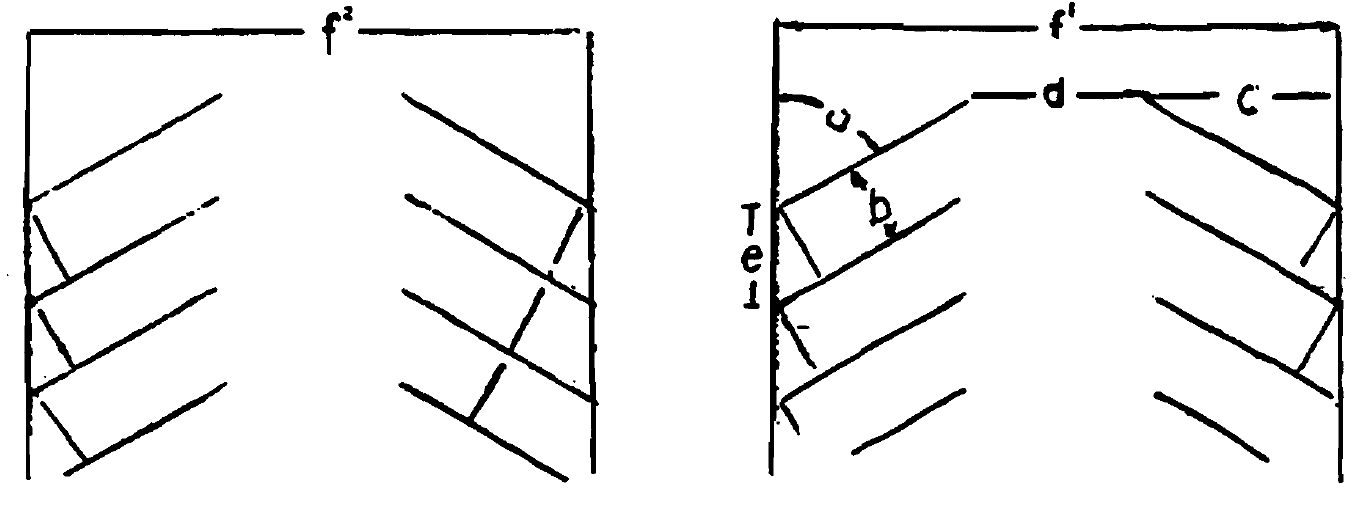
* For two-way circulation the minimum aisle width shall be twenty feet; adequate ingress, egress and turnaround space shall be provided.
No portion of a parking space or aisle shall be located in a required landscaped yard.
(Ord. 1831 § 10, 2025; Ord. 1733 § 2, 2018: Ord. 1002 (Attachment A) (part), 1989)
20.56.090 Downtown parking exemption—Conditional use permit required.
Exemptions from the standard off-street parking requirements set forth in this chapter for developed commercial properties located in the downtown commercial area may be approved by the city council where consistent with the following:
(1) This section establishes an exemption from the off-street automobile parking space requirements established under Section 20.56.060 and/or the off-street loading space requirements established under Section 20.56.070.
(2) Exemptions under this section are limited to those properties either fronting on Cherry Street between Boundary Street and Columbia Street or fronting on Garfield Street between Cherry Street and Sumas Avenue that contain an existing primary commercial structure as of the effective date of the ordinance codified in this section.
(3) Applications for such exemptions shall be submitted and processed as conditional use permit applications pursuant to Chapter 20.66. Such applications shall be submitted using the forms prepared by the city and shall be subject to payment of the application fees established in Chapter 20.108.
(4) Approval of such an application shall be granted only where the city council finds that the criteria set forth under Section 20.66.020 are met and where the conditions set forth in subsections (5) through (8) of this section are also met.
(5) The parking exemption shall not apply to properties that do not contain at the time of application a primary commercial structure that was existing as of the effective date of the ordinance codified in this section.
(6) The parking exemption shall only apply to use of an existing primary structure and shall not apply to the expansion of such structure, such as the expansion of the building footprint or the addition of a second story.
(7) The parking exemption shall not be applicable to a property where an off-site parking agreement is in place unless the city council specifically authorizes the termination or amendment of said off-site parking agreement.
(8) The applicant shall demonstrate that the parking exemption is necessitated by a proposed change of use of an existing structure where sufficient space to meet standard parking requirements on the site is not available because the footprint of the structure occupies all or nearly all of the subject property, thereby leaving insufficient additional area available for development of required on-site, off-street parking.
(9) The city council may establish conditions in relation to any such application to provide mitigation or compensation for all or a portion of the on-site parking that would otherwise be required. (Ord. 1582 § 1, 2011)