


Chapter 17.150
DEFINITIONS
Sections:
17.150.010 Purpose.
The purpose of this chapter is to define terms used in the CBDC and other terms that may arise interpreting the CBDC.
(1) Applicability. The definitions in this chapter apply to actions and interpretations of the CBDC.
(2) General Provisions. Terms not identified herein shall have their ordinary accepted meanings within the context they are used pursuant to the current edition of the Websters New International Dictionary of the English Language, unabridged. Where the singular variation of a term is used it also includes the plural.
(3) Conflicting Definitions. Where a term is listed in this chapter but defined by another section of this title, the term is not redefined in this chapter for purposes of that other code or statute. Unless the context clearly requires otherwise, the definitions in this section shall apply to terms in this title. In addition to definitions provided below, there are chapter-specific or section-specific definitions in this title.
(4) All definitions related to the city’s flood management regulations can be found in CBDC 17.318.060. [Ord. 518 § 8 (Exh. 1), 2019].
17.150.020 Definitions.
The following definitions are organized alphabetically.
A.
Access – The place, means, or way by which pedestrians and vehicles shall have safe, adequate, and usable ingress and egress to a property or use, as required by this title.
Access easement – An easement conveyed for the purpose of providing pedestrian, vehicle, bicycle, and/or similar access.
Access way – Pedestrian and/or bicycle connections between streets, rights-of-way, or a street or right-of-way and a building, school, park, transit stop, or other destination.
Accessory building/structure – A detached, subordinate building located on the same lot with the main building (except as provided by Chapter 17.314 CBDC) occupied by or devoted to an accessory use. If an accessory building is attached to the main building in a substantial manner as by a wall or roof, or as determined by the building official, the building shall be considered part of the main building. Examples of accessory structures include but are not limited to: buildings not attached to the main building (e.g., garages, carports, guest houses, workshops, and sheds), arbors, gazebos, and mechanical equipment.
Accessory dwelling unit – See “Dwelling, Accessory dwelling unit.”
Accessory use – A use customarily incidental and subordinate to the principal use of the building or land and located on the same lot (except as provided by Chapter 17.314 CBDC). In no case shall the accessory use dominate in area, extent, or purpose the principal lawful use of the building or land.
Addition (to an existing building) – Any walled and roofed expansion to the perimeter of a building in which the addition is connected by a common load-bearing wall other than a firewall. Any walled and roofed addition that is connected by a firewall or is separated by independent perimeter load-bearing walls is considered to be new construction.
Adjacent – Near, close; for example, an industrial district across the street or highway from a commercial district shall be considered as “adjacent.”
Adjoin – The same as “abutting.”
Adjustment review – A review process to allow greater flexibility in site and building design than afforded by development standards in this title to encourage innovative and desirable projects; workforce, affordable and senior housing; energy conservation; and economic development.
Administrative service – Consulting, record-keeping, clerical, or public contact services that deal directly with the citizen, together with incidental storage and maintenance of necessary vehicles, and excludes commercial use type “professional and administrative service.” Typical use types are associated with governmental offices.
Adult business – A business establishment where sexual activity, services, merchandise and/or entertainment is offered.
Affordable housing – Residential property as defined by the U.S. Department of Housing and Urban Development as an “affordable dwelling.”
Agricultural sales – Sale of feed, grain, fertilizers, pesticides, and similar goods from the premises. Typical uses include hay, feed, and grain stores.
Animal waste processing – The processing of animal waste and by-products, including, but not limited to, animal manure, animal bedding waste, and similar by-products of an animal-raising agricultural operation, for use as a commercial fertilizer or soil amendment and including composting for commercial purposes.
Apartment. See “Dwelling, Multi-unit.”
Applicant – Any person or his or her authorized agent or representative who has applied for a permit and who has a valid, existing legal interest in the property proposed to be developed.
Area of special flood hazard – The land in the floodplain subject to a one percent chance or greater of flooding in any given year as shown on flood insurance rate maps (FIRM) or except as otherwise determined by the Federal Emergency Management Agency (FEMA).
Arterial street. See “Street, Major arterial” and “Street, Minor arterial.”
Assessment – An estimation or determination of the significance, importance, or value of land, buildings, or a proposed development activity.
B.
Basement – The portion of a building between floor and ceiling which is wholly or partly below grade and so constructed that the vertical distance from grade to the floor is equal to or greater than the vertical distance from grade to ceiling.
Bedroom – Any space in a dwelling unit which contains a minimum of 70 square feet of floor area exclusive of garages, attic space, or similar spaces which are not habitable, such as foyers, storage closets, utility rooms, or unfinished attics and basements, that meets all of the following:
(a) Is a room that is a “habitable space” as defined by the current applicable building code;
(b) Meets the applicable building code requirements for natural light, ventilation, and emergency escape and rescue windows; and
(c) Is a room that is accessed by a door on an interior wall and that does not provide access to another room except for a bathroom, toilet room, closet, hall, or storage or utility space.
Billboard – A surface whereon advertising matter is set in view conspicuously and the advertising thereon does not apply to the premises or any use of the premises whereon it is displayed or posted.
Building – A structure constructed for the support, shelter, or enclosure of persons, animals, or property of any kind.
Building, Nonconforming – A legally existing building that fails to comply with this title (for height, number of stories, size, area, yards, location, or use) applicable to the district in which the building is located.
Building coverage – The usable floor area under the horizontal projection of any roof or floor above, excluding eave overhang.
Building height – Height measured from the lowest finished grade level to the highest point on the roof ridge.
Building line – The point at the outermost face of any vertical support, exterior wall line, or foundation.
Building permit – The document or certificate issued by the city of Coos Bay that sanctions adherence to all applicable building and development regulations and gives permission to the applicant to proceed with the actions for which the permit was requested.
Business – An organization and/or individuals engaged in activities or efforts to produce and sell goods and services for profit.
C.
Camper – A structure designed to be mounted on a truck chassis for use as a temporary dwelling for travel, recreational, and/or vacation use.
Camping trailer – A structure mounted on wheels and designed for travel, recreational, and/or vacation uses.
Canopy – A roofed shelter projecting over a sidewalk, driveway, entry, window, or similar area that may be wholly supported by a building or may be wholly or partially supported by columns, poles, or braces extending from the ground.
Car wash – A building, or portion thereof, containing facilities for washing automobiles utilizing mechanical devices.
Carport – An accessible and usable covered space enclosed on not more than two sides, designed, constructed, and maintained for the parking or storage of one or more motor vehicles.
Cemetery – A place for the burial or interment of dead persons or household pets.
Certified cultural resource – Any structure, natural feature, site or area or archaeological site listed on the National Register of Historic Places, or which receives federal matching grants in aid for restoration or receives special assessment status for an historic property under Oregon law.
Certified factory-built home – Also called “Manufactured dwelling.” A certified factory-built home may include the following:
(a) Residential trailer – A structure constructed for movement on the public highways, that has sleeping, cooking and plumbing facilities, that is intended for human occupancy, is being used for residential purposes and was constructed before January 1, 1962. Residential trailers shall only be allowed in the city of Coos Bay upon submittal of evidence to the building official indicating substantial compliance with the standards required for an insignia of compliance.
(b) Mobile home – A structure constructed for movement on the public highways, that has sleeping, cooking and plumbing facilities, that is intended for human occupancy, is being used for residential purposes and was constructed between January 1, 1962, and June 15, 1976, and met the construction requirements of Oregon mobile home law in effect at the time of construction.
(c) Manufactured home – A structure constructed for movement on the public highways, that has sleeping, cooking and plumbing facilities, that is intended for human occupancy, is being used for residential purposes and was constructed in accordance with federal manufactured housing construction and safety standards regulations in effect at the time of construction.
(d) Modular home/prefabricated home – A residential structure, consisting of many components, which meets the State of Oregon Building Codes and CBMC requirements constructed in a factory, transported to the building site, and then partially constructed at the site. The construction requirements are to be the same as for a site-built home.
(e) Recreational vehicle – A vehicle that is with or without motive power designed for use as temporary living quarters, as further specified in ORS 174.101d (or NFPA 501c or ANSI A119.2 if the vehicle is an older RV), is eight and one-half feet wide or less, designed to be easily transported and set up on a daily basis, and designed to be mounted on or towed by another vehicle or travel by its own power.
(f) Park model – Unless otherwise defined by the state of Oregon, to be considered a park model, a recreational vehicle must:
• Have been manufactured to the ANSI A119.5 standard;
• Be over eight and one-half feet wide;
• Be designed for use as temporary living quarters;
• Be built on a single chassis mounted on wheels;
• Have a gross trailer area of 400 square feet or less;
• Be subject to this definition and the administration of the Coos Bay building official.
Certified factory-built home park.
(a) Manufactured dwelling park – As described in ORS 446.003(22), any place where four or more manufactured dwellings are located within 500 feet of one another on a lot, tract or parcel of land under the same ownership, the primary purpose of which is to rent or lease space or keep space for rent or lease to any person for a charge or fee paid or to be paid for the rental or lease or use of facilities or to offer space free in connection with securing the trade or patronage of such person.
(b) Small manufactured dwelling park – An individual lot or parcel under single ownership with two or three certified factory-built home sites.
(c) Recreational vehicle park – Any parcel or tract of land under the control of any person, organization or governmental entity wherein two or more recreational vehicle sites are offered for rent or lease, including park-owned recreational vehicles.
(d) Park model park – Any parcel or tract of land under the control of any person, organization or governmental entity wherein two or more park model unit sites are offered for rent or lease, including park-owned park models available for rent.
Child care facility – Establishments authorized by state licensure or certification to provide supervisory or day care services for 13 or more children, excluding uses classified as educational facilities or medical facilities, and where communal kitchen/dining facilities may be provided. Typical uses include day care centers, day care facilities, or drop-in centers.
Club – Buildings or facilities owned or operated by a corporation, association, person or persons for a social, educational, fraternal, civic, religious, or recreational purpose, but not primarily for profit or to render a service that is customarily carried on as a business.
Commercial use types – The distribution and sale or rental of goods, and the provision of services other than those classified as “civic use types.”
Commission – The planning commission of the city.
Common area – The total area not designed for rental or sale to tenants and that is available for common use by all tenants or groups of tenants and their guests, including such areas as parking lots and their appurtenances, lobbies, malls, sidewalks, landscaped areas, public restrooms, truck and service facilities, etc.
Common courtyard – A common area for use by residents of a multi-unit dwelling. A common courtyard may function as a community yard that serves residents of the multi-unit dwelling for which the courtyard was developed. Hard and soft landscape features may be included in a common courtyard, such as lawn, groundcover, trees, shrubs.
Communication services – Establishments primarily engaged in the provision of broadcasting and other information-relay services accomplished through the use of electronic and telephonic mechanisms but excludes those classified as “minor utilities and services.” Typical uses include television studios, telecommunication service centers, or telegraph service offices.
Concomitant rezone – A site- or area-specific rezone which uses an agreement to impose conditions on, or limitations on, uses and/or standards. It may also require performance by the applicant(s) which is/are directly related to mitigation of probable on- and off-site impacts to adjacent uses, public services and the environment. The agreement may be in the form of a covenant running with the land.
Concrete slab – A broad, flat, somewhat thick concrete surface extending under a certified factory-built home or built-in-place to the extent of the structure which rests upon it which meets applicable building code standards.
Conditional use – A use allowed in one or more zones as defined by this title but which, because of characteristics peculiar to such use, or because of size, technological processes or equipment, or because of the exact location with reference to surroundings, streets and existing improvements or demands upon public facilities, requires a special permit in order to provide a particular degree of control to make such uses consistent with and compatible to other existing or permissible uses in the same zone.
Condominium – Subject to ORS statutes in effect at the time of authorization, the private ownership of single units in a multi-unit dwelling with common or single ownership of land and facilities.
Construction – Development, erection, enlargement, alteration, conversion or movement of any building, structure, or land. When appropriate to the context, “construction” refers to the act of construction or the result of construction.
Construction sales and service – Establishments or places of business primarily engaged in construction activities and incidental storage on lots other than construction sites as well as the retail or wholesale sale from the premises of materials used in the construction of buildings or other structures other than solely retail sale of paint, fixtures, and hardware; but excludes those classified as one of the “automotive and heavy equipment” use types. The following are construction sales and service use types:
(a) Light. Service and/or sales with no outside storage of material, equipment, or display. Typical uses include electrical contractors, cabinet makers, finish contractors.
(b) Heavy. Service and/or sales requiring the outside storage of building materials and equipment. Typical uses include building materials stores, tool and equipment rental or sales, excavation, septic, and demolition services.
Council or city council – The city council of the city of Coos Bay.
Critical facility – A facility for which even a slight chance of flooding might be too great. Critical facilities include, but are not limited to, schools, nursing homes, hospitals, police, fire and emergency response installations, and installations which produce, use or store hazardous materials or hazardous waste.
D.
De novo – Latin, “anew.” A de novo hearing is a completely new hearing. De novo review implies no deference to a previous hearing ruling.
Dedication – The deliberate appropriation of land by the owner for any general and public uses, personally reserving no other rights than those rights compatible with the full exercise and enjoyment of the public uses to which the property has been devoted. The intention to dedicate shall be evidenced by the owner by the presentment for filing of a final plat or short plat showing the dedication thereon; and the acceptance by the public shall be evidenced by the approval of such plat for filing.
Density – The number of permitted dwelling units allowed on each acre of land.
(a) In calculating the minimum density required for a specific lot or development site, the director shall round down to the previous whole number.
(b) In calculating the maximum density allowed for a specific lot or development site, the director shall round up to the next whole number.
Example: A 50,000-square-foot (sf) property in a MDR zone is allowed to have a minimum net density of 12 dwelling units per acre (dua) to a maximum net density of 25 dua.
50,000 sf/43,560 sf = 1.15 acres (1 acre = 43,560 sf)
Minimum dwelling units allowed: 1.15 acres x 12 dua = 13.2 or 13 dwelling units (round down per subsection (a) of this definition)
Maximum dwelling units allowed: 1.15 acres x 25 dua = 28.75 or 29 dwelling units (round up per subsection (b) of this definition)
Density, Gross – The acreage of land considered part of the residential use shall include public and private streets and alleys, public parks, and other public facilities, and natural or historic resources as determined by the CBCP and CBDC.
Density, Net – The number of dwelling units per each acre of land in residential use, excluding the acreage dedicated streets, neighborhood parks, sidewalks, and other public facilities.
Density bonus – Additional dwelling units or “bonus” beyond the maximum density specified in a zoning district granted to a developer by the city in exchange for meeting city objectives, including, but not limited to, the inclusion of affordable housing units.
Discrete lots – A lot or parcel lawfully created shall remain a discrete lot or parcel, unless the lot or parcel lines are vacated or the lot or parcel is further divided, as provided by law (ORS 92.017).
District, Zoning – See “Zone or zoning district.”
Double-faced sign – A sign with advertising on two surfaces, generally back-to-back.
Driveway – That space specifically designated and reserved on the site for the movement of vehicles from one site to another or from a site to a public street.
Drive aisles – Drive aisles are private roadways for projects or portions of projects that access private on-street parking and site amenities not served by streets.
Dryland moorage – Boat moorage space provided on dry land, such that boats are mechanically lowered to and raised from the water.
Dwelling – A building, or portion thereof, designed for and used as a residence, including attached enclosed parking. This includes both buildings constructed on site and certified factory-built homes. It does not include hotels, motels, boarding houses, recreational vehicles, park models, tents, yurts, pods or other similar accommodations.
Dwelling, Accessory dwelling unit (ADU) – An interior, attached, or detached residential structure that is used in connection with or that is accessory to a single-unit or duplex primary dwelling.
Dwelling, Attached – A dwelling having any portion of a wall in common with adjoining dwellings on the same lot or an adjoining lot. Examples include townhouses, duplexes, and interior or attached accessory dwelling units.
Dwelling, Cottage cluster – A grouping of detached dwelling units located on a single lot or parcel that includes a common courtyard. Cottage cluster may also be known as “cluster housing,” “cottage housing,” “bungalow court,” “cottage court,” or “pocket neighborhood.”
Dwelling, Detached – A dwelling that is entirely surrounded by open space on the same lot.
Dwelling, Duplex – Two dwelling units on a lot or parcel in any configuration. See some possible duplex configurations in Dwelling, Duplex figure below.
Dwelling, Duplex Figure
Stacked duplex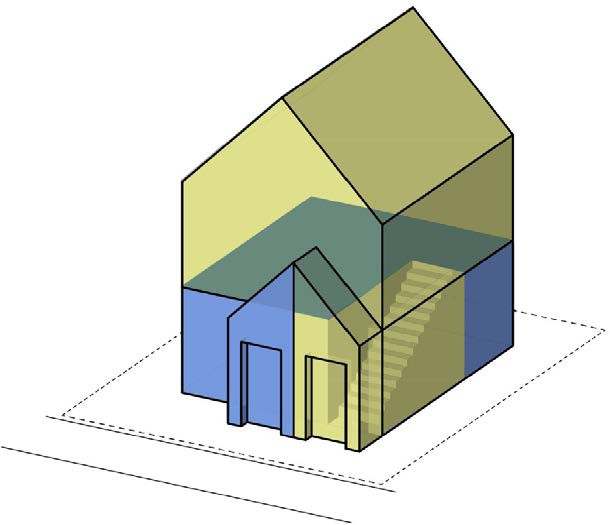
Side-by-side duplex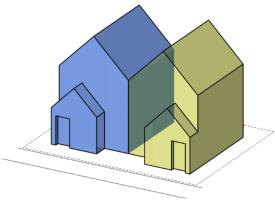
Duplex attached by a garage wall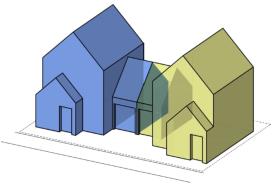
Duplex attached by a breezeway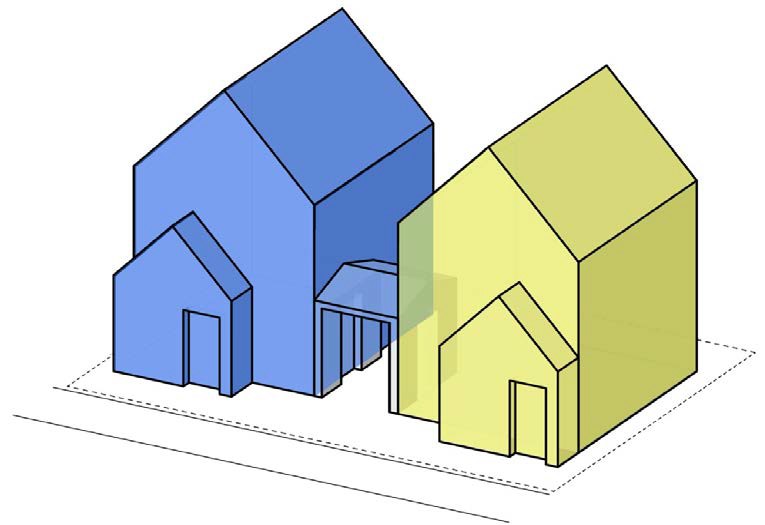
Detached duplex units front and back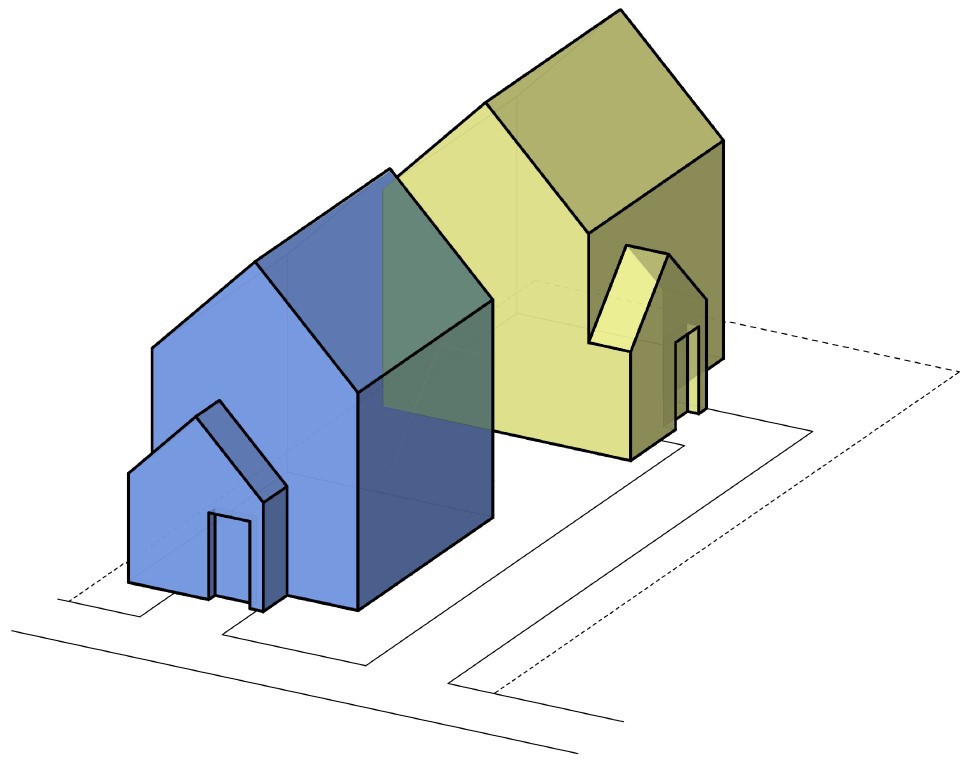
Dwelling, Manufactured home. See “Certified factory-built home.”
Dwelling, Multi-unit – Three or more dwellings on a single lot or parcel, including, but not limited to, townhouses, cottage clusters, triplexes, and quadplexes. The units may be detached units or may share common walls, common roofs, or common foundations. Multi-unit dwellings also include condominium and apartment units without regard to ownership status.
Dwelling, Quadplex – Four dwelling units on a lot or parcel in any configuration. See some possible quadplex configurations in Dwelling, Quadplex figure below.
Dwelling, Quadplex Figure
Stacked quadplex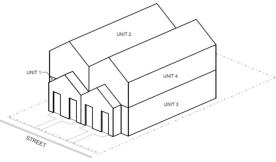
Detached quadplex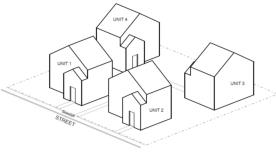
Dwelling, Single-unit – A dwelling designed for and used as one dwelling unit. A single-unit dwelling may share a common wall, common roof, or common foundation with another single-unit dwelling on another lot or share a common wall, roof, or foundation with an accessory dwelling unit on the same lot.
Dwelling, Tiny home – A dwelling that is 400 square feet or less in floor area excluding lofts.
Dwelling, Townhouse – A dwelling unit constructed in a row of two or more attached units, where each dwelling unit is located on an individual lot or parcel and shares at least one common wall with an adjacent unit. A townhouse is also commonly called a “townhome,” “rowhouse,” “attached house,” or “common-wall house.”
Dwelling, Triplex – Three dwelling units on a lot or parcel in any configuration. See some possible triplex configurations in Dwelling, Triplex figure below.
Dwelling, Triplex Figure
Attached triplex front and back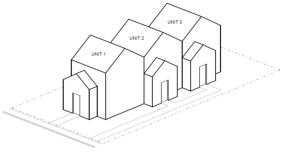
Attached triplex side by side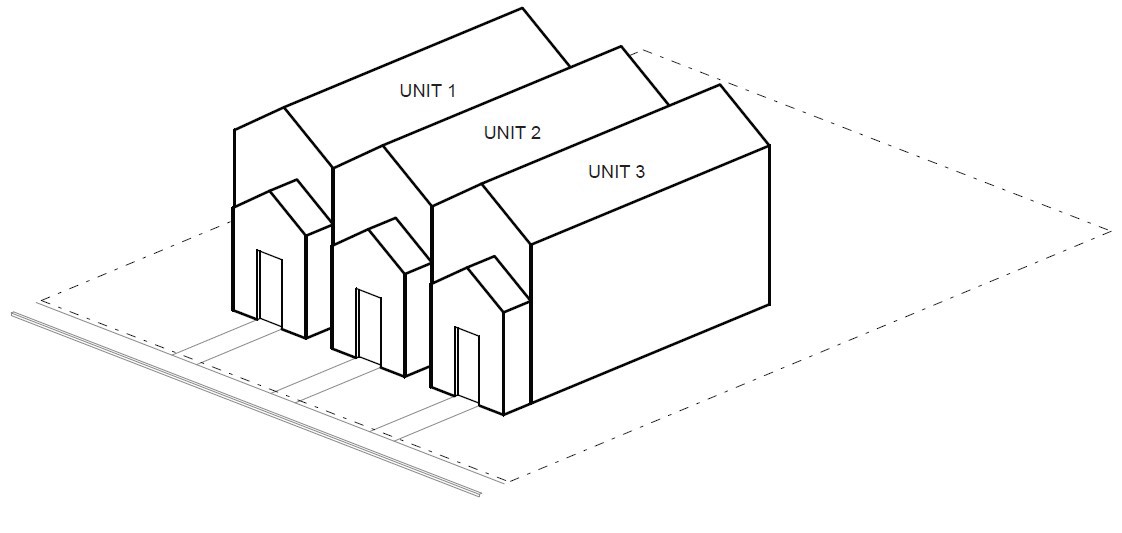
Detached triplex side by side
Dwelling unit – One or more rooms which have cooking and toilet facilities designed and used as a residence.
E.
Easement – A right which one person has to use the land of another for a specific purpose.
Educational institution – A facility customarily associated with public, private, charter, and/or alternative educational facilities, including the following:
(a) Primary and secondary schools, (kindergarten through grade 12 or any part thereof);
(b) Nursery and pre-schools (ages zero through five);
(c) Preschools providing primarily instruction, supplemented by daytime care, for four or more children between the ages of two and five years, and which operate on a regular basis;
(d) Vocational schools, colleges, or universities; or
(e) Dance, theater or other arts education facilities.
(f) Does not include personal instructional services listed under “Personal services, general.”
Elevated building – For National Flood Insurance Program purposes, a no basement building which has its lowest elevated floor raised above ground level by foundation walls, shear walls, posts, piers, pilings, or columns.
F.
Facade – The front of a building, particularly that part of a building facing a street or courtyard.
Farmer’s market/fish market – The commercial premises for the retail sale of produce, meat and poultry, seafood and other products.
Food packing and processing – Businesses engaged in the packing or processing of agricultural crops, animals, seafood, and their by-products which entails cutting, sorting, boxing, crating, canning, rendering, tanning, and so forth.
Foot-candle – A unit of measure of the intensity of light falling on a surface, equal to one lumen per square foot or the intensity of light from a standardized candle burning at one foot from a given surface.
Foster care home – A home licensed and regulated by the state and classified by the state as a foster home, providing care and guidance for not more than five unrelated juveniles, adults or both.
G.
Gallery – A business establishment devoted to the exhibition, display and/or sale of collections of such items as art, crafts and memorabilia.
Garage – A building or portion thereof, other than a private or storage garage, designed or used for equipping, servicing, repairing, or storing motor vehicles internally and enclosed within the building.
Garage, Detached – An accessory building intended and primarily used for the storage of motor vehicles, which is separate from and secondary to the main structure of the occupants.
General review – Director assessment of development and uses that do not require a land use application.
Glare – The effect produced by a light source within the visual field that is sufficiently brighter than the level to which the eyes are adapted, such as to cause annoyance, discomfort or loss of visual performance and ability.
Greenhouse – An enclosed building, permanent or portable, that is used for the growth of plants.
Group care facility – A facility licensed by the state to provide, on a 24-hour basis, training, care, custody, correction or control, or any combination of those functions, to one or more persons who may be children, the aged, disabled, underprivileged, indigent, handicapped or other special class of persons, either by governmental unit or agency or by a person or organization devoted to such functions. This term shall not include schools, hospitals, prisons or other social service facilities.
Group residential care facility – Any private or public institution requiring state licensure and/or any nonprofit facility performing the same functions which provide services including, but not limited to, the care, boarding, housing or training of more than five physically, mentally, or socially handicapped or delinquent persons or dependent persons by any person who is not the parent or guardian of, and who is not related by blood, marriage, or legal adoption to, these persons.
H.
Historic property – A building, structure, object, area or site that is significant in the history, architecture, archaeology or culture of Coos Bay, the region or the nation.
Home occupation – An occupation, profession, or craft secondary to the use of a dwelling unit for residential purposes and is carried on by a dwelling resident.
Homeless shelter – Any place or premises wherein residence is provided to persons who need emergency shelter on a daily or weekly basis. Individual bath and cooking/eating facilities may or may not be provided.
Homeowners’ association – A nonprofit organization operating under recorded land agreements through which the following take place: (a) Each person owning or purchasing a lot in a planned unit or other described land area is automatically a member by such ownership or purchase; (b) Each lot is automatically subject to a charge for a proportionate share of the expenses for the organization’s activities, such as maintaining a common property; and (c) Construction and maintenance responsibilities for any undivided property are identified and assigned.
I.
Industrial park – A planned, coordinated development of a tract of land with two or more separate industrial buildings. An industrial park is planned, designed, constructed, and managed on an integrated and coordinated basis with special attention given to on-site circulation, parking, utility needs, building design and orientation, and open space.
Industry, Heavy – A use engaged in the basic processing and manufacturing of materials or products predominantly from extracted or raw materials, or a use engaged in the storage of or manufacturing processes that potentially involve hazardous or commonly recognized offensive conditions.
Industry, Light – A use engaged in the manufacture, predominantly from previously prepared materials, of finished products or parts, including process, fabrication, assembly, treatment, packaging, incidental storage, sales and distribution of such products, but excluding basic industrial processing.
Infill – The development of land uses upon vacant or under-utilized sites.
J.
K.
L.
Lodge, Club, fraternal or civic assembly – Buildings and facilities owned or operated by a corporation, association, person, or persons for a social, educational, or recreational purpose for members, but not primarily for profit nor for rendering a service which is customarily carried on as a business. Typical uses include meeting places for civic clubs, lodges, or fraternal or veteran organizations. The following are assembly types:
(a) Small. Fewer than 16 persons on a regular basis.
(b) Large. Sixteen or more persons on a regular basis.
Lot – A single unit of land legally created by a partition or a subdivision or a unit of continuous land under a single ownership capable of being used under the regulations of this title, lawfully created as such in accordance with the subdivision laws or ordinances in effect at the time of its creation. “Lot” also means any space, area or tract of land, or portion of a certified factory-built home park, that is designated or used for occupancy by one certified factory-built home.
Lot, Building – Land occupied or to be occupied by one or more buildings and their accessory buildings.
Lot, Corner – A lot abutting on two or more intersecting streets other than an alley with a boundary line bordering on each of the streets as shown on the Lot, Corner figure below.
Lot, Corner Figure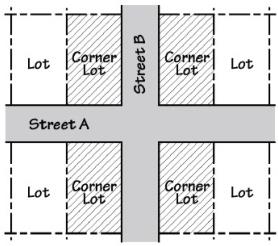
Lot, Flag – A lot the developable portion of which is located behind another lot that has normal street frontage. A flag lot includes a strip of land that goes out to the public right-of-way street for public access. As shown on the Lot, Flag figure below, there are two distinct parts to a flag lot: the flag which comprises the actual building site located behind another lot, and the pole which provides access from the street to the flag. A flag lot generally results from the division of a large lot that does not have sufficient width for division into two lots that would both have normal frontage onto the street. Creation of a flag lot is subject to additional standards in this code.
Lot, Flag Figure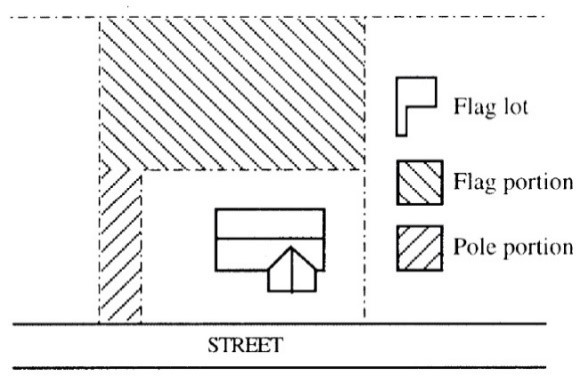
Lot, Interior – A lot or parcel of land other than a corner or a through lot.
Lot, Irregular – A lot which is shaped so that application of setback requirements is difficult; examples include a lot with a shape which is not close to rectangular, or a lot with no readily identifiable rear lot line.
Lot, Through – An interior lot having a frontage on two parallel or approximately parallel streets other than alleys. Such a lot has one front yard fronting on the primary public street.
Lot area – The computed area contained within the horizontal area within the lot lines of a lot exclusive of street or alley rights-of-way.
Lot coverage – That percentage of the total lot area covered by structures.
Lot depth – The horizontal distance between the midpoint of the front lot line and opposite lot line, usually the rear lot line. In the case of a corner lot, the depth shall be the length of the street side lot line.
Lot line – The property line along the edge of a lot. The Lot Line figure below identifies front and side and rear property lines.
Lot Line Figure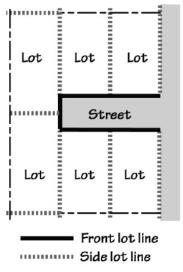
Lot line, Front – In the case of an interior lot, the lot line separating a lot from the street other than an alley, and in the case of a corner lot, the shortest lot line along a street other than an alley.
Lot line, Rear – A lot line which is opposite and most distant from the front lot line; and in the case of an irregular, triangular, or other shaped lot, a line 10 feet in length within the lot, parallel to and at a maximum distance from the front lot line.
Lot line, Side – Any lot line which is not a front or rear lot line.
Lot line, Street side – Any side lot line that abuts a public street right-of-way or public or private access easement.
Lot of record – A lot as shown on the records of the county assessor or county auditor at the time of the passage of this title; provided, however, this shall not include lots that may appear on the records of the county assessor which were created contrary to the provisions of laws and regulations in effect prior to the passage of this title. Any lots created after the adoption of this title shall comply with the standards contained herein.
Lot width – The average (mean) horizontal distance measured between the side lot lines, ordinarily measured parallel to the front lot line.
M.
Maintain – To cause or allow to continue in existence. When the context indicates, the word means to preserve and care for a structure; improve or condition an area to such an extent that it remains attractive, safe, presentable, and carries out the purpose for which it was installed, constructed, or required.
Major remodeling. See “Substantial improvement.”
Manufactured home – See “Certified factory-built home.”
Manufactured dwelling park – See “Certified factory-built home park.”
Manufacturing – Establishments engaged in the mechanical or chemical production, processing, assembling, packaging, or treatment of materials or substances into new products usually by power-driven machines and materials-handling equipment. Products of these establishments are primarily for wholesale markets or transfer to other industrial users but may include direct sale to consumers.
Marijuana related businesses
Marijuana grow – To grow immature marijuana plants or to breed or produce marijuana seeds.
Marijuana processing – The processing, compounding or conversion of marijuana into cannabinoid products, cannabinoid concentrates or cannabinoid extracts. Processing does not include packaging or labeling.
Marijuana retail – Sale of marijuana goods, merchandise, articles or things in small quantities directly to the consumer by a business holding a City of Coos Bay business license.
Marijuana wholesaler – A commercial entity that purchases marijuana products in Oregon for resale to a person or persons other than a consumer.
Marina – A facility that provides moorage, launching, storage, supplies, and a variety of services for recreational, commercial, fishing, and other vessels. Moorage facilities with five or fewer berths are excluded from this category.
Marquee – A permanent or temporary roofed structure attached to and supported by the building and projecting over public property.
Medical services – Establishments primarily engaged in the provision of personal health services ranging from prevention, diagnosis, and treatment or rehabilitation services provided by physicians, dentists, nurses, and other health personnel as well as the provision of medical testing and analysis services but excludes those classified as any civic use or group residential (group care) use type. Typical uses include medical offices, dental laboratories, health maintenance organizations, or detoxification centers.
Mitigation – Taking one or more of the following actions listed in order of priority:
(a) Avoiding the impact altogether by not taking a certain development action or parts of that action.
(b) Minimizing impacts by limiting the degree or magnitude of the development action and its implementation.
(c) Rectifying the impact by repairing, rehabilitating, or restoring the affected environment.
(d) Reducing or eliminating the impact over time by preservation and maintenance operations during the life of the development action by monitoring and taking appropriate corrective measures.
(e) Compensating for the impact by replacing or providing comparable substitute resources or environments.
Mobile home. See “Certified factory-built home.”
Modular home/prefabricated home. See “Certified factory-built home.”
Motor home – A portable, temporary dwelling to be used for travel, recreational, and/or vacation use constructed as an integral part of a self-propelled vehicle.
N.
National Register of Historic Places – A list of properties that have been formally judged to have historic significance and which have been accepted by the keeper of the National Register. The state of Oregon and the city of Coos Bay also maintain separate designations for inclusion. The city’s list is contained within the comprehensive plan.
Natural grade – The elevation of the ground level in its natural and original state, before manmade alterations such as grading, filling, excavation, and construction. See the Natural Grade figure below.
Natural Grade Figure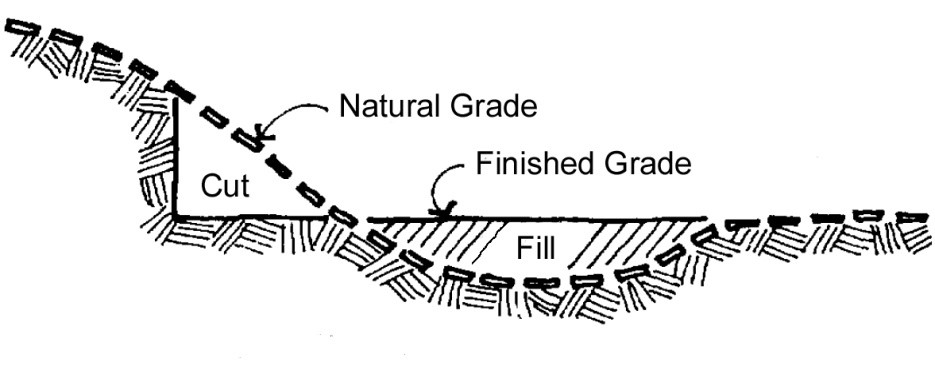
Neighborhood – An identifiable geographic area of relatively small size; a collection of units and other land uses that provide a relationship between dwellings, school, religious facilities, minor retail and/or other local facilities.
Net acres – The number of developable acres on a development site, derived from the total (gross) acreage of the site minus public rights-of-way, road easements, and any similar public facilities.
New construction – Structures for which the start of construction commenced on or after the effective date of this title.
Non-water-dependent – In general, non-water-dependent uses are those that do not require direct access to or location near waterways, and therefore could be located away from said waters.
O.
P.
Parcel – A single unit of land that is created by a partition of land (ORS 92.010).
Park-and-ride – A facility designed to city standards at or within 500 feet of a transit stop where automobiles, bicycles, and other vehicles and mobility devices can be parked by transit and rideshare riders. Location and design are guided by the currently adopted transit master plan.
Park model – See “Certified factory-built home.”
Park, Public – An area that may be improved for the purpose of providing public access in a manner consistent with the preservation of its recreational, educational, cultural, historical, or aesthetic qualities.
Parking lot or area and/or garage – An off-street facility used for the storage or parking of four or more motor vehicles to provide an accessory service to a commercial, industrial, public or residential use.
Parking lot or area and/or garage, Private – A parking area for the exclusive use of the owners of the lot on which the parking area is located or whomever else they permit to use the parking area.
Parking lot or area and/or garage, Public – A parking area available to the public, with or without payment of a fee.
Parking service – Parking services involving public garages and lots.
Parking space – A rectangular space designed and designated to provide parking for automobiles and bicycles in compliance with Chapter 17.330 CBDC. A parking space will provide access and maneuvering space sufficient to permit an automobile to be parked without the necessity of moving other vehicles; said rectangle to be located off the street right-of-way.
Parking structure – A standalone structure used for the storage or parking of motor vehicles. The footprint of a parking structure will be included in the calculation of lot coverage.
Parkrow or planter strip – A landscape area for street trees and other plantings within the public right-of-way, usually in the form of a continuous planter area between the street and sidewalk.
Partition, Land – To divide land into two or three parcels of land within a 12-month period, but does not include:
(a) A division of land resulting from a lien foreclosure, foreclosure of a recorded contract for the sale of real property or the creation of cemetery lots; or
(b) An adjustment of a property line by the relocation of a common boundary where an additional unit of land is not created and where the existing unit of land reduced in size by the adjustment complies with any applicable zoning ordinance.
Partition, Major – A partition which necessitates the creation of a road or street.
Partition, Minor – A partition that does not necessitate the creation of a road or street.
Pathway – A pedestrian and/or bicycle access facility outside of a roadway right-of-way that conforms to city standards. Pathways must be constructed of concrete, asphalt, brick/masonry pavers, or another city-approved durable surface meeting ADA requirements.
Permit – A license, certificate, approval, or other entitlement for use granted by a public agency.
Permit modification, Major – As determined by the director, a modification that includes a significant departure for the originally approved permit for land development or land use.
Permit modification, Minor – As determined by the director, a modification that includes minor changes not affecting the use, design or intent of the originally approved permit for land development or land use.
Personal services, General – Establishments primarily engaged in the provision of informational, instructional, personal improvement, and similar services of a nonprofessional nature, but excludes services classified as “spectator sports and entertainment,” or “participant sports and recreation.” Typical uses include photography studios, driving schools, or reducing salons, laundromats, or martial arts.
Planned unit development (PUD) – Subdivision – A tract of land planned and developed as an integrated unit under single ownership or control which in this context may be vested in partnerships, corporations, syndicates, or trusts. The PUD shall encompass a comprehensive development plan of a parcel of land, which has been approved by the review authority, and may use innovative and unique development concepts, including but not limited to clustering and mixing of land uses to create useful open space and to preserve site features.
Plot – A parcel of ground upon which a building and its accessory buildings have been or may be erected.
Porch – A structure attached to a building to shelter an entrance or serve as a semi-enclosed space, usually roofed and generally open sided.
Porch, Enclosed – A porch that contains wall(s) that are more than 42 inches in height measured from finished floor level for 50 percent or more of the porch perimeter.
Porch, Unenclosed – All walls contained in an unenclosed porch are less than 42 inches in height, but an unenclosed porch may be covered.
Preliminary plat – A neat and approximate drawing of either a proposed subdivision showing the general layout of rights-of-way and easements, streets and alleys, lots, blocks, and tracts in the subdivision or short subdivision, and other elements of a subdivision which shall furnish a basis for the approval or disapproval of the general layout of the preliminary plat.
Private clubs – Organizations that are privately owned and operated by their members and not operated for profit, and which maintain recreational, dining, and/or athletic facilities for the exclusive use of the members and their guests and uses accessory or incidental thereto.
Private drive – A road in private ownership, not dedicated to the public, which serves three or fewer dwelling units.
Private parking – Parking facilities for the noncommercial use of the occupant and guests of the occupant, which includes garages and carports meeting the dimensional requirements of off-street parking requirements of this title.
Project – Any proposal for a new or changed use, or for new construction, alteration, or enlargement of any structure, that is subject to the provisions of the CBDC.
Projecting sign – A sign other than a wall-mounted sign which projects from and is supported by a wall of a building or structure.
Property line adjustment – The relocation of a single common property line between two or more existing adjacent parcels not resulting in an increase in the number of lots pursuant to the requirements of Chapter 17.367 CBDC. See an example in the Property Line Adjustment figure below.
Property Line Adjustment Figure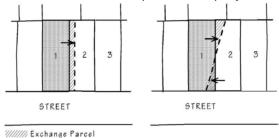
Public assembly, Place of – Any area, building or structure where large numbers of individuals meet or collect to participate or to observe programs of participation. Places of public assembly shall include theaters, auditoriums, gymnasiums, stadiums, houses of worship, or comparable facilities.
Public building – Buildings which are owned, operated, and maintained by a public agency such as City Hall, police and fire stations, educational institutions, zoos, libraries, museums, and similar facilities for public use.
Public improvement – Any improvement, facility, or service, together with customary improvements and appurtenances thereto, necessary to provide for public needs such as vehicular and pedestrian circulation systems, storm sewers, flood control improvements, water supply and distribution facilities, sanitary sewage disposal and treatment, public utility, and energy services.
Q.
R.
Reader board sign – A sign with letters and/or advertising which can be readily changed manually or electronically.
Real property – Land and improvements, if any, including anything permanently affixed to the land, such as buildings, walls, fences, and paved areas.
Recreational area – Lands perpetually set aside and maintained for use by all residents of a development. These areas shall be improved and shall be of a specified size.
Recreational facility, Low density and high density. See “Community recreation.”
Recreational space – An area that shall be improved and maintained for its intended use. Exterior as well as interior areas can constitute recreation space. Examples of usable recreation space include swimming pools, community buildings, interior gyms, picnic areas, tennis courts, community gardens, improved playgrounds, paths and passive seating areas.
Recreational vehicle. See “Certified factory-built home.”
Recreational vehicle park – Land designed, maintained, or used for the purpose of supplying temporary accommodation for recreational vehicles.
Refuse service – Any place used for disposal of used material. Typical uses include sanitary landfills, dumps, or refuse disposal sites.
Residential treatment facility – A facility that provides both a residence (for varying periods of time) and a care component. Among such facilities are group care homes, emergency or homeless shelters (including victims of violence), recovery homes, and nursing homes, rest and convalescent homes, and orphanages.
Residential use – Use of land or structure thereon, or portion thereof, as a dwelling, but not including occupancy of a transient nature, such as in hotels, motels, or timesharing condominium uses.
Retail food establishment – Any fixed or mobile place or facility at or in which food or beverages are offered or prepared for retail sale or for service. The definition includes restaurants, fast food restaurants, carry out restaurants and drive-in restaurants. A cafeteria is a restaurant for purposes of this title.
Retail sales, General – The sale or rental of commonly used goods and merchandise for personal or household use, but excludes those classified as “agricultural sales,” “animal sales and service,” “automotive and equipment,” “business equipment sales and service,” “construction sales and service,” “food and beverage retail sales,” and “fuel sales.” Typical uses include department stores, apparel stores, furniture stores, hardware stores, or florists.
Rooming house – A building wherein furnished rooms without cooking facilities are rented for compensation to three or more nontransient persons not included in the family unit of the owner or tenant of the premises.
S.
Service station – A building or structure designed or used for the retail sale or supply of fuels (stored only as prescribed by existing legal regulations), lubricants, air, water, other operating commodities for motor vehicles or boats, and food and beverages as an accessory to automobile related uses. The cross-section areas of service station canopy support where they meet the ground shall be measured as coverage for the purposes of determining maximum lot coverage, and also shall be used for measurement of setback requirements.
Setback – The minimum allowable horizontal distance required between a structure and a property lot line. See Setback figure below.
Setback Figure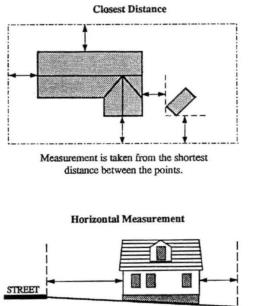
Shopping center – A group of architecturally unified commercial establishments built on a site that is planned, developed, owned, and managed with common street frontage and shared common drives and off-street parking.
Sidewalk – That portion of a transition strip improved for pedestrian traffic in accordance with standards fixed by the review authority.
Single-faced sign – A sign with advertising on only one surface.
Single-room occupancy (SRO) – A structure providing living units with separate sleeping areas and some combination of shared bath or toilet facilities. The structure may or may not have separate or shared cooking facilities for the residents. SROs may include boarding houses and structures commonly called SRO living units or SRO residential hotels.
Site – The lot(s), parcel(s) and tract(s) included in a proposed subdivision or short subdivision and contiguous lots, parcels or tracts in which the owner of the site has a greater than possessory interest.
Site plan – A plan prepared to scale, showing accurately and with complete dimensions all proposed and existing buildings, landscaping, open space, structures and features on abutting properties, and parking proposed for a specific parcel of land. See Site Plan figure below.
Site Plan Figure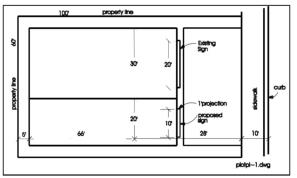
Slope – The deviation of a surface from the horizontal, usually expressed in percent. See Slope figure below.
Slope Figure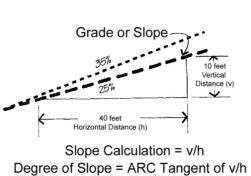
Soil – The surface layer of the earth, supporting plant life.
Spectator sports and entertainment – Establishments or places primarily engaged in the provision of cultural, entertainment, athletic, and other events to spectators as well as those involving social or fraternal gatherings. The following are spectator sports and entertainment use types:
Spectator sports and entertainment, Indoor – Those uses conducted within an enclosed building. Typical uses include theaters or meeting halls.
Spectator sports and entertainment, Outdoor – Those uses conducted outdoors. Typical uses include stadiums or drive-in theaters.
Standard factory-built home. See “Certified factory-built home.”
Start of construction (for flood damage prevention only) – Includes major remodeling, and means the date the building permit was issued, provided the actual start of construction, repair, reconstruction, placement or other improvement was within 180 days of the permit date. The “actual start” means either the first placement of permanent construction of a structure on a site, such as the pouring of slab or footings, the installation of piles, the construction of columns, or any work beyond the stage of excavation; or the placement of a certified factory-built home on a foundation. Permanent construction does not include land preparation, such as clearing, grading and filling; nor does it include the installation of streets and/or walkways; nor does it include excavation for a basement, footings, piers, or foundation or the erection of temporary forms; nor does it include the installation on the property of accessory buildings, such as garages or sheds not occupied as dwelling units or not part of the main structure.
Stepback – Building stepbacks are stepped or progressive recessions in a building’s face as the building rises higher. Stepbacks are designed to reduce building mass to allow views around the building from above and/or from a distance, to allow more light down to the adjacent rights-of-way, and to improve the aesthetic experience of the building from adjacent rights-of-way. See Stepback figure below.
Stepback Figure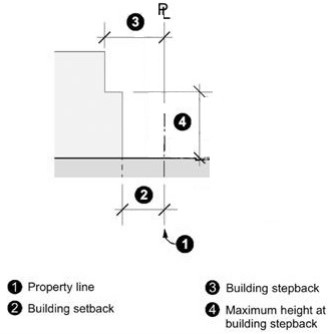
Stormwater – That portion of precipitation that does not naturally percolate into the ground or evaporate, but flows via overland flow, interflow, channels or pipes into a defined surface water channel, or a constructed infiltration facility.
Story – That portion of a building included between the upper surface of any floor and the upper surface of the floor next above, except that the topmost story shall be that portion of a building included between the upper surface of the topmost story shall be that portion of a building included between the upper surface of the topmost floor and the ceiling. If the finished floor level directly above a basement or unused under-floor space is more than six feet above grade for more than 50 percent of the total perimeter or is more than 12 feet above grade at any point, such basement or unused under-floor space shall be considered as a story.
Street – All roads, streets, highways, freeways, easements, and public rights-of-way used for or designed for vehicular access or use, including private roads but not including private driveways.
Street, Collector – A street penetrating neighborhoods, collecting traffic from local streets in the neighborhood and channeling it into the arterial system.
Street, Dead-end – A local street with only one outlet, without possibility of extension, and a maximum length of 400 feet. A vehicle turnaround may be required.
Street, Improved – A street with a paved roadway that has a structural cross-section that meets the minimum street improvement standards of the city of Coos Bay.
Street Line – The dividing line between any street, road or other thoroughfare and the adjacent lots.
Street, Local – A street which is primarily to provide direct access to abutting property and for local traffic movement.
Street, Major arterial – All state highways and major routes leading into and through the city.
Street, Minor arterial – A street of considerable continuity which is used primarily for through traffic and travel between large areas.
Street, Open – A street which provides access for property development. An open street must be:
(a) One for which the city accepts responsibility of grading and drainage maintenance;
(b) Paved to city standards with curbs, storm drainage, etc.; or
(c) An all-weather roadway and, in most cases, graveled or strip-paved. (“All-weather” means that a standard automobile can negotiate the road without difficulty year-round.)
Street, Private – A thoroughfare that is privately built and maintained which affords a primary means of vehicular access.
Structural alteration – Any material or dimensional changes in the structural elements of a building such as bearing walls, columns, beams, and roofs.
Structure – Anything assembled or constructed on the ground or attached to anything with a foundation on the ground. Under the National Flood Insurance Program, “structure” means a walled and roofed building, including a gas or liquid storage tank that is principally above ground.
Structure, Primary – A structure housing the primary use of a site or functioning as the primary use.
Subdivision, Land – Either an act of subdividing land into four or more lots or a tract of land subdivided. To divide an area into four or more lots within a calendar year when such area or tract of land exists as a unit or contiguous units of land under single ownership at the beginning of such a year.
Substantial improvement – Any repair, reconstruction, or improvement of a structure, the cost of which equals or exceeds 50 percent of the market value of the structure either:
(a) Before the improvement or repair is started; or
(b) If the structure has been damaged and is being restored, before the damage occurred. For the purposes of this definition, “substantial improvement” is considered to occur when the first alteration of any wall, ceiling, floor, or other structural part of the building commences, whether or not that alteration affects the external dimensions of the structure.
(c) The term does not, however, include either:
(i) Any project for improvement of a structure to correct existing violations of state or local health, sanitary, or safety code specifications which have been identified by the local code enforcement official and which are the minimum necessary to assure safe living conditions; or
(ii) Any alteration of a structure listed on the National Register of Historic Places or a state inventory of historic places.
Surface water – Waters that flow over the land surface and frequently interact with groundwater.
T.
Topography – The drawing accurately on a map lines that represent particular and consistent elevation levels on the land area depicted on said drawing; also, the actual physical surface’s relief characteristics.
Tourist habitation – Establishments primarily engaged in the provision of lodging services on a temporary basis (30 days or less) with incidental food, drink, and other sales and services intended for the convenience of guests. The following are tourist habitation use types:
(a) Bed and Breakfast. Lodging services involving the provision of room and/or board in an existing dwelling with no more than eight bedrooms.
(b) Bed and Breakfast House. A hotel in what was built as a single-unit dwelling and which offers up to six bedrooms for transient guests. This definition is for historic reference for vacation rentals authorized prior to October 15, 2020.
(c) Campground. Campground services involving transient habitation areas for travelers in recreational vehicles or tents. Typical uses include recreational vehicle parks.
(d) Lodging. Lodging services involving the provision of room and/or board. Typical uses include hotels, motels and pay for stay arrangements in city residences (examples: Airbnb, Vrbo).
(e) Waterfront Heritage Bed and Breakfast. Lodging facilities in the WH zone in a dwelling with no more than eight bedrooms involving the provision of room and board.
(f) Waterfront Inn. Overnight lodging facilities in the WH zone with all units water-oriented. A restaurant and conference facilities may be included.
(g) Hostel. A property where four to 20 individuals may live for not more than 30 continuous days, exclusive of management staff who may reside on the property. If there are more than 20 persons at maximum occupancy, such a facility shall be considered a hotel or motel as defined in this chapter.
(h) Hotel/Motel. A building or portion thereof designed and used for transient lodging in a nonresidential zone, lodged with or without meals and which may include additional facilities and services, such as restaurants, meeting rooms, entertainment and personal services.
(i) Vacation Rental. A residential structure being rented for compensation for less than 30 days without concurrent occupation by the owner/operator.
(j) Homestay. A residential structure being rented for compensation for less than 30 days with owner/occupant concurrent occupation or residence in another dwelling on the same property.
Tract – One or more contiguous lots or parcels under the same ownership.
U.
Units per acre – The number of dwelling units allowed on one acre. For example, a maximum of four units/acre would mean that no more than four dwelling units on one acre are allowed in a particular zone.
Unstable slopes – Those sloping areas of land which have in the past exhibited, are currently exhibiting, or will likely in the future exhibit movement of earth.
Use – The purpose for which land or the premises of a building, structure, or facility thereon is or may be occupied, maintained, arranged, designed or intended.
Use, Cease of – Use shall be considered as ceased when the site and/or building is no longer used or available for occupancy by the specific use for 24 months. A building or site vacant while being continuously marketed, repaired, or otherwise similarly unavailable for use is not considered to be a cessation of use. A building or site that is occupied by a different use shall be considered as a cessation of the former use.
Use, Principal – The main use of land or buildings as distinguished from a subordinate or accessory use.
Use, Start of – Use shall be considered as begun when the applicant has physically moved into the site or is in the process of physically moving into the site in preparation of beginning occupation and/or operation. Actual operation and/or business open to the public need not occur to consider a use as begun.
Use, Temporary – A use established for a fixed period of time with the intent to discontinue such use upon the expiration of such time. Temporary uses do not involve the construction or alteration of any permanent structure.
Utilities easements – Rights-of-way that may be used by public utilities, including, but not limited to, electricity, water, natural gas, sewer, telephone, and television cable for the construction, operation, maintenance, alteration, and repair of their respective facilities.
V.
W.
X.
Y.
Yard – Open space on a lot which is unobstructed by a structure and measured between the property line and the nearest point at the outermost face of any vertical support, exterior wall line, or foundation of a building. May also be an area defined by required setbacks.
Yard, Front – A yard between side lot lines and measured horizontally at right angles to the front lot line to the nearest point of the building.
Yard, Rear – A yard between side lot lines and measured horizontally at right angles to the rear yard line to the nearest point of the building.
Yard, Side – An open space between the front yard and rear yards measured horizontally and at right angles from the side lot line or street side lot line to the nearest point of a building.
Z.
Zero lot line development – A single-unit dwelling which has no yard requirements on one or more of the lot lines, in conformance with the International Building Code.
Zone – Area within which certain uses of land and buildings are permitted and certain others are prohibited; yards and other open spaces are required; lot areas, building height limits, and other requirements are established.
Zone or zoning district – Any portion of the city within which, on a uniform basis, certain uses of land and buildings are permitted and certain other uses of land and buildings are prohibited as set forth in this title and within which certain yards and other open spaces are required, certain lot areas are established, and a combination of such aforesaid conditions are applied. [Ord. 553 § 1, 2022; Ord. 549 § 2, 2022; Ord. 547 § 1, 2021; Ord. 540 § 6 (Exh. 1), 2021; Ord. 532 § 2 (Att. B), 2020; Ord. 518 § 8 (Exh. 1), 2019; Ord. 513 § 7 (Exh. 2), 2019; Ord. 503 § 1 (Exh. B), 2018; Ord. 490 § 1, 2018; Ord. 486 § 1, 2017; Ord. 473 § 3 (Exh. A), 2016. Formerly 17.150.010].