


Chapter 17.15
SINGLE-FAMILY AND TWO-FAMILY OBJECTIVE DESIGN AND DEVELOPMENT STANDARDS
Sections:
17.15.010 Intent and purpose.
17.15.020 Applicability.
17.15.030 Process.
17.15.040 Design standards.
17.15.050 Supplemental design and development standards.
17.15.010 Intent and purpose.
A. It is the intent of the city council in enacting this chapter to protect the health, safety, and general welfare of the city by maintaining the high standards of architectural design that have distinguished Foster City as a thriving master planned city in California.
B. This chapter establishes design and development standards to meet the following objectives:
1. Maintain the integrity and high-quality living environment of the city’s residential neighborhoods.
2. Achieve a high-quality baseline for the design of applicable single-family and two-family residential projects (“dwelling units”) that are integrated with the existing surroundings and neighborhoods and provide attractive and desirable living environments.
3. Establish clear expectations for community members, decision-makers, and applicants prior to the submittal and approval of applicable new and modified single-family and two-family dwelling units.
C. This chapter is intended to supplement, not replace, regulations in other titles and chapters of the Foster City Municipal Code and any other relevant state or federal regulations applicable to single-family and two-family dwelling units, including but not limited to the California Building Code. Where there are any conflicts, the most restrictive regulations shall govern. (Ord. 698 § 2 (Exh. A), 2026)
17.15.020 Applicability.
A. The provisions of this chapter shall apply to applications for planning approval of residential projects such as new, replaced, or modifications to buildings and/or structures and other property improvements in the R-1 single-family residence district, R-1/PD single-family residence district/planned development, R-2 two-family residence district and R-2/PD two-family residence district/planned development.
B. Effective Date. This chapter shall apply to applications for planning approval of residential projects identified in subsection A of this section, submitted on or after the date this chapter becomes effective. (Ord. 698 § 2 (Exh. A), 2026)
17.15.030 Process.
A. The standards contained in this chapter shall be applied as part of the review of any required application(s) for planning approval for all residential projects in zoning districts identified in Section 17.15.020(A).
B. As an alternative to a variance as provided in Section 17.06.080, a project applicant may request planning commission approval of an exception or exceptions to the design standards, as part of the required review process, use permit, or architectural review, as follows:
1. The request shall be in writing, in conjunction with a planning application.
2. The request shall include: (a) the standard that is requested to be waived, (b) how the unique circumstances of the project and/or physical constraints of the project site make application of the standard infeasible, and (c) how the requested exception meets the intent of the standard.
3. The planning commission shall approve an exception if all of the following findings are made:
a. Approving the exception will not create a safety hazard; and
b. The proposed project meets the intent of the standard under consideration to the extent feasible. (Ord. 698 § 2 (Exh. A), 2026)
17.15.040 Design standards.
A. Site Design.
1. Entry Location and Street Orientation. These standards shall apply to new dwelling unit(s).
a. The primary entry for a proposed new dwelling unit shall comply with one of the following:
i. Be located and oriented to face the public or private street.
ii. Be located inside an entry courtyard.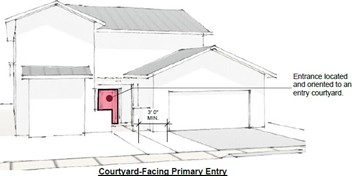
iii. Be located on the side of the dwelling unit, with a side setback of no less than ten feet from the side property line in the area between the front property line and furthest extent of the primary entry.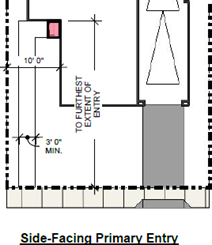
b. For corner lots, the primary entry may be oriented toward either street.
c. A walkway measuring a minimum of thirty-six inches in width shall be provided from the driveway or sidewalk to the primary entry.
d. The design of the primary entry shall be in conformance with subsection (B)(5) of this section.
2. Curb Cuts and Driveways. These standards shall apply to new or modifications to existing curb cuts or driveways.
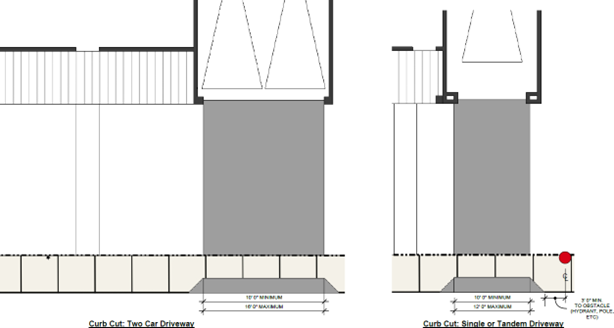
a. Curb Cut Standards.
i. Curb cuts shall be permitted only to provide access to garages, carports, and parking spaces approved pursuant to a building permit or Chapter 17.64.
ii. Curb Cut Widths.
(A) Single or Tandem Parking. The width of a curb cut serving one parking space or two parking spaces in a tandem configuration shall be a minimum of ten feet and a maximum of twelve feet, excluding aprons.
(B) Side-by-Side or Two-Car Parking. The width of a curb cut serving two or more parking spaces in a side-by-side configuration shall be a minimum of ten feet and a maximum of twenty feet, excluding aprons.
iii. The nearest edge of a driveway curb cut shall be at least three feet from the centerline of a fire hydrant, light standard, traffic signal, utility pole, water meter, crosswalk, curb inlet, or other similar facility.
iv. Curb cuts shall conform to the latest city standard detail.
b. Street-Facing Garage/Carport Driveway.
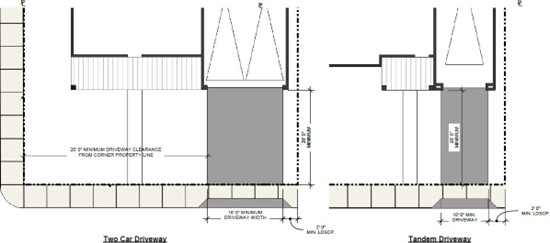
i. A driveway serving two or more parking spaces in a side-by-side configuration shall be a minimum of twenty feet in depth and a minimum of sixteen feet in width.
ii. A driveway serving one parking space or two parking spaces in a tandem configuration shall be a minimum of twenty feet in depth and a minimum of ten feet in width.
iii. Driveways on corner lots shall be located at least twenty feet from the property lines at the intersection of the corner or pedestrian crosswalk.
iv. Driveways abutting a side property line shall include a landscape buffer that is a minimum two feet in width between the property line and the driveway.
c. Side-Entry Garage/Carport Driveway.
i. A landscape buffer that is minimum of two feet in depth shall be provided between the driveway and the primary building.
ii. A minimum distance of at least twenty-four feet shall be required between the garage face and the opposite edge of the driveway for any garage/carport that does not directly face the street.
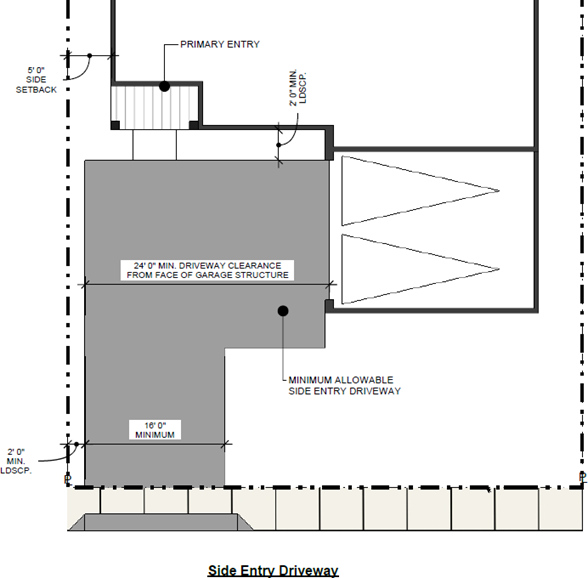
d. Shared Driveways.
i. Shared driveways between two separately owned properties shall provide a minimum distance of fifty-two feet between the faces of garage doors that face each other across a shared driveway. A recorded reciprocal easement shall be provided to ensure shared access.
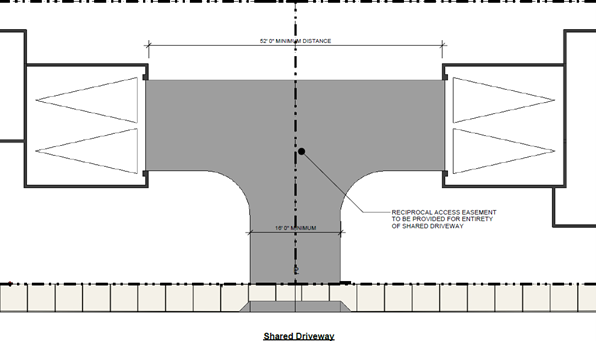
ii. If there is a shared driveway between two properties, and one of the property owners wishes to separate the driveway, that property owner shall ensure that both driveways, upon separation, meet the requirements of this chapter.
e. Street Corner and Driveway Visibility Requirements.
i. No accessory structure, or other obstruction, more than forty inches in height, shall be located within visibility triangles required by Section 17.52.030.
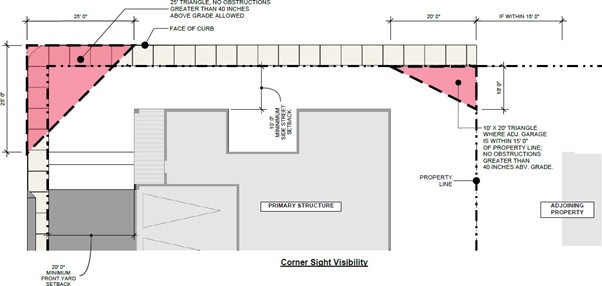
3. Landscaping and Lighting. These standards shall apply to new or modifications to dwelling unit(s).
a. Front Yard Landscaping. All portions of the front yard, except walkways, driveways, and approved parking areas, shall be landscaped according to the following standards:
i. The ground area shall be covered with plantings, mulch, or inorganic ground cover.
b. Front Yard Paving.
i. Where the garage or carport entry faces the street, paving in the front yard, including the driveways, shall not exceed sixty-five percent of the front yard.
ii. For side entry garages or carports, the paved area (if any) between the side of the garage or carport facing the street and the front property line parallel to the street shall not exceed fifty percent.
iii. Front yard paving shall maintain a minimum setback of two feet from any side property line.
c. Lighting. Exterior lighting shall be subject to the following restrictions:
i. Wall fixtures shall be mounted below the roof eave.
ii. All light fixtures mounted more than four feet from grade shall be directed downward and shielded.
iii. A motion-activated light shall be directed downwards to prevent the light from reaching adjacent properties.
iv. No permanently installed outdoor lights that blink, revolve, flash, or change intensity shall be permitted.
v. Uplighting of architectural and landscape features is permitted if the fixture is fully shielded and aimed upwards to illuminate only the intended surface.
vi. Uplighting of glass, reflective, or polished surfaces is prohibited.
4. Mechanical Equipment/Utilities.
a. Conduits or ducts for mechanical equipment/utilities shall be painted to match the surrounding surface color.
b. Mechanical Equipment/Utilities in Front Yards. Mechanical equipment shall not be located in front yards. Notwithstanding the foregoing, one electric vehicle (EV) charger up to two square feet in size shall be exempt from this requirement.
c. Mechanical Equipment/Utilities in the Side and Rear Yards. Mechanical equipment may be located in the side or rear yards when all the requirements below are met:
i. The equipment is located behind and lower than a fence or wall; and
ii. The equipment shall maintain a setback of at least three feet from the side property line; and
iii. The noise levels produced by the mechanical equipment/utilities do not exceed those levels identified in Section 17.68.030(B), Noise Limits (Table 1).
d. Mechanical Equipment/Utilities on the Roof.
i. All roof-mounted mechanical equipment/utilities, except solar panels, shall be screened or incorporated into the design of the building(s) so as not to be visible from private street or public right-of-way.
ii. All vents/flues/termination/exhausts shall not extend above the roof except as required by the California Building Code and shall be painted to match the adjacent surface.
B. Building Design.
1. Building Massing. These standards shall apply to new two-story home(s) or second-story additions to existing dwelling unit(s):
a. If the addition will cause any loss of sunlight to any window of an adjacent house, the applicant shall provide a shading impact study with the permit application to demonstrate compliance with this section.
b. No new two-story home(s) or second-story addition shall:
i. Eliminate all direct sunlight to any living/family room, dining room, or kitchen in an adjacent house.
ii. Reduce more than two hours of direct sunlight to a living/family room or kitchen in an adjacent house, or more than four hours of direct sunlight to a bedroom in an adjacent house.
iii. Reduce the amount of time that an adjacent house’s window receives direct sunlight by more than fifty percent at any season where an impact occurs (requires a comparison of the hours that a window receives direct sunlight in an existing and proposed condition).
c. If a living/family room, dining room, or kitchen in the adjacent house has multiple windows, the solar impact will be based on the aggregate impact.
2. Building Articulation. These standards shall apply to new dwelling unit(s).
a. Front and Street Side Articulation. Any front or street-side elevation shall contain at least two of the following treatments, compliant with associated standards or regulations:
i. A primary entry designed in conformance with subsection (B)(5) of this section.
ii. Change in material, texture, or color in conformance with subsection (B)(2)(c) of this section.
iii. Window(s) designed in conformance with subsection (B)(7) of this section.
iv. A recess or projection on the lower or upper floor that is at least two feet in depth and four feet in width.
v. An attached trellis or pergola in conformance with Section 17.15.050(A)(2) or (D)(2) as applicable.
b. Rear Elevation Articulation. Any rear elevation shall provide at least two of the following treatments:
i. Change in material, texture, or color in conformance with subsection (B)(2)(c) of this section.
ii. Window(s) designed in conformance with subsection (B)(7) of this section.
iii. Entry door.
iv. A deck or balcony.
v. An attached trellis or pergola in conformance with Section 17.15.050(A)(2) or (D)(2) as applicable.
vi. A recess or projection of at least two feet in depth and four feet in width.
c. Prohibited Building Materials and Colors.
i. The applicant shall refer to the list of prohibited building materials established by the community development department for use on building exteriors and available on the department’s website. Any items on the prohibited building materials list are prohibited on building exteriors. The list may be amended from time to time to accommodate new materials and colors.
ii. Color. See Section 17.58.020(C).
3. Building Roofs.
a. Articulation. These standards shall apply to roof(s) for new dwelling unit(s).
i. Continuous rooflines that face a public or private street shall not exceed thirty feet in length and shall be vertically articulated with at least one of the following treatments, compliant with the associated standards or regulations:
(A) A change in height of at least four feet.
(B) A roof dormer.
(C) A change in roof orientation.
(D) A change in roof form that projects at least two feet above the main roofline.
(E) Openings in the roof, such as openings with exposed rafters.
b. Roof Pitch. These standards shall apply to roof(s) for new dwelling unit(s).
i. The roof pitch shall be consistent on all pitched roof sections.
c. Materials and Colors. These standards shall apply to roof(s) for new dwelling unit(s) and modifications to existing dwelling unit(s).
i. The community development department shall establish a list of approved roof materials and colors and make it available on the department’s website. The list may be amended from time to time to accommodate new materials and colors.
ii. The roof material on a single structure shall be the same material on all sides.
4. Garage. These standards shall apply to new or replaced garage(s) and not modifications or improvements to existing garages(s).
a. Garage Frontage.
i. Street-Facing Garages.
(A) For lots with a width between fifty and sixty feet, the garage frontage, including the door width and space between multiple doors, shall not exceed fifty percent of the front facade of the dwelling unit.
(B) For lots wider than sixty feet, the garage frontage, including the door width and space between multiple doors, shall not exceed forty percent of the front facade of the dwelling unit.
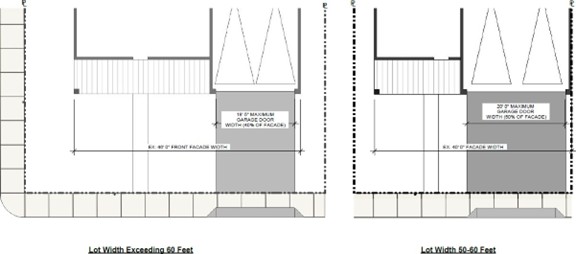
b. Garage Interior Size.
i. Garage interiors shall be the minimum size required by Section 17.62.050(B)(1).
(A) Exception. Certain mechanical systems and electrical storage batteries may extend up to three feet into the required unobstructed area; provided, that they are placed at a height of forty-two inches above the floor.
c. Garage Location.
i. A street-facing garage must be set back at least twenty feet from the front property line unless otherwise permitted within a planned development (PD) district.
ii. Side-entry garage shall have driveway consistent with subsection (A)(2) of this section.
d. Garage Door Opening Size. The primary garage entry/doors shall be sized as follows:
i. Single car or tandem garage shall have a minimum opening width of eight feet and a maximum opening width of nine feet.
ii. Two-car (side-by-side) garage shall have a minimum opening width of sixteen feet and a maximum opening width of eighteen feet.
e. Garage Articulation.
i. Front-facing garages shall incorporate either a recess of at least five inches from the surrounding wall plane or an overhang at least twelve inches in depth.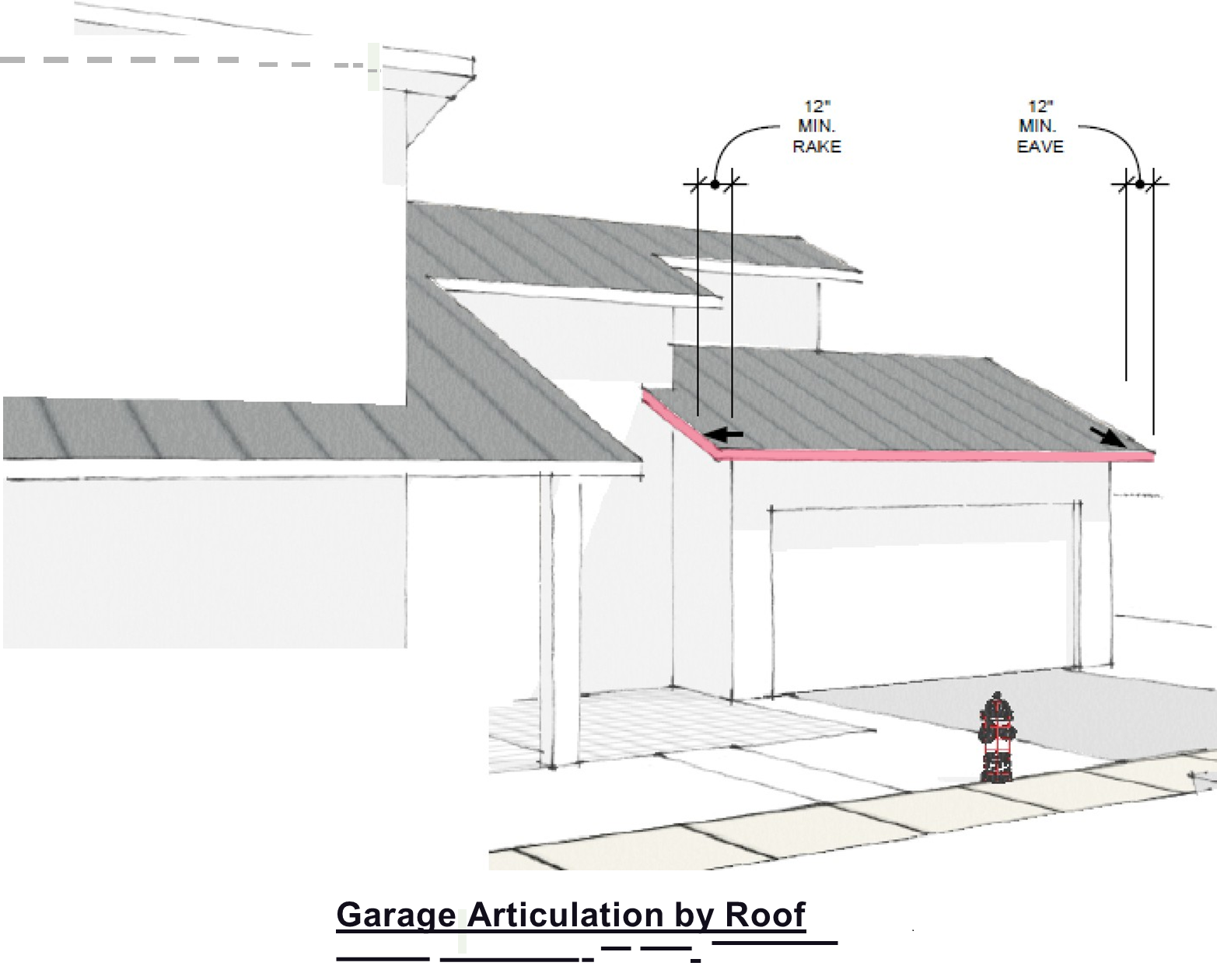
Garage Articulation by Roof Overhang
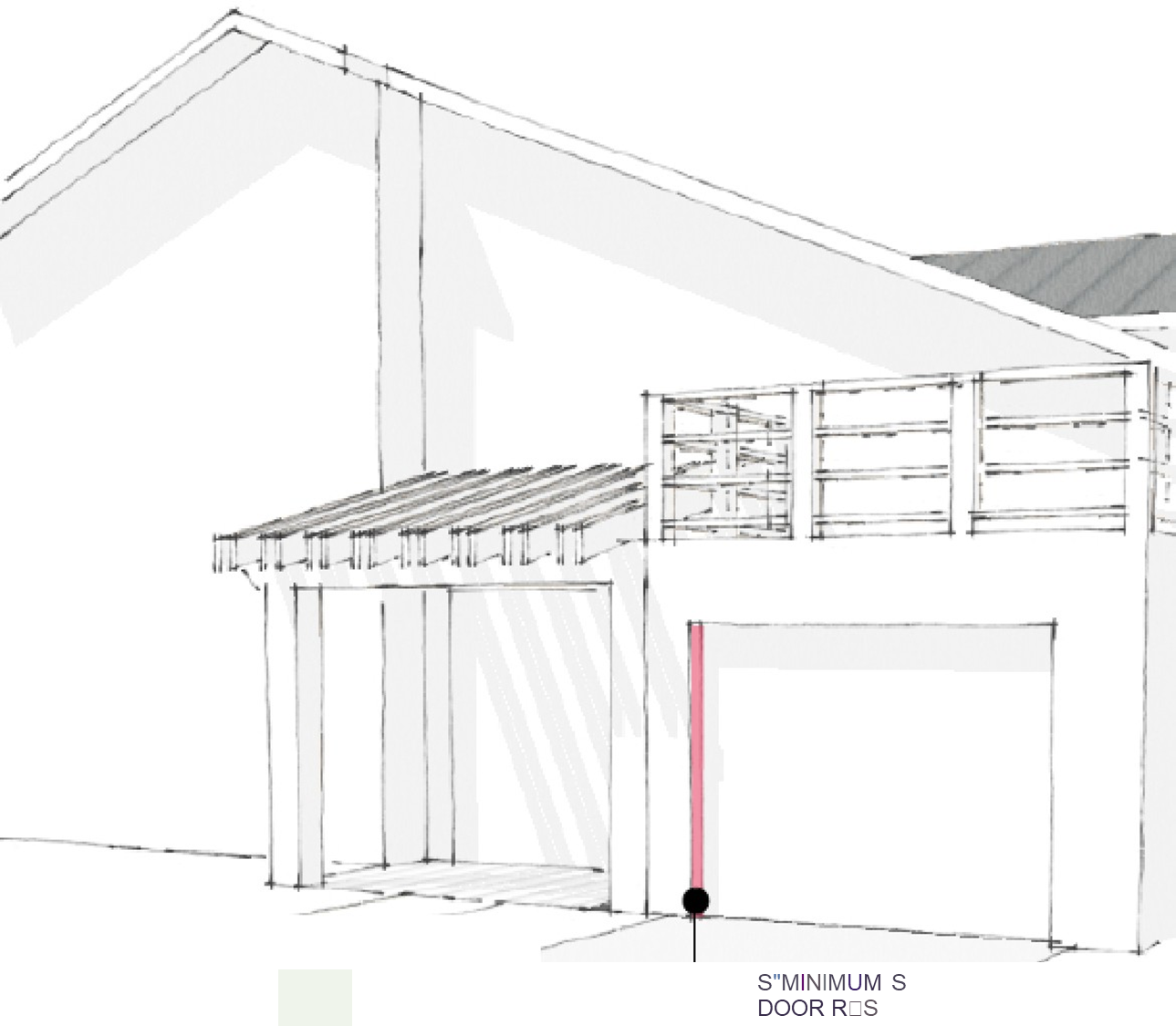
Garage Articulation by Recess
ii. Side entry garages shall incorporate at least one of the following along the street frontage facade:
(A) Window(s) designed in conformance with subsection (B)(7) of this section.
(B) Decorative trellis minimum eight feet in width.
f. Style. All garages, either attached or detached, front or side entry, shall have the same architectural style as the primary residence, including but not limited to roof pitch, color, and materials.
5. Primary Entry. These standards shall apply only to new dwelling unit(s). A primary entry shall be defined by at least one of the following elements:
a. Articulated with a roof form that projects from the front elevation at least three feet.
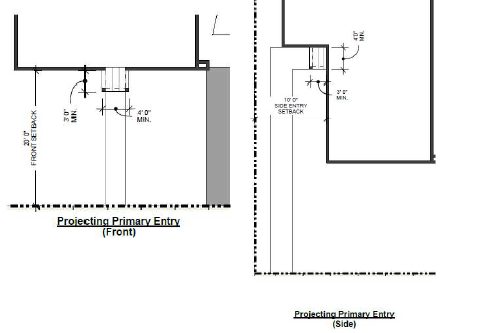
b. A covered porch with a minimum of three feet in depth and four feet in width.
c. Recessed entry of at least three feet in depth and four feet in width that creates a covered landing area.
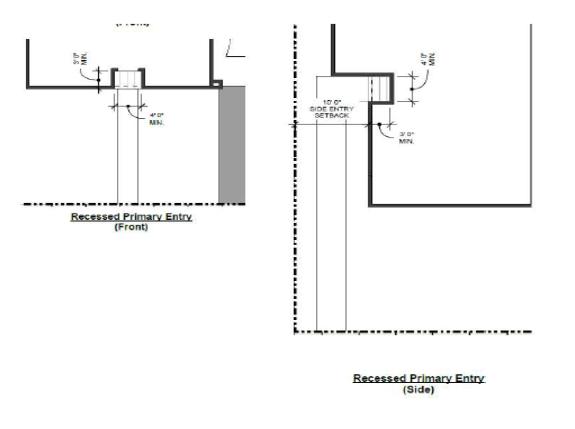
d. Any architectural feature associated with a primary entry that projects into yards shall comply with the requirements of Section 17.15.050(E)(2).
6. Balconies. These standards shall apply to new dwelling unit(s) and modifications/improvements to existing dwelling unit(s) that are adding new balconies.
a. Balconies shall not be located on any elevation facing a side yard unless there is a separation from the edge of the balcony to the nearest wall plane of the adjacent dwelling unit of at least twenty-five feet.
i. Exceptions. Juliette balconies on a side elevation are allowed to extend six inches into the side setback.
b. The outer edge of projecting balconies located on rear elevations shall not be closer than fifteen feet to the property line which it faces.
7. Windows. These standards shall apply to new dwelling unit(s) and modifications/improvements to existing dwelling unit(s) that are adding, replacing, or modifying windows, as follows:
a. Frame color, window type, and style.
i. On the front elevation and street side elevation, all windows shall have the same frame color, frame width, trim width, window type, and style, except for side lite windows adjacent to the primary entry door(s).
(A) For the purposes of this section, window styles with the same exterior appearance, including casement, fixed, and awning window styles are considered the same style.
ii. On side (not street-facing) and rear elevations, the frames of all windows shall be the same color.
iii. Shutters. If shutters are provided, they shall be sized to cover one hundred percent of the window and match the exact window shape.
b. Window Projections. Windows that project from the wall plane of any elevation are subject to the following standards:
i. Window projection(s) that extend to the ground shall count towards lot coverage and shall not extend into the required setback.
ii. Window projection(s) that do not extend to the ground shall be considered an architectural feature and may extend into the required setback in conformance with subsection (E)(2) of this section.
c. Windows exempt from architectural review pursuant to Section 17.58.020(B)(11) shall provide the same frame color. (Ord. 698 § 2 (Exh. A), 2026)
17.15.050 Supplemental design and development standards.
A. Accessory Structures. This section shall apply to all new detached or attached accessory structures, including but not limited to carports, sheds, workshops, gazebos, trellises, and covered patios that are six feet or taller in height.
1. Detached Accessory Structures.
a. Location. Detached accessory structures shall be located in the rear half of the lot. Trellises and pergolas can be located in the front yard as long as they are no larger than fifty square feet in size and open on all sides.
i. For waterfront properties, the rear one-half of the lot shall be determined by: (A) measuring from the front property line to the water side of the bulkhead; or (B) in the case where there is no bulkhead, the rear one-half of a waterfront lot shall be determined by taking the total lot depth of the lot excluding any easement that the city has been granted to maintain the lagoon for waterfront properties; or (C) in the case where there is no bulkhead or no maintenance easement, the rear one-half of a waterfront lot shall be determined by measuring from the front property line to the highest water line.
b. Setbacks. Accessory structures taller than six feet in height shall be set back:
i. A minimum of four feet from any rear or non-street side property line.
ii. A minimum of ten feet from a street-side property line.
iii. A minimum of five feet from the primary dwelling.
iv. A minimum of ten feet from the lagoon bulkhead, rip-rap, or water’s edge if a waterfront property.
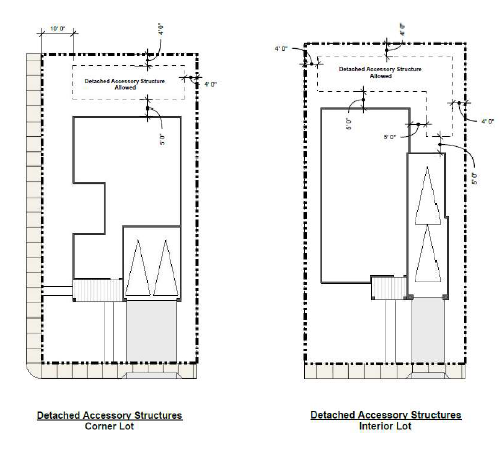
c. Height. The maximum allowable height of detached accessory structures is ten feet measured from grade to the highest point of the structure.
d. Lot Coverage. Detached accessory structures, six feet or taller, shall be included in the calculation of the maximum lot coverage of fifty percent.
2. Attached Accessory Structures.
a. Accessory structures are considered “attached” when any portion is located within twelve inches of the main building.
b. Setbacks. Attached accessory structures taller than six feet in height shall comply with setback requirements for the main building.
c. Height. The maximum allowable height of attached accessory structures is ten feet measured from grade to the highest point.
d. Lot Coverage. Attached accessory structures taller than six feet shall be included in the calculation of maximum fifty percent lot coverage.
e. Exception. A patio cover unenclosed on at least two sides to serve the ground floor shall be allowed to extend into the rear yard area; provided, that:
i. The patio cover shall not extend more than twenty feet from the rear of the main structure and shall not exceed fifty percent of the rear yard area; and
ii. The patio cover shall maintain a minimum setback of five feet from the rear property line.
3. Other Regulations.
a. Plumbing to accessory structures shall be limited to cold water, hot water, and gas in conformance with building code requirements.
b. No use of any attached accessory structure extending into any yard area shall be permitted above the first floor.
c. No attached accessory structure shall be enclosed to form a living or storage area unless it complies with all requirements and standards for a room addition.
B. Decks and Patios. These standards shall apply to new decks and modifications to existing decks and patios.
1. Setbacks.
a. Any deck which is raised more than six inches above grade shall maintain a minimum setback of two feet from any property line(s).
b. Decks and patios raised three feet and higher shall require a minimum five-foot setback from any property line(s).
c. For waterfront properties, decks shall be three feet from the inside edge of the bulkhead or top of the rip-rap.
2. Screening. Decks and patios taller than twelve inches from grade shall provide skirting to screen off-site views of the underside of the structure unless located within a yard fully enclosed by a fence at least six feet in height.
C. Windscreens.
1. Windscreens in Side and Rear Yards. Windscreens shall be allowed in a side or rear yard, subject to the following:
a. Windscreens shall be permitted at grade or on decks no higher than five feet above grade.
b. Windscreens shall be constructed of clear tempered glass or other clear rigid material.
c. Windscreens may include a frame not to exceed six inches in width.
d. Maximum height shall be ten feet, measured from grade or from the top of a first-floor deck, whichever is higher.
e. Windscreens shall maintain a setback of at least five feet from any property line or public walkway easement.
f. For waterfront properties, windscreens shall be three feet from the inside edge of the bulkhead or top of the rip-rap.
g. Windscreens shall not be used to enclose space to form a living or storage area.
D. Yards.
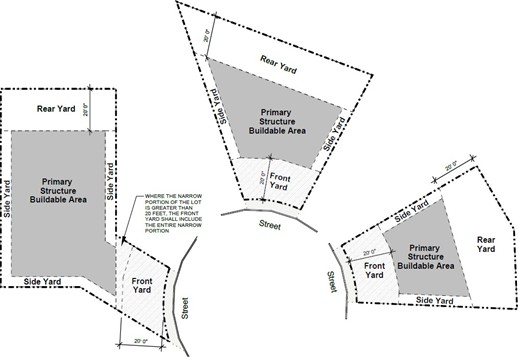
1. Yards on Irregular (Nonrectangular) Lots.
a. Front Yard. The front yard setback shall be twenty feet or the length of the narrow portion of the lot, whichever is greater.
b. Rear Yard. The rear yard is the yard farthest from the street.
c. Other Yards. All yards other than the front and rear yards shall be considered side yards unless shown to be otherwise on the original building permit plans.
2. Projections Into Yards.
a. Architectural Features. Architectural features on the main building, such as bay windows, cornices, and eaves, may extend into the required yard subject to the following:
i. Architectural features may extend a maximum of two feet into any required side yard and five feet into any required front or rear yard, except as provided below:
(A) Awnings.
(1) Placement.
(a) Awnings are prohibited in front yards.
(b) Awnings shall only be located in the side and rear yards and may not extend more than three feet from the primary dwelling.
(2) Materials.
(a) Awnings shall be flush-mounted on a wall and painted to match the wall color, or flush-mounted low on the first-floor roof near the roof edge, or along the first-floor eave.
(b) Awning materials shall be non-glare and conform to requirements of the fire code.
(c) Awnings shall have no stripes or patterns, lettering, symbols, graphics, or logos.
(B) Patio covers as provided in subsection (A)(2) of this section. (Ord. 698 § 2 (Exh. A), 2026)