


Chapter 12.70
SIDEWALKS, PLANTING STRIPS AND STREET TREES
Sections:
12.70.020 Abutting property owner to maintain sidewalk in safe condition.
12.70.030 Abutting property owner shall be responsible for expense of maintenance and repair.
12.70.040 Procedure for sidewalk reconstruction or repair.
12.70.050 Right-of-way vegetation maintenance.
12.70.060 Sidewalk – Snow, ice and trash removal required when.
12.70.070 Sidewalk – Violation of KMC 12.70.050 deemed misdemeanor.
12.70.080 Exemption from KMC 12.70.030 and 12.70.050 permitted when.
12.70.085 Garbage, trash, recycling, and yard waste.
12.70.090 Right-of-way vegetation – Trimming limitations – Removal prohibited.
12.70.100 Right-of-way maintenance – Enforcement.
12.70.010 Definitions.
In addition to the definitions in Chapter 12.05 KMC, the following definitions shall apply to this chapter:
A. “Hazardous tree” means any dead tree or a tree with any structural defect, disease, damage, or combinations of these which make it subject to a high probability of failure which might cause damage to persons or property. A “hazard tree” includes, but is not limited to, any isolated tree(s) that have a high probability of failure due to low wind-firmness in post-construction conditions as determined by a qualified tree protection professional.
B. “Planting strip” means that portion of the right-of-way which lies:
1. Between the curb line and the sidewalk; or
2. Between the sidewalk and the right-of-way line; or
3. Between the edge of pavement and the right-of-way line where sidewalk and/or curb are not present; or
4. Between the curb line and the right-of-way line where sidewalk is not present;
and may include, but is not limited to, trees, shrubs, groundcover, fences, facilities, signs, hydrants, gravel, drainage infrastructure. [Ord. 25-0628 § 1 (Att. A); Ord. 23-0578 § 2 (Exh. 1).]
12.70.020 Abutting property owner to maintain sidewalk in safe condition.
It shall be the responsibility of the owner of property abutting upon a public sidewalk to maintain the sidewalk at all times in a safe condition, free of any and all obstructions; see KMC 12.70.050. [Ord. 25-0628 § 1 (Att. A); Ord. 23-0578 § 2 (Exh. 1).]
12.70.030 Abutting property owner shall be responsible for expense of maintenance and repair.
The burden and expense of maintaining sidewalks along the side of any street or other public place shall be borne by and the responsibility of the owner of the property directly abutting thereon. The abutting property owner shall also be responsible for performing and paying for sidewalk repairs to the extent the need for repairs is caused by the actions or omissions of the abutting property owner. [Ord. 25-0628 § 1 (Att. A); Ord. 23-0578 § 2 (Exh. 1).]
12.70.040 Procedure for sidewalk reconstruction or repair.
A. If, in the judgment of the city engineer, public convenience or safety requires that a sidewalk be reconstructed or repaired along either side of any street, pursuant to KMC 12.70.030, such fact shall be reported to the city council.
B. If, upon receiving a report from the proper official, the city council deems the reconstruction of the proposed sidewalk or repair of such sidewalk necessary or convenient for the public health, safety or welfare, the city council may then order such work to be done pursuant to the procedures established in Chapter 35.68, 35.69 or 35.70 RCW. The cost of such proposed sidewalk reconstruction or sidewalk repair shall be borne by the abutting property owner in accordance with Chapter 35.68, 35.69 or 35.70 RCW.
C. Permit Required. Before commencing reconstruction or repair of a sidewalk, the owner must submit an application for a right-of-way use permit, limited (Type A) pursuant to Chapter 12.35 KMC. The application must include the plans for the reconstruction or repair in accordance with the Road Standards, together with an estimate of the cost of the reconstruction or repair. The city engineer shall evaluate the cost of the reconstruction/repair. The city engineer may require the owner to provide additional information to evaluate the cost. If the city engineer determines that the cost of the reconstruction or repair will exceed 50 percent of the abutting property valuation, exclusive of improvements, the owner must modify the plans for the reconstruction or repair so that the cost does not exceed 50 percent of such valuation. The owner will not commence the reconstruction or repair until the city engineer has approved the modified plans. The abutting property valuation shall be the current valuation as determined by the King County assessor’s office website for said property. [Ord. 25-0628 § 1 (Att. A); Ord. 23-0578 § 2 (Exh. 1).]
12.70.050 Right-of-way vegetation maintenance.
A. The abutting property owner is responsible for and shall maintain planting strips, sidewalks, and unimproved right-of-way, including:
1. Hazardous trees;
2. Tree limbs and shrubbery that obstructs the road and/or sidewalk traveled way, blocks sight distance or signage, or presents a safety hazard to the public; and
3. Soil, gravel, weeds, grass, or other ground cover, encroaching within the traveled way.
B. The abutting property owner is responsible for maintaining vegetation in planting strips as follows:
1. Will be maintained in a condition that does not impair the use of the right-of-way by the City or the traveling public.
2. Shall be free from weeds and grass in excess of 12 inches.
3. Shall be free from noxious weeds contained in the current King County noxious weeds list or contained in the current Chapter 16-750 WAC. Noxious weeds list Classes A, B, and C shall be prohibited.
4. Vegetation shall be removed and replaced as required by subsection G of this section.
5. The use of the right-of-way includes, but is not limited to:
a. Motor vehicles on paved roadways;
b. Bicycles on paved surfaces or designated trails;
c. Pedestrians on sidewalks, designated paved walkways, gravel shoulders, or other pedestrian paths as determined by the city manager; and
d. City maintenance and operations.
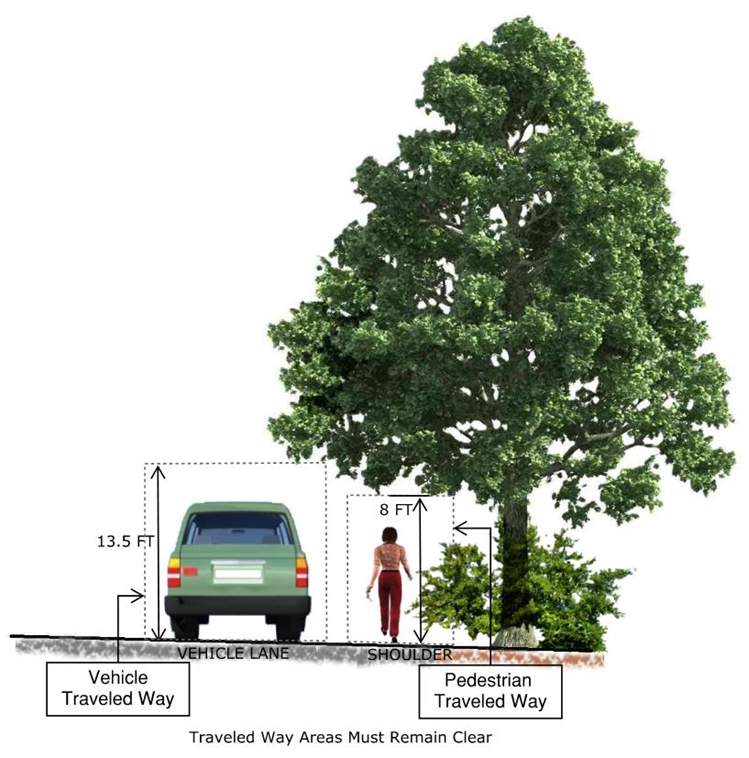
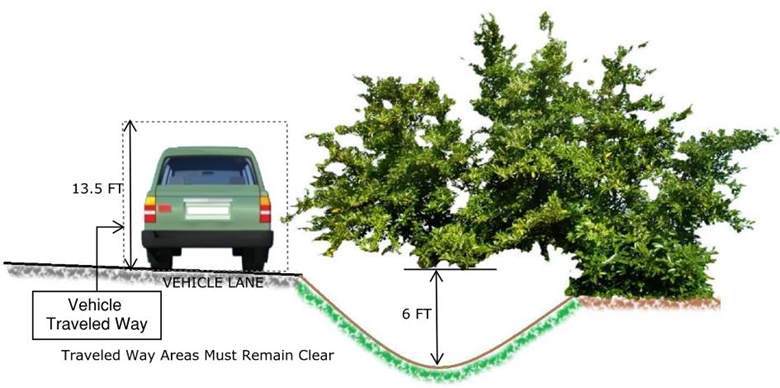
C. Vegetation shall not overhang sidewalks, walkways or bike lanes within eight feet, measured vertically from any point on the traveled way. Vegetation shall not overhang vehicle lanes within 13.5 feet, measured vertically from any point on the traveled way. Vegetation shall not intrude into pedestrian, bicycle, or vehicle traveled way. The abutting property owner shall maintain vegetation as needed to prevent blockage of sight distance and the traveled way per the Road Standards or blockage of any roadway sign. In addition to the definition established for traveled way in Chapter 12.05 KMC, the traveled way is further defined as:
1. The traveled way for pedestrians shall be sidewalks, paved walkways separated by a curb from the vehicle traveled way, paved walkways signed for pedestrians, or paved/gravel shoulders as determined by the city manager. Other pedestrian paths, as determined by the city manager, may also be defined as a pedestrian traveled way.
2. The traveled way for bicycles shall be defined by signage and pavement markings and shall be a paved area separated by pavement markings from the vehicle traveled way or a paved path as determined by the city manager.
3. The traveled way for vehicles will be defined by the edge stripe or edge of pavement where no stripe is present.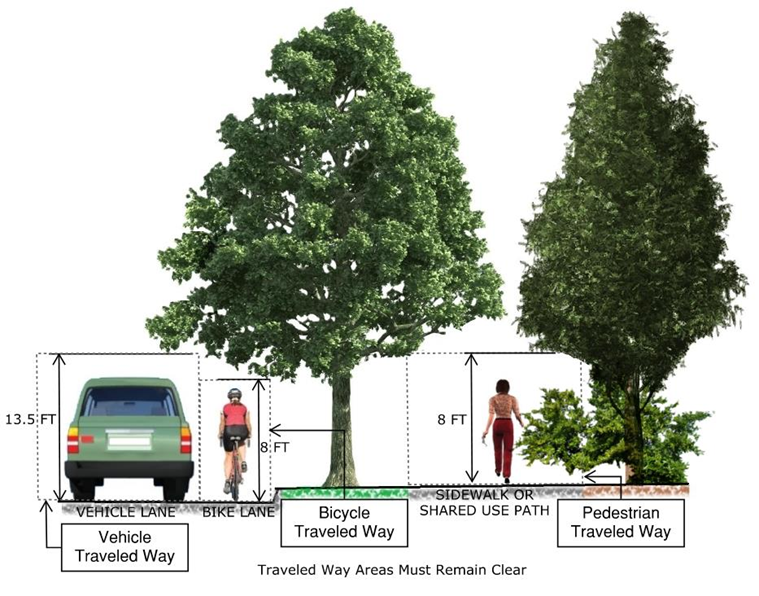
D. Drainage ditches shall be kept free of debris and maintained in a condition that allows the free flow of water and provides for adequate access for City maintenance and inspections. Ditches shall be mowed regularly. Aesthetic maintenance of drainage ditch vegetation, assuming adequate access and free flow of water is maintained, is the responsibility and at the discretion of the abutting property owner.
E. Within unimproved right-of-way, abutting property owners shall be responsible for trimming vegetation that overhangs onto their respective property and for removing hazardous trees. The abutting property owner’s responsibility shall extend to the center of the unimproved right-of-way.
F. All slopes adjacent to abutting properties shall be maintained by the owner. Maintenance shall be consistent with the requirements for planting strips and shall include erosion control and vegetation stabilization.
G. Hazardous trees, diseased or dead shrubs, or vegetation not maintained pursuant to this chapter shall be removed from the right-of-way and replaced with a suitable species per the Road Standards. Replacement tree shall be a minimum two inches diameter measured five feet up from the root ball.
H. Certain planting strips, sidewalks, unimproved right-of-way and other right-of-way areas may be maintained by the City at the city manager’s discretion. [Ord. 25-0628 § 1 (Att. A); Ord. 23-0578 § 2 (Exh. 1).]
12.70.060 Sidewalk – Snow, ice and trash removal required when.
It is unlawful for any person owning abutting property within the City to permit the accumulation of snow, ice, vegetative debris, trash or any other material on an existing sidewalk which impedes the normal flow of pedestrian traffic. In the event the property is owned by a person not a resident of the City, a reasonable period of time shall be provided for the owner or the owner’s agent to remove the material. If such removal is not accomplished within a reasonable period of time, the city manager may have the sidewalk cleaned and the cost thereof shall be billed to the property owner. The determination of reasonable period of time shall be at the sole discretion of the city manager. [Ord. 25-0628 § 1 (Att. A); Ord. 23-0578 § 2 (Exh. 1).]
12.70.070 Sidewalk – Violation of KMC 12.70.050 deemed misdemeanor.
Each day any sidewalk, or driveway portion thereof, is permitted to remain in a hazardous condition as specified in KMC 12.70.050 shall be considered and shall constitute a separate violation. Violation of KMC 12.70.050 shall constitute a misdemeanor and shall be punishable as provided by law. [Ord. 25-0628 § 1 (Att. A); Ord. 23-0578 § 2 (Exh. 1).]
12.70.080 Exemption from KMC 12.70.030 and 12.70.050 permitted when.
The city manager may approve exemptions to KMC 12.70.030 and 12.70.050 for the following reasons:
A. Property that abuts the right-of-way which does not have reasonable access through the property to that section of the right-of-way and where that portion of right-of-way is not connected to other right-of-way abutting the property;
B. For properties with single detached dwelling units as defined by KMC 18.20.840, duplexes, or triplexes, hazardous trees in excess of 15 feet in height and eight inches in diameter at breast height as defined pursuant to KMC 18.20.752, the City may assist in providing traffic control services. The city manager shall make the final determination of what assistance may be provided by the City; or
C. Other exemptions based upon standards which shall be established by the department. [Ord. 25-0628 § 1 (Att. A); Ord. 23-0578 § 2 (Exh. 1).]
12.70.085 Garbage, trash, recycling, and yard waste.
Any property accumulating garbage, trash, recyclables, and yard waste shall place their materials in approved carts or contained in a manner to prevent scattering. Garbage, trash, recyclables, and yard waste for collection in the right-of-way shall be placed no earlier than 24 hours prior to the day of collection. All carts must be removed from the right-of-way within 24 hours of being collected. All carts and other containers shall be placed by the occupant for pickup in a convenient, accessible location where such placement does not block the traveled way unless otherwise allowed below. Carts, other containers, and bulk trash shall be placed in the following manner:
A. For properties with level planting strips between a curb and sidewalk, place in either the planting strip or driveway within one foot of the curb; or
B. For properties with sidewalks but no planting strips, place within one foot of the front of the curb; or
C. For properties with no sidewalk, curb, or gutter, within existing shoulder or, if no shoulder, at edge of pavement; or
D. When the foregoing locations slope at a grade making placement of a cart difficult, a level area that is nearest to either of the previous locations; or
E. If the foregoing locations are not available due to extraordinary circumstances, then placement shall be at a location suitable to the occupant and approved by the hauler that does not interfere with the traveled way;
F. Cart spacing shall be placed as per the respective hauler. [Ord. 25-0628 § 1 (Att. A).]
12.70.090 Right-of-way vegetation – Trimming limitations – Removal prohibited.
A. Notwithstanding any provision of franchise agreements or KMC 12.70.050, vegetation within the public right-of-way shall not be removed or cut back so as to generally damage the aesthetic quality or survivability of the vegetation. Such trimming, when required by utility companies to safeguard their facilities or as required pursuant to KMC 12.70.050, shall be done in a manner that preserves the general appearance of the vegetation. The same provisions shall be applicable to others in that trees, shrubs and other plantings shall not be removed or otherwise trimmed so as to damage the general appearance of the planting areas.
B. Judicious trimming is permitted in such areas that will provide proper sight distance for intersections and driveways and such traffic warning or regulatory signs that are in place. [Ord. 25-0628 § 1 (Att. A); Ord. 23-0578 § 2 (Exh. 1).]
12.70.100 Right-of-way maintenance – Enforcement.
A. Should the city engineer find that such right-of-way is not being properly maintained consistent with KMC 12.70.050 through 12.70.090, the city engineer may, but is not required to, notify the abutting property owner to comply with the provisions of this chapter. The notice will be prepared per KMC 1.20.070 as amended below and include:
1. All references to “code enforcement officer” shall mean city manager;
2. Instruction to the abutting property owner to trim or remove the vegetation and specify a reasonable time for the trimming or removal of said vegetation.
3. A statement that if the property owner fails to trim or remove the vegetation within the time frame provided, the City will begin enforcement proceedings per Chapter 1.20 KMC or if determined by the city engineer to be a public safety hazard, interferes with Americans with Disabilities Act (ADA) accessibility, an environmental hazard, or impedes City maintenance and operations, that the City will perform the maintenance pursuant to subsection B of this section; and
4. A statement that in the case of a public safety hazard, interference with ADA accessibility, an environmental hazard, or impeding City maintenance and operations, that any cost incurred by the City may be assessed against the property owner for failure to comply with this provision.
B. If, by determination of the city engineer, the vegetation is a public safety hazard, environmental hazard, or impedes City maintenance and operations and the abutting property owner fails to complete the required maintenance within the time period stated in the notice, the City will perform the required maintenance and the cost may, at the discretion of the city engineer, be assessed against the abutting property owner. After completion, the city engineer will determine the cost to be charged to the property owner and the time and manner of payment thereof; provided, that the cost will not exceed 50 percent of the valuation of the abutting property, exclusive of improvements. The cost will include all direct invoiced costs for materials and equipment as well as $75.00 per hour per person of labor performed by the City in completing the maintenance requirements. If contracting services are necessary to complete the maintenance, the full cost of the contract services shall be included in the cost charged to the property owner. The abutting property valuation shall be as determined by the most current assessment of King County assessor’s office for said property. The city engineer will give notice of the cost to the owner. The notice shall:
1. State the cost to be charged to the owner and the time and manner of payment thereof;
2. Include documentation to support the charges;
3. Advise the owner that the cost cannot exceed 50 percent of the valuation of the property, exclusive of improvements;
4. State that the city engineer will hear protests to the determination of cost, time, and manner of payment if received within 30 calendar days of date of delivery of the notice.
C. In the event payment is not received by the City within the time frame stated in the notice, the city engineer may place a lien upon the property or submit the charges to a licensed collection agency. Any lien will be collected in the manner as provided by law for collection of local improvements assessments.
D. The owner may appeal the city engineer’s determination of cost, time, and manner of payment for KMC 12.70.050 through 12.70.090 by filing a notice of appeal with the city manager within 14 calendar days after delivery of the city engineer’s determination. The city manager will give notice of receipt of the appeal and a deadline for response. After the protest consideration, the city manager will issue a decision, which will be the City’s final decision on the owner’s responsibility for maintenance. Additional time to submit an appeal may be granted at the city engineer’s discretion.
E. All notices will be mailed to the owner of the abutting property, to the property tax address on file on the King County tax assessor’s website, if the City determines that the abutting property is not owner-occupied, or to any address noted on any communication from the abutting property owner. [Ord. 25-0628 § 1 (Att. A); Ord. 23-0578 § 2 (Exh. 1).]