


Chapter 15.02
DEFINITIONS Revised 1/23 Revised 7/23 Revised 8/23
Sections:
15.02.001 Rules of construction.
15.02.002 Applicability.
15.02.003 Accessory dwelling unit (ADU).
15.02.004 Accessory living quarters.
15.02.005 Accessory use or structure. Revised 7/23
15.02.006 Adult entertainment.
15.02.007 Adult entertainment business.
15.02.008 Adult uses.
15.02.009 Adult entertainment material.
15.02.010 Agricultural use.
15.02.015 Alley.
15.02.020 Apartment.
15.02.025 Repealed.
15.02.026 Architectural detail element.
15.02.026.1 Assisted living facility.
15.02.027 Automobile body repair.
15.02.028 Automobile detailing.
15.02.030 Automobile repair.
15.02.033 Repealed.
15.02.035 Automobile service station or gasoline filling station.
15.02.040 Automobile wrecking or motor vehicle wrecking.
15.02.045 Basement.
15.02.050 Repealed.
15.02.051 Battery charging equipment.
15.02.052 Battery exchange station.
15.02.055 Short-term rental.
15.02.060 Building.
15.02.065 Building height.
15.02.066 Build-to line.
15.02.067 Bulk retail uses.
15.02.070 Canopy.
15.02.070.1 Card room, house-banked.
15.02.071 Cargo containers.
15.02.072 Charging levels.
15.02.073 Clustering or cluster subdivision.
15.02.073.1 Communal residence.
15.02.074 Repealed.
15.02.075 Comprehensive plan.
15.02.080 Combining district.
15.02.085 Common open space.
15.02.086 Composted material.
15.02.088 Repealed.
15.02.089 Repealed.
15.02.090 Conditional use.
15.02.091 Condominium.
15.02.092 Repealed.
15.02.093 Repealed.
15.02.095 Crop and tree farming.
15.02.097 Dangerous wastes.
15.02.098 Day-care center.
15.02.099 Day-care home.
15.02.100 Day-care operation.
15.02.100.5 Designated manufactured home.
15.02.101 Designated zone facility.
15.02.102 Development plan.
15.02.103 Density, maximum permitted.
15.02.105 Development standards.
15.02.106 Diminished garage door.
15.02.107 Discontinuance.
15.02.110 District.
15.02.110.1 Dock-high doors.
15.02.111 Dock-high loading areas.
15.02.111.1 Downtown.
15.02.112 Repealed.
15.02.113 Dripline.
15.02.113.1 Drive-in, drive-through facilities.
15.02.114 Duplex/two-family dwelling. Revised 7/23
15.02.115 Dwelling, single-family.
15.02.120 Repealed.
15.02.125 Dwelling, multifamily.
15.02.130 Dwelling unit.
15.02.130.1 Electric vehicle (EV).
15.02.130.2 Electric vehicle (EV) charging station.
15.02.130.3 Electric vehicle charging station – Public.
15.02.130.4 Electric vehicle charging station – Restricted.
15.02.130.5 Electric vehicle parking space.
15.02.131 Emergency housing facility, emergency shelter.
15.02.131.5 Equitable distribution.
15.02.132 Repealed.
15.02.133 Extremely hazardous waste.
15.02.134 Facade modulation.
15.02.135 Family. Revised 1/23
15.02.140 Fence, sight-obscuring.
15.02.145 Fence, one hundred (100) percent sight-obscuring.
15.02.147 Floor area ratio.
15.02.150 Frontage, building or occupancy.
15.02.151 Fulfillment center.
15.02.155 Garage or carport, private.
15.02.160 General conditional uses.
15.02.165 Grade.
15.02.170 Gross floor area.
15.02.172 Repealed.
15.02.173 Group home.
15.02.174 Guest cottage.
15.02.174.1 Harm reduction programs. Revised 8/23
15.02.175 Hazardous substance.
15.02.176 Hazardous substance facility buffer zone.
15.02.177 Hazardous substance land use.
15.02.178 Hazardous substance land use facility.
15.02.179 Hazardous substance, processing or handling of.
15.02.180 Hazardous waste.
15.02.181 Hazardous waste facility.
15.02.182 Hazardous waste storage facility.
15.02.183 Hazardous waste treatment facility.
15.02.184 Hazardous waste treatment or storage facility, offsite.
15.02.185 Hazardous waste treatment or storage facility, onsite.
15.02.186 Hearing examiner (land use).
15.02.187 Highest shade-producing point.
15.02.190 Home occupation.
15.02.195 Homeowners’ association.
15.02.200 Hotel.
15.02.202 Impervious surface.
15.02.203 Independent senior living facility.
15.02.203.1 Industrial use.
15.02.204 Institution.
15.02.205 Interior court.
15.02.207 Isolation and quarantine facility.
15.02.210 Junkyard.
15.02.215 Kennel.
15.02.217 Lake.
15.02.220 Landscaping.
15.02.222 Repealed.
15.02.223 Less restrictive alternative.
15.02.224 Live-work unit.
15.02.225 Lot.
15.02.228 Long term commercial significance.
15.02.230 Lot, corner.
15.02.231 Lot area.
15.02.235 Lot frontage.
15.02.240 Lot lines.
15.02.245 Lot measurements.
15.02.250 Lot of record.
15.02.252 Lot, riverfront.
15.02.255 Lot, through.
15.02.257 Major nonconforming building or structure.
15.02.257.1 Manufacturing, assembly, and fabrication, heavy.
15.02.257.2 Manufacturing, assembly, and fabrication, light.
15.02.257.3 Manufacturing, assembly, and fabrication, medium.
15.02.257.4 Minor conditional use.
15.02.258 Minor nonconforming building or structure.
15.02.259 Mixed use building or structure.
15.02.260 Mixed use development. Revised 1/23
15.02.261 Manufactured home.
15.02.262 Mobile home.
15.02.265 Mobile home park.
15.02.267 Moderate risk waste.
15.02.268 Modular home.
15.02.270 Motel.
15.02.270.5 Motor vehicle.
15.02.271 Multifamily design review.
15.02.272 Repealed.
15.02.274 Native adapteds.
15.02.275 Natural or native areas.
15.02.280 Net acreage.
15.02.281 New manufactured home.
15.02.282 Nonconforming lot of record.
15.02.283 Nonconforming sign.
15.02.285 Nonconforming use.
15.02.286 Nonconformity.
15.02.287 Northern lot line.
15.02.288 North-south lot dimension.
15.02.290 Repealed.
15.02.295 Occupancy.
15.02.300 Official map.
15.02.305 Open green area.
15.02.307 Opioid treatment program. Revised 1/23 Revised 8/23
15.02.310 Ordinary high-water mark.
15.02.315 Outdoor storage or outside storage.
15.02.317 Overlay district.
15.02.318 Park, riverfront.
15.02.320 Parking space or parking stall.
15.02.325 Parking, temporary.
15.02.326 Patient cooperative, medical marijuana.
15.02.327 Pedestrian-oriented use.
15.02.330 Performance standards.
15.02.331 Permeable surface.
15.02.332 Planned unit development.
15.02.333 Planning director.
15.02.334 Preempted facility.
15.02.335 Preschool.
15.02.335.01 Provider.
15.02.335.1 Public area.
15.02.335.2 Rapid charging station.
15.02.335.3 Residential facility with health care.
15.02.336 Revegetation.
15.02.337 Repealed.
15.02.338 Recreational vehicles.
15.02.338.1 Research, development, and testing.
15.02.338.5 Risk potential activity or risk potential facility.
15.02.339 Road, scenic and recreational.
15.02.340 Roadside stand.
15.02.340.1 Roofline variation.
15.02.341 Secure community transition facility.
15.02.342 Repealed.
15.02.343 Service uses or activities.
15.02.344 Setback, average.
15.02.345 Shopping center.
15.02.350 Sign.
15.02.355 Sign area.
15.02.360 Sign height.
15.02.365 Sign, abandoned.
15.02.370 Sign, advertising.
15.02.375 Sign, business.
15.02.380 Sign, canopy.
15.02.385 Sign, construction.
15.02.390 Sign, directional or informational.
15.02.391 Sign, electronic messaging center.
15.02.395 Sign, flashing.
15.02.400 Sign, freestanding.
15.02.403 Sign, freestanding monument.
15.02.405 Sign, gate or entrance.
15.02.410 Sign, identification.
15.02.415 Sign, illuminated.
15.02.420 Sign, indirectly illuminated.
15.02.425 Sign, institutional.
15.02.430 Sign, off-premises.
15.02.435 Sign, on-premises.
15.02.440 Sign, painted.
15.02.445 Repealed.
15.02.450 Sign, portable.
15.02.455 Sign, projecting.
15.02.460 Sign, roof.
15.02.465 Sign, rotating.
15.02.470 Sign, subdivision.
15.02.475 Sign, temporary.
15.02.480 Sign, wall.
15.02.485 Sign, window.
15.02.487 Single-family zoning district.
15.02.490 Site coverage.
15.02.495 Slope line.
15.02.496 Solar factor.
15.02.497 Solar setback.
15.02.498 Solar slope.
15.02.499 Solid waste incinerator.
15.02.499.1 Special life safety measures.
15.02.500 Special use.
15.02.501 Special trees.
15.02.502 Specified anatomical areas.
15.02.503 Specified sexual activities.
15.02.505 Stacking space.
15.02.506 Stadium.
15.02.510 Structure.
15.02.515 Story.
15.02.520 Street.
15.02.525 Townhouse.
15.02.525.1 Townhouse with ownership interest.
15.02.527 Trade, retail.
15.02.527.5 Transit operations and maintenance facilities.
15.02.528 Transitional housing.
15.02.528.5 Transportation and transit facilities, including high capacity transit facilities.
15.02.529 Tree.
15.02.529.5 Undeveloped land.
15.02.530 Repealed.
15.02.531 Urban separators.
15.02.532 Use.
15.02.533 Use, change of.
15.02.534 Use, temporary.
15.02.535 Used.
15.02.536 Variance.
15.02.540 Vegetation, shading.
15.02.541 Vegetative aid.
15.02.545 Veterinary clinic.
15.02.550 Veterinary hospital.
15.02.555 View.
15.02.560 View property.
15.02.565 Yards.
15.02.570 Yard, front.
15.02.575 Yard, rear.
15.02.580 Yard, side.
15.02.585 Zoning.
15.02.588 Zoning districts redefined.
15.02.590 Zoning lot.
15.02.595 Zoning permit.
15.02.001 Rules of construction.
For purposes of this title, certain terms or words used in this title shall be interpreted as follows:
A. The word person includes a firm, association, organization, partnership, trust, company, or corporation, as well as an individual.
B. The present tense includes the future tense, the singular number includes the plural, and the plural number includes the singular.
C. The word shall is mandatory; the word may is permissive.
D. The word used or occupied includes the words “intended, designed, or arranged to be used or occupied.”
E. The word lot includes the words “plot” and “parcel.”
15.02.002 Applicability.
The definitions contained in this chapter are those that are generally used throughout this title; except for those definitions specified in KCC 15.08.035, which are specific to that section and chapter.
(Ord. No. 3409, § 1, 7-7-98)
15.02.003 Accessory dwelling unit (ADU).
An accessory dwelling unit (ADU) is a habitable dwelling unit added to, created within, or detached from and on the same lot with a detached single-family dwelling that provides basic requirements for living, sleeping, eating, cooking (including a stove), and sanitation.
(Ord. No. 3251, § 1, 11-21-95; Ord. No. 3409, § 2, 7-7-98; Ord. No. 4174, § 1, 11-17-15. Formerly § 15.02.004)
15.02.004 Accessory living quarters.
Accessory living quarters is a single residential dwelling unit within a commercial or manufacturing building which is incidental to the commercial or manufacturing use.
(Ord. No. 3409, § 3, 7-7-98)
15.02.005 Accessory use or structure. Revised 7/23
Accessory use or structure means a use or structure on the same lot with, and of a nature customarily incidental and subordinate to, the principal use or structure. Accessory structures include, but are not limited to: garages, guest cottages, sheds, storage buildings, and workshops.
15.02.006 Adult entertainment.
Adult entertainment means any dance, amusement, show, display, merchandise, material, exhibition, pantomime, modeling, or any other like performance of any type, for the use or benefit of a member or members of the public or advertised for the use or benefit of a member of the public where such is characterized by an emphasis on the depiction, description, or simulation of “specified anatomical areas,” as defined in this chapter, or the exhibition of “specified sexual activities,” also as defined in this chapter, or in the case of live adult entertainment performances, which emphasizes and seeks to arouse or excite the patron’s sexual desires.
Any patron of an adult entertainment business, as defined in KCC 15.02.007, shall be deemed a member of the public.
15.02.007 Adult entertainment business.
Adult entertainment business means any establishment providing adult entertainment as defined in KCC 15.02.006 including, but not limited to, adult arcade, adult bookstore, adult novelty store, adult video store, adult motion picture theater, and exotic dance studio, more specifically defined as follows:
A. Adult arcade means a commercial establishment where, for any form of consideration, one (1) or more still or motion picture projectors, slide projectors, computer-generated or enhanced pornography, panoram, peep show, or similar machines, or other image-producing machines, for personal viewing, are used to show films, motion pictures, video cassettes, slides, or other photographic reproductions which provide materials for individual viewing by patrons on the premises of the business which are characterized by an emphasis on the depiction, description, or simulation of “specified anatomical areas” or “specified sexual activities.”
B. Adult motion picture theater means a commercial establishment where films, motion pictures, video cassettes, slides, or similar photographic reproductions characterized by an emphasis on the depiction, description, or simulation of “specified anatomical areas” or “specified sexual activities” are regularly shown for any form of consideration.
C. Adult retail establishment means any bookstore, adult novelty store, adult video store, or other similar commercial establishment, business, service, or portion thereof, which, for money or any other form of consideration, provides as a significant or substantial portion of its stock-in-trade the sale, exchange, rental, loan, trade, transfer, and/or provision for viewing or use off the premises of adult entertainment material as defined in this chapter. For purposes of this provision, it shall be a rebuttable presumption that thirty (30) percent or more of a business’ stock-in-trade in adult retail material, based on either the dollar value (wholesale or retail) or the number of titles of such material, is significant or substantial.
In determining whether or not the presumption is rebutted, the clerk may consider the following factors, which are not conclusive:
1. Whether minors are prohibited from access to the premises of the establishment due to the adult entertainment nature of the inventory;
2. Whether the establishment is advertised, marketed, or held out to be an adult merchandising facility;
3. Whether adult entertainment material is an establishment’s primary or one of its principal business purposes; or
4. Whether thirty (30) percent or more of an establishment’s revenue is derived from adult entertainment material.
An establishment may have other principal business purposes that do not involve the offering for sale or rental of adult entertainment materials and still be categorized as an adult retail establishment. Such other business purposes will not serve to exempt such establishments from being categorized as an adult retail establishment so long as one (1) of its principal business purposes is offering for sale or rental, for some form of consideration, the specified adult entertainment materials.
The clerk shall have full discretion to give appropriate weight to the factors set forth above as well as other factors considered depending on the particular facts and circumstances of each application.
D. Exotic dance studio, also known as “topless bar” and “adult cabaret,” means a nightclub, bar, restaurant, or similar commercial establishment, or any premises or facility to which any member of the public is invited or admitted and where an entertainer provides live performances to any member of the public, which performances are characterized by an emphasis on the depiction, description, or simulation of “specified anatomical areas” or “specified sexual activities,” or which emphasize and seek to arouse or excite the patron’s sexual desires.
15.02.008 Adult uses.
Adult uses means and includes any adult entertainment business as defined by KCC 15.02.007 and regulated pursuant to Chapter 5.10 KCC.
(Ord. No. 2687, § 2, 12-15-86; Ord. No. 2785, § 1, 6-21-88; Ord. No. 3475, § 8, 10-5-99)
15.02.009 Adult entertainment material.
Adult entertainment material means any books, magazines, cards, pictures, periodicals, or other printed matter, or photographs, films, motion pictures, video tapes, slides, or other photographic reproductions, or visual representations, CD-ROMs, DVDs, disks, electronic media, or other such media, or instruments, devices, equipment, paraphernalia, toys, novelties, games, clothing, or other merchandise or material, which are characterized by an emphasis on the depiction, description, or simulation of “specified anatomical areas” or “specified sexual activities.”
15.02.010 Agricultural use.
Agricultural use means land primarily devoted to the commercial production of horticultural, viticultural, floricultural, dairy, apiary, vegetable, or animal products or of berries, grain, hay, straw, turf, seed, Christmas trees not subject to the excise tax imposed by RCW 84.33.100 through 84.33.140, fin fish in upland hatcheries, or livestock, and that has long-term commercial significance for agricultural production.
(Ord. No. 3409, § 4, 7-7-98)
15.02.015 Alley.
Alley means a public or private way not more than thirty (30) feet wide at the rear or side of property affording only secondary means of vehicular or pedestrian access to abutting property.
(Ord. No. 3409, § 5, 7-7-98)
15.02.020 Apartment.
Apartment means a dwelling unit in a multifamily building.
15.02.026 Architectural detail element.
Architectural detail element means contrasting trim at least five and one-half (5 1/2) inches wide around the doors and windows of a facade; window shutters; minimum fifty (50) square foot and five (5) foot deep covered area around a point of entry; minimum three (3) foot deep eaves; minimum of two (2) distinct finish materials used on a facade, not including trim material; balconies; or other methods approved by the planning manager which diminish the perception of bulk and provide visual interest along home facades facing public areas.
(Ord. No. 3830, § 13, 3-6-07)
15.02.026.1 Assisted living facility.
Assisted living facility means an establishment that has the express or implied purpose of providing housing and basic services (such as laundry, housekeeping, meals, and activities), and assuming general responsibility for the safety and well-being of the residents, and that may also provide domiciliary (home or personal) care, to more than 10 individuals who may be unable to live independently due to infirmity of age, or physical or mental handicap, but who do not need the skilled nursing care of a convalescent home or a residential facility with health care. These facilities may consist of individual dwelling units, with separate bathroom facilities, a full kitchen, partial kitchen, or no kitchen. In addition, these facilities may have communal dining areas, recreation facilities (library, lounge, game room), laundry facilities and open space. An assisted living facility is a state-licensed residential facility pursuant to Chapter 18.20 RCW, as amended, but not a group home or a residential facility with health care.
15.02.027 Automobile body repair.
Automobile body repair includes those establishments primarily engaged in furnishing automotive vehicle body work and painting.
(Ord. No. 3409, § 7, 7-7-98)
15.02.028 Automobile detailing.
Automobile detailing means any scratch and oxidation removal, buffing, interior and exterior washing or shampooing, paint overspray removal, stain removal, non-spray touch up painting, power washing, hand drying, road tar removal, polishing, deodorizing of any type of passenger vehicles and trucks. Automobile detailing does not include cleaning of engines or engine parts.
(Ord. No. 3575, § 2, 9-18-01)
15.02.030 Automobile repair.
Automobile repair includes fixing, incidental body or fender work, painting, upholstering, engine tuneup, adjusting lights or brakes, or supplying and installing replacement parts of or for passenger vehicles and trucks.
15.02.035 Automobile service station or gasoline filling station.
Automobile service station or gasoline filling station means a building or lot having pumps and storage tanks where fuels, oils, or accessories for motor vehicles are dispensed, sold, or offered for sale at retail only, repair service is incidental, and no storage or parking space is offered for rent.
15.02.040 Automobile wrecking or motor vehicle wrecking.
Automobile wrecking or motor vehicle wrecking means the dismantling or disassembling of motor vehicles or the storage, sale, or dumping of dismantled, partially dismantled, obsolete, or wrecked motor vehicles or their parts.
15.02.045 Basement.
Basement means that portion of a building between floor and ceiling, which is partly below and partly above grade, but so located that the vertical distance from grade to the floor below is less than the vertical distance from grade to ceiling.
15.02.050 Board of adjustment.
Repealed by Ord. No. 3409.
Editor’s note – Ord. No. 3169, § 3, adopted May 16, 1994, repealed provisions relating to the board of adjustment. The hearing examiner now performs the duties of the former board of adjustment.
15.02.051 Battery charging equipment.
Battery charging equipment means an electrical component assembly or cluster of component assemblies designed specifically to charge batteries within electric vehicles, which meet or exceed any standards, codes, and regulations set forth by Chapter 19.28 RCW and consistent with rules adopted under RCW 19.27.540.
(Ord. No. 3976, § 1, 10-19-10)
15.02.052 Battery exchange station.
Battery exchange station means a fully automated facility that will enable an electric vehicle with a swappable battery to enter a drive lane and exchange the depleted battery with a fully charged battery through a fully automated process, which meets or exceeds any standards, codes, and regulations set forth by Chapter 19.27 RCW and consistent with rules adopted under RCW 19.27.540.
(Ord. No. 3976, § 1, 10-19-10)
15.02.055 Short-term rental.
Short-term rental means a dwelling or part thereof, other than a motel or hotel, where lodging, with or without meals, is provided, for compensation, for fewer than 30 consecutive nights.
(Ord. No. 4339, § 1, 11-19-19)
15.02.060 Building.
Building means any structure having a roof supported by columns or walls used or intended to be used for the shelter or enclosure of persons, animals or property of any kind.
15.02.065 Building height.
Building height means the vertical distance from the average finished grade to the highest point of the coping of a flat roof or to the deck line of a mansard roof or to the average height of the highest gable of a pitch or hip roof as depicted in Diagram A below. The average finished grade shall be determined by first delineating the smallest square or rectangle that can enclose the building and then averaging the elevations taken at the midpoint of each side of the square or rectangle as depicted in Diagram B below; provided, that the measured elevations do not include berms.
Diagram A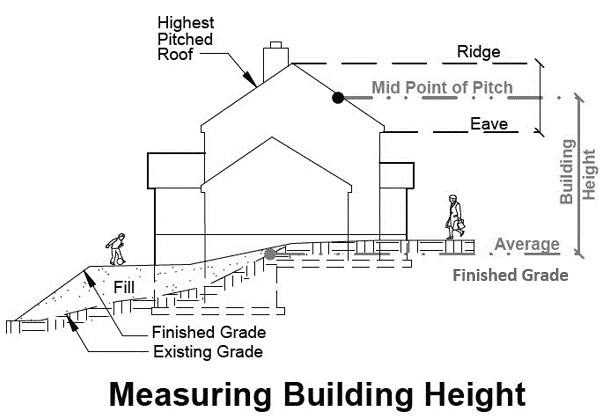
Diagram B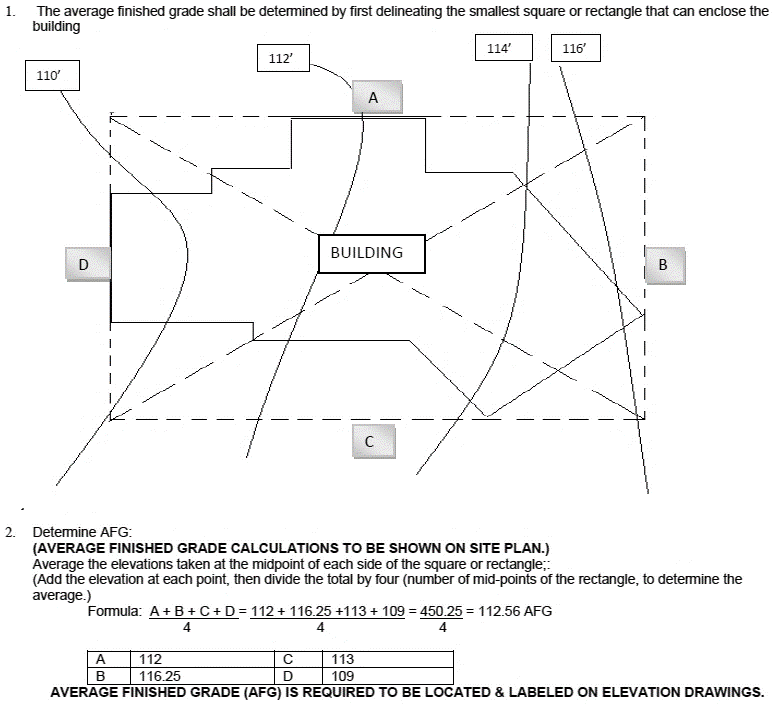
(Ord. No. 4329, § 5, 7-16-19)
15.02.066 Build-to line.
Build-to line means the location along a designated block or right-of-way where a building must be constructed. The build-to line is the property line.
(Ord. No. 4011, § 3, 12-13-11)
15.02.067 Bulk retail uses.
Bulk retail uses are distinguished from other retail uses in that they typically combine retail sales with warehouse and storage of goods. These uses generally require large, high-ceiling buildings since they store large quantities of inventory onsite. They also require large sites since adequate parking is essential.
(Ord. No. 3175, § 1, 7-19-94)
15.02.070 Canopy.
Canopy means a rooflike projection.
15.02.070.1 Card room, house-banked.
House-banked card room means a use governed pursuant to the provisions of Chapter 9.46 RCW, 1973 Gaming Act, and licensed by the Washington State Gambling Commission.
(Ord. No. 4257, § 4, 11-21-17)
15.02.071 Cargo containers.
Cargo containers means standardized, reusable vessels, designed without an axle or wheels, which were:
1. Originally, specifically, or formerly designed for or used in the packing, shipping, movement or transportation of freight, articles, goods or commodities; and/or
2. Designed for or capable of being mounted or moved on a rail car; and/or
3. Designed for or capable of being mounted on a chassis or bogie for movement by truck trailer or loaded on a ship.
When used for any purpose other than those listed in subsection (1) of this section, a cargo container is a structure.
(Ord. No. 3792, § 1, 3-21-06)
15.02.072 Charging levels.
Charging levels means the standardized indicators of electric force, or voltage, at which an electric vehicle’s battery is recharged. The terms 1, 2, and 3 are the most common EV charging levels, and include the following specifications:
1. Level 1 is considered slow charging.
2. Level 2 is considered medium charging.
3. Level 3 is considered fast or rapid charging.
(Ord. No. 3976, § 1, 10-19-10)
15.02.073 Clustering or cluster subdivision.
Clustering or cluster subdivision means a development or division of land in which residential building lots are reduced in size and concentrated in specified portion(s) of the original lot, tract, or parcel.
(Ord. No. 3551, § 8, 3-20-01)
15.02.073.1 Communal residence.
Communal residence means a business operated out of a single-family residential home with or without an owner occupant residing therein, where the residential home, or portions thereof, are rented to residential tenants through separate, unrelated lease or rental agreements. The fact that the individuals rent the residence or a portion thereof through separate, unrelated lease or rental agreements shall be prima facie evidence that the individuals are unrelated, not living as a single housekeeping unit, and do not meet the definition of family per KCC 15.02.135. Group homes and short-term rentals are not communal residences.
(Ord. No. 4339, § 2, 11-19-19)
15.02.075 Comprehensive plan.
Comprehensive plan means the document, including maps, adopted by the city council which outlines the city’s goals and policies relating to management of growth, and prepared in accordance with Chapter 36.70A RCW. The term also includes adopted subarea plans prepared in accordance with Chapter 36.70A RCW.
(Ord. No. 3409, § 10, 7-7-98)
15.02.080 Combining district.
Combining district means district regulations superimposed on an underlying zoning district which impose additional regulations for specific
uses, and which are valid for a stipulated time period. Uses permitted by the underlying zone may also be developed.
15.02.085 Common open space.
Common open space means a parcel of land or an area of water or a combination of land and water within the site designated for a planned unit development, and designed and intended primarily for the use or enjoyment of the residents of such development.
15.02.086 Composted material.
Composted material means organic solid waste that has undergone biological degradation and transformation under controlled conditions designed to promote aerobic decomposition at a solid waste facility in compliance with state regulations. Natural decay of organic solid waste under uncontrolled conditions does not result in composted material. Composted material must contain forty (40) to sixty-five (65) percent organic matter and meet the contaminant standards for “composted materials” in WAC 173-350-220.
(Ord. No. 4074, § 8, 2-19-13)
15.02.090 Conditional use.
Conditional use means a use permitted in a zoning district only after review and approval by the hearing examiner. Conditional uses are such that they may be compatible only on certain conditions in specific locations in a zoning district, or if the site is regulated in a certain manner.
15.02.091 Condominium.
Condominium means real property, portions of which are designated for separate ownership and the remainder of which is designated for common ownership solely by the owners of those portions. Real property is not a condominium unless the undivided interest in the common elements are vested in the unit owners, and unless a declaration and a survey map and plans have been recorded. Condominiums must meet all provisions of Chapter 64.34 RCW.
(Ord. No. 3381, § 1, 12-9-97)
15.02.095 Crop and tree farming.
Crop and tree farming means the use of land for horticultural purposes.
15.02.097 Dangerous wastes.
Dangerous wastes means those wastes designated in WAC 173-303-070 through 173-303-103 as dangerous wastes. This may include any discarded, useless, unwanted, or abandoned substances, including but not limited to certain pesticides, or any residues or containers of such substances which are disposed of in such quantity or concentration as to pose a substantial present or potential hazard to human health, wildlife, or the environment because such wastes or constituents or combinations of such wastes:
A. Have short-lived toxic properties that may cause death, injury, or illness or have mutagenic, teratogenic, or carcinogenic properties; or
B. Are corrosive, explosive, or flammable, or may generate pressure through decomposition or other means.
A moderate risk waste is not a dangerous waste.
(Ord. No. 2801, § 1, 9-6-88)
15.02.098 Day-care center.
Day-care center means a day-care operation with thirteen (13) or more persons in attendance at any one (1) time.
15.02.099 Day-care home.
Day-care home means a day-care operation with no more than twelve (12) persons in attendance at any one (1) time in the provider’s home in the family living quarters, including immediate family members who reside in the home.
(Ord. No. 3409, § 14, 7-7-98)
15.02.100 Day-care operation.
Day-care operation means the temporary care of persons in a residence or structure (meeting the requirements of Chapter 388-150 WAC) for less than twenty-four (24) hours a day on a regular recurring basis for pay or other valuable consideration, including, but not limited to, the furnishing of shelter, sustenance, supervision, education, or other supportive services.
(Ord. No. 3409, § 15, 7-7-98)
15.02.100.5 Designated manufactured home.
Designated manufactured home means a manufactured home constructed after June 15, 1976, in accordance with state and federal requirements for manufactured homes, which:
A. Is comprised of at least two (2) fully enclosed parallel sections each of not less than twelve (12) feet wide by thirty-six (36) feet long;
B. Was originally constructed with and now has a composition or wood shake or shingle, coated metal, or similar roof of nominal 3:12 pitch; and
C. Has exterior siding similar in appearance to siding materials commonly used on conventional site-built Uniform Building Code single-family residences.
(Ord. No. 3753, § 1, 6-7-05)
15.02.101 Designated zone facility.
Designated zone facility means any hazardous waste facility that requires an interim or final status permit under rules adopted under Chapter 70.105 RCW and Chapter 173-303 WAC, and that is not a preempted facility as defined in RCW 70.105.010 or in Chapter 173-303 WAC. A hazardous waste treatment or storage facility is a designated zone facility.
(Ord. No. 2801, § 1; Ord. No. 3409, § 16, 7-7-98. Formerly § 15.02.098)
15.02.102 Development plan.
Development plan means a plan drawn to scale, indicating the proposed use, the actual dimensions and shape of the lot to be built upon, the exact sizes and locations on the lot of buildings already existing, if any, and the location on the lot of the proposed building or alteration, yards, setbacks, landscaping, off-street parking, ingress and egress, and signs.
(Ord. No. 3409, § 17, 7-7-98)
15.02.103 Density, maximum permitted.
Maximum permitted density refers to the maximum number of dwelling units permitted per acre, subject to lot size and other development standards of Chapter 15.04 KCC. When determining the allowed number of lots or dwelling units for a subdivision, short subdivision, or multifamily project all site area may be included in the calculation. If calculations result in less than one full lot or unit, fractions above 0.50 shall be rounded up and fractions 0.50 and below shall be rounded down.
(Ord. No. 3290, § 1, 4-18-96; Ord. No. 3830, § 13, 3-6-07; Ord. No. 3978, § 1, 10-19-10; Ord. No. 4257, § 7, 11-21-17. Formerly 15.02.096)
15.02.105 Development standards.
Development standards means regulations including but not limited to setbacks, landscaping, screening, height, site coverage, signs, building layout, parking, and site design, and related features of land use.
15.02.106 Diminished garage door.
Diminished garage door means a garage in the rear portion of the lot accessed via a common driveway between lots; or a side access garage where the front facade facing a public area is finished with a window or other architectural feature; or a garage accessed via a rear alley; or a garage set back no less than ten (10) feet from the front facade of the home; or other design strategies which similarly diminish the prominence of the garage and are approved by the planning manager.
(Ord. No. 3830, § 13, 3-6-07)
15.02.107 Discontinuance.
Discontinuance means the abandonment or nonuse of a building, structure, sign, or lot for a period of six (6) months.
15.02.110 District.
District means an area designated by this title, with specific boundaries, in which lie specific zones, which zones are described in this title.
15.02.110.1 Dock-high doors.
Dock high doors means the openings in the loading dock area to the outside of a building. The typical interface involves a semi-truck backing up to a building directly aligning the back doors of the truck with a loading dock door. The elevation of the dock apron, the approach pavement area, is lower than the building slab elevation so that the bed of the truck will match the building slab elevation. The typical offset is 48 inches and the typical loading dock door is nine feet wide by 10 feet tall. A loading dock can be accessorized with dock equipment that interfaces with the truck. These may include dock seals, dock bumpers, dock levelers, dock communication lights, and canopies. Also known as loading dock doors.
(Ord. No. 4355, § 4 (Exh. D), 3-3-20)
15.02.111 Dock-high loading areas.
Dock-high loading areas means truck maneuvering areas and loading or unloading areas associated with loading doors that are located above the finish grade.
15.02.111.1 Downtown.
Downtown means the area designated in the city of Kent downtown subarea action plan as the “downtown study area,” as amended.
(Ord. No. 4225, § 1, 12-13-16)
15.02.113 Dripline.
Dripline means a circle drawn at the soil line directly under the outermost branches of a tree.
(Ord. No. 2932, § 1, 7-17-90)
15.02.113.1 Drive-in, drive-through facilities.
Drive-in, drive-through facilities means a business or portion of a business where a consumer is permitted or encouraged, either by the design of physical facilities or by the provisions of services and/or packaging procedures, to carry on business while seated in a motor vehicle. This definition shall include but not be limited to drive-up windows, drive-through banks, and drive-in/drive-through restaurants.
(Ord. No. 3600, § 2, 5-7-02)
15.02.114 Duplex/two-family dwelling. Revised 7/23
Duplex/two-family dwelling means one detached residential building containing two dwelling units totally separated from each other by a one-hour fire wall or floor, designed for occupancy by not more than two families. Accessory dwelling units attached to a principal dwelling unit regardless of the presence of a fire wall are not considered duplexes for the purposes of land use and zoning regulations.
15.02.115 Dwelling, single-family.
Single-family dwelling means a detached residential dwelling unit, other than a mobile home, designed for and occupied by one (1) family only.
15.02.125 Dwelling, multifamily.
Multifamily dwelling means a residential building designed for or occupied by three or more families, with the number of families in residence not exceeding the number of dwelling units provided. This definition does not include independent senior living facilities, assisted living facilities, detached single-family structures designed as part of a multiple-structure development such as a planned unit development, residential facilities with health care, transitional housing, or group homes. This definition does include senior housing that does not provide meals, as well as permanent supportive housing as defined in RCW 36.70A.030.
(Ord. No. 4089, § 3, 9-17-13; Ord. No. 4188, § 3, 2-16-16; Ord. No. 4225, § 2, 12-13-16; Ord. No. 4410, § 2, 9-7-21)
15.02.130 Dwelling unit.
Dwelling unit means one room, or rooms connected together, constituting a separate, independent housekeeping establishment for owner occupancy, or rental or lease on a weekly, monthly, or longer basis, and physically separated from any other rooms or dwelling units which may be in the same structure or on the same property, and containing independent cooking (including a stove) and sleeping facilities.
(Ord. No. 4174, § 3, 11-17-15)
15.02.130.1 Electric vehicle (EV).
Electric vehicle (EV) means any vehicle that operates, either partially or exclusively, on electrical energy from the grid, or an off-board source, that is stored on-board for motive purpose.
(Ord. No. 3976, § 1, 10-19-10)
15.02.130.2 Electric vehicle (EV) charging station.
Electric vehicle (EV) charging station means a public or private parking space that is served by battery charging equipment that has as its primary purpose the transfer of electric energy (by conductive or inductive means) to a battery or other energy storage device in an electric vehicle.
(Ord. No. 3976, § 1, 10-19-10)
15.02.130.3 Electric vehicle charging station – public.
Electric vehicle charging station – public means an electric vehicle charging station that is (1) publicly owned and publicly available (e.g., Park & Ride parking, public library parking lot, on-street parking), or (2) privately owned and publicly available (e.g., shopping center parking, nonreserved parking in multi-family parking lots).
(Ord. No. 3976, § 1, 10-19-10)
15.02.130.4 Electric vehicle charging station – restricted.
Electric vehicle charging station – restricted means an electric vehicle charging station that is (1) privately owned with restricted access (e.g., single-family home, executive parking, designated employee parking) or (2) publicly owned and restricted (e.g., fleet parking with no access to the general public).
(Ord. No. 3976, § 1, 10-19-10)
15.02.130.5 Electric vehicle parking space.
Electric vehicle parking space means any marked parking space that identifies the use to be exclusively for the parking of an electric vehicle.
(Ord. No. 3976, § 1, 10-19-10)
15.02.131 Emergency housing facility, emergency shelter.
Emergency housing facility means a facility operated to provide temporary housing within a permanent enclosed building for individuals who are otherwise homeless and have no immediate housing options available to them. An “emergency housing facility” does not include “isolation and quarantine facilities” as defined in this chapter.
Emergency shelter means a temporary structure, not permanently fixed to the ground, or not served by fixed permanent utilities, such as but not limited to tents, tiny houses, sheds, trailers, or recreational vehicles, operated to provide temporary shelter to individuals who are otherwise homeless and have no immediate housing options available to them. An “emergency shelter” does not include “isolation and quarantine facilities” as defined in this chapter.
(Ord. No. 3600, § 2, 5-7-02; Ord. No. 4089, § 3, 9-17-13; Ord. No. 4358, § 3, 5-5-20; Ord. No. 4373, § 1, 10-20-20)
15.02.131.5 Equitable distribution.
Equitable distribution means siting or locating secure community transition facilities in a manner that will not cause a disproportionate grouping of similar facilities either in any one (1) county, or in any one (1) jurisdiction or community within a county, as relevant.
(Ord. No. 3615, § 1, 9-17-02)
15.02.133 Extremely hazardous waste.
Extremely hazardous waste means those wastes designated in WAC 173-303-070 through 173-303-103 as extremely hazardous wastes. This may include any dangerous waste which:
A. Will persist in a hazardous form for several years or more at a disposal site and which in its persistent form:
1. Presents a significant environmental hazard and may be concentrated by living organisms through a food chain or may affect the genetic makeup of man or wildlife; and
2. Is highly toxic to man or wildlife.
B. Is disposed of at a hazardous waste disposal site in such quantities as would present an extreme hazard to man or the environment.
(Ord. No. 2801, § 1, 9-6-88)
15.02.134 Facade modulation.
Facade modulation means a horizontal stepping back or projecting forward of portions of a building facade.
15.02.135 Family. Revised 1/23
Family means an individual; two or more persons related by blood, marriage, or state-registered domestic partnership under Chapter 26.60 RCW; a group of two or more disabled residents protected under the Federal Housing Act Amendments, who are not related by blood, marriage, or state-registered domestic partnership under Chapter 26.60 RCW, living together as a single housekeeping unit; or two or more persons who are not related by blood, marriage, or state-registered domestic partnership under Chapter 26.60 RCW, living together as a single housekeeping unit.
(Ord. No. 2958, § 1, 1-2-91; Ord. No. 3451, § 1, 4-20-99; Ord. No. 4089, § 3, 9-17-13; Ord. No. 4339, § 3, 11-19-19; Ord. No. 4456, § 1, 12-13-22)
15.02.140 Fence, sight-obscuring.
The minimum for a sight-obscuring fence is a chainlink fence with woven slats in every row or available space of the fence.
15.02.145 Fence, one hundred (100) percent sight-obscuring.
One hundred (100) percent sight-obscuring fence means a fence constructed of solid wood, metal, or other appropriate material which totally conceals the subject use from adjoining uses at six (6) feet above the base of the fence line, at twenty (20) feet from the subject property line.
15.02.147 Floor area ratio.
Floor area ratio is a measure of development intensity which is determined by dividing gross floor area by lot area.
(Ord. No. 3345, § 1, 5-7-97)
15.02.150 Frontage, building or occupancy.
Building or occupancy frontage means the length of that portion of a building or ground floor occupancy which abuts a street, publicly used parking area, or mall appurtenant to such building or occupancy, expressed in lineal feet and fractions thereof.
15.02.151 Fulfillment center.
Fulfillment center means a building that is used primarily for the storage and/or consolidation of manufactured goods (and to a lesser extent, raw materials) prior to their distribution to retail customers, retail locations, or other warehouses. A typical fulfillment center has a high level of onsite automation and logistics management. The automation and logistics enable highly efficient processing of goods through the center. Fulfillment centers are generally characterized by a significant storage function and direct distribution of ecommerce product to end users. These facilities usually handle smaller packages and quantities than other types of warehouses, and operations at these facilities often include employees fulfilling online orders by picking, packing, and shipping the goods and materials directly to online retail customers. These qualities, large scale, and volume of goods moved directly to home customer delivery differentiate it from other kinds of warehouse distribution.
(Ord. No. 4355, § 4 (Exh. D), 3-3-20)
15.02.155 Garage or carport, private.
Private garage or carport means a building, or a portion of a building, principally for vehicular equipment such as automobiles, boats, etc., in which only vehicles used by the tenants of the buildings on the premises are stored or kept.
(Ord. No. 4174, § 4, 11-17-15)
15.02.160 General conditional uses.
General conditional uses means uses described in KCC 15.08.030. Such uses shall be deemed conditional uses in all districts.
15.02.165 Grade.
Grade means the lowest point of elevation of the finished surface of the ground between the exterior wall of a building and a point five (5) feet distant from such wall, or the lowest point of elevation of the finished surface of the ground between the exterior wall of a building and the property line if it is less than five (5) feet distant from such wall. In case walls are parallel to and within five (5) feet of a public sidewalk, alley, or other public way, the grade shall be the elevation of the sidewalk, alley, or public way.
15.02.170 Gross floor area.
Gross floor area means the area included within the surrounding exterior walls of a building expressed in square feet and fractions thereof. The floor area of a building not provided with surrounding exterior walls shall be the usable area under the horizontal projections of the roof or floor above.
15.02.173 Group home.
A. Class I group home means publicly or privately operated residential facilities including state-licensed adult family homes as defined by RCW 70.128.010; state-licensed foster-family homes as defined by RCW 74.15.020(e); group homes for individuals who are developmentally, physically, or mentally disabled; group homes or halfway houses for recovering alcoholics and former drug addicts; and permanent supportive housing as defined in RCW 36.70A.030 within a single-family dwelling. A class I group home shall have a maximum of six residents not including providers.
B. Class II group home means publicly or privately operated residential facilities for juveniles under the jurisdiction of the criminal justice system. These homes include state-licensed group care homes or halfway homes for juveniles which provide residence in lieu of sentencing or incarceration, and halfway houses providing residence to juveniles needing correction or for juveniles selected to participate in state-operated work release and pre-release programs. The planning director shall have the discretion to classify a group home proposing to serve juveniles convicted of the offenses listed under class III group home in this section as a group home class III, and any such home shall be sited according to the regulations contained within the group III classification.
1. Group home, class II-A. A class II-A group home shall have a maximum of eight residents including resident staff.
2. Group home, class II-B. A class II-B group home shall have a maximum of 12 residents including resident staff.
3. Group home, class II-C. A class II-C group home shall have a maximum of 18 residents including resident staff.
C. Class III group home means privately or publicly operated residential facilities for adults under the jurisdiction of the criminal justice system who have entered a pre- or post-charging diversion program, or been selected to participate in state-operated work/training release or other similar programs as provided in Chapters 137-56 and 137-57 WAC. Such groups also involve individuals who have been convicted of a violent crime against a person, or a crime against property with a sexual motivation and convicted or charged as a sexual or assaultive violent predator. Secure community transition facilities are considered class III group homes. Secure community transition facilities shall have a maximum of three residents, excluding resident staff, unless the state agency proposing to establish and operate the facility can demonstrate that it has equitably distributed other secure community transition facilities with the same or a greater number of residents in other jurisdictions or communities throughout the entire geographic limits of King County.
(Ord. No. 2958, § 2, 1-2-91; Ord. No. 3451, § 2, 4-20-99; Ord. No. 3615, § 1, 9-17-02; Ord. No. 4089, § 3, 9-17-13; Ord. No. 4339, § 4, 11-19-19; Ord. No. 4410, § 1, 9-7-21)
15.02.174 Guest cottage.
Guest cottage means an accessory, detached dwelling without any kitchen facilities designed for and used to house transient visitors or nonpaying guests of the occupants of the main building.
(Ord. No. 2801, § 1, 9-6-88)
15.02.174.1 Harm reduction programs. Revised 8/23
Harm reduction programs means programs that emphasize working directly with people who use drugs to prevent overdose and infectious disease transmission, improve the physical, mental, and social well-being of those served, and offer low threshold options for accessing substance use disorder treatment and other services. Harm reduction programs authorized within the city of Kent do not include community health engagement locations, as regulated in KCC 15.08.550. Further, harm reduction programs operating within the city of Kent may not provide the following services within the city limits of Kent: distribution or exchange of drug paraphernalia, including, but not limited to, pipes, pipettes, or other smoking equipment, syringes, needles, or associated syringe equipment, unless the item was obtained directly from, or pursuant to, a valid prescription or order of a practitioner while acting in the course of their professional practice.
(Ord. No. 4469, § 2, 6-20-23)
15.02.175 Hazardous substance.
Hazardous substance means any liquid, solid, gas, or sludge, including any material, substance, product, commodity, or waste, regardless of quantity, that exhibits any of the characteristics or criteria of hazardous waste as described in rules adopted under Chapter 70.105 RCW or in WAC
173-303-090, 173-303-100, 173-303-101, 173-303-102, or 173-303-103.
15.02.176 Hazardous substance facility buffer zone.
Hazardous substance facility buffer zone means a setback area between the hazardous substance land use facility boundary and the nearest point of the hazardous substance land use property line, necessary to provide added protection to adjacent land uses or resources of beneficial use. All hazardous waste treatment and storage facilities must maintain at least a fifty (50) foot buffer zone.
(Ord. No. 2801, § 1, 9-6-88)
15.02.177 Hazardous substance land use.
Hazardous substance land use means any use which is permitted under this title and which includes a designated zone facility or the processing or handling of a hazardous substance.
(Ord. No. 2801, § 1, 9-6-88)
15.02.178 Hazardous substance land use facility.
Hazardous substance land use facility means the projected line enclosing the area of all structures and lands on which hazardous substance land use activities occur, have occurred in the past, or will occur in the future. This does not include the application of products for agricultural purposes or the use, storage, or handling of hazardous substances used in public water treatment facilities.
15.02.179 Hazardous substance, processing or handling of.
Processing or handling of a hazardous substance means the compounding, treatment, manufacture, synthesis, use, or storage of hazardous substances in excess of the following amounts in bulk quantities: five thousand (5,000) pounds of solid hazardous substances, five hundred (500) gallons of liquid hazardous substances, and six hundred fifty (650) cubic feet of gaseous hazardous substances.
(Ord. No. 2801, § 1, 9-6-88)
15.02.180 Hazardous waste.
Hazardous waste means any dangerous and extremely hazardous waste, including substances composed of radioactive and hazardous components. A moderate risk waste is not a hazardous waste.
(Ord. No. 2801, § 1, 9-6-88)
15.02.181 Hazardous waste facility.
Hazardous waste facility means the contiguous land and structures, other appurtenances, and improvements on the land used for recycling, storing, treating, incinerating, or disposing of hazardous waste.
(Ord. No. 2801, § 1, 9-6-88)
15.02.182 Hazardous waste storage facility.
Hazardous waste storage facility means any designated zone facility which holds hazardous waste for a temporary period not to exceed five (5) years; this does not include accumulation of hazardous waste by the generator on the site of generation, as long as the generator complies with the applicable requirements of WAC 173-303-200 and 173-303-201.
(Ord. No. 2801, § 1, 9-6-88)
15.02.183 Hazardous waste treatment facility.
Hazardous waste treatment facility means any designated zone facility which processes hazardous waste by physical, chemical, or biological means to make such waste nonhazardous or less hazardous, safer for transport, amenable for energy or material resource recovery, amenable for storage, or reduced in volume.
(Ord. No. 2801, § 1, 9-6-88)
15.02.184 Hazardous waste treatment or storage facility, offsite.
Offsite hazardous waste treatment or storage facility means any hazardous waste treatment or storage facility which treats or stores wastes that are generated off the site.
(Ord. No. 2808, § 1, 10-18-88)
15.02.185 Hazardous waste treatment or storage facility, onsite.
Onsite hazardous waste treatment or storage facility means any hazardous waste treatment or storage facility which treats or stores only those wastes that are generated on the site.
(Ord. No. 2808, § 1, 10-18-88)
15.02.186 Hearing examiner (land use).
Hearing examiner (land use) means a person appointed by the city administrator to conduct public hearings on applications outlined in the city ordinance creating the hearing examiner, and who prepares a record, findings of fact, and conclusions on such applications.
(Ord. No. 2808, § 1, 10-18-88)
15.02.187 Highest shade-producing point.
Highest shade-producing point means the point of a structure which casts the longest shadow at noon on January 21.
15.02.190 Home occupation.
Home occupation means any use customarily carried on within a dwelling by the inhabitants thereof which use is incidental to the residential use and not primarily considered as a business and which complies with the conditions of KCC 15.08.040.
15.02.195 Homeowners’ association.
Homeowners’ association means an incorporated, nonprofit organization operating under recorded land agreements through which (a) each lot owner is automatically a member, and (b) each lot is automatically subject to a charge for a proportionate share of the common property, and (c) a charge, if unpaid, becomes a lien against the property.
15.02.200 Hotel.
Hotel means any building or group of buildings held out to the public to be an inn, hotel or public lodging house or place where sleeping accommodations, whether with or without meals, or the facilities for preparing the same, are furnished in exchange for payment typically based on a per night and per room basis to transient guests, in which six or more rooms are used for the accommodation of such guests with a majority of the entrances to guest rooms on the inside of the building. Hotels do not include “short-term rentals” as defined in this chapter, nor do they include “dwelling units” or “premises” as defined and covered by Chapter 59.18 RCW, the Residential Landlord Tenant Act.
(Ord. No. 4373, § 2, 10-20-20)
15.02.202 Impervious surface.
Impervious surface means that hard surface area which either prevents or retards the entry of water into the soil mantle as it entered under natural conditions preexistent to development, or that hard surface area which causes water to run off the surface in greater quantities or at an increased rate of flow from that present under natural conditions preexistent to development. Common impervious surfaces include but are not limited to rooftops, concrete or asphalt paving, paved walkways, patios, driveways, parking lots or storage areas, and oiled, macadam or other surfaces which similarly impede the natural infiltration of surface water.
15.02.203 Independent senior living facility.
Independent senior living facility means a multi-dwelling-unit facility that provides housing, communal areas, and limited basic services (including a variety of social and transportation services) to individuals 60 or more years of age who choose to live in a congregate setting. These facilities consist of individual dwelling units that contain separate bathroom facilities, and which also may contain a full kitchen, partial kitchen, or no kitchen. Communal areas include: a dining room in which at least one meal per day is served; social and activity areas; laundry facilities; and open spaces. This definition does not include senior housing that does not provide meals, assisted living facilities, group homes, or residential facilities with health care. (Ord. No. 4188, § 1, 2-16-16)
15.02.203.1 Industrial use.
Industrial use means an activity that includes production, testing, distribution, or repair of commodities or materials.
(Ord. No. 4355, § 4 (Exh. D), 3-3-20)
15.02.204 Institution.
Institution means a civic, religious, or other similar organization, including, but not limited to, an athletic field, hospital, university, religious institution, and community center.
(Ord. No. 3706, § 1, 8-17-04)
15.02.205 Interior court.
Interior court means a space, open and unobstructed to the sky, located at or above grade level on a lot and bounded on three (3) or more sides by walls of a building.
15.02.207 Isolation and quarantine facility.
Isolation and quarantine facility means a building, trailer, tent, shed, recreational vehicle or any other permanent or temporary structure, used to house individuals who lack a suitable location to quarantine or isolate in order to control or prevent the spread of any dangerous, contagious, communicable or infectious disease agent or contaminant.
(Ord. No. 4373, § 3, 10-20-20)
15.02.210 Junkyard.
Junkyard means a place where waste, discarded or salvaged materials are bought, sold, exchanged, stored, baled, cleaned, packed, disassembled, or handled, including, but not limited to, auto and motor vehicle wrecking yards, house wrecking yards, used lumber yards, and yards for use of salvaged house wrecking and structural steel materials and equipment.
(Ord. No. 3409, § 20, 7-7-98)
15.02.215 Kennel.
Kennel means any premises on which four (4) or more dogs which are five (5) months old or older are kept.
15.02.217 Lake.
Lake means a natural or artificial body of water of two (2) or more acres or where the deepest part of the basin at low water exceeds two (2) meters (six and six-tenths (6.6) feet). Artificial bodies of water with a recirculation system approved by the public works department are not included in this definition.
15.02.220 Landscaping.
Landscaping means vegetative cover including shrubs, trees, flowers, seeded lawn or sod, ivy, and other similar plant material.
15.02.223 Less restrictive alternative.
Less restrictive alternative means court-ordered treatment in a setting less restrictive than total confinement which satisfies the conditions set forth in RCW 71.09.092.
(Ord. No. 3615, § 1, 9-17-02)
15.02.224 Live-work unit.
Live-work unit means a structure or portion of a structure that functions predominantly as work spaces and secondarily as residences, and:
A. Combines a commercial or manufacturing activity that is allowed in the zone with a residential living space for the owner of the commercial or manufacturing business, or the owner’s employee, and that person’s household;
B. The resident owner or employee of the business is responsible for the commercial or manufacturing activity performed; and
C. The commercial or manufacturing activity conducted takes place subject to a valid business license associated with the premises.
(Ord. No. 4011, § 4, 12-13-11)
15.02.225 Lot.
Lot means a parcel of land of at least sufficient size to meet minimum zoning requirements for use, coverage, and area, and to provide such yards and other open spaces as are required in this title. Such lot shall have frontage on an improved public street, or on an approved private street, and may consist of:
A. A single lot of record;
B. A portion of a lot of record;
C. A combination of complete lots of record and portions of lots of record;
D. A parcel of land described by metes and bounds;
provided, that in no case of division or combination shall any residual lot or parcel be created which does not meet the requirements of this title.
15.02.228 Long term commercial significance.
Long term commercial significance includes the growing capacity, productivity, and soil composition of the land for long-term commercial production, in consideration with the land’s proximity to population areas, and the possibility of more intense uses of the land.
(Ord. No. 3409, § 21, 7-7-98)
15.02.230 Lot, corner.
Corner lot means a lot abutting upon two (2) or more streets at their intersection, or upon two (2) parts of the same street, such streets or parts of the same street forming an interior angle of less than one hundred thirty-five (135) degrees within the lot lines.
15.02.231 Lot area.
Lot area means the area included within the property lines of a lot, including any easement area.
(Ord. No. 3409, § 22, 7-7-98)
15.02.235 Lot frontage.
The front of a lot shall be that portion nearest the street or, if the lot does not abut a street, the portion nearest an ingress/egress easement. On a corner lot, the front yard shall be considered the narrowest part of the lot that fronts on a street, except in industrial and commercial zones, in which case the user of a corner lot has the option of determining which part of the lot fronting on a street shall become the lot frontage.
(Ord. No. 3409, § 23, 7-7-98)
15.02.245 Lot measurements.
A. Depth of a lot shall be considered to be the distance between the foremost points of the side lot lines in front and the rearmost points of the side lot lines in the rear.
B. Width of a lot shall be considered to be the distance between the side lines connecting front and rear lot lines; provided, however, that width between side lot lines at their foremost points (where they intersect with the street line) shall not be less than eighty (80) percent of the required lot width, except in the case of lots on the turning circle of cul-de-sacs, where the eighty (80) percent requirement shall not apply.
15.02.250 Lot of record.
Lot of record means a lot which is part of a subdivision recorded in the office of the county assessor, or a lot or parcel described by metes and bounds, the description of which has been so recorded.
15.02.252 Lot, riverfront.
Riverfront lot means any lot or land parcel which is adjacent to the Green River, a scenic and recreational road, a riverfront road, or a riverfront park.
15.02.255 Lot, through.
Through lot means a lot that has both ends fronting on a street. Either end may be considered the front.
15.02.257 Major nonconforming building or structure.
Major nonconforming building or structure means any nonconforming building or structure located on a parcel which at any point borders or is in a residential district and which is not in compliance with the minimum development standards of the district in which it is located.
15.02.257.1 Manufacturing, assembly, and fabrication, heavy.
Manufacturing, assembly, and fabrication, heavy means the transformation of materials or substances into new products including additive or subtractive processes, construction, testing, and assembling of component parts, and the blending of materials such as lubricating oils, plastics, resins, or liquors. Heavy manufacturing and fabrication are often characterized by the need for large outdoor areas in which to conduct operations, and typically result in environmental impacts beyond their own sites. This definition includes, but is not limited to: manufacture and fabrication of cement, brick, lime, gypsum, asphalt, and other manufacturing and fabrication uses as determined by the community and economic development director. This definition excludes slaughterhouses, manufacture of shellac, varnish or turpentine, paper, pulp, rubber from crude material, refining and/or manufacturing of petroleum products.
(Ord. No. 4355, § 4 (Exh. D), 3-3-20)
15.02.257.2 Manufacturing, assembly, and fabrication, light.
Manufacturing, assembly, and fabrication, light means the transformation of materials or substances into new products including additive or subtractive processes, construction, testing, and assembling of component parts, and the blending of materials such as lubricating oils, plastics, resins, or liquors. Light manufacturing and fabrication is characterized by the use being contained within buildings, and materials or equipment used in production not being stored outside. Light manufacturing and fabrication activities do not generate external emissions such as smoke, odor, noise, vibrations, or other nuisances outside the building. This definition includes but is not limited to manufacture and fabrication of food products, electronic components, office products, furniture, glass products, printing and publishing, and other manufacturing and fabrication uses as determined by the community and economic development director. This definition excludes manufacture of hazardous substances, as well as slaughterhouses, manufacture of shellac, varnish or turpentine, paper, pulp, rubber from crude material, refining and/or manufacturing of petroleum products.
(Ord. No. 4355, § 4 (Exh. D), 3-3-20)
15.02.257.3 Manufacturing, assembly, and fabrication, medium.
Manufacturing, assembly, and fabrication, medium means the transformation of materials or substances into new products including additive or subtractive processes, construction, testing, and assembling of component parts, and the blending of materials such as lubricating oils, plastics, resins, or liquors. Medium manufacturing and fabrication is characterized by need for only very limited areas of outdoor storage and may create minor external environmental impacts during the conduct of operations but most impacts are contained onsite. This definition includes but is not limited to manufacture and fabrication of automotive and aerospace vehicles and their parts, alcoholic products, paints, printing ink, leather goods, and other manufacturing and fabrication uses as determined by the community and economic development director. This definition excludes manufacture of hazardous substances, as well as slaughterhouses, manufacture of shellac, varnish or turpentine, paper, pulp, rubber from crude material, refining and/or manufacturing of petroleum products.
(Ord. No. 4355, § 4 (Exh. D), 3-3-20)
15.02.257.4 Minor conditional use.
Minor conditional use means a use permitted in a zoning district only after review and approval by the planning director. Minor conditional uses are such that they may be compatible only on certain conditions in specific locations in a zoning district, or if the site is regulated in a certain manner.
(Ord. No. 4372, § 3, 10-20-20)
15.02.258 Minor nonconforming building or structure.
Minor nonconforming building or structure means any nonconforming building or structure which is not a major nonconforming structure and which is not in compliance with the minimum development standards of the district in which it is located.
15.02.259 Mixed use building or structure.
Mixed use building or structure means a building that contains two (2) or more separate and distinct uses permitted in the zoning district where such building is located.
(Ord. No. 3014, § 1, 12-3-91)
15.02.260 Mixed use development. Revised 1/23
Mixed use development shall mean two or more permitted uses or conditional uses developed in conjunction with one another on the same site. Provided that the aforementioned requirements are met, a mixed use development may include two or more separate buildings.
(Ord. No. 3092, § 1, 2-16-93; Ord. No. 3345, § 2, 5-7-97; Ord. No. 4093, § 2, 11-19-13; Ord. No. 4132, § 1, 12-9-14; Ord. No. 4166, § 2, 9-1-15; Ord. No. 4456, § 2, 12-13-22)
15.02.261 Manufactured home.
Manufactured home means a single-family dwelling constructed in a factory after June 15, 1976, and installed in accordance with the U.S. Department of Housing and Urban Development (HUD) requirements for manufactured housing and bearing the appropriate insignia indicating such compliance.
(Ord. No. 3409, § 24, 7-7-98)
15.02.262 Mobile home.
Mobile home means a factory-constructed residential unit with its own independent sanitary facilities that is intended for year round occupancy and is composed of one (1) or more major components which are mobile in that they can be supported by wheels attached to their own integral frame or structure and towed by an attachment to that frame or structure over the public highway under trailer license or by special permit, and which was constructed prior to June 15, 1976.
15.02.265 Mobile home park.
Mobile home park means an area under one (1) ownership designed to accommodate ten (10) or more mobile homes.
15.02.267 Moderate risk waste.
Moderate risk waste means those wastes defined in WAC 173-303-040 as moderate risk wastes. This may include any waste that exhibits any of the properties of hazardous waste but is exempt from regulation under Chapter 70.105 RCW solely because the waste is generated in quantities below the threshold for regulation, and any household waste which is generated from the disposal of substances identified by the Department of Ecology as hazardous household substances.
(Ord. No. 2808, § 1, 10-18-88)
15.02.268 Modular home.
Modular home means a single-family dwelling constructed in a factory and shall be constructed and installed in accordance with applicable provisions of the International Building Code, the International Residential Code, or other applicable building codes, and shall bear the appropriate insignia indicating compliance with those codes. This definition includes “prefabricated,” “panelized,” and “factory built” units.
15.02.270 Motel.
Motel means any building or buildings held out to the public to be an inn, hotel or public lodging house or place where sleeping accommodations, whether with or without meals, or the facilities for preparing the same, are furnished in exchange for payment typically based on a per night and per room basis to transient guests, in which six or more rooms are used for the accommodation of such guests with a majority of entrances to guest rooms on the outside of the building. Motels do not include “short-term rentals” as defined in this chapter, nor do they include “dwelling units” or “premises” as defined and covered by Chapter 59.18 RCW, the Residential Landlord Tenant Act.
(Ord. No. 4373, § 4, 10-20-20)
15.02.270.5 Motor vehicle.
Motor vehicle means a vehicle, machine, tractor, trailer, or semitrailer propelled or drawn by mechanical power used on highways, or any other vehicle required to be registered under the laws of this state, but does not include a vehicle, machine, tractor, trailer, or semitrailer operated exclusively on a rail.
(Ord. No. 3813, § 1, 9-5-06)
15.02.271 Multifamily design review.
Multifamily design review means an administrative process for the purpose of reviewing multifamily development applications for compliance with specific site design, landscape design, and building design criteria.
(Ord. No. 3014, § 2, 12-3-91)
15.02.274 Native adapteds.
Native adapteds means noninvasive plant species that have adapted to the climatic conditions of the Northwest region.
(Ord. No. 4074, § 10, 2-19-13)
15.02.275 Natural or native areas.
Natural or native areas means all or portions of a parcel of land undisturbed by development and maintained in a manner which preserves the indigenous plant materials.
15.02.280 Net acreage.
Net acreage means the buildable area after the area of street rights-of-way has been subtracted.
15.02.281 New manufactured home.
New manufactured home means any manufactured home required to be titled under RCW Title 46, which has not been previously titled to a retail purchaser, and is not a “used mobile home” as defined in RCW 82.45.032(2).
(Ord. No. 3753, § 1, 6-7-05)
15.02.282 Nonconforming lot of record.
Nonconforming lot of record means any validly recorded lot which at the time it was recorded fully complied with the applicable laws and ordinances but which does not fully comply with the lot requirements of this title.
15.02.283 Nonconforming sign.
Nonconforming sign means any sign legally established prior to the effective date of this title or subsequent amendments thereto, which is not in full compliance with the regulations of this title.
(Ord. No. 3409, § 27, 7-7-98)
15.02.285 Nonconforming use.
Nonconforming use means the use of land, a building, or a structure lawfully existing prior to the effective date of this title or subsequent amendments thereto, which does not conform with the use regulations of the district in which it is located on the effective date of such use regulations.
(Ord. No. 3409, § 28, 7-7-98)
15.02.286 Nonconformity.
Nonconformity means any land use, structure, lot of record, or sign legally established prior to the effective date of this title or subsequent amendment to it which would not be permitted by or is not in full compliance with the regulations of this title.
15.02.287 Northern lot line.
Northern lot line means a lot line or lines less than forty-five (45) degrees southeast or southwest of a line drawn east-west and intersecting the northernmost point of the lot. If the northern lot line adjoins any unbuildable area (e.g., streets, alleys, public rights-of-way, parking lots, common areas) other than a required yard area, the northern lot line shall be that portion of the northerly edge of the unbuildable area which is due north from the actual northern lot line of the applicant’s property.
15.02.288 North-south lot dimension.
North-south lot dimension means the average distance between lines from the corners of the northern lot line south to a line drawn east-west and intersecting the southernmost point of the lot.
15.02.295 Occupancy.
Occupancy means the purpose for which a building is used or intended to be used. The term shall also include the building or room housing such use. Change of occupancy is not intended to include change of tenants or proprietors.
15.02.300 Official map.
Official map means maps showing the designation, location, and boundaries of the various districts which have been adopted and made a part of this title.
15.02.305 Open green area.
Open green area means landscaped areas and areas of natural or native vegetation.
15.02.307 Opioid treatment program. Revised 1/23 Revised 8/23
Opioid treatment program means a program that: (1) engages in the treatment of opioid use disorder with medications approved by the United States Food and Drug Administration for the treatment of opioid use disorder and reversal of opioid overdose, including methadone; and (2) provides a comprehensive range of medical and rehabilitative services.
(Ord. No. 4193, § 1, 4-19-16; Ord. No. 4456, § 3, 12-13-22; Ord. No. 4469, § 1, 6-20-23)
15.02.310 Ordinary high-water mark.
Ordinary high-water mark, on the Green River, Lake Fenwick, streams, marshes, and swamps, is that mark that will be found by examining the bed and banks and ascertaining where the presence and action of waters are so common and usual, and so long continued in all ordinary years, as to mark upon the soil a character distinct from that of the abutting upland, in respect to vegetation as that condition exists on the effective date of this title, or as it may naturally change thereafter; provided, that in any area where the ordinary high-water mark cannot be found, the ordinary high-water mark shall be the line of mean high water.
15.02.315 Outdoor storage or outside storage.
Outdoor storage or outside storage means all or part of a lot which is used for the keeping of materials or products in an open, uncovered yard or in an unwalled building. Outdoor storage does not apply to materials which are displayed for marketing purposes to the general public, such as retail products for sale or rent.
(Ord. No. 4212, § 1, 8-16-16; Ord. No. 4355, § 4 (Exh. D), 3-3-20)
15.02.317 Overlay district.
Overlay district means a defined geographic area where a set of development regulations are established to achieve a specific public purpose. These regulations are in addition to those of the underlying zoning district. Where a conflict exists between the regulations of the overlay district and the underlying zoning, the regulations of the overlay district shall apply.
(Ord. No. 3409, § 30, 7-7-98)
15.02.318 Park, riverfront.
Riverfront park means a publicly owned open space which lies along the Green River, along a scenic and recreational road.
15.02.320 Parking space or parking stall.
Parking space or parking stall is any off-street space intended for the use of vehicular parking, with ingress or egress to the space easily identifiable.
15.02.325 Parking, temporary.
Temporary parking means parking facilities specifically designed to accommodate not less than fifty-one (51) vehicles and intended for public use for a period of not more than five (5) years, subject to annual maintenance review by the engineering department. Temporary parking shall not be in lieu of specified off-street parking as required in Chapter 15.05 KCC pertaining to off-street parking and loading requirements.
15.02.326 Patient cooperative, medical marijuana.
Medical marijuana patient cooperative means a group of four or fewer qualifying patients and/or designated providers who share responsibility for producing and processing marijuana only for the medical use of the members of the cooperative, pursuant to, and in accordance with, all the terms and conditions of RCW 69.51A.250, as now enacted or as subsequently amended.
(Ord. No. 4208, § 4, 7-5-16)
15.02.327 Pedestrian-oriented use.
Pedestrian-oriented use means a commercial use whose customers commonly arrive on foot, or where signage, advertising, window display, and entry ways are oriented toward pedestrian traffic on a public sidewalk. Pedestrian-oriented businesses may include restaurants, retail shops, personal service businesses, travel services, banks, (except drive-through windows), and similar establishments.
(Ord. No. 3409, § 31, 7-7-98)
15.02.330 Performance standards.
Performance standards means regulations for the control of dangerous or objectionable elements, as defined in KCC 15.08.050(A).
15.02.331 Permeable surface.
Permeable surface means a hard, drivable surface designed to allow a high degree of infiltration of water through the pavement. The pavement is usually constructed of concrete, asphalt, or manufactured systems such as interlocking brick or a combination of sand and brick lattice.
(Ord. No. 4043, § 9, 8-21-12)
15.02.332 Planned unit development.
Planned unit development is a development built under those provisions of this title which permit departures from the conventional siting, setback, and density requirements of other sections of this title in the interest of achieving superior site development, creating open space, and encouraging imaginative design by permitting design flexibility.
(Ord. No. 3007, § 1, 10-15-91)
15.02.333 Planning director.
Planning director means the director of the city of Kent economic and community development department or the director’s authorized designee.
15.02.334 Preempted facility.
Preempted facility means any hazardous waste facility defined as a preempted facility in RCW 70.105.010 or in Chapter 173-303 WAC. This may include any facility that includes as a significant part of its activities any of the following hazardous waste operations: (a) landfill, (b) incineration, (c) land treatment, (d) surface impoundment to be closed as a landfill, or (e) waste pile to be closed as a landfill.
(Ord. No. 2808, § 1, 10-18-88)
15.02.335 Preschool.
Preschool means establishments providing exclusively educational programs for prekindergarten or preschool children, but excluding day-care uses as defined in KCC 15.02.100.
(Ord. No. 3409, § 33, 7-7-98)
15.02.335.01 Provider.
Provider means one of the following:
A. Any person, as defined by RCW 70.128.010(9), that is licensed to operate an adult family home;
B. Any person, firm, partnership, association, corporation, or facility, as defined by RCW 74.15.020(1), that is licensed to care for children, expectant mothers, or persons with developmental disabilities; or
C. Any person or legal entity that operates a halfway house or group home for recovering alcoholics or drug addicts.
(Ord. No. 4339, § 5, 11-19-19)
15.02.335.1 Public area.
Public area means public or private roadways, pedestrian paths, parks, open spaces, or other common spaces.
(Ord. No. 3830, § 13, 3-6-07)
15.02.335.2 Rapid charging station.
Rapid charging station means an industrial grade electrical outlet that allows for faster recharging of electric vehicle batteries through higher power levels and that meets or exceeds any standards, codes, and regulations set forth by Chapter 19.28 RCW and consistent with rules adopted under RCW 19.27.540.
(Ord. No. 3976, § 1, 10-19-10)
15.02.335.3 Residential facility with health care.
Residential facility with health care means a medically staffed facility intended for the long-term residential care of more than 10 handicapped individuals who, because of age or medical condition, are incapable of independent living. This definition also includes nursing homes, as defined in RCW 18.51.010, and continuing care retirement communities as defined in RCW 70.38.025, but does not include group homes.
15.02.336 Revegetation.
Revegetation means the planting of vegetation to cover any land areas which have been disturbed during construction. This vegetation shall be maintained to ensure its survival and shall be consistent with planting requirements of the city landscape regulations as set out in Chapter 15.07 KCC.
15.02.338 Recreational vehicles.
A. Recreational vehicles mean motorized vehicles that include a cabin for living accommodations and are commonly used for recreational travel and touring. Vehicles included in this category come in several forms: travel trailers, tent trailers, and camping trailers, all of which must be towed by a car; and truck campers, motor homes, and camper vans, all of which have the motor within the body of the vehicle.
B. Recreational vehicles may also include any motorized or nonmotorized vehicle, boat, boat trailer, or other vehicle to be used for recreational purposes.
(Ord. No. 2656, § 3, 9-15-86)
15.02.338.1 Research, development, and testing.
Research, development, and testing means activities which involve the conceptualization, design, and modification of new products or commodities. They may also involve tests, trials, or scientific analysis.
(Ord. No. 4355, § 4 (Exh. D), 3-3-20)
15.02.338.5 Risk potential activity or risk potential facility.
Risk potential activity or risk potential facility means an activity or facility that provides a higher incidence of risk to the public from persons conditionally released from the special commitment center. Risk potential activities and facilities include: public and private schools, school bus stops, licensed day-care and licensed preschool facilities, public parks, publicly dedicated trails, sports fields, playgrounds, recreational and community centers, churches, synagogues, temples, mosques, public libraries, and others identified by the department following the hearings on a potential site required in RCW 71.09.315. The term school bus stops does not include bus stops established primarily for public transit.
(Ord. No. 3615, § 1, 9-17-02)
15.02.339 Road, scenic and recreational.
Russell Road and Frager Road shall be designated as scenic and recreational roads.
15.02.340 Roadside stand.
Roadside stand means a temporary structure designed or used for the display or sale of agricultural products primarily produced on the premises upon which such a stand is located.
15.02.340.1 Roofline variation.
Roofline variation means a vertical offset in ridge line, horizontal offset in ridge line, variations of roof pitch, gables, or any other similar technique approved by the planning manager. The minimum horizontal or vertical offset shall be three (3) feet, and the minimum variation length shall be eight (8) feet.
(Ord. No. 3830, § 13, 3-6-07)
15.02.341 Secure community transition facility.
Secure community transition facility means a residential facility for persons civilly committed and conditionally released to a less restrictive alternative under Chapter 71.09 RCW. A secure community transition facility has supervision and security, and either provides or ensures the provision of sex offender treatment services. Secure community transition facilities include but are not limited to the facilities established pursuant to RCW 71.09.250 and any community-based facilities established under Chapter 71.09 RCW and operated by the Secretary of the State of Washington Department of Social and Health Services or under contract with the Secretary.
(Ord. No. 3615, § 1, 9-17-02)
15.02.343 Service uses or activities.
Service uses or activities means a business which sells the knowledge or work of its people rather than a tangible product.
15.02.344 Setback, average.
The average setback is the mean or average depth of yard (setback) measured from the property line to the building. The average setback is computed along the full length of the property line, utilizing a designated property depth.
15.02.345 Shopping center.
Shopping center means a retail shopping area designed as a unit, which utilizes a common parking area.
15.02.350 Sign.
Sign means any structure, device, letter, figure, character, poster, picture, trademark, or reading matter which is used or designed to announce, declare, demonstrate, display, or otherwise identify or advertise, or attract the attention of the public. However, a sign shall not include the following:
A. Official notices authorized by a court, public body, or public officer.
B. Direction, warning, or information sign authorized by federal, state, or municipal authority.
C. The official flag, emblem, or insignia of a government, school, or religious group or agency.
D. A memorial plaque or tablet, or cornerstones indicating the name of a building and date of construction, when cut or carved into any masonry surface or when made of bronze or other incombustible material and made an integral part of the building or structure.
15.02.355 Sign area.
Sign area means the total area of all faces of a sign expressed in square feet. Area is measured from the outside perimeters, including backup, molding, framing, decorative scrollwork, etc. The area of a group of individual mounted letters or figures shall be the area of the geometric form necessary to enclose the group of letters or figures.
15.02.360 Sign height.
Sign height means the distance from ground level to the highest point on the sign structure.
15.02.365 Sign, abandoned.
Abandoned sign means any sign which has been deserted and its effective use terminated, and which no longer fulfills the purpose for which it was constructed.
15.02.370 Sign, advertising.
Advertising sign means a sign which directs attention to a business, commodity, or service or entertainment sold or offered elsewhere than on the premises and only incidentally on the premises.
15.02.375 Sign, business.
Business sign means a sign which directs attention to a business, commodity, service, or entertainment conducted, sold, or offered on the premises.
15.02.385 Sign, construction.
Construction sign means a temporary sign placed in advance of occupancy of a building or structure indicating the name of the building or structure, the architects, the contractors, and other information regarding the building or structure.
15.02.390 Sign, directional or informational.
Directional or informational sign means a sign designated to guide or direct pedestrians or vehicles.
15.02.391 Sign, electronic messaging center.
Electronic messaging center sign means a variable message sign that utilizes computer-generated messages or some other electronic means of changing copy. These signs include displays using incandescent lamps, LEDs, LCDs, or PDPs.
(Ord. No. 4340, § 3, 11-19-19)
15.02.395 Sign, flashing.
Flashing sign means an illuminated sign with action or motion, or light or color changes.
15.02.400 Sign, freestanding.
Freestanding sign means a sign standing directly upon the ground or having one (1) or more supports standing directly upon the ground, and being detached from any building or structure.
15.02.403 Sign, freestanding monument.
Freestanding monument sign means a sign above grade that is mounted or attached to a wide base or grade, and is composed of a sign face and a sign base. The base and architectural detail must be consistent with the character of the primary structure.
(Ord. No. 4011, § 5, 12-13-11)
15.02.405 Sign, gate or entrance.
Gate or entrance sign means a sign attached or adjacent to an entranceway of a residential site or subdivision, which identifies the site or subdivision.
15.02.410 Sign, identification.
Identification sign means a sign used only for the purpose of identifying the occupancy of a building, structure, or property.
15.02.415 Sign, illuminated.
Illuminated sign means a sign designed to give forth any artificial light or reflect such light from an artificial source.
15.02.420 Sign, indirectly illuminated.
Indirectly illuminated sign means an illuminated nonflashing sign whose illumination is derived entirely from an external artificial source and which is so arranged that no direct rays of light are projected from such artificial source into residences or the street.
15.02.425 Sign, institutional.
Institutional sign means a sign used only for the purpose of identifying an institution.
15.02.430 Sign, off-premises.
Off-premises sign means a sign that contains a message or directs attention to a business, profession, product, activity, or service that is not related to a use or activity conducted or offered on the premises or at the location where the sign is located, excluding road directional signs, and is generally available by means of rental or lease to persons other than the owner of the sign. An off-premises sign includes the sign face(s) that contains the message or direction noted above, as well as the pole or other structure upon which the sign face is attached.
(Ord. No. 3501, § 1, 2-1-00)
15.02.435 Sign, on-premises.
On-premises sign means a sign identifying a business, product, service, or activity conducted or sold on the same premises as that on which the sign is located.
15.02.440 Sign, painted.
Painted sign means a sign which is painted on any office, wall, window, fence, or structure of any kind.
15.02.450 Sign, portable.
Portable sign means a sign which is not permanently affixed to the ground or to a building or structure and which may be easily moved.
15.02.455 Sign, projecting.
Projecting sign means a sign affixed to the exterior wall of a building or structure with the exposed faces perpendicular to the plane of such wall.
15.02.460 Sign, roof.
Roof sign means a sign attached to a building which projects above the structure of the building. This definition refers to the architectural unity of a building or structure.
15.02.470 Sign, subdivision.
Subdivision sign means a sign erected and maintained within the boundaries of a recorded subdivision and indicating the name of the subdivision, the name of the contractor or subdivider, and the name of the owner or agent, and giving information regarding directions, price, or terms.
15.02.475 Sign, temporary.
Temporary sign means a sign intended to be displayed for a limited period of time.
(Ord. No. 4340, § 5, 11-19-19)
15.02.480 Sign, wall.
Wall sign means a sign affixed to the exterior wall of a building or structure with the exposed face of the sign on a plane parallel to the plane of such wall.
15.02.485 Sign, window.
Window sign means a sign painted on, affixed to, or placed in an exterior window with the exposed face of the sign on a plane parallel to the plane of such window.
15.02.487 Single-family zoning district.
A single-family zoning district is a zoning district with any of the following designations: SR-3; SR-4.5; SR-6; SR-8; single-family residential; and SR-1, residential agricultural; and A-10, agricultural district.
(Ord. No. 3290, § 2, 4-18-96; Ord. No. 3612, § 1, 8-6-02; Ord. No. 3770, § 4, 11-15-05)
15.02.490 Site coverage.
Site coverage means that portion of a lot covered by buildings or structures.
15.02.495 Slope line.
Slope line is defined as the line perpendicular to the contour lines crossing the property. The precise bearing or heading of the slope line shall be determined by the planning department.
15.02.496 Solar factor.
Solar factor means a number assigned to every lot which is based on the lot’s north-south lot dimension and solar slope as determined by Table 1 referred to in KCC 15.08.234.
15.02.497 Solar setback.
Solar setback means a setback from the northern lot line equal to the distance between the northern lot line and that point on grade immediately beneath the highest shade-producing point of a structure.
15.02.498 Solar slope.
Solar slope means the average of slope lines from the corners of the northern lot line south to a property line. The slope of a single line is determined by dividing the vertical distance between the two (2) end points by the horizontal distance between the same two (2) points. North-facing slopes will have a negative (-) value. South-facing slopes will have a positive (+) value.
15.02.499 Solid waste incinerator.
Solid waste incinerator means the processing of solid wastes by means of pyrolysis, refuse-derived fuel, or mass incineration within an enclosed structure. These processes may include the recovery of energy resources from such waste or the conversion of the energy in such wastes to more useful forms or combinations thereof. This definition refers to citywide or regional-scale operations and does not include solid waste incineration which is accessory to an individual principal use.
(Ord. No. 2786, § 1, 6-21-88)
15.02.499.1 Special life safety measures.
Special life safety measures means upper story rescue windows accessible from the front and rear of a home, or a fire department-approved automatic fire suppression system.
(Ord. No. 3830, § 13, 3-6-07)
15.02.500 Special use.
Special use means use permitted in a district provided such use meets specific development standards as outlined in KCC 15.08.020.
(Ord. No. 3409, § 34, 7-7-98)
15.02.501 Special trees.
Special trees means trees significant due to their size, age, species and variety, or historical importance.
(Ord. No. 2932, § 1, 7-17-90)
15.02.502 Specified anatomical areas.
Specified anatomical areas means:
A. Less than completely and opaquely covered human genitals, pubic region, buttocks, anus, or female breast below a point immediately above the top of the areolae; or
B. Human male genitals in a discernibly turgid state, even if completely and opaquely covered.
(Ord. No. 3475, § 10, 10-5-99)
15.02.503 Specified sexual activities.
Specified sexual activities means:
A. The caressing, touching, fondling, or other intentional or erotic touching of male genitals, female genitals, pubic region, buttocks, anus, or female breasts of oneself or of one person by another; or
B. Sex acts, normal or perverted, actual or simulated, including masturbation, intercourse, oral copulation, flagellation, sodomy, bestiality, or any sexual acts which are prohibited by law; or
C. Human genitals in a state of sexual stimulation, arousal, or tumescence or visual state of sexual stimulation, arousal, or tumescence, even if completely and opaquely covered; or
D. Excretory functions as part of or in connection with any of the activities set forth in subsections (A) through (C) of this section.
(Ord. No. 3475, § 11, 10-5-99)
15.02.505 Stacking space.
Stacking space means the space specifically designated as a waiting area for vehicles whose occupants will be patronizing a drive-in business. Such space is considered to be located directly alongside a drive-in window, facility, or entrance used by patrons and in lanes leading up to and away from the business establishment.
15.02.506 Stadium.
Stadium means a large oval, round, or U-shaped open structure, as for football, baseball, track events, etc., surrounded by tiers of seats, for a minimum of two thousand five hundred (2,500) spectators.
(Ord. No. 3706, § 2, 8-17-04)
15.02.510 Structure.
Structure means that which is built or constructed, or an edifice or building of any kind or any piece of work composed of parts joined together in some definite manner, and includes posts for fences and signs, but does not include mounds of earth or debris.
15.02.515 Story.
Story means that portion of a building included between the upper surface of any floor and the upper surface of the floor next above, except that the topmost story shall be that portion of a building included between the upper surface of the topmost floor and the ceiling or roof above. If the finished floor level directly above a basement, cellar, or unused underfloor space is more than six (6) feet above grade for more than fifty (50) percent of the total perimeter or is more than twelve (12) feet above grade at any point, such basement, cellar, or unused underfloor space shall be considered as a story.
15.02.520 Street.
Street means a public way thirty (30) feet or more in right-of-way width which affords a primary means of access to property.
15.02.525 Townhouse.
Townhouse means a multifamily residential dwelling unit which is attached to other dwelling units along one (1) or both sides and which occupies the building area from ground level to the roof with no dwelling units located above or below.
(Ord. No. 3470, § 1, 8-17-99)
15.02.525.1 Townhouse with ownership interest.
Townhouse with ownership interest means real property formed as a townhouse, where portions are designated for separate ownership and the remainder is designated for common ownership solely by the owners of those portions, with an undivided interest in the common elements vested in the unit owners. Real property is not considered a townhouse with ownership interest until after a declaration encompassing and outlining the above requirements is recorded.
(Ord. No. 3761, § 1, 9-6-05)
15.02.527 Trade, retail.
Retail trade means the sale or rental of goods and merchandise for final use or consumption.
15.02.527.5 Transit operations and maintenance facilities.
Transit operations and maintenance facilities means facilities that serve the primary purpose of storing, refueling, cleaning, repairing, refurbishing, rehabilitating, reconstructing, renovating, rebuilding, improving, or otherwise maintaining transit vehicles. Transit operations and maintenance facilities are characterized as being used to support the function of fixed route or fixed track transit systems, but not serving passengers directly. Transit operations and maintenance facilities may include, but are not limited to, buildings or structures, including office space, as well as outdoor storage space and large areas of track to support said facilities.
(Ord. No. 4325, § 2, 6-4-19)
15.02.528 Transitional housing.
Transitional housing means a facility owned by a public housing authority, nonprofit organization or other public interest group, that provides housing to persons on a temporary basis for a duration not to exceed twenty-four (24) months in conjunction with job training, self sufficiency training, life skills training, human services counseling, or other similar services. Transitional housing is not a transient accommodation. Transitional housing does not include group homes.
(Ord. No. 2832, § 1, 2-21-89; Ord. No. 3600, § 2, 5-7-02; Ord. No. 4089, § 5, 9-17-13)
15.02.528.5 Transportation and transit facilities, including high capacity transit facilities.
Transportation and transit facilities, including high capacity transit facilities means heavy rail stations, light rail stations, and bus depots that serve the primary purpose of boarding, alighting, or otherwise transferring passengers onto or off of transit vehicles. Transportation and transit facilities do not include bus stops within the right-of-way. Transportation and transit facilities, including high capacity transit facilities, may include such appurtenances as ticketing systems, rider amenities, loading and unloading zones, parking lots, driver comfort stations, traction power substations, security offices, or other similar uses that are accessory to the primary purpose of serving passengers of the particular heavy rail station, light rail station, or bus depot at which they are located.
(Ord. No. 4325, § 3, 6-4-19)
15.02.529 Tree.
Tree means any living woody plant characterized by one main stem or trunk and many branches, and having a diameter of six inches or more measured at four and one-half feet above ground level.
15.02.529.5 Undeveloped land.
Undeveloped land means a parcel of land which does not have an inhabitable building or where the inhabited buildings occupy no more than three (3) percent of the total parcel area.
(Ord. No. 2932, § 1, 7-17-90)
15.02.531 Urban separators.
Urban separators are low-density lands that define community or municipal identities and boundaries, protect adjacent resource lands, rural areas, and environmentally sensitive areas, and create open space corridors within and between urban areas which provide environmental, visual, recreational, and wildlife benefits.
(Ord. No. 3551, § 10, 3-20-01)
15.02.532 Use.
Use means an activity for which land or premises or a building thereon is designed, arranged, or intended, or for which it is occupied or maintained, let, or leased.
(Ord. No. 2832, § 1, 2-21-89; Ord. No. 3551, § 9, 3-20-01)
Note – Formerly § 15.02.531.
15.02.533 Use, change of.
A change of use shall be determined to have occurred when it is found that the general character of the operation has been modified. This determination shall include review of but not be limited to: (1) hours of operation, (2) materials processed or sold, (3) required parking, (4) traffic generation, (5) impact on public utilities, (6) clientele, and (7) general appearance and location.
(Ord. No. 2832, § 1, 2-21-89; Ord. No. 3551, § 11, 3-20-01)
Note – Formerly § 15.02.532.
15.02.534 Use, temporary.
Temporary use means any activity or structure permitted under the provisions of KCC 15.08.205 which is intended to exist or operate for a limited period of time and which does not comply with the development standards and requirements set out in this title as specified for the zoning district in which it is located.
(Ord. No. 2832, § 1, 2-21-89)
15.02.535 Used.
The word “used” in the definition of the term “adult motion picture theater” in this chapter describes a continuing course of conduct of exhibiting specific sexual activities and specified anatomical areas in a manner which appeals to a prurient interest.
(Ord. No. 2832, § 1, 2-21-89)
15.02.536 Variance.
Variance means a modification of regulations of this title when authorized by the hearing examiner after finding that the literal application of the provisions of this title would cause undue and unnecessary hardship in view of certain facts and conditions applying to a specific parcel of property.
(Ord. No. 2832, § 1, 2-21-89)
15.02.540 Vegetation, shading.
Shading vegetation means vegetation planted on the south side of a major creek that generally provides shade from midmorning to midafternoon. Examples of shading vegetation are specified in KCC 15.07.050 pertaining to landscaping.
(Ord. No. 2832, § 1, 2-21-89)
15.02.541 Vegetative aid.
Vegetative aid means bark mulch, gravel and other nonvegetative materials which promote vegetative growth by retaining moisture or preventing weeds. These materials are not a substitute for vegetative cover.
(Ord. No. 2832, § 1, 2-21-89)
15.02.545 Veterinary clinic.
Veterinary clinic means any premises to which animals are brought, or where they are temporarily kept, solely for the purpose of diagnosis or treatment of any illness or injury, which does not have outdoor runs.
15.02.550 Veterinary hospital.
Veterinary hospital means any premises to which animals are brought, or where they are temporarily kept, solely for the purpose of diagnosis or treatment of any illness or injury, which may have outdoor runs.
15.02.555 View.
View means an unrestricted angle of vision emanating from a location that qualifies as view property.
15.02.560 View property.
View property means any property having a general slope of twenty (20) percent or more and that property located immediately upslope of such property for a distance of one hundred (100) feet in all SR zones, and a distance of two hundred (200) feet in all other zones, from the contour line where the slope becomes twenty (20) percent or greater.
(Ord. No. 3409, § 35, 7-7-98)
15.02.565 Yards.
Yard means the land unoccupied or unobstructed, from the ground upward, except for such encroachments as may be permitted by this title, surrounding a building site.
15.02.570 Yard, front.
Front yard means an open space, other than a court, on the same lot with the building, between the front line of the building (exclusive of steps) and the front property line, including the full width of the lot to its side line.
15.02.575 Yard, rear.
Rear yard means an open space on the same lot with the building between the rear line of the building (exclusive of steps, porches, and accessory buildings) and the rear line of the lot, including the full width of the lot to its side lines.
15.02.580 Yard, side.
Side yard means an open space on the same lot with the building between the side wall line of the building and the side line of the lot and extending from front yard to rear yard. No portion of a structure shall project into any side yard, except cornices, canopies, eaves, or other architectural features, which may project two (2) feet, zero inches.
15.02.585 Zoning.
Zoning means the regulation of the use of private lands or the manner of construction related thereto in the interest of implementing the goals and policies of the comprehensive plan. Zoning includes both the division of land into separate and district zoning districts, and the specific use and development standards which regulate development. Such regulation shall also govern those public and quasi-public land use and buildings which provide for government activities and proprietary type services for the community’s benefit, except as prohibited by law. State and federal governmental activities are encouraged to cooperate under these regulations to secure harmonious city development.
(Ord. No. 3409, § 36, 7-7-98)
15.02.588 Zoning districts redefined.
Any references in the Kent City Code to the former zoning districts R1-5.0, R1-7.2, R1-9.6, R1-12.0, and RA shall mean the zoning districts designated as follows:
|
Former Zone |
Current Zone |
|---|---|
|
R1-5.0 |
SR-8 |
|
R1-7.2 |
SR-6 |
|
R1-9.6 |
SR-4.5 |
|
R1-12.0 |
SR-3 |
|
RA |
SR-1 |
15.02.590 Zoning lot.
Zoning lot means a tract of land occupied or to be occupied by a principal building and its accessory facilities, together with such open spaces and yards as are required under the provisions of this title, having not less than the minimum area required by this title for a zoning purpose in the district in which such land is situated, and having its principal frontage on a public street of standard width and improvement. A zoning lot need not necessarily coincide with the record lot, which refers to land designated as a separate and distinct parcel on a legally recorded subdivision plat or in a legally recorded deed filed in the records of the county.