


Chapter 15.08
GENERAL AND SUPPLEMENTARY PROVISIONS* Revised 7/23
Sections:
15.08.010 Applicability.
15.08.020 Special permit uses.
15.08.030 General conditional uses.
15.08.035 Wireless telecommunications facilities.
15.08.040 Home occupations.
15.08.050 Performance standards.
15.08.060 View corridor protection regulations on hillside development.
15.08.070 Keeping of animals.
15.08.080 Parking, storage or habitation of major recreational equipment.
15.08.085 Parking commercial motor vehicles in residential zones.
15.08.090 Parking or storage of inoperable vehicles.
15.08.100 Nonconforming development.
15.08.110 Reduction of lot area.
15.08.120 Irregular-shaped lots.
15.08.130 Visibility at intersections in residential districts.
15.08.140 Visibility at access points for automobiles.
15.08.150 Side yard on corner lot.
15.08.160 Accessory buildings. Revised 7/23
15.08.170 Projections into required yards.
15.08.180 Structures to have access.
15.08.190 Exceptions to height regulations.
15.08.205 Temporary use regulations.
15.08.210 Transition area combining district.
15.08.215 Repealed.
15.08.220 Repealed.
15.08.222 Repealed.
15.08.224 Repealed.
15.08.230 Solar access setback – Purpose.
15.08.232 Solar access setback – Applicability.
15.08.234 Solar access setback – Calculation.
15.08.240 Preservation of trees.
15.08.260 Green River Corridor district regulations.
15.08.270 Adult uses.
15.08.280 Group homes class II and III.
15.08.290 Repealed.
15.08.295 Patient cooperatives.
15.08.300 Zero lot line development – Authorized.
15.08.310 Same – Permitted uses.
15.08.320 Zero lot line – Development standards for single-family zoning districts.
15.08.330 Same – Development standards for multifamily zoning districts.
15.08.340 Same – Platting requirements.
15.08.350 Accessory dwelling unit (ADU) regulations. Revised 7/23
15.08.359 Accessory living quarters.
15.08.400 Planned unit development, PUD.
15.08.450 Development agreements.
15.08.500 Illegal uses prohibited – Marijuana producer, processor, retailer.
15.08.550 Use prohibited in all zoning districts.
*Cross reference(s) – Subdivision requirements for parks and open space, § 12.04.490.
15.08.010 Applicability.
The provisions of this chapter are of general application to several or all zoning districts unless otherwise noted.
15.08.020 Special permit uses.
The following uses are permitted in the several districts in which they are listed as special permit uses; provided, that they conform to the development standards listed in this section in addition to conforming to the development standards of the zoning district in which the use is located:
A. Churches (excluding drive-in churches, which are conditional uses).
1. Minimum lot area. Minimum lot area is one (1) acre in SR zones; in other zoning districts it shall be the minimum lot area of the underlying district.
2. Front yard. There shall be a front yard of at least twenty (20) feet in depth.
3. Side yard. Each side yard shall be a minimum of fifteen (15) feet in width.
4. Rear yard. There shall be a rear yard of at least twenty (20) feet in depth.
5. Ingress and egress. A separate entrance and exit shall be provided. Loading and unloading areas shall be provided and shall be located off public streets.
6. Landscaping. All yard areas must be landscaped.
7. Day-care centers. Day-care centers in churches shall comply with state regulations in WAC 388-148-1275.
8. Parking; signs. Off-street parking and sign regulations shall be observed.
B. Gasoline service stations (with or without retail convenience grocery sales). The provision of gasoline pumps shall not be considered incidental or secondary to a permitted use, and must conform to the requirements of this section.
1. Minimum lot area. Minimum lot area is fifteen thousand (15,000) square feet.
2. Lot frontage. There shall be at least one hundred twenty (120) feet of frontage on a public street.
3. Pump setbacks. The pump island shall be set back fifteen (15) feet from the public right-of-way and any property lines.
4. Lubrication facilities. Lubrication shall be done within an enclosed building.
5. Buffering of adjacent property. A solid or woven fence, free of advertising, shall be maintained along property lines which flank residential districts.
6. Lighting. Lighting devices shall be shaded so as not to glare into residential districts.
7. Hours. Gasoline service stations providing automobile repair services abutting residential districts shall limit their hours of operation from 6:00 a.m. to 9:00 p.m. Signs shall not be lit when the service station is closed.
8. Ingress and egress. Driveway widths and separation shall be reviewed and approved by the public works department. There shall be not more than two (2) driveways per public right-of-way.
9. Parking. Off-street parking shall be provided in compliance with Ch. 15.05 KCC.
10. Signs. The sign regulations of Ch. 15.06 KCC shall apply.
11. Grocery sales facilities. Convenience grocery sales facilities shall be limited to a maximum size of three thousand (3,000) square feet of gross floor area in zones which do not allow retail grocery sales as a principally permitted use.
12. General development standards. Development standards and criteria of the underlying zoning district shall apply unless otherwise noted in this section.
13. Storage of motor fuels. Quantity limitations on hazardous substance land uses, including onsite hazardous waste treatment or storage facilities, shall not apply to motor fuels that may be stored on the site for the permitted use.
C. Drive-in restaurants.
1. Minimum lot area. Minimum lot area is fifteen thousand (15,000) square feet.
2. Front yard. There shall be a front yard of at least twenty (20) feet in depth.
3. Side yard. Each side yard shall be at least twenty (20) feet in width.
4. Rear yard. There shall be a rear yard of at least twenty (20) feet in depth.
5. Ingress and egress. Driveway widths shall not be greater than thirty (30) feet, and driveways shall not be closer together than twenty-five (25) feet. Driveways shall not be closer than five (5) feet to a property line. There shall be not more than two (2) driveways per public right-of-way.
6. Landscaping. A ten (10) foot strip is required along street rights-of-way, except at points of ingress and egress to the property. A five (5) foot strip of landscaping along side lot lines shall be provided. Landscaping shall be provided in a manner assigned by the planning department at the time of development plan review.
(Ord. No. 2801, § 17, 9-6-88; Ord. No. 3409, § 47, 7-7-98; Ord. No. 3439, § 6, 2-2-99; Ord. No. 4003, § 4, 9-20-11)
15.08.030 General conditional uses.
A. Purpose. It is the purpose of this section to identify certain types of land uses that usually require relatively greater freedom of location than other uses restricted to certain districts by this title. General conditional uses may be allowed in the various zoning districts following the procedures in this section. General conditional uses may have one (1) or all of the following characteristics:
1. Public necessity requires such use in all or several districts.
2. Their technical, operating, or service characteristics are such as to make it impractical to restrict their location only to certain districts.
3. Although they fit the description in subsections (1) and (2) of this section, their impact or effect on the immediate neighborhood or vicinity in which they are located may be detrimental in the absence of adequate performance standards, development controls, or good site planning.
It is, therefore, the purpose of this section to reconcile potential conflicts between public necessity of certain uses and their possible detrimental effects on other uses.
B. Types of uses identified. The uses identified for the purpose of this section will generally fall into several broad categories, as follows:
1. Utility, transportation, and communication facilities. Includes electrical substations, pumping or regulating devices for the transmission of water, (including public water treatment facilities), gas, steam, petroleum, etc., bus stops, transit stations, etc.
2. Public facilities. Includes firehouses, police stations, libraries, and administrative offices of governmental agencies.
3. Open space uses. Includes cemeteries, parks, playgrounds, golf courses, and other recreation facilities, including buildings or structures associated therewith.
4. Drive-in churches; welfare facilities. Drive-in churches, retirement homes, convalescent homes, and other welfare facilities (excluding group homes class I, II, and III as defined in KCC 15.02.173), whether privately or publicly operated, facilities for rehabilitation or correction, private clubs, fraternal lodges, etc.
5. Schools. Primary and secondary schools, vocational schools, and colleges, whether privately or publicly operated.
(Ord. No. 2958, § 19, 1-2-91; Ord. No. 3360, § 1, 9-2-97; Ord. No. 3386, § 2, 1-7-98)
15.08.035 Wireless telecommunications facilities.
A. Purpose and goals. The purpose of this section is to establish general guidelines for the siting of wireless telecommunications facilities (WTFs), specifically including, without limitation, towers and antennas, in light of the following goals:
1. Protecting residential areas from potential adverse impacts;
2. Enhancing the ability of the providers of wireless telecommunications services to provide those services quickly, effectively, and efficiently;
3. Encouraging location in nonresidential areas;
4. Minimizing the total height of towers within the community;
5. Encouraging the joint use of new and existing sites;
6. Encouraging service providers to locate and configure facilities to minimize adverse impacts through careful design, siting, landscaping, screening, and innovative camouflaging techniques; and
7. Considering potential adverse impacts to the public health and safety from these facilities except where preempted by other laws, rules, and regulations.
In furtherance of these goals, the city shall give due consideration to the city’s comprehensive plan, zoning map, existing land uses, and environmentally sensitive areas in approving sites for the location of WTFs, including towers and antennas.
B. Definitions. As used in this section only, the following terms shall have the meanings set forth below:
Abandon or abandonment means:
1. To cease operation for a period of 180 or more consecutive calendar days; or
2. To reduce the effective radiated power of an antenna by 75 percent for 180 or more consecutive calendar days unless new technology or the construction of additional cells in the same locality allows reduction of effective radiated power by more than 75 percent, so long as the operator still serves essentially the same customer base.
Antenna means any exterior transmitting or receiving device used in communications that radiates or captures electromagnetic waves.
Backhaul network means the lines that connect a provider’s WTFs/towers/cell sites to one or more cellular telephone switching offices, and/or long distance providers, or the public switched telephone network.
Camouflage means to disguise, hide, or integrate with an existing or proposed structure or with the natural environment so as to be significantly screened from view.
Colocate means use of a WTF by more than one service provider.
COW means cell on wheels or cellular on wheels.
EIA means Electronic Industries Association.
FAA means the Federal Aviation Administration.
FCC means the Federal Communications Commission.
Guyed tower means a wireless communication support structure which is typically over 100 feet tall and is steadied by guy wires in a radial pattern around the tower.
Height means, when referring to a tower or other WTF, the distance measured from the finished grade of the parcel at the base of the WTF to the highest point on the tower or other WTF, including the base pad and any antennas.
Lattice tower means a support structure which consists of a network of crossed metal braces, forming a tower which is usually triangular or square in cross-section. A lattice tower shall not include a replacement utility pole as defined herein.
Monopole tower means a support structure which consists of a single pole sunk into the ground and/or attached to a foundation. A monopole tower shall not include a replacement utility pole as defined herein.
Non-whip antenna means an antenna that is not a whip antenna, such as dish antennas, panel antennas, etc.
Personal wireless service means commercial mobile services, unlicensed wireless services, and common carrier wireless exchange access services as defined in 47 U.S.C. Section 332(c)(7)(C), or as amended.
Preexisting WTF means any WTF for which a building permit has been properly issued prior to July 7, 1997, including permitted WTFs that have not yet been constructed, so long as that permit or approval has not expired.
Replacement utility pole is as defined in KCC 6.16.030(H) and subject to the requirements set forth within KCC 6.16.040.
Small wireless facilities means facilities that meet each of the following conditions:
1. The facilities –
a. Are mounted on structures 50 feet or less in height including their antennas as defined in 47 CFR Section 1.1320(d); or
b. Are mounted on structures no more than 10 percent taller than other adjacent structures; or
c. Do not extend existing structures on which they are located to a height of more than 50 feet or by more than 10 percent, whichever is greater;
2. Each antenna associated with the deployment, excluding associated antenna equipment (as defined in the definition of antenna in 47 CFR Section 1.1320(d)), is no more than three cubic feet in volume;
3. All other wireless equipment associated with the structure, including the wireless equipment associated with the antenna and any preexisting associated equipment on the structure, is no more than 28 cubic feet in volume.
Telecommunications means the transmission, between or among points specified by the user, of information of the user’s choosing without change in the form or content of the information as sent and received.
Telecommunications service means the offering of telecommunications for a fee directly to the public, or to such classes of users as to be effectively available directly to the public, regardless of the facilities used.
Tower means any structure that is designed and constructed primarily for the purpose of supporting one or more antennas for telecommunications, telephone, radio, and similar communication purposes, including lattice towers and monopole towers. The term includes the structure, all structural supports, and all related buildings and appurtenances. A tower shall not include a replacement utility pole as defined herein.
Whip antenna means an omnidirectional dipole antenna of cylindrical shape that is no more than six inches in average diameter.
Wireless telecommunications facility or WTF includes “personal wireless service,” “personal wireless service facilities,” and “facilities” as defined in 47 U.S.C. Section 332(c)(7)(C), including all future amendments, and also includes facilities for the transmission and reception of radio or microwave signals used for communication, telecommunication, cellular phone personal communications services, enhanced specialized mobile radio, and any other services licensed by the FCC, and also includes any other unlicensed wireless services.
C. Applicability.
1. New uses. All WTF proposals made in the city, whether for new construction or for modification of existing facilities, shall be subject to the regulations set forth in this code, except as provided in subsection (D) of this section.
D. Exemptions. The following are exempt from the provisions of this section and are allowed in all zoning districts, unless otherwise listed herein:
1. Existing uses. WTFs that currently exist on July 7, 1997, or for which a valid building permit has been obtained and remains in effect on July 7, 1997, except this exemption does not apply to modifications of existing facilities.
2. Industrial/scientific equipment. Industrial processing equipment and scientific or medical equipment using frequencies regulated by the FCC.
3. Amateur radio station operators or receive-only antennas. Any tower or antenna that is under 70 feet in height and is owned and operated by a federally licensed amateur radio station operator or is used exclusively for receive-only antennas.
4. Home satellite services. Satellite dish antennas less than two meters in diameter, including direct-to-home satellite services, when used as a secondary use of the property.
5. COW. A COW or other temporary WTF, but its use anywhere in the city cannot exceed 30 days, unless extended by permit issued by the planning manager or unless the city has declared an area-wide emergency.
6. Public safety WTFs and equipment. Public safety WTFs and equipment, including, but not limited to, the regional 911 system.
7. Small wireless facilities. Small wireless facilities, as defined in subsection (B) of this section, when located within right-of-way. Such facilities are subject to a specific agreement with the city, and all requirements provided in Chapter 6.16 KCC.
8. Replacement utility poles. Replacement utility poles containing wireless or small wireless facilities or equipment, as defined in subsection (B) of this section, subject to a specific agreement with the city, and all requirements provided in Chapter 6.16 KCC.
E. General.
1. Principal or accessory use. WTFs may be considered either principal or accessory uses. A different use of an existing structure on the same lot shall not preclude the installation of WTFs on that lot.
2. Not essential services. WTFs shall be regulated and permitted pursuant to this section and shall not be regulated or permitted as essential public services.
F. General requirements.
1. Siting. Anyone who applies to construct a WTF or to modify or add to an existing WTF shall demonstrate to the city’s satisfaction that the proposed facility is located at the least obtrusive and the most appropriate available site to function in the applicant’s grid system.
2. FCC licensing. The city will only process WTF permit applications upon a satisfactory showing of proof that the applicant is an FCC licensed telecommunications provider or that the applicant has agreements with an FCC licensed telecommunications provider for use or lease of the facility.
3. Compliance with other laws. Applicants must show, to the satisfaction of the planning manager, compliance with current FCC and FAA rules and regulations and all other applicable federal, state, and local laws, rules, and regulations.
4. Lot size. For purposes of determining whether the installation of WTFs complies with district development regulations including, but not limited to, setback requirements, lot-coverage requirements, and other requirements, the dimensions of the entire lot shall control, even though the WTFs may be located on leased parcels within that lot.
5. Height. Unless further restricted or expanded elsewhere in this section, no WTFs may exceed the following height and usage criteria:
a. For a single user, up to 90 feet in height; and
b. For two or more users, up to 120 feet in height.
6. Security fencing. WTFs shall be enclosed, where appropriate, by security fencing not less than six feet in height; provided, however, that the planning director may waive these requirements, as appropriate.
7. Landscaping. WTFs shall be landscaped with a buffer of plant materials that effectively screens the view of the WTF compound; provided, however, that the planning director may waive these requirements if the goals of this section would be better served.
8. WTFs mounted on structures or rooftops. WTFs mounted on existing structures or rooftops shall be designed and located so as to minimize visual and aesthetic impacts to the adjoining land uses and structures and shall, to the greatest extent practical, blend into the existing environment.
9. Aesthetics. WTFs shall meet the following requirements:
a. WTFs shall be painted a neutral color so as to reduce visual obtrusiveness.
b. At a WTF site, the design of the buildings and related structures shall, to the extent possible, use materials, colors, textures, screening, and landscaping that will blend into the existing natural and constructed environment.
10. Lighting. Towers shall not be artificially lighted, unless required by the FAA or other applicable authority. If lighting is required for any WTF, the lighting must cause the least disturbance to the surrounding area.
11. Measurement. For purposes of measurement, WTF setbacks and separation distances shall be calculated and applied irrespective of municipal and county jurisdictional boundaries.
12. Franchises, licenses, and permits. Owners and/or operators of WTFs shall certify that they have obtained all franchises, licenses, or permits required by law for the construction and/or operation of a wireless telecommunication system in the city and shall file a copy of all required franchises, licenses, and permits with the planning manager.
13. Signs. No signs shall be allowed on an antenna or tower.
14. Backhaul providers. Backhaul providers shall be identified and they shall have and maintain all necessary approvals to operate as such, including holding necessary franchises, permits, and certificates. The method of providing backhaul, wired or wireless, shall be identified.
G. Tower requirements.
1. Tower setbacks. All towers, support structures, and accessory buildings must satisfy the minimum setback requirements for that zoning district.
2. Support systems setbacks. All guy wires, anchors, and other support structures must be located within the buildable area of the lot and not within the front, rear, or side yard setbacks and no closer than five feet to any property line.
3. Monopole construction required. All towers will be of a tapering monopole construction; however, the planning director may allow another type of tower upon a showing that it would cause less impact to the surrounding property than a similar monopole structure or would further the purposes and goals in this section.
4. Inventory of existing sites. Each applicant for a tower shall provide an inventory of its existing WTF sites that are either within the jurisdiction of the city or within one mile of its borders, including specific information about the location, height, and design of each facility.
5. EIA standards. Towers shall be constructed so as to meet or exceed the most recent EIA standards. Prior to issuance of a building permit, the building official shall be provided with an engineer’s certification that the tower’s design meets or exceeds those standards.
6. Site selection and height. Towers shall be located to minimize their number and height and to minimize their visual impacts on the surrounding area in accordance with the following policies:
a. Ensure that the height of towers has the least visual impact and that the height is no greater than necessary to achieve service area requirements and to provide for potential colocation; and
b. Demonstrate that the owner or operator has, to the greatest extent practical, selected a new tower site that provides the least visual impact on residential areas. This shall include an analysis of the potential impacts from other vantage points in the area to illustrate that the selected site and design provide the best opportunity to minimize the visual impact of the proposed facility; and
c. Site so as to minimize being visually solitary or prominent when viewed from surrounding areas, especially residential areas. The facility should be camouflaged to the maximum extent feasible.
7. Colocation priority. Colocation of antennas by more than one carrier on existing towers is preferred to construction of new towers; provided, that the colocation is consistent with the following:
a. Redesign restrictions. A tower that is modified or reconstructed to accommodate the colocation of an additional antenna shall be of the same tower type as the existing tower, or of a less obtrusive design (such as a monopole), if practical.
b. Height. Except as may be modified in subsection (I)(1)(a) of this section, an existing tower may be modified or rebuilt to a taller height, not to exceed 30 feet over the tower’s existing height or 120 feet, whichever is lower, to accommodate the colocation by another provider or operator of an additional antenna system in any district except DC, DCE, NCC, and all SR districts. This additional height shall not require an additional distance separation.
c. Onsite relocation. A tower that is being rebuilt to accommodate the colocation of an additional antenna may be relocated on its existing site within 50 feet of its existing location. If consistent with the purposes and goals in subsection (A) of this section, the planning director may permit the onsite relocation of a tower which comes within the separation distances to residential units or residentially zoned lands.
8. Separation distances between towers. Separation distances between towers shall be measured between the proposed tower and preexisting towers. Measurement shall be from base of tower to base of tower, excluding pad, footing, or foundation. The separation distances shall be measured by drawing or following a straight line between the nearest point on the base of the existing tower and the proposed tower base, pursuant to a site plan of the proposed tower. The separation distances (listed in linear feet) shall be as shown in Table 1, unless the distance is reduced by the planning manager when administratively approving a WTF or by the planning director through issuance of a minor conditional use permit.
|
|
Lattice |
Guyed |
Mono-pole 75 feet in height or greater |
Mono-pole less than 75 feet in height |
|---|---|---|---|---|
|
Lattice |
5,000 |
5,000 |
1,500 |
750 |
|
Guyed |
5,000 |
5,000 |
1,500 |
750 |
|
Monopole 75 feet in height or greater |
1,500 |
1,500 |
1,500 |
750 |
|
Monopole less than 75 feet in height |
750 |
750 |
750 |
750 |
H. Administratively approved WTFs. The planning director may administratively approve the uses listed in this subsection once each applicant has applied for and provided all necessary information required in this code and in the city’s application form. This administrative approval is classified as a Process I application and is subject to the requirements of Chapter 12.01 KCC.
1. Administratively approved uses. The following uses may be approved by the planning director after conducting an administrative review:
a. Industrial/commercial zones. Locating WTFs, including the placement of additional buildings or other supporting equipment used in connection with WTFs, that do not exceed 90 feet in height for a single user and 120 feet in height for two or more users in the following districts: MA, I1, I2, I3, CM, GC, and GWC.
b. Antennas on existing structures. Locating a WTF other than a tower as an accessory use by attachment to any building or structure other than a single-family dwelling or multifamily structure of fewer than eight dwelling units in any zoning district, provided:
i. The antenna does not extend more than 20 feet above the highest point of the structure if a whip antenna, or 10 feet above the highest point of the structure if a non-whip antenna; and
ii. The antenna complies with all applicable building codes; and
iii. All associated equipment is placed either within the same building or in a separate structure that matches the existing building or structure in character and materials.
c. WTFs on existing towers. Locating a WTF through colocation by attaching the antenna to an existing tower.
d. WTFs within allowable building height. Locating WTFs, including placement of additional buildings or other supporting equipment used in connection with the WTF in O, CC, MRG, MRM, MRH, AG, and A-10 districts, so long as the WTF does not exceed the allowable building height for that district.
e. COWs for greater than 30-day periods. Upon a proper showing of extreme necessity (for example, if repair or modification of an existing WTF clearly and legitimately cannot be completed within 30 days), locating a COW at a single location for more than 30 calendar days; however, purely economic convenience shall not be considered a viable factor in making this determination.
2. Authority to waive certain requirements. In connection with this administrative approval, the planning director may, in order to encourage camouflaging and colocation of WTFs, administratively waive separation distance requirements between WTFs by up to 50 percent in nonresidential zones. Additionally, the planning director may, in order to encourage the use of the least obtrusive type of WTF, administratively allow the reconstruction of an existing WTF to that less obstructive use.
I. Minor conditional use permits. Applications for minor conditional use permits under this subsection shall be subject to the procedures and requirements of KCC 15.09.032 and Chapter 12.01 KCC, except as modified by this subsection. If the WTF is not subject to administrative approval pursuant to subsection (H) of this section, then a minor conditional use permit shall be required.
1. Minor conditional WTF uses. Specifically, minor conditional use permits shall be required for the following WTFs:
a. Industrial/commercial zones. Locating WTFs that exceed 90 feet in height for a single user or 120 feet for two or more users or locating antennas on existing structures that exceed the height limitations in subsection (H)(1)(b) of this section in the following districts: MA, I1, I2, I3, CM, GC, and GWC.
b. Government property, excluding right-of-way. Locating WTFs (i) separate from existing structures on property owned, leased, or otherwise controlled by the city or other governmental entity, excluding right-of-way or (ii) attached to existing structures on property owned, leased, or otherwise controlled by the city or other governmental entity, excluding right-of-way, exceeding the height limitations in subsection (H)(1)(b) of this section, but only on the condition that the total height of the attached WTF, including the structure, does not exceed 120 feet, unless permitted under subsection (I)(1)(a) of this section; however, this subsection shall not apply in DC, DCE, and NCC districts.
c. WTFs exceeding allowable building height. Locating WTFs that exceed the allowable building height in the following districts: O, CC, MRG, MRM, MRH, AG, and A-10.
d. Tower construction under allowed separation distances. Locating towers that do not meet the separation distance requirements in subsection (G)(8) of this section or that do not meet administratively approved separation distance limits.
2. Factors considered in granting minor conditional use permits for towers. In addition to KCC 15.09.030(D), the planning director shall also consider the following factors when considering a MCUP application for WTF towers:
a. Height of the proposed tower;
b. Proximity of the tower to residential structures and residential district boundaries;
c. Nature of uses on adjacent and nearby properties;
d. Surrounding topography;
e. Surrounding tree coverage and foliage;
f. Design of the tower, with particular reference to design characteristics that have the effect of reducing or eliminating visual obtrusiveness;
g. Availability of suitable existing towers, other structures, or alternative technologies not requiring the use of towers or structures;
h. Obstruction of or interference with views;
i. Consistency with purpose and goals set forth in subsection (A) of this section.
3. Availability of suitable existing towers, other structures, or alternative technology. No new tower shall be permitted unless the applicant demonstrates to the reasonable satisfaction of the hearing examiner that no existing tower, structure, or alternative technology that does not require the use of towers can accommodate the applicant’s proposed WTF. An applicant shall submit information requested by the hearing examiner related to the availability of suitable existing towers, other structures, or alternative technology. Evidence submitted to demonstrate that no existing tower, structure, or alternative technology can accommodate the applicant’s proposed WTF may consist of any of the following:
a. No existing WTF is located within the geographic area that meets applicant’s engineering requirements.
b. Existing WTFs are not of sufficient height to meet applicant’s engineering requirements.
c. Existing WTFs cannot practically be reconstructed to provide sufficient structural strength to support applicant’s proposed antenna and related equipment.
d. Electromagnetic interference would occur between two or more WTF systems.
e. The fees, costs, or contractual provisions required by the owner in order to share an existing WTF or to adapt an existing WTF for colocation are unreasonable. Fees or costs that exceed new WTF development shall not be presumed to render sharing facilities unsuitable.
f. Other limiting factors render existing WTFs unsuitable.
g. An alternative technology that does not require the use of towers or structures would be unsuitable. Costs of alternative technology that exceed new WTF development shall not be presumed to render the technology unsuitable.
4. Separation requirements. The planning director may reduce tower separation distance requirements, including administratively approved separation distance reductions, if the purposes and goals of this section would be better served; however, development of multiple tower locations on a single site (often referred to as “antenna farms”) are specifically discouraged wherever possible.
J. Removal of abandoned towers.
1. Abandonment and removal. The owner or operator of any abandoned tower shall notify the city’s planning manager, in writing, of that abandonment and shall remove the same within 90 calendar days. Failure to remove an abandoned tower within 90 calendar days shall be grounds to remove the tower at the owner’s expense. If there are two or more users of a single tower, then the city’s right to remove the tower shall not become effective until all users abandon the tower.
2. Partial abandonment and removal. If the antennas on any tower are removed or relocated to a point where the top 20 percent or more of the height of the tower is no longer in use, the tower shall be deemed partially abandoned. The owner or operator of any partially abandoned tower shall notify the city’s planning manager, in writing, of that partial abandonment and shall remove the partially abandoned portion within 90 calendar days. Failure to remove a partially abandoned tower within 90 calendar days shall be grounds to remove the abandoned portion of the tower at the owner’s expense.
3. Security and lien. Each applicant, prior to commencement of construction, shall post sufficient security in the form of a bond, assignment of funds, cashier’s check, or cash, in a form acceptable to the city, to cover the estimated cost of demolition or removal of the tower and support structures, including complete site restoration. If for any reason the posted funds are not adequate to cover the cost of removal, then the city may charge the facility owner or operator with the city’s total cost incurred in removing the abandoned structures. If the owner or operator fails to make full payment within 30 calendar days, then the amount remaining unpaid shall become a lien on the facility property.
1. Preexisting towers. Preexisting towers shall be allowed to continue their usage as they presently exist. Routine maintenance shall be permitted. Any construction other than routine maintenance on a preexisting tower shall comply with the requirements of this section.
2. Damage or destruction not the fault of owner/occupant. Bona fide nonconforming WTFs that are damaged or destroyed without fault attributable to the owner or entity in control may be rebuilt without first having to obtain administrative approval or a minor conditional use permit and without having to meet separation requirements. The type, height, and location of the tower onsite shall be of the same type and intensity as the original facility. Building permits to rebuild the facility shall comply with applicable building codes and shall be obtained within 180 days from the date the facility is damaged or destroyed. If no permit is obtained or if the permit expires, the tower or antenna shall be deemed abandoned as specified in subsection (J) of this section.
(Ord. No. 3424, § 30, 11-17-98; Ord. No. 3600, § 4, 5-7-02; Ord. No. 3612, § 7, 8-6-02; Ord. No. 4286, § 1, 9-18-18; Ord. No. 4355, § 10 (Exh. J), 3-3-20; Ord. No. 4372, § 15, 10-20-20; Ord. No. 4409, § 3, 8-17-21)
15.08.040 Home occupations.
A. Purpose. It is the purpose of this section to outline general conditions in which home occupations may be permitted in all zoning districts. These conditions have been designed to help preserve the residential character of the city’s neighborhoods from commercial encroachment while recognizing that certain selected business activities are compatible with residential uses.
B. Home occupations permitted. Home occupations which meet the requirements of this section are permitted in every zone where a dwelling unit was lawfully established. The requirements of this section shall not apply to the following home occupations:
1. Home child care.
2. The sale of agricultural products produced on the premises.
C. Development standards. All dwelling units in which a home occupation is located must meet the following minimum development standards:
1. The residential character of the exterior of the building shall be maintained.
2. The outdoor storage or display of materials, goods, products, or equipment is prohibited.
3. A home occupation shall not occupy more than 300 square feet.
4. The sign regulations of Chapter 15.06 KCC shall apply.
D. Performance standards. All home occupations must meet the following minimum performance standards:
1. Employees. A home occupation may not employ on the premises more than one person who is not a resident of the dwelling unit.
2. Traffic. The traffic generated by a home occupation shall be limited to four two-way client-related trips per day and shall not create a need for additional onsite or offsite parking spaces.
3. Sale of goods and services. The sale of goods and services from a home occupation shall be to one customer at a time, by appointment only, between the hours of 7:00 a.m. and 7:00 p.m., Monday through Saturday only.
4. Electrical or mechanical equipment usage. The use of electrical or mechanical equipment that would change the fire rating of the structure or create visual or audible interference in radio or television receivers or electronic equipment or cause fluctuations in line voltage outside the dwelling unit is prohibited.
5. Utility demand. Utility demand for sewer, water, electricity, garbage, or natural gas shall not exceed normal residential levels.
6. Other criteria. There shall be no noise, vibration, smoke, dust, odors, heat, glare, or other conditions produced as a result of the home occupation which would exceed that normally produced by a single residence, or which would create a disturbing or objectionable condition in the neighborhood.
E. Permit required. A zoning permit is required as provided in KCC 15.09.020.
F. Special home occupation permits. A special home occupation permit shall be required for the following home occupations:
1. Music lessons if more than one student at a time or otherwise not compliant with the development and performance standards of subsections (C) and (D) of this section.
2. Dance lessons if more than one student at a time or otherwise not compliant with the development and performance standards of subsections (C) and (D) of this section.
3. Art lessons if more than one student at a time or otherwise not compliant with the development and performance standards of subsections (C) and (D) of this section.
4. Academic tutoring if more than one student at a time or otherwise not compliant with the development and performance standards of subsections (C) and (D) of this section.
5. Automobile detailing.
A special home occupation permit may only be issued as follows:
1. Application. Applications for a special home occupation permit under this subsection shall be subject to the procedures and requirements of Chapter 12.01 KCC. The application fee for a special home occupation permit shall be established by city council resolution.
2. Criteria for approval. In conducting review on an application for a special home occupation permit, the planning director shall consider the nature and conditions of all adjacent uses and structures. A special home occupation permit may only be approved by the planning director if it is found that such permit will not be materially detrimental to the public welfare or injurious to the property in the zone or vicinity in which the property is located, and that the issuance of such special home occupation permit will be consistent with the spirit and purpose of this section and subject to the applicable provisions of Chapter 12.01 KCC.
3. Conditions of approval. In approving a special home occupation permit, the planning director may impose such requirements and conditions with respect to location, installation, construction, maintenance and operation, and extent of open spaces in addition to those expressly set forth in this section, as may be deemed necessary for the protection of other properties in the zone or vicinity and the public interest.
4. Issuance. Any special home occupation permit application approved by the planning director shall be forwarded to the permit center for issuance.
5. Appeal of decision. The decision of the planning director on a special home occupation permit application shall be final. Any appeal of the planning director’s decision shall be pursuant to the appeal provisions of Chapter 12.01 KCC.
G. Home occupations prohibited.
1. The following uses, by the nature of their operation or investment, have a pronounced tendency, once started, to increase beyond the limits permitted for home occupations and impair the use and value of zoning districts where dwelling units are lawfully established. Therefore, the uses listed below shall not be permitted as home occupations:
a. Repair, body repair, building, or servicing of vehicles.
2. Home occupations prohibited by subsection (G)(1) of this section and which were operated lawfully in the city of Kent in compliance with the provision of this chapter as of the date of passage may continue to operate until October 18, 2004, after which date no prohibited home occupations may lawfully operate in the city of Kent.
(Ord. No. 3340, § 1, 4-2-97; Ord. No. 3424, § 31, 11-17-98; Ord. No. 3575, § 1, 9-18-01; Ord. No. 3646, § 1, 7-1-03: Ord. No. 3752, § 2, 5-17-05; Ord. No. 4003, § 5, 9-20-11; Ord. No. 4372, § 16, 10-20-20)
15.08.050 Performance standards.
A. Performance standards defined. Performance standards deal with the operational aspects of land uses. While performance standards shall apply to all land uses within the city, they are primarily concerned with the impact of industrial development upon the environment. Continued compliance with the performance standards shall be required of all uses, except as otherwise provided for in this title. No land or building in any district shall be used or occupied in any manner so as to create any dangerous, injurious, noxious or otherwise objectionable condition. The following elements, if created, may become dangerous, injurious, noxious or otherwise objectionable under the circumstances, and are then referred to as dangerous or objectionable elements:
1. Noise, vibration, or glare.
2. Smoke, dust, odor, or other form of air pollution.
3. Heat, cold, or dampness.
4. Hazardous substances and wastes.
B. Nonconforming uses. Uses established before the effective date of this title and nonconforming as to performance standards shall be given three years in which to conform therewith.
C. Locations where determinations are to be made for enforcement of performance standards. The determination of the existence of any dangerous and objectionable elements shall be made at the location of the use creating the dangerous or objectionable elements and at any points where the existence of such elements may be more apparent (referred to in the section as “at any point”); provided, however, that the measurement of performance standards for noise, vibration, odors, glare, or hazardous substances or wastes shall be taken at the following points of measurement:
1. In all districts: at the property lines or lot lines; or
2. In all districts: at the buffer zone setback line for any hazardous substance land use facility, which must be at least 50 feet from any property line.
D. Restrictions on dangerous and objectionable elements.
1. Vibration. No vibration shall be permitted which is discernible without instruments at the points of measurement specified in this section.
2. Odors. No emission shall be permitted of odorous gases or other odorous matter in such quantities so as to exceed the odor threshold at the following points of measurement. The odor threshold shall be defined as the concentration in the air of a gas or vapor which will just evoke a response in the human olfactory system.
a. Industrial business district, I1. Odorous matter released from any operation or activity shall not exceed the odor threshold beyond lot lines.
b. Mixed industrial district, I2. Odorous matter released from any operation or activity shall not exceed the odor threshold beyond lot lines.
c. Heavy industrial district, I3. Odorous matter released from any operation or activity shall not exceed the odor threshold beyond the district boundary or 500 feet from the lot line, whichever distance is shortest.
3. Glare. No direct or sky-reflected glare, whether from floodlights or from high temperature processes such as combustion or welding or otherwise, so as to be visible at the points of measurement specified in subsection (C) of this section shall be permitted. This restriction shall not apply to signs or floodlighting of buildings for advertising or protection otherwise permitted by the provisions of this title.
4. Radioactivity or electrical disturbance. The regulations of the federal occupational safety and health standards shall apply for all radioactivity and electrical disturbance unless local codes and ordinances supersede this federal regulation.
5. Fire and explosion hazards. The relevant provisions of federal, state and local laws and regulations shall apply.
6. Smoke, fly ash, dust, fumes, vapors, gases and other forms of air pollution. The standards of the Puget Sound Air Pollution Control Agency, Regulation I, or those regulations as may be subsequently amended, shall apply.
7. Liquid or solid wastes. No discharge of any materials of such nature or temperature as can contaminate any water supply, interfere with bacterial processes in sewage treatment, or otherwise cause the emission of dangerous or offensive elements shall be permitted at any point into any public sewer, private sewage disposal system, or stream, or into the ground, except in compliance with state and federal regulations and Chapter 7.14 KCC.
8. Hazardous substances or wastes. No release of hazardous substances or wastes as can contaminate any water supply, interfere with bacterial processes in sewage treatment, or otherwise cause the emission of dangerous or offensive elements shall be permitted at any point into any public sewer, private sewage disposal system, watercourse, or water body, or the ground, except in compliance with state and federal regulations and Chapter 7.14 KCC. The relevant provisions of federal, state, and local laws and regulations shall apply, and compliance shall be certified by applicants for permits under this title. The following site development standards shall apply:
a. Hazardous waste facilities shall meet the location standards for siting dangerous waste management facilities adopted pursuant to Chapter 70.105 RCW;
b. Hazardous substance land use facilities shall be located at least:
i. Two hundred feet from erosion, landslide or seismic hazard areas, or the ordinary high water mark of streams, as defined in Chapter 11.06 KCC, lakes, shorelines of statewide significance, or shorelines of the state;
ii. Repealed by Ord. No. 4257;
iii. One-quarter mile from public parks, public recreation areas, or natural preserves, or state or federal wildlife refuges; provided, that for purposes of this section public recreation areas do not include public trails;
iv. Fifty feet from any property line to serve as an onsite hazardous substance land use facility buffer zone;
v. Five hundred feet and 100 feet from a residential zone and a residential unit, respectively; and
vi. Five hundred feet from a public gathering place or agricultural land or zone, in the case of a nonagricultural hazardous substance land use facility;
c. Hazardous substance land use facilities shall not be located in a 100-year floodplain;
d. Hazardous substance land use facilities which are not entirely enclosed within a building shall provide a type I solid screen landscaping of a width of at least 10 feet in the hazardous substance facility buffer zone required by subsection (D)(8)(b)(iv) of this section;
e. Above ground hazardous substance land use facilities shall be constructed with containment controls which will prevent the escape of hazardous substances or wastes in the event of an accidental release from the facility, and shall meet federal, state, and local design and construction requirements;
f. Underground hazardous substance land use facilities shall meet federal, state, and local design and construction requirements;
g. Hazardous substance land uses shall comply with adopted fire codes;
h. Hazardous substance land uses shall provide for review and approval by the city fire department of a hazardous substance spill contingency plan for immediate implementation in the event of a release of hazardous substances or wastes at the facility;
i. Hazardous substance land uses should use traffic routes which do not go through residential zones;
j. Hazardous substance land uses in the O, NCC, CC, and DC zones shall be entirely enclosed within a building; and
k. Without limiting the application of the adopted fire codes to diesel fuel tanks, above and below ground diesel fuel storage tanks exclusively intended for use on stationary, onsite, oil burning equipment (such as electrical power generator systems) in all nonresidential zoning districts shall be exempt from the hazardous substance regulations of this section, and above and below ground diesel fuel tanks of up to 6,000 gallons intended exclusively for use on stationary, onsite, oil burning equipment (such as electrical power generator systems) in residential zones shall be exempt from the hazardous substance regulations of this section for essential governmental facilities only. The hazardous substance zoning code regulations, including the existing 500-gallon limit for hazardous substances for residential uses, shall otherwise remain in force and effect. Additionally, all above ground diesel fuel tanks over 500 gallons exempted by this subsection are required to have a five-foot minimum landscape buffer surrounding the tank to buffer the visual impacts of these tanks. Moreover, the planning director shall have the discretion to increase or modify this landscape buffer requirement depending upon the specific circumstances posed by any particular tank location.
E. Aesthetics. The following may not be visible from adjacent properties: waste materials, parts or material storage, or machinery or equipment other than that which is necessary for the operation and which, because of size and function, cannot be installed for practical purposes within an enclosed building.
In case of conflict between any of these site development standards and the development standards of specific zoning districts or other requirements of this title, the more restrictive requirement shall apply.
(Ord. No. 2801, § 18, 9-6-88; Ord. No. 2808, § 9, 10-18-88; Ord. No. 3285, § 1, 3-19-96; Ord. No. 3507, § 1, 3-21-00; Ord. No. 3691, § 8, 5-4-04; Ord. No. 3770, § 1, 7-20-04; Ord. No. 3916, § 4, 6-2-09; Ord. No. 4003, § 6, 9-20-11; Ord. No. 4257, § 21, 11-21-17; Ord. No. 4355, § 10 (Exh. J), 3-3-20)
Cross reference(s) – Public nuisances, ch. 8.01; litter control, ch. 8.04; noise control, ch. 8.05; rodent control, ch. 8.06.
15.08.060 View corridor protection regulations on hillside development.
A. Purpose.
1. The visual environment of the city of Kent is strongly characterized by scenic vistas to the Green River valley from the slopes of the East and West Hills which frame the valley. The purpose of the view regulations set out in this section is to regulate the height and location of buildings on hillsides in order to protect view corridors to and from these hillsides which are on the visual forefront of the city and encourage placement of residences in ways which are compatible with the preservation of such public vistas.
2. The criteria of this section establish procedures for determining heights and locations of buildings on hillsides so that views will not be destroyed by site development plans that fail to consider the topography of the lot and the orientation of adjacent properties. The regulations of this section shall be interpreted and enforced at the time of development plan review. The regulations of this section shall not, however, prohibit construction of any building with a building height of twenty-five (25) feet or less, as measured from natural or finished grade, whichever is lower, on any legal lot of record.
B. View regulations defined. Any projected development located within two hundred (200) feet downslope from an SR or MR-D zoned area or within five hundred (500) feet downslope from an MR-G, MR-M or MR-H zoned area when such area qualifies as view property must allow for the protection of the view from such property as follows:
1. Protection of view of large tracts of land.
a. If the property which has a view to be protected exceeds either twenty thousand (20,000) square feet in area or two hundred (200) feet in length or width, the restriction on height of the building to be erected on the adjacent downslope property shall be determined as follows:
b. Two (2) lines shall be drawn parallel to the slope line, one (1) such line on either side of the building. The term “side,” as used in this subsection, shall be defined as the furthest point of the building measured outward perpendicular from a line through the center of the building parallel to the slope line. These two (2) lines shall extend upslope continuing parallel to the slope line until they meet the property line. No part of the proposed building shall exceed in height by more than ten (10) feet the mean elevation along the property line between these two (2) parallel lines.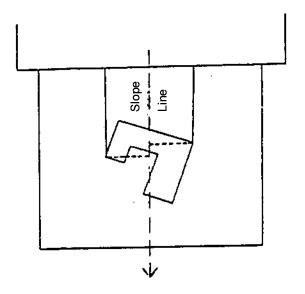
2. Protection of view of smaller tracts of land. Those tracts of land measuring less than twenty thousand (20,000) square feet in area and less than two hundred (200) feet in both length and width, as well as the erection of more than one (1) residential building on the same piece of property, will be covered by the following regulations:
a. View property in SR and MR-D zones.
(1) “View” is an unobstructed field of vision comprising a horizontal angle of not more than ninety (90) degrees and a vertical angle of not more than five (5) degrees below the horizontal.
(2) The horizontal view angle shall have as its origin a vertical axis passing through the geographic center of the lot whose view is to be protected. The ninety (90) degree angle shall be oriented with forty-five (45) degrees on either side of the slope line, which shall be laid out perpendicular to the mean contour of the area as contrasted to the slope of the particular lot in question.
(3) The vertical view angle shall have as its origin a point six (6) feet above the ground surface on a lot prior to any excavation for a foundation or basement.
Horizontal View Angle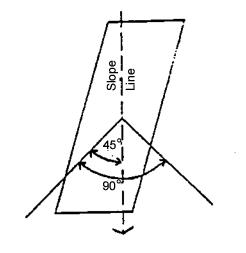
Vertical View Angle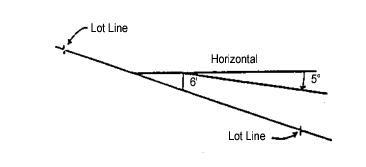
(4) No building constructed within five hundred (500) feet of the point of origin of the view angle and located beneath the airspace located within that angle shall rise above the lower extent of the vertical angle.
b. View property in MR-G, MR-M, and MR-H zones.
(1) “View” is an unobstructed field of vision comprised of a horizontal view angle of sixty (60) degrees and a vertical view angle extending from the horizontal upward to the vertical line.
(2) The horizontal view angle shall have as its origin a vertical axis passing through the geographic center of the lot whose view is to be protected or, in the case of an existing apartment building, the vertical axis should pass through the geographical center of those units whose view is to be protected. The sixty (60) degree angle may be shifted to the extent that no less than twenty (20) degrees of the sixty (60) degrees lies on either side of the slope line, which shall be laid out perpendicular to the mean contour of the area as contrasted to the slope of the particular lot in question. 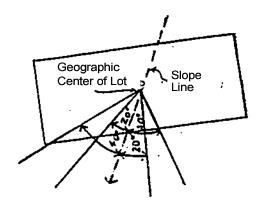
(3) The vertical angle shall originate on a horizontal line extending from the intersection of the vertical line forming the axis for the horizontal view angle and the original slope, or in the case of an existing apartment building, the floor level of the lowest residential floor.
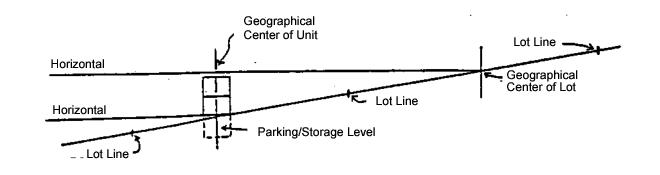
(4) No building constructed within five hundred (500) feet of the point of origin of the view angle and located beneath the airspace located within the angle shall rise above the lower extent of the vertical angle.
C. Exemptions. The planning director may waive or modify the view regulations on hillside development if it is determined that the intent to preserve views cannot be met by a strict application of the requirements, or if one (1) or more of the following conditions applies:
1. There is no available clear view of the valley from development located upslope of the proposed building; or
2. The orientation of development located upslope is toward a different view angle than prescribed in the view development regulations; or
3. The shape or topography of the lot and lots located upslope make a strict application of the view requirements unnecessary or impractical.
D. Application for variance. If an applicant requests relief from the provisions of this section through a variance as provided in KCC 15.09.040 prior to public hearing, the applicant shall erect a pole structure outlining the proposed height of the building where it is to be constructed on the proposed site to allow adjacent property owners to assess the view impact of the proposed variance. The pole structure shall be in place at least ten (10) days prior to the date of the public hearing on the proposed variance.
(Ord. No. 3469, § 1, 8-3-99)
15.08.070 Keeping of animals.
The keeping of bees, small domesticated animals, large domesticated animals, and domesticated fowl, as those terms are defined in KCC 8.03.030, is permitted in all zones as an accessory use to any principal use permitted or to a permitted conditional use, subject to the standards and restrictions of this section and Ch. 8.03 KCC.
A. Small domesticated animals. Up to three (3) small domesticated animals may be kept accessory to each business establishment or dwelling unit on a lot, except as follows:
1. In no case is more than one (1) miniature potbelly pig allowed per business establishment or dwelling unit.
2. More than three (3) small domesticated animals are permitted on lots of at least twenty thousand (20,000) square feet, subject to the provisions of Ch. 8.03 KCC.
3. In no case shall a structure that restrains or houses small domesticated animals, such as a kennel or other accessory structure, be located closer than ten (10) feet from any other residential lot.
B. Miniature potbelly pigs. The type of swine commonly known as the Vietnamese, Chinese, or Asian potbelly pigs (Sus scrofa bittatus) may be kept as a small domesticated animal in accordance with subsection (A) of this section; provided, the swine is neither greater than twenty-two (22) inches in height at the shoulder nor more than one hundred fifty (150) pounds in weight. In the event the swine exceeds either of these limitations, it is not allowed within the city. A miniature potbelly pig shall be considered a small domesticated animal when determining the number of small domesticated animals permitted on a lot.
C. Domesticated fowl. Up to three (3) domesticated fowl may be kept on any lot that is at least five thousand (5,000) square feet, subject to the provisions of Ch. 8.03 KCC. These domesticated fowl are in addition to the small domesticated animals that may be permitted on a lot in accordance with subsection (A) of this section. One (1) additional domesticated fowl is permitted for each one thousand (1,000) square feet of land in excess of the minimum five thousand (5,000) square foot threshold. In no case shall a coop or other accessory structure that restrains or houses domesticated fowl be located closer than ten (10) feet from any other residential lot.
D. Large domesticated animals. Large domesticated animals are permitted only on lots of at least twenty thousand (20,000) square feet subject to the provisions of Ch. 8.03 KCC. The keeping of swine is prohibited, except for a single miniature potbelly pig maintained in accordance with subsection (B) of this section.
1. One (1) large domesticated animal for every ten thousand (10,000) square feet of lot area is permitted.
2. Large domesticated animals and structures housing them must be kept at least fifty (50) feet from any other lot in a residential zone.
E. Beekeeping. Beekeeping is permitted as an accessory use, when registered with the State Department of Agriculture; provided, that:
1. No more than four (4) hives, each with only one (1) swarm, shall be kept on lots of less than ten thousand (10,000) square feet.
2. Hives shall not be located within twenty-five (25) feet of any property line except when situated eight (8) feet or more above the grade immediately adjacent to the grade of the lot on which the hives are located or when situated less than eight (8) feet above the adjacent existing lot grade and behind a solid fence or hedge six (6) feet high parallel to any property line within twenty-five (25) feet of a hive and extending at least twenty-five (25) feet beyond the hive in both directions.
(Ord. No. 3844, § 3, 6-19-07)
Cross reference(s) – Animal control, ch. 8.03.
15.08.080 Parking, storage or habitation of major recreational equipment.
No more than one (1) unit of a recreational vehicle as defined in KCC 15.02.338 or equipment shall be stored outside an enclosed building or structure on residential property; said equipment shall be screened from view of surrounding neighbors and shall not be used for habitation.
(Ord. No. 3409, § 48, 7-7-98)
15.08.085 Parking commercial motor vehicles in residential zones.
A. Commercial motor vehicles are not permitted to be parked on residentially zoned properties with a land use designation of urban separator (US) and a zoning designation of single-family, one (1) unit per acre (SR-1), unless actively delivering goods. “Commercial motor vehicles” include:
1. Vehicles used in a commercial enterprise which exceed nineteen (19) feet in length; and
2. Truck tractors used in the drayage of semi-truck trailers.
B. Commercial motor vehicles are not permitted to be parked on residentially zoned property with a zoning designation of SR-2 or greater unless actively delivering goods. Commercial motor vehicles include:
1. Vehicles with a gross weight rating (GVWR) of twenty-six thousand and one (26,001) pounds or more; and
2. Trailers with a GVWR of ten thousand and one (10,001) pounds or more if the gross weight rating of the combined vehicles is twenty-six thousand and one (26,001) pounds or more.
(Ord. No. 3813, § 2, 9-5-06)
15.08.090 Parking or storage of inoperable vehicles.
Only one vehicle of any kind in an inoperable condition, not licensed nor legally operable upon the roadway, may be stored or parked on a residentially zoned property for more than 30 days. Such vehicle must be stored or parked in an enclosed area and hidden from view of surrounding neighbors.
(Ord. No. 3409, § 49, 7-7-98; Ord. No. 4329, § 7, 7-16-19)
Cross reference(s) – Parking regulations, ch. 9.38.
15.08.100 Nonconforming development.
A. Purpose. The intent and purpose of this section is to:
1. Ensure reasonable opportunity for use of legally created lots which do not meet current minimum requirements for the district in which they are located.
2. Ensure reasonable opportunity for use, maintenance, and improvement of legally constructed buildings, structures, and site development features which do not comply with current minimum requirements for the district in which they are located.
3. Ensure reasonable opportunity for continuation of legally established uses which do not conform to use regulations for the district in which they are located.
4. Encourage the eventual replacement of nonconforming uses having potentially undesirable impacts on conforming uses.
5. Encourage the eventual upgrading of nonconforming buildings, structures, and site development features which do not comply with current minimum requirements for the district in which they are located.
B. Applicability. Nonconforming uses, structures, lots, or signs are not favored by law and this title, and it is to avoid injustice that this title accepts such elements. To benefit from the protection given to nonconforming development, such use, structure, or sign must have been lawfully established pursuant to a county resolution in effect at the time of annexation which rendered it nonconforming, or it must have been lawfully established prior to the effective date of the ordinance codified in this chapter or subsequent amendments thereto, or lawfully established prior to the purchase or condemnation of right-of-way by the city of Kent. This section distinguishes between and defines nonconforming uses, major nonconforming buildings and structures, minor nonconforming buildings and structures, nonconforming lots of record and nonconforming signs. Different requirements are made applicable to each of these categories. The degree of restriction made applicable to each separate category is dependent upon the degree to which that category of nonconformance is a nuisance or incompatible with the purpose and requirements of this title.
1. Applicability of restrictions. Regulations applicable to nonconforming uses are in addition to regulations applicable to nonconforming structures, lots, and signs, and in the event of any conflict the most restrictive provisions shall apply.
2. Expansion of nonconforming uses. No existing building, structure, or land devoted to a nonconforming use shall be expanded, enlarged, extended, reconstructed, intensified, or structurally altered unless the use thereof is changed to a use permitted in the district in which such building, structure, or land is located except as follows: When authorized by conditional use permit, a nonconforming use may be expanded, enlarged, extended, reconstructed, intensified, or structurally altered.
3. Change of nonconforming use. When authorized by the planning manager, a nonconforming use may be changed to a use of a like or more restrictive nature.
4. Extension of nonconforming use. When authorized by the planning manager, a nonconforming use may be extended throughout those parts of a building which were manifestly designed or arranged for such use prior to the date when such use of such building became nonconforming, if no structural alterations except those required by law are made therein.
5. Discontinuance of nonconforming use. When a nonconforming use of land or a nonconforming use of all or part of a structure is discontinued or abandoned for a period of six (6) months, such use shall not be resumed, notwithstanding any reserved intent not to abandon such use. Normal seasonal cessation of use, or temporary discontinuance for purposes of maintenance or improvements, shall not be included in determination of the six (6) month period of discontinuance.
6. Reversion to nonconforming use. If a nonconforming use is changed to a permitted use, the nonconforming use shall not be resumed.
7. Residential exception to nonconforming use status. Legally established residential uses located in any residential zoning district shall not be deemed nonconforming in terms of density provisions and shall be a legal use.
8. Exception for certain drive-through banking facilities. Legally established bank buildings with drive-through facilities in the downtown commercial zoning district that existed prior to August 9, 1992, shall not be nonconforming; however, these drive-through facilities may not be expanded beyond that which existed on August 9, 1992, when the city prohibited bank drive-through facilities in DC zones.
D. Nonconforming buildings and structures.
1. Applicability of restrictions. Regulations applicable to nonconforming structures are in addition to regulations applicable to nonconforming uses, lots, and signs, and in the event of any conflict the most restrictive provisions shall apply.
2. Major nonconforming buildings and structures. Except as allowed in KCC 15.04.030(6), no major nonconforming structure may be expanded, enlarged, extended, reconstructed, or structurally altered or changed, nor may any major nonconforming building, structure, or lot be occupied after discontinuance of change in use, unless the structure, use, and associated grounds and development are brought into compliance with use and minimum development standards of the district in which such structure is located, except as follows:
a. Any major nonconforming structure damaged by fire, flood, explosion, wind, earthquake, war, riot, or other natural disaster may be restored, reconstructed, and used as before; provided, that the work be vested by permit application within one (1) year of such happening; any restoration or reconstruction not vested by permit application within twelve (12) months from the date of the fire or other casualty shall be deemed abandoned and not allowed to be restored.
b. Such repairs and maintenance work as required to keep the structure in sound condition may be made to a major nonconforming structure, provided no such structural alterations shall be made except such as are required by law or ordinance or authorized by the planning manager.
3. Minor nonconforming buildings and structures. No minor nonconforming structure may be expanded, enlarged, extended, reconstructed or otherwise structurally altered or changed, nor may any minor nonconforming building, structure, or lot be occupied after discontinuance or change in use, unless the structure and associated grounds and development are brought into compliance with the minimum development standards of the district in which such structure is located, except as follows:
a. Any minor nonconforming structure damaged by fire, flood, explosion, wind, earthquake, war, riot, or other natural disaster may be restored, reconstructed and used as before; provided, that the work be vested by permit application be completed within one (1) year of such happening; any restoration or reconstruction vested by permit application twelve (12) months from the date of the fire or other casualty shall be deemed abandoned and not allowed to be restored.
b. Such repairs and maintenance work as required to keep the structure in sound condition may be made to a minor nonconforming structure, provided no such structural alterations shall be made except such as are required by law or ordinance or authorized by the planning manager.
4. Planning manager’s authority. The planning manager may waive specific development standard requirements or impose additional requirements when all the following criteria are met:
a. When owing to special circumstances a literal enforcement of the provisions of this title or other land use regulatory ordinances of the city will result in unnecessary hardship.
b. When the waiver of development requirements is in harmony with the purpose and intent of city ordinances and the comprehensive plan.
c. When the proposed use, building, and development will function without adverse impact upon adjacent property, development in the area or the city as a whole.
d. When a conditional use permit is not required.
E. Nonconforming lots.
1. Applicability of restrictions. Regulations applicable to nonconforming lots are in addition to the regulations applicable to nonconforming uses, structures, and signs, and, in the event of conflict, the most restrictive provisions shall apply.
2. Nonconforming lots of record.
a. Residential districts.
i. In any district in which single-family dwellings are permitted, a single-family dwelling and customary accessory buildings may be erected on any single lot of record as of June 20, 1973, notwithstanding limitations imposed by other provisions of this title. Such lot must be in separate ownership and not of continuous frontage with other lots in the same ownership. This provision shall apply even though such lot fails to meet the requirements for area or width that are generally applicable in the district; provided, that yard dimensions and requirements other than those applying to area or width of the lot shall conform to the regulations for the district in which such lot is located.
ii. In all single-family zoning districts, with the exception of the SR-8 zoning district, if two (2) or more lots or combinations of lots and portions of lots with continuous frontage in single ownership are of record prior to June 20, 1973, and if all or part of the lots do not meet the minimum requirements established for lot width and area, the land involved shall be considered to be an undivided parcel for the purposes of this title, and no portion of the parcel shall be used or sold in a manner which diminishes compliance with lot width and area requirements established by this title, nor shall any division of any parcel be made which creates a lot with width or area below the requirements stated in this title.
iii. In the SR-8 zoning district, if two (2) or more single-family zoned lots or combination of lots and portions of lots with continuous frontage in single ownership are of record prior to June 20, 1973, and if all or part of the lots do not meet the following minimum requirements established for lot width, lot area, and topography, the land involved shall be considered to be an undivided parcel for the purposes of this title, and no portion of the parcel shall be used or sold in a manner which diminishes compliance with lot width and area requirements established by this title, nor shall any division of any parcel be made which creates a lot with width or area below the requirements stated in this title.
(A) Minimum lot area: Four thousand six hundred (4,600) square feet.
(B) Minimum lot width: Forty (40) feet.
(C) Maximum site slope: Fifteen (15) percent.
iv. In any district in which duplex dwellings are permitted, a duplex dwelling and customary accessory buildings may be erected on any single lot of record as of June 20, 1973, with a minimum area of seven thousand two hundred (7,200) square feet, notwithstanding limitations imposed by other provisions of this title. Such lot must be in separate ownership and not of continuous frontage with other lots in the same ownership. This provision shall apply even though such lot fails to meet the requirements for area or width that are generally applicable in the district; provided, that yard dimensions and requirements other than those applying to area or width of the lot shall conform to the regulations for the district in which such lot is located.
b. Other districts. In any other district, permitted building and structures may be constructed on a nonconforming lot of record, provided site coverage, yard, landscaping, and off-street parking requirements are met. Such lots must be in separate ownership and not of continuous frontage with other lots in the same ownership prior to June 20, 1973, and if all or part of the lots do not meet the minimum requirements established for lot width and area, the land involved shall be considered to be an undivided parcel for the purposes of this title, and no portion of the parcel shall be used or sold in a manner which diminishes compliance with lot width and area requirements established by this title, nor shall any division of any parcel be made which creates a lot with width or area below the requirements stated in this title.
1. Applicability of restrictions. Regulations applicable to nonconforming signs are in addition to regulations applicable to nonconforming uses, structures, and lots, and in the event of conflict the most restrictive provisions shall apply.
2. Continuation of nonconforming signs.
a. Signs that were legally existing as of the effective date of this title or subsequent amendments thereto that do not conform to the regulations of this title shall be considered nonconforming signs. Nonconforming signs may not be moved, relocated, altered, or added to without receiving approval from the planning services office.
b. No sign permit shall be issued to allow legal signs on property having an illegal or nonconforming sign until such time as the nonconforming or illegal sign is modified to conform to this title.
3. Amortization period.
a. Abandoned signs. Abandoned signs must be removed within ninety (90) days.
b. Number and type of signs. The number and type of allowable signs for each occupancy must conform to the regulations of this title.
(Ord. No. 2905, § 1, 2-20-90; Ord. No. 3122, § 1, 6-15-93; Ord. No. 3409, § 50, 7-7-98; Ord. No. 3439, § 7, 2-2-99; Ord. No. 3521, § 2, 8-15-00; Ord. No. 3600, § 5, 5-7-02; Ord. No. 3665, § 1, 10-7-03; Ord. No. 4003, § 7, 9-20-11)
15.08.110 Reduction of lot area.
No land may be so reduced in area that it would be in violation of minimum lot size, yard provisions, lot coverage, off-street parking or any other requirements of the zoning district or use.
15.08.120 Irregular-shaped lots.
On irregular-shaped lots, the average distance from the building line to the lot line shall be no less than the minimum yard provision; provided, however, that no part of the structure shall be located so that one-half (1/2) the minimum yard provision occurs at any point along such averaged alignment.
15.08.130 Visibility at intersections in residential districts.
On a corner lot in any residential district, nothing shall be erected, placed, planted, or allowed to grow in such a manner as materially to impede vision between a height of two and one-half (2 1/2) and ten (10) feet above the centerline grades of the intersecting streets in the area bounded by the street lines of such corner lots and a line joining points along the street lines twenty (20) feet from the point of the intersection.
Cross reference(s) – Traffic code, Chapter 9.36 KCC.
15.08.140 Visibility at access points for automobiles.
Areas for ingress and egress for automobiles shall be designed in such a manner that adequate visibility is ensured.
Cross reference(s) – Traffic code, Chapter 9.36 KCC.
15.08.150 Side yard on corner lot.
The side yard along a side street on a corner lot shall have a minimum yard of ten (10) feet, except where a larger yard may be required.
15.08.160 Accessory buildings. Revised 7/23
A. An accessory building can be located anywhere on a lot if it conforms with the setbacks required by this title for a principal building. In the rear one-half of a lot the accessory building can be built to within two feet of the side and rear lot lines, except when attached to a principal building, in which case it must have the same setbacks as the main building. Accessory dwelling units are not considered an accessory building subject to this section.
B. There shall be not more than one guest cottage unit on any one lot. The guest cottage shall be located on the rear half of the lot, unless determined to be infeasible due to lot shape, house placement, or other factors as approved by the economic and community development director.
C. The combined footprint of all accessory buildings on a lot shall not exceed 15 percent of the lot area.
D. Accessory buildings shall not exceed 23 feet in height.
E. Accessory buildings shall not exceed the height of the principal building.
F. Accessory buildings that are 12 feet in height or higher must be visually compatible with the principal building by meeting all of the following:
1. The exterior finish material must be the same or visually match the exterior finish material of the principal building, in type, size, and placement;
2. The trim on the accessory building must be the same or visually match the trim used on the principal building, in type, size, and placement; and
3. The roof pitch of the accessory building must be substantially the same as the roof pitch of the principal building.
(Ord. No. 4003, § 8, 9-20-11; Ord. No. 4174, § 19, 11-17-15; Ord. No. 4464, § 9, 5-16-23)
15.08.170 Projections into required yards.
Certain architectural features may project into required yards or courts as follows: Cornices, canopies, eaves, or other architectural features may protrude up to a distance of two (2) feet into any required yard.
15.08.180 Structures to have access.
Every building hereafter erected or moved shall be on a lot adjacent to a public street, or with access to an approved private street, and all structures shall be so located on lots as to provide safe and convenient access for servicing and required off-street parking.
15.08.190 Exceptions to height regulations.
The height limitations for the various districts shall not apply to spires, flagpoles, belfries, cupolas, noncommercial antennas, ventilators, chimneys, or other appurtenances usually required to be placed above the roof level and not intended for human occupancy. The height limitations shall not apply to barns and silos provided that they are not located within fifty (50) feet of any lot line. City-owned elevated reservoirs, water tanks, fire or police training towers, and standpipes are exempt from height restrictions.
(Ord. No. 2805, § 1, 10-4-88)
15.08.205 Temporary use regulations.
This section shall be known as the temporary use regulations. Provisions authorizing temporary uses are intended to permit occasional temporary uses, activities, and structures when consistent with the purpose of this title and when compatible with the general vicinity and adjacent uses.
A. Permitted uses. The following types of temporary uses, activities, and associated structures may be authorized, subject to specific limitations in this section and such additional conditions as may be established by the planning director:
1. Model homes or apartments and related real estate sales and display activities located within the subdivision or residential development to which they pertain.
2. Contractor’s office, storage yard, and equipment parking and servicing on the site of an active construction project.
3. Circuses, carnivals, rodeos, fairs, or similar transient amusement or recreational activities.
4. Indoor or outdoor art and craft shows and exhibits.
5. Christmas tree sales lots, fireworks, and flower stands, limited to location on lots not used for residential purposes in commercial or industrial zoning districts.
6. Mobile home residences used for occupancy by supervisory and security personnel on the site of an active construction project.
7. Mobile home residential units used for occupancy of security personnel when not otherwise allowed as an accessory use.
8. Indoor or outdoor special sales, including swap meets, flea markets, parking lot sales, warehouse sales, or similar activities, limited to locations on lots not used for residential purposes in commercial or industrial districts, and when operated not more than 10 days in the same month, unless otherwise permitted by the city.
9. Temporary use of mobile trailer units or similar portable structures for nonresidential purposes, located in districts where the use is a permitted use.
10. Seasonal retail sales of agricultural or horticultural products raised or produced off the premises, to be permitted in commercial or industrial zoning districts only.
11. Temporary signs relating directly to the temporary uses described in this section, which may be permitted for a period not to exceed the operation of the use. The signs may be portable in nature and must be placed on the premises. No off-premises signs are permitted. No more than two signs per use shall be permitted and no sign shall exceed a 32-square-foot total of all faces. Maximum sign height shall be eight feet. No sign permit shall be required.
12. Garage sales, moving sales, and similar activities for the sale of personal belongings when operated not more than three days in the same week or more than twice in the same calendar year. No permit is required.
13. Fund-raising carwashes. No permit is required; however, a car wash kit from public works operations is required.
14. Isolation and quarantine facilities in the I1, I2 and I3 zoning districts for a period not to exceed 180 days unless approved through a conditional use permit.
15. The planning director may authorize additional temporary uses not listed in this subsection when it is found that the proposed uses are in compliance with the requirements and findings of subsection (C) of this section.
B. Conditions of temporary use.
1. Each site occupied by a temporary use shall be left free of debris, litter, or other evidence of temporary use upon completion or removal of the use.
2. A temporary use conducted in a parking facility shall not occupy or remove from availability more than 25 percent of the spaces required for the permanent use, except in the downtown commercial (DC-1) zoning district or as approved by the city council.
3. Each site occupied by a temporary use must provide or have available sufficient off-street parking and vehicular maneuvering area for customers. Such parking need not comply with the development requirements of Chapter 15.05 KCC, but must provide safe and efficient interior circulation and ingress and egress from the public right-of-way.
4. No temporary use shall occupy or use public rights-of-way, parks, or other public lands in any manner unless specifically approved by the city council.
5. No temporary use shall occupy a site or operate within the city for more than 90 days within any calendar year, except as follows:
a. When authorized by the planning director, a temporary use may operate an additional 90 days if it is found that such an extension will be consistent with the requirements of subsection (C) of this section.
b. When authorized by the hearing examiner, a temporary use may operate an additional one year if it is found that such an extension will be consistent with the requirements of subsection (C) of this section.
6. All signs shall comply with the requirements of Chapter 15.06 KCC, pertaining to sign regulations, except as otherwise specified in this section.
7. All temporary uses shall obtain, prior to occupancy of the site or culmination of activities, all required city permits, licenses or other approvals, e.g., business license, building permit, zoning permit, etc.
8. The planning director may establish such additional conditions as may be deemed necessary to ensure land use compatibility and to minimize potential impacts on nearby uses. These include but are not limited to time and frequency of operation, temporary arrangements for parking and traffic circulation, requirements for screening or enclosure, and guarantees for site restoration and cleanup following temporary use.
C. Determinations. The planning director may authorize the temporary uses described in subsection (A) of this section after consultation and coordination with all other applicable city departments and other agencies and only when the following determinations can be made:
1. The temporary use will not impair the normal, safe, and effective operation of a permanent use on the same site.
2. The temporary use will be compatible with uses in the general vicinity and on adjacent properties.
3. The temporary use will not impact public health, safety, or convenience, or create traffic hazards or congestion, or otherwise interrupt or interfere with the normal conduct of uses and activities in the vicinity.
4. The use and associated structures and living quarters will be conducted and used in a manner compatible with the surrounding area.
5. The temporary use shall comply with all applicable standards of the Seattle King County health department.
D. Application and authorization.
1. Application to conduct a temporary use shall be made to the planning department, and shall include such information as the planning director may require to evaluate the use and to make the determinations required by this section.
2. Application shall be made prior to the requested date for commencement of the temporary use, and the planning director shall make a determination whether to approve, approve conditionally, or deny the temporary use within 10 days after the date of application.
3. Authorization of a temporary use shall be by issuance of a zoning permit.
4. A temporary use authorized pursuant to this section shall not be exempted or relieved from compliance with any other ordinance, law, permit, or license applicable to such use, except where specifically noted.
15.08.210 Transition area combining district.
The purpose of this section is to provide for a transition area between industrial and residential zoning districts or commercial and residential zoning districts. The transition area provides both a physical and visual buffer between residential districts and other land uses. Transition area regulations shall be superimposed over those of the underlying zones. Buildings and setback areas within industrial or commercial districts shall be affected by these regulations if they are less than three hundred (300) feet from a property line in a single-family residential district, or are less than one hundred fifty (150) feet from a property line in a multifamily residential district. Transition area regulations shall apply to those areas designated as transition area combining districts on the official zoning code map, which shall reflect those areas designated as transition area combining districts as set out in charts A and B following this section.
A. Building height. Building height shall not exceed two (2) stories or thirty-five (35) feet. Beyond this height, to a height not greater than either three (3) stories or forty-five (45) feet, two (2) feet of yard space beyond that required for a particular district shall be added to compensate for each foot of additional building height allowed at the planning director’s finding that such heights will not be detrimental to their surroundings.
B. Building setback. Building setback shall be a minimum of fifty (50) feet from the nearest residential property line.
C. Building length. Building frontage adjacent to residential zones shall not exceed two hundred (200) feet.
D. Principal access. Wherever possible, access to any use in a transition area shall be such that traffic does not travel through or past residential districts.
E. Sight screening. Screening equivalent to type I (solid screen) specified in the city’s landscape regulations shall apply in a transition area directly adjacent to a residential zone. Where a transition area occurs along a street that separates industrial or commercial uses from residences, type III (visual buffer) planting shall apply.
F. Parking. Parking and internal circulation of vehicles shall occur along boundaries with residential districts only if sight screened according to type III requirements of the city’s landscape regulations.
G. Building size. No building shall exceed one (1) acre in size.
H. Glare. Highly reflective building materials shall be avoided in transition areas unless it can be shown that they will not adversely impact any other private or public property.
I. Noise. Truck traffic and other noise normally associated with an operation or use in the transition area shall be limited to the hours between 7:00 a.m. and 10:00 p.m.
J. Separation of buildings. Buildings shall be separated by no less than twenty (20) feet. Variations in this standard may be approved by the planning director if more usable configuration of open space is obtained while still protecting visual transition to residential uses.
(Ord. No. 2786, § 6, 6-21-88)
TRANSITION AREA COMBINING DISTRICT
CHART A
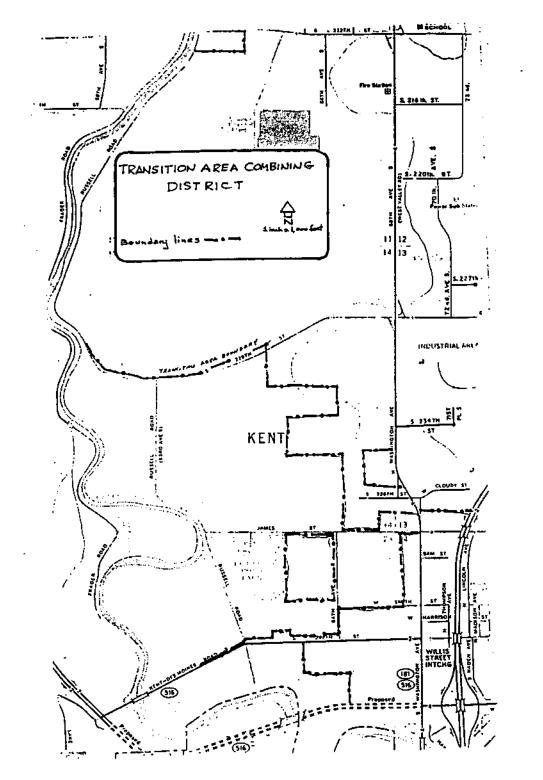
TRANSITION AREA COMBINING DISTRICT
CHART B
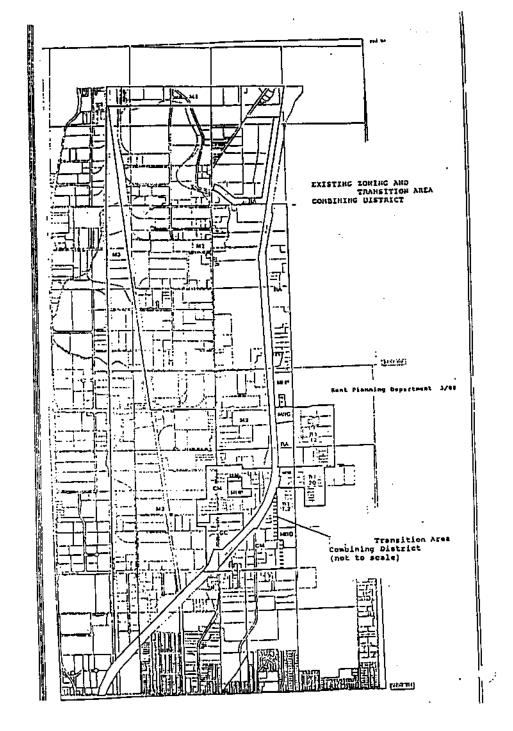
15.08.224 Same – Classifications and restrictions.
Repealed by Ord. No. 3746.
(Ord. No. 3312, § 1, 9-17-96)
15.08.230 Solar access setback – Purpose.
The purpose of the solar access setback provisions is to provide a reasonable amount of solar access, wherever feasible, to lots in the city, so that the economic value of solar radiation falling on those properties will be preserved, investments in solar equipment will be secure, and the option to use solar energy will be preserved and encouraged, as provided for in RCW 64.04.140. While the solar access setback is not mandatory, planning department staff will work with applicants on a cooperative and voluntary basis to attempt to site buildings on lots to preserve solar access opportunities.
(Ord. No. 3409, § 51, 7-7-98)
15.08.232 Solar access setback – Applicability.
All structures over six (6) feet in height proposed on properties in the agricultural (A-10), residential agricultural (SR-1), and single-family zones will be reviewed in accordance with the design standards outlined in KCC 15.08.234, and are encouraged to meet those standards when feasible, based on the size and configuration of the lot. The provisions of this section shall not require that the yard and setback requirements of the underlying zone be exceeded.
15.08.234 Solar access setback – Calculation.
A. Solar factor.
1. The planning director or his designee shall determine the solar factor for a lot based on Table 1, attached to the ordinance from which this section is derived and by this reference incorporated in this section, or the formula set out in subsection (A)(2) of this section.
2. The formula referred to in subsection (A)(1) of this section is as follows:
|
N |
|
((1/.42 + P) / 2.38) |
B. Solar setback. The following calculations shall be used to assess the distance of the highest shade-producing point of a structure from the northern property line. This setback should be applied where feasible, based on the size and configuration of the lot.
1. (H – 6)/(.42 + P), for a lot with a solar factor equal to or greater than eighty-five (85); or
2. (H – 14)/(.42 + P), for a lot with a solar factor equal to or greater than forty-seven (47) and less than eighty-five (85).
3. For any lot with a solar factor less than forty-seven (47), the lot is exempt from solar setback calculations.
C. Definitions. For purposes of this section, “H” is the height of the highest shade-producing point of the structure above grade, and “P” is the solar slope of the lot. “N” is the north-south lot dimension.
(Ord. No. 3409, § 53, 7-7-98)
15.08.240 Preservation of trees.
A. Purpose. Trees have a significant role in contributing to the quality of life in urban environments. The planting or retention of significant trees as required by this section is necessary to maintain and protect property values, to enhance the visual appearance of the city, to reduce the impacts of development on the storm drainage system, to improve air quality, to provide habitat for wildlife, and to provide a transition between various land uses in the city.
B. General restrictions for all districts. Except as provided for in this section, on undeveloped property in the city, all trees of a six-inch diameter or greater shall be retained on the property where they are growing.
C. Applicability.
1. The requirements of this section shall apply to new single-family or duplex development that is not subject to a previously approved tree plan, including but not limited to subdivisions, short subdivisions, planned unit developments, and development of existing lots.
2. Developments other than new single-family or duplex developments, such as multifamily, commercial, institutional, or industrial developments, are exempt from the requirements of this section.
D. Tree density credits requirements. The number of trees required for new development shall be measured in tree density credits. Development proposals shall provide a minimum of 20 tree density credits per net acre. Tree density credits may be achieved by preservation of existing trees, planting of supplemental trees, or a combination of both. The density credit value of existing and supplemental trees is shown in Table A. A tree density calculation that results in a fraction shall be rounded to the nearest whole number.
1. The net area to be used for tree density calculation shall include all residential building lots, recreation space, and open space tracts or easements not designated as critical areas. Public right-of-way, areas of a project site required to be dedicated as public right-of-way, critical areas and associated buffers, stormwater tracts, perimeter landscaping areas required by city code, and vehicular access or utility tracts shall be excluded from the area used for tree density calculation.
2. The tree credit value that corresponds with a tree’s diameter at breast height (DBH) is found in Table A. Diameter breast height (DBH) of the tree shall be measured in inches at the height of four and one-half feet above the ground.
a. Existing individual trees proposed for retention shall be at least six inches in diameter at breast height (DBH).
b. For the purpose of fulfilling the required tree density, the diameter inches of alder and cottonwood trees proposed for retention shall be discounted by a factor of one-half in the tree density calculation.
c. Where the existing trees to be retained do not alone satisfy the tree density requirement, supplemental trees shall be planted to achieve the required tree density. Credit value for supplemental trees is shown in Table A.
d. Supplemental trees shall be of a type and variety that is compatible with development in the Pacific Northwest, such as those included on the city’s approved street tree list.
e. Street trees required by public works standards shall be counted to fulfill the tree density credit requirement.
f. Supplemental trees shall be planted in the following locations, in order of priority:
i. On individual residential building lots;
ii. In private access tracts, as approved by the public works department;
iii. In onsite recreation areas as approved by the parks and human services department.
g. Trees required to be planted around stormwater ponds and in site perimeter tracts, pursuant to other city codes, regulations or development standards, shall not be counted as supplemental trees for the purpose of achieving the required tree density credits.
|
DBH |
Tree Credits |
DBH |
Tree Credits |
DBH |
Tree Credits |
|---|---|---|---|---|---|
|
*2.0 – 5" |
1 |
|
|
|
|
|
6 – 10" |
1 |
24" |
8 |
38" |
15 |
|
12" |
2 |
26" |
9 |
40" |
16 |
|
14" |
3 |
28" |
10 |
42" |
17 |
|
16" |
4 |
30" |
11 |
44" |
18 |
|
18" |
5 |
32" |
12 |
46" |
19 |
|
20" |
6 |
34" |
13 |
48" |
20 |
|
22" |
7 |
36" |
14 |
50" or greater |
21 |
* Applies to supplemental trees only. Supplemental or replacement deciduous trees shall be at least two inches DBH at the time of planting. An evergreen tree shall be at least six feet in height at the time of planting. See KCC 15.08.240(I)(3).
E. Tree retention plan. An applicant for a development permit shall submit and receive city approval of a tree retention plan prior to permit issuance, unless modified by the economic and community development director in accordance with the criteria set forth in subsection (H) of this section. The tree retention plan shall contain the following elements:
1. A tree inventory containing the following:
a. Size (DBH) and common genus name of trees proposed for retention; and
b. A formalized finding by a licensed arborist stating that all trees proposed for retention are healthy and growing in a condition and manner that is compatible with the proposed development.
2. A site plan drawn to a verifiable engineering scale depicting the following:
a. Accurate location of trees proposed for retention in relationship to proposed buildings, streets, parking areas, storm drainage facilities, and utilities (surveyed locations may be required);
b. Limits of disturbance (LOD) around retained trees, as recommended by a licensed arborist to ensure the health of the trees during and after construction;
c. Location, common genus name, and size of proposed supplemental trees; and
d. Location of tree protection measures to be maintained in proximity to retained trees, as recommended by a licensed arborist.
F. Protection of trees during construction. Temporary fencing shall be placed around the tree and its LOD prior to site development work, and no construction activities may be carried out within the protected area, except as allowed by permit, in accordance with the recommendation of a licensed arborist.
G. Required review. The city planning services division shall review the tree retention plan concurrently with each application for a development permit.
H. Alternative tree provision option. The economic and community development director may approve a modification of the tree provision requirements if:
1. The modification is consistent with the stated purpose of this section; and
2. The modification proposal incorporates the retention of other vegetation in consolidated locations which promotes the quality and character of the site and neighborhood.
I. Replacement of removed or damaged trees. Trees removed illegally from undeveloped land or trees designated for retention which are damaged or destroyed shall be replaced as follows:
1. One existing tree with a six-inch DBH shall be replaced by two new trees.
2. For each additional three inches of diameter at breast height, one new replacement tree shall be added, up to a maximum of six trees.
3. Replacement deciduous trees shall be at least two inches DBH at the time of planting. A replacement evergreen shall be at least six feet high.
(Ord. No. 2452, § 1; Ord. No. 2932, § 2, 7-17-90; Ord. No. 3830, § 19, 3-6-07; Ord. No. 4209, § 1, 7-19-16)
15.08.260 Green River Corridor district regulations.
A. Purpose. The Green River Corridor district is hereby created to protect, conserve, and manage areas generally located on both sides of the Green River, and to ensure that urban development within the district is compatible with the open natural configuration of the Green River and its adjacent lands.
B. Location.
1. The Green River Corridor district is that area of the city one thousand (1,000) feet from the ordinary high-water line of the Green River; provided, that the shoreline master program shall govern development within the first two hundred (200) feet of the ordinary high-water line of the river. The district is more particularly described as follows:
Two (2) strips of land each eight hundred (800) feet in width which begin at the north city limit line, on March 4, 1985, and end at the south city limit line, which south line ends in Section 30, Township 22 North, Range 5 East, W.M. Each strip shall be measured from each side of the Green River and the measurement shall be two hundred (200) feet from the ordinary high-water line of the river, all in King County, Washington; except any portions thereof lying outside of the city limits.
2. Property exemption. Property platted in accordance with the city subdivision code, Ordinance No. 1840, before March 2, 1981 (adoption of the Valley Studies), shall be exempt from the provisions of this section.
1. Green River access. No building or lot within the district shall be constructed or created without providing access to the Green River via public sidewalks or a private trail system. Such sidewalks or private trail systems shall connect to riverside public trails or scenic drives at intervals of one thousand (1,000) feet or less in industrial developments, and intervals of five hundred (500) feet or less in residential developments.
2. Pedestrian access in residential development. In residential developments, pedestrian access to the Green River shall be accomplished without crossing streets or roads, except scenic and recreational roads, unless clearly shown to be infeasible.
3. Parking facilities. Parking facilities for access to the Green River shall be located as near as practicable to riverfront parks or historic sites and shall be clustered in lots not exceeding thirty (30) cars. Every public parking area shall be visible from a street accessible to the public and be situated so that the public can clearly see riverfront open space and gain access to the public portion of that open space.
4. Payment in lieu of parking facilities. The city may accept or require payment in lieu of providing parking facilities which are required as a condition of the issuance of development permits.
5. Loading dock location. Loading docks shall not be constructed on river-facing sides of buildings unless a minimum fifty (50) foot buffer of native vegetation is provided to screen the loading docks from the shoreline, unless otherwise required by the Kent shoreline master program. Other design and landscaping requirements may be imposed by the planning manager to meet the purpose of the Green River Corridor district.
6. Exterior walls of buildings. No building on any riverfront lot shall have an exterior wall parallel to, or within forty-five (45) degrees of parallel to, the river which exceeds two hundred (200) feet in length, except as follows: buildings on riverfront lots in the MA, M1, M1-C, M2, GC-MU, and M3 zoning districts may have exterior walls parallel to, or within forty-five (45) degrees of parallel to, the river which exceed two hundred (200) feet in length, provided they are screened by a vegetative buffer per subsection (C)(8)(c) of this section.
7. Lots.
a. Each riverfront lot within a subdivision shall contain area sufficient to comply with minimum lot size requirements of Chapter 15.04 KCC and provide a public access easement and building setback line as required by this section.
b. No subdivision of professional and office (O), general commercial (GC), industrial agricultural (MA), industrial park (M1), and limited industrial (M2) zoned land shall be approved unless each lot within the subdivision has an upland boundary at least five hundred (500) feet from the ordinary high-water line of the river.
8. Vegetation buffer.
a. A permanent vegetation buffer, in accordance with KCC 15.07.050(C) pertaining to landscaping type III, shall be maintained or established for each building or use within the district. Any materials storage yard, truck maneuvering area, equipment parking area, junkyard, refuse storage, or similar use within the district shall install such a permanent vegetative buffer between the use and the Green River within two (2) years of the effective date of the ordinance from which this section is derived.
b. Landscape screening and buffer strips shall be planted in order to be harmonious with those already planted on adjacent properties and consistent with the city landscaping requirements as set out in Chapter 15.07 KCC.
c. Buildings on riverfront lots in industrial zoning districts which have exterior walls exceeding two hundred (200) feet in length parallel to, or within forty-five (45) degrees of parallel to, the river must be screened by a vegetation buffer. This vegetative buffer shall be located along the length of the property line located parallel to, or within forty-five (45) degrees of parallel to, the river, for a minimum depth of twenty (20) feet in accordance with type III, visual buffer landscape standards pursuant to KCC 15.07.050(C). In addition, an earth berm of a minimum of forty-eight (48) inches in height must be provided for.
9. Rail lines. No rail lines shall be permitted within five hundred (500) feet of the Green River; provided, however, rail lines shall be permitted to within three hundred (300) feet of the Green River in those locations specified on Exhibit B attached to the ordinance from which this section is derived and by this reference incorporated in this section, such locations having been found to be best suited to rail.
10. Road access. All new lots and buildings shall be designed with primary street access to streets other than scenic and recreational roads, unless no other access is available.
11. Street connections. Development shall include no street connections to scenic and recreational roads, unless no other access is available.
12. Utilities. Utilities shall be installed in accordance with Chapter 7.10 KCC.
13. Surface drainage facilities. Surface drainage facilities such as drainage channels and retention areas shall be designed to applicable city standards and shall be integral parts, if possible, of any common trail and open space system connections to the riverfront.
1. Fish and game requirements. The applicant shall comply with applicable requirements of the State Department of Fisheries and State Department of Game for preventing and mitigating adverse impacts on fish and wildlife resources and enhancing wildlife habitat.
2. Flood control works. If city funds are used in the construction of flood control works such as dikes, levees, or floodwalls, public rights of access to such works shall be dedicated prior to construction, where practicable.
(Ord. No. 3338, § 1, 2-18-97; Ord. No. 3600, § 6, 5-7-02; Ord. No. 3612, § 9, 8-6-02; Ord. No. 3746, § 9, 4-19-05; Ord. No. 3750, § 1, 5-17-05; Ord. No. 4120, § 1, 8-19-14)
15.08.270 Adult uses.
A. Adult uses, as defined in KCC 15.02.008, are prohibited within the area circumscribed by a circle which has a radius consisting of the following distances from the following specified uses or zones:
1. Within one thousand (1,000) feet of any residential zone (SR-1, A-10, AG, SR-6, SR-4.5, SR-3, MR-D, MR-G, MR-M, MR-H, and MHP as provided in Ch. 15.09 KCC).
2. Within one thousand (1,000) feet of any public or private school.
3. Within one thousand (1,000) feet of any church or other religious facility or institution.
4. Within one thousand (1,000) feet of any public park.
5. Within one thousand (1,000) feet of any public library.
B. The distances provided in this section shall be measured by following a straight line, without regard to intervening buildings, from the nearest point of the property or parcel upon which the proposed use is to be located, to the nearest point of the parcel of property or the land use district boundary line from which the proposed land is to be separated.
C. Violation of the use provisions of this section is declared to be a public nuisance per se, which shall be abated by the city attorney under state law, including procedures set forth in KCC 15.09.090.
D. Nothing in this section is intended to authorize, legalize, or permit the establishment, operation, or maintenance of any business, building, or use which violates any city ordinance or statute of the state regarding public nuisances, sexual conduct, lewdness, or obscene or harmful matter or the exhibition or public display thereof.
(Ord. No. 2785, § 2, 6-21-88; Ord. No. 3275, § 2, 1-2-96; Ord. No. 3612, § 10, 8-6-02; Ord. No. 3770, § 14, 11-15-05)
Cross reference(s) – Adult entertainment regulations, ch. 5.10.
15.08.280 Group homes class II and III.
A. Purpose. It is the purpose of this section to outline general conditions with which class II and III group homes, as defined in KCC 15.02.173, must comply when applying for a conditional use permit to locate in the city.
B. Dispersion requirements. A class II and III group home must locate a minimum of six hundred (600) feet from any other class II or III group home. This distance will be measured by following a straight line, without regard to intervening buildings, from the nearest point of the property or parcel upon which the proposed use is to be located, to the nearest point of the parcel or property or the land use district boundary line from which the proposed use is to be separated.
C. Separation requirements. A one thousand (1,000) foot separation requirement will apply to class II and III group homes to separate such facilities from sensitive land uses such as public or private schools, churches, or other religious facilities or institutions, parks and playgrounds, and other such uses that are deemed to be sensitive. In addition to the sensitive uses listed in this subsection, class III group homes must be separated at least one thousand (1,000) feet from all residential areas. This distance would be measured by the same method as that used for the dispersion requirements described in subsection (B) of this section.
D. Registration and licensing. Group homes must obtain all licenses necessary for operation by state and federal agencies. Class II and III group homes must also register with the city by supplying information pertinent to the validity, update, and renewal status of the home’s state and federal license. Accuracy of all information contained in any state or federal license shall be verified to the extent possible by the city, and any applicant for a group home conditional use permit shall have the responsibility to ensure that any changes made to the license prior to its renewal are immediately provided to the city.
(Ord. No. 2958, § 18, 1-2-91)
15.08.295 Patient cooperatives.
A. Medical marijuana patient cooperatives, as defined in KCC 15.02.326, are prohibited in the following zoning districts:
1. All agricultural districts, including A-10 and AG;
2. All residential districts, including SR-1, SR-3, SR-4.5, SR-6, SR-8, MR-D, MR-T12, MR-T16, MR-G, MR-M, MR-H, MHP, PUD, MTC-1, MTC-2, and MCR;
3. All commercial districts, including NCC, CC, CC-MU, DC, DCE, DCE-T, CM, GC, and GC-MU;
4. All industrial districts, including I1, I2, and I3; and
5. Any new district established on or after July 1, 2016.
B. Any violation of this section is declared to be a public nuisance per se, and shall be abated by the city attorney under applicable provisions of this code or state law, including, but not limited to, Chapter 1.04 KCC.
C. Nothing in this section is intended to authorize, legalize or permit the establishment or operation of a use that violates any city, county, state or federal law or statute.
(Ord. No. 4208, § 5, 7-5-16; Ord. No. 4355, § 10 (Exh. J), 3-3-20)
15.08.300 Zero lot line development – Authorized.
Zero lot line development may be permitted in the following zoning districts:
A. SR-3 single-family residential.
B. SR-4.5 single-family residential.
C. SR-6 single-family residential.
D. SR-8 single-family residential.
E. MR-D duplex multifamily residential.
F. MR-G low density multifamily residential.
(Ord. No. 2656, § 1, 9-15-86; Ord. No. 3409, § 54, 7-7-98; Ord. No. 3770, § 15, 11-15-05)
Cross reference(s) – Zero lot line subdivisions, § 12.04.485.
15.08.310 Same – Permitted uses.
Uses permitted in zero lot line developments shall be as outlined in the underlying zoning district.
(Ord. No. 2656, § 1, 9-15-86)
15.08.320 Zero lot line – Development standards for single-family zoning districts.
Zero lot line development standards for single-family zoning districts are as follows:
A. Minimum lot. Minimum lot size is three thousand six hundred (3,600) square feet.
B. Maximum site coverage. Maximum site coverage is fifty (50) percent.
C. Density. The density of the zero lot line development shall not exceed the density of the underlying zoning district.
D. Minimum yard requirements. Minimum yard requirements are as follows:
1. Front (dwelling): Ten (10) feet.
2. Front (garage): Twenty (20) feet.
3. Rear: Eight (8) feet.
4. One (1) side: Zero (0) feet.
5. Other side (dwelling): Ten (10) feet.
6. Other side (garage): Five (5) feet.
E. Distance between dwellings. Minimum distance between dwellings is fifteen (15) feet.
F. Height limitation. The height limitation is two (2) stories, not to exceed thirty-five (35) feet.
G. Openings prohibited on zero lot line side. The wall of the dwelling located on the lot line shall have no windows, doors, air conditioning units, or any other type of opening; provided, however, that atriums or courts shall be permitted on the zero lot line side when the court or atrium is enclosed by three (3) walls of the dwelling unit and a solid wall of at least eight (8) feet in height is provided on the zero lot line. The wall shall be constructed of the same material as exterior walls of the unit. Opaque openings or high-level windows above eight (8) feet in height shall be allowed. There is no restriction on openings where a wall is located on a zero lot line facing open space.
H. Open space. Each zero lot line development shall provide not less than twenty-five (25) percent of the gross land area for common open space, which shall be:
1. Concentrated in large areas and designed to provide either passive or active recreation.
2. Owned and maintained as follows:
a. If under one (1) ownership, owned and maintained by the ownership:
b. Held in common ownership by all the owners of the development by means of a homeowners’ association. Such homeowners’ association shall be responsible for maintenance of the common open space. If such open space is not maintained in a reasonable manner, the city shall have the right to provide for the maintenance thereof and bill the homeowners’ association accordingly. If unpaid, such bills shall be a lien against the homeowners’ association; or
c. Dedicated for public use if accepted by the city legislative authority or other appropriate public agency.
I. Perimeter buffer. A ten (10) foot minimum width buffer strip is required on all boundaries of the development. A one hundred (100) percent sight-obscuring wall, fence, or landscape shall be established along all boundaries. The ten (10) foot buffer strip inside this sight-obscuring screen may be part of the lots, or may be an area maintained by a homeowners’ association. The buffer strip required in this subsection may be a credit against the open space requirements of subsection (I) of this section.
J. Walls. There shall be no contiguous walls between units.
K. Storage of recreational vehicles. The storage or parking of recreational vehicles shall be prohibited within a zero lot line development.
15.08.330 Same – Development standards for multifamily zoning districts.
Zero lot line development standards for multifamily zoning districts are as follows:
A. Minimum site area. Minimum site area is five (5) acres.
B. Minimum lot size. Minimum lot size is three thousand (3,000) square feet.
C. Maximum site coverage. Maximum site coverage is fifty (50) percent.
D. Density. The density of the zero lot line development shall not exceed the density of the underlying zoning district.
E. Minimum yard requirements. Minimum yard requirements are as follows:
1. Front (dwelling): Fifteen (15) feet.
2. Front (garage): Twenty (20) feet.
3. Rear: Ten (10) feet.
4. One (1) side: Zero (0) feet.
5. Other side (dwelling): Fifteen (15) feet.
6. Other side (garage): Five (5) feet.
F. Distance between dwellings. Minimum distance between dwellings is fifteen (15) feet.
G. Height limitation. The height limitation is two (2) stories, not to exceed thirty-five (35) feet.
H. Openings prohibited on zero lot line side. The wall of the dwelling located on the lot line shall have no windows, doors, air conditioning units, or any other type of opening; provided, however, that atriums or courts shall be permitted on the zero lot line side when the court or atrium is enclosed by three (3) walls of the dwelling unit and a solid wall at least eight (8) feet in height is provided on the zero lot line. The wall shall be constructed of the same material as exterior walls of the unit. Opaque openings or high-level windows above eight (8) feet in height shall be allowed. There is no restriction on openings where a wall is located on a zero lot line facing open space.
I. Open space. Each zero lot line development shall provide not less than twenty (20) percent of the gross land area for common open space, which shall be:
1. Concentrated in large areas and designed to provide either passive or active recreation.
2. Owned and maintained as follows:
a. If under one (1) ownership, owned and maintained by the ownership;
b. Held in common ownership by all the owners of the development by means of a homeowners’ association. Such homeowners’ association shall be responsible for maintenance of the common open space. If such open space is not maintained in a reasonable manner, the city shall have the right to provide for the maintenance thereof and bill the homeowners’ association accordingly. If unpaid, such bills shall be a lien against the homeowners’ association; or
c. Dedicated for public use if accepted by the city legislative authority or other appropriate public agency.
J. Perimeter buffer. A ten (10) foot minimum width buffer strip is required on all boundaries of the development. A one hundred (100) percent sight-obscuring wall, fence, or landscape shall be established along all boundaries. The ten (10) foot buffer strip inside this sight-obscuring screen may be part of the lots, or may be an area maintained by a homeowners’ association. The buffer strip required in this subsection may be a credit against the open space requirements of subsection (I) of this section.
K. Walls. One (1) wall may be contiguous between buildings.
L. Storage of recreational vehicles. The storage or parking of recreational vehicles shall be prohibited within a zero lot line development.
(Ord. No. 2656, § 1, 9-15-86)
15.08.340 Same – Platting requirements.
Zero lot line subdivisions are subject to the procedures outlined in the city subdivision code, KCC 12.04.260, regarding zero lot line subdivisions.
(Ord. No. 2656, § 1, 9-15-86)
Cross reference(s) – Zero lot line subdivisions, § 12.04.485; lot line adjustments in subdivision regulations, § 12.04.560.
15.08.350 Accessory dwelling unit (ADU) regulations. Revised 7/23
A. Intent. The city views accessory dwelling units (ADUs) as a method to increase the diversity of housing stock within the city and to expand affordable housing options. ADUs provide options for different household types (single people, older people aging in place, people with disabilities, multigenerational housing, and others).
B. Standards and criteria.
1. An ADU may be attached (established within or as an addition to a single-family dwelling) or detached from the principal dwelling. All ADUs not established within or as an addition to the principal dwelling shall be deemed “detached,” including those attached to an accessory structure such as a garage or via an external-only connection like a breezeway or shared roof form.
2. Two ADUs per lot are allowed in any of the following configurations:
a. One attached and one detached accessory dwelling unit;
b. Two attached accessory dwelling units; or
c. Two detached accessory dwelling units.
3. ADU location:
a. An ADU may be located anywhere on a lot if it conforms with the setbacks required by this title.
b. An attached ADU must have the same setbacks as the principal dwelling unit.
c. A detached ADU may be located in the rear one-half of a lot and can be built to within two feet of the side and rear lot lines. If on a corner lot it may be built to the side yard setback of the flanking street.
d. If the planning director determines that an ADU will be infeasible due to lot shape, the location of existing structures, or other factors, the planning director may grant modifications to this section.
e. All applicable health and safety standards shall apply, including but not limited to building code standards and fire and life safety standards.
4. A detached ADU shall not exceed 24 feet in height. Features such as chimneys, antennas and railings may extend up to four feet above the maximum allowed height.
5. The design and size of an ADU shall conform to the requirements of all building, plumbing, electrical, mechanical, energy, fire, health, and any other applicable codes. ADUs may not use metal, aluminum, or fiberglass siding.
6. The maximum size of an accessory dwelling unit is 1,000 square feet. The maximum gross floor area allowed shall not be transferred between units from one ADU to another. When calculating the square footage of the ADU refer to KCC 15.02.170 definition of “gross floor area.” The gross floor area shall not include:
a. Areas with less than seven feet of ceiling height, as measured between the finished floor and the supporting members for the roof.
b. Covered exterior elements such as decks and porches; provided, the total size of all such covered exterior elements does not exceed 200 square feet.
c. If the detached ADU is built within, above, or in addition to another accessory structure, the gross floor area of the accessory structure is not counted towards the gross floor area of the ADU.
7. Parking requirements are set forth in KCC 15.05.040.
8. Development standards listed in KCC 15.04.170 not specified in this section shall apply to all ADU development including, but not limited to, building coverage, site coverage, impervious surface, and setbacks.
9. A covenant limiting the use of one of the dwelling units to an owner occupant is not required and previously recorded covenants to that effect may be released by the planning director. The cost of recording any release shall be paid by the applicant. The release of the covenant does not change or alter the established use or the accessory dwelling unit on the property.
10. A permit application must be completed and approved for all ADUs. The economic and community development department shall determine the application requirements for an ADU permit.
11. An accessory dwelling unit and the principal dwelling may be designated for separate ownership. However, the city does not regulate the creation of condominiums or other common interest communities, which are governed under state law (Uniform Common Interest Ownership Act, Chapter 64.90 RCW).
12. The planning director may allow reasonable deviations from these requirements due to site conditions and existing structures.
13. Any deviations granted by the planning director under this section must demonstrate that the deviation does not interfere with or negatively impact the operations of existing land uses and all legally permitted uses within the zoning district it occupies, and does not constitute a threat to the public health, safety, and welfare.
(Ord. No. 4464, § 11, 5-16-23)
15.08.359 Accessory living quarters.
A. Intent. The city provides these accessory living quarter (ALQ) regulations for the following purposes:
1. To meet the need for onsite dwelling of an owner or employee to provide for security of the business.
2. To reduce the need for commute trips.
B. Standards and criteria.
1. One (1) ALQ per commercial or manufacturing building is allowed outright within all commercial and manufacturing zones within the city.
2. An ALQ may be established in a new or existing commercial or manufacturing building by creating the living quarters within or as an addition to the building, or as a detached structure from the principal structure.
3. The ALQ, as well as the main structure, must meet all applicable setbacks, lot coverage, and building height requirements.
4. The design and size of an ALQ shall conform to all applicable standards in the building, plumbing, electrical, mechanical, fire, health, and any other applicable codes. When there are practical difficulties involved in carrying out the provisions of this section, the building official may grant modifications for individual cases pursuant to the International Building Code, the International Residential Code, or other applicable building codes, and as subsequently amended or recodified.
5. The size of an ALQ contained within or attached to a commercial or manufacturing establishment shall be limited to twenty (20) percent of the commercial or manufacturing structure in which the ALQ is located. The size of a detached ALQ shall be limited to no more than one thousand (1,000) square feet.
6. A permit application must be completed and approved for all ALQs. The planning department shall determine the applicable requirements for an ALQ permit.
15.08.400 Planned unit development, PUD.
The intent of the PUD is to create a process to promote diversity and creativity in site design, and protect and enhance natural and community features. The process is provided to encourage unique developments which may combine a mixture of residential, commercial, and industrial uses. The PUD process permits departures from the conventional siting, setback, and density requirements of a particular zoning district in the interest of achieving superior site development, creating open space, and encouraging imaginative design by permitting design flexibility. By using flexibility in the application of development standards, this process will promote developments that will benefit citizens that live and work within the city.
A. Zoning districts where permitted. PUDs are permitted in all zoning districts with the exception of the A-10, agricultural zone; provided, however, that PUDs in SR zones are only allowed if the site is at least 100 acres in size, except as provided in subsection (C) of this section.
B. Permitted uses.
1. Principally permitted uses. The principally permitted uses in PUDs shall be the same as those permitted in the underlying zoning classifications, except as provided in subsection (B)(4) of this section.
2. Conditional uses. The conditional uses in PUDs shall be the same as those permitted in the underlying zoning classification. The conditional use permit review process may be consolidated with that of the PUD pursuant to procedures specified in subsection (F) of this section.
3. Accessory uses. Accessory uses and buildings which are customarily incidental and subordinate to a principally permitted use are also permitted.
4. Exceptions. In residential PUDs of 100 acres or more located in SR zones, and in residential PUDs of 10 acres or more located in other zoning districts, commercial uses may be permitted. Commercial uses shall be limited to those uses permitted in the neighborhood convenience commercial district. In PUDs of 100 acres or more in size located in SR zones, attached dwelling units are permitted only if they are condominiums created in accordance with the Washington Condominium Act, Chapter 64.34 RCW; provided, that if a proposed PUD in a single-family zoning district includes such attached condominiums, the density bonus provisions outlined in subsection (D) of this section shall not apply; and further provided, that no condominium building may exceed two stories.
C. Development standards. The following development standards are minimum requirements for a planned unit development:
1. Minimum lot size exclusion. The minimum lot size requirements of the districts outlined in this title shall not apply to PUDs.
2. Minimum site acreage. Minimum site acreage for a PUD is established according to the zoning district in which the PUD is located, as follows:
|
Zones |
Minimum Site Acreage |
|---|---|
|
Multifamily (MR-D, MR-G, MR-M, MR‑H, MR‑T12, MR‑T16) |
None |
|
Commercial, office and manufacturing zones |
None |
|
SR zones (SR-1, SR-3, SR-4.5, SR-6, SR‑8) consisting entirely of detached single-family dwellings as defined in KCC 15.02.115 |
5 acres |
|
SR zones (SR-1, SR-3, SR-4.5, SR-6, SR‑8) consisting entirely of detached single-family dwellings as defined in KCC 15.02.115 and if providing increased wetland buffers pursuant to KCC 11.06.600(D) |
0 acres |
|
SR zones (SR-1, SR-3, SR-4.5, SR-6, SR‑8) not comprised entirely of detached single-family dwellings as defined in KCC 15.02.115 |
100 acres |
3. Minimum perimeter building setback. The minimum perimeter building setback of the underlying zone shall apply. The hearing examiner may reduce building separation requirements to the minimum required by the building and fire departments according to the criteria set forth in subsection (G)(1) of this section. If an adjacent property is undevelopable under this title, the hearing examiner may also reduce the perimeter building setback requirement to the minimum standards in the city building and fire codes.
4. Maximum height of structures. The maximum height of structures of the underlying zone shall apply. The hearing examiner may authorize additional height in CC, GC, DC, CM, I1, I2, and I3 zones where proposed development in the PUD is compatible with the scale and character of adjacent existing developments.
5. Open space.
a. The standard set forth in this subsection shall apply to PUD residential developments only. Each PUD shall provide a minimum of 35 percent of the total site area for common open space. In mixed use PUDs containing residential uses, 35 percent of the area used for residential use shall be reserved as open space.
b. For the purpose of this section, open space shall be defined as land which is not used for buildings, dedicated public rights-of-way, traffic circulation and roads, parking areas, or any kind of storage. Open space includes, but is not limited to, privately owned woodlands, open fields, streams, wetlands, severe hazard areas, landscaped areas, trails through parks and sensitive areas (not including required sidewalks), gardens, courtyards, or lawns. Common open space may provide for either active or passive recreation.
c. Open space within a PUD shall be available for common use by the residents, tenants, or the general public, depending on the type of project.
6. Streets. If streets within the development are required to be dedicated to the city for public use, such streets shall be designed in accordance with the standards outlined in the city subdivision code and other appropriate city standards. If streets within the development are to remain in private ownership and remain as private streets, the following standards shall apply:
a. Minimum private street pavement widths for parallel parking in residential planned unit developments. Minimum private street pavement widths with and without parallel parking in residential planned unit developments are as follows:
|
|
No Parking (feet) |
Parking One Side (feet) |
Parking Both Sides (feet) |
|---|---|---|---|
|
One-way streets |
20 |
29 |
38 |
|
Two-way streets |
22 |
31 |
40 |
The minimum widths set out in this subsection may be modified upon review and approval by the city fire chief and the city traffic engineer, providing they are sufficient to maintain emergency access and traffic safety. A maintenance agreement for private streets within a PUD shall be required by the hearing examiner as a condition of PUD approval.
b. Vehicle parking areas. Adequate vehicular parking areas shall be provided. Vehicular parking areas may be provided by on-street parking or off-street parking lots. The design of such parking areas shall be in accordance with the standards outlined in Chapter 15.05 KCC. In single-family PUDs, parking shall be provided at a ratio of 1.8 parking stalls per dwelling unit; garages are excluded from the parking calculation. The planning manager may recommend for hearing examiner approval additional parking based upon site design and project land uses; the recommendation may include a requirement for on-street parking.
c. One-way streets. One-way loop streets shall be no more than 2,000 feet long.
d. On-street parking. On-street parking shall be permitted. Privately owned and maintained “no parking” and “fire lane” signs may be required as determined by the city traffic engineer and city fire department chief.
7. Pedestrian walkways. Pedestrian walkways shall be provided to connect residences to public walkways and streets and shall be constructed of material deemed to be an all-weather surface by the public works director and planning manager.
8. Landscaping.
a. Minimum perimeter landscaping of the underlying zone shall apply. Additional landscaping shall be required as provided in Chapter 15.07 KCC.
b. All PUD developments shall ensure that parking areas are integrated with the landscaping system and provide screening of vehicles from view from public streets. Parking areas shall be conveniently located to buildings and streets while providing for landscaping adjacent to buildings and pedestrian access.
c. Solid waste collection areas and waste reduction or recycling collection areas shall be conveniently and safely located for onsite use and collection, and attractively site screened.
9. Signs. The sign regulations of Chapter 15.06 KCC shall apply.
10. Platting. If portions of the PUD are to be subdivided for sale or lease, the procedures of the city subdivision code, as amended, shall apply. Specific development standards such as lot size, street design, etc., shall be provided as outlined in subsection (E) of this section.
11. Green River Corridor. Any development located within the Green River Corridor district shall adhere to the Green River Corridor district regulations.
12. View regulations. View regulations as specified in KCC 15.08.060 shall apply to all PUDs.
13. Shoreline master program. Any development located within 200 feet of the Green River shall adhere to the city shoreline master program regulations.
14. Design review. PUDs shall be subject to administrative design review in KCC 15.09.045. PUDs of only single-family detached residences shall be evaluated using the review criteria of KCC 15.09.045(C), residential design review. Multifamily dwellings, multifamily townhouse units, independent senior living facilities, assisted living facilities, residential facilities with health care or transitional housing for three or more families located outside of downtown and Meeker Street from 64th Avenue South to Kent-Des Moines Road are subject to multifamily design review as provided for in KCC 15.09.045(D), or as provided for in KCC 15.09.046 if located within downtown or along Meeker Street from 64th Avenue South to Kent-Des Moines Road.
D. Density bonus standards. The density of residential development for PUDs will be based on the gross density of the underlying zoning district with density bonuses allowed as described below. PUDs under 20 acres in size located in SR zones shall not be allowed density bonuses except as provided by subsection (D)(8) of this section. For all other PUDs, the hearing examiner may recommend a dwelling unit density not more than 20 percent greater than that permitted by the underlying zone upon findings and conclusions that the amenities or design features which promote the purposes of this subsection, as follows, are provided:
1. Open space. A four percent density bonus may be authorized if at least 10 percent of the open space is in concentrated areas for passive use. Open space shall include significant natural features of the site, including but not limited to fields, woodlands, watercourses, and permanent and seasonal wetlands. Excluded from the open space definition are the areas within the building footprints, land used for parking, vehicular circulation or rights-of-way, and areas used for any kind of storage.
2. Active recreation areas. A four percent density bonus may be authorized if at least 10 percent of the site is utilized for active recreational purposes, including but not limited to jogging or walking trails, pools, children’s play areas, etc. Only that percentage of space contained within accessory structures that is directly used for active recreation purposes can be included in the 10 percent active recreation requirement.
3. Stormwater drainage. A two percent density bonus may be authorized if stormwater drainage control is accomplished using natural onsite drainage features. Natural drainage features may include streams, creeks, ponds, etc.
4. Native vegetation. A four percent density bonus may be authorized if at least 15 percent of the native vegetation on the site is left undisturbed in large open areas.
5. Parking lot size. A two percent density bonus may be authorized if off-street parking is grouped in areas of 16 stalls or less. Parking areas must be separated from other parking areas or buildings by significant landscaping in excess of Type V standards as provided in KCC 15.07.050. At least 50 percent of these parking areas must be designed as outlined in this subsection to receive the density bonus.
6. Mixed housing types. A two percent density bonus may be authorized if a development features a mix of residential housing types. Single-family residences, attached single units, condominiums, apartments, and townhomes are examples of housing types. The mix need not include some of every type.
7. Project planning and management. A two percent density bonus may be granted if a design/development team is used. Such a team would include a mixture of architects, engineers, landscape architects, and designers. A design/ development team is likely to produce a professional development concept that would be consistent with the purpose of the zoning regulations.
8. Increased wetland buffer widths. A 10 percent density bonus may be granted for a wetland buffer that is increased by 25 feet. A 20 percent density bonus may be granted for a wetland buffer that is increased by 50 feet. All other requirements of the PUD standards shall apply.
These standards are thresholds, and partial credit is not given for partial attainment. The site plan must at least meet the threshold level of each bonus standard in order for density bonuses to be given for that standard. In no case shall any of the density bonus provisions be combined to create a total bonus greater than 20 percent.
E. Master plan approvals. The master plan process is intended to allow approval of a generalized, conceptual development plan on a site which would then be constructed in phases over a longer period of time than a typical planned unit development. The master plan approval process is typically appropriate for development which might occur on a site over a period of several years, and in phases which are not entirely predictable.
1. Submittal requirements. The distinguishing characteristic between a master plan development application and a planned unit development application is that a master plan development proposal is conceptual in nature. However, the master plan application shall provide sufficient detail of the scope of the development, the uses, the amount of land to be developed and preserved, and how services will be provided. The specific submittal requirements are noted below:
a. A written description of the scope of the project, including total anticipated build-out (number of units of residential, gross floor area for commercial), and the types of uses proposed;
b. A clear vicinity map, showing adjacent roads;
c. A fully dimensional site plan, which would show the areas upon which development would occur, the proposed number of units or buildings in each phase of the development, the areas that would be preserved for open space or protection of environmentally sensitive features, and a generalized circulation plan, which would include proposed pedestrian and bicycle circulation;
d. A generalized drainage and stormwater runoff plan;
e. A site map showing contours at not greater than five-foot intervals and showing any wetlands, streams, or other natural features;
f. A description of the proposed phasing plan;
g. Documentation of coordination with the Kent school district;
h. Certificates of water and sewer availability;
i. Generalized building elevations showing the types of uses being proposed.
2. Density. The gross density of a residential master plan project shall be the same as the density allowable in the underlying zoning district.
3. Open space. The criteria in subsection (C)(5) of this section shall apply.
4. Application process. The application process for a master plan application shall be as outlined in subsection (F) of this section.
5. Review criteria. The review criteria for a master plan application shall be the same as those outlined in subsection (G) of this section.
6. Administrative approval of individual phases. Once a master site plan PUD has been approved pursuant to subsection (F) of this section, any individual phase of the development shall be reviewed and approved administratively, as outlined in Chapter 15.09 KCC; provided, that for each phase of development that includes a residential condominium, the applicant shall submit a copy of the condominium declaration recorded against the property, and as outlined in RCW 64.34.200.
7. Time limits. The master plan approved by the hearing examiner or city council, as provided in subsection (F) of this section, shall be valid for a period of up to seven years. At the end of this seven-year period, development permits must be issued for all phases of the master plan development. An extension of time may be requested by the applicant. A single extension may be granted by the planning manager for a period of not more than two additional years.
8. Modifications. Once approved, requests for modifications to the master plan project shall be made in writing to the planning manager. The planning manager shall make a determination as to whether the requested modification is major or minor as outlined in subsection (I) of this section.
F. Application process. The application process includes the following steps: informal review process, compliance with the State Environmental Policy Act, community information meeting, development plan review, and public hearing before the hearing examiner.
1. Informal review process. An applicant shall meet informally with the planning department at the earliest possible date to discuss the proposed PUD. The purpose of this meeting is to develop a project that will meet the needs of the applicant and the objectives of the city as defined in this title.
2. SEPA compliance. Compliance with the State Environmental Policy Act and regulations and city SEPA requirements shall be completed prior to development plan review.
3. Development plan review. After informal review and completion of the SEPA process, a proposal shall next be reviewed by city staff through the development plan review process. Comments received by the project developer under the development review process shall be used to formalize the proposed development prior to the development being presented at a public hearing before the hearing examiner.
4. Community information meeting.
a. A community information meeting shall be required for any proposed PUD located in a residential zone or within 200 feet of a residential zone. At this meeting, the applicant shall present the development proposed to interested residents. Issues raised at the meeting may be used to refine the PUD plan. Notice shall be given in at least one publication in the local newspaper at least 10 days prior to the public hearing. Written notice shall be mailed first class to all property owners within a radius of not less than 200 feet of the exterior boundaries of the property subject to the application. Any alleged failure of any property owner to actually receive the notice of hearing shall not invalidate the proceedings.
b. Nonresidential PUDs not located within 200 feet of a residential zone shall not require a community information meeting.
5. Public notice and hearing examiner public hearing. The hearing examiner shall hold at least one public hearing on the proposed PUD and shall give notice thereof in at least one publication in the local newspaper at least 10 days prior to the public hearing. Written notice shall be mailed first class to all property owners within a radius of not less than 200 feet of the exterior boundaries of the property subject to the application. Any alleged failure of any property owner to actually receive the notice of hearing shall not invalidate the proceedings.
6. Consolidation of land use permit processes. The PUD approval process may be used to consolidate other land use permit processes, which are required by other sections of this title. The public hearing required for the PUD may serve as the public hearing for the conditional use permit, subdivision, shoreline substantial development, and rezoning if such land use permits are a part of the overall PUD application. When another land use permit is involved which requires city council approval, the PUD shall not be deemed to be approved until the city council has approved the related land use permit. If a public hearing is required for any of the categories of actions listed in this subsection, the hearing examiner shall employ the public hearing notice requirements for all actions considered which ensure the maximum notice to the public.
7. Hearing examiner decision. The hearing examiner shall issue a written decision within 10 working days from the date of the hearing. Parties of record will be notified in writing of the decision. For PUDs which propose a use permitted in the underlying zoning district, the hearing examiner’s decision is final. For PUDs which propose a use which is not typically permitted in the underlying zoning district as provided in subsection (B)(4) of this section, the hearing examiner shall forward a recommendation to the city council, which shall have the final authority to approve or deny the proposed PUD. For a proposed residential PUD that includes condominiums as outlined in subsection (B)(4) of this section, a condition of approval by the city council shall be that for each development phase the applicant shall submit a recorded copy of the covenants, conditions, and restrictions recorded against the property. Within 30 days of receipt of the hearing examiner’s recommendation, the city council shall, at a regular meeting, consider the application. Any appeal from the final decision of the hearing examiner and city council shall be pursuant to the appeal provisions of Chapter 12.01 KCC.
8. Effective date. In approving a PUD, the hearing examiner shall specify that the approved PUD shall not take effect unless or until the developer files a completed development permit application within the time periods required by this title as set forth in subsection (H) of this section. No official map or zoning text designations shall be amended to reflect the approved PUD designation until such time as the PUD becomes effective.
G. Review criteria for planned unit developments. Upon receipt of a complete application for a residential PUD, the planning department shall review the application and make its recommendation to the hearing examiner. The hearing examiner shall determine whether to grant, deny, or condition an application based upon the following review criteria:
1. Residential planned unit development criteria.
a. The proposed PUD project shall have a beneficial effect upon the community and users of the development which would not normally be achieved by traditional lot-by-lot development and shall not be detrimental to existing or potential surrounding land uses as defined by the comprehensive plan.
b. The proposed PUD project shall be compatible with the existing land use or property that abuts or is directly across the street from the subject property. The term compatibility includes but is not limited to apparent size, scale, mass, and architectural design.
c. Unusual and sensitive environmental features of the site shall be preserved, maintained, and incorporated into the design to benefit the development and the community.
d. The proposed PUD project shall provide areas of openness by using techniques such as clustering, separation of building groups, and use of well-designed open space and landscaping. Open space shall be integrated within the PUD rather than be an isolated element of the project.
e. The proposed PUD project shall promote variety and innovation in site and building design, and shall include architectural and site features that promote community interaction, such as porches, de-emphasized garages, sidewalks/walkways, and adjacent common areas. Buildings in groups shall be related by common materials and roof styles, but contrast shall be provided throughout the site by the use of varied materials, architectural detailing, building scale, and orientation.
f. Building design shall be based on a unified design concept, particularly when construction will be in phases.
2. Nonresidential planned unit development criteria.
a. The proposed project shall have a beneficial effect which would not normally be achieved by traditional lot-by-lot development and not be detrimental to present or potential surrounding land uses as defined by the comprehensive plan.
b. Unusual and sensitive environmental features of the site shall be preserved, maintained, and incorporated into the design to benefit the development and the community.
c. The proposed project shall provide areas of openness by the clustering of buildings, and by the use of well-designed landscaping and open spaces. Landscaping shall promote a coordinated appearance and break up continuous expanses of building and pavement.
d. The proposed project shall promote variety and innovation in site and building design. It shall encourage the incorporation of special design features such as visitor entrances, plazas, outdoor employee lunch and recreation areas, architectural focal points, and accent lighting.
e. Building design shall be based on a unified design concept, particularly when construction will be in phases.
H. Time limits.
1. Application for development permit. The applicant shall apply for a development permit no later than one year following final approval of the PUD. The application for development permit shall contain all conditions of the PUD approval.
2. Extensions. An extension of time for development permit application may be requested in writing by the applicant. Such an extension may be granted by the planning manager for a period not to exceed one year. If a development permit is not issued within two years, the PUD approval shall become null and void and the PUD shall not take effect.
I. Modifications of plan. Requests for modifications of final approved plans shall be made in writing and shall be submitted to the planning services office in the manner and form prescribed by the planning manager. In commercial, office, industrial, and manufacturing zoning districts, where a master plan is consistent with a planned action ordinance and a development agreement, the determination of whether a proposed modification is minor or major shall be made at the sole discretion of the planning manager; provided, however, that the planning manager’s determination must be consistent with criteria established in either the planned action ordinance or the development agreement. If the planned action ordinance or the development agreement does not establish such criteria, the planning manager’s determination shall be consistent with the criteria stated in subsections (I)(1) and (I)(2) of this section. The criteria for determining minor and major modifications in all other cases shall be as stated in subsections (I)(1) and (I)(2) of this section. The criteria for approval of a request for a major modification shall be those criteria covering original approval of the permit which is the subject of the proposed modification.
1. Minor modifications. Modifications are deemed minor if all the following criteria are satisfied:
a. No new land use is proposed;
b. No increase in density, number of dwelling units, or lots is proposed;
c. No change in the general location or number of access points is proposed;
d. No reduction in the amount of open space is proposed;
e. No reduction in the amount of parking is proposed;
f. No increase in the total square footage of structures to be developed is proposed; and
g. No increase in general height of structures is proposed.
Examples of minor modifications include but are not limited to lot line adjustments, minor relocations of buildings or landscaped areas, minor changes in phasing and timing, and minor changes in elevations of buildings.
2. Major modifications. Major adjustments are those which, as determined by the planning manager, substantially change the basic design, density, open space, or other similar requirements or provisions. Major adjustments to the development plans shall be reviewed by the hearing examiner. The hearing examiner may review such adjustments at a regular public hearing. If a public hearing is held, the process outlined in subsection (F) of this section shall apply. The hearing examiner shall issue a written decision to approve, deny, or modify the request. Such a decision shall be final. Any appeals of this decision shall be in accordance with KCC 12.01.040.
(Ord. No. 3439, § 8, 2-2-99; Ord. No. 3600, § 7, 5-7-02; Ord. No. 3612, § 11, 8-6-02; Ord. No. 3633, § 1, 1-7-03; Ord. No. 3639, § 1, 4-1-03; Ord. No. 3643, § 1, 5-6-03; Ord. No. 3681, § 1, 3-2-04; Ord. No. 3746, § 10, 4-19-05; Ord. No. 3750, § 3, 5-17-05; Ord. No. 3752, § 3, 5-17-05; Ord. No. 3770, § 16, 11-15-05; Ord. No. 3805, § 2, 8-15-06; Ord. No. 4225, § 13, 12-13-16; Ord. No. 4355, § 10 (Exh. J), 3-3-20)
15.08.450 Development agreements.
A. Pursuant to RCW 36.70B.170 through 36.70B.210, as amended, a person or entity having ownership or control of real property within the city may file an application for a development agreement with the planning director, or on a form approved by the director and acceptable to the city attorney, together with a filing fee as established by council resolution.
B. Terms of the proposed development agreement shall be subject to the preapplication conference established in KCC 12.01.080, along with such other provisions of Chapter 12.01 KCC as may be deemed appropriate by the director.
C. The director, and such designee as may be appointed for this purpose, is authorized, but not required, to negotiate acceptable terms and conditions of the proposed development agreement with due regard for the following criteria:
1. The development agreement conforms to the existing comprehensive plan policies.
2. The terms of the development agreement are generally consistent with the development regulations of the city then in effect.
3. Appropriate project or proposal elements such as permitted uses, residential densities, and nonresidential densities and intensities or structure sizes are adequately provided, to include evidence that the site is adequate in size and shape for the proposed project or use; that it conforms to the general character of the neighborhood; and that it would be compatible with adjacent land uses.
4. Appropriate provisions are made for the amount and payment of impact fees imposed or agreed to in accordance with any applicable provisions of state law, any reimbursement provisions, other financial contributions by the property owner, inspection fees, or dedications.
5. Adequate mitigation measures, development conditions, and mitigation requirements under Chapter 43.21C RCW are provided, including monitoring and adjustment of measures and conditions to ensure mitigation is effective.
6. Adequate and appropriate design standards such as maximum heights, setbacks, drainage and water quality requirements, landscaping, and other development features are provided.
7. If applicable, targets and requirements regarding affordable housing are addressed.
8. Provisions are sufficient to assure requirements of parks and preservation of open space.
9. Interim uses and phasing of development and construction are appropriately provided. In the case of an interim use of a parcel of property, deferments or departures from development regulations may be allowed without providing a demonstrated benefit to the city; provided, that any departures or deferments to the code requested for a final use of the property shall comply with subsection (C)(11) of this section. The agreement shall clearly state the conditions under which the interim use shall be converted to a permanent use within a stated time period and the penalties for noncompliance if the interim use is not converted to the permanent use in the stated period of time.
10. Where a phased development agreement is proposed, a site plan shall be provided and shall clearly show the proposed interim and final uses subject to the agreement.
11. In the case of a development agreement where the proposed use is intended to be the final use of the property, it shall be clearly documented that any departures from the standards of the code that are requested by the applicant are, in the judgment of the city, offset by providing a benefit to the city of equal or greater value relative to the departure requested. In no case shall a departure from the code be granted if no benefit to the city is proposed in turn by the applicant.
12. Conditions are set forth providing for review procedures and standards for implementing decisions.
13. Provisions for maintenance and operations, including landscape maintenance.
14. A build-out or vesting period for applicable standards is provided.
15. Provisions for resolving disputes.
16. Any other appropriate development requirements or procedures necessary to the specific project or proposal are adequately addressed.
17. If appropriate, and if the applicant is to fund or provide public facilities, the development agreement shall contain appropriate provisions for reimbursement over time to the applicant.
18. Appropriate statutory authority exists for any involuntary obligation of the applicant to fund or provide services, infrastructure, impact fees, inspection fees, dedications, or other service or financial contributions.
D. If the director deems that an acceptable development agreement has been negotiated and recommends the same for consideration, the city council shall hold a public hearing and then may take final action, by resolution, to authorize entry into the development agreement. In addition, the council may continue the hearing for the purpose of clarifying issues, or obtaining additional information, facts, or documentary evidence.
E. The decision of the council shall be final immediately upon adoption of a resolution authorizing or rejecting the development agreement.
F. Following approval of a development agreement by the council, and execution of the same, the development agreement shall be recorded with the King County recorder, at the applicant’s expense.
G. Because a development agreement is not necessary to any given project or use of real property under the existing comprehensive plan and development regulations in effect at the time of making application, approval of a development agreement is wholly discretionary and any action taken by the city council is legislative only, and not quasi-judicial.
H. During the term of an approved development agreement, the agreement is binding on the parties and their successors, and any permit or approval issued by the city after execution of the development agreement must be consistent with the development agreement.
I. The city will process and decide upon an application for an amendment to an existing development agreement as if it were an application for a new development agreement in the manner set forth above, unless it is deemed a minor modification as set forth in subsection (J) of this section.
J. Modifications of development agreements.
1. The director may approve minor modifications to an existing development agreement. Criteria for approving minor modifications include but are not limited to the following:
a. Shall conform to the terms of the development agreement;
b. Shall not reduce landscaping, buffering, or open space areas;
c. Shall not reduce setback requirements;
d. Shall not result in an increase in height of any structure;
e. Shall not result in a change in ingress or egress;
f. Shall not increase any adverse impacts or undesirable effects;
g. Shall not significantly alter the project.
(Ord. 4151, § 4, 5-19-15)
15.08.500 Illegal uses prohibited – Marijuana producer, processor, retailer.
A. No use that is illegal under, or contrary to, any city, county, state or federal law or statute shall be allowed in any zoning district within the city unless otherwise specifically allowed for in the Kent City Code.
B. No person holding, or claiming to hold, a license from any state regulatory agency to produce, process, sell or distribute marijuana or marijuana-infused products, including but not limited to licenses issued pursuant to Chapter 69.50 RCW and Chapter 314-55 WAC, shall operate, maintain, cause or allow to exist any marijuana-based business in any zoning district within the city. This prohibition is supplemental to, and in no way limits, the scope or effect of subsection (A) of this section.
(Ord. No. 4124, § 1, 10-7-14)
15.08.550 Use prohibited in all zoning districts.
Community health engagement locations (CHELs) designed to provide a hygienic environment where individuals are able to consume illegal or illicit drugs intravenously or by any other means are prohibited in all zoning districts in the city. A CHEL includes all uses established or activities undertaken for the above-defined purpose, irrespective of how the use or activity is described. A CHEL may also be referred to as a medically supervised injection center, supervised injection site or facility, safe injection site, fix room, or drug consumption facility.
(Ord. No. 4261, § 1, 11-21-17)