


Chapter 16.12
TREE PRESERVATION AND MANAGEMENT
Sections:
16.12.060 Prohibited tree removal and topping.
16.12.070 Permit application and application expiration.
16.12.120 Replacement tree requirements.
16.12.130 Provisions for emergency hazard tree removal.
16.12.140 Provisions for hazard tree removal.
16.12.150 Provisions for routine property maintenance.
16.12.160 Provisions for tree topping.
16.12.170 Provisions for land development activities.
16.12.180 Resolution by agreement.
16.12.190 Tree management plan.
16.12.200 Performance and maintenance bonds.
16.12.210 Enforcement and penalties.
16.12.010 Purpose and intent.
It is the purpose and intent of this chapter to:
A. Implement the Town’s comprehensive plan goals and the policies of the conservation element including the goal "to preserve and enhance existing natural vegetation and encourage the addition of native drought-tolerant species to developed areas while eliminating invasive plant species";
B. To protect and encourage the enhancement of environmentally critical areas and their buffers as defined in Chapter 16.10 of this code;
C. Preserve, maintain, and protect the visual appearance and natural wooded character of the Town;
D. Preserve wildlife habitat, and to reduce the impacts of development on storm drainage and water resources;
E. Preserve trees in buffers, trees in setback areas adjacent to public rights-of-way, and those trees that have been determined by the Director to be an exceptional tree as defined in this chapter;
F. Enhance tree protection efforts and promote site planning and horticultural practices consistent with reasonable use of property;
G. Provide guidance to property owners conducting routine tree management activities;
H. Enhance the quality of the Town’s natural environment during land development activities;
I. Prohibit clear cutting of the Town’s urban forest;
J. Allow removal of hazardous trees that would harm the Town’s residents or property; and
K. Preserve and enhance the Town’s urban canopy. (Ord. 20-611 § 4 (Exh. D (part)), 2020)
16.12.020 Definitions.
As used in this chapter:
"Certified arborist" means an individual:
1. With related training and three years of experience to demonstrate competency in arboriculture; and
2. Who holds one of the following credentials:
a. American Society of Consulting Arborists (ASCA) Registered Consulting Arborist; or
b. International Society of Arboriculture (ISA) Certified Arborist with:
i. An associate degree; and/or
ii. A minimum of two years of college-level credit; and/or
iii. One hundred twenty continuing education units.
"Coppicing" is a tree management technique that encourages growth or re-sprouting from the roots or stump and requires repeatedly cutting stems to near ground level once they have reached the desired size.
"Critical areas" or "critical area buffers" are those areas defined in and governed by Chapter 16.10 of this code. See Chapter 16.10 of this code for regulations related to critical areas or their buffers referenced in sections of this chapter.
"Critical root zone" means the area around a tree requiring protection, as determined by an arborist; generally, the area surrounding a tree trunk at a distance equal to one foot for every inch of tree diameter.
"Developed lot, tract or parcel" means any share, portion, or division of real property, whether developed or partially developed with a structure requiring a building permit.
"Diameter" means a straight line passing through the center of a tree from side to side measured at four and one-half feet above grade (DBH). The methodology to compute the diameter shall be the circumference of the tree at that point divided by 3.1416.
"Director" means the Public Works Director, or his or her designee.
"Emergency hazard tree removal" means removal of a tree with a structural defect and/or disease that creates an imminent likelihood of failure as defined in the ISA Basic Tree Risk Assessment, as determined by the Director. Proximity to a target is not necessary when determining whether a tree is a hazard tree.
"Exceptional tree" means a tree that has been determined by the Director to be worthy of long-term retention because of its unique combination of size, species, age, location, and health. All trees, except red alder or species listed as exempt in Section 16.12.050, with a diameter of thirty inches or greater are exceptional trees.
"Hazard tree" means a tree with a structural defect and/or disease that creates a probable or imminent likelihood of failure as defined in the ISA Basic Tree Risk Assessment, as determined by the Director. Proximity to a target is not necessary when determining whether a tree is a hazard tree.
"Hedge tree" means a tree in a group or row of similar tree type that has been maintained to a maximum height of thirty feet.
"Land development activity" means any activity requiring permits or other approvals for the purposes of land clearing, grading/land modification, subdivisions or short subdivisions, an increase in lot coverage, or the construction or alteration of any building, utility, or improvement.
"Permit" shall mean, unless otherwise noted, the tree permit or tree management permit; see "tree permit" and "tree management permit."
"Pollarding" is a specialty pruning technique in which a tree with a large-maturing form is kept relatively short. Normally starting on a young tree, internodal cuts are made at a chosen height, resulting in the development of callus knobs at the cut height. Requires regular (usually every one to three years) removal of the sprouts arising from the callus knobs.
"Pruning" is the targeted removal of diseased, damaged, dead, nonproductive, structurally unsound, or otherwise unwanted tissue from a tree to support tree health, public health and safety, and view protection. Pruning may include techniques identified in and implemented consistent with the most recent version of the International Society of Arboriculture’s Best Management Practices.
"Replacement tree" means any tree that is planted that meets the criteria in:
1. Section 16.12.120; and
2. Section 16.12.150 or 16.12.170, whichever is relevant, or
3. An approved resolution by agreement or tree management plan.
"Resolution by agreement" is an agreement between the Town and the applicant for the short-term maintenance, management, preservation, replacement, and/or enhancement of trees. A resolution by agreement is administered through an approved tree permit pursuant to Section 16.12.180.
"Routine property maintenance" means any work on a developed lot, tract or parcel that results in the loss of a tree but is not associated with any other permit application.
"Routine tree maintenance" shall mean keeping a tree healthy, clean, and safe using hand labor and light equipment to prune trees by a person in connection with the normal maintenance and repair of property.
1. This definition also includes removal of the following trees:
a. English laurel (Prunus laurocerasus) and other laurel species;
b. English holly (Ilex aquifolium);
c. Leyland cypress (Cuprocyparis leylandii); and
d. Nonnative cultivated fruit trees including, but not limited to, apple (Malus sp.), pear (Pyrus sp.), cherry (Prunus sp.), plum (Prunus sp.), peach (Prunus sp.), apricot (Prunus sp.), and nectarine (Prunus sp.).
2. This definition does not include work associated with a larger common plan of development that, if combined with the routine maintenance, would require a permit.
"Topping" means removing no more than thirty percent of the total height of a tree. Removal of suckers and broken, split, dead or diseased tops or branches is not considered tree removal or topping.
"Tree" means a tree with a trunk of eight inches or more in diameter.
"Tree management permit" is a tree permit administering a tree management plan approved pursuant to Section 16.12.190.
"Tree management plan" is an agreement between the Town and the applicant for the long-term maintenance, management, preservation, replacement, and/or enhancement of trees and tree communities.
"Tree permit" means the permit granted by the Town to remove or top a tree(s).
"Tree removal" means the removal of a tree, through direct or indirect actions, including, but not limited to:
1. Clearing;
2. Cutting or pruning that causes irreversible damage to roots or trunks;
3. Poisoning;
4. Destroying structural integrity;
5. Filling, excavation, grading, or trenching in the critical root zone of a tree that has the potential to cause irreversible damage to the tree; and/or
6. Removing more than thirty percent of the total height of the tree.
"Undeveloped lot, tract or parcel" means any share, portion, or division of real estate on which no structure requiring a building permit exists and which may be further developed or subdivided in accordance with the Town’s zoning regulations. For the purposes of this chapter, lots, tracts, or parcels that are in the process of being developed with an approved development permit are considered undeveloped.
"Year" means a twelve-month period beginning on the day a tree permit is issued by the Town. (Ord. 20-611 § 4 (Exh. D (part)), 2020)
16.12.030 Applicability.
A. The provisions of this chapter shall apply to the removal of tree(s) from any private lot, parcel, or tract within the corporate limits of the Town of Woodway.
B. Except for trees exempted under Section 16.12.050, no person, corporation or other entity shall engage in any act of tree removal, as defined in this chapter, without first obtaining a tree permit approved by the Town.
C. Tree permits shall apply to the land parcel and are not specific to the applicant/individual.
D. Trees located on property owned by the Town of Woodway are not subject to the regulations in this chapter and may only be removed as authorized by the Town of Woodway. (Ord. 20-611 § 4 (Exh. D (part)), 2020)
16.12.040 Permit required.
A permit is required for removal or topping of a tree(s) alone or in conjunction with a use requiring an approved development application, unless the tree to be removed is included in the exemptions listed in Section 16.12.050. (Ord. 20-611 § 4 (Exh. D (part)), 2020)
16.12.050 Exemptions.
A. The removal of any of the following species with hand labor and light equipment when located outside of a critical area is exempt from tree permit and replacement requirements in this chapter:
1. English laurel (Prunus laurocerasus) and other laurel species;
2. English holly (Ilex aquifolium);
3. Leyland cypress (Cuprocyparis leylandii); and
4. Nonnative cultivated fruit trees, including, but not limited to:
a. Apple (Malus sp.);
b. Pear (Pyrus sp.);
c. Cherry (Prunus sp.);
d. Plum (Prunus sp.);
e. Peach (Prunus sp.);
f. Apricot (Prunus sp.);
g. Nectarine (Prunus sp.).
B. A permit is not required for tree topping except for:
1. Topping trees in a setback adjacent to public rights-of-way; or
2. Topping exceptional conifer trees.
C. A permit is not required for routine tree maintenance. (Ord. 20-611 § 4 (Exh. D (part)), 2020)
16.12.060 Prohibited tree removal and topping.
A. Tree removal is prohibited in each of the following circumstances:
1. Without receiving an approved permit, unless such activity is exempt. Residents are encouraged to notify the Director before removing exempt trees; prior notification can help avoid confusion about allowable removal.
2. On those specific portions of lots, tracts or parcels that contain critical areas and their associated buffers unless:
a. The tree to be removed is a hazard tree as defined in Section 16.12.020; or
b. The removal is authorized under Chapter 16.10 of this code; or
c. The removal is authorized as part of a tree management plan as set forth in Section 16.12.190.
B. Tree topping is prohibited without receiving an approved permit, unless such activity is exempt. Residents are encouraged to notify the Director before topping exempt trees; prior notification can help avoid confusion about allowable topping. (Ord. 20-611 § 4 (Exh. D (part)), 2020)
16.12.070 Permit application and application expiration.
A. Application for a permit under this chapter shall:
1. Be on forms provided by the Town;
2. Include payment of permit review fees as set forth in Section 3.32.010; and
3. Grant permission for Town inspectors to enter the property during:
a. Town review of the permit;
b. The life of the permit to ensure compliance with all applicable codes and conditions; and
c. Any required maintenance or monitoring period.
B. Permit applications submitted for review under this chapter shall expire three months after the date of filing a complete application. The Director may extend the application thirty days upon request of the applicant. The Director may extend the life of an application further if any of the following conditions exist:
1. A related permit review is in progress; provided the applicant has submitted a complete, timely response to Town requests or the Director determines that unique or unusual circumstances exist that warrant additional time for such response, and the Director determines that the review is proceeding in a timely manner toward a final Town decision; or
2. Litigation against the Town or applicant is in progress, the outcome of which may affect the validity or the provisions of any permit issued pursuant to such application. (Ord. 20-611 § 4 (Exh. D (part)), 2020)
16.12.080 Application review.
A. The Director shall review the completed application and determine if the application demonstrates compliance with or can be conditioned to satisfy the following criteria:
1. The proposal is consistent with the purposes of this chapter set forth in Section 16.12.010.
2. A proposal for tree removal within a critical area or its associated buffer shall comply with regulations of Chapter 16.10 of this code.
3. A proposal for tree removal within designated shoreline setback areas shall comply with the additional requirements of the Town of Woodway Shoreline Master Program.
4. All additional criteria listed in specific sections of this chapter, as applicable.
B. The Director may consult with a certified arborist to peer review the applicant’s submitted arborist report. The applicant must reimburse the Town for any related costs that the Town incurs in processing this permit, including, but not limited to, arborist consultation.
C. Approval or Denial.
1. For emergency hazard tree removal:
a. If the application demonstrates compliance with this chapter and other applicable regulations, or can be conditioned to comply, the Director shall approve the permit.
b. If the application does not demonstrate compliance, or cannot be conditioned to comply, the applicant and/or other responsible person shall be subject to the penalty provisions of this chapter and code.
2. For all removal or topping other than emergency hazard tree removal:
a. If the application demonstrates compliance with this chapter and other applicable regulations, or can be conditioned to comply, the Director shall approve the permit.
b. If the application does not demonstrate compliance, or cannot be conditioned to comply, the Director shall deny the permit. (Ord. 20-611 § 4 (Exh. D (part)), 2020)
16.12.090 Permit expiration.
A. A tree permit issued under the provisions of this chapter shall be valid for one year following the date of permit issuance, after which it cannot be renewed, extended, or in any way applied in a cumulative manner to any future year. Trees removed under an approved resolution by agreement are governed by the tree permit regulations.
B. A tree management permit shall be valid for the time period approved by the Director in the tree management plan and, when applicable, shall match the term of the associated clearing and grading management permit. (Ord. 20-611 § 4 (Exh. D (part)), 2020)
16.12.100 Permit fee.
Permits issued under this chapter are subject to fees as set forth in Section 3.32.010, including reimbursement of any reasonable related costs that the Town incurs in processing this permit, including, but not limited to, peer review of submitted application materials or arborist consultation. (Ord. 20-611 § 4 (Exh. D (part)), 2020)
16.12.110 Inspections.
A. Inspections. The Director is authorized to make such inspections and take such actions as may be required to enforce the provisions of this chapter.
B. Access.
1. Whenever necessary to make an inspection to enforce any of the provisions of this chapter, or whenever the Director has reasonable cause to believe that a violation of this chapter is occurring or has occurred, the Director may enter the person’s property at reasonable times after notice to and with the permission of the property owner. This provision shall not be interpreted to limit the Town’s rights under this code, any permit or permit application, easement, license, or right arising from a public right-of-way.
2. Failure to permit entry or inspection may result in the following actions or consequences:
a. The Town may at its sole option seek a search warrant from a court of competent jurisdiction.
b. If it is later determined that a violation of this chapter has occurred, the violation shall be assumed to have been occurring from the date of the Town’s original request and to have continued until discovered by the Town. Each and every day shall be a separate violation. This presumption may be overcome by the presumed violator only by clear and convincing evidence that the violation began at a later date. (Ord. 20-611 § 4 (Exh. D (part)), 2020)
16.12.120 Replacement tree requirements.
Tree removal activities that require tree replacement shall be subject to the following:
A. Trees removed from critical area buffers or the setback areas adjacent to public rights-of-way shall be replaced in the same critical area buffer or setback area, unless otherwise approved by the Director in a resolution by agreement or tree management plan.
B. All replacement trees shall be installed within six months of initial tree removal.
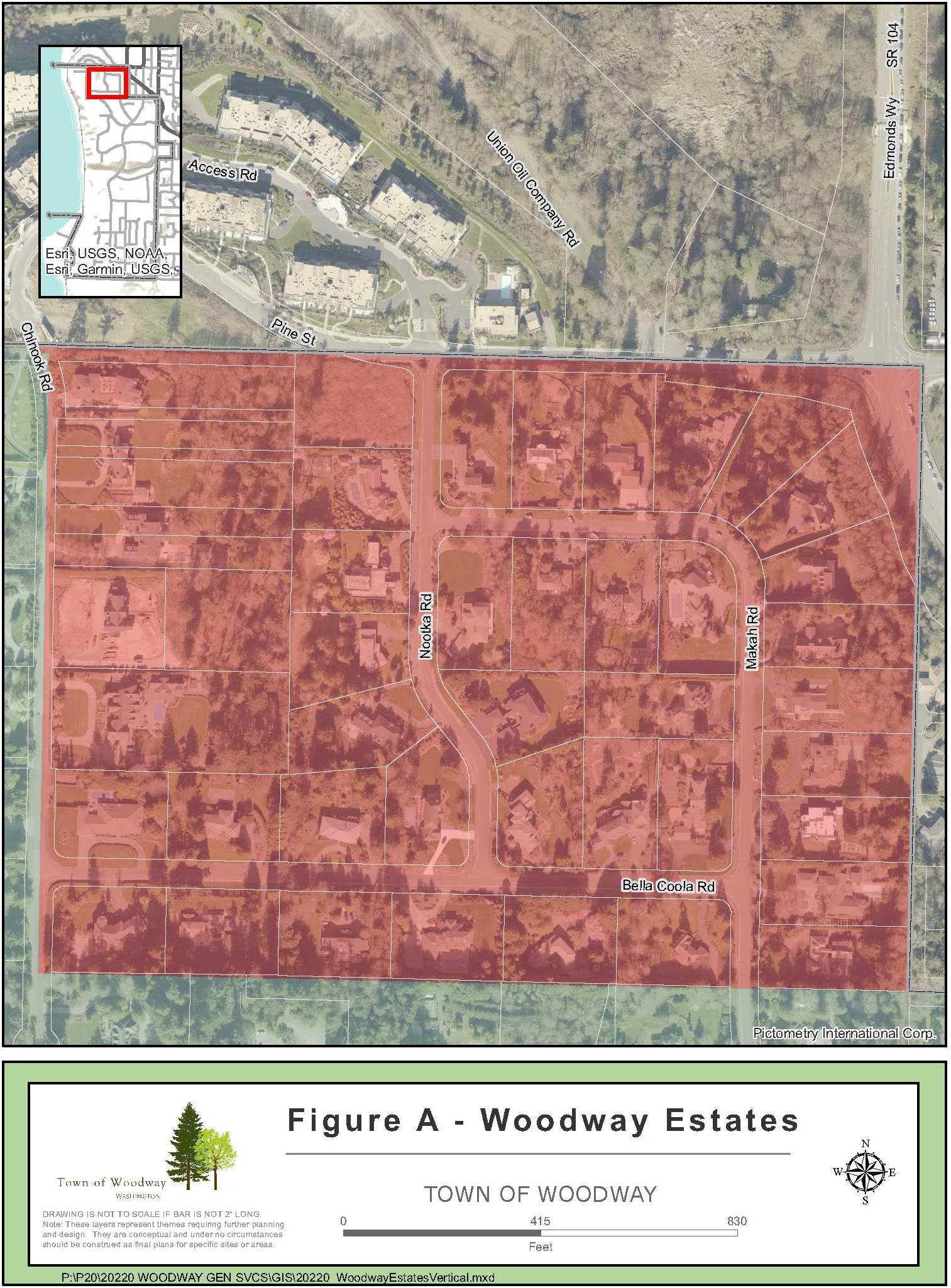
C. Replacement trees shall be a minimum of three feet in height, as measured from the grade at installation except for replacement trees on properties shown on Figure A at the end of this chapter, in critical area buffers, and in setback areas adjacent to public rights-of-way, which shall be a minimum of six feet in height.
D. Replacement trees must be a native species with similar or better growth characteristics, canopy cover, and/or habitat value, as approved by the Director.
E. Replacement trees shall remain in a healthy condition for a minimum of five years after installation. Any replacement tree that is unhealthy within five years of planting must be replaced with a new replacement tree, with the same requirement for continued health and replacement.
F. The Director shall have the right to inspect the health and condition of replacement trees at any time within five years of installation.
G. Replacement trees shall not be installed in easements for public facilities or utilities.
H. Trees removed from setbacks adjacent to public rights-of-way shall be replaced at a 1:1 ratio. (Ord. 20-611 § 4 (Exh. D (part)), 2020)
16.12.130 Provisions for emergency hazard tree removal.
Emergency hazard tree removal may be done immediately but shall require a tree permit application to be filed with the Town within fourteen days of the removal.
A. Tree Permit Application. The applicant shall include on the permit application:
1. A site plan showing the location of the trees that were removed.
2. Proof of imminent likelihood of failure, to the satisfaction of the Director, that may include:
a. Photographs of the tree and surrounding area prior to removal.
b. A report by a certified arborist attesting to the tree’s imminent likelihood of failure.
B. Application Review. In addition to the review criteria and procedure outlined in Section 16.12.080, applications for emergency hazard tree removal shall meet the requirements for emergency hazard tree removal as defined in Section 16.12.020.
C. Inspection. The Director, in the course of review of the permit application, may inspect the tree stump(s) after removal.
D. Maximum Tree Removal.
1. Emergency hazard tree removal does not apply toward the maximum tree removal allowed per year in Table 1 of Section 16.12.150.
2. Removal of exceptional trees is allowed under the emergency hazard tree removal provisions.
E. Exemption from Tree Replacement.
1. Emergency hazard tree removals are exempt from tree replacement requirements, unless the property is in the area shown on Figure A at the end of this chapter.
2. Emergency hazard tree removals on property shown on Figure A at the end of this chapter shall be replaced at a rate of three replacement trees for each tree removed. The replacement trees must meet the criteria listed in Section 16.12.120. (Ord. 20-611 § 4 (Exh. D (part)), 2020)
16.12.140 Provisions for hazard tree removal.
A. Tree Permit Application. The applicant shall include on the permit application:
1. A site plan showing the location of the trees to be removed.
2. Proof of hazard that may include:
a. Photographs of the tree and surrounding area.
b. A report by a certified arborist that:
i. The tree meets the definition of a hazard tree per Section 16.12.020; and
ii. The hazard cannot be eliminated with reasonable and proper arboricultural practices.
B. Application Review. In addition to the review criteria and procedure outlined in Section 16.12.080, applications for hazard tree removal shall demonstrate compliance with the following criteria:
1. The tree to be removed meets the definition of a hazard tree per Section 16.12.020; and
2. The hazard cannot be eliminated with reasonable and proper arboricultural practices.
C. Inspection. The Director may inspect, at the Director’s discretion, the tree(s) identified for removal and the applicant shall cooperate with the Director in the exercise of such discretion.
D. Maximum Tree Removal.
1. Hazard tree removal does not apply toward the maximum tree removal allowed per year in Table 1 of Section 16.12.150.
2. Removal of exceptional trees is allowed under the hazard tree provisions.
E. Exemption from Tree Replacement.
1. Hazard tree removals are exempt from tree replacement requirements unless the property is in the area shown on Figure A at the end of this chapter.
2. Hazard tree removals on property shown on Figure A at the end of this chapter shall be replaced at a rate of three replacement trees for each tree removed. The replacement trees must meet the criteria listed in Section 16.12.120. (Ord. 20-611 § 4 (Exh. D (part)), 2020)
16.12.150 Provisions for routine property maintenance.
A. Tree Permit Application. The applicant shall include on the permit application:
1. A site plan showing the property setbacks and the location of the tree(s) to be removed;
2. The size and species of the tree(s) to be removed;
3. The size, species, and location of replacement trees.
B. Application Review. In addition to the review criteria and procedure outlined in Section 16.12.080, applications for routine property maintenance tree removal shall demonstrate compliance with the following criteria:
1. The proposal is consistent with the tree replacement requirements of this section and Section 16.12.120;
2. The proposal will not likely result in harm to sensitive flora or fauna species listed as endangered, threatened, sensitive, and candidate species and priority habitats by the State of Washington Department of Fish and Wildlife, or listed as threatened or endangered under the federal Endangered Species Act;
3. The proposed tree removal is not prohibited by Section 16.12.060(B).
C. Inspection. The Director may inspect, at the Director’s discretion, the tree(s) identified for removal and the applicant shall cooperate with the Director in the exercise of such discretion.
D. Directional Felling. Directional felling of trees shall be used to avoid damage to trees designated for retention.
E. Maximum Tree Removal. Table 1 of this section lists the total number of trees that may be removed in any one year.
|
A. |
B. |
C. |
|---|---|---|
|
Zone District |
Maximum # of Trees That May Be Removed per Year |
Maximum # of Trees That May Be Removed in Setback Areas Adjacent to Public Rights-of-Way per Year |
|
UR |
Two |
Only allowed under a resolution by agreement or tree management permit |
|
R-14.5 |
Two |
Only allowed under a resolution by agreement or tree management permit |
|
R-43 |
For all tree removal on properties identified in Figure A: One All other R-43 zoned lots: Three |
For all tree removal on properties identified in Figure A: One All other R-43 zoned lots: Two |
|
R-87 |
Eight |
Two |
1. The number of trees in column B also includes trees in setback areas listed in column C.
2. Additional Tree Removal.
a. Parcels in the UR, R-14.5, and R-43 zone districts that are at least one hundred percent greater in size than the minimum lot size of the zone district in which the parcel is located or parcels in the R-87 zone district that are larger than two acres may increase the number of trees that can be removed and shall be replaced.
b. For the UR, R-14.5, and R-43 properties, the specific number of removed trees shall correspond to the quantities listed in Table 1 of this section for the zone district with the minimum lot area that most closely approximates the subject parcel’s lot size.
c. For R-87 properties larger than two acres, an additional four trees may be removed for each additional full acre, rounded to the nearest whole acre.
d. The calculation of parcel area under this subsection shall exclude Puget Sound and critical areas. The calculation shall include the associated critical area buffers.
3. To combine allowable tree removal or replacement on adjacent lots under common ownership, see Section 16.12.190, Tree management plan.
4. Removal of exceptional trees for routine property maintenance is only allowed under an approved resolution by agreement or tree management permit.
5. If a tree proposed for removal is located on a property line, the owners of the subject properties shall submit with the tree permit application their agreement as to which property the tree and any required replacement are assigned.
6. Dead trees must be included in the permit application, but do not count toward the maximum allowable tree removal listed above.
F. Tree Replacement Requirements.
1. Replacement trees are subject to the criteria in Section 16.12.120.
2. The number of required replacement trees shall be equal to at least fifty percent of the number of trees removed per year. When fifty percent equals less than a whole number, the number of replacement trees shall be rounded up to the next whole number.
3. Exemptions from Replacement. Removal of dead trees conducted under an approved tree permit is exempt from tree replacement requirements. (Ord. 20-611 § 4 (Exh. D (part)), 2020)
16.12.160 Provisions for tree topping.
A. Topping of exceptional conifer trees is only allowed under an approved tree management permit.
B. Tree topping in setback areas adjacent to public rights-of-way is only allowed under an approved tree management permit. (Ord. 20-611 § 4 (Exh. D (part)), 2020)
16.12.170 Provisions for land development activities.
A. Tree Permit Application. Applicants proposing to remove trees in conjunction with a land development activity shall submit, concurrent with the development application, a tree removal plan or other map that includes the following information:
1. Graphic scale and north arrow;
2. Vicinity map and property address;
3. Location of all existing and proposed improvements;
4. Location and delineation of slopes greater than fifteen percent, wetlands and water courses, or other areas, with any associated buffer areas, as required by Chapter 16.10 of this code, and any open areas and associated buffers;
5. Public roads and rights-of-way;
6. Property line boundaries and setback lines;
7. Location, size, species, and critical root zone of all trees, within the area to be impacted, including an indication or schedule of which trees will be retained, removed, and/or replaced;
8. Location and design of proposed protective barrier for all retained trees; and
9. Location, species, and size of all replacement trees to be planted.
B. Application Review. In addition to the review criteria and procedure outlined in Section 16.12.080, applications for land development tree removal shall demonstrate compliance with the following criteria:
1. The proposal is consistent with the tree replacement requirements of this section and Section 16.12.120;
2. The proposal will not likely result in harm to sensitive flora or fauna species listed as endangered, threatened, sensitive, and candidate species and priority habitats by the State of Washington Department of Fish and Wildlife, or listed as threatened or endangered under the federal Endangered Species Act;
3. That the proposal will not likely result in negative impacts to soil or hydrology of the site and adjacent properties;
4. When there are feasible and prudent location alternatives on site for proposed building structures or other site improvements, viable wooded areas and trees are to be preserved. This may require site redesign, including, but not limited to: redesign of streets, sidewalks, stormwater facilities, utilities; changing the shape and size of the parking lot; reducing or limiting proposed site grading; and changing the location of driveways, buildings or building lots; provided, however, that no yard setback variance shall be granted in order to comply with the provisions of this section;
5. The proposed tree removal is not prohibited by Section 16.12.060(B).
C. Inspection. The Director may inspect the tree(s) identified for removal at the Director’s discretion. The applicant shall cooperate with the Director in the making of such inspections.
D. Tree Assessment and Standards.
1. Trees to be preserved must be healthy, wind-firm, and appropriate to the site at their mature size, as identified by an arborist.
2. Trees growing in a grove or part of a stand must be considered part of group when determining retention potential.
3. Declaration of hazard tree(s) must meet the criteria outlined in Section 16.12.140(B).
4. The arborist must determine the critical root zone to establish the limits of disturbance around the trees to be retained on site and include proper tree protection standards that shall be incorporated into grading, demolition, and other appropriate site plans.
5. The arborist must include discussion of any off-site trees or adjacent trees which could be adversely affected by the proposed activity and the proposed mitigation for such impact.
6. The Director may require additional information to support findings and conclusions, and that can include soil or diagnostic testing, photographs of claimed disease/defect, or another professional opinion paid for by the applicant.
E. Tree Protection During Construction. Prior to initiating tree removal on the site, vegetated areas and individual trees to be preserved shall be protected from potentially damaging activities pursuant to the following standards:
1. Placing Materials Near Trees. No person may conduct any activity within the protected area of any tree designated to remain, including, but not limited to, parking equipment, placing solvents, storing building material and soil deposits, dumping concrete washout, and locating burn holes.
2. Objects on Trees. During construction, no person shall attach any object to any tree designated for protection.
3. Protective Barrier. Before development, land clearing, filling, or any land alteration for which a tree removal permit is required, the applicant:
a. Shall erect and maintain readily visible temporary protective tree fencing constructed of chain link and to a height of at least four feet. This protective tree fence shall be placed along the outer edge and completely surrounding the protected area of all retained trees or groups of trees, as determined by an arborist. Other types of fencing may be authorized by the Director;
b. Shall install highly visible signs spaced no further than fifteen feet along the entirety of the protective tree fence. The signs must be approved by the Town and shall state at a minimum "TREE PROTECTION AREA, ENTRANCE RESTRICTED" and shall reference the appropriate code and provide the current Public Works Department phone number to report violations;
c. Shall prohibit excavation or compaction of earth or other potentially damaging activities within the barriers;
d. Shall maintain the protective barriers in place until the Director authorizes their removal or a final certificate of occupancy is issued, whichever occurs first;
e. Shall ensure that any landscaping done in the protected zone subsequent to the removal of the barriers shall be accomplished with light machinery or hand labor.
4. Additional Protection. In addition to the above, the Director may require the following:
a. Cover with mulch to a depth of at least six inches or with plywood or similar material the areas adjoining the critical root zone of a tree in order to protect roots from damage caused by heavy equipment;
b. Minimize root damage by excavating a two-foot-deep trench, at edge of critical root zone, to cleanly sever the roots of trees to be retained;
c. Have corrective pruning performed on protected trees in order to avoid damage from machinery or building activity;
d. Maintain trees throughout construction period by watering and fertilizing.
F. Grade.
1. The grade shall not be elevated or reduced within the critical root zone of trees to be preserved without the Director’s authorization. The Director may allow coverage of up to one-half of the area of the tree’s critical root zone with light soils (no clay) to the minimum depth necessary to carry out grading or landscaping plans, if it will not imperil the survival of the tree. Aeration devices may be required to ensure the tree’s survival.
2. If the grade adjacent to a preserved tree is raised such that it could slough or erode into the tree’s critical root zone, it shall be permanently stabilized to prevent suffocation of the roots.
3. The applicant shall not install an impervious surface within the critical root zone of any tree to be retained without the authorization of the Director. The Director may require specific construction methods and/or use of aeration devices to ensure the tree’s survival and to minimize the potential for root-induced damage to the impervious surface.
4. To the greatest extent practical, utility trenches shall be located outside of the critical root zone of trees to be retained. The Director may require that utilities be tunneled under the roots of trees to be retained if the Director determines that trenching would significantly reduce the chances of the tree’s survival.
5. Trees and other vegetation to be retained shall be protected from erosion and sedimentation. Clearing operations shall be conducted so as to expose the smallest practical area of soil to erosion for the least possible time. To control erosion, shrubs, groundcover and stumps shall be maintained on the individual lots, where feasible. Where not feasible, appropriate erosion control practices shall be implemented pursuant to current adopted Stormwater Management Manual.
G. Directional Felling. Directional felling of trees shall be used to avoid damage to trees designated for retention.
H. Additional Requirements. The Director may require additional tree protection measures.
I. Maximum Tree Removal.
1. A tree management permit is required to remove more than one tree on properties in the R-43 zone district identified in Figure A at the end of this chapter.
2. Tree removal on properties not identified in Figure A at the end of this chapter shall comply with the following:
a. Trees removed from the following locations do not apply toward the maximum tree removal allowed as listed below:
i. Within the proposed building footprint;
ii. Within twenty-five feet of the proposed building footprint for buildings one hundred twenty square feet or larger;
iii. Within the footprint of the driveway or pedestrian access to the proposed building; and
iv. Within utility easements.
b. Developed Lots. For redevelopment projects on previously developed lots, tracts, or parcels, trees to be removed outside the areas listed in subsection (I)(1) of this section apply toward the maximum tree removal allowed in Table 1 of Section 16.12.150.
c. Undeveloped Lots. Tree removal for development projects on undeveloped lots, tracts or parcels shall not exceed five percent of the trees located outside of the areas listed in subsection (I)(1) of this section.
d. Tree removal in setback areas adjacent to public rights-of-way is only allowed under an approved resolution by agreement or tree management permit.
e. Removal of exceptional trees for land development is only allowed under an approved resolution by agreement or tree management permit.
f. Dead trees must be included in the permit application, but do not count toward the maximum allowable tree removal listed above.
J. Tree Replacement Requirements.
1. Developed Lots. Trees removed from previously developed lots shall be replaced according to the requirements in Section 16.12.150(F) unless the trees to be removed are included in the exemptions listed in subsection (J)(3) of this section.
2. Undeveloped Lots.
a. Replacement trees are subject to the criteria in Section 16.12.120.
b. Removal of trees from an undeveloped lot requires a one-for-one replacement unless the trees to be removed are included in the exemptions listed in subsection (J)(3) of this section.
3. Exemptions from Replacement. The following activities conducted under an approved land development permit are exempt from tree replacement:
a. Removal of hazard trees;
b. Removal of dead trees;
c. The removal of trees within the proposed building footprint for buildings one hundred twenty square feet or larger and extending twenty-five feet in all directions. (Ord. 20-611 § 4 (Exh. D (part)), 2020)
16.12.180 Resolution by agreement.
A. A property owner may request, and the Public Works Director may enter into, a resolution by agreement. A resolution by agreement may include the following:
1. The number of trees allowed to be removed in one year under the provisions of Sections 16.12.150 and 16.12.170(I)(3) may be increased when the additional removal would enhance the overall health and safety of the trees that remain.
a. Two years’ total tree removal is allowed under a resolution by agreement.
i. The agreement shall prohibit future tree removal for the number of years that would have elapsed had the trees been removed pursuant to the code.
ii. Example: In the R-87 zone district, eight trees per year may be removed under the routine property maintenance provisions. If a resolution by agreement allowed sixteen trees to be removed in one year, no further tree removal would be allowed for two years following the issuance of the permit.
b. Removal of more than two years’ total trees requires an approved tree management permit.
2. Alternate replacement tree locations may be approved.
3. One exceptional tree may be removed every five years.
a. The Director may approve only one exceptional tree removal every five years under a resolution by agreement.
b. Removal of more than one exceptional tree every five years requires an approved tree management permit.
4. Removal and Replacement of Trees from Setbacks Adjacent to Public Rights-of-Way.
a. Removal: In the UR and R-14.5 zone districts, one tree may be removed every three years.
b. Replacement: The replacement tree must meet the criteria listed in Section 16.12.120.
c. Removal of more than the maximum allowable listed in subsection (A)(4)(a) of this section requires an approved tree management permit.
5. Removal and Replacement of Trees in a Geologic Hazard Area Buffer.
a. Removal.
i. Removal of a tree in a geologic hazard area buffer shall comply with the maximum tree removal allowed under Section 16.12.150, Table 1.
ii. A proposal to remove trees within fifty feet of the top of the steep slope shall require an approved tree management permit.
b. Replacement.
i. Trees removed from geologic hazard area buffers shall be replaced at a rate of three replacement trees for each tree removed.
ii. The replacement tree must meet the criteria listed in Section 16.12.120.
B. By entering into a resolution by agreement, the property owner waives the right to a hearing before the Examiner under this chapter or any other appeal regarding the agreement. (Ord. 20-611 § 4 (Exh. D (part)), 2020)
16.12.190 Tree management plan.
A. A property owner may request a tree management permit to administer an approved tree management plan if they propose to remove or replant trees:
1. Where circumstances exist rendering compliance with the provisions of this chapter impractical; or
2. Where specific circumstances pose a risk to property, heath, or safety; or
3. To provide for the protection of views; or
4. Where such compliance would create unnecessary hardships to the owner of land or buildings; or
5. When the Director finds that an alternative tree replacement plan would be consistent with the general purpose and intent of the tree preservation code; or
6. When the trees to be removed are in a critical area or associated buffer; or
7. When a tree management plan will allow greater improvements to existing conditions from an environmental or public health and safety perspective; or
8. When a property is located within the area shown on Figure A at the end of this chapter.
B. A tree management permit and plan shall be required under circumstances that include, but are not limited to:
1. When the proposed tree removal and replacement:
a. Includes more than two years’ total tree removal; or
b. Will take place in a critical area, associated buffer, or in a geologic hazard area buffer within fifty feet of the top of the steep slope; or
c. Includes trees on adjacent properties under common ownership; or
d. Exceeds removal of one exceptional tree every five years; or
e. Includes more than one tree on a property within the area shown on Figure A at the end of this chapter.
2. When the proposed tree topping:
a. Includes exceptional conifers (allowed only under subsections (A)(2) and (3) of this section); or
b. Will take place in setback areas adjacent to public rights-of-way.
C. By entering into the tree management plan, the property owner waives the right to a hearing before the Examiner under this chapter or any other appeal regarding the agreement.
D. Tree Management Permit Application. The applicant’s permit application shall include a tree management plan that meets the definition in Section 16.12.020, demonstrates consistency with the review criteria listed in subsection F of this section, and may include the following:
1. A map that includes a general description of the:
a. Size, species, condition, and location of the tree(s) to be removed. Any exceptional trees proposed for removal must be identified by size, type, and location.
b. Size, species, and location of replacement trees.
i. To the extent allowed by site-specific conditions, the replacement trees in critical areas shall utilize a mix of native species intended to increase habitat value and structural diversity.
ii. In addition, within critical erosion or landslide hazard areas or their associated buffers, replacement trees that support soil and slope stability shall be selected.
2. For complex projects, the Director may require a detailed map and/or narrative outlining:
a. The boundaries of the tree management plan including discrete treatment areas, when appropriate;
b. Existing conditions within each treatment area, including but not limited to staging areas; and
c. The purpose and objectives of each proposed treatment.
3. An estimated timeline for tree-related activity in each treatment area, including tree removal, tree pruning, coppicing, tree replacement, and maintenance.
4. Temporary erosion and sediment control details, if applicable. Tree removal operations shall be conducted to expose the smallest practical area of soil to erosion. To control erosion, existing vegetation not proposed for removal shall be retained when feasible.
5. Proof of compliance with the regulations in Chapter 16.10 of this code if the plan proposes tree removal in critical areas or their associated buffers.
6. The Director may require geotechnical and/or soils reports if the proposed tree removal includes areas within critical areas or their associated buffers.
7. Phased projects shall clearly state the scope of work and estimated timeline for each phase.
8. A description of other factors influencing tree management plan design.
E. If any clearing and grading work is included in the proposal, a separate clearing and grading permit or clearing and grading management permit must be obtained. When a proposed activity requires both a clearing and grading management permit and a tree management permit, the plans shall be integrated into a single set of documents that address the requirements of Chapter 16.08 of this code, this chapter, and, if applicable, Chapter 16.10 of this code.
F. Application Review.
1. In addition to the review criteria and procedure outlined in Section 16.12.080, applications for tree management permits shall demonstrate compliance with the following criteria:
a. The proposal will minimize, to the extent possible, harm to sensitive flora or fauna species listed as endangered, threatened, sensitive, and candidate species and priority habitats by the State of Washington Department of Fish and Wildlife, or listed as threatened or endangered under the federal Endangered Species Act.
b. The proposed tree removal is not prohibited by Section 16.12.060(B).
c. Trees identified for protection are appropriately safeguarded.
2. The Director may impose conditions that include but are not limited to the following:
a. Owners may have the right to maintain and inspect the area covered by the approved and implemented tree management plan after the monitoring period has ended. The Director may include a time limit on this condition.
b. All areas governed by a tree management plan shall be maintained and managed to prevent degradation and ensure protection of the replanted areas subject to field verification by the Town.
G. Permit Issuance.
1. Upon permit approval and prior to permit issuance, the applicant may be required to submit a copy of their contract with a certified arborist for yearly monitoring as outlined in subsection H of this section, to be paid for by the applicant. The contract must specify that the arborist will:
a. Perform annual site visits for the term of the permit and submit a report outlining the status of the approved plan activities to the Director each year during the project term.
b. Perform annual site visits for the duration of the required monitoring period. Yearly monitoring reports, as outlined in subsection H of this section, shall be due to the Town within thirty days of the anniversary of the permit issuance date.
2. Before the permit may be issued, the applicant must pay all fees as set forth in Section 3.32.010, including reimbursement of any reasonable related costs that the Town incurs in processing this permit, including, but not limited to, peer review of submitted application materials or arborist consultation.
H. Monitoring. The Town shall have the authority to require that tree management plans be monitored during plan implementation and annually after the project is completed to establish that performance standards and conditions have been met.
1. The applicant and his/her representatives shall demonstrate sufficient scientific expertise and capability to implement the tree management plan, monitor the site, and make corrections if the project fails to meet projected goals.
2. Monitoring reports shall document milestones, successes, problems, and contingency actions of implementing the tree management plan.
3. The Town shall have the authority to extend the monitoring period, require corrective measures, and/or require additional monitoring reports beyond the initial monitoring period for any project that does not meet the performance standards identified in the tree management plan, or does not provide adequate replacement for the functions and values of an impacted critical area.
4. The Town shall have the authority to enter the property with one week’s notice by mail to the property owner to inspect the elements of the tree management plan at any time during the monitoring period. Notice shall be effective two days after the date of postmark.
I. Maximum Tree Removal. The limitations on maximum tree removal identified in Table 1 of Section 16.12.150 do not apply to a tree management permit. Tree removal is only limited by the terms and conditions of the applicant’s tree management plan and permit. The maximum tree removals in Table 1 shall govern all routine property maintenance removals not included in the tree management plan.
J. Tree Replacement Requirements. Replacement trees approved under a tree management permit do not need to comply with the replacement requirements in Section 16.12.120.
K. Inspection. The Director may enter the property at reasonable times to conduct inspections related to all elements of the plan during the permit period. The applicant or any successor in interest shall cooperate with the Director in the making of such inspections.
L. Directional Felling. Directional felling of trees shall be used to avoid damage to trees designated for retention.
M. Amendments. Amendments to the approved tree management plan may only be made with approval of the Director.
N. Recording of Tree Management Plan. The Director may require recording of the tree management plan. If recording is required, the following shall apply:
1. Within thirty days of tree management permit issuance or before the approved work begins, whichever is sooner, the applicant shall record a notice of the plan with the Snohomish County Recorder’s Office and return the original or a conformed copy to the Town. If the Town does not receive the recorded document within forty days of permit issuance, the permit approval shall be suspended until the document is received.
2. The property owner requesting the tree management permit and all subsequent owners are bound by the tree management permit and its associated tree management plan until a "Completion of Tree Management Plan" document is recorded with the Snohomish County Recorder’s Office.
O. Completed Implementation of Tree Management Plan.
1. After the Director has determined that the tree management plan has been successfully implemented but before the monitoring/maintenance period is completed, the applicant can request that the Town prepare a "Completed Implementation of Tree Management Plan" document.
2. The document shall:
a. Specify that the plan has been fully implemented;
b. Note when the monitoring period is scheduled to end; and
c. Specify that Town approval is needed at the end of the monitoring/maintenance period.
3. The applicant shall record the document with the Snohomish County Recorder’s Office and return the original or a conformed copy to the Town within thirty days of recording.
P. Completion of Tree Management Plan and Monitoring/Maintenance Period.
1. After the successful completion of the required monitoring and/or maintenance period and upon approval by the Director, the applicant can request that the Town prepare a "Completion of Tree Management Plan and Monitoring/Maintenance Period" document.
2. The applicant shall record the document with the Snohomish County Recorder’s Office and return the original or a conformed copy to the Town within thirty days of recording. (Ord. 20-611 § 4 (Exh. D (part)), 2020)
16.12.200 Performance and maintenance bonds.
A. When the expected cost of tree replacement exceeds five thousand dollars, the Director may require a performance bond to be posted to secure the applicant’s compliance with the conditions of the permit approval. The performance bond shall be equal to one hundred twenty-five percent of the estimated cost of tree replacement of the property, including labor, as determined by the Director. The contingency is added to cover mobilization, prevailing wages, oversight, and other such costs to represent the full cost to the Town to complete the replacement tree installation should the applicant fail to do so.
B. The Director may waive this requirement where the Director reasonably determines that the project poses minimal risk of drainage or erosion contributions to downstream waters, to neighboring properties, public properties, and the public.
C. Performance bond duration shall be determined by the nature of the project.
1. Tree permits and tree management permits without phased implementation shall be valid for the duration of the permit.
2. Tree management permits with phased implementation can be valid for either:
a. The entire duration of all phases; or
b. The duration of the next applicable phase; provided, that maintenance bonds for all previous phases have been posted and are still active.
D. A one-time bond reduction of the performance bond may be granted upon request by the applicant. Upon request, the Director will conduct an inspection to estimate the percent completion of the project. Project completion will be based on the approved plans and replacement cost estimate. No more than eighty-five percent of the original bond may be released under this provision.
E. A maintenance bond is required to be posted after final inspection to ensure the survival of the newly planted trees. The amount of the bond is calculated as fifteen percent of the original performance bond amount. The maintenance bond must be in place before the Town will release the performance bond.
1. A maintenance bond for a tree permit shall be for a period of five years from the date of final construction approval.
2. A maintenance bond for a tree management permit without phased implementation shall be for the time period approved by the Director in the tree management plan and, when applicable, shall match the term of the associated clearing and grading management permit.
3. Maintenance bonds for each phase of a tree management permit with phased implementation shall be for the time period approved by the Director in the tree management plan and may be required to match the term of the associated clearing and grading management permit. These maintenance bonds may be required to have the same release date even if they are posted at different times.
F. The Town of Woodway accepts standard bonds and dedicated frozen fund accounts for guaranteeing performance and maintenance. Other types of guarantees may also be approved by the Director.
G. Bond Release.
1. Performance Bond. This bond cannot be released until all planting has been completed and approved and a maintenance bond as required in the permit conditions has been secured. Once these items are complete, the applicant must submit a written request to the Town to release the performance bond. The Town will then submit a written authorization for release of the performance bond to the bonding company or bank.
2. Maintenance Bond. This bond will be released only upon satisfactory completion of the designated maintenance or monitoring period. The holder shall provide a request for an inspection no more than thirty days prior to bond expiration. The replacement trees shall be inspected by the Director and written notice will be provided to the applicant that either the trees are healthy and the maintenance bond can be released, or specify which trees have not survived and need to be replaced before bond release.
H. Any failure to satisfy requirements established by law or condition including, but not limited to, the failure to provide a monitoring report within thirty days after it is due or comply with other provisions of an approved tree management plan shall constitute a default and the Town may demand payment of any financial guarantees or require other action authorized by Town code or any other law.
I. Any funds recovered pursuant to this section shall be used to complete the required mitigation.
J. Depletion, failure, or collection of surety funds shall not discharge the obligation of an applicant or violator to complete required mitigation, maintenance, or monitoring. (Ord. 20-611 § 4 (Exh. D (part)), 2020)
16.12.210 Enforcement and penalties.
A. Failure to submit an application for a tree permit shall be a violation under Chapters 1.12 and 1.14 of this code and may be subject to the penalties and enforcement proceedings contained therein.
B. Removal or topping of a tree inconsistent with this chapter shall be a violation and shall require the property owner to replace the removed or topped tree(s) at a ratio of three replacement trees to each one removed tree, and result in a penalty, assessed against the property owner, in the amount of one thousand dollars assessed for each tree that is damaged, destroyed or removed.
C. Each tree removed or topped inconsistent with this chapter shall constitute a separate violation.
D. For knowing or willful violations of this chapter, an amount not to exceed the appraised value of the removed tree(s), as determined by the Director using the industry standard trunk formula method in the current edition of the Guide for Plant Appraisal, may be added to the penalty for each violation. If the diameter of the removed tree is unknown, the diameter size used shall be the greater of the diameter of the remaining stump at the cut or eight inches.
E. Penalties associated with the unauthorized removal or topping of a tree located on property owned by the Town of Woodway shall be assessed against the person, corporation, or other entity engaged in such tree removal.
F. Stop work orders may be issued by the Director whenever there is a violation. The posting of the stop work order on the site shall be deemed adequate notice of the order. A failure to comply with a stop work order shall constitute a separate violation of Chapter 1.14 of this code. (Ord. 20-611 § 4 (Exh. D (part)), 2020)
16.12.220 Appeals.
A. Any decision to approve, condition, or deny a permit under this chapter may be appealed to the Hearing Examiner according to and as part of the appeal procedure outlined in Chapter 2.60 of this code.
B. Prior to processing the appeal, the appeal fee, as set forth in Section 3.32.010, shall be submitted to the Town.
C. Timely filing of an appeal shall stay the effect of order, permit, decision, determination or other action related to the removal of any tree being appealed until the appeal is disposed of by the Hearing Examiner or withdrawn.
D. The Hearing Examiner shall give substantial weight to the Director’s decision and the burden of showing that the Director’s decision was clearly erroneous shall be upon the appellant. (Ord. 20-611 § 4 (Exh. D (part)), 2020)
Figure A
(Ord. 20-611 § 4 (Exh. D (part)), 2020)